Available Online At www.ijpret.com
INTERNATIONAL JOURNAL OF PURE AND
APPLIED RESEARCH IN ENGINEERING AND
TECHNOLOGY
A PATH FOR HORIZING YOUR INNOVATIVE WORK
COIN RECOGNIZATION USING GENETIC ALGORITHM: A REVIEW
ASHWINI DAKHODE1, DR. P. R. DESHMUKH2
1. M.E Scholar (CSE), Sipna College of Engineering & Technology, Amtavati.
2. Professor (CSE), Sipna College of Engineering & Technology, Amtavati.
Accepted Date:
27/02/2013
Publish Date:
01/04/2013
Keywords
Artificial Neural Network,
Genetic algorithm,
Pattern Matching,
Corresponding Author Ms. Ashwini Dakhode
Abstract
Coins are integral part of our day to day life. We use coins
everywhere like grocery store, banks, buses, trains etc. So it becomes
a basic need that coins can be sorted and counted automatically. For
this it is necessary that coins can be recognized automatically. In this
paper we have developed an ANN (Artificial Neural Network) based
Automated Coin Recognition System for the recognition of Indian
Coins of denomination `1, `2, `5 and `10 with rotation invariance. We
have taken images from both sides of coin. So this system is capable
of recognizing coins from both sides. Features are extracted from
images using techniques of Genetic algorithm. Then, the extracted
features are passed as input to a trained Neural Network. 97.74%
recognition rate has been achieved during the experiments i.e. only
Available Online At www.ijpret.com Introduction
We cannot imagine our life without coins.
We use coins in our daily life almost
everywhere like in banks, supermarkets,
grocery stores etc. They have been the
integral part of our day to day life. So there
is basic need of highly accurate and efficient
automatic coin recognition system. In-spite
of daily uses coin recognition systems can
also be used for the research purpose by
the institutes or organizations that deal
with the ancient coins. There are three
types of coin recognition systems available
in the market based on different methods:
1. Mechanical method based systems
2. Electromagnetic method based systems
3. Image processing based systems
The mechanical method based systems use
parameters like diameter or radius,
thickness, weight and magnetism of the
coin to differentiate between the coins. But
these parameters cannot be used to
differentiate between the different
materials of the coins. It means if we
provide two coins one original and other
fake having same dia meter, thickness,
weight and magnetism but with different
materials to mechanical method based coin
recognition system then it will treat both
the coins as original coin so these systems
can be fooled easily. The electromagnetic
method based systems can differentiate
between different materials because in
these systems the coins are passed through
an oscillating coil at a certain frequency and
different materials bring different changes
in the amplitude and direction of frequency.
So these changes and the other parameters
like diameter, thickness, weight and
magnetism can be used to differentiate
between coins. The electromagnetic
method based coin recognition systems
improve the accuracy of recognition but still
they can be fooled by some game coins. In
the recent years coin recognition systems
based on images have also come into
picture. In these systems first of all the
image of the coin to be recognized is taken
either by camera or by some scanning. Then
these images are processed by using various
techniques of image processing like FFT [1,
2], Gabor Wavelets [3], DCT, edge
detection, segmentation, image subtraction
Available Online At www.ijpret.com features are extracted from the images.
Then based on these features different
coins are recognized.
Automatic machines are used for Coins
classification and recognition to find the
sum of the coin is quite complicate. In this
paper, it is proposed a coin recognition
method by Genetic algorithm. The
effectiveness of the coins classification is
ensured based on the parameters of the
coin. Moreover, the variations in images
obtained from new and old coins are also
discussed. The polar coordinate image of
coin on circles with different radii is used as
the feature for coin recognition. Finally, the
knowledge base of the coin is fed to the
recognition system to classify the coin
easily. For a given coin, image is scanned
and stored as gray values in a matrix. The
intensity of the pixel is maximized. The
Genetic algorithm is adapted to classify the
coin after pre-processing of the image. We
present a coin classification which is able to
discriminate between many coin classes.
The approach described is a multistage
procedure. In the first stage a translational
and rotationally invariant description is
computed. Correct decision into one of the
different coin classes and the rejection
class, i.e., correct classification or rejection,
was achieved for 99.23% of coins in a test
sample containing 10,000 coins. False
decisions, i.e., false classification, false
rejection or false acceptance, were
obtained for 0.67% of the test coins. The
classification of these coins according to
their denomination in the field of
application for the method is presented in
this paper. The basic idea of the method
can be seen from the coin image of
detecting a straight line in coin image [Duda
and Hart 72]. The criteria for coin
classification can be based on gray-level,
color, texture, shape, model, etc, are
discussed by R. Bremananth [1]. The
method which specifically addresses coin
segmentation based on color or gray value
is reported by P. Thumwarin and Petra
Perner [2, 6]. Many serious problems like
shape, peak detection in surface of the
coins are reported by Reinhold Huber [3].
An attempt has been made to use genetic
algorithm techniques to recognize most of
the coin images.
Classification tasks arise in a very wide
Available Online At www.ijpret.com faces from video images, recognizing words
in streams of speech, diagnosing medical
conditions from the output of medical tests,
and detecting fraudulent credit card fraud
transactions [11, 15]. In many cases, people
(possibly highly trained experts) are able to
perform the classification task well, but
there is either a short-age of such experts,
or the cost of people is too high. Given the
amount of data that needs to be classified,
automatic computer-based classification
programmes/systems are of immense social
and economic value. A classification
programme must correctly map an input
vector describing an instance (such as an
object image) to one of a small set of class
labels. Writing classification programmes
that have sufficient accuracy and reliability
are usually very difficult and often
infeasible: human programmers often
cannot identify all the subtle conditions
needed to distinguish between all instances
of different classes. Genetic programming
(GP) is a relatively recent and fast
developing approach to automatic
programming [4, 23, and 24]. In GP,
solutions to a problem can be rep-resented
in different forms but are usually
interpreted as computer programmes.
Darwinian principles of natural selection
and recombination are used to evolve a
population of programmes towards an
effective solution to specific problems. The
flexibility and expressiveness of computer
programme representation, combined with
the powerful capabilities of evolutionary
search, make GP an exciting new method to
solve a great variety of problems. Strength
of this approach is that evolved
programmes can be much more flexible
than the highly constrained, parameterized
models used in other techniques such as
neural networks and support vector
machines. GP has been applied to a range
of object recognition tasks such as shape
classification, face identification, and
medical diagnosis with some success.GP
research has considered a variety of kinds
of classifier programmes, using different
programme representations, including tree
or tree-like classifiers, decision tree
classifiers, classification rule sets [24], and
linear and graph classifiers[4]. Recently,
tree-like numeric expression representation
classifiers have been developed using GP [3,
Available Online At www.ijpret.com successfully applied to some real-world
classification problems such as detecting
and recognizing particular classes of objects
in images [22] demonstrating the potential
of GP as a general method for classification
problems. Tree-like numeric expression GP
classifiers model a solution to a
classification problem in the form of a
mathematical expression, using a set of
arithmetic and mathematical operators,
possibly combined with conditional/logic
operators such as the “if-then-else”
structures commonly used in computer
programmes. The output of a tree-like
numeric expression GP classifier is a
numeric value that is typically translated
into a class label. For the simple binary
classification case, this translation can be
based on the sign of the numeric value [17];
for multiclass problems, finding the
appropriate boundary values to separate
the different classes is more difficult. The
simplest approach—fixing the boundary
values at manually chosen points—often
results in unnecessarily complex
programmes and could lead to poor
performance and very long training times
[3,5,9]
2. Literature review
In 1992 [6] Minoru Fukumi et al. presented
a rotational invariant neural pattern
recognition system for coin recognition.
They performed experiments using 500 yen
coin and 500 won coin. In this work they
have created a multilayered neural network
and a preprocessor consisting of many slabs
of neurons to provide rotation invariance.
They further extended their work in 1993
[7] and tried to achieve 100% accuracy for
coins. In this work they have used BP (Back
Propagation) and GA (Genetic Algorithm) to
design neural network for coin recognition.
Adnan Khashman et al. [8] presented an
Intelligent Coin Identification System (ICIS)
in 2006. ICIS uses neural network and
pattern averaging for recognizing rotated
coins at various degrees. It shows 96.3%
correct identification i.e. 77 out of 80
variably rotated coin images were correctly
identified. Mohamed Roushdy [9] had used
Generalized Hough Transform to detect
coins in image. In our work we have
combined Hough Transform and Pattern
Averaging to extract features from image.
Then, these features are used to recognize
Available Online At www.ijpret.com details are given. In section 4 we have
presented training and testing data. Then,
in section 5 the experimental results are
provided. Then, in section 6 we have
concluded the work.
Robinson and McIlroy [14] apply genetic
programming techniques to the problem of
eye location in grey-level face images. The
input data from the images is restricted to a
3000-pixel block around the location of the
eyes in the face image. This approach
produced promising results over a very
small training set, up to 100% true positive
detection with no false positives, on a
three-image training set. Over larger sets,
the genetic programming approach
performed less well however, and could not
match the performance of neural network
techniques. Winkler and Manjunath [5]
produce genetic programmes to locate
faces in images. Face samples are cut out
and scaled, then preprocessed for feature
extraction. The statistics gleaned from
these segments are used as terminals in
genetic programming which evolves an
expression returning how likely a pixel is to
be part of a face image. Separate
experiments process the grey scale image
directly, using low-level image processing
primitives and scale-space filters. Zhang et
al. [8] uses genetic programming for a
number of object classification and
detection problems. Typically, low-level
pixel statistics are used to form the terminal
set, the four arithmetic operators are used
to construct the function set, and the
fitness functions are based on either
classification accuracy or error rate for
object classification problems, and
detection rate and false alarm rate for
object localization and detection problems.
Good results have been achieved on
classification and detection of regular
objects against a relatively uncluttered
background. Since the work to be presented
in this paper focuses on the use of genetic
programming techniques for object
recognition.
3.Our Proposed Method
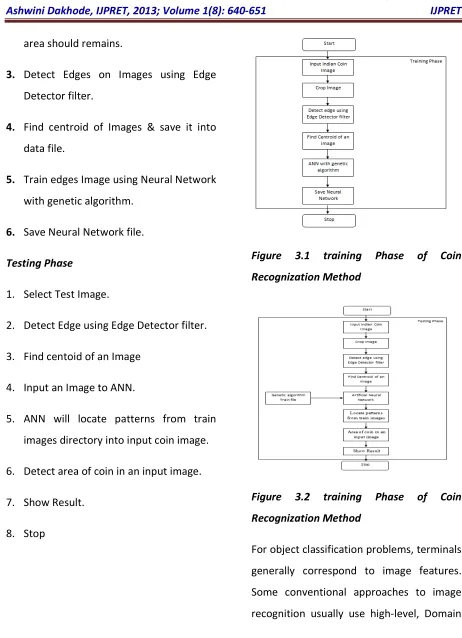
Training Phase
1. Select Indian Coin images of front &
back side.
Available Online At www.ijpret.com area should remains.
3. Detect Edges on Images using Edge
Detector filter.
4. Find centroid of Images & save it into
data file.
5. Train edges Image using Neural Network
with genetic algorithm.
6. Save Neural Network file.
Testing Phase
1. Select Test Image.
2. Detect Edge using Edge Detector filter.
3. Find centoid of an Image
4. Input an Image to ANN.
5. ANN will locate patterns from train
images directory into input coin image.
6. Detect area of coin in an input image.
7. Show Result.
8. Stop
Figure 3.1 training Phase of Coin
Recognization Method
Figure 3.2 training Phase of Coin
Recognization Method
For object classification problems, terminals
generally correspond to image features.
Some conventional approaches to image
Available Online At www.ijpret.com specific features of images as inputs to a
learning/classification system, which
generally involves a time consuming feature
selection and a hand crafting of feature
extraction programmes. In this approach,
we used pixel level, domain-independent
statistical features (referred to as pixel
statistics) as terminals. We expect that the
GP evolutionary process can automatically
select features that are relevant to a
particular domain to construct good genetic
programmes. Four pixel statistics are used
in this approach: the average intensity of
the whole object image, the variance of
intensity of the whole object image, the
average intensity of the central local region,
and the variance of intensity of the central
local region.
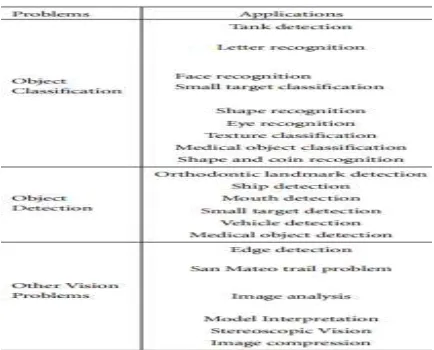
Figure 3.3 Object recognition related work
based on genetic programming.
4.Summary & discussion
In summary, the results suggest that the
SCBD method could perform well on
relatively easy object classification problems
if the classes were arranged in their ordinary
order (such as Shape1), but would perform
badly when the classes were out of this order
(as in Shape2) or when the classification
problems became more difficult (such as
Coin1, Coin2, and Face datasets). This is
mainly because a high degree of nonlinearity
is required to map the class regions on the
programme out-put to the object features in
these situations. The performances of all the
three methods on Coin1, Coin2, and the Face
datasets were worse than the two shape
datasets, reflecting the fact that the
classification problems in these datasets are
more difficult than in the two shape datasets.
Because these problems were harder, more
features might need to be selected, extracted
and added to the terminal set. Also more
powerful functions might also need to be
applied in order to obtain good performance.
Available Online At www.ijpret.com developments is beyond the goal and the
scope of this chapter. We leave this for the
future work. In terms of the classification
performance, the CDCBD method performed
better than the SDCBD method for all of the
datasets investigated here. In particular, the
CDCBD method achieved over 90% of
accuracy for the difficult problems in Coin2
and Face datasets, which was significantly
better than the other two methods. Also
notice that this method resulted in the least
standard deviation over 50 runs among all
the three methods investigated here. For
training generations, it seems that the
computational cost of the CDCBD method is
also lower than the SDCBD method for the
two shape datasets, but slightly higher for
the three difficult problems in the coin and
the face datasets. However, if a slightly
higher computational cost can lead to clear
improvement in classification performance,
this will be a small price to pay in most
situations.
5.Conclusion
The goal of this chapter was to investigate
and explore dynamic class boundary
determination methods as class translation
rules in genetic programming for multiclass
object classification problems, and to
determine whether the new dynamic
methods could outperform the static
method. Two classification methods, CDCBD
and SDCBD, were developed and
implemented where the class boundaries
were dynamically determined during the
evolutionary process. The two dynamic
methods were examined on five datasets in
three object image groups providing object
classification problems of varying difficulty.
The results showed that the static method,
SCBD, performed very well on the relatively
easy, linearly separable object classification
problems where the classes were arranged
in their ordinary order, but performed less
well when the classes were arranged in an
arbitrary order. The two dynamic methods,
CDCBD and SDCBD, always outperformed
the static method on all the object
classification problems in the five datasets
in terms of both classification performance
and the training convergence. The centered
dynamic method achieved better
classification performance than the slotted
dynamic method for all cases. Although
Available Online At www.ijpret.com problems, these two dynamic methods are
also expected to be applied to other
classification problems. For future work, we
will investigate whether the performance
on the relatively difficult coin and face
datasets can be improved if more features
are added to the terminal set. We will also
compare the performance with other
long-term established methods such as decision
trees and neural networks
6. References
1. Cai-ming Chen, Shi-qing Zhang, Yue-fen
Chen, "A Coin Recognition System with
Rotation Invariance," 2010 International
Conference on M achine Vision and
Human-machine Interface, 2010, pp. 755-757
2. Thumwarin, P., M alila, S., Janthawong,
P. and Pibulwej, W., “A Robust Coin
Recognition M ethod with Rotation
Invariance”, 2006 International Conference
on Communications, Circuits and Systems
Proceedings, 2006, pp. 520-523.
1. 3. Shen, L., Jia, S., Ji, Z. and Chen,
W.S., “Statictics of Gabor features for coin
recognition”, IEEE International Workshop
on Imaging Systems and Techniques, 2009,
pp. 295 - 298.
3. Gupta, V., Puri, R., Verma, M ., “Prompt
Indian Coin Recognition with Rotation
Invariance using Image Subtraction
Technique”, International Conference on
Devices and Communications (ICDeCom),
2011
4. P. Davidsson, “ Coin classification using a
novel technique for learning characteristic
decision trees by controlling the degree of
generalization”, Ninth International
Conference on Industrial & Engineering
Applications of Artificial Intelligence &
Expert Systems, 1996.
5. Fukumi M. and Omatu S.,
"Rotation-Invariant Neural Pattem Recognition System
with Application to Coin Recognition", IEEE
Trans. Neural Networks, Vol.3, No. 2, pp.
272-279, M arch, 1992
6. Fukumi M. and Omatu S., "Designing A
Neural Network For Coin Recognition By A
Genetic Algorithm”, Proceedings of 1993
International Joint Conference on Neural
Available Online At www.ijpret.com 2. 8. Khashman A., Sekeroglu B. and
Dimililer K., “Intelligent Coin Identification
System”, Proceedings of the IEEE
International Symposium on Intelligent
Control ( ISIC'06 ),M unich, Germany, 4-6
October 2006, pp. 1226-1230.
9. Roushdy, M., “Detecting Coins with
Different Radii based on Hough Transform
in Noisy and Deformed Image”, In the
proceedings of GVIP Journal, Volume 7,
Issue 1, April, 2007.
10. Akca, D., Gruen, B., Breuckmann, B. &
Lahanier, C. (2007). High definition
3D-scanning of arts objects and paintings,
Optical 3-D Measurement Techniques VIII,
Vol. 2, pp. 50–58
11. Arandjelovi´ c, O. (2010). Automatic
attribution of ancient roman imperial coins,
Proc. Of Conference on Computer Vision
Pattern Recognition, pp. 1728–1734
12. Bay, H., Tuytelaars, T. & Gool, L. V.
(2006). SURF: Speeded up robust features,
Proc. of Europ.Conf. on Compute. Vision,
Vol. 3951/2006 of LNCS, Springer, pp. 404–
417
13. Besl, P. & McKay, N. (1992). A method
for registration of 3D shapes, IEEE Trans.
Patt. Anal.Mach. Intell. 14(2): 239–256.
14. Bischof, H., Wildenauer, H. & Leonardis,
A. (2001). Illumination insensitive
eigenspaces, Proc.of International
Conference on Computer Vision, pp. 233–
238
15. Canny, J. (1986). A computational
approach to edge detection, IEEE Trans.
Patt. Anal. Mach.Intell. 8(6): 679–698.
16. Chen, Y. & Medioni, G. (1992). Object
modeling by registration of multiple range
images,Image and Vision Computing 10(3):
145–155
17. Cooley, J. W. & Tukey, J. W. (1965). An
algorithm for the machine calculation of
complex fourier series, Math. Comput. 19:
297–301.
18. M. Zhang and W. Smart, “Multiclass
object classification using genetic
programming,” inAp-plications of
Evolutionary Computing, EvoWorkshops:
EvoBIO, EvoCOMNET, EvoHOT,
EvoIASP,EvoMUSART, and EvoSTOC, G. R.
Available Online At www.ijpret.com 3005 of Lecture Notes in Computer Science,
pp. 369–378, Springer, Coimbra, Portugal,
April 2004.
19. M. Zhang, V. Ciesielski, and P. Andreae,
“A domain-independent window approach
to multi-class object detection using genetic
programming,”EURASIP Journal on Applied
Signal Process-ing, vol. 2003, no. 8, pp. 841–
859, 2003, special issue on genetic and
evolutionary computation for signal
processing and image analysis
20. M. Zhang and V. Ciesielski, “Genetic
programming for multiple class object
detection,” inPro-ceedings of the 12th
Australian Joint Conference on Artificial
Intelligence (AI ’99),N.Foo,Ed.,vol. 1747
ofLecture Notes in Artificial Intelligence, pp.
180–192, Springer, Sydney, Australia,
De-cember 1999
21. X. Yao and Y. Liu, “A new evolutionary
system for evolving artificial neural
networks,”IEEE Trans-actions on Neural
Networks, vol. 8, no. 3, pp. 694–713, 1997
22. Y. C. Wong and M. K. Sundareshan,
“Data fusion and tracking of complex target
maneuvers with a simplex-trained neural
network-based architecture,” inProceedings
of IEEE International Joint Conference on
Neural Networks. IEEE World Congress on
Computational Intelligence (IJCNN ’98),vol.
2, pp. 1024–1029, Anchorage, Alaska, USA,