journal homepage: http://farplss.org
Volume 32, Number 2, 2019
30
The representation features of the personal experience
substructures of students with different self-concept profiles
P. Sevostianov
V.N. Karazin Kharkiv National University, Kharkiv, Ukraine
ORCID ID 0000-0003-3461-9920
Article info
Received 26.02.2019
Accepted 30.04.2019
Applied Psychology Department of V.N. Karazin Kharkiv National University, Kharkiv, Ukraine.
e-mail:
[email protected] Phone: +380663604117
Sevostianov, P. (2019). The representation features of the personal experience substructures of students with different self-concept profiles.Fundamental and applied researches in practice of leading scientific schools, 32 (2), 30–35.
The article is devoted to the substructures of the personal component of individual experience research. In the framework of theoretical analysis, the structural organization of individual experience is reviewed. The author's position consists in sticking to the O.M. Laktionov three-component model of the experience.
During the theoretical analysis contemporary studies devoted to the study of individual experience are reviewed. Several substructures of the personal component of individual experience, that require attentive study, are defined. The self-concept notion is analyzed. For the first time, an analysis of the features of relationship between the feeling of self-concept well-being and the personal experience substructures are presented.
The analysis, described in this article, is a continuation of the research, which devoted to the study of self-concept in the framework of the structure of the students` personal component of individual experience, during which on the basis of analysis the substructures of personal experience formation features the self-concept profiles were received. Four self-concept profiles were taken into consideration out of the results of the study: the "Conflict profile": persons for whom the simultaneous inclusion of the prosperous and problematic types of self-perception is inherent; "Prosperous profile": persons for whom the prosperous self-concept perception, that combines with low level of problem self-concept perception, is inherent; "Tendency to well-being": persons who are characterized by the tendency to decrease the negative evaluation of their self-concept, having the average indicators of their self-concept well-being; "Tendency to conflict": individuals, who are characterized by average indicators of their self-concept perception in a problematic context in a tendency to decrease the assessment of their self-concept well-being.
Directly in the course of the work, described in the article, a comparative analysis of students with different profiles was performed, that was based on the degree of representation of individual experience personal component substructures. The comparison was made using the rank criterion of Kruskal-Wallis.
Volume 32, Number 2, 2019
31
as the value was found the most expressive among the students with a tendency to a conflict in their own self-perception; the least expressive it was for students with a prosperous profile.
Keywords: Self-concept profiles; self-perception; individual experience.
Introduction
The personality individual experience is one of the most important phenomena, which, on the one hand, reflects the human activities, and on the other –
determines the further course of this activity features. Thus, subject to the slightest changes, occurring during the individual`s life, there are corresponding transformations in the whole system of personal functioning are happening, therefore the relevance of the constant tracking the problem of individual experience to date is not in doubt.
Following the three-factor model of individual experience (Laktionov, 2000), which points at the personal, social and mnemonic components, within the framework of studies devoted to the analysis of this problem, our efforts are directed towards the study of the very personal experience as the basic way of human life reflection. Appealing to the "basis" of the life reflection implies its fundamental characteristic - "the subjective value of oneself", which is derived from the personal interpretive complexes and self-concept.
Consequently, as it was already noted in our previous publications, precisely because of the fact of representing the personal experience as the main way of reflecting the individual`s activity, in our opinion, the primary focus should be aimed at the studying exactly this structural element, and further thanks to this studies there will be an opportunity to reveal more fully the content of social and mnemonic components; so, in an effort to explore the problem of individual experience formation deeper, an attempt to analyze it`s personal component in detail will be made within the framework of this article.
Recent studies of individual experience are aimed at deepening the understanding of its structure. Thus, Alexandrov Y.I., Krylov A.K. and Arutyunova K.R. (Alexandrov, Krylov, Arutyunova, 2017) have proved the connection between the intensity of individual activity and the degree of the substructures of individual experience differentiation.
In addition, individual experience is being considered today through autobiographical memory. Rollins and colleagues (Rollins, Gibbons, Cloude, 2018) have shown that individual personality experience is forming depending on the subjective perception of the past events. To understand the peculiarities of individual experience building, Denault A.S. and Poulin. F (Denault, Poulin, 2016) devote their efforts to study the formation of positive and negative experiences in social and individual contexts. In their research they tried to separate the profiles of individual experience, as a result of which the researchers proposed a three-profile model. While researching adolescents, the authors attributed such characteristics as identity, initiative, emotional regulation, social skills, teamwork skills, social integration and leadership support to social and individual
experiences. Based on these scales, researchers have formed three profiles: with low, medium and high experience expressiveness. It should be noted, that the social and individual experience after receiving the results of the experiment were presented equally, that is, their expressiveness levels did not contradict each other.
Considering the latest study, it should be drawn attention to the individual personal experience that was presented by Denault and Poulin with identity, initiative and emotional regulation. In our opinion, each of these components requires constant in-depth studying. But due to our concentration on the phenomenon of the person self-interpretation mentioned above, at this stage of the research exactly the identity, as the characteristic that is responsible for the personal property to realize the integrity of its personality, for identification with a certain image, will be considered by us in the context of the personal component of individual experience within the framework of this article.
Turning to the latest studies of the person identity phenomenon, let`s draw attention to the comparison of the "actual myself" and "possible myself" with the self-concept, which, according to J. Smith (Smith, 2013), forms a dynamic system guided by the autopoietic process. Consequently, identifying with a certain image, that is inherent in the phenomenon of identity, leads us directly to the self-concept notion. The last one, as it was already shown, is also an integral structural element of the personal component of the individual experience. The self-concept is a significant representative structure of the personal component of individual experience, and exactly this phenomenon deserves a special attention during disclosing the problem raised in the article.
To argue more strongly the focusing at the self-concept, it should be said that, first, the self-concept is a rather broad concept in the background of all phenomena associated with identity. Secondly, the self-concept is a stable and perceived personal structure that can be verbally reflected by a person - and this fact opens considerable opportunities for its analysis.
In addition, the self-concept in fact is one of the main ways of personal subjective assessment of its own well-being, and this fact indicates that the self-concept can act as a very informative indicator that reflects the processes occurring in the structural organization of the personal component of individual experience.
Volume 32, Number 2, 2019
32
Briefly updating the contents of the study, we recall that in the first place factorization of the self-concept well-being indicators was carried out, which resulted in two factors that explain 60% of the total dispersion; both factors associate within their limits the same ideas about self-concept in the past, the present and the future. In the first factor ("Me prosperous"), there were combined positive personal perceptions about its self-concept throughout life. The second factor ("Me problematic") described the students` perceptions about themselves as rigid and disturbing in the future, with feeling of anxiety and stiffness in the past and the present.
Directly self-concept profiles were obtained by clustering these factors. As a result of this procedure, four profiles representing groups in two dimensions of self-concept:
Group 1 ("Conflict profile"): Persons who are characterized by a combination of the prosperous and problematic types of self-perception.
Group 2 ("Prosperous profile"): persons who are characterized by prosperous self-concept perception, and who have low values of representations of their personality as a problem.
Group 3 ("Tendency to well-being"): Individuals with a typical tendency to lower their negative self-concept values, who have the average rate of their well-being.
Group 4 ("Tendency to conflict"): individuals who are characterized by average perceptions of their self-concept in a problematic context in a tendency to lower their well-being.
Goals of article
At this stage, the goal of article is to conduct a comparative analysis of student groups by the profiles received by us, based on a comparison of a number of substructures of the personal component of individual experience. In our opinion, this analysis will allow in the future to reveal the peculiarities of the formation of personal experience, depending on the degree of well-being of self-perception. Thus, the purpose of the article is to identify differences in the personal component of the individual experience substructures of students with different self-concept profiles.
Materials and Methods
During the experiment, the following techniques were used: NEO PI-R – Revised NEO Personality Inventory, D. A. Leontiev lifesense orientation tests, V. I. Morosanova questionnaire "The style of behavior self-regulation", S. A. Budassi self-esteem diagnostics method, and Sh. Schwartz's personality values study method.
The Revised NEO Personality Inventory, as a technique characterized by a significant coverage of personality manifestations, was chosen in order to capture the characteristics that represent the personal component of individual experience. In addition, such a scale of this method as "Openness to experience", that indicating the originality and individual openness to various incentives, should clearly reflect the direct individual relation to its own experience.
The rest of the techniques are aimed at a detailed consideration of the personality individual experience substructures.
In the course of the study, an appeal to the abovementioned self-concept profiles, obtained using the I. V. Kryazh method of self-concept well-being studying (Kryazh, 2007) in our previous studies was done, and the students with different self-concept profiles were compared by the degree of the personal component of individual experience substructures representation in them. The comparative analysis was carried out using the rank criterion of Kruskal-Wallis with the using the statistical software “Statistica v. 7.0”.
The experiment involved 210 students from V. N. Karazin Kharkiv National University (Kharkiv) and Slavic National University (Slavyansk).
Results
During the comparative analysis, several indicators were obtained, which were conditionally divided into two groups: results with significant differences and results without any differences between the profiles. Such a division, in our opinion, should help to separate the individual experience personal component substructures, which have no connection, or have little connection with the feeling of self-concept well-being.
So, referring to a group of results that did not receive significant indexes, we turn to table 1, which presents the indicators for which there are no differences among students with different self-concept profiles.
Table 1
Indicators of the individual experience personal component substructures with no differences among
students with different self-concept profiles
Indicator H p
Self-esteem 6.153 0.104
Neuroticism 3.176 0.365
Extroversion 2.209 0.53
Cooperation 1.728 0.631
Conscientiousness 7.301 0.063
Self-regulation planning 3.341 0.342
Self-regulation flexibility 2.706 0.439 Sense-life orientation towards the
goal 4.564 0.207
Conformity (value) 7.173 0.067
Traditions (value) 2.839 0.417
Kindness (value) 5.113 0.164
Universalism (value) 5.829 0.12
Security (value) 6.668 0.083
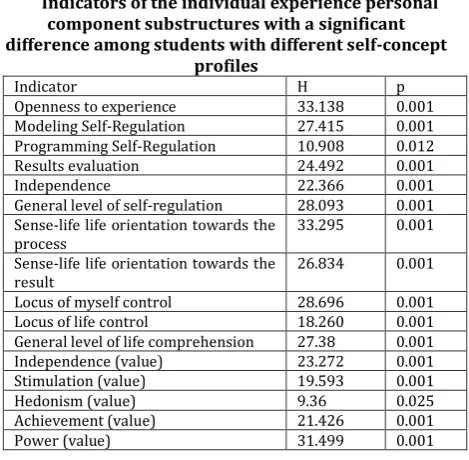
The results with significant differences are presented in Table 2.
Volume 32, Number 2, 2019
33
(except the modeling indicator, which is the lowest for students with a profile "tendency to well-being").
The rate of programming self-regulation is most expressive for students with a tendency to well-being (although students with a prosperous profile lags slightly); a similar situation with indicators of such values as stimulation, achievement and power.
Table 2
Indicators of the individual experience personal component substructures with a significant difference among students with different self-concept
profiles
Indicator H p
Openness to experience 33.138 0.001 Modeling Self-Regulation 27.415 0.001 Programming Self-Regulation 10.908 0.012
Results evaluation 24.492 0.001
Independence 22.366 0.001
General level of self-regulation 28.093 0.001 Sense-life life orientation towards the
process 33.295 0.001
Sense-life life orientation towards the
result 26.834 0.001
Locus of myself control 28.696 0.001 Locus of life control 18.260 0.001 General level of life comprehension 27.38 0.001 Independence (value) 23.272 0.001
Stimulation (value) 19.593 0.001
Hedonism (value) 9.36 0.025
Achievement (value) 21.426 0.001
Power (value) 31.499 0.001
The locus of life control of and hedonism as value scales are most expressive for the subjects with a profile with a tendency to conflict in the perception of their self-concept, and the least expressive - for students with a prosperous profile.
Discussion
Based on the data obtained, we can say that the feeling of self-concept well-being is not connected with the perceptions of the individual about his significance, with emotional instability, with the "outside" direction, with the desire to cooperation, with a conscientious attitude towards others, with a high ability to plan the activities, with the flexibility of self-regulation processes, with the orientation of the individual towards the target, as well as with the perception of sequacity to others, traditions, kindness, understanding of others, and security.
Paying attention to self-esteem as a phenomenon that has the system of the individual meanings as the main criterion, basing on the sense-forming peculiarities, that consist in connecting new objects to the already existing system of semantic connections, we can talk about some inconsistency in the self-esteem construction and a well-being feeling. In other words, the individual, having a certain system of ideas about the ideal of his own Self, strives for it, builds his own Self in a certain way, respectively evaluates it, but at the same time, the feeling of well-being is not satisfied. This may be due to many reasons: the feeling of the inaccessibility of the ideal, the
application of significant efforts, the targeting to the universally praised ideals with the detriment of own interests, and so on. Consequently, from this position, the result obtained is completely legitimate. In addition, this result may allow to disclose the problem of inconsistency of the individual true intentions and his real activity more deeply in the future.
Next, it is shown that four out of the five G-5 scales (except the Openness to experience) are not related to the feeling of Self well-being. We believe that this result should be explained by the fact that neuroticism, extraversion, cooperation and integrity, as the qualities that are more responsible for the social interaction of the individual, are more relevant to the social component of individual experience, and therefore these phenomena are to a lesser extent related to the sense of personal self-well-being. It is possible that, in the case of a studying a feeling of social well-being of my own Self, the result would be different.
Planning ability is not related with the Self well-being feeling, in our opinion, because planning as an independent phenomenon is usually does not act as the final goal of the activity but serves only as a tool for its implementation. In this case, it should be mentioned a person's attitude to a certain goal: an individual may need to plan activity or do not need it, however, in any case, the sense of satisfaction will depend to a greater extent on whether the final goal will be achieved. Undoubtedly, it can be said that certain individuals can satisfy their feeling of well-being thanks to the process of planning through the sense of controlling the goal achievement, however, in case of failure to reach the goal, this feeling will change to the opposite. Consequently, in this case it should be said, that exactly the purpose determines the Self well-being more than means of its achievement.
Addressing to the flexibility index as a parameter, that is responsible for the level of the ability to rebuild formation and for making corrections to the system of self-regulation when changing the external and internal conditions of the person's functioning, we must also state its independence from the sense of Self well-being. This fact, at first glance, is controversial, because the high ability to adapt adequately to changes should contribute to improving the sense of Self well-being, while low flexibility in the changes would lead to an insecurity and depression. In this situation, several assumptions can be made. First, any changes touch upon certain cognitive schemes in the individual consciousness, so they make dissonance even at high flexibility of regulatory processes, which will not enhance the sense of Іуда well-being. Secondly, it can be assumed that certain mechanisms are turned on in low flexibility, and these mechanisms guide their functioning to minimize negative experiences, that does not significantly increase the feeling of Self adversity (for example, impossibility to adapt to new conditions in a certain activity can force a person find an alternative). Within the framework of our article, it will not be analyzed which exact mechanisms may be involved, since this is the subject of a separate study.
well-Volume 32, Number 2, 2019
34
being of his own Self. Here, in our opinion, it should be explained by the features of building individual`s life priorities: for one, forming goals and their achievements may be necessary, so, a change in the sense of their own Self well-being depends on the ability to achieve a certain goal; for others, for whom the purpose construction is not necessary, the feeling of Self well-being is formed depending on the current situation. Consequently, in the context of focusing on the sense in life, it should be said about the disconnection between the fact of goal presence or lack and a sense of Self well-being.
Analyzing the results obtained further, let`s draw attention to the lack of significant differences between students with different profiles in relation to such value, as a conformality. That is, it should be affirmed, that the feeling of Self well-being is not connected with the attitude to the deterrence of actions and motives, that can harm others and do not match social expectations. Obviously, the situation is traced here similar to the described above: since the value of conformality is more socially oriented, it should show more of its connection with the social component of individual experience; therefore, the conformality does not have such a strong connection with the personal substructure. The same fact can also be explained by similar results of such values as kindness and universalism.
Another value that does not reveal differences in students with different profiles is tradition. That is, respect and responsibility for cultural and religious practices and ideas are not closely associated with the sense of Self well-being. Here we tend to talk about the causes diversity of a certain relation to traditions: they can be honored as a result of upbringing without being taken it at a conscious level, or as a result of the desire for ethnic identity, which may be accompanied by the rejection of certain traditional elements, etc. That is, because of the rich variety of possible causes of a certain attitude to the traditions, their connection vector in relation to the sense of Self well-being is not stable.
Finally, the last value, which did not reveal differences in students with different profiles of the Self-concept, is safety. At first glance, the attitude to security should be directly related to the sense of Self well-being, but in our study it was not revealed that, and, in our opinion, it should be explained by the fact that the safety value given by Schwartz is presented quite versatile: security and stability of society, relationships and own Self. That is, in this case, the spreading of emphasis on the social or personal component of this value is possible, and these accents may not coincide, therefore, in our opinion, that is why we have not found significant relations between the security as a value and a sense of the Self well-being.
Next we turn to the analysis of those indicators, which obtained differences in students with different Self-concept profiles.
The first thing to note here is that the indicator of openness of experience is most expressive for students with a prosperous Self-concept profile. And the least – for the respondents with a conflict profile and with a tendency to conflict.
Since the openness to experience shows how original person is, how person is opened to all kinds of incentives, how wide is person`s interests, and how strongly
expressed person`s willingness to take risks, we tend to say that as long as a person has all these qualities highly developed, it has the ability to control a variety of situations, it`s ability to take a risk, that is, it feels prosperous when interacting with many surrounding phenomena. Conversely, the low openness of experience does not contribute to the development of a sense of Self well-being.
The ability to allocate significant conditions for achieving goals in both the current situation and in the future is more expressive in the students with a prosperous profile, and the least expressed in the persons with a conflict profile and with a tendency to conflict profile. Obviously, it should be said here about the preservation of the individual`s psychological and physical resources in the performance of certain activities, which is achieved due to concentration on the main points. In our opinion, exactly the resources preservation and their rational using leads to a sense of activity satisfaction, and therefore stimulates an increasing the sense of Self well-being.
A similar distribution of Self-concept profiles was obtained by the ability to program the activity indicator. Consequently, the sense of Self well-being is associated with the ability to conscious programming of the person`s actions, while self-perception conflict has to be correlated with impulsiveness. It should be assumed that there is a direct connection between the sense of controllability of the situation achieved through modeling and the sense of Self well-being. It is possible to explain by the same reason the similar results by such indicators as results estimation, power value, autonomy, and general level of self-regulation (similar tendency can be seen in the analysis of the planning indicator).
Life-sense orientation to the process as a phenomenon that reflects the fact that a person perceives the process of it`s life as interesting, as emotionally rich and as content-filled, quite logically turned out to be most expressive in a students with a prosperous profile, since such perception of life is directly related to the feeling Self well-being. The same should be said about the orientation to the result as self-realization satisfaction: the sense of Self well-being directly depends on this satisfaction.
Perception about Self as about a strong personality, that is free to choose the way to build it`s own life in accordance with it`s tasks, goals and ideas about life senses, is also most characteristic for a students with prosperous profile, which, in our opinion, should be explained by satisfaction with the correspondence of person`s power and available ambitions.
It was interesting that, the belief that the person is given to control over it`s own life, to make decisions and implement them in life freely is most characteristically for students with a profile with a tendency to conflict, which can be explained by dissatisfaction with own abilities because of certain failures, due to why person idealizes unfulfilled activity, attributing the ability to control fully person`s own life to human.
Volume 32, Number 2, 2019
35
greater tendency to live for today, and in such circumstances there is no need to sacrifice certain current benefits for the final goal, which leads to increasing in such value as hedonism.
Consequently, we see that the different substructures of the personal component of the individual experience can be either distinct, or similar to the students with different Self-concept profiles.
Limitation. It should be accented that the study was carried out on the student's voters, so the fact that the received data can be considered as universal, requires additional experiments.
Conclusions
Based on comparative analysis of the individual experience personal component substructures of students with different Self-concept profiles, the following conclusions can be made:
Students with different Self-concept profiles do not show differences in such indicators as self-esteem, neuroticism, extraversion, cooperation, conscientiousness, self-regulation planning, self-regulation flexibility, goal sense-life orientation, and such values as conformance, traditions, kindness, universality and safety.
Openness to experience, modeling, results evaluation, independence, self-regulation level, process orientation, results orientation, locus of myself control, life meaningfulness and independence appreciation are most expressive for students with a prosperous Self-concept profile. The least expressive it is for students with a conflict profile and profile with a tendency to conflict.
Indicators of programming, as well as the such values as stimulation, achievement and power are most expressive for students who are characterized by a tendency to a prosperous self-perception.
Scales of the locus of life control and hedonism as a value are most expressive for students who have a profile with a tendency to conflict in the perception of their own Self, the least expressive it is for students with a prosperous Self-concept profile.
References
Alexandrov Y. I., Krylov A.K., & Arutyunova K. R. (2017). Activity during Learning and the Nonlinear Differentiation of Experience. Nonlinear Dynamics Psychology and Life Sciences, 21(4), 391-405.
Denault A. S., & Poulin F. (2016). What adolescents experience in organized activities: Profiles of individual and social experiences. Journal of Applied Developmental Psychology, 42, 40-48.
Goldberg, L. R. (1992). The development of markers for the Big-Five factor structure. Psychological Assessment, 4(1), 26-42. Ivaschenko A. V. (2000). Personality Self-concept in native
psychology. A. V. Ivaschenko, V. S. Agapov, I. V. Baryshnikova. M .: MGSA. - 153 p. [In Russian].
Иващенко A. B. (2000). Я-концепция личности в
отечественной психологии. A. B. Иващенко, B. C. Агапов, И.
В. Барышникова. М.: Изд. МГСА. - 153 с.
Kim, W. (2008). The Relation between Self-Concept Differentiation, Self-concept Integration and Psychological Well-being. Korea Journal of Counseling, 9(3), 1043-1061.
Kryazh I. V. (2007). Social Time in the Views of Residents of Eastern and Western Ukraine. Visnik of V. N. Karazin Kharkiv National University; A Series of «Psychology», 771, 137-145. [In Russian].
Кряж И. В. (2007). Социальное время в представлениях жителей восточной и западной Украины. Вісник Харківського національного університету імені В. Н.
Каразіна. Серія психологія, 771, 137-145.
Laktionov A. N. (1998). The Coordinates of individual experience. Kharkov: Business-Inform, 1998. - 492 p. [In Russian].
Лактионов А. Н. (1998). Координаты индивидуального
опыта. Харьков: Бизнес-Информ, 1998. –492 с.
Laktionov, O. M. (2000). Structural and dynamic organization of individual experience. dis ... Doctor of Psychological Sciences: 19.00.01. K. - 374 p. [In Ukrainian].
Лактіонов,О.М. (2000). Структурно-динамічна організація
індивідуального досвіду. дис. ... доктора психологічних
наук: 19.00.01. К. - 374 с.
Norman, W. T. (1963). Toward an adequate taxonomy of personality attributes: Replicated factor structure in peer nomination personality ratings. The Journal of Abnormal and Social Psychology, 66(6), 574-583.
Radyuk O. M. (2016) "Big Five" of Personality Characteristics. II International Congress of the Cognitive-behavioral Psychotherapy Association: a Collection of Scientific Articles, St. Petersburg: SINEL, 92-104. [In Russian].
Радюк О. М. (2016) «Большая пятёрка» личностных
особенностей. II Международный съезд Ассоциации
когнитивно-поведенческой психотерапии: сборник
научных статей, Санкт-Петербург: СИНЭЛ, 92-104.
Rollins, L., Gibbons, J. A., & Cloude, E. B. (2018). Affective change greater for unpleasant than pleasant events in autobiographical memory of children and adults: A retrospective study. Cognitive Development, 47, 46-52. Sevostianov P. (2018). The Self-concept in the Personal
Component of Individual Experience Structure. Visnik of V. N. Karazin Kharkiv National University; A Series of «Psychology», 64, 51-55.
Sevostianov P. O. (2018) The Relationship Between the Openness of Experience and the Semantic-life Orientation of Students. Visnik of V. N. Karazin Kharkiv National University; A Series of
«Psychology», 63, 12-16. [In Ukrainian].
Севост`янов П. О. (2018). Взаємозв’язок відкритості досвіду та смисложиттєвих орієнтацій у студентів. Вісник
Харківського національного університету імені В. Н.
Каразіна. Серія «Психологія», 63, 12-16.
Shvalb Yu. M. (2005). Psychological Forms of Life Experience Fixation. Actual problems of psychology: Psychological hermeneutics. N.V. Chepeva. (Ed.). K .: Milenium, 2 (3), 14-20. [In Russian].
Швалб Ю. М. (2005). Психологические формы фиксации жизненного опыта. Актуальні проблеми психології: Психологічна герменевтика. За ред. Н. В.Чепелєвої. К.:
Міленіум, 2(3), 14-20.