Asian Journal of Pharmaceutical Education and Research
Vol -5, Issue-4, October-December 2016
SJIF Impact Factor 4.101ISSN: 2278-7496
AJPER October – December 2016, Vol 5, Issue 4 (64-74)
RESEARCH ARTICLE
FORMULATION DEVELOPMENT AND EVALUATION OF CREAM USING RICE BRAN WAX FOR TOPICAL APPLICATION
Rajeev Malviya*, Dr. M.D. Khirsagar, Dr. A.V. Chandewar
Sant Gadge Baba Amravati University, Amravati
ABSTRACT:
In the treatment skin disease, the vehicle (cream, ointment or lotion )
may be as important as the active agent. Semisolid preparations are
appropriate for patients with sensitive or dry skin who require a
nonirritating, nondrying formulation. Patient with dry skin may
complain of a “dry” feel with gels. So the people are performing deal
with semisolid preparation (ointment, cream and lotion). Patients who
have dry skin may be more comfortable with semisolid preparation like
cream ointment and lotion, because they have an oily effect. Semisolid
preparation work best in patients for the treatment of topical infections.
The aim of the present investigation is to formulate and evaluate the best
and safe semisolid preparation (cream) in topical composition by using
rice bran wax as a base composition for econazole for the treatment of
skin disease.
Keywords: Cream, Rice bran wax, econazole
Article Received on 10/09/2016
Revised on 15/09/2016
Accepted on 21/09/2016
*Correspondence for Author
Rajeev Malviya
Sant Gadge Baba
Amravati University,
Amravati, Maharashtra.
Email:
AJPER October – December 2016, Vol 5, Issue 4 (64-74) INTRODUCTION
Over the last decades the treatment of illness have been accomplished by
administrating drugs to human body via various roots namely oral, sublingual, rectal,
parental, topical ,inhalation etc. 1
Creams are semisolid emulsion systems with opaque appearances as contrasted with
translucent ointments. Their consistency and rheologic character depend on whether the
emulsion is water in oil or oil-in-water type and/or the nature of the solids in the internal
phase.2 Oil-in-water emulsions are most useful as water-washable bases where as
water-in-oil emulsions are emollient and cleansing. Patients often prefer water in water-in-oil cream to an
ointment because the cream spreads more readily, less greasy and the evaporating water
soothes the inflamed tissue. Oil in water creams (vanishing creams) rub into the skin; the
continuous phase evaporates and increases the concentration of a water soluble drug in the
adhering film. The concentration gradient for a drug across the stratum corneum therefore
increases, promoting percutaneous absorption. To minimize drug precipitation, a formulator
may include a nonvolatile, water miscible co-solvent such as propylene glycol. An o/w
cream is non-occlusive because it does not deposit a continuous film of water-impervious
liquid. However such a cream can deposit lipids and other moisturizers on the stratum
corneum and so restore the tissue’s hydration ability, i.e. the preparation has emollient
properties.3
Econazole (Eco), an anti-fungal imidazole compound, has been used in the treatment
of vulvovaginal candidiasis 4,5 and superficial fungal infection.6-8 Econazole has been shown
to inhibit lipopolysaccharide-inducible nitric oxide synthase (iNOS) activity in rat aortic
rings and cultured murine macrophage cells suggesting that it exerted a potential
anti-inflammatory effect.9
MATERIAL AND METHOD Material
Econazole of pharmaceutical grade were obtained as gift sample from Euphoria Healthcare
Pvt. Ltd. Mumbai, Rice bran wax was procured from Bajaj Rice Mill, Warangal
(Andhra-Pradesh, India), Lanolin & Lanolin Alcohols, Stearic acid purchased from Merck, Liquid
paraffin purchased from Qualigens. All other reagents and chemicals used were of analytical
AJPER October – December 2016, Vol 5, Issue 4 (64-74) Formulation development of cream
Cream preparation
Preparation of aqueous phase
For the water phase all water soluble material (Triethenolamine, Glycerin, drug and Sorbitol)
were mixed in a beaker and this solution heated till it attained a temperature of about 700 C.
Preparation of oil phase
For the oil phase rice brane wax, glycerol monostearate, cetostearyl alcohol, stearic acid,
lanolin and liquid paraffin were added in a beaker and temperature was increase about
700C.
Preparation of cream
The aqueous phase was then transferred to the oil phase maintained at 70°C. The mixture
was stirred manually with a glass stirring rod until the phases were homogeneous. The
temperature of the mixture was allowed to cool to 50°C while stirring manually, and a
separate solution of Methyl and Propyl Paraben in Propylene Glycol was added. The creams
were then stirred until a smooth consistency was obtained, after which they were packed into
25 g ointment jars and stored at room temperature (25°C) until required for further analysis.
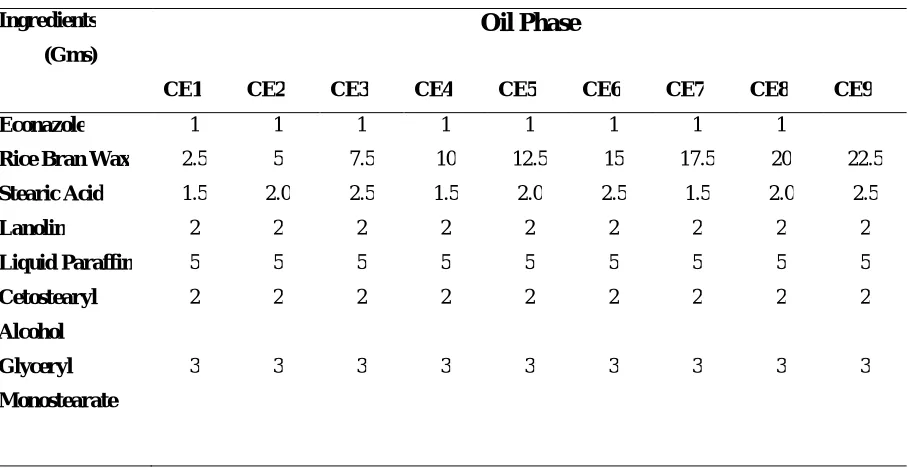
Table 1: Preparation of Cream
Ingredients
(Gms)
Oil Phase
CE1 CE2 CE3 CE4 CE5 CE6 CE7 CE8 CE9
Econazole 1 1 1 1 1 1 1 1
Rice Bran Wax 2.5 5 7.5 10 12.5 15 17.5 20 22.5
Stearic Acid 1.5 2.0 2.5 1.5 2.0 2.5 1.5 2.0 2.5
Lanolin 2 2 2 2 2 2 2 2 2
Liquid Paraffin 5 5 5 5 5 5 5 5 5
Cetostearyl
Alcohol
2 2 2 2 2 2 2 2 2
Glyceryl
Monostearate
AJPER October – December 2016, Vol 5, Issue 4 (64-74) Aqueous Phase
Triethanolamine 0.8 0.8 0.8 0.8 0.8 0.8 0.8 0.8 0.8
Glycerin 7.5 7.5 7.5 7.5 7.5 7.5 7.5 7.5 7.5
Sorbitol 2.5 2.5 2.5 2.5 2.5 2.5 2.5 2.5 2.5
Propylene glycol 5 5 5 5 5 5 5 5 5
Methyl paraben 0.18 0.18 0.18 0.18 0.18 0.18 0.18 0.18 0.18
Propyl paraben 0.02 0.02 0.02 0.02 0.02 0.02 0.02 0.02 0.02
Water
(qs to)
100 100 100 100 100 100 100 100 100
Characterization of developed formulation
Cream was evaluated for their clarity, pH, viscosity, spreadability, skin irritation test, in vitro
diffusion studies using standard procedure. All studies were carried out in triplicate and
average values were reported.
Psychorheological Characteristic
The Psychorheological Characteristic was checked for topical cream formulations (colour,
clogging, homogeneity and texture) and observations were shown in Table no.1 & 2
Washability
Formulations were applied on the skin and then ease and extent of washing with water were
checked manually and observations were shown in Table No.
Extrudability study
The cream formulations were filled into collapsible metal tubes or aluminium collapsible
tubes. The tubes were pressed to extrude the material and the extrudability of the formulation
was checked. Spreadability Principle:
An important criterion for creams is that it must possess good spreadability. Spreadability is
a term expressed to denote the extent of area to which the cream readily spreads on
application to skin. The therapeutic efficacy of a formulation also depends on its spreading
value.
A special apparatus has been designed to study the spreadability of the formulations.
Spreadability is expressed in terms of time in seconds taken by two slides to slip off from
formulation, placed between, under the application of a certain load. Lesser the time taken
AJPER October – December 2016, Vol 5, Issue 4 (64-74) Method:
Two glass slides of standard dimensions (6×2) were selected. The cream formulation whose
spreadability had to be determined was placed over one of the slides. The second slide was
placed over the slide in such a way that the formulation was sandwiched between them
across a length of 6 cms along the slide. 100 grams of weight was placed up on the upper
slide so that the hair cream formulation between the two slides was traced uniformly to form
a thin layer.
The weight was removed and the excess of the hair cream formulation adhering to the slides
was scrapped off. The lower slide was fixed on the board of the apparatus and one end of the
upper slide was tied to a string to which 20 gram load could be applied 50with the help of a
simple pulley. The time taken for the upper slide to travel the distance of 6 cms and separate
away from lower slide under the direction of the weight was noted. The experiment was
repeated and the average of 6 such determinations was calculated for each cream
formulation.
Where, S=Spreadability (gcm/sec)
m = weight tied to the upper slide (20 grams)
l= length of glass slide (6cms).
t = time taken is seconds.
Determination of pH
The pH of the skin creams were determined by digital pH meter. One gram of cream was
dissolved in 25 ml of distilled water and the electrode was then dipped in to cream
formulation for 30 min until constant reading obtained. And constant reading was noted.
The measurements of pH of each formulation were replicated two times.
Viscosity
The measurement of viscosity of the prepared cream was done using Brookfield
digital Viscometer. The viscosity was measured using spindle no. 6 at 10 rpm and 250C. The
sufficient quantity of cream was filled in appropriate wide mouth container. The cream was
filled in the wide mouth container in such way that it should sufficiently allow to dip
AJPER October – December 2016, Vol 5, Issue 4 (64-74)
Samples of the creams were allowed to settle over 30 min at the constant temperature (25
±/10C) before the measurements.
In-vitro Drug Release Studies Using the Prehydrated Cellophane Membrane
Preparation of cellophane membrane for the diffusion studies:
The cellophane membrane approximately 25 cm x 2cm was taken and washed in the running
water. It was then soaked in distilled water for 24 hours, before used for diffusion studies to
remove glycerin present on it and was mounted on the diffusion cell for further studies.
Diffusion Studies:
The in-vitro diffusion of drug from the different cream preparations were studied using the
classical standard cylindrical tube fabricated in the laboratory; a simple modification of the
cell is a glass tube of 15mm internal diameter and 100mm height. The diffusion cell
membrane was applied with one gram of the formulation and was tied securely to one end of
the tube, the other end kept open to ambient conditions which acted as donor compartment.
The cell was inverted and immersed slightly in 250 ml of beaker containing neutralizing
phosphate buffer, freshly prepared (pH 7.4)as a receptor base and the system was maintained
for 2 hrs at 37± 0.5o C. The media was stirred using magnetic stirrer. Aliquots, each of 5 ml
volume were withdrawn periodically at predetermined time interval of 15, 30, 45, 60, 90, 120
min and replaced by an equal volume of the receptor medium. The aliquots were suitably
diluted with the receptor medium and analyzed by UV-Vis spectrophotometer at 233.0nm for
econazole and 264nm for 5-FU using phosphate buffer as blank.
Determination of stability conditions
Optimized formulation code CE3 was prepared and kept in humidity chamber at 25°C ±
2°C/60% RH ± 5% RH for 12 months and samples were withdrawn after every 3 months and
evaluated for its physico-chemical properties such as pH, spreadability, and rheological
AJPER October – December 2016, Vol 5, Issue 4 (64-74) Results and Discussion
Characterization of cream formulation
Table 2: Characterization of formulations CE1 to CE5
Parameters Formulation
CE1 CE2 CE3 CE4 CE5
Physical Appearance Translucent, white, smooth on application Translucent, white, smooth on application Translucent, white, smooth on application Translucent, white, smooth on application Translucent, white, smooth on application
pH 6.78±0.2 6.59±0.1 7.00±0.3 6.56±0.2 6.89±0.3
Viscosity
(CP) 48840±3.5 52355±9.4 53147±5.0 54514± 4.56 55451± 2.5 Spreadability
(gm.cm/sec) 32.36±0.7 31.56±0.58 31.56±1.2 32.54±3.56 30.45±2.15 % Drug
content 98.1±0.50 98.3±0.12 99.7±0.12 98.16±0. 99.16±0.3 Extrudability +++ +++ +++ +++ +++
+++ Excellent, ++ Good, + Satisfactory
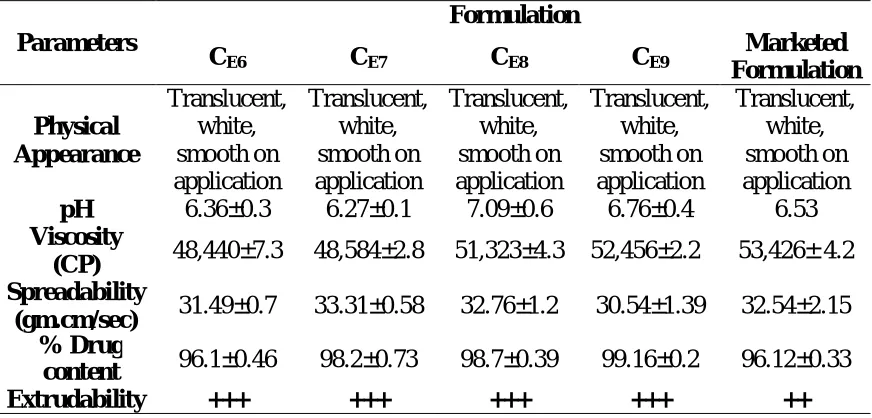
Table 3: Characterization of formulations CE6 to CE9 and marketed formulation
Parameters
Formulation
CE6 CE7 CE8 CE9
Marketed Formulation Physical Appearance Translucent, white, smooth on application Translucent, white, smooth on application Translucent, white, smooth on application Translucent, white, smooth on application Translucent, white, smooth on application
pH 6.36±0.3 6.27±0.1 7.09±0.6 6.76±0.4 6.53
Viscosity
(CP) 48,440±7.3 48,584±2.8 51,323±4.3 52,456±2.2 53,426± 4.2 Spreadability
(gm.cm/sec) 31.49±0.7 33.31±0.58 32.76±1.2 30.54±1.39 32.54±2.15 % Drug
content 96.1±0.46 98.2±0.73 98.7±0.39 99.16±0.2 96.12±0.33 Extrudability +++ +++ +++ +++ ++
AJPER October – December 2016, Vol 5, Issue 4 (64-74) In-vitro Drug Release Studies of CE1 to CE9 and marketed formulation
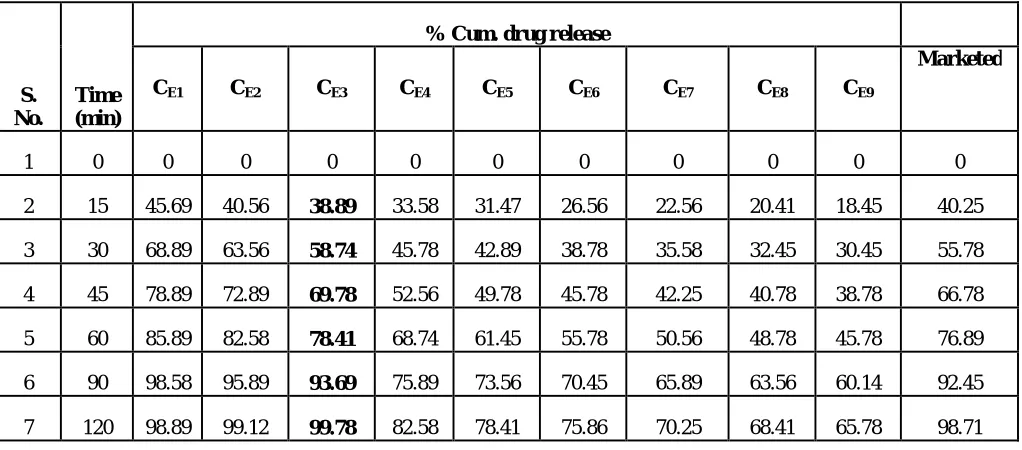
Release of drug from cream base was significantly slower, which confirmed that slight
prolonged drug release rate. Incorporation of rice bran wax affected the release rate of the
drug. By increasing the amount of wax, the release rate of the drug decreased, which could
be related to the increased rigidity of the formulation, followed by its de-creased
permeability for the drug.
Table 4: In vitro drug release study of Econazole cream formulation
Discussion and conclusion
Different Semisolid preparation of econazole was prepared by fusion methods using rice
bran wax as a semisolid base part. The semisolid preparations are able to giving local action
for the treatment of skin cancer and had acceptable consistency and excludability. In vitro
drug release from the semisolid preparation of rice bran wax shows significantly improved in
drug release rate as compare to marketed preparation. It was concluded that in fusion
method, CE3 formulation was the best formulation for deliver the drug for the treatment of
skin disease. Hence it could be concluded that the rice bran wax based semisolid preparation
would providing taste masking of drug and local onset of action without need of any device
for their application on skin.
The preparation of rice bran wax based cream has potential advantages over marketed
preparation as they improved patient compliance rapid local onset of action for longer
period with cost effectiveness. The pediatric and geriatric populations are the primary
ones whose problems are easily targets by ointment, as both the groups found it difficult
S. No.
Time (min)
% Cum. drug release
CE1 CE2 CE3 CE4 CE5 CE6 CE7 CE8 CE9
Marketed
1 0 0 0 0 0 0 0 0 0 0 0
2 15 45.69 40.56 38.89 33.58 31.47 26.56 22.56 20.41 18.45 40.25
3 30 68.89 63.56 58.74 45.78 42.89 38.78 35.58 32.45 30.45 55.78
4 45 78.89 72.89 69.78 52.56 49.78 45.78 42.25 40.78 38.78 66.78
5 60 85.89 82.58 78.41 68.74 61.45 55.78 50.56 48.78 45.78 76.89
6 90 98.58 95.89 93.69 75.89 73.56 70.45 65.89 63.56 60.14 92.45
AJPER October – December 2016, Vol 5, Issue 4 (64-74)
to swallow conventional tablets and drug taste.
Bibliography
1. Kumar KK, Sasikanth K, Sabareesh M and Dorababu N. Formulation and evaluation
of diacerein cream. Asian J. of Pharm Clin. Res. 2011;4 (2): 93-98.
2. Huczko A and Lange H. Fullerenes experimental evidence for a null risk of skin
irritation and allergy. Fullerene Sci Technol 1999; 7:935-939.
3. Nayank SH, Nkhat PD and Yeole PG. The Indian Pharmacist. 2004; 3(27): 7-14.
4. Dellenbach P, Thomas JL, Guerin V, Ochsenbein E and Contet-Audonneau N.
Topical treatment of vaginal candidosis with sertaconazole and econazole
sustained-release uppositories. Int. J. Gynaecol. Obstet. 2000; 71 (1): S47–S52.
5. Osser S, Haglund A and Westrom L. Treatment of candidal vaginitis. A prospective
randomized investigator-blind multicenter study comparing topically applied
econazole with oral luconazole. Acta Obstet. Gynecol. Scand. 1991; 70 (1): 73–78.
6. Aron-Brunetiere R, Dompmartin-Pernot D and Drouhet E. Treatment of pityriasis
capitis (dandruff) with econazole nitrate. Acta Derm. Venereol. 1977;57 (1): 77–80.
7. Prajna NV, John RK, Nirmalan PK, Lalitha P and Srinivasan M. A randomised
clinical trial comparing 2% econazole and 5% natamycin for the treatment of fungal
keratitis. Br. J. Ophthalmol. 2003; 87(10): 1235–1237.
8. Rigoni C, Toffolo P, Cantu A, Beretta D and Terenzio C. 1% econazole
hair-shampoo in the treatment of pityriasis capitis; a comparative study versus
zinc-pyrithione shampoo. G. Ital. Dermatol. Venereol. 1989; 124 (11–12): 67–70.
9. Bogle RG and Vallance P. Functional effects of econazole on inducible nitric oxide
synthase: production of a calmodulin dependent enzyme. Br. J. Pharmacol. 1996;