journal homepage: http://farplss.org
Volume 28, Number 4, 2018
60
Project management models: determining adequacy to the
conditions of the implementation environment
O. Khadartsev
Poltava National Technical Yuri Kondratyuk University, Poltava, Ukraine
Article info
Received 29.05.2018
Accepted 31.08.2018
Poltava National Technical Yuri Kondratyuk University, Poltava, Ukraine
Khadartsev, O. (2018). Project management models: determining adequacy to the conditions of the implementation environment.Fundamental and applied researches in practice of leading scientific schools, 28 (4),60-64.
The article explores the specifics of the methodology and models of project management in relation to the interconnection with the project implementation environment. The peculiarities of influence through elements of management models on the effectiveness of project implementation are determined. The author's methodical approach for evaluating the project environment in terms of its components is presented, the mechanism of interaction between the constituent environments and groups of factors is constructed, and the use of specific evaluation indicators is proposed, which in the end will allow determining an adequate management model for the implementation of the project.
Keywords: project management models; methodology of management; project environment; efficiency; evaluation.
Introduction
In modern dynamic economic conditions, the use of relevant models of project management determines the commercial success not only for business entities, but also determines the achievement of strategic priorities of state development. A qualitative transition to a new, higher level of economic development is putting forward appropriate requirements for the application of adequate project management models, in accordance with the existing conditions of the economic environment. It is the principle of adequacy that allows having a synergistic result of project management – sustainable development of the Ukrainian economy [1], which integrates in such aspects as achieving the objectives of the projects of the corresponding level, ensuring the efficiency of the process of social production, increasing the productivity potential and independence of economic systems of any level.
Goals of article
To propose a methodological approach for evaluating and selecting adequate models of project management, which will further ensure their effective implementation and maximize the expected result of the project, which is based on the scientific and conceptual provisions of project management.
Materials and Methods
The analytical base of the research is the theoretical
basis of effective project management, set forth in the works of domestic and foreign scientists. The research used: logical-structural and comparative analysis to characterize the advantages and disadvantages of project management models; methods of scientific abstraction, dialectical methods and theoretical generalization for substantiation of the initial significance of the resource component; synthesis, induction and deduction in developing the mechanism of mutual influence of factors of the economic environment and the sequence of assessing the adequacy of project management models.
Results
Volume 28, Number 4, 2018
61
development of the financial and credit industry. This is evidenced by the experience of developed countries, besides for this purpose in Ukraine already there are appropriate prerequisites [3, p. 10]. At the same time, the resource provision of the project is the starting point for its feasibility, but it does not always become crucial in achieving its goals. The generalization of research on the efficiency of economic activity at different levels of the hierarchy shows that only about one third of the created welfare depends on the available resource provision, and 60-70% depends on the effectiveness of management and it usage. At the same time, about 2/3 of the achieved results and successes depends on the system approach to management, the effectiveness of management, and only 1/3 – from other factors [4, p. 94]. In today's economic conditions, success is not only the current efficiency, but also the stability of functioning, the ability to adapt to changes of the conditions of the economic environment, the ability to adjust the vector of development, that is, the dynamics of adaptation [5, p. 253]. Such circumstances are relevant to the specifics of Ukraine, which necessitates a detailed consideration of the adequacy of methods and models of project management.
Researchers of the problems of methodology of project management, as a rule, distinguish the following main approaches [6; 7; 8 9; 10]: РМВoК (Project Management Book of Knowledge); PRINCE 2 (PRojects In Controlled Environments), P2M (Project and Program Management for Enterprise Innovation); ICB IPMA (International Competence Baseline International Project Management Association), ISO 21500:2012 (International Standards Organization); MSP (Managing Successful Programs); APM (Guide to the Governance of Project Management); COBIT (Control Objectives for Information and Related Technologies); СРМ (Critical path method); CCPM (Critical Chain Project Management) and others. However, experts highlight certain disadvantages of these methods and models that can create significant obstacles in the process of project implementation. J. Derenska, based on the results of grouping the methodologies of project management into traditional and flexible, concludes that these groups have shortcomings. In her view, traditional models require significant investment in planning, although in project management methodologies their share is dominant. In turn, the disadvantage of flexible models is the vagueness of the boundaries of the phases and processes, and the impossibility of timely planning of the works and the parameters of their implementation [6]. The team of researchers in the work [7] points to the domination of iconographic models that do not adequately reflect the overall properties of the project as a system, and therefore emphasize the use of cybernetic tools, in particular the Markov chains. To similar conclusions on the use of Markov chains to solve communication problems when building a management system for the project, another group of authors in the work [8] comes. These specialists prove that the task of creating a stable management basis for the project must be effectively solved at the stage of its initiation. This will allow to get a synergistic effect due to the consistent consistency of the concept, the purpose and design of the project, as well as requirements to the level of specialization and competence in the formation of the project team.
The analysis of scientific and practical developments has shown that existing proposals for the improvement of methodologies and models of project management directly or indirectly relate to the primary impact of the project implementation environment itself. In particular, N. Pavlicha and Y. Marchuk point out the lack of models and approaches for comprehensive diagnostics of the development of spatial systems in the context of individual economic disciplines [11]. To manage the territory development projects, the authors propose their own two-stage management model, which should be based on social, economic, environmental and other dynamics, which will allow forecasting, planning and control in the process of project implementation. Ö Hazır also notes the negative impact of the uncertainty of the project environment, which in turn does not allow for quality monitoring and control of the achievement of project objectives [12]. The author draws attention to the need to improve traditional project management models using EVA (Earned Value Analysis), optimization tools, and to design of DSS (Decision Support Systems). It deserves attention to the study [13], where the authors conducted a stochastic analysis of the implementation of various types of projects in individual countries of the world. According to the results of the study, it was revealed that the highest significance of the correlation communication of the effectiveness of project management with the availability of adequate information about the state of the business environment in the decision-making process; the second most significant was the influence of management mechanisms throughout the life cycle of the project.
In turn, the choice of an adequate model of project management has an impact by a resource base. According to the grouping of the resources by the levels of enterprising and the levels of management (proposed by O. Poltoratska), the management levels should take into account the specificity of the scale: І group – a set of branches of the national economy (vector of macroeconomic development); group II – enterprises (vector of microeconomic development); group III - effective functioning associations of enterprises (the vector of joint macro- and microeconomic development - mesoeconomics), for which a number of aggregate tasks can be summarized [14, p. 242]. Although the allocation based on these features of the third group is debatable, nevertheless it proves the need to consolidate the economic interests of the micro and macro level - a separate entity, society, and state. O. Aparshina observes that the processes of using resources require universal goals that are equally acceptable for the majority of contracting agents of the project environment [15, p. 63].
Volume 28, Number 4, 2018
62
uncontrolled resource use and awareness of all the results (not only profit and welfare growth) in the short term and potential long-term effects. Accordingly, it is logical to direct the efforts to create an effective external environment in relation to the enterprise, which is precisely what depends on the actions of state authorities.
Since policy measures are implemented through appropriate socio-economic development programs, the methods and models of project management will play an important role. In the aspect of the effectiveness of management at the stages of the life cycle of resources, the greatest impact is characterized by resource efficiency at the stages of production and consumption of the resource, since these effects extend to other stages, with the results can take both direct and indirect forms. Therefore, it would be advisable to direct the assessment of the project environment to resource security on the one hand, which leads to increased control over economic activity, and on the
other hand, requires support and support from the state for technical and technological development through innovation. This aspect is important because the analysis of the innovative activity of the Ukrainian economy made by I. Lyashenko showed that resource-saving industrial development and optimization of production processes are not moving through the production of their own advanced production technologies [16], which contributes both to resource conservation and growth products with a significant share of value added. I. Lyashenko's proposed systematization of the features of resource consumption and resource use in accordance with technological methods also points to the need for comprehensive support for innovation development. Therefore, the influence of project management models on the effectiveness of project implementation is carried out at the expense of specific characteristics of the relevant elements (fig. 1.)
Managerial element Characteristics of features
Co
n
ce
p
tu
al
fo
u
n
d
at
io
n
s Theoretical
basis General orientation on the concept of sustainable development, lack of a concrete vision of Ukraine's place in the world economic system
Methodological framework
Lack of scientifically grounded models and forecasts of the development of the economy in the medium and long-term prospects, failure to take into account possible scenarios of the development of the economic environment, lack of profound knowledge of the current state of the economic environment
O
rg
an
iz
at
io
n
al
a
n
d
m
an
ag
er
ia
l p
ri
n
ci
p
le
s Objectives
and priorities
Imperfection of the system of goals, lack of ranking of priorities and directions of economic and social development of cities, regions, branches
Strategy and tactics
The absence of a distinction between the significance of measures of state economic policy, the implicit logical-structural connection, the disintegration of directions between individual components of the project environment
Coordination and division of
powers
Lack of effective coordination, clear distribution of powers and obligations of actors in the processes of project management
D
yn
am
ic
ext
er
n
al
s
A set of factors of different-areas of origin
Globalization, scientific discoveries, technological advances, crisis phenomena of various scales, political and geopolitical problems and disruptions, trade and economic interventions and sabotage, force majeure circumstances, etc. - a set of factors that can significantly change the state, qualitative and quantitative characteristics of the economic environment for fast or relatively fast time period
Fig. 1 - Modern features of the impact on project management (built by the author on the basis of [7; 8; 9; 10; 17; 18])
The assessment of the adequacy of models to the environment should also take into account the levers of state influence on the economy [19], where the key direction should be the restructuring of existing property relations, as one of the means of creating an effective economic system in Ukraine. This primarily applies to the following industries:
mining, metallurgical, gas, petrochemical, space, electricity, railways, roads, forestry and other industries where there is a predominantly natural monopoly. These industries require a well-grounded state interference in the application of objective economic laws for the expansion of market mechanisms for effective management. At the same time, the
2
Volume 28, Number 4, 2018
63
excessive restriction of economic rights and freedoms is unacceptable, which will ensure transparency of economic processes and the effectiveness of the selection of adequate models of project management [20; 21]:
- realization of the state economic policy through economic forecasts, plans and programs;
- formation of legal principles for the functioning of the economy;
- ensuring the realization of economic rights and freedoms of economic entities;
- control over observance of the "rules of the game" between the subjects of market relations, prevention of
unlawful actions in this area, protection of competition as the main "engine" of the market mechanism;
- stabilization of the economy and sustainable development.
Discussions
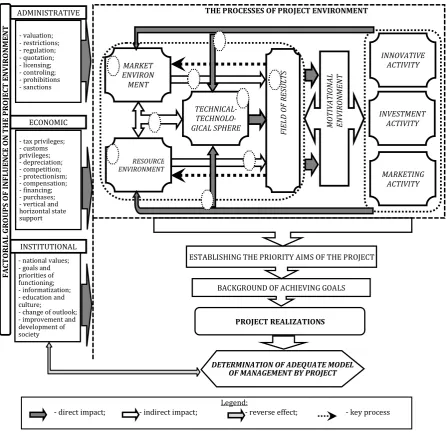
The proposed method for evaluating the design environment for choosing an adequate management model is based on the establishment of indicators for individual areas, among which the mechanism of interconnection has been determined (fig. 2).
Fig. 2 – Methodological approach to the evaluation of the project environment (developed by the author)
Since the indicators can be endogenous or exogenous, that is, to be variables or set in time, the application of this technique can be presented as an investigation of the corresponding stationary or non-stationary trajectories of
the system's motion. The method reflects the causal relationship and patterns of the course of project management processes through the dual influence of motivational mechanisms:
Legend:
- direct impact; - indirect impact; - reverse effect; - key process THE PROCESSES OF PROJECT ENVIRONMENT
TECHNICAL- TECHNOLO-GICAL SPHERE
INNOVATIVE ACTIVITY MARKET
ENVIRON MENT
M
O
TI
VA
TI
O
N
A
L
EN
VI
R
O
N
M
EN
T
INVESTMENT ACTIVITY
FIE
LD
O
F
RE
SU
LTS
RESOURCE ENVIRONMENT
MARKETING ACTIVITY
INSTITUTIONAL
FA
CT
O
R
IAL
G
R
O
UP
S
O
F
IN
FLUE
N
CE
O
N
T
H
E
P
R
O
JE
CT
E
N
V
IR
O
N
M
EN
T
ADMINISTRATIVE
ECONOMIC - valuation; - restrictions; - regulation; - quotation; - licensing; - controling; - prohibitions - sanctions
- national values; - goals and priorities of functioning; - informatization; - education and culture;
- change of outlook; - improvement and development of society - tax privileges; - customs privileges; - depreciation; - competition; - protectionism; - compensation; - financing; - purchases; - vertical and horizontal state support
ESTABLISHING THE PRIORITY AIMS OF THE PROJECT
E V A L U A T I O N O F P R O J E C T E N V I R O N M E N T S T A T E A N D P R O C E S S E S
DETERMINATION OF ADEQUATE MODEL OF MANAGEMENT BY PROJECT
BACKGROUND OF ACHIEVING GOALS
PROJECT REALIZATIONS B
D E
F
G H
I C
A
2
Volume 28, Number 4, 2018
64
- market environment, resource environment, technical and technological sphere, fields of results;
- innovative activity, investment activity, marketing (commercial activity).
Quantitative and qualitative characteristics and factors of the economic environment generate motivation for the development and implementation of the project, in different areas and areas of implementation. This leads to the activation of innovative research and development, their implementation through investment, dissemination and promotion of the results in the business through marketing. The last link can also have a reverse effect - identifying the needs and prospects for changing the economic environment (marketing), finding investment sources and making innovations. Nevertheless, the starting point is the state and specifics of individual environments and areas of project activity that form the dominant motivating factors. Therefore, in order to evaluate individual components of the project environment, as well as the influence of groups of factors on them, is proposed the usage of indicators:
- A – reproductive characteristic of economic development;
- B – priority of using resources from the point of view; - C – description of the type of development and the impact on the attraction of resources;
- D – structural-resource characteristics of the effect on the result;
- E – technological characteristic of influence on functionality;
- F – characteristic of development potential formation; - G – characteristic of progressiveness (innovation) of processes;
- H – productive and cost characteristic of functionality; - I – description of the resource-market situation.
Conclusions
The implementation of the proposed methodological approach will allow a preliminary assessment of the effectiveness of project management models, the analyzing of the prospects of influencing, the implementation of the project of the environment itself, and is reasonable to determine the most effective group of factors for a particular project. The application of the technique will increase the effectiveness of project management and let achieve qualitative changes in the process of social production. The next step in the development of this methodical apparatus is to definite a mathematical tools for interpreting the indicators as components of the project environment.
References
1. Дульзон, А. А., Ушаков, В. Я., & Чубик, П. С. (2012). Ресурсоэффективность основа устойчивого развития
цивилизации. Известия Томского политехнического
университета. Инжиниринг георесурсов, 320(6), 39-46. 2. Указ Президента України «Про Стратегію сталого розвитку
«Україна – 2020» від 12.01.2015 р. № 5/2015 [Електронний ресурс]. Верховна Рада України (офіційний веб-сайт): http://zakon2.rada.gov.ua/ laws/show/5.-2015.
3. Бредіхін, В. М., & Тарасенко, С. І. (2017). Управління проектами: проблеми та перспективи. Молодий вчений, 44.4, 9-11.
4. Прангишвили, И. В. (2000). Системный подход и общесистемные закономерности. М.: СИН-ТЕГ, 528. 5. Лупак, Р. Л., & Приходько, Л. О. (2011). Конкурентні переваги
як наслідок відтворення підприємством ресурсних можливостей. Науковий вісник: зб. наук.-техн. праць. – Львів: НЛТУУ, 20.6, 252-256.
6. Деренська, Я. М. (2017). Аналіз методологій управління проектами. Формування національної лікарської політики за умов впровадження медичного страхування: питання освіти, теорії та практики:матер. IV Всеукр. наук.-практ. конф., м. Харків, 15 березня 2017 р. Х. : Вид-во НФаУ, 58-65. 7. Гогунський, В. Д., Власенко, О. В., Васильєва, В. Ю., & Лебедь, В.
В. (2014). Розробка Марківської моделі управління міжнародними проектами. Шляхи реалізації кредитно-модульної системи організації навчального процесу і тестових форм контролю знань студентів: Наукові дослідження – основа навчального процесу у вищій школі, 8, 89-95.
8. Колеснікова, К. В., Бондар, В. І., Москалюк, А. Ю., & Яковенко, В. О. (2017). Розробка моделі ініціації проектів у формі ланцюга Маркова. Вісник НТУ «ХПІ». Серія: Стратегічне управління, управління портфелями, програмами та проектами, 2 (1224), 29-34.
9. Kerzner, H. (2018). Project management best practices: Achieving
global excellence. John Wiley & Sons, 4th ed., 754.
10. Galli, B. J. (2018). Project Management Maturity Models: An Overview of the Common Models and a Proposed Uniform Model. International Journal of Applied Logistics (IJAL), 8(2), 19-38. doi:10.4018/IJAL.2018070102.
11. Павліха, Н. В. & Марчук, Ю. В. (2014). Концептуальні засади управління проектами сталих просторових систем. Управління розвитком складних систем, 8, 74-79.
12. Hazır, Ö. (2015). A review of analytical models, approaches and decision support tools in project monitoring and control. International Journal of Project Management, 33(4), 808-815. 13. ul Musawir, A., Serra, C. E. M., Zwikael, O., & Ali, I. (2017). Project
governance, benefit management, and project success: Towards a framework for supporting organizational strategy implementation. International Journal of Project Management, 35(8), 1658-1672.
14. Полторацька, О. В. (2014). Теоретичні аспекти поняття ресурсозбереження. Теоретичні і практичні аспекти економіки та інтелектуальної власності: збірник наукових праць, 10.1, 239-244.
15. Апаршина, О. І. (2011). Методологічні підходи до трактування поняття «ресурсозбереження». Теоретичні і практичні аспекти економіки та інтелектуальної власності: збірник наукових праць, 1, 156-163.
16. Ляшенко, І. О. (2012). Особливості та перспективи розвитку ресурсозбереження в Україні [Електронний ресурс]. Ефективна економіка (електронне фахове видання), 11: http://www.economy.nayka.com.ua.
17. Kerzner, H. (2017). Project management metrics, KPIs, and dashboards: a guide to measuring and monitoring project performance. John Wiley & Sons, 435.
18. Markou, C., Koulinas, G. K., & Vavatsikos, A. P. (2017). Project resources scheduling and leveling using Multi-Attribute Decision Models: Models implementation and case study. Expert Systems with Applications, 77, 160-169.
19. Апарова, О. В. (2014). Теоретичні підходи до визначення поняття економічної політики. «Наука й економіка»: науково-теоретичний журнал Хмельницького економічного університету, 1(33), 218-224.
20. Жаліло, Я. А. (2009). Теорія та практика формування ефективної економічної стратегії держави: монографія. К., НІСД, 336.