Mobile Photography and Open, Networked Learning
Mark McGuire
Abstract
This paper explores the intersection of photography and education at a time when both are facing significant changes, partly as a result of the increasing use of digital, mobile devices. Mobile smart phones not only include increasingly good quality built-in cameras, they also enable the immediate editbuilt-ing and sharbuilt-ing of photos through social networks. This reduces the importance of the image as an artifact and increases the social aspect of photography. Similarly, Bring Your Own Device (BYOD) policies in schools and universities provide opportunities to reconsider how and where learning happens. Mobile digital devices allow students to explore, create, communicate and collaborate with their peers in the classroom and with others beyond. Following a review of how networked smart phones are used for photography and in education, I report on two innovative photography courses that make effective use of mobile devices and social networks to empower students and enhance the learning experience. Phonar (photography and narrative) is a hybrid course that is offered to fee-paying place-based students at the University of Coventry and is also open for others to access for free. Phonar Nation is a free, non-credit course designed for teenagers and delivered through a mobile Web app with the help of community mentors. I discuss how their use of mobile media and social networks, together with collaboration and open strategies, serve as examples of how mobile devices can be effectively used to serve creative practice and extend learning.
Introduction
In traditional film photography, a camera recorded light on a physical negative, which was used to make one or more paper prints, or on reversal film, which created a positive transparent slide that could be projected. Different filters, lenses and camera settings could be used to alter how the light was recorded. Darkroom techniques could also be used to emphasise or reduce selected aspects of the image when it was printed. However, nonprofessionals were more likely to use their camera’s automatic settings and take the exposed film to a shop for processing and printing. The resulting image was considered to be a record of objects as they existed in space, or a documentation of an event that had happened. During the mid to late 1990s, digital cameras began to replace analogue technology and physical film was replaced with electronic sensors. Digital files could be produced immediately, without the costs associated with film and processing. Although these images could be easily edited and copied on a computer, the new cameras looked much like the old ones, and they were used in very much the same way to create photographs that looked like they could have been taken with an analogue camera.
Digital cameras have now all but completely replaced analogue film cameras and, for many, smart phones and other personal, mobile, networked devices have replaced single purpose digital cameras. The integration of high quality cameras into smart devices that can also perform editing functions and serve as a social media platform is changing the practice of photography as a popular pursuit. A variety of apps make it easy to substantially alter an image immediately after it is captured, and Twitter, Instagram, Tumblr and other social networks allow anyone to share their images with a global audience and to follow, and learn from, the work of others. Mobile digital devices are also increasingly used in both formal and informal learning. Laptop computers, tablets and smart phones can be used in a classroom to write assignments, to read digital textbooks, and to submit work electronically, essentially utilising the new technology to support traditional approaches to education. Alternatively, students can leverage the capabilities of mobile technologies to actively participate in networked learning. In this way, learning, like photography, can become more open, social, connected and collaborative.
Smart Phones and Digital Photography
on the move. The smart phone camera is not simply an add on, but an important part of a technical and social ecosystem of digital tools, media and networks that now shape everyday experiences. It is more convenient to carry one pocket-sized phone that can integrate many tools and functions than it is to carry several different single purpose devices. It should not be surprising, therefore, that in May 2015 the five most popular cameras used by members of Flickr, the world’s largest online photo management and sharing site, were all smart phones (the top three were Apple iPhones) (Camera Finder, 2015).
The quality of the images that can be taken by smart phones is quickly improving. In January 2014, a professional photographer published a systematic comparison of images taken in bright sunlight and low interior light conditions with an iPhone 5S, a Nokia Lumina 1020, popular DSLRs dating from 2003 to 2012, and a high end Nikon DSLR using traditional print and transparency film (Holland, 2014). He was surprised to discover that the smart phones were able to capture images as good as the best US$2,000 DSLR cameras from about six years earlier. He notes that, aside from the inability to use additional lenses, faster processing could ameliorate the limitations of the smart phone cameras resulting from their small lens and image sensor. Since manufacturers are selling 13 times as many phones with cameras as dedicated cameras, he suggests that more money is likely to be invested in improving the technology of increasingly popular smart phones than cameras, which are declining in sales.
For many, the improved resolution and quality of digital images is not as important as the shared experiences that they enable. The networking capabilities of smart phones allow for creative roles and social practices that are not possible with a stand alone camera devoted to simply capturing images. As Joanna Zylinska writes in
Photomediations: An Open Book, today, we have all become “distributors, archivists and curators of the light traces immobilised on photo-sensitive surfaces”. She believes that low cost digital storage and the ease with which images and other data can be distributed through digital networks have “changed the very ontology of the photographic medium.” Photographs, she argues, now “function less as individual objects or as media content to be looked at and more as data flows to be dipped or cut into occasionally” (Zylinska, 2015).
of the place where an image has been captured can be shared only if it is uploaded from the spot where the photograph was taken. This argues for a photographic practice that takes place entirely in the field, using mobile technology, rather than one that is anchored in a studio or classroom.
In her research into Instagram, Histamatic and Camera 360, Elena Caoduro argues that the use of filters to create washed out colours, torn borders and scratches communicates the “illusory physicality of picture-taking” in the digital era. She suggests that the desire to participate in a culture of connectivity and become involved in the current nostalgia for analogue technology and images is central to the popularity of Instagram and similar photo sharing and editing apps. She refers to Robert Willim, who suggests that the main attraction of Instagram is the opportunity to take part “in a larger web of image sociality” (Caoduro, 2014). This is apparent with users who consistently create photos with a particular visual effect. For example, Sasha Bach has a preference for high contrast black and white urban images, which he posts to Instagram with hashtags like #bw, #iphoneography and #streetphotography, so they can be easily found by those who share his aesthetic preferences (Bach, 2015).
Filters are used not only to enhance images, but also to increase the likelihood that photos will be seen, favoured, and shared. In a quantitative study of 7.6 million photos shared on Flickr, researchers at Yahoo Labs discovered that casual photographers filter their photos to a greater degree than serious practitioners. They also found that filtered photos attracted 21% more views and 45% more comments than unfiltered images, and that filters that enhance the contrast, exposure and warmth increased engagement the most (Bakhshi, Ayman Shamma, Kennedy, & Gilbert, 2015). The demand for more, and customisable, filters has led to the appearance of tools like Mix, a free app that “enables you to transform your photos in almost every way imaginable on-the-go”. Mix, which is available for Android and IOS mobile devices, offers 200 filters and makes it easy for users to design their own “signature effects” and save them for future use. The question posed by the creators of Mix, “What does your photo editing say about you?,” underlines the role that personalised filters can play in self-expression (MIX by Camera360, 2015). Clearly, in networked photographic communities, how images are manipulated before sharing is just as important as the images that have been captured. Smart mobile devices and photo apps are more than a practical convenience; they are crucial to self-expression and social connection in contemporary photographic practice.
Mobile devices and education
innovative learning environments and increased collaboration between institutions are two long-term trends identified in the report. The need to improve digital literacy across the curriculum is highlighted as an important issue that the sector will need to address in order to support these ongoing changes (Johnson, Adams Becker, Estrada, & Freeman, 2015, p. 1).
The increasing use of personal mobile devices is a significant enabler of the shifts that are discussed in the NMC Horizon Report. It notes that businesses found that they realised significant productivity gains when they allowed employees to connect their personal devices to the company network, and that the education sector was learning from this experience. Although productivity is an important consideration, in both business and education, BYOD policies are gaining traction because they fit with contemporary lifestyles and preferences for accessing information and for communicating and sharing with others. The report cites studies that show that students own an average of 2.7 devices and that, worldwide, college students spend an average of 3.5 hours a day on their mobile phones. A study at California State University found that students sought support from their mobile devices every six minutes while engaging in educational activities (Johnson et al., 2015, p. 36). In addition to the portable, mobile nature of these devices, personalised content, tools and apps all allow students to maximise their enjoyment and comfort level as well as their efficiency. These readily available, personal devices also enable students to easily and quickly connect to, and collaborate with, others.
Changes in the social activities and learning experiences of younger students is likely to have a significant impact on the capabilities and expectations that these students will have as they enter higher education in the years to come. The authors of the
NMC Horizon Report: 2014 K-12 Edition identify the elements of a “Creative Classroom Framework” that characterises innovative pedagogical practices. These include learning that involves exploring, creating, playing, personalisation and peer to peer collaboration. The use of social networks, learning events, and activities that incorporate networking with the world outside the classroom are listed as part of a more connected approach to learning (Johnson, Adams Becker, Estrada, & Freeman, 2014, p. 2). The authors note that, in 2014, the number of mobile-cellular subscriptions was expected to approach seven billion — close to the number of people on earth. More than half of the respondents to a recent survey of K-12 school districts in the USA and UK reported that personal, mobile digital devices were integrated into classroom experiences. In addition, 56% of school districts in the USA had already implemented a Bring Your Own Device programme (Johnson et al., 2014, p. 34).
mobile technologies also offers opportunities to transform education for disadvantaged youth who live in isolated, underserved locations or who lack the financial means to access expensive formal courses. The authors are cautious about the promises and limits of MOOCS (Massive Open Online Courses), citing poor completion rates and an outdated pedagogy that is reliant on information transmission, peer assessment and the computer marking of assignments. However, the image of traditional higher education as an experience for people between 18 and 22 years old on a physical campus centred on classrooms and lecturers is rapidly changing in response to societal shifts and technological developments (iBid., pp. 51-52). Contributing to this change is the dramatic increase in the availability of Open Educational Resources (OER), which UNESCO defines as “teaching, learning or research materials that are in the public domain or released with an intellectual property license that allows for free use, adaptation, and distribution” (UNESCO: Open Educational Resources, 2015).
The use of smart mobile devices and social networks is rapidly transforming photography into a practice that places increasing importance on connecting and sharing. As these same devices and networks become more integrated into teaching and learning, traditional classroom and lecture-based delivery could give way to more open, flexible and networked approaches. By examining early initiatives that combine photography and learning, we might gain some insights into what is possible and desirable. Phonar, a blended, open, university level course that makes extensive use of social networks, and Phonar Nation, a free, open course offered to teenagers through mobile media, provide examples to learn from as we look ahead.
Phonar
Phonar (photography and narrative) is a good example of a course that uses blended strategies to enhance the learning experience for place-based fee-paying students, while enabling others to look in and participate for free from their computer or mobile device. The ten week undergraduate course has been offered at Coventry University to third year students since 2009. Jonathan Worth, the course designer and coordinator, was trained as a photographer, and he reports that he was unsure about how to teach photography at a time when teaching and photography were undergoing a paradigm shift. “So”, he says, “I asked everyone else ‘how can I teach this?’” (Worth, 2014b). Using blogging, social media, and assistance over the years from Jonathan Shaw, Matt Johnston, Chantel Riekel and expert guests, Worth created a course that has attracted significant attention and recognition. In “The Guardian’s University guide 2015”, Coventry University was ranked number one in the UK in the league table for film production and photography (University guide 2015, 2014). It is the newest programme on the Guardian’s list, and it is also the only one that offers open courses.
received on a mobile device. As well as being able to create images and curate experiences, he believes that successful visual storytellers need to be publishers in the sense that they know how to reach out and connect with people directly. Through “rapid fire production and thinking through doing”, students create, share and critique audio, video and still image projects using an iterative process. Although the initial focus of the course is photography, it is also about digital literacy and visual fluency in an increasingly nonlinear, decentralised and networked media environment (Worth, 2014d). Rather than a MOOC, Worth describes Phonar as an OUCH (Open Undergraduate Class Hybrid), a university course that increases the value that students receive from the educational experience by introducing them to professional networks and leveraging the expertise of others beyond the campus (Worth, 2012).
Because the course is archived on a public blog (http://phonar.org/), noncredit participants can also access it. By the end of the 2011, the number of place-based, fee-paying students had grown to 40, but the number of individuals who were engaging with Phonar from a distance for free had increased to more than 30,000 (Bivens, 2014). In 2012, the availability of a free #Phonar app made it easy for mobile participants to access course videos, audio recordings and Twitter discussions while on the move. As an example of a contemporary “trans-media” course, the app was designed to support “multi-media/multi-platform practices” and “non-linear, and vicariously dynamic narrative approaches to story telling” (iTunes Preview: #Phonar, 2012). The strategic use of hashtags (the course is often referred to as #phonar) makes it possible to follow and contribute to ongoing discussions, and to share images relating to course tasks on social media, especially Twitter. The students use their smart phones to access Twitter during class, sharing their comments, links and embedded content publically using the #phonar hashtag. Others are invited to join in on the conversation as it unfolds from wherever they are. The live presentations are video recorded and published on the course website, and the Twitter messages associated with each session are archived using Storify, providing a public record of the event (Worth, 2015e). A visualisation of #phonar Twitter messages shows the class as a tight network of students clustered around Jonathan Worth and his colleagues, surrounded by a looser and much larger distribution of individuals participating from a distance (Worth, 2015d).
In a 2011 article about Phonar in WIRED magazine, Professor David Campbell, a member of the Centre for Advanced Photography Studies at Durham University, commented that “[i]n the UK, as a result of the Conservative-led government’s insistence that students are consumers, universities are under massive pressure.” He goes on to explain:
That ideological program is pushing an out-moded model of learning, where more time in the classroom listening to a teacher’s broadcast is the goal. Thinking creatively about teaching demands an emphasis on engagement. Leveraging social media technologies to extend learning beyond the classroom is central to engagement. (Brook, 2011)
The use of smart mobile devices both inside and outside of the university setting enables students to participate in discussions and to share work within the formal confines of the class, and to extend the sharing and continue those conversations with friends and others across global social media networks. This greatly enhanced visibility, and the opportunity to get recognition and feedback from a wide variety of people, including experts off campus, is a strategy designed to increase the level of engagement with the subject matter and with the course.
As well as learning what it means to be a photographer in the age of digital networked media, students gain experience working in the open and learn to use and create Open Educational Resources. The “Tasks” section on the Phonar website contains links to the weekly course projects and student outcomes. In the second creative workshop in 2014, “Alienated Sensory Mashup,” students were asked to explore and document the visual and aural environment outside the classroom with their mobile phones. They then uploaded their images to the Phonar group in Flickr and their audio recordings to the Phonar group in Soundcloud, using a Creative Commons licence so that others could legally use and alter the files. The following week, the students remixed their work with the work of others, creating mash-ups that they then shared and discussed in personal blog posts that were linked to the Phonar workshop page (Worth, 2014c). In this way, course work and related commentary is archived on the Phonar website and also distributed across the web to maximise exposure. Since, as with Phonar, free mobile apps are available for Soundcloud and Flickr, these projects can be created and viewed on mobile devices, further increasing access and extending reach.
Given the importance of sharing photos through social networks, the medium and the message are closely intertwined. Placing mobile digital devices at the centre of the learning experience is a natural development, since the same device that is used for taking and sharing photographic images can also be used for engaging in networked communication about those images. It is not surprising, then, that the next step for Jonathan Worth was to experiment with a completely mobile photography course.
Phonar Nation
Phonar Nation, a free, open, five week photography course intended for 12 to 18 year olds, was offered twice during the North American summer in 2014 and is set to run again in the summer of 2015. With support from The MacArthur Foundation, Worth presented the noncredit course as part of the Cities of Learning initiative in association with the Connected Learning Alliance, the Digital Youth Network, and the Badge Alliance. Beginning on June 23, the first iteration of the course attracted participants from the USA, Spain, Ireland, New Zealand and elsewhere. The author followed the course while his 12 year old son completed it from Dunedin, New Zealand. Promoted as “the biggest youth photography class in history,” the website estimates that almost 300,000 youth took the class in the summer of 2014 (Worth, 2015b).
Launched in Chicago in 2013 and later joined by several other USA municipalities, Cities of Learning works with libraries, parks, schools, community centres and other partners to turn communities into integrated networks of informal learning opportunities for young people. Central to this initiative is the notion of Connected Learning, an approach that believes that young people are better able to imagine a productive future for themselves when they can connect extracurricular interests to formal learning, have supportive social networks and mentors, and are able to create things in the real world (Cities of Learning, 2015). The Digital Youth Network (DYN) was established in Chicago in 2006 to assist underprivileged urban youth in the use of digital technologies to support their formal educational and general social development. DYN works with researchers, educators and organisations in helping youth to improve their digital literacy, which they believe is a key that can unlock the creative, technical and analytic skills that are required in order to succeed in learning and in contemporary society (Digital Youth Network, 2014). With its focus on enabling youth in the community to use their mobile phones to engage in social networks and learn practical photographic skills, Phonar Nation is well aligned with the aims and objectives of the Cities of Learning and DYN.
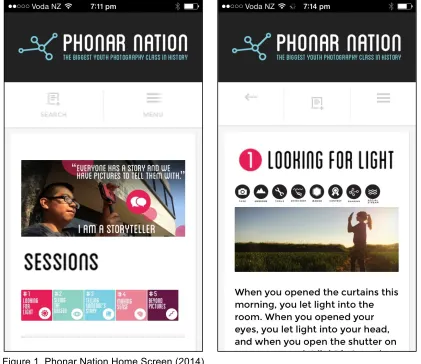
Although the Phonar Nation site (http://phonarnation.org/) works well on any computer, it was designed with a scalable interface so that it could be viewed and navigated on smart phones and tablets using a Wi-Fi or cellular data connection. The first time the site is accessed on a mobile device, the user is prompted to download a Web app so that it can be launched without the need to open a browser. The top of the home screen (Figure 1.) features banner photographs of the young participants, celebrating their central role as storytellers, artists, and publishers. Individuals are invited to participate in Phonar Nation through six social media sites where the course has an active presence: Twitter, Facebook, Google +, Flickr, Instagram and YouTube. Once they are uploaded to these sites, images that include the #PhonarNation, #NationLooking4Light or other course related hashtags automatically appear on the Phonar Nation site, which features a constantly updated gallery of submitted work. Colour-coded icons on the home page link to the main session topics for the five week course: Looking for Light, Seeing the Unseen, Telling Someone’s Story, Making Sense, and Beyond Pictures (Worth, 2015a).
Figure 1. Phonar Nation Home Screen (2014) Figure 2. Phonar Nation Session 1 (2014)
reflections, and so on. The “Task” for the week is to document as many different kinds of light as possible, including soft, hard, shafts, cold, night, bounced, multiple sources, etc. Most of the images by various photographers (including Jonathan Worth) that are used as examples are sourced from (and link back to) Flickr and are covered by a Creative Commons licence. The “Awesome” step challenges participants to see how many different sources of light they can include in a single image, which they are then asked to share using the #LevelAwesome hashtag. The “Tools” step includes a video by artist and photographer Todd Hido about using long exposures to combine artificial and natural light. This links to a set of related videos in Vimeo and, from there, to the Forward Thinking Museum, a contemporary photography website. As with the other five sessions, the “Going Deep” step branches into three subsessions, each with the same seven steps as the main sessions. These effectively add another 15 supported tasks for students who are keen to explore the five main topics further. The “Badge” step invites individuals to create an account on persuitery.com, where they can earn digital badges for their work, see what others are doing and win weekly prizes. The “Sharing” step asks participants to post their images to Flickr or Instagram, and the “Social Stream” step provides the hashtag that should be added to the image caption (in this case, #NationLooking4Light) to ensure that it will be displayed with other contributions at the bottom of the session screen (Worth, 2015c).
The smart, considered use hashtags enables Phonar Nation content to be distributed through different social media streams and automatically aggregated on the course website. The course is also scattered across many different physical locations. Through the Book-in-a-Box project, 10 libraries in five cities across America received a selection of 10 photo books (one each week) and study guides to promote Phonar Nation. Under the direction of library mentors, teenagers were encouraged to share their comments in a travelling journal, upload images using the #NationBookBox hashtag, and become involved in the course (Worth, 2014a). Because the session prompts, Creative Commons licensed resources and participant contributions are all delivered through the mobile Web app, librarians, teachers and other mentors could assemble a group of individuals anywhere, anytime and make use of all or part of the course to create their own variant of Phonar Nation, remixing the resources and adding their own projects and associated hashtags. Schools with teachers and students who are participating in Phonar Nation in 2015 include St. Andrew’s Church of England Primary School in Lincolnshire, UK and Gems World Academy in Chicago. These two schools are collaborating through Phonar Nation, beginning with an exchange of “message in a bottle self portraits” (Green, 2015; Looking for Light, 2015). Collaborations between institutions, teachers, mentors, and participants are encouraged by Worth, who believes that “open” does not simple mean “openly accessible”, but also “open to improvement” and “open to being shared” (Worth, 2013). As with Phonar, all of the resources and contributions for Phonar Nation continue to remain accessible online, and images in response to the various tasks continue to be uploaded months after the summer courses have concluded.
Mobile devices are increasingly used to access and produce digital media and to share work over social networks. Smart phones are powerful computing devices that typically incorporate a camera, a touch screen, Internet access, and a large variety of apps for specific tasks. The fast take-up of these devices for work, play and education has affected some activities more than others. The technology is particularly suited to the practice and the study of photography. The same smart phone that can be used to record, edit, and share images can also be used to consume course content and participate actively in a blended or online class. It is not surprising, then, that it is at this intersection of creative activity and learning where we find innovative experiments that demonstrate what is now possible.
References
About Phonar Nation. (2014). Retrieved September 25, 2014, from http://phonarnation.org/about/
Arthur, C. (2015, April 13). Camera-makers focus on adapting to smartphones’ market surge. The Guardian. Retrieved June 16, 2015, from
http://www.theguardian.com/technology/2015/apr/13/cameras-slrs-dslr-overtaken-by-smartphones-charles-arthur
Bach, S. (2015, June 2). Instagram: a_t_8. Retrieved June 2, 2015, from https://instagram.com/a_t_8/
Bakhshi, S., Ayman Shamma, D., Kennedy, L., & Gilbert, E. (2015, April 21). Why we filter our photos and how it impacts engagement. In Proceedings of the 9th International Aaai Conference On Web And Social Media, Oxford University. Retrieved from
http://www.aaai.org/ocs/index.php/ICWSM/ICWSM15/paper/view/10573
Berry, M. (2014). Re-Imagining place with filters: More than meets the eye. Journal of Creative Technologies, (Special Issue 1: Selected Proceedings from 2013 MINA Conference). Retrieved from https://ctechjournal.aut.ac.nz/paper/re-imagining-place-filters-meets-eye/
Bivens, M. (2014, July 25). Phonar Nation — An educator innovator Webinar. Retrieved from http://educatorinnovator.org/webinars/phonar-nation-an-educator-innovator-webinar/
Brook, P. (2011, August 11). Free online class shakes up photo education. WIRED.
Retrieved from http://www.wired.com/rawfile/2011/08/free-online-class-shakes-up-photo-education/
Camera Finder. (2015). Retrieved May 29, 2015, from https://www.flickr.com/cameras
Caoduro, E. (2014). Photo filter apps: Understanding analogue nostalgia in the new media ecology. Networking Knowledge, 7(2). Retrieved from
http://ojs.meccsa.org.uk/index.php/netknow/article/view/338
Cities of Learning. (2015). Retrieved June 9, 2015, from http://citiesoflearning.org/
Digital Youth Network. (2014). Retrieved June 9, 2015, from http://digitalyouthnetwork.org/
Green, K. (2015, March 23). St Andrews primary take #PhonarNation by storm. [Web log post]. Retrieved from http://kategreen28.org/st-andrews-primary-take-phonarnation-by-storm
2015, from http://connect.dpreview.com/post/5533410947/smartphones-versus-dslr-versus-film
iTunes Preview: #Phonar. (2012, November 20). Retrieved October 6, 2014, from
https://itunes.apple.com/nz/app/phonar/id479530911?mt=8
Jarvis, C. (2009). The best camera is the one that’s with you. Berkeley, CA: New Riders.
Johnson, L., Adams Becker, S., Estrada, V., & Freeman, A. (2014). NMC Horizon Report: 2014 K-12 Edition. Austin, Texas: The New Media Consortium. Retrieved from http://www.nmc.org/publication/nmc-horizon-report-2014-k-12-edition/
Johnson, L., Adams Becker, S., Estrada, V., & Freeman, A. (2015). NMC Horizon Report: 2015 Higher Education Edition. Austin, Texas: The New Media Consortium. Retrieved from http://www.nmc.org/publication/nmc-horizon-report-2015-higher-education-edition/
Looking for Light. (2015, March 4). St Andrew’s Woodall Spa Phonar Nation project
[Web log post]. Retrieved from
https://standrewsphonarnation.wordpress.com/2015/03/04/looking-for-light-2/
MIX by Camera360 – Design your own photo filter. (2015, May 22). iTunes Preview.
Retrieved June 2, 2015, from https://itunes.apple.com/us/app/mix-by-camera360-design-your/id913947918?mt=8
Phonar: FAQs. (2014, January). Retrieved October 5, 2014, from http://phonar.org/faqs/
Rethinking Education: Towards a global common good? (2015). Paris, France: UNESCO. Retrieved from
http://unesdoc.unesco.org/images/0023/002325/232555e.pdf
Rheingold, H. (2013). Phonar: Openly networked digital storytelling. Connected Learning Alliance. Retrieved June 8, 2015, from
http://clalliance.org/whatsnew-main/phonar-case-study/
UNESCO: Open Educational Resources. (2015). UNESCO Communication and Information. Retrieved June 8, 2015, from
http://www.unesco.org/new/en/communication-and-information/access-to-knowledge/open-educational-resources/
University guide 2015: League table for film production and photography. (2014). Retrieved September 23, 2014, from
http://www.theguardian.com/education/ng-interactive/2014/jun/03/university-guide-2015-league-table-for-film-production-and-photography
Worth, J. (2012, November 22). OUCH not MOOC. New Photographics. [Web log post]. Retrieved June 8, 2015, from
Worth, J. (2013, October 1). Open and connected teaching and learning in a
paragraph. New Photographics. [Web log post]. Retrieved October 23, 2014, from http://jonathan-worth.blogspot.co.nz/2013/10/open-and-connected-teaching-and.html
Worth, J. (2014a). Book-in-a-Box FAQ. Retrieved June 14, 2015, from http://phonarnation.org/book-in-a-box-faq/
Worth, J. (2014b, September 9). Leveraging your “Why?”, in answer to Mike Wesch. Phonar. Retrieved October 20, 2014, from
http://phonar.org/2014/09/leveraging-you-why-in-answer-to-mike-wesch/
Worth, J. (2014c, October 1). Phonar: Creative Workshop 2. [Web log post].
Retrieved June 8, 2015, from http://phonar.org/2014/10/creative-workshop-2-alienated-sensory-mashup/
Worth, J. (2014d, September 8). Why Phonar? Lecture 1. Phonar. [Web log post]. Retrieved October 20, 2014, from http://phonar.org/2014/09/why-phonar-lecture-1/
Worth, J. (2015a, June 14). Phonar Nation. Retrieved June 14, 2015, from http://phonarnation.org/
Worth, J. (2015b). Phonar Nation 2014. Retrieved June 14, 2015, from http://phonarnation.org/phonar-nation-2014/
Worth, J. (2015c, April). Phonar Nation: 1 Looking for Light. Retrieved June 14, 2015, from http://phonarnation.org/session-1-looking-for-light/
Worth, J. (2015d). #phonar Twittersphere. [Web log post]. Retrieved June 8, 2015, from http://phonar.org/twitter-visualisation/
Worth, J. (2015e). Storify: “#phonar” in tweets, images, videos and links. Retrieved June 8, 2015, from https://storify.com/search?q=%23phonar - stories
Zylinska, J. (2015). Photomediations: An introduction. In K. Kuc, J. Shar, R. Varney, M. Wamposzyc, & J. Zylinska (Eds.), Photomediations: An Open Book. Retrieved from http://photomediationsopenbook.net/data/index.html - ch1.
List of Figures
Figure 1. Phonar Nation Home Screen. (2014). Retrieved from http://phonarnation.org/ CC-BY Jonathan Worth. Used with permission. ... 10
About the Author
Dr Mark McGuire is a Senior Lecturer in Design in the Department of Applied Sciences at the University of Otago, where he has worked as a Design academic since 1994. For 10 years prior to that, he operated Mediatrix Inc., a design and consulting company based in Toronto. He has a BA (Guelph), a Bachelor of Environmental Studies (Pre-Professional Architecture, Waterloo), a Masters in Information Science (Otago) and a PhD in Media Studies (Auckland). He teaches Communication Design, Experience Design, Design for Innovation, and Open Network Design. Dr McGuire’s research focuses on the interrelationship between social dynamics, interface design, digital technology, private enterprise, and education. This work covers two main themes. The first is a user-centred approach to the design and use of communication media in both physical and screen-based forms, with an emphasis on the transition from physical to digital artefacts. The second is a human-centred investigation into the development and use of digital networks for engaging in social activity, work, and education. More recently, he has been researching developments in higher education and design arising from “open” strategies and processes enabled by electronic media, digital networks and the use of open licences.
Contact:
[email protected]Personal Blog: http://markmcguire.net/
Twitter: https://twitter.com/mark_mcguire
Instagram: https://instagram.com/mark_mcguire/
The Journal of Creative Technologies (JCT) https://ctechjournal.aut.ac.nz
ISSN: 2230-2115
Colab, Auckland University of Technology, New Zealand Creative Commons Attribution 4.0 International License (CC-BY)
All articles published in The Journal of Creative Technologies (JCT) from Issue 4 onwards are be licensed under a Creative Commons Attribution 4.0 International License (CC-BY). The copyright of the material remains with the author(s), and third-parties are granted permission to use, shared, and adapted the material, provided the original work is appropriately attributed.
The Journal of Creative Technologies (JCT) is an online, open access, peer-reviewed journal for the publication of research and innovation about new technologies, creative practices, and critical theories. The journal aims to explore applied, methodological and theoretical perspectives on emergent technological platforms and strategies through thematically focused issues.