
Available Online at www.ijpret.com 300
INTERNATIONAL JOURNAL OF PURE AND
APPLIED RESEARCH IN ENGINEERING AND
TECHNOLOGY
A PATH FOR HORIZING YOUR INNOVATIVE WORK
ZIGBEE TECHNOLOGY IN COMMUNICATION AND NETWORKING
ROHINI M. WARHEKAR, RENUKA S DESHPANDE
Dept. of Computer Science & Engineering, Prof. Ram Meghe Institute of Tech. & Research, Amravati, INDIA
Accepted Date: 15/03/2016; Published Date: 01/05/2016
\
Abstract:ZigBee is an IEEE 802.15.4 standard. It deals with communication in business and consumer devices. ZigBee consume low power so batteries last forever. The ZigBee standard provides network, security, and application support services operating on top of the IEEE 802.15.4 Medium Access Control (MAC) and Physical Layer wireless standard. It employs a group of technologies to enable scalable, self-organizing, self-healing networks that can manage various data cost, low-power, wireless mesh networking standard. The low cost allows the technology to be widely deployed in wireless control and monitoring applications, the low power-usage allows longer life with smaller batteries, and the mesh networking which promises high reliability and larger range. ZigBee has-been developed to meet the growing demand for capable wireless networking between numerous low power devices. In industry ZigBee is being used for next generation automated manufacturing, with small transmitters in every device on the floor, allowing for communication between devices to a central computer. This new level of communication permits finely-tuned remote monitoring and manipulation.
Keywords: Zigbee, Communication, Networking
Corresponding Author: MS. ROHINI M. WARHEKAR
Access Online On:
www.ijpret.com
How to Cite This Article:
Rohini M. Warhekar, IJPRET, 2016; Volume 4 (9): 300-308
Available Online at www.ijpret.com 301 INTRODUCTION
Zigbee is type of low cost, low power and wireless technology which is used for the different purposes at ultra-low power is known as Zig bee technology. Low power radios on the basis of standard personal wireless networking are used by a protocol to enhance the technology. It offers excellent wireless control path network. It was not proposed or designed for the excellent or high speed data transfer rate applications. But it was designed for working on excellent long battery timings at low cost and also at ultra-low power consumption. It is an ideal technology which operates at low power and low cost and used for wireless monitoring and control. The name refers to the waggle dance of honey bees after their return to the beehive. ZigBee is a specification for a suite of high level communication protocols using tiny, low-power digital radios based on an IEEE 802 standard for personal area networks. ZigBee has a defined rate of 250 Kbit/s best suited for periodic or irregular data or a single signal transmission from a sensor or input device. ZigBee based traffic management system have also been implemented [1] .there are a multitude of standards that address mid to high data rates for voice, PC LANs, video, etc. However, up till now there hasn’t been a wireless network standard that meets the unique needs of sensors and control devices. Sensors and controls don’t need high bandwidth but they do need low latency and very low energy consumption for long battery lives and for large device arrays [2]. There are a multitude of proprietary wireless systems manufactured today to solve a multitude of problems that also don’t require high data rates but do require low cost and very low current drain.
1. USES OF ZIGBEE:
*Small lightning and advanced temperature control
*Power sensors and filter detector.
*Environmental and energy management.
*Energy monitoring.
*Mobile monitoring and security.[3]
II.ZIBBEE NETWORKING DEVICES:
Available Online at www.ijpret.com 302 addresses to reduce packet size, and work in either of two addressing modes – star and peer-to-peer.
1. The ZigBee coordinator node: There is one, and only one, ZigBee coordinator in each network to act as the router to other networks, and can be likened to the root of a (network) tree. It is designed to store information about the network.
2. The full function device FFD: The FFD is an intermediary router transmitting data from other devices. It needs lesser memory than the ZigBee coordinator node, and entails lesser manufacturing costs. It can operate in all topologies and can act as a coordinator.
3. The reduced function device RFD: This device is just capable of talking in the network; it cannot relay data from other devices. Requiring even less memory, (no flash, very little ROM and RAM), an RFD will thus be cheaper than an FFD. This device talks only to a network coordinator and can be implemented very simply in star topology.[4]
III.ZIGBEE PROTOCOL STACK:
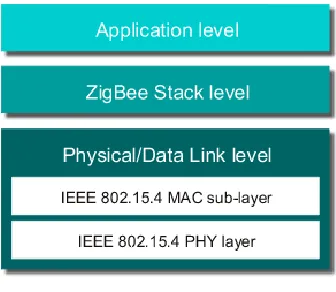
1Application Level: The Application level contains the applications that run on the network node. These give the device its functionality - essentially an application converts input into digital data, and/or converts digital data into output. A single node may run several applications - for example, an environmental sensor may contain separate applications to measure temperature, humidity and atmospheric pressure.
Figure 1: Zigbee protocol stack
Available Online at www.ijpret.com 303 3. Physical/Data Link Level: The Physical/Data Link level is concerned with low-level network operation such as addressing and message transmission/reception. It is based on the IEEE 802.15.4 standard and comprises the following two layers:MAC (Media Access Control) sub-layer and PHY (Physical) sub-layer
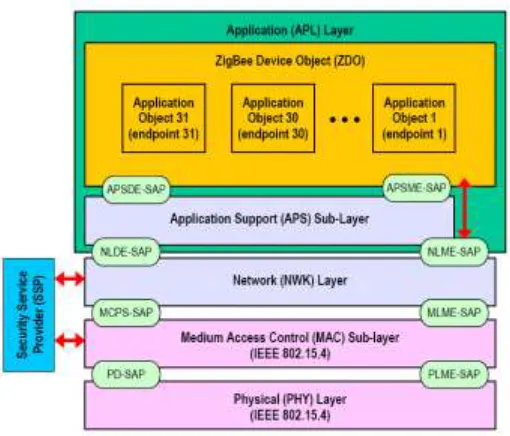
4. Application Framework: The Application Framework (AF) contains the application objects and facilitates interaction between the applications and the APS layer. An application object interacts with the APS layer through an interface known as a Service Access Point (SAP).
5. Service Access Points: A Service Access Point (SAP) implements a set of operations to pass information and commands between layers. There are usually four types of operation implemented by a SAP:
1. Request: Typically, a layer using the services of another layer generates a Request to the lower layer.
2. Confirm: In general, the lower layer responds with a Confirm, which indicates whether it has accepted or rejected the request. A rejection could occur if the Request is invalid or the layer does not implement the operation concerned (the operation could be defined as optional).
3. Response: Normally, Requests result in some sort of Response from the lower layer. This may be a simple status message indicating that the Request has been performed, or may contain further information that the Request has asked for. Responses can be immediate or delayed:
Synchronous Response: Responses may be generated immediately after the Request has been issued - for example, if the information or command is available on the local node.
Asynchronous Response: A Request may require messages to be sent over the network to a remote node, in which case there will be a delay between issuing the Request and the arrival of the Response.
The SAP mechanism allows both types of Response to be handled and delivered to the higher layer.
Available Online at www.ijpret.com 304 IV. FORMING A ZIGBEE NETWORK AND ARCHITECTURE:
The Co-ordinator is responsible for starting a ZigBee network. Network initialization involves the following steps:
1. Search for a Radio Channel-The Co-ordinator first searches for a suitable radio channel (usually the one which has least activity). This search can be limited to those channels that are known to be usable - for example, by avoiding frequencies in which it is known that a wireless LAN is operating[6], [7].
2. Assign PAN ID- The Co-ordinator starts the network, assigning a PAN ID (Personal Area Network identifier) to the network. The PAN ID can be pre-determined, or can be obtained dynamically by detecting other networks operating in the same frequency channel and choosing a PAN ID that does not conflict with theirs.
At this stage, the Co-ordinator also assigns a network (short) address to itself. Usually, this is the address 0x0000.
3. Start the Network- The ordinator then finishes configuring itself and starts itself in Co-ordinator mode. It is then ready to respond to queries from other devices that wish to join the network.
Available Online at www.ijpret.com 305 1. V.CHARECTERISTICS AND FEATURES OF ZIGBEE TECHNOLOGY:
There are different features of Zigbee technology on the basis of which we can understand characteristics and features of zigbee.1.In this technology maximum data rates allowed for different frequency bands but in some cases this bands are fixed.2.High throughput and low latency for low duty cycle applications that are nearly to 0.1%.3.ZigBee technology used carrier sense multiple for channel access and also avoid the collision during the access.4.It is type of technology which requires ultra-low power consumption with an excellent battery life ranging from month to year.5.ZigBee network can be achievable by two different means i.e continuous network connection: these connections are slow but they drain the battery surely. Second is intermittent connection: these are slower than the previous one but they can also drain the battery.
VI.ADVANTAGES OF ZIGBEE
1. Rapid innovation
2. Extremely Low cost
3. Open standards enable markets
4. Easy to deploy
5. Excellent performance in environments with low signal-to-noise ratio
6. Appropriate range of operation (30 - 100 meters)
7. Appropriate and reliable data transfer, bit rate : 250kbps at 2.4 GHz
8. Very low power consumption
9. Secure data transfer
10.Zigbee protocol needs less than 64 kb of ROM and 2-32 kb of RAM
11.Zigbee can bee implemented with any type of microcontroller .[5]
VII.ZIGBEE VS BLUETOOTH
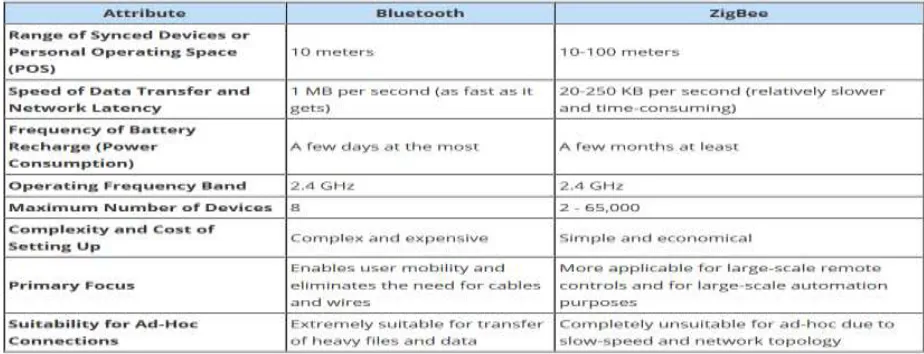
Available Online at www.ijpret.com 306 a multitude of differences between the two wireless technologies for ‘personal area networks’ both application and technical. As will be explained in the article, both technologies aim towards a different set of devices and applications and different means of designing for those applications.
Whereas Bluetooth is geared towards user mobility and eliminating cabling between short-distanced devices, Zigbee is more oriented towards remote control and automation. Bluetooth aims at doing away with the cabling between devices that are in close proximity with each other for example between mobile phone and a laptop or desktop or a printer and a PC. Users with Bluetooth supported handsets are able to effortlessly exchange documents, calendar appointments and other files.
Zigbee supports protocols for defining a type of sensor network that controls applications used in residential and commercial settings such as air conditioning, heating and lighting. It harmonizes the application software layers specified by the Zigbee alliance and the IEEE 802.15 that defines the physical and MAC protocol layers. Zigbee is anticipated to be able to eliminate electrical cabling in houses thereby allowing the freedom of wireless light switches.[8]
Figure 3: Difference between Zigbee and Bluetooth
VIII.APPLICATIONS:
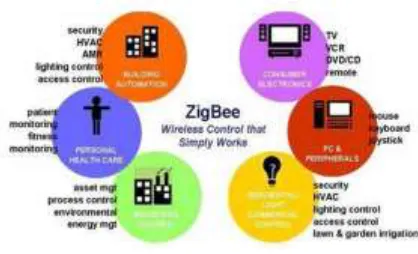
Available Online at www.ijpret.com 307 1. Building Automation: It provides security, HVAC (Heating, Ventilation, and Air conditioning) refers to technology of indoor or automotive environmental comfort. Now HVAC is widely used in the buses and cabs. It is also used in lighting control, access control and Adaptive coding. To provide greater information and control of energy usage, provide customers with better service and more choice, better manage resources, and help to reduce environmental impact.
2. Energy Management and Efficiency: To provide greater information and control of energy usage, provide customers with better service and more choice, better manage resources, and help to reduce environmental impact
3. Consumer Electronics: To provide more flexible management of lighting, heating, cooling, security and home entertainment systems such as TV, DVD’s, home theatre.
4. PC and Peripherals: To integrate the system to perform different types of tasks, we have input/output devices as well as high speed processors, storage media and many other devices such as joystick, OMR.
Figure 4: Applications of ZigBee
5. Home Control: To integrate the lighting, heating, cooling and security or we can say that it is responsible for controlling the home.
6. Telecommunication Service: It covers information services, Mobile Commerce, also known as M-Commerce or mCommerce, is the ability to conduct commerce using a mobile device, such as a mobile phone, Personal Digital Assistant (PDA), smartphone, or other emerging mobile equipment such as dashtop mobile devices.
Available Online at www.ijpret.com 308 8. Personal Health Care: ZigBee Alliance provided many devices which helps for the fitness of patients such as personal wellness monitoring, Electrocardiograph (ECG), chronic disease monitoring, glucose meter and pulse oximeter.
IX. CONCLUSION:
Zigbee and the underlying IEEE 802.15.4 standard promise a low-cost, low-power and reliable wireless network technology for a wide range of control and monitoring applications within the private sphere and industrial environment. It is likely that ZigBee will increasingly play an vital role in the future of computer and communication technology. In terms of protocol stack size, ZigBee's 32 KB is about one third of the stack size necessary in other wireless technologies.. The ZigBee Alliance targets applications across consumer, commercial, industrial and government markets worldwide. ZigBee technology is designed to best suit these applications, for the reason that it enables lesser costs of development and very swift market adoption.
X. REFERENCES:
1. ZigBee Alliance, ZigBee Specification. Version 1.0 ZigBee Document 053474r06, December 14th, 2004.
2. William Stalling, ―Wireless Communication and Networks‖, Fourth Edition, Pearson Publication Limited, 2004, Pp 39-118.
3. www.wifinotes.com/what-is-zigbee-wireless-technology.html
4. by gc on Mon, 02/18/2013www.tutorial-reports.com/wireless/zigbee/zigbee-characterstics.php
5. electronic-setup.blogspot.com/2010/12/advantages-of-zigbee.html
6. Freescale Semiconductor, ZigBee Implementer’s Guide; Document Number: F8W-2004-0007, May 23, 2005.
7. Weiser, M. (1991). The Computer for the 21st Century. Scientific America, September 1991, 94-104. Journal of Theoretical and Applied Information Technology © 2005 - 2009 JATIT.
![5,12 Dimethylpyrazino[1,2 a:4,5 a′]dibenzimidazole 5,12 diium dichloride dihydrate](data:image/gif;base64,R0lGODlhAQABAIAAAP///wAAACH5BAEAAAAALAAAAAABAAEAAAICRAEAOw==)