The Journal of Science Policy & Governance
POLICY ANALYSIS:
CLEANING UP THE CAPITAL’S RIVERS:
SOLVING THE PROBLEM OF
COMBINED SEWER OVERFLOWS IN
WASHINGTON D.C.
BY
MEGAN ULRICH, UNIVERSITY OF MARYLAND
Executive Summary
Combined Sewer Overflows (CSOs) are a problem that has been plaguing the United States’ water quality since the inception of the modern sewage system. This policy analysis
provides a background on CSOs by discussing: 1) the history of CSOs, 2) pollutants in CSOs, 3) impacts of CSOs, 4) and Federal enforcement related to CSOs.
Additionally, this paper explores the specific case of Washington D.C.’s CSO problem
and offers potential solutions. Approximately one-third of the District is served by a Combined Sewer System (CSS). Due to frequent overflow events, the United States Environmental
Protection Agency (EPA) took legal action to stop CSO’s from occurring and entered into a consent decree with Washington D.C. The District is currently attempting to retrofit its CSS at a projected cost of $2.6 billion (D.C. Water and Sewer Authority [D.C. Water], 2013e).
Since undertaking the retrofit project, D.C. has submitted a request to EPA to modify its consent decree and change its plan from “grey” infrastructure to “green” infrastructure.
However, based on the risk of impacts from time delays, the best scenario for D.C. would likely be to implement its original “grey” infrastructure design and partner with other city agencies and stakeholders to implement other forms of low impact development. This solution would facilitate
I. Introduction
Combined Sewer Overflows (CSOs) are a problem that has been plaguing the United States’ water quality since the inception of the modern sewage system. This paper provides a
background on CSOs and their history. In addition, the paper covers the following topics: what pollutants are found in CSOs; how climate change is affecting CSOs; what effect CSOs have on human health; steps the United States Environmental Protection Agency (EPA) has taken to
correct the issue; Washington D.C.’s $2.6 billion retrofit project; and solutions that can lead to the best water quality for Washington D.C.
A. Background
CSOs are discharges of untreated sanitary and industrial
wastewater and stormwater runoff. CSOs occur in collection systems,
known as Combined Sewer Systems (CSSs), which utilize a single sewer pipe to transport both wastewater and
stormwater (Anderson, 1991).
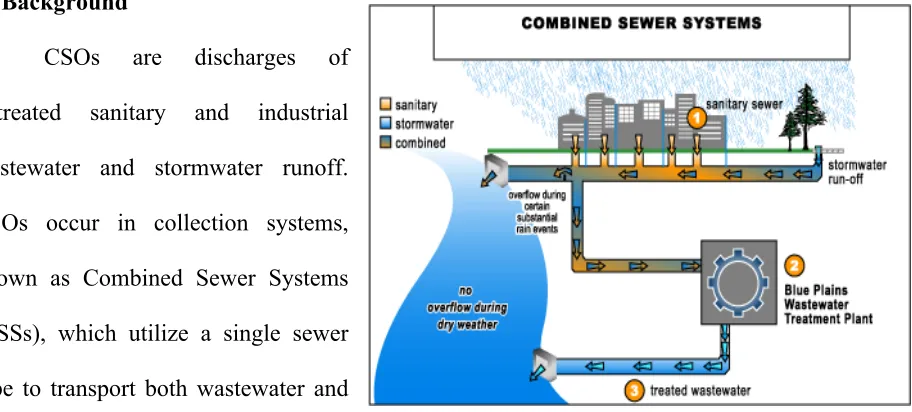
CSOs typically occur during periods of wet weather (see Figure 1). The excess water generated
by a wet weather event, such as heavy rainfall, snow, or a hurricane overloads the CSS and exceeds capacity shortfalls (Anderson, 1991). In the normal functioning of a CSS the wastewater and stormwater are sent to a wastewater treatment plant for physical, chemical, and biological
processing before they are discharged into the receiving waters. When the system is over capacity, both the untreated wastewater and stormwater are directly discharged into receiving
waters without treatment. The types of chemicals, nutrients, floatables, and pathogens discharged can be very potent and contain many components that are injurious to human health and the
environment (Anderson, 1991). The problem of CSOs is vast because CSSs serve 40 million people in 772 communities (U.S. Environmental Protection Agency [EPA], 2013e). In order to address the large number of CSOs that occur every year, EPA has implemented many CSO
policies and national enforcement initiatives.
B. History of the CSS in Washington D.C.
The majority of cities that have combined sewers are concentrated in the Northeast and the Great Lakes Region (EPA, 2013e). These regions contain some of the oldest cities and communities in the country and CSSs are an artifact of the country’s early infrastructure.
Stormwater and sanitary sewers did not initially connect to each other, but were made into one system over a period of time (D.C. Water, 2013d). The District of Columbia (Washington D.C.
or D.C.) has one of the oldest sewer systems in the United States. Sewers and culverts that collected surface water runoff were constructed as early as 1810 (D.C. Water, 2013d). At that time the drains were not connected to form a system. A surge in population during the Civil War
led to an increase in water pollution and waterborne diseases that claimed many lives (D.C. Water, 2013d). The outbreak of disease led the city to connect the drains and culverts to form a
sewer system in hopes of better handling the sewage.
Washington D.C. built 80 miles of sewers from 1871 to 1874. Unfortunately, the work was not well planned because it solved the sewage problem in part of the city, but transferred the
problem to the wetlands along the Potomac and Anacostia Rivers (D.C. Water, 2013d). The D.C. Board of Public Works thought “that all the sewage flows should be discharged at a point far
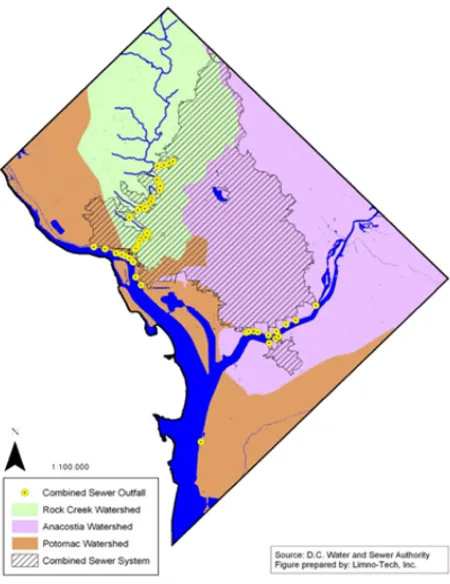
But the city grew and this southernmost tip of D.C. is now plagued by CSO problems. (see
Figure 2).
In the 1890s, engineers debated about whether Washington, D.C. should keep a CSS
or move to separate systems for sewer and stormwater. They ultimately decided to retain
the combined system, but build new extensions to the system as separate systems for stormwater and sewer (D.C. Water, 2013d). The sewer and
stormwater system in use today is a hybrid of
the original CSS and separate sewer and
stormwater systems.
II. Current problems related to CSOs A. Environmental issues
1. Pollutants found in CSOs
The combination of pollutants in a CSO can vary according to each community
and within each CSO event. The variety of chemicals depends on the demographics of the specific community, when the last wet weather event occurred, and other factors. The EPA has found the following pollutants in CSOs: total suspended solids (TSS), toxic substances, oxygen
depleting substances, nutrients, floatables, microbial pathogens, and fats, oils, and grease (EPA, 2004).
Of these possible contaminants, oxygen depleting substances, TSS, floatables and nutrients
Figure 2. Washington DC Watersheds (D.C. Water, 2013d).
are most harmful to aquatic life. Nutrients, such as nitrogen and phosphorus, create eutrophic conditions by causing algae blooms to form (National Estuarine Research Reserve System,
2013). The decomposition of algae blooms consumes oxygen, which depletes the amount of oxygen in the water and causes fish and other aquatic animals to suffocate (Chesapeake Bay Foundation, 2013).
Biological oxygen demand (BOD5), the amount of dissolved oxygen consumed in five days
by biological processes breaking down organic matter, is utilized to determine how much
oxygen-demanding organic matter is in wastewater (EPA, 2004). Recent studies have found that concentrations of BOD5 in CSOs are usually 5 times greater than concentrations of BOD5 found
in stormwater alone (EPA, 2004).
TSS is a measure of the small particles that float in water or wastewater (EPA, 2004). TSS has a harmful effect on aquatic life because it clogs the gills of fish, decreases aquatic organisms
resistance to disease, and reduces growth rates (EPA, 2004).
Floatables is defined as material, such as trash or debris that is visible when sewers overflow (EPA, 2004). This can include sanitary products, plastics, and other litter that
accumulates on streets. Floatables can be harmful to aquatic life, including seabirds, because the wildlife can become entangled in floatables or ingest them.
Industrial sources can also contribute to pollution in the CSO. Industrial facilities contribute toxic substances, such as metals and synthetic compounds and fats, oils, and grease (FOG) (EPA, 2004). Toxic substances in the water can also have a harmful effect on aquatic life.
Exposure to various toxics can cause a reduced rate of growth and reproduction, bioaccumulation of chemicals, or reduced biological diversity (EPA, 2004). FOG is a problem because it can lead
conveying the wastewater and stormwater.
Furthermore, because CSOs are a mixture of wastewater and stormwater, the stormwater
can also carry pollutants and other substances that are harmful to the environment and ecosystems. Stormwater can carry many of the pollutants listed above, such as TSS, toxics, floatables and nutrients (EPA, 2004). Additionally, stormwater can carry sediment from various
urban and suburban activities. This sediment can fill in rivers and smother oyster beds.
CSOs discharge a large amount of pollutants and sediment. While the amounts of each
pollutant discharged annually are unknown, the EPA reported that CSOs accounted for 1.2 trillion gallons of untreated wastewater, untreated industrial wastes and stormwater runoff entering receiving waters annually. The shear volume of water indicates large amounts of
pollutants and sediment were discharged as well.
2. Climate Change
Climate change has led to increases in the frequency and severity of extreme wet weather events, such as storms and hurricanes, which can raise the risk of major flooding (EPA, 2013b). Consequently, increased flooding will lead to increased CSOs (Baer, 2010). As noted by press
sources, “Scientists link climate change to increasingly volatile and extreme weather conditions, such as [Hurricane Sandy]. Americans must take Sandy as a sign of what’s to come – based on a
problem we have largely helped to create” (Christian Science Monitor, 2012).Hurricanes like Sandy and Irene and Tropical Storm Lee have caused intense flooding, destruction, and sediment pollution. These storms could add to existing CSO issues and put an additional burden on
communities that are susceptible to climate change (Frumhoff, McCarthy, Melillo, Moser, & Wuebbles, 2007). The frequency of these storms shows that changing climate patterns will need
B. Public health issues
Chemical pollutants, discussed above, and microbial pathogens are the leading
contributors to human health impacts of CSOs. Three major types of microbial pathogens found in wastewater are bacteria, viruses, and parasites. Two categories of bacteria contained in wastewater are indicator bacteria and pathogenic bacteria (EPA, 2004). Indicator bacteria, are
not disease-causing organisms themselves, rather they suggest the presence of disease causing organisms. The principle types of indicator bacteria are fecal coliform and E. coli (EPA, 2004).
Coliform counts in CSOs range as high as 1 million per 100 milliliters, which is roughly 1,000 to 5,000 times the level that is considered safe for swimming (Anderson, 1991). Pathogenic bacteria are disease-causing organisms, such as salmonella (EPA, 2004).
Another type of microbial pathogen found in CSOs are viruses. More than 120 types of viruses may be found in sewage. The viruses reported in wastewater vary greatly (EPA, 2004).
Some potential viruses that may be present in a CSO are polio and infectious hepatitis. The third type of microbial pathogens that could be present in a CSO event are parasites, such as tapeworms and hookworms (EPA, 2004).
There are many pathways through which humans can become exposed to the pollutants found in CSOs. According to the EPA the most common ways for humans to become exposed to
contaminants in CSOs are by recreating in waters, drinking water, or consuming fish that have been contaminated (EPA, 2004). Because of these typical exposure pathways, CSO events can lead to beach closings, swimming advisories, and fishing prohibitions (Craig, 2010). People
recreating in the water usually are exposed to the pollutants via oral ingestion. However, exposure can also occur through the ears, eyes, nose or cuts on the skin (EPA, 2004). Many
infections. A study found that 34.5 percent of people who swam in CSOs had gastroenteritis and 65.8 percent has ear infections (EPA, 2004).
Another segment of the population that is at a higher risk of becoming ill from CSOs are subsistence and recreational fisherman, who contract gastroenteritis
from eating contaminated fish (EPA, 2004). People with lower income levels tend to be subsistence fishers
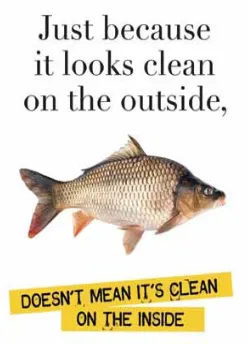
because catching fish or shellfish can be an inexpensive way to include protein in their diet (EPA, 2004). Many cities have posted signs and advisories on the dangers
of fishing in certain areas after wet weather events (see Figure 3). However, studies have shown that despite these warnings, many fisherman consume the fish or shellfish (EPA, 2004). The
Anacostia River in D.C. provides an unfortunate example of subsistence fisherman eating and sharing contaminated fish. The water in the Anacostia River is severely polluted. Many communities located along the river are among the poorest in Washington, D.C. (Brandes, 2005).
In 2002, the District of Columbia Water and Sewer Authority (D.C. Water) found that in addition to toxic substances, the Anacostia River was plagued by an average of 75 CSO episodes per year
(D.C. Water, 2002). A National Oceanic and Atmospheric Administration (NOAA) study found that thousands of local fishermen, who are usually minorities, are catching, eating, and sharing potentially contaminated fish with family, friends, and others. NOAA estimated some 17,000
people living near the Anacostia could be eating these polluted fish (National Oceanic and Atmospheric Administration, 2013). In addition to locals who knowingly eat fish from the
Anacostia, another segment of the population may be unknowingly eating it. Some Anacostia
fisherman sell their catch to the Maine Avenue Fish Market (Wiener, 2012). Thus, the segment of Washington D.C.’s population suffering the consequences of eating contaminated fish from
the Anacostia could be larger than people think.
III. EPA actions related to CSOs
A. EPA’s 1989 CSO Policy
After passage of the Clean Water Act (the CWA or the Act), there was some confusion over which provisions of the Act, if any, applied to CSOs. In 1989, EPA issued a CSO policy to
address the misunderstanding (Mann, 1999). The 1989 National Combined Sewer Overflow Control Strategy (1989 CSO Policy), clarified that CSOs are “considered point source discharges under the CWA,” and therefore they are subject to NPDES permits, technology based standards,
and water quality standards (WQs) (Mann, 1999). The 1989 CSO Policy had three objectives: (1) to ensure that CSO discharges occur only as a result of
wet-weather (2) to bring all wet-wet-weather CSO discharge points into compliance with the technology based requirements of the CWA and the applicable state WQs (3) to minimize water quality, aquatic biota, and human health impacts from wet-weather discharges (Mann, 1999).
Many people criticized the 1989 CSO Policy was for its “perceived shortcomings,” such as high costs of implementation and failure to recognize the variable nature of CSOs (Mann, 1999).
B. EPA’s CSO Control Policy of 1994
In 1994, EPA released its revised Combined Sewer Overflow Control Policy (CSO
Control Policy) and addressed some of the issues in the 1989 CSO Policy (Combined Sewer Overflow Control Policy, 1994). The CSO Control Policy provides the ability to adapt to the localized nature of CSOs. The CSO Control Policy achieves this by ensuring that CSO controls
“demonstration approach” (Combined Sewer Overflow Control Policy, 1994). A permit holder can use the “presumption approach,” where EPA presumes compliance with WQs, if the permit
holder achieves: a limited amount of discharges per year, and a capture or elimination rate of eighty-five percent for both the mass and the volume of pollutants concerned (Mann, 1999). Alternately, the demonstration approach requires the permit holder to demonstrate that it can
actually meet all of the present and future WQs (Mann, 1999). The CSO Control Policy sets out major provisions such as:
CSO permittees should immediately undertake a process to accurately characterize their CSS and CSO discharges, demonstrate implementation of minimum technology-based controls identified in the Policy, and develop long-term CSO control plans which evaluate alternatives for attaining compliance with the CWA, including compliance with water quality standards and protection of designated uses. Once the long-term CSO control plans are completed, permittees will be held responsible to implement the plans’ recommendations as soon as practicable (Combined Sewer Overflow Control Policy, 1994).
The CSO Control Policy reiterates the objectives of the 1989 CSO Policy and adds that the CWA
also prohibits CSO’s during dry weather (Combined Sewer Overflow Control Policy, 1994). Additionally, the CSO Control Policy emphasizes cost-effectiveness. This addition to the Policy was largely seen as a reaction to the criticism of implementation costs in the 1989 CSO
Policy. The CSO Control Policy provides flexibility to local jurisdictions by taking the site-specific nature of CSOs into account and allowing them to consider cost effective solutions for
meeting WQs (Combined Sewer Overflow Control Policy, 1994).
The CSO Control Policy establishes guidelines for meeting the technology based requirements of the CWA (Mann, 1999). This framework emphasizes that the permit holder
permitting requirements for the LTCP (Mann, 1999). The NMCs are:
• Proper operation and regular maintenance programs for the sewer system;
• maximum use of the collection system for storage;
• review and modification of pretreatment requirements to assure CSO impacts are minimized;
• maximization of flow to the publicly owned treatment works for treatment;
• prohibition of CSOs during dry weather;
• control of solid and floatable materials in CSOs; • pollution prevention;
• public notification to ensure that the public receives adequate notification of CSO occurrences and CSO impacts;
• monitoring to effectively characterize CSO impacts and the efficacy of CSO controls
(Combined Sewer Overflow Control Policy, 1994). Each permittee is responsible for
implementing the NMCs (Combined Sewer Overflow Control Policy, 1994). Even though cost effectiveness is a consideration, the EPA made it clear that “each permittee is ultimately
responsible for aggressively pursuing financial arrangements” to implement its LTCP (Combined Sewer Overflow Control Policy, 1994). Initially, the EPA had some problems enforcing the CSO Control Policy. In 2000, the CSO Control Policy was codified in Section 402(q) of the CWA, 33
U.S.C. §1342(q) (Consolidated Appropriations Act for Fiscal Year 2001, 2000). Now, each permit issued for a discharge from a CSS must comply with the CSO Control Policy
(Consolidated Appropriations Act for Fiscal Year 2001, 2000). When the CSO Control Policy was codified in law, EPA expected compliance with the CSO Policy to improve.
C. EPA’s report to Congress
In 2002, EPA found that many factors affected CSO Control Policy implementation
(EPA, 2004). Two of the main factors cited by EPA were the “lack of any statutory or regulatory endorsement of the CSO Control Policy from 1994 until December 2000, and competing
be implemented by January 1, 1997 and LTCPs would be developed as soon as practicable (EPA, 2004). The EPA acknowledged that the LTCPs involved major investments in
infrastructure and those investments are expensive and have to compete with other priorities (EPA, 2004).
D. Current EPA Enforcement of the CSO Policy
Despite the codification of the CSO Policy, reducing CSOs remains a national issue. According to EPA, communities across the country are in various stages of development and
implementation of their LTCPs (EPA, 2013d). EPA has been working to increase compliance with the CSO Policy through a variety of mechanisms. EPA’s approaches range from providing more information in guidance documents to pursuing enforcement action, through means such as
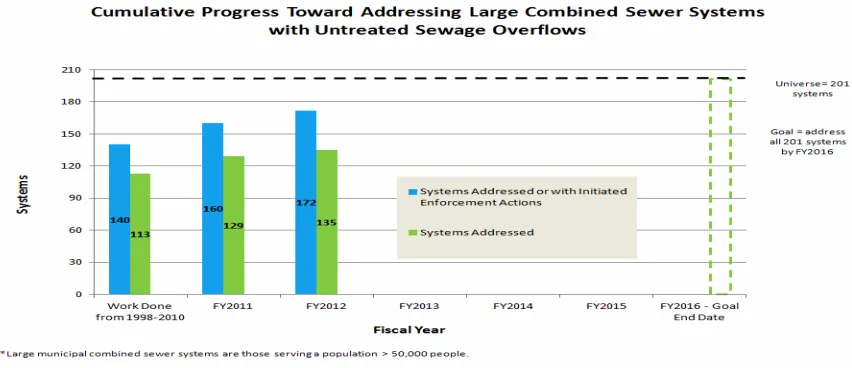
consent decrees (EPA, 2013d). EPA’s enforcement actions have increased since 1998 (see Figure 4). EPA demonstrated its commitment to ensuring compliance with the CSO Policy by making it
a National Enforcement Initiative in FY 2011-2013 and continuing to make it a National Enforcement Initiative for FY 2014-2016 (EPA, 2013a).
IV. Washington D.C.’s compliance history and progress A. Compliance between 1994–2002
Approximately one-third of the District, or 12,955 acres, is served by a CSS. The District of Columbia Water and Sewer Authority (D.C. Water) submitted its NMC to EPA in 1996(EPA, 2004).D.C. Water started to develop its LTCP in 1998. In 2001 D.C. Water submitted a draft
LTCP to EPA Region III (EPA, 2004).The LTCP utilized the demonstration approach and a 20-year implementation schedule based on a financial assessment and practical aspects (EPA, 2004).
D.C. Water included the following NMCs: inspections of critical facilities; use of inflatable dams to maximize storage; and industrial flow pretreatment (EPA, 2004). In addition, D.C. Water identified some actions that could begin before approval of the LTCP (EPA, 2004).These items
included monitoring, and low impact development (LID) retrofits (EPA, 2004).Even though the NMCs were implemented and the LTCP was developed, D.C. Water was still experiencing CSO
events. Due to the continuing CSO events, the EPA and the Anacostia Watershed Society (a private citizens’ group) filed suit against D.C. Water, alleging failure to comply with the District of Columbia WQs, effluent limitations and other conditions in their NPDES permit, failure to
manage and maintain the CSO control facilities, and failure to implement the NMCs (Anacostia Watershed Society, 2003). This enforcement action led to a consent decree between EPA, the
Anacostia Watershed Society and D.C. Water (Anacostia Watershed Society, 2003).
B. D.C. Water’s Consent Decree
Under the terms of the consent decree, D.C. Water is responsible for the proper operation
and regular maintenance of the CSS (Anacostia Watershed Society, 2003). The consent decree specifically states that D.C. Water is responsible for assigning which organizations perform the
what procedures should be followed in emergency situations (Anacostia Watershed Society, 2003). Additionally, D.C. Water must maximize storage capacity in the CSS by replacing
inflatable dams in the CSS, repairing and replacing tide gates, and cleaning eighty-five percent of the catch basins in the CSS annually (Anacostia Watershed Society, 2003). The consent decree also specifies that D.C. Water must maximize the flow to the Blue Plains Wastewater treatment
plant, make improvements at Blue Plains, modify the CSS to prevent dry weather CSOs, control construction debris and floatable materials, notify the public of CSOs, and conduct monitoring
(Anacostia Watershed Society, 2003).
In addition to the injunctive aspects of the consent decree, D.C. Water was ordered to pay a civil penalty of $250,000 (Anacostia Watershed Society, 2003). D.C. Water was also instructed
to spend $1,700,000 on supplemental environmental projects. The consent decree specified that the projects these supplemental environmental projects should consist of the creating rain
gardens as well as other types of LID (Anacostia Watershed Society, 2003).
The consent decree lists many other types of LID that D.C. Water could utilize to help control CSOs. The decree identifies filter strips, vegetated buffers, rain barrels, cisterns,
infiltration trenches, additional tree cover and permeable pavement (Anacostia Watershed Society, 2003).
C. Current status of D.C.’s CSS retrofit
D.C. is currently separating the CSS and eliminating several CSO outfalls. The CSO outfalls that remain will be used for storm water only. Additionally, D.C. Water will create new
stormwater outfalls for both the Anacostia and Potomac Rivers (D.C. Water, 2013g). By the year 2025, D.C. expects a 96% reduction in CSOs (D.C. Water, 2013g). D.C. Water is currently
River to better control CSOs. This phase of the LTCP is built with largely “grey” or traditional infrastructure (D.C. Water, 2013f). The later phases of the LTCP include construction of similar
grey infrastructure tunnels in the Potomac and Rock Creek sewersheds (D.C. Water, 2013f). However, D.C. Water is implementing LID pilot projects or “green infrastructure” in the Potomac and Rock Creek areas. This plan drew criticism because D.C. Water requested an
eight-year implementation and trial period for these pilot projects. D.C. Water also asked the EPA to reopen the consent decree to change the Potomac and Rock Creek tunnels to “green
infrastructure” (Hawkins, 2011). This led others to question why D.C. Water wanted to re-open the consent decree.
1. Modification of the consent decree
D.C. Water sent a letter to EPA in August of 2011, requesting EPA’s support to modify the deadlines for the Potomac and Rock Creek CSO retrofits in D.C. Water’s consent decree
(Hawkins, 2011). The process for modification of the consent decree is the following: DC Water submits a draft consent degree modification to EPA. Within 60 days of receiving EPA’s comments, D.C. Water publishes public notice of the proposed modified consent decree. Next
there is a public comment period for 60 days followed by 21 days for D.C. Water to respond to the comments and submit a revised modified consent decree to EPA. EPA and the Department of
Justice (DOJ) determine whether or not to support the proposed consent decree modification and make a recommendation to the Federal District Court for the District of Columbia. Finally, the Court decides whether or not to accept the recommendation from the EPA and DOJ(Hawkins,
2012b). If the Court upholds the modification to the consent decree, then D.C. Water will begin its green infrastructure pilot project.
River assumes that the consent decree modification will be approved in early 2013 (Hawkins, 2012b). After the consent decree is approved, the proposed schedule anticipates the design phase
of the project will take place from 2013 to 2015 (Hawkins, 2012b). Construction of the pilot project will take place from 2015 to 2017. Upon completion of the Green Infrastructure Demonstration Project, D.C. Water will use the project’s findings to analyze the green and the
green/gray infrastructure proposals (Hawkins, 2012b). This alternatives analysis would be used as a foundation for proposing changes to D.C.’s LTCP.
This proposed schedule provoked many questions and clarifications from federal regulators. The EPA questioned who would be responsible for financing the project (Capacasa, 2011). They also questioned what the measures of success would be for the project and why D.C.
Water needed a schedule extension (Capacasa, 2011). EPA asked D.C. Water to conduct individual screening analyses of the Potomac and Rock Creek Sewersheds to evaluate the
implementation of green infrastructure within those two sewersheds (Capacasa, 2012). EPA stated that if it determined that a “full scale demonstration was warranted in either of the sewersheds,” EPA would “look favorably” at modifying the consent decree (Capacasa, 2012).
The EPA also made numerous requests to keep the process moving (Capacasa, 2012).
D.C. Water responded that the screening analysis requested by EPA was not feasible
because the information could only be obtained by installing a large-scale demonstration project (Hawkins, 2012a). D.C. Water worked on a desktop evaluation but warned that the desktop evaluation would not provide reasonable certainty of success like a large demonstration project
would (Hawkins, 2012a). D.C. Water expressed its disappointment with EPA Region III’s response to the deadline extensions (Hawkins, 2012a).
Columbia signed the Clean Rivers, Green District- Green Infrastructure Partnership Agreement
(the Agreement) (D.C. Water, 2013a). The Agreement states that D.C. Water is implementing its
green infrastructure plan to conduct a large-scale, multi-million dollar Green Infrastructure Demonstration Project in the Potomac and Rock Creek watersheds. Importantly, this Agreement does not, in of itself, modify the consent decree. D.C. Water must still follow the consent decree
modification process. Additionally, the Agreement states that the EPA and the Court must still approve the consent decree modifications (D.C. Water, 2013a).
If the United States notifies DC Water that it does not support the proposed Consent Decree amendments or if the Court refuses to approve the proposed Consent Decree amendments, this Agreement will be terminated and DC Water will discontinue the Green
Infrastructure Demonstration Project and proceed with implementation of the CSO controls (D.C. Water, 2013a).
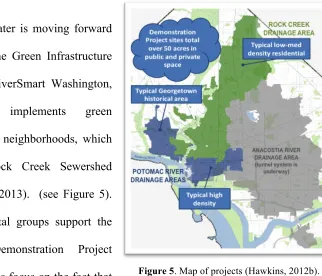
Currently, D.C. Water is moving forward
with implementation of the Green Infrastructure Demonstration Project (RiverSmart Washington, 2013). The project implements green
infrastructure in two pilot neighborhoods, which both drain into the Rock Creek Sewershed
(RiverSmart Washington, 2013). (see Figure 5). Not all local environmental groups support the Green Infrastructure Demonstration Project
(Fears, 2012). These groups focus on the fact that
the Green Infrastructure Demonstration Project will take eight-years to implement. “Billions of Figure 5. Map of projects (Hawkins, 2012b).
gallons of sewage [will] pour into the Potomac River and Rock Creek for eight years while D.C. Water conducts its tests” (Fears, 2012). Some environmental organizations have little faith that
the reasons behind D.C. Water’s LID proposal are actually related to green infrastructure. A staff attorney for Earthjustice said “this proposal is purely about delays…that is the purpose behind it” (Fears, 2012).
V. Solutions
There are many scenarios that could unfold in regard to the future of D.C. Water’s green
infrastructure proposal. The first scenario is that the EPA, the DOJ, and the Court could approve D.C. Water’s green infrastructure proposal. If this occurs, D.C. Water may need to focus on cutting down the proposed timetables. Eight years is a long time to further delay water quality
improvements. D.C. Water has stated that one limitation on green infrastructure is that the city owns very little public land in the District (D.C. Water, 2013c).
In response to this issue, D.C. Water partnered with the District Department of the Environment (DDOE), the District Department of Transportation (DDOT), LimnoTech, Casey Trees, and Rock Creek Conservancy to implement the Green Infrastructure Demonstration
Project (RiverSmart Washington, 2013). As part of this initiative, porous paving, tree boxes, and street gardens were installed (RiverSmart Washington, 2013).
There is already a green roofs initiative in D.C. As part of the consent decree, D.C. Water provided approximately $300,000 to the Chesapeake Bay Foundation for green roof demonstration projects. The money was utilized to create 121,000 square feet of green roofs. The
roofs retain about 1.8 million gallons of stormwater each year (Natural Resources Defense Council, 2012).
incentive programs are the RiverSmart Homes Program, RiverSmart Communities Program, and the Rain Barrel Rebate (District of Columbia, 2013). The RiverSmart Homes Program offers
incentives to homeowners in the District for reducing stormwater runoff. The homeowners receive landscaping services, up to $1,200 that include LID items such as tree planting and pervious pavers. Homeowners are expected to contribute 10% of the project cost (District of
Columbia, 2013). The RiverSmart Communities Program applies to churches, small businesses, and multi-family residential properties. These property owners may apply for a 60% rebate of the
cost to implement LID improvements. Additionally, the Rain Barrel Rebate Program provides rebates of up to one dollar per gallon of rain barrel capacity (District of Columbia, 2013). The DDOE has also acted to incentivize private landowners with a green roof subsidy program
currently offering a rebate of five dollars per square foot for green roof installation. After these incentive based approaches have been applied, the city could make a certain amount of green
infrastructure on property mandatory via changes to the city zoning code.
In addition to working on private green infrastructure, D.C. Water should also consider long term plans for stormwater outfalls. If the proposal goes through unmodified, the CSS
outfalls will become outfalls for stormwater only. Stormwater, as stated above, contains many harmful pollutants and if the city does not fix the problems of stormwater overflows now, it will
have to fix them in the future. While the consent decree is being modified, D.C. Water should develop a long-term plan to drastically decrease stormwater overflow events.
The second scenario is that the EPA, DOJ, and the Court could deny the proposal and
instruct D.C. Water to implement the “grey infrastructure” in the consent decree. If this happens, D.C. Water can still implement other green infrastructure initiatives as well as the grey
partnerships that it formed with other city agencies and departments to implement LID. For example, D.C. Water can form an agreement with DDOT to install street side curb extensions
and permeable pavement.
If D.C. Water can retain these agreements with other city entities it can implement green infrastructure while defraying its costs. This may actually be the best scenario for the city. If the
tunnels are built as originally planned they will have enough capacity for future growth and green infrastructure partnerships with other agencies will help to minimize stormwater entering
the CSS. This would allow D.C. Water to fund the tunnels and the LID development it had already planned. Therefore, green infrastructure initiatives could be realized while planning for future population growth.
The third scenario is that D.C. Water’s proposal to modify the consent decree could lead to more debate, delay, and possibly more litigation. This scenario would not be a win for anyone,
especially water quality in the District of Columbia. A delay on consent decree modifications could contribute to adverse outcomes in terms of environmental and economic objectives because the District has already begun the Green Infrastructure Demonstration Project. Delay on
the decision of whether or not to approve the consent decree modifications creates uncertainty for the District and may result in the District stopping the Green Infrastructure Demonstration
Project in the middle of completion. For these reasons, EPA and DOJ should make a timely and careful decision on whether or not to approve the consent decree modifications.
VI. Conclusion
CSOs are still a significant problem in many communities around the United States. CSOs discharge toxic pollutants that lead to environmental and human health impacts. Therefore,
for addressing CSOs. EPA’s CSO Control Policy, now codified in the CWA, provides a basic framework for mitigating these challenges. However, decisionmakers should also be considering
green infrastructure initiatives. The best scenario for Washington, D.C. could be to implement its original “grey infrastructure” design and partner with other city agencies and stakeholders to implement other forms of LID. This solution could create more green sustainable infrastructure
while also planning for future population growth.
Works Cited
Anacostia Watershed Society v. D.C. Water & Sewer Authority, No. 00-0183. (June 25, 2003).
Retrieved from http://www.epa.gov/compliance/resources/decrees/civil/cwa/dcwasa-cd.pdf
Anderson, P. C. (1991) The CSO Sleeping Giant: Combined Sewer Overflow or Congressional
Stalling Objective. Virginia Environmental Law Journal, 10, 372-73.
Baer, K. (2010). Stormwater, Green Buildings and Water Conservation: Water in the Built Environment. ALI-ABA Course of Study, 5, 469.
Brandes, U. (2005). Recapturing the Anacostia River: The Center of 21st Century Washington, DC. Golden Gate University Law Review, 35, 411.
Capacasa, J., Letter to George S. Hawkins, General Manager, D.C. Water. Apr. 2, 2012. Capacasa, J., Letter to George S. Hawkins, General Manager, D.C. Water. Dec. 14, 2011. Chesapeake Bay Foundation (2013). Dead Zones. Retrieved from
http://www.cbf.org/how-we-save-the-bay/issues/dead-zones?
Christian Science Monitor. (2012). Hurricane Sandy Blows Climate Change Back on the Table.
Combined Sewer Overflow Control Policy, 59 Fed. Reg. 18,688. (1994). Retrieved from nepis.epa.gov/Exe/ ZyPURL.cgi?Dockey=200040M5.txt
Consolidated Appropriations Act for Fiscal Year 2001, P.L.106-554, 114 Stat. 2763 (2000). Craig, R., (2010). The Public Health Aspects of Environmental Enforcement. Pittsburgh Journal
of Environmental Public Health, 4, 56.
District of Columbia. (2013). District of Columbia Green Financial Incentives. Retrieved from http://ddoe.dc.gov/sites/default/files/dc/sites/ddoe/publication/attachments/Green%20Ince
ntives%20Brochure_April%205%202013.pdf
District of Columbia Water and Sewer Authority. (2013a) Clean Rivers, Green District- Green Infrastructure Partnership Agreement. Retrieved from http://www.dcwater.com/
education/pdfs/Clean_Rivers_Green_District_Partnership_Agreement.pdf District of Columbia Water and Sewer Authority. (2013b). Combined Sewer System.
Retrieved from http://www.dcwater.com/wastewater_collection/css/
District of Columbia Water and Sewer Authority. (2013c). DC Water’s Proposed Green Development Pilot: Frequently Asked Questions. Retrieved from DC Water's Proposed
Green Development Pilot: Frequently Asked Questions (PDF)
District of Columbia Water and Sewer Authority. (2013d). History of Sewer System.
http://www.dcwater.com/wastewater_collection/history.cfm
District of Columbia Water and Sewer Authority. (2013e). Impervious Area Charge. Retrieved from http://www. Dcwater.com/customercare/iab.cfm
District of Columbia Water and Sewer Authority. (2013g). Sewer System Improvements. Retrieved from http://www.dcwater.com/education/sewer_improvements.cfm
District of Columbia Water and Sewer Authority. (2002). WASA's Recommended Combined Sewer System Long Term Control Plan.
Fears, D. (2012, December 2). D.C. debates best path to cleaner waterways, The Washington
Post. Retrieved from http://www.washingtonpost.com/national/health-science/dc-
debates-best-path-to-cleaner-waterways/2012/12/02/68e9bef8-17b9-11e2-a55c-39408fbe6a4b_story.html
Frumhoff, P. C., McCarthy, J. J., Melillo, J. M., Moser, S. C., & Wuebbles, D. J. (2007).
Confronting Climate Change in the U.S. Northeast: Science, Impacts, and Solutions.
Synthesis report of the Northeast Climate Impacts Assessment. Cambridge, MA: Union of Concerned Scientists.
Hawkins, G. (2012a). Letter to Jon M. Capacasa, Director Water Protection Division, EPA Region III. May 21, 2012.
Hawkins, G. (2011) Letter to Lisa P. Jackson, Administrator of the EPA. Aug. 1, 2011.
Hawkins, G. (2012b). Presentation to DC Water Board of Directors, Green Infrastructure Partnership Agreement. Oct. 4, 2012.
Mann, J. (1999). Economic Infeasibility and EPA's 1994 Combined Sewer Overflow Policy: A Successful Solution in Massachusetts Still Leaves A Turbid Understanding Between State and Federal Officials. British Columbia Environmental Law Review, 26, 864.
NRDC. (2012). Rooftops to Rivers II: Green Strategies for Controlling Stormwater and Combined Sewer Overflows. Retrieved from http://www.nrdc.org/water/pollution/
rooftopsii/files/RooftopstoRivers_WDC.pdf
NOAA Office of Response and Restoration. (2013). Response and Restoration. Retrieved from
http://response.restoration.noaa.gov/about/media/study-reveals-dc-community-near-anacostia-river-are-eating-and-sharing-contaminated-fish.html
RiverSmart Washington. (2013). About the Program. Retrieved from http://www.rockcreek
conservancy.org/index.php/about-the-program-riversmart.
U.S. Environmental Protection Agency. (2013a). Announcing EPA’s Selection of National Enforcement Initiatives for FY 2014-2016. Retrieved from http://www2.epa.gov/sites/
production/files/2013-09/documents/2014-2016-nei-announcement.pdf
U.S. Environmental Protection Agency. (2013b). Climate Change- Human Health Impacts.
Retrieved from http://www.epa.gov/climatechange/impacts-adaptation/health.html U.S. Environmental Protection Agency. (2013c). Combined Sewer Overflows. Retrieved from
http://www2.epa.gov/sites/production/files/2013-09/2012-eoy-combined-sewer-overflow.gif
U.S. Environmental Protection Agency. (2013d). Combined Sewer Overflows CSO Control
Policy. Retrieved from http://cfpub.epa.gov/npdes/cso/cpolicy.cfm?program_id=5 U.S. Environmental Protection Agency. (2013e). Combined Sewer Overflows Demographics.
Retrieved from http://cfpub.epa.gov/npdes/cso/demo.cfm
Wiener, A. (2012, Nov. 7) Reel Talk. Washington City Paper. Retrieved from
http://www.washingtoncitypaper.com/blogs/housingcomplex/2012/11/07/reel-talk/
Bio