Organized by C.O.E.T, Akola. Available Online at www.ijpret.com386
INTERNATIONAL JOURNAL OF PURE AND
APPLIED RESEARCH IN ENGINEERING AND
TECHNOLOGY
A PATH FOR HORIZING YOUR INNOVATIVE WORK
BIOMASS ENERGY CONVERSION TECHNOLOGIES
S. R. KALBANDE, V. P. KHAMBALKAR1. Department of Un-conventional Energy Sources & Electrical Engineering, 2. Dr Panjabrao Deshmukh Agricultural University, Akola - 444 104, (MS), India.
Accepted Date: 12/03/2016; Published Date: 02/04/2016
Abstract: Utilization of biomass has long back history from the civilization of mankind. The global environment has facilitated to use of renewable energy sources. Biomass is one potential source of renewable energy and the conversion of plant material into a suitable form of energy. Electricity can be generated from various route and enable us to use the various resources of energy. Biomass is the clean source and many times it is perianal available worldwide. This paper narrated the overview of the biomass resources and the conversion systems.
Keywords: Biomass, Energy Route, Clean Energy
Corresponding Author: S. R. KALBANDE
Co Author: V. P. KHAMBALKAR
Access Online On:
www.ijpret.com
How to Cite This Article:
S. R. Kalbande, IJPRET, 2016; Volume 4 (8): 386-391
PAPER-QR CODE
SPECIAL ISSUE FOR
NATIONAL LEVEL CONFERENCE
"RENEWABLE ENERGY
Organized by C.O.E.T, Akola. Available Online at www.ijpret.com387
INTRODUCTION
Biomass consists of solid, liquid, or gaseous fuels. Liquid fuels can be used directly in the existing road, railroad, and aviation transportation network stock, as well as in engine and turbine electrical power generators. Solid and gaseous fuels can be used for the production of electrical power from purpose-designed direct or indirect turbine-equipped power plants. Chemical products can also be obtained from all organic matter produced. Additionally power and chemicals can come from the use of plant-derived industrial, commercial, or urban wastes, or agricultural or forestry residues. Biomass resources include primary, secondary, and tertiary sources of biomass. Primary biomass resources are produced directly by photosynthesis and are taken directly from the land. They include perennial short-rotation woody crops and herbaceous crops, the seeds of oil crops, and residues resulting from the harvesting of agricultural crops and forest trees. Secondary biomass resources result from the processing of primary biomass resources either physically (e.g., the production of sawdust in mills), chemically (e.g., black liquor from pulping processes), or biologically (e.g., manure production by animals). Tertiary biomass resources are post-consumer residue streams including animal fats and greases, used vegetable oils, packaging wastes, and construction and demolition debris.
KEY ISSUES IN BIOMASS ENERGY:
In order to analyses the use of biomass for power generation, it is important to consider three critical components of the process:
Biomass feed stocks: These come in a variety of forms and have different properties that impact their use for power generation.
Biomass conversion: This is the process by which biomass feed stocks are transformed into the energy form that will be used to generate heat and/or electricity.
Power generation technologies: There is a wide range of commercially proven power generation technologies available that can use biomass as a fuel input.
BIOMASS FEEDSTOCK:
Organized by C.O.E.T, Akola. Available Online at www.ijpret.com388 feedstock per unit of energy, transportation, pre-treatment and storage costs, as well as the appropriateness of different conversion technologies. Bioenergy can be converted into power through thermal-chemical processes (i.e. combustion, gasification and pyrolysis) or bio-chemical processes like anaerobic digestion (Table 1).
Table 1: Biomass feedstock for power generation
OVERVIEW OF BIOMASS CONVERSION:
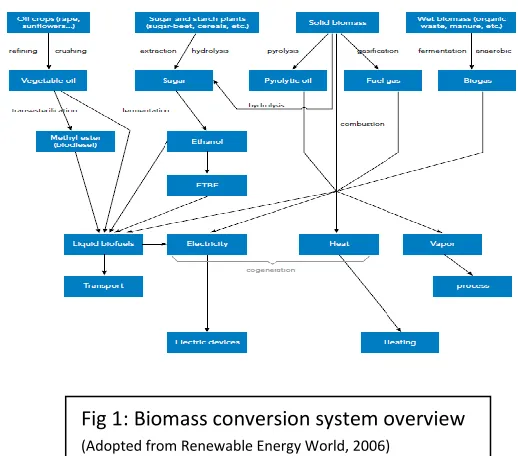
Power generation from biomass can be achieved with a wide range of feedstock’s and power generation technologies that may or may not include an intermediate conversion process (e.g. gasification). In each case, the technologies available range from commercially proven solutions with a wide range of technology suppliers (e.g. solid fuel combustion) through to those that are only just being deployed at commercial scale (e.g. gasification).
SN Rural Urban
1 Forest residues and wood waste Urban wood waste
2 Agricultural residues Waste water and sewage
3 Energy crops Landfill gas
4 Livestock waste Municipal solid waste, food processing
residues
Organized by C.O.E.T, Akola. Available Online at www.ijpret.com389 There are other technologies that are at an earlier stage of development and are not considered in this analysis (Figure 1). In addition, different feedstock’s and technologies are limited or more suited to different scales of application, further complicating the picture. The following sections discuss each of the major technology groups and their technical parameters.
FEEDSTOCK & PROCESSES:
Biomass resources include agricultural residues; animal manure; wood wastes from forestry and industry; residues from food and paper industries; municipal green wastes; sewage sludge; dedicated energy crops such as short-rotation (3-15 years) coppice (eucalyptus, poplar, willow), grasses, sugar crops (sugar cane, beet, sorghum), starch crops (corn, wheat) and oil crops (soy, sunflower, oilseed rape, jatropha, palm oil). Organic wastes and residues have been the major biomass sources so far, but energy crops are gaining importance and market share. With re-planting, biomass combustion is a carbon-neutral process as the CO2 emitted has previously been absorbed by the plants from the atmosphere. Residues, wastes, bagasse are primarily used for heat & power generation. Sugar, starch and oil Cheap, high-quality biomass (e.g., wood waste) for power generation may become scarce as it is also used for heat production and in the pulp & paper industry.
Co-firing:
Biomass co-firing in modern, large scale coal power plants is efficient, cost-effective and requires moderate additional investment. In general, combustion efficiency of biomass can be 10 percentage points lower than for coal at the same installation, but co-firing efficiency in large-scale coal plants (35%-45%) is higher than the efficiency of biomass-dedicated plants. In the case of co-combustion of up to 5%-10% of biomass (in energy terms) only minor changes in the handling equipment are needed and the boiler is not noticeably derated.
Combustion power:
Organized by C.O.E.T, Akola. Available Online at www.ijpret.com390 assessment, net carbon emissions per unit of electricity are below 10% of the emissions from fossil fuel-based electricity.
Gasification:
Biomass conversion into biogas can be either from fast thermo-chemical processes (e.g.,pyrolysis1) which can produce biogas and other fuels, with only 2%-4% of ash, or from slow anaerobic fermentation - which converts only a fraction (50%- 60%) of feedstock but produces soil conditioners as a byproduct. The biogas can be used in combustion engines (10 kW to 10 MW) with efficiency of some 30%-35%; in gas turbines at higher efficiencies or in highly-efficient combined cycles. Biomass integrated gasification gas turbines (BIG/GT) are not yet in commercial use, but their economics is expected to improve.
Biogas conversion system:
In the absence of air, organic matter such as animal manures, organic wastes and green energy crops (e.g. grass) can be converted by bacteria-induced fermentation into biogas (a 40%-75% methane-rich gas with CO2 and a small amount of hydrogen sulphide and ammonia). Anaerobic digestion is also the basic process for landfill gas production from municipal green waste. It has significant potential, but it is characterized by relatively small plant size. Anaerobic digestion is increasingly used in small-size, rural and off-grid applications at the domestic and farm-scale. The rising cost of waste disposal may improve its economic attractiveness..
Organized by C.O.E.T, Akola. Available Online at www.ijpret.com391
CONCLUSIONS:
The advancement in the technology and high strength of the biomass resources will surely lead towards the sustainable development of the power generation. India has great potential of biomass resources availability through the large number of crop residues, livestock waste and the forest which lead the country as self-reliable villages in the near future. A variety of technology options exist for biomass that rely on several feedstock alternatives. These options can serve many different energy needs, from large scale industrial applications to small-scale, rural end-uses.
REFERENCES:
1. Murphy, J., R. Braun, P. Weiland and A. Wellinger (2010), Biogas from Energy Crop Digestion, IEA Bioenergy Task.
2. NREL (2000), Lessons Learned from Existing Biomass Power Plant. NREL/SR – 570-26496.
3. United Nations Industrial Development Organization (UNIDO) (2008), Guidebook on Modern Bioenergy Conversion Technologies in Africa, UNIDO, Vienna.
4. UNIDO (2009), Deployment of Technologies for Sustainable Bioenergy: Towards an Agenda for International Cooperation, UNIDO, Vienna.
5. United States Department of Agriculture (US DOA) (2007), An Analysis of Energy Production Costs from Anaerobic Digestion Systems on U.S. Livestock Production Facilities, US DOA, Natural Resources Conservations Service, Washington, D.C.