Journal of Algebra and Related Topics Vol. 6, No 1, (2018), pp 35-44
NON-REDUCED RINGS OF SMALL ORDER AND THEIR MAXIMAL GRAPH
A. SHARMA∗ AND A. GAUR
Abstract. Let R be a commutative ring with nonzero identity. Let Γ(R) denotes the maximal graph corresponding to the non-unit elements of R, that is, Γ(R) is a graph with vertices the non-unit elements ofR, where two distinct verticesa andb are adjacent if and only if there is a maximal ideal ofR containing both. In this paper, we investigate that for a given positive integern, is there a non-reduced ringRwithnnon-units? Forn≤100, a complete list of non-reduced decomposable ringsR=Qk
i=1Ri (up to
cardinali-ties of constituent local ringsRi’s) with n non-units is given. We
also show that for which n, (1 ≤n ≤7500), |Center(Γ(R))| at-tains the bounds in the inequality 1≤ |Center(Γ(R))| ≤nand for whichn, (2≤n≤100),|Center(Γ(R))|attains the value between the bounds.
1. Introduction
The maximal graph G(R) associated to R was introduced by the authors [3] in 2013. The authors considered G(R) as a simple graph whose vertices are elements ofR, and two distinct vertices a and b are adjacent if and only if there is a maximal ideal of R containing both. In [4], the authors defined Γ(R) as the restriction of G(R) to the non-unit elements of R, that is, Γ(R) is a simple graph whose vertices are the non-unit elements of R such that two distinct vertices a and b are adjacent if and only if a, b∈ m for some maximal ideal m of R. Γ(R)
MSC(2010): Primary: 13M99; Secondary: 05C99
Keywords: Non-reduced ring, Jacobson radical, maximal graphs, center, median. Received: 17 April 2018, Accepted: 12 June 2018.
∗Corresponding author.
was also named as maximal graph of R as the units in R are just the isolated vertices in G(R).
This paper is inspired by a simple question: Given any positive in-teger n, is there a commutative ring with nonzero identity having n
non-units? One can easily verify that a ring R has a finite number
n ≥2 of non-units only if R is finite. So, to answer this question, we need to consider finite rings only.
Of course, the question is somewhat trivial if one removes the require-ment that the ring must have an identity. Letting Ak denote the
addi-tive groupZk with the trivial multiplication (xy= 0 for all x, y ∈Ak),
then Ak has k non-units. Thus, for this paper, all rings considered will
be finite with nonzero identity. We use Fk to denote the finite field
with k elements.
Restricting the question to local rings (rings which have a unique maximal ideal, including fields) can give examples only for certain val-ues of n. For a finite local ring R with m its maximal ideal, |R|=pkα
and|m|=p(k−1)αfor some primepand some positive integerk. Hence, one must look beyond local rings to answer this question in general.
For finite commutative rings with nonzero identity, every non-unit is zero-divisor. In [6], it was shown that there is no commutative ring with nonzero identity and 1210 non-units. Moreover, for 1≤n≤7500,
n = 1210, n = 3342, and n = 5466 are the only positive integers for which there is no commutative ring R with nonzero identity and n
non-units [6]. Now, there are few other questions:
• For which positive integer n, do there exist only reduced rings with n non-units?
• Given a positive integern, do there exist non-reduced rings with
n non-units?
• If we determine a non-reduced ring R with n non-units, then what is the value of |J(R)|, where J(R) denotes the Jacobson radical of R. Whether it depends on prime factorization of n
or not?
In Section 2, we find some conditions on |J(R)|such that for a given positive integer n, there does not exist a non-reduced ring withn non-units. In Section 3, we present tables listing all non-reduced decompos-able rings R = Qki=1Ri (up to cardinalities of constituent local rings Ri’s) with n non-unit elements, where 2 ≤ n ≤ 100. In Section 4, we
discuss that for which positive integern, 1≤n≤7500,|Center(Γ(R))|
bounds. Throughout the paper, ring shall mean a finite commutative ring with nonzero identity.
2. Non-reduced Rings
We begin the section with some results which are established for zero-divisors. In view of the fact that every non-unit is a zero-divisor in a finite ring R, we are restating them for non-units.
• [5, Theorem 2] Let R be a commutative ring of cardinality α
havingn non-units, where 1< n≤α. Thenα < n2.
• [5, Theorem 3] Suppose thatpis prime ands andt are integers such that 0 < s < t. Then there exists a local ring of order pt
having maximal ideal of cardinalitypsif and only ift−sdivides s.
• [7, Proposition 2.1] LetR be a finite commutative reduced ring. (1) Ifkis the smallest positive integer such that|R|<2k, then
R is a product of k−1 or fewer fields.
(2) SupposeR has n non-units. Let k be the smallest positive integer such thatn <2k−1. ThenR is a product of k−1
or fewer fields.
If R is a finite ring with maximal ideals m1,m2, . . . ,mk, then R ∼= Qk
i=1Ri, where Ri is a finite local ring with maximal ideal, say ni for
alli. Also,|Ri|=pimiαi for some prime pi, wheremi is the length ofRi
and|Ri/ni|=pαii for alli. Ifmi =R1× · · · ×Ri−1×ni×Ri+1× · · · ×Rk,
then
|mi|=p
(mi−1)αi
i
k Y
j=1
j6=i
pmjαj
j =p
−αi
i |R|
for all i, and
|J(R)|=| ∩k
i=1mi|= k Y
i=1
p(mi−1)αi
i .
Also
| ∪k
i=1mi|=|J(R)| ( k
Y
i=1 pαi
i − k Y
i=1
(pαi
i −1) )
(2.1)
In the next two propositions we show that under certain conditions there does not exist any finite, non-reduced ring R with n non-units.
Proposition 2.1. Let p and q be distinct primes, pl < q and n =plq
for some l ∈N. Then there does not exist any finite, non-reduced ring
Proof. Suppose thatRis a finite ring withplqnon-units. Let|J(R)|=q
and pl < q. SinceR is a finite ring, it will have finitely many maximal
ideals, sayk. Then, in the decomposition ofRas a finite direct product of finite local rings, that is, R∼=Qki=1Ri, all Ri’s are field except one,
say Rk, which is a local ring with maximal ideal of cardinality q, and
hence by [5, Theorem 3], |Rk|=q2.
Thus, equation (2.1) becomes
pl=q k−1 Y
i=1 pαi
i −(q−1) k−1 Y
i=1
(pαi
i −1) (2.2)
which is not possible as pl < q. Thus there does not exist a non-reduced ring with plq non-units and |J(R)|=q.
Proposition 2.2. Let p, q, and r be distinct primes, p < q < r and
n =pqr. Then there does not exist any finite, non-reduced ring R with
n non-units satisfying the following:
(i) |J(R)|=r if pq < r; (ii) |J(R)|=qr;
(iii) |J(R)|=pr.
Proof. Suppose thatR is a finite ring with pqr non-units. SinceR is a finite ring, it will have finitely many maximal ideals, say k.
Let us assume that |J(R)|=r. Then, in the decomposition of R as a finite direct product of finite local rings, that is, R ∼= Qki=1Ri, all Ri’s are field except one, say Rk, which is a local ring with maximal
ideal of cardinality r, and hence by [5, Theorem 3], |Rk|=r2.
Thus, equation (2.1) becomes
pq=r k−1 Y
i=1 pαi
i −(r−1) k−1 Y
i=1
(pαi
i −1) (2.3)
which is not possible as pq < r.
Next assume that|J(R)|=qr. Then, in the decomposition ofRas a finite direct product of finite local rings, that is, R∼=Qki=1Ri, all Ri’s
are field except two, say Rk−1, Rk, which are local rings with maximal
ideals of cardinalityq and r, respectively and hence by [5, Theorem 3],
|Rk−1|=q2,|Rk|=r2.
Thus, equation (2.1) becomes
p=qr k−2 Y
i=1 pαi
i −(q−1)(r−1) k−2 Y
i=1
(pαi
which is not possible as p < q, p < r. Thus there does not exist a non-reduced ring with pqr non-units and |J(R)| = qr. Similarly for
|J(R)|=pr, there does not exist a non-reduced ring.
Remark 2.3. Thus equation (2.1) gives a useful criteria to determine the non-existence of a non-reduced ring with n=p1p2· · ·pm non-units
and appropriate |J(R)|.
3. The List
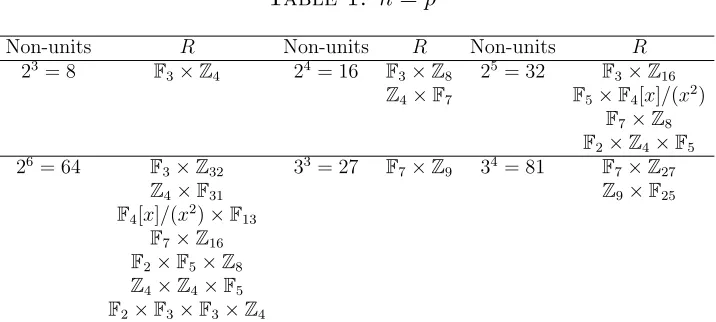
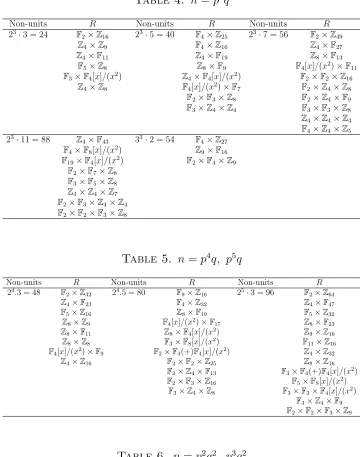
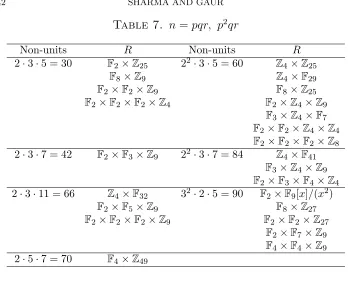
In this section, we present tables listing all non-reduced decompos-able rings R = Qki=1Ri (up to cardinalities of constituent local rings Ri’s) having n non-units, where 2 ≤ n ≤ 100. For n = 1, we have a
field, which is a reduced ring. Next, if n =ps, where p is prime and s
is a positive integer, then by [2, Theorem 2], we have either local rings of order pt, 0 < s < t or reduced ring for 1 ≤ s < 3. For s ≥ 3, we have non-reduced decomposable rings listed in the table:
Table 1. n=ps
Non-units R Non-units R Non-units R
23= 8
F3×Z4 24= 16 F3×Z8 25 = 32 F3×Z16 Z4×F7 F5×F4[x]/(x2)
F7×Z8 F2×Z4×F5
26= 64
F3×Z32 33= 27 F7×Z9 34 = 81 F7×Z27
Z4×F31 Z9×F25
F4[x]/(x2)×F13 F7×Z16 F2×F5×Z8 Z4×Z4×F5 F2×F3×F3×Z4
Now, suppose n is not a prime power. First we consider simple prime factorization n =pq. We may also assume that p < q. Then by Proposition2.1, there does not exist a non-reduced ring with|J(R)|=
q. Let us find a non-reduced ring with|J(R)|=p. Now, if |J(R)|=p, then the equation (2.1) becomes
q=p k−1 Y
i=1 pαi
i −(p−1) k−1 Y
i=1
(pαi
i −1) (3.1)
Thus, for the existence of a non-reduced ring with pq non-units and
Suppose n = 2·3 = 6. Sincen ≤23−1, by [7, Proposition 2.1], we have k≤2. Thus, the equation (3.1) becomes
3 = pα1
1 + 1.
This implies thatp1 = 2 andα1 = 1. ThusF2×Z4 is non-reduced ring
with n = 6 and|J(R)|= 2.
By applying the same argument ton∈ {22,38,51,69,74,78,82,94,95}, we conclude that there does not exist a non-reduced ring with n non-units.
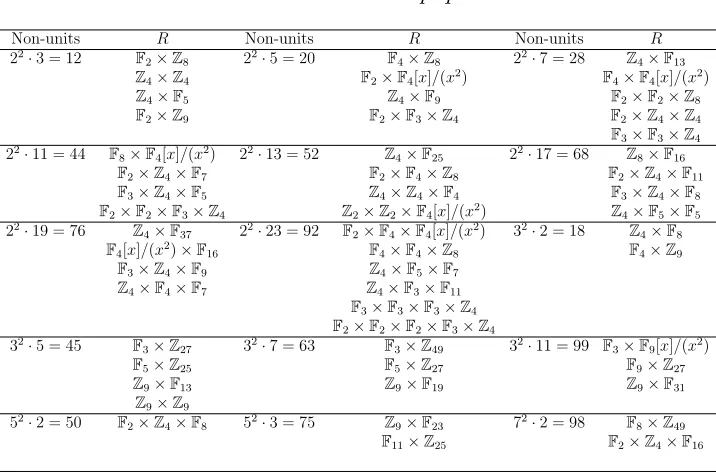
We now give a list of non-reduced decomposable rings with n (2≤ n ≤ 100) non-units, where n 6∈ {22,38,51,69,74,78,82,94,95} and is not a prime power.
Table 2. n=pq
Non-units R Non-units R Non-units R
2·3 = 6 F2×Z4 2·5 = 10 Z4×F4 2·7 = 14 F2×F2×Z4 2·13 = 26 F2×F4×Z4 2·17 = 34 Z4×F16 2·23 = 46 Z4×F4×F4 2·29 = 58 F2×F2×Z4×F4 2·31 = 62 F2×F2×F2×F2×Z4 2·43 = 86 F4×Z4×F8
3·5 = 15 F3×Z9 3·7 = 21 F5×Z9 3·11 = 33 F9×Z9 3·13 = 39 Z9×F11 3·19 = 57 Z9×F17 3·29 = 87 Z9×F27
F3×F3×Z9 F3×F5×Z9 3·31 = 93 Z9×F29 5·7 = 35 F3×Z25 5·11 = 55 F7×Z25 5·13 = 65 F9×Z25 5·17 = 85 F13×Z25 7·11 = 77 F5×Z49 7·13 = 91 F7×Z49
Table 3. n =p2q
Non-units R Non-units R Non-units R
22·3 = 12
F2×Z8 22·5 = 20 F4×Z8 22·7 = 28 Z4×F13
Z4×Z4 F2×F4[x]/(x2) F4×F4[x]/(x2)
Z4×F5 Z4×F9 F2×F2×Z8
F2×Z9 F2×F3×Z4 F2×Z4×Z4
F3×F3×Z4 22·11 = 44
F8×F4[x]/(x2) 22·13 = 52 Z4×F25 22·17 = 68 Z8×F16
F2×Z4×F7 F2×F4×Z8 F2×Z4×F11
F3×Z4×F5 Z4×Z4×F4 F3×Z4×F8
F2×F2×F3×Z4 Z2×Z2×F4[x]/(x2) Z4×F5×F5 22·19 = 76
Z4×F37 22·23 = 92 F2×F4×F4[x]/(x2) 32·2 = 18 Z4×F8
F4[x]/(x2)×F16 F4×F4×Z8 F4×Z9
F3×Z4×F9 Z4×F5×F7
Z4×F4×F7 Z4×F3×F11
F3×F3×F3×Z4
F2×F2×F2×F3×Z4 32·5 = 45
F3×Z27 32·7 = 63 F3×Z49 32·11 = 99 F3×F9[x]/(x2)
F5×Z25 F5×Z27 F9×Z27
Z9×F13 Z9×F19 Z9×F31
Z9×Z9 52·2 = 50
F2×Z4×F8 52·3 = 75 Z9×F23 72·2 = 98 F8×Z49
Table 4. n =p3q
Non-units R Non-units R Non-units R 23·3 = 24
F2×Z16 23·5 = 40 F4×Z25 23·7 = 56 F2×Z49
Z4×Z9 F4×Z16 Z4×F27
Z4×F11 Z4×F19 Z8×F13
F5×Z8 Z8×F9 F4[x]/(x2)×F11 F3×F4[x]/(x2) Z4×F4[x]/(x2) F2×F2×Z16
Z4×Z8 F4[x]/(x2)×F7 F2×Z4×Z8 F2×F3×Z8 F2×Z4×F9 F3×Z4×Z4 F3×F3×Z8 Z4×Z4×Z4 F4×Z4×Z5
23·11 = 88
Z4×F43 33·2 = 54 F4×Z27 F4×F8[x]/(x2) Z9×F16 F19×F4[x]/(x2) F2×F4×Z9
F2×F7×Z8 F3×F5×Z8 Z4×Z4×Z7 F2×F3×Z4×Z4 F2×F2×F3×Z8
Table 5. n =p4q, p5q
Non-units R Non-units R Non-units R
24.3 = 48
F2×Z32 24.5 = 80 F9×Z16 25·3 = 96 F2×Z64
Z4×F23 F4×Z32 Z4×F47
F5×Z16 Z8×F19 F5×Z32
Z8×Z9 F4[x]/(x2)×F17 Z8×F23
Z8×F11 Z8×F4[x]/(x2) Z9×Z16
Z8×Z8 F3×F8[x]/(x2) F11×Z16
F4[x]/(x2)×F9 F2×F4(+)F4[x]/(x2) Z4×Z32
Z4×Z16 F2×F2×Z25 Z8×Z16
F2×Z4×F13 F3×F4(+)F4[x]/(x2)
F2×F3×Z16 F5×F8[x]/(x2)
F3×Z4×Z8 F3×F3×F4[x]/(x2)
F4×Z4×F9
F2×F2×F3×Z9
Table 6. n =p2q2, p3q2
Non-units R Non-units R Non-units R
22·32= 36
F2×Z27 22·52= 100 Z4×F49 23·32= 72 Z4×Z27
Z4×F17 F16×Z25 F8×Z16
F8×Z8 F2×F8×Z8 F4[x]/(x2)×Z9
Z4×F3×F4 Z4×Z4×F8 Z8×F17
F2×F2×Z4×F7 F2×F8[x]/(x2)
F3×F4×Z9
F3×F4×Z8
F2×F3×F4[x]/(x2)
Table 7. n=pqr, p2qr
Non-units R Non-units R
2·3·5 = 30 F2×Z25 22·3·5 = 60 Z4×Z25
F8×Z9 Z4×F29
F2×F2×Z9 F8×Z25
F2×F2×F2×Z4 F2×Z4×Z9
F3×Z4×F7
F2×F2×Z4×Z4
F2×F2×F2×Z8
2·3·7 = 42 F2×F3×Z9 22·3·7 = 84 Z4×F41
F3×Z4×Z9
F2×F3×F4×Z4
2·3·11 = 66 Z4×F32 32·2·5 = 90 F2×F9[x]/(x2)
F2×F5×Z9 F8×Z27
F2×F2×F2×Z9 F2×F2×Z27
F2×F7×Z9
F4×F4×Z9
2·5·7 = 70 F4×Z49
4. Center and Median
4.1. Center. We begin this section with the following definition from [1].
Definition 4.1. Center: The set of vertices with minimum eccentric-ity of a graph Gis called the center of G. It is denoted byCenter(G).
Note that ifR is a commutative ring with nonzero identity having n
non-units, then maximal graph Γ(R) has n vertices. As Γ(R) may be a complete graph for some n, we have the following inequality:
1≤ |Center(Γ(R))| ≤n (4.1)
In the view of (6), the following question may arises:
Question 4.2. Given a positive integer n do there exist maximal graphs Γ(R) of order n such that
(1) |Center(Γ(R))| attains the bounds in the Inequality (6)? (2) 1<|Center(Γ(R))|< n?
Note that for any maximal graph Γ(R) of ordern, the following are equivalent:
(iii) R is a local ring.
Similarly, the following are equivalent: (i) |Center(Γ(R))|= 1.
(ii) There exists exactly one vertexv ∈V((Γ(R))) such thatdeg(v) =
n−1.
(iii) R is a reduced ring.
Therefore, for 1 < |Center(Γ(R))| < n, R must be a non-reduced and non-local ring.
If n = ps, where p is prime and s is a positive integer, then by [5,
Theorem 3], there exists a local ringRwith maximal ideal of cardinality
psand hence|Center(Γ(R))|=ps. Ifnis not a prime power, then there is no ring R with n non-units and |Center(Γ(R))|=n.
In [6], it was shown that for 1 ≤n ≤7500, there always exist a re-duced ring exceptn ∈ {2,1206,1210,1806,3342,5466,6462,6534,6546,
7430}. Thus for 1 ≤n ≤7500,n 6∈ {2,1206,1210,1806,3342,5466,6462,
6534,6546,7430} there always exist ring R such that Γ(R) is of order
n and |Center(Γ(R))|= 1.
In general, we cannot say that there always exist a maximal graph whose center attains the value between the bounds, that is, there exists a non-reduced ring having n non-units. However, from the list given in Section 3, we conclude that there does not exist a ring
R for which Γ(R) is of order n and 1 < |Center(Γ(R))| < n for
n ∈ {22, 38, 51, 69, 74, 78, 82, 94, 95}. Clearly, for all the rings R
listed in Section 3, we have 1 <|Center(Γ(R))|< n.
4.2. Median. LetGbe a connected graph. For any vertex xofG, the status ofx, is the sum of the distances fromxto all the other vertices of
G, and is denoted bys(x), that is, s(x) =P
{d(x, y) :y∈V(G)}. The set of vertices with minimal status is called the median of the graph. If G has no edges, then we shall say the median ofG isV(G).
Although both the center and the median relate to the topic of cen-trality in a graph, they need not coincide. One can easily construct examples where the center is a proper subset of the median, or the median is a proper subset of the center. In general, finding the median of a graph is more involved than finding the center. However, the fol-lowing theorem gives a relationship between the center and median, in the case of maximal graphs of finite commutative rings with identity.
Theorem 4.3. Let R be a finite commutative ring with nonzero iden-tity. Then the median and center of Γ(R) are equal.
for all x∈V(Γ(R))\J(R), s(x)≥n. Since Center(Γ(R)) =J(R), by [4, Proposition 2.8], the result follows.
Remark 4.4. Note that Center(Γ(R)) = J(R) = M edian(Γ(R)), by Theorem 4.3 and [4, Proposition 2.8].
Acknowledgements
The first author was supported by a grant from CSIR India, No. 09/045 (1142)/2011-EMR-I and the second author was supported by R & D grant, University of Delhi, Delhi. The authors would like to thank the referee for the careful reading.
References
1. R. Balakrishnan and K. Ranganathan, A Textbook of Graph Theory, Springer, 2012.
2. M. Behboodi and R. Beyranvand,On the Structure of Commutative Rings with pk1
1 · · ·pknn (1≤ki ≤7) Zero-Divisors, Eur. J. Pure Appl. Math., (2) 3(2010),
303-316.
3. A. Gaur and A. Sharma,Maximal graph of a commutative ring, Int. J. Algebra, (12)7(2013), 581-588.
4. A. Gaur and A. Sharma, Eulerian graphs and automorphisms of a maximal graph, Indian J. Pure Appl. Math., (2)48(2017), 233-244.
5. R. Gilmer, Zero-divisors in commutative rings, Amer. Math. Monthly, (5) 93 (1986), 382-387.
6. S. P. Redmond, Counting zero-divisors, In: Lee, J., ed. Commutative Rings: New Research. Hauppauge, NY: Nova Science Publishers, 2009.
7. S. P. Redmond, On zero-divisor graphs of small finite commutative rings, Dis-crete Math.,307(2007), 1155–1166.
Arti Sharma
Department of Mathematics, University of Delhi, Delhi, India.
Email: [email protected]
Atul Gaur
Department of Mathematics, University of Delhi, Delhi, India.