journal homepage: http://jac.ut.ac.ir
Theta Graph Designs
Anthony D. Forbes
∗1, Terry S. Griggs
†2and Tamsin J. Forbes
‡31,2Department of Mathematics and Statistics, The Open University, Milton Keynes MK7 6AA,
UK.
322 St Albans Road, Kingston upon Thames KT2 5HQ, UK.
ABSTRACT ARTICLE INFO
We solve the design spectrum problem for all theta graphs with 10, 11, 12, 13, 14 and 15 edges.
Article history:
Received 30, August 2016 Received in revised form 10, April 2017
Accepted 3 May 2017
Available online 01, June 2017
Keyword: Graph design; Graph decomposition; Theta graph.
AMS subject Classification: 05C51
1
Introduction
Let G be a simple graph. If the edge set of a simple graph K can be partitioned into edge sets of graphs each isomorphic to G, we say that there exists adecomposition of K
into G. In the case where K is the complete graph Kn, we refer to the decomposition as
a G designof order n. The spectrum of G is the set of non-negative integersn for which there exists a Gdesign of ordern. For completeness we remark that the empty set is aG
design of order 0 as well as 1; these trivial cases will usually be omitted from discussion henceforth. A complete solution of the spectrum problem often seems to be very difficult. However it has been achieved in many cases, especially amongst the smaller graphs. We
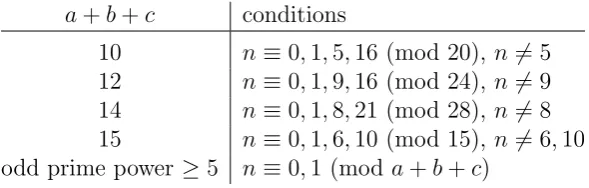
Table 1: Design existence conditions for theta graphs
a+b+c conditions
10 n≡0,1,5,16 (mod 20), n 6= 5 12 n≡0,1,9,16 (mod 24), n 6= 9 14 n≡0,1,8,21 (mod 28), n 6= 8 15 n≡0,1,6,10 (mod 15), n 6= 6,10 odd prime power≥5 n≡0,1 (mod a+b+c)
refer the reader to the survey article of Adams, Bryant and Buchanan, [2], and, for more up to date results, the Web site maintained by Bryant and McCourt, [5].
A theta graph Θ(a, b, c), 1 ≤a≤b≤c,b ≥2 is the graph witha+b+c−1 vertices and
a+b+c edges that consists of three paths of lengthsa, b and cwith common end points but internally disjoint. Each of the two common end points of the paths has degree 3 and all other vertices have degree 2. Observe that Θ(a, b, c) is bipartite ifa ≡b≡c(mod 2), tripartite otherwise.
The aim of this paper is to establish the design spectrum for every theta graph with 10, 11, 12, 13, 14 or 15 edges. The design spectra for all theta graphs with 9 or fewer edges have been determined, [4]. Also there are some partial results for Θ(1, b, b), odd b > 1, [3], and it is known that there exists a Θ(a, b, c) design of order 2(a+b+c) + 1, [10]. See [2, Section 5.5], specifically Theorems 5.9 and 5.10, for details and further references. For convenience, we record the main result of [10] as follows.
Theorem 1.1. (Punnim & Pabhapote) If 1≤a≤b ≤c and b≥2, then there exists a Θ(a, b, c) design of order 2(a+b+c) + 1.
It is clear that a Θ(a, b, c) design of ordern can exist only if (i)n≤1, or n≥a+b+c−1, and (ii) n(n−1)≡0 (mod 2(a+b+c)). These necessary conditions are determined by elementary counting and given explicitly in Table 1 for some values of a+b+c. In this paper we show that the conditions are sufficient for n = 10, 11, 12, 13, 14 and 15. We state our results formally.
Theorem 1.2. Designs of order n exist for all theta graphs Θ(a, b, c) with a+b+c= 10
if and only if n ≡0,1,5 or 16 (mod 20) and n6= 5.
Theorem 1.3. Designs of order n exist for all theta graphs Θ(a, b, c) with a+b+c= 11
if and only if n ≡0 or 1 (mod 11).
Theorem 1.4. Designs of order n exist for all theta graphs Θ(a, b, c) with a+b+c= 12
if and only if n ≡0,1,9 or 16 (mod 24) and n6= 9.
Theorem 1.5. Designs of order n exist for all theta graphs Θ(a, b, c) with a+b+c= 13
Theorem 1.6. Designs of order n exist for all theta graphs Θ(a, b, c) with a+b+c= 14
if and only if n ≡0,1,8 or 21 (mod 28) and n6= 8.
Theorem 1.7. Designs of order n exist for all theta graphs Θ(a, b, c) with a+b+c= 15
if and only if n ≡0, 1, 6 or 10 (mod 15) and n6= 6, 10.
2
Constructions
We use Wilson’s fundamental construction involving group divisible designs, [12]. Recall that aK-GDD of typegt1
1 . . . gtrr is an ordered triple (V,G,B) whereV is a set of cardinality
v =t1g1+· · ·+trgr,G is a partition ofV intoti subsets each of cardinalitygi,i= 1, . . . , r,
called groups and B is a collection of subsets of cardinalities k ∈ K, called blocks, which collectively have the property that each pair of elements from different groups occurs in precisely one block but no pair of elements from the same group occurs at all. A {k} -GDD is also called a k-GDD. As is well known, whenever q is a prime power there exists a q-GDD of type qq and a (q+ 1)-GDD of type qq+1 (arising from affine and projective planes of order q respectively). A parallel class in a group divisible design is a subset of the block set in which each element of the base set appears exactly once. A k-GDD is called resolvable, and denoted by k-RGDD, if the entire set of blocks can be partitioned into parallel classes.
Propositions 2.1 and 2.2 are for dealing with bipartite graphs, the latter being used only for 15-edge bipartite theta graphs, where a suitable decomposition of the form Kdr,ds is
not available. Propositions 2.3 to 2.8 deal with tripartite graphs.
Proposition 2.1. Let d, f, r and s be positive integers, let g be a non-negative integer, and let e = 0 or 1. Suppose there exist G designs of orders f drs+e and gds+e, and suppose there exists a decomposition into G of the complete bipartite graph Kdr,ds. Then
there exist G designs of order tf drs+gds+e for integers t ≥0.
Proof If t = 0, there is nothing to prove; so we may assume t ≥ 1. Let g = 0 and use induction on t. Assume there exists a Gdesign of order tf drs+e for somet≥1. Take a complete bipartite graph Ktf s,f r and inflate the first part by a factor dr and the second
part by a factor ofds, so that the edges becomeKdr,dsgraphs. Ife= 1, add an extra point,
∞. Overlay the inflated parts, together with ∞ when e= 1, with Ktf drs+e orKf drs+e as
appropriate. The result is a complete graph K(t+1)f drs+e which admits a decomposition
into G since there exist decompositions into G of the components, Ktf drs+e, Kf drs+e and
Kdr,ds.
For g ≥ 1, the same construction but starting with a complete bipartite graph Ktf s,g
yields a design of order Ktf drs+gds+e since we may now assume that there exists a design
of order tf drs+e.
Proposition 2.2. Let r and s be not necessarily distinct positive integers, and let e = 0
Then there exist G designs of order tr+s+e for integers t≥0.
Proof If t = 0, there is nothing to prove; so we may assume t ≥ 1. Start with the graph Kt+1, inflate one point by a factor of s and all others by r so that the original edges become Kr,s graphs and, when t ≥ 2, Kr,r graphs. Add a new point, ∞, if e = 1.
Overlay the r-inflated parts together with ∞ if e = 1 by Kr+e. Overlay the s-inflated
part together with ∞ if e = 1 by Ks+e. The result is a graph Ktr+s+e which admits a
decomposition into G.
Proposition 2.3. Let p be a positive integer. Suppose there exist G designs of orders p,
p+ 1, 2p and2p+ 1. Suppose also there exist decompositions intoG of Kp,p,p, Kp,p,p,p and
Kp,p,p,p,p. Then there exist G designs of order n for n ≡0,1 (mod p).
Proof It is known that there exists a{3,4,5}-GDD of type 1t for t≥3,t6= 6,8; see [1].
Inflate each point of the GDD by a factor of p, thus expanding the blocks to complete multipartite graphs Kp,p,p, Kp,p,p,p and Kp,p,p,p,p. Let e = 0 or 1. If e = 1, add an extra
point, ∞. Overlay each inflated group, together with ∞ if e = 1, with Kp+e. Since a
design of order p+e and decompositions into Gof Kp,p,p, Kp,p,p,p and Kp,p,p,p,p exist, this
construction creates a design of orderpt+e for t≥3, t6= 6,8.
For order 6p+e, use a p-inflated 3-GDD of type 23, plus an extra point if e = 1, with decompositions into G of K2p+e and Kp,p,p. Similarly, for order 8p+e, use a 3-GDD of
type 24 instead.
Proposition 2.4. Let p be a positive integer, let f = 0 or 1 and write f0 for 1−f. Suppose there exist G designs of orders 3p+f0, 4p, 4p+ 1, 5p+f, 7p+f0, 8p, 8p+ 1,
9p+f, 11p+f0, 13p+f and suppose there exist decompositions intoGof Kp,p,p,p, Kp,p,p,p,p,
Kp,p,p,p,3p and Kp,p,p,p,4p, K2p,2p,2p and K4p,4p,4p,5p. Then there exist G designs of order n
for n≡0,1, p+f,3p+f0 (mod 4p), n6=p+f.
Proof Start with a 4-RGDD of type 43t+1, t ≥1, [8]; see also [9]. There are 4t parallel classes. Let x, y, z ≥ 0 and w=x+y+z ≤ 4. If w >0, add a new group of size w and adjoin each point of this new group to all blocks of a parallel class to create a{4,5}-GDD of type 43t+1w1, t ≥ 1, which degenerates to a 5-GDD of type 45 if t = 1 and w= 4. In the new group inflate x points by a factor of p, y points by a factor of 3p and z points by a factor of 4p. Inflate all points in the other groups by a factor of p. So the original blocks become Kp,p,p,p graphs, and new ones Kp,p,p,p,p or Kp,p,p,p,3p or Kp,p,p,p,4p graphs.
Either overlay the groups with K4p and, if w > 0, Kpx+3py+4pz, or add a new point and
overlay with K4p+1 and, if w > 0, Kpx+3py+4pz+1. Using decompositions into G of K4p,
K4p+1,Kp,p,p,p,Kp,p,p,p,p,Kp,p,p,p,3p and Kp,p,p,p,4p this construction yields a design of order
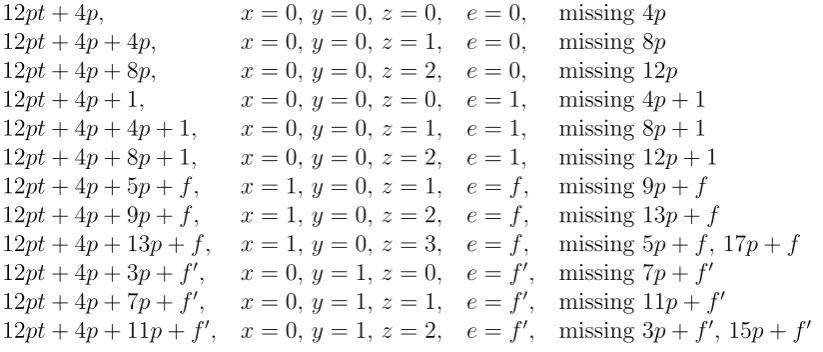
12pt+ 4p+px+ 3py + 4pz+e if t ≥ 1, where e = 0 or 1, whenever a design of order
px+ 3py+ 4pz+e exists.
Table 2: The construction for Proposition 2.4
12pt+ 4p, x= 0, y= 0, z = 0, e= 0, missing 4p
12pt+ 4p+ 4p, x= 0, y= 0, z = 1, e= 0, missing 8p
12pt+ 4p+ 8p, x= 0, y= 0, z = 2, e= 0, missing 12p
12pt+ 4p+ 1, x= 0, y= 0, z = 0, e= 1, missing 4p+ 1 12pt+ 4p+ 4p+ 1, x= 0, y= 0, z = 1, e= 1, missing 8p+ 1 12pt+ 4p+ 8p+ 1, x= 0, y= 0, z = 2, e= 1, missing 12p+ 1 12pt+ 4p+ 5p+f, x= 1, y= 0, z = 1, e=f, missing 9p+f
12pt+ 4p+ 9p+f, x= 1, y= 0, z = 2, e=f, missing 13p+f
12pt+ 4p+ 13p+f, x= 1, y= 0, z = 3, e=f, missing 5p+f, 17p+f
12pt+ 4p+ 3p+f0, x= 0, y= 1, z = 0, e=f0, missing 7p+f0
12pt+ 4p+ 7p+f0, x= 0, y= 1, z = 1, e=f0, missing 11p+f0
12pt+ 4p+ 11p+f0, x= 0, y= 1, z = 2, e=f0, missing 3p+f0, 15p+f0
given are handled independently as follows. See [7, Tables 4.3 and 4.10] for lists of small 3- and 4-GDDs.
For 12p+e, use decompositions of K4p+e and K2p,2p,2p with a 2p-inflated 3-GDD of type
23 plus an extra point if e= 1.
For 15p+f0, use decompositions of K3p+f0 and Kp,p,p,p with a p-inflated 4-GDD of type
35 plus an extra point if f0 = 1.
For 17p+f, use decompositions of K4p+f, K5p+f, K4p,4p,4p,5p with the trivial 4-GDD of
type 14 plus an extra point if f = 1.
Proposition 2.5. Suppose there exist G designs of orders 16, 20, 21, 25, 36, 40, 41,
45, 56, 65 and suppose there exist decompositions into G of K10,10,10, K5,5,5,5, K20,20,20,25,
K5,5,5,5,5,K5,5,5,5,15andK5,5,5,5,20. Then there existGdesigns of ordernforn≡0,1,5,16 (mod 20), n6= 5.
Proof Use Proposition 2.4 with p= 5 andf = 0.
Proposition 2.6. Suppose there exist G designs of orders 16, 24, 25, 33, 40, 49, 57, 81
and suppose there exist decompositions into G of K8,8,8, K8,8,8,8 and K8,8,8,24. Then there
exist G designs of order n for n ≡0,1,9,16 (mod 24), n 6= 9.
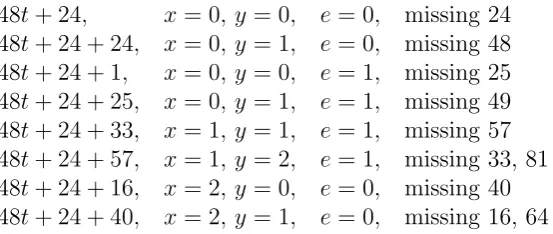
Table 3: The construction for Proposition 2.6
48t+ 24, x= 0, y= 0, e= 0, missing 24 48t+ 24 + 24, x= 0, y= 1, e= 0, missing 48 48t+ 24 + 1, x= 0, y= 0, e= 1, missing 25 48t+ 24 + 25, x= 0, y= 1, e= 1, missing 49 48t+ 24 + 33, x= 1, y= 1, e= 1, missing 57 48t+ 24 + 57, x= 1, y= 2, e= 1, missing 33, 81 48t+ 24 + 16, x= 2, y= 0, e= 0, missing 40 48t+ 24 + 40, x= 2, y= 1, e= 0, missing 16, 64
new point and overlay the groups withK25 and possiblyK8x+24y+1. Using decompositions into G of K24, K25, K8,8,8, K8,8,8,8 and K8,8,8,24 this construction yields a design of order 48t+ 24 + 8x+ 24y+e,t≥1, e= 0 or 1, whenever a design of order 8x+ 24y+e exists. As illustrated in Table 3, all design orders n ≡ 0,1,9,16 (mod 24), n 6= 9, are covered except for those values indicated as missing. The missing values not assumed as given in the statement of the proposition, namely 48 and 64, are constructed using decompositions of K16 and K8,8,8 with an 8-inflated 3-GDD of type 23 for 48, or type 24 for 64.
Proposition 2.7. Suppose there exist G designs of orders 21, 28, 29, 36, 49, 56, 57,
64, 77, 92 and suppose there exist decompositions into G of K14,14,14, K7,7,7,7, K28,28,28,35,
K7,7,7,7,7,K7,7,7,7,21andK7,7,7,7,28. Then there existGdesigns of ordernforn≡0,1,8,21 (mod 28), n6= 8.
Proof Use Proposition 2.4 with p= 7 andf = 1.
Proposition 2.8. Suppose there exist G designs of orders 15, 16, 21, 25, 30, 31, 36, 40,
51, 55, 66 and 70, and suppose there exist decompositions into G of K5,5,5 and K5,5,5,5.
Then there exist G designs of order n for n≡0,1,6,10 (mod 15), n6= 6,10.
Proof Start with a 3-RGDD of type 32t+1, t≥1, [11] (see also [9]), which has 3t parallel classes. Letw≥0,w≤3t, and ifw >0, add a new group of sizewand adjoin each point of this new group to all blocks of a parallel class to create a {3,4}-GDD of type 32t+1w1. This degenerates to a 4-GDD of type 34 if t = 1 and w= 3. Inflate all points by a factor of 5, so that the original blocks become K5,5,5 graphs and new ones K5,5,5,5 graphs. Let e= 0 or 1, and if e= 1, add a new point, ∞. Overlay each group, including ∞ if e = 1, with K15+e or K5w+e, as appropriate. Using decompositions of K15+e, K5,5,5, and K5,5,5,5 this construction yields a design of order 30t+ 15 + 5w+e,t ≥w/3,e= 0 or 1, whenever a design of order 5w+e exists.
Table 4: The construction for Proposition 2.8
30t+ 15, w= 0, e= 0, t≥1, missing 15 30t+ 15 + 15, w= 3, e= 0, t≥1, missing 30 30t+ 15 + 1, w= 0, e= 1, t≥1, missing 16 30t+ 15 + 16, w= 3, e= 1, t≥1, missing 31 30t+ 15 + 21, w= 4, e= 1, t≥2, missing 36, 66
30t+ 15 + 36, w= 7, e= 1, t≥3, missing 21, 51, 81, 111 30t+ 15 + 25, w= 5, e= 0, t≥2, missing 40, 70
30t+ 15 + 40, w= 8, e= 0, t≥3, missing 25, 55, 85, 115
For 81, use decompositons of K21 and K5,5,5 with a 5-inflated 3-GDD of type 44 and an extra point.
For 85, use decompositons of K15, K25 and K5,5,5 with a 5-inflated 3-GDD of type 3451. For 111, use decompositons of K21, K31 and K5,5,5 with a 5-inflated 3-GDD of type 4461 and an extra point.
For 115, use decompositons ofK15,K25andK5,5,5with a 5-inflated 3-GDD of type 3154.
3
Proofs of the theorems
We deal with each of the theta graphs stated in the theorems. The lemmas in this section assert the existence of specific graph designs and decompositions of multipartite graphs. These are used as ingredients for the propositions of Section 2 to construct the decompositions of complete graphs required to prove the theorems. With a few exceptions, the details of the decompositions that constitute the proofs of the lemmas have been deferred to sections in the rather lengthy Appendix to this paper. If absent, the Appendix may be obtained from the ArXiv (identifier 1703.01483), or by request from the first author. In the presentation of our results we represent Θ(a, b, c) by a subscripted ordered (a+b+c−1)-tuple (v1, v2, . . . , va+b+c−1)Θ(a,b,c), wherev1 and v2 are the vertices of degree 3 and the three paths are
(i) (v1, v2) ifa= 1, (v1, v3, . . . , va+1, v2) if a≥2, (ii) (v1, va+2, . . . , va+b, v2),
(iii) (v1, va+b+1, . . . , va+b+c−1, v2).
If a graph G has e edges, the numbers of occurrences of G in a decomposition into G of the complete graphKn, the completer-partite graphKnr and the complete (r+ 1)-partite
graph Knrm1 are respectively
n(n−1) 2e ,
n2r(r−1)
2e and
nr(n(r−1) + 2m)
The number of theta graphs witheedges isbe2/12−1/2cof whichbe2/48+(e mod 2)(e−8)/8+ 1/2c are bipartite; see [6] for example.
All decompositions were created by a computer program written in the C language, and a
Mathematicaprogram provided final assurance regarding their correctness. Most of the
decompositions were obtained without difficulty. However, there were a few that seemed to present a challenge, notably K20 for theta graphs of 10 edges, K24 for theta graphs of 12 edges and K30 for theta graphs of 15 edges. So, for these three cases, it is appropriate to include the decomposition details in the main body of the paper.
Lemma 3.1. There exist Θ(a, b, c) designs of orders 16, 20 and 25 for a+b+c = 10. There exist Θ(a, b, c) designs of orders 36, 40, 41, 45, 56, 65 for a+b+c= 10 with a, b,
c not all even.
Proof There are seven theta graphs of which two are bipartite. We present designs of order 20 here; the remaining decompositions are presented in the Appendix.
K20 Let the vertex set be Z20. The decompositions consist of the graphs
(4,17,0,9,7,1,12,15,13)Θ(1,2,7), (11,17,18,10,1,13,3,7,16)Θ(1,2,7), (1,6,18,14,11,12,2,0,15)Θ(1,2,7),
(12,4,10,18,0,8,15,3,11)Θ(1,2,7), (6,2,8,11,19,7,0,14,16)Θ(1,2,7), (2,4,18,7,15,10,14,8,16)Θ(1,2,7), (6,12,0,10,16,3,18,14,19)Θ(1,2,7),
(0,1,9,18,12,15,4,3,5)Θ(1,3,6), (0,7,17,5,10,14,12,8,2)Θ(1,3,6), (8,6,14,1,13,3,17,4,19)Θ(1,3,6),
(3,15,2,1,11,17,18,7,6)Θ(1,3,6), (3,7,14,11,19,5,6,18,10)Θ(1,3,6), (7,19,15,18,13,14,2,10,11)Θ(1,3,6), (15,19,11,2,14,6,3,9,10)Θ(1,3,6),
(0,2,3,6,9,11,10,14,8)Θ(1,4,5), (17,2,7,12,13,9,0,18,11)Θ(1,4,5), (6,11,5,3,17,18,8,0,7)Θ(1,4,5),
(8,12,13,15,16,4,3,11,9)Θ(1,4,5), (1,8,3,15,7,16,13,0,5)Θ(1,4,5), (1,17,5,7,19,4,9,16,0)Θ(1,4,5), (12,17,5,9,13,11,19,0,4)Θ(1,4,5),
(2,1,8,10,18,7,12,0,6)Θ(2,2,6), (10,15,7,8,12,11,6,13,5)Θ(2,2,6), (10,8,11,9,0,16,7,14,17)Θ(2,2,6),
(5,1,7,3,8,13,11,17,15)Θ(2,2,6), (1,9,4,5,19,3,7,13,15)Θ(2,2,6), (5,17,0,19,11,9,13,16,1)Θ(2,2,6), (9,17,3,12,7,11,15,19,13)Θ(2,2,6),
(0,5,18,2,10,4,9,8,17)Θ(2,3,5), (13,5,2,11,9,3,7,6,12)Θ(2,3,5), (7,6,0,1,15,2,12,9,10)Θ(2,3,5),
(11,3,12,16,15,0,8,7,4)Θ(2,3,5), (3,7,10,0,15,8,16,4,19)Θ(2,3,5), (7,19,16,14,11,12,4,15,2)Θ(2,3,5), (11,19,8,3,6,18,15,12,0)Θ(2,3,5),
(8,2,7,5,13,9,4,18,17)Θ(2,4,4), (18,6,10,9,8,0,7,17,4)Θ(2,4,4), (13,11,15,8,18,0,10,3,5)Θ(2,4,4),
(7,3,6,13,4,11,15,0,9)Θ(2,4,4), (3,7,0,2,19,4,8,11,10)Θ(2,4,4),
(15,10,18,13,6,12,11,0,8)Θ(3,3,4), (0,11,16,3,17,8,10,1,5)Θ(3,3,4), (5,7,0,13,3,8,17,19,14)Θ(3,3,4),
(6,18,7,17,13,12,0,1,2)Θ(3,3,4), (6,10,5,4,14,18,2,16,17)Θ(3,3,4), (10,14,9,8,11,1,2,3,13)Θ(3,3,4), (14,18,10,6,15,5,2,9,19)Θ(3,3,4)
under the action of the mapping x 7→ x+ 4 (mod 20) for only the first three graphs in each design.
Lemma 3.2. There exist decompositions into Θ(a, b, c) of the complete bipartite graph
K10,5 for a+b+c= 10 with a, b, c all even. There exist decompositions into Θ(a, b, c)
of the complete multipartite graphs K10,10,10, K5,5,5,5, K20,20,20,25, K5,5,5,5,5, K5,5,5,5,15 and K5,5,5,5,20 for a+b+c= 10 with a, b, c not all even.
Proof The decompositions are presented in the Appendix.
Theorem 1.2 for Θ(a, b, c) with a+b+c= 10 follows from Theorem 1.1, Lemmas 3.1 and 3.2, and Proposition 2.1 (with d= 5, r = 2, s = 1, f = 2 and g = 0, 3 or 5) if a, b and c
are all even, Proposition 2.5 otherwise.
Lemma 3.3. There existΘ(a, b, c) designs of orders 11and 12 for a+b+c= 11. There exists a Θ(a, b, c) design of order 22 for a+b+c= 11 with a, b, c not all odd.
Proof There are nine theta graphs of which three are bipartite. The decompositions are presented in the Appendix.
Lemma 3.4. There exist decompositions into Θ(a, b, c) of the complete bipartite graph
K11,11 fora+b+c= 11 with a, b, call odd. There exist decompositions into Θ(a, b, c) of
the complete multipartite graphs K11,11,11, K11,11,11,11 and K11,11,11,11,11 for a+b+c= 11
with a, b, c not all odd.
Proof The decompositions are presented in the Appendix.
Theorem 1.3 for Θ(a, b, c) with a+b+c= 11 follows from Theorem 1.1, Lemmas 3.3 and 3.4, and Proposition 2.1 (with d= 11, r=s=f = 1 and g = 0) if a, b and care all odd, Proposition 2.3 otherwise.
Lemma 3.5. There exist Θ(a, b, c) designs of orders 16, 24 and 33 for a+b+c = 12. There exist Θ(a, b, c) designs of orders 40, 49, 57 and 81 for a+b+c= 12 with a, b, c
not all even.
Proof There are eleven theta graphs of which three are bipartite. We present designs of order 24 here; the remaining decompositions are presented in the Appendix.
K24 Let the vertex set be Z24. The decompositions consist of
(2,6,13,15,1,17,18,14,22,19,21)Θ(1,2,9), (10,7,1,3,21,8,14,9,19,16,13)Θ(1,2,9), (16,21,1,7,9,22,15,19,5,17,4)Θ(1,2,9), (18,4,10,21,17,14,16,6,11,12,19)Θ(1,2,9), (21,20,7,2,14,13,18,6,5,4,12)Θ(1,2,9), (21,12,13,22,10,5,15,20,16,3,9)Θ(1,2,9), (4,20,0,1,19,23,11,15,3,7,5)Θ(1,2,9), (4,23,13,8,15,12,7,0,11,17,20)Θ(1,2,9), (12,23,16,8,19,7,4,15,13,5,21)Θ(1,2,9),
(22,18,1,11,8,16,17,13,9,15,2)Θ(1,3,8), (9,20,10,22,1,3,21,4,19,12,2)Θ(1,3,8), (7,4,17,5,10,12,21,6,19,16,20)Θ(1,3,8), (16,2,3,9,21,22,0,18,13,15,11)Θ(1,3,8), (18,19,14,7,9,12,11,13,0,6,22)Θ(1,3,8), (12,7,16,11,17,22,4,15,10,13,6)Θ(1,3,8), (8,15,17,0,10,21,11,19,5,18,16)Θ(1,3,8), (5,21,13,7,15,6,11,3,22,9,0)Θ(1,3,8), (7,23,8,5,22,12,0,2,13,16,1)Θ(1,3,8), (8,23,1,14,20,6,17,15,7,9,16)Θ(1,3,8), (13,23,21,15,3,19,14,4,16,7,0)Θ(1,3,8),
(22,19,10,9,20,11,16,8,2,21,4)Θ(1,4,7), (19,9,3,21,18,14,1,7,2,20,4)Θ(1,4,7), (20,18,15,0,3,6,2,16,21,10,11)Θ(1,4,7), (21,0,7,20,22,14,18,16,15,3,13)Θ(1,4,7), (4,11,7,18,15,8,12,0,9,17,13)Θ(1,4,7), (4,1,22,13,15,18,2,9,11,7,0)Θ(1,4,7), (6,22,1,8,14,0,11,17,5,20,21)Θ(1,4,7), (7,9,15,14,6,22,8,19,1,13,21)Θ(1,4,7), (1,22,5,21,15,23,7,14,13,9,16)Θ(1,4,7), (6,23,7,13,5,16,3,9,14,17,22)Θ(1,4,7), (15,17,23,14,0,6,5,4,13,12,21)Θ(1,4,7),
(1,6,22,19,9,8,5,13,12,11,17)Θ(1,5,6), (0,7,9,17,19,4,8,3,16,2,21)Θ(1,5,6), (5,17,19,16,9,15,6,4,22,12,18)Θ(1,5,6), (3,15,22,16,12,10,21,8,20,9,4)Θ(1,5,6), (13,4,22,15,7,12,16,20,3,5,18)Θ(1,5,6), (15,1,16,6,22,10,0,2,19,18,21)Θ(1,5,6), (18,2,10,19,3,11,1,4,21,14,15)Θ(1,5,6), (5,7,0,18,15,11,12,9,2,6,10)Θ(1,5,6), (7,13,22,11,19,6,3,14,23,2,8)Θ(1,5,6), (10,23,14,18,22,5,17,20,13,15,19)Θ(1,5,6), (21,23,16,10,2,22,15,6,7,18,3)Θ(1,5,6),
(11,15,2,13,19,1,0,4,12,3,20)Θ(2,2,8), (16,13,18,1,21,17,4,14,15,0,10)Θ(2,2,8), (12,11,18,0,14,19,20,5,21,7,15)Θ(2,2,8), (13,3,17,14,20,18,15,19,22,0,8)Θ(2,2,8), (12,14,2,17,13,19,18,9,22,7,8)Θ(2,2,8), (13,20,7,0,3,1,15,8,5,22,17)Θ(2,2,8), (2,17,9,18,22,4,7,19,16,6,10)Θ(2,2,8), (14,2,6,10,18,22,15,3,0,17,1)Θ(2,2,8), (1,2,7,8,23,17,15,12,6,22,13)Θ(2,2,8), (9,10,15,16,7,14,22,8,11,23,18)Θ(2,2,8), (14,18,0,5,20,23,6,21,10,9,1)Θ(2,2,8),
(7,11,0,1,14,3,15,10,22,17,16)Θ(2,3,7), (1,20,15,17,3,8,18,5,22,14,4)Θ(2,3,7), (7,0,13,6,8,16,4,9,2,12,14)Θ(2,3,7), (10,14,13,1,5,2,3,21,19,17,18)Θ(2,3,7), (9,7,21,20,18,6,19,15,22,4,5)Θ(2,3,7), (1,3,19,4,10,16,13,21,2,6,0)Θ(2,3,7), (3,11,12,13,20,18,16,15,4,8,2)Θ(2,3,7), (13,15,17,4,7,8,10,19,20,0,18)Θ(2,3,7), (5,23,12,0,2,9,7,10,16,21,1)Θ(2,3,7), (15,21,12,6,11,23,20,7,22,3,4)Θ(2,3,7), (19,23,14,4,0,5,20,16,12,8,7)Θ(2,3,7),
(16,23,19,18,10,14,17,11,15,2,6)Θ(2,4,6),
(15,14,21,3,0,4,11,19,20,1,13)Θ(2,5,5), (14,0,18,15,2,4,19,8,16,1,5)Θ(2,5,5), (18,1,11,9,8,6,21,19,17,0,15)Θ(2,5,5), (10,21,2,13,5,19,8,7,14,0,20)Θ(2,5,5), (21,13,4,3,11,17,15,0,7,1,2)Θ(2,5,5), (19,22,10,21,7,15,11,14,12,18,1)Θ(2,5,5), (2,7,12,0,10,20,8,6,17,1,4)Θ(2,5,5), (10,18,8,15,6,12,4,14,9,20,23)Θ(2,5,5), (4,22,17,14,1,12,9,20,15,16,18)Θ(2,5,5), (7,12,22,2,16,4,15,20,6,14,23)Θ(2,5,5), (20,22,14,12,0,23,4,17,9,1,6)Θ(2,5,5),
(14,13,20,7,16,9,22,17,18,21,0)Θ(3,3,6), (21,9,3,5,22,18,2,16,1,17,19)Θ(3,3,6), (21,12,4,13,16,18,14,15,20,17,11)Θ(3,3,6), (19,2,22,8,15,9,12,1,13,21,11)Θ(3,3,6), (7,2,21,10,9,4,14,17,16,22,12)Θ(3,3,6), (18,14,7,2,15,1,19,4,16,8,23)Θ(3,3,6), (8,19,7,0,11,6,12,20,16,3,14)Θ(3,3,6), (14,3,5,7,12,15,18,11,16,23,0)Θ(3,3,6), (0,3,11,19,20,22,4,7,23,15,8)Θ(3,3,6), (6,19,4,8,21,23,10,3,11,15,7)Θ(3,3,6), (16,22,15,13,19,2,12,4,20,23,11)Θ(3,3,6),
(16,9,17,13,2,11,4,8,22,14,19)Θ(3,4,5), (21,19,6,7,22,4,15,2,20,8,11)Θ(3,4,5), (3,5,8,7,4,1,19,6,9,14,18)Θ(3,4,5), (22,4,5,17,10,11,0,20,6,2,7)Θ(3,4,5), (14,11,16,9,8,10,13,7,1,17,15)Θ(3,4,5), (22,21,11,5,7,10,20,9,2,1,16)Θ(3,4,5), (10,20,1,15,3,12,4,18,7,21,0)Θ(3,4,5), (16,20,10,12,7,0,13,5,23,9,18)Θ(3,4,5), (2,16,10,23,15,7,13,4,8,21,12)Θ(3,4,5), (7,15,12,5,17,2,8,23,13,4,21)Θ(3,4,5), (18,23,0,15,2,19,4,11,20,5,8)Θ(3,4,5),
(20,6,21,4,11,14,18,17,2,10,5)Θ(4,4,4), (13,12,10,14,22,17,16,0,2,8,11)Θ(4,4,4), (5,19,7,4,2,8,22,0,17,15,18)Θ(4,4,4), (8,1,14,15,22,13,21,3,7,2,16)Θ(4,4,4), (5,21,14,12,8,19,3,15,20,0,7)Θ(4,4,4), (21,7,14,9,3,19,8,1,17,20,15)Θ(4,4,4), (20,11,10,22,7,4,17,1,9,2,14)Θ(4,4,4), (11,18,2,15,1,20,7,16,22,19,6)Θ(4,4,4), (2,4,0,15,19,12,23,9,17,7,18)Θ(4,4,4), (3,10,12,20,1,14,23,8,17,9,19)Θ(4,4,4), (3,12,6,15,4,18,9,1,23,10,17)Θ(4,4,4)
under the action of the mapping x7→x+ 8 (mod 24) for only the first six graphs in each design.
Lemma 3.6. There exist decompositions into Θ(a, b, c) of the complete bipartite graph
K12,8 for a+b+c= 12 with a, b, c all even. There exist decompositions into Θ(a, b, c) of
the complete multipartite graphs K8,8,8, K8,8,8,8 and K8,8,8,24 for a+b+c= 12 with a, b, c not all even.
Proof The decompositions are presented in the Appendix.
Theorem 1.4 for Θ(a, b, c) with a+b+c= 12 follows from Theorem 1.1, Lemmas 3.5 and 3.6, and Proposition 2.1 (with d= 4, r = 3, s = 2, f = 1 and g = 0, 2 or 4) if a, b and c
are all even, Proposition 2.6 otherwise.
Proof There are thirteen theta graphs of which four are bipartite. The decompositions are presented in the Appendix.
Lemma 3.8. There exist decompositions into Θ(a, b, c) of the complete bipartite graph
K13,13 fora+b+c= 13 with a, b, call odd. There exist decompositions into Θ(a, b, c) of
the complete multipartite graphs K13,13,13, K13,13,13,13 and K13,13,13,13,13 for a+b+c= 13
with a, b, c not all odd.
Proof The decompositions are presented in the Appendix.
Theorem 1.5 for Θ(a, b, c) with a+b+c= 13 follows from Theorem 1.1, Lemmas 3.7 and 3.8, and Proposition 2.1 (with d= 13, r=s=f = 1 and g = 0) if a, b and care all odd, Proposition 2.3 otherwise.
Lemma 3.9. There exist Θ(a, b, c) designs of order 21, 28 and 36 for a+b+c = 14. There exist Θ(a, b, c) designs of order 49, 56, 57, 64, 77and 92 for a+b+c= 14 with a,
b, c not all even.
Proof There are fifteen theta graphs of which four are bipartite. The decompositions are presented in the Appendix.
Lemma 3.10. There exist decompositions into Θ(a, b, c) of the complete bipartite graph
K14,7 for a+b+c= 14 with a, b, c all even. There exist decompositions into Θ(a, b, c)
of the complete multipartite graphs K14,14,14, K7,7,7,7, K28,28,28,35, K7,7,7,7,7, K7,7,7,7,21 and K7,7,7,7,28 for a+b+c= 14 with a, b, c not all even.
Proof The decompositions are presented in the Appendix.
Theorem 1.6 for Θ(a, b, c) with a+b+c= 14 follows from Theorem 1.1, Lemmas 3.9 and 3.10, and Proposition 2.1 (withd = 7,r = 2, s= 1, f = 2 andg = 0, 3 or 5) if a, b and c
are all even, Proposition 2.7 otherwise.
Lemma 3.11. There existΘ(a, b, c)designs of orders15,16, 21, and 25fora+b+c= 15. There exist Θ(a, b, c) designs of orders 30, 36, 40, 51, 55, 66 and 70 for a+b+c = 15
with a, b, c not all odd.
Proof There are eighteen 15-edge theta graphs of which six are bipartite. We present designs of order 30 here; the remaining decompositions are presented in the Appendix.
K30 Let the vertex set be Z30. The decompositions consist of the graphs
(27,5,16,22,6,18,13,0,14,2,9,21,11,4)Θ(1,2,12), (5,17,26,11,23,2,15,22,4,6,10,28,21,8)Θ(1,2,12), (23,5,14,17,2,11,7,28,24,22,18,16,25,29)Θ(1,2,12), (17,29,11,13,4,0,28,16,12,10,22,1,5,20)Θ(1,2,12), (23,29,8,19,10,3,20,11,26,9,16,4,27,14)Θ(1,2,12),
(19,1,6,11,23,0,27,21,5,18,14,7,15,17)Θ(1,4,10), (15,19,0,28,20,1,6,9,18,22,11,16,25,8)Θ(1,4,10), (17,26,16,15,8,23,10,28,5,9,20,12,19,21)Θ(1,4,10), (0,9,1,10,21,14,12,23,15,25,5,7,2,26)Θ(1,4,10), (10,15,4,2,28,25,19,16,13,17,27,26,6,22)Θ(1,4,10), (12,0,5,20,23,24,4,14,11,2,16,6,28,18)Θ(1,4,10), (12,18,4,20,10,11,26,23,14,29,6,5,8,17)Θ(1,4,10), (0,24,10,26,16,29,2,17,14,28,8,22,12,6)Θ(1,4,10), (18,24,11,8,23,6,0,22,2,5,26,29,20,17)Θ(1,4,10),
(5,2,26,10,18,8,4,16,25,14,20,17,21,6)Θ(1,6,8), (9,21,18,15,4,17,22,11,12,24,13,10,0,14)Θ(1,6,8), (10,6,15,2,3,27,13,11,17,0,8,23,12,7)Θ(1,6,8), (24,0,22,19,15,20,9,26,14,13,8,28,12,5)Θ(1,6,8), (21,13,19,28,4,26,17,18,1,14,7,5,15,23)Θ(1,6,8), (19,7,5,17,3,10,25,11,4,22,15,28,13,1)Θ(1,6,8), (7,23,13,3,16,28,5,27,10,22,29,15,25,11)Θ(1,6,8), (1,19,17,10,28,21,4,16,9,22,7,29,13,25)Θ(1,6,8), (1,23,21,5,13,19,9,25,17,29,11,27,4,16)Θ(1,6,8),
(12,18,17,28,24,15,7,19,22,3,23,9,27,2)Θ(2,2,11), (18,8,15,7,5,2,24,9,22,1,27,28,11,4)Θ(2,2,11), (15,22,17,10,11,19,23,8,6,12,13,26,20,2)Θ(2,2,11), (15,13,23,22,25,14,28,6,9,0,4,26,17,20)Θ(2,2,11), (5,21,7,19,23,22,20,0,25,12,8,9,15,2)Θ(2,2,11), (13,16,19,10,6,17,24,5,26,1,7,0,28,22)Θ(2,2,11), (4,25,10,19,23,17,28,1,24,22,11,18,29,20)Θ(2,2,11), (4,13,7,28,6,29,23,14,19,12,5,11,17,8)Θ(2,2,11), (16,25,1,18,5,29,10,12,23,0,11,2,7,22)Θ(2,2,11),
(19,3,9,0,22,7,6,20,26,10,28,17,4,18)Θ(2,4,9), (14,6,4,26,19,13,9,20,7,8,16,12,11,24)Θ(2,4,9), (8,28,15,18,26,5,21,17,19,14,25,4,7,23)Θ(2,4,9), (11,20,23,7,28,21,17,27,6,15,16,22,3,5)Θ(2,4,9), (10,4,8,11,3,1,15,12,23,9,21,7,29,24)Θ(2,4,9), (1,25,0,11,20,24,19,7,17,26,23,2,6,3)Θ(2,4,9), (25,18,13,5,14,11,7,12,6,29,2,0,24,19)Θ(2,4,9), (1,12,9,6,8,5,13,23,0,26,24,17,20,18)Θ(2,4,9), (12,18,14,13,21,24,8,29,19,27,0,6,7,15)Θ(2,4,9)
(5,15,17,7,4,20,28,16,26,25,9,27,18,2)Θ(2,5,8), (25,27,24,6,26,5,1,3,2,8,11,18,10,7)Θ(2,5,8), (11,24,4,0,12,6,22,19,14,18,17,26,8,1)Θ(2,5,8), (26,28,21,7,9,15,24,3,6,14,12,25,13,19)Θ(2,5,8), (5,3,18,22,27,28,23,0,25,10,19,2,17,11)Θ(2,5,8), (5,11,25,9,28,22,10,21,2,4,8,27,16,14)Θ(2,5,8), (10,17,21,14,3,22,16,4,28,29,15,26,23,7)Θ(2,5,8), (5,10,8,4,22,26,28,19,29,13,23,9,20,16)Θ(2,5,8), (11,17,1,27,23,22,20,15,4,16,28,2,29,3)Θ(2,5,8),
(4,7,25,26,27,15,23,10,9,12,28,14,16,22)Θ(2,6,7), (26,12,16,9,19,11,8,1,5,6,24,18,27,13)Θ(2,6,7), (3,5,14,22,1,20,26,11,7,17,12,2,9,10)Θ(2,6,7), (13,0,11,8,5,23,27,2,18,14,26,22,4,7)Θ(2,6,7), (7,18,1,8,24,2,19,5,11,10,17,27,25,3)Θ(2,6,7), (21,22,0,15,12,4,27,24,28,17,3,5,16,9)Θ(2,6,7), (22,27,11,12,3,16,18,10,15,28,6,4,23,21)Θ(2,6,7), (9,21,18,6,29,15,24,4,23,0,3,10,12,5)Θ(2,6,7), (9,27,3,15,17,24,16,6,11,18,28,0,10,29)Θ(2,6,7),
(19,17,3,15,13,16,9,23,7,24,12,14,21,2)Θ(3,4,8), (11,25,16,17,18,24,2,1,19,28,8,3,6,10)Θ(3,4,8), (4,14,9,10,15,11,20,2,5,7,26,1,6,27)Θ(3,4,8), (6,15,26,14,17,0,9,2,19,18,7,4,12,28)Θ(3,4,8), (11,19,22,12,21,6,9,27,1,3,25,16,29,20)Θ(3,4,8), (22,11,16,4,28,20,17,10,12,26,23,24,8,5)Θ(3,4,8), (10,22,16,8,17,23,29,26,4,6,5,0,28,14)Θ(3,4,8), (10,29,28,5,4,22,24,2,16,23,18,17,12,11)Θ(3,4,8), (11,29,14,0,23,5,17,6,20,4,28,16,18,2)Θ(3,4,8),
(1,9,17,7,3,15,27,19,25,11,13,23,14,21)Θ(3,6,6), (25,1,5,29,11,17,8,15,7,27,13,21,3,9)Θ(3,6,6), (9,19,27,21,2,11,5,26,3,15,13,7,23,29)Θ(3,6,6), (19,25,17,23,5,7,21,15,1,13,29,20,27,3)Θ(3,6,6),
(19,9,5,1,12,26,15,22,16,10,23,21,7,28)Θ(4,4,7), (13,3,2,28,18,19,24,7,14,5,10,25,23,15)Θ(4,4,7), (10,20,12,3,25,22,11,15,9,4,0,1,21,5)Θ(4,4,7), (9,23,7,20,18,26,4,12,0,24,6,22,2,3)Θ(4,4,7), (6,1,20,17,23,13,22,19,14,8,15,21,18,11)Θ(4,4,7), (11,14,24,23,16,8,10,26,12,2,6,5,18,17)Θ(4,4,7), (14,20,23,22,29,28,26,0,18,8,17,5,2,4)Θ(4,4,7), (11,29,10,17,0,23,5,28,2,14,24,20,8,26)Θ(4,4,7), (20,29,2,16,17,22,8,12,23,6,26,5,4,11)Θ(4,4,7),
(11,7,6,8,15,18,4,9,19,28,27,0,10,26)Θ(4,5,6), (24,28,2,17,19,5,14,13,10,25,16,3,8,21)Θ(4,5,6), (26,9,28,5,21,8,16,27,13,22,17,18,2,11)Θ(4,5,6), (1,22,24,27,18,5,9,7,23,25,12,4,6,2)Θ(4,5,6), (28,13,25,20,26,22,7,14,24,17,9,8,11,23)Θ(4,5,6), (23,9,1,6,24,17,11,14,3,26,15,0,12,18)Θ(4,5,6), (0,9,25,17,20,6,27,12,29,18,24,11,21,15)Θ(4,5,6), (0,5,24,19,11,17,27,3,18,21,6,12,7,29)Θ(4,5,6), (5,23,13,18,6,15,24,12,3,8,27,21,2,29)Θ(4,5,6)
under the action of the mappingx7→x+ 6 (mod 30) for only the first five graphs in each design.
Lemma 3.12. There exist decompositions into Θ(a, b, c) of the complete bipartite graphs
K15,15, K15,20 andK15,25 for a+b+c= 15with a, b, c all odd. There exist decompositions
into Θ(a, b, c)of the complete multipartite graphsK5,5,5 andK5,5,5,5 fora+b+c= 15with a, b, c not all odd.
Proof The decompositions are presented in the Appendix.
Theorem 1.7 follows from Theorem 1.1, Lemmas 3.11 and 3.12, and Proposition 2.2 (with (r, s, e) = (15,15,0), (15,15,1), (15,20,1) or (15,25,0)) if a, b and c are all odd, Propo-sition 2.8 otherwise.
References
[2] Adams. P, D. E. Bryant and M. Buchanan, A survey on the existence of G-designs,
J. Combin. Des. 16 (2008), 373–410.
[3] Blinco. A. , On diagonal cycle systems, Australas. J. Combin. 24 (2001), 221–230.
[4] Blinco. A. B, Decompositions of complete graphs into theta graphs with fewer than ten edges, Utilitas Mathematica 64 (2003), 197–212.
[5] Bryant. D. E. and T. A. McCourt, Existence results for G–designs,
http://wiki.smp.uq.edu.au/G-designs/.
[6] Forbes. A. D. , Solution 265.6 – Triples, M500 276 (June 2017).
[7] Ge. G. , Group divisible designs,Handbook of Combinatorial Designs second edition (ed. C. J. Colbourn and J. H. Dinitz), Chapman & Hall/CRC Press (2007), 255–260.
[8] Ge. G. and A. C. H. Ling, Asymptotic results on the existence of 4-RGDDs and uniform 5-GDDs, J. Combin. Des.13 (2005) 222–237.
[9] Ge. G. and Y. Miao, PBDs, Frames and Resolvability, Handbook of Combinatorial Designs, second edition (ed. C. J. Colbourn and J. H. Dinitz), Chapman & Hall/CRC Press (2007), 261–265.
[10] Punnim. N. and N. Pabhapote, On graceful graphs: cycles with a Pk chord, k ≥ 4,
Ars Combin. 23A (1987), 225–228.
[11] Rees. R. S. , Two New Direct Product-Type Constructions for Resolvable Group-Divisible Designs, J. Combin. Designs 1 (1993), 15–26.