A Structural Model of Marital Commitment Prediction based on
Personality Traits by the Mediation of Attachment Styles and
Self-differentiation
Atena Ehsan-Niarami
1(PhD), Hasan Heydari
1(PhD), Mehdi Zare–Bahramabadi
2(PhD), Hossein Davoudi
1(PhD)1. Department of Counseling, Faculty of Psychology and Educational Sciences, Khomein Branch, Islamic Azad University, Khomein, Iran
2. The Institute for Research and Development in Humanities, SAMT, Tehran, Iran
Submitted: 26 December 2018
Accepted: 17 February 2019 Int J Behav Sci. 2019; 12(4): 183-192
Corresponding Author: Hasan Heydari,
Department of Counseling,
Faculty of Psychology and Educational Sciences,
Khomein Branch, Islamic Azad University, Khomein,
Iran
E-mail: h e y d a r i ha s a n 2 4 8 @ g m a i l . c o m
Abstract
Introduction: This study aimed to develop a structural model for marital commitment based on personality traits according to the mediating role of attachment styles and self-differentiation.
Method: In a correlational research method, 409 volunteers (204 women and 205 men) were selected by convenience sampling method among the married students of the Islamic Azad University, Science and Research Branch in 2017. They answered to the following questionnaires: Neo-FFI, Adult Attachment Style, self-differentiation and Marital Commitment. Data was analyzed using structural equation modeling by SPSS and LISREL software packages.
Results: Findings showed that in overall, a prediction model of marital commitment based on personality traits, attachment styles, and self-differentiation was confirmed and its fit goodness was approved. In regards to the RMSEA index, the fit goodness of the model was approved, as well. Regarding direct ways, all were confirmed except the effect of attachment styles on marital commitment. Besides, regarding indirect ways, the effect of attachment styles on the marital commitment was confirmed through the mediating role of self-differentiation.
Conclusion: This study shows that focusing on personality traits, attachment styles, and self-differentiation can cause considerable effects on increasing marital commitment.
Keywords: Personality Traits, Attachment Styles, Self-differentiation, Marital Commitment
Introduction
Marital commitment with high importance in all marriage and family areas, means the extent spouses value their marital relationships and how motivated they are to maintain their marriage [1]. Marital commitment was originally addressed by Deen and Spanier as a commitment leading to enhance marital relationships.
Marital relationships are affected by factors such as personality traits, and emotional, communicative, empirical, feedback and motivational styles [3]. Personality can be considered as the person’s most important perception of others, which is evaluated by the degree of individual’s effectiveness in provoking positive reactions in others under different circumstances [4].
Nowadays, most of the personality-based studies are conducted using Costa & McCrae’s five personality traits. Plenty of evidence exists regarding the stability and significance of this model [5]. In this model, five factors are defined including openness to experience, conscientiousness, extraversion, agreeableness, and neuroticism [6].
Marital Commitment Prediction based on Personality Traits
correlation between personality traits and commitment, quality and stability of marriage [4, 7].
The literature demonstrate agreeableness, conscientiousness, extraversion, and neuroticism playing the most important roles [8]. Also, the women with high conscientiousness and introvert women and extrovert men have higher marital satisfaction and longer marriage [7]. In addition, neuroticism and flexibility are shown to have a negative relationship with marital commitment [9]. Furthermore, agreeableness and conscientiousness have been revealed to have a positive relation to emotional commitment and can predict it [10].
However, the perception of marital commitment is impossible without considering the impact of attachment style [11]. Some studies have tried to answer how initial individual experiences at childhood can affect his/her relationship in adulthood [12]. Accordingly, although the attachment styles are more visible during infancy and childhood, they affect how people think, feel, and behave in close relationships for the rest of their lives. Studies show that the parent’s relationship quality in childhood is particularly important for practical patterns’ transformation which affects the close relationships in adolescence and adulthood [13].
Adults’ attachment is divided into three groups including secure, avoidant and anxious [14]. Investigations on the characteristics of people with different attachment styles and the corresponding impact on relationships with others suggest two indices including fear of rejection and feeling of comfort in relationships, reflecting a secure attachment [15].
Insecurity in attachment to a love partner is seen from two anxious angles including leaving and avoiding proximity. The former increases the desire for extreme closeness and reliance on others to maintain their value, while the latter is a reflection of discomfort in closeness and interdependence [12]. The studies also show a correlation between attachment style and romantic relationships, choosing the spouse and commitment to marriage [12, 16].
Studies mostly report the negative and positive correlations respectively between unsecure and secure attachment styles with marital commitment. However, some studies show no correlation between secure attachment style and marital commitment [16]. Similarly, no correlation is found between an attachment style and marital commitment [17]. Importantly, attachment styles affect personality traits. The basic and durable characteristics of personality affect the formation of an attachment style through the mother’s (parent’s) interaction with her child. Most recently, some related studies have focused on attachment and personality separately and some other investigated the relationship between them [6]. Accordingly, some show that secure attachment is less correlated with neuroticism and is more correlated with conscientiousness, extraversion and agreeableness and some other found that neuroticism are extraversion and are negatively and positively correlated to secure attachment to parents and peers respectively [6].
Besides, self-differentiation is another important personality aspect for mental health and natural transformation and indicates an emotional maturity level encompassing the four aspects: emotional reaction, I-position, emotional cutoff and fusion with others [18]. It is also shown in two levels including interpersonal and intrapersonal: the former is defined as an individual’s ability to function independently without emotional dependence on family and the ability to maintain close and intimate encounters in important relationships, and the latter reflects the individual’s ability to differentiate and continue the balance between rational and emotional processes [18].
The spouses with less emotional reactions, less emotional cutoffs, more limited fusion with others and ability to defend from their beliefs will experience higher marital commitment and satisfaction [19]. Accordingly, couples with higher self-differentiation will experience higher adaptability in marital life, lower sexual dysfunction and thus higher marital commitment [19, 20].
Given the self-differentiation’s definition, this variable is associated with the attachment style, too. Consequently, attachment and self-differentiation are two correlated concepts in charge of managing intimacy and closeness in important relationships [20]. Accordingly, a positive relationship exists between safe attachment style and self-differentiation, while a negative relationship exists between avoidant attachment style and self-differentiation [21].
Similarly, those having higher self-differentiation show lower avoidance attachment style and are more committed to their spouses, while, those with secure attachment style will show higher levels of confidence in their marital relationships [22].
Various models are proposed to explain marital commitment and identifying the related, predictive and effective variables, including structural model of marital commitment prediction based on attachment styles and self-control mediators and early maladaptive schemas [23], prediction of marital commitment based on self-differentiation, family correlation and consistency and marital intimacy [24], relationship between attachment style and marital commitment through the mediation of self-differentiation and guilt [25], marital commitment prediction based on self-consciousness emotions and self-differentiation [25], interdependence model for marital virtue by investigating the correlation between commitment, forgiveness, and individual perception of the spouse’s relative self-regulation [26], and marital commitment model based on the results of a relationship [27].
preventing family injuries, enhancing effectiveness of the intervention/treatment in marital problems through identifying causative factors and penetration paths.
Accordingly, the present research aimed to investigate the contribution of personality traits, attachment styles and self-differentiation in marital commitment by examining the relationships between these variables as a causal structural model. To this end, the structural model of personality traits-based marital commitment is fitted with the mediating role of attachment styles and self-differentiation among men and women.
Method
Regarding the objective and research method, the present study is respectively a fundamental and correlation work, aiming to model structural equations. The statistical population consisted of married students of Tehran Science and Research Branch of Islamic Azad University in 2017. For this purpose, 409 students (204 females and 205 males) were selected using convenience method, because the least sample size in the structural equations modeling was determined based on the latent variables not visible ones, such that 20 samples were required for each agent. Generally, a minimum number of 200-400 samples is recommended for such cases [28]. The inclusion criteria were marriage for at least one year, an age range of 20-40 and education level of higher than high-school.
The statistical measures included descriptive (frequency, percentage, mean and normality test) and inferential (Pearson’s correlation coefficient and evaluation tests of measurement model and structural model). Statistics were analyzed using LISREL and SPSS software packages.
The tools used in this study are as follows:
Personality Traits Questionnaire
This inventory is conventionally known as the NEO questionnaire which is derived from the three first factors Neuroticism (N), Extraversion (E), Openness to experience (O). The short form of this questionnaire has 60 questions of which 12 questions are considered for each personality trait. This questionnaire is a pen-paper type and each question is answered in a 5-point Likert Scale where “1 and 5” are used to score strongly disagree and strongly agree, respectively. In order to obtain the reliability of this questionnaire in Iran, it was applied on 208 academic students at intervals of three months and the coefficients of 0.83, 0.75, 0.80, 0.79 and 0.79 were respectively derived for neuroticism, extraversion, openness to experience, agreeableness, and conscientiousness [29]. For validity assessment of this test, the correlation between personal reports and peer evaluations were examined in a sample of 250 people and a correlation of 0.30-0.65 was calculated, accordingly [30]. For validation of this scale in Iran using by using Cronbach’s Alpha, consciousness, neuroticism, agreeableness and extraversion showed an alpha of 0.83, 0.80, 0.60 and 0.58, respectively; however, the openness found unacceptable internal consistency (0.39). Additionally, concurrent validity assessment showed the correlation coefficients of 0.68 and 0.47 for neuroticism and extraversion, respectively, in NEO with
those in the Eyesneck’s questionnaire [31].
Revised Adult Attachment Scale (RAAS)
The RAAS was originally developed by Collins & Read in 1990 and was revised in 1996. It is theoretically based on the attachment theory. The RAAS which examines an individual’s assessment about communication skills and intimate relationship style, has 18 items answered in a five-point Likert scale in three sub-scales: dependence to show the subject’s degree of reliance and reliance on others, the closeness to measure the level of intimacy and emotional closeness, and anxiety to evaluate the degree of an individual’s concern of rejection. The retest reliability coefficient of this test for closeness, dependence and anxiety are reported to be 0.68, 0.71 and 0.52, respectively. The subscales were also shown to be persistent in an interval of 2 months and even 8 months [32]. In Iran, by using the retest method on a sample of 100 with a one-month interval the reliability measurement showed that the insignificant difference between the two scales while RAAS was reliable at the level of 0.95. The correlation between the results of the two implementations showed the most reliable subscales as follows: anxiety (r = 0.75), closeness (r = 0.57) and dependency (r = 0.28). By calculating Cronbach's alpha, the anxiety and dependency were found to have the highest (0.74) and lowest (0.28) reliability, respectively. The reliability of the closeness was in the middle (0.52). These results are consistent to those obtained by the retest method [33].
Differentiation of Self Inventory-Revised (DSI-R)
The initial form of this questionnaire was developed by Skowron and Friedlander in 1998 and the final test containing 46 items was revised in 2003 [34]. The DSI-R is a reporting instrument to measure self-differentiation, focusing on main life communication and relations to the main family [34]. Actually, the DSI-R is graded in a 6-item range from 1 (quite wrong about me) to 6 (quite right about me). The maximum score is 276 and the lowest score shows low levels of self-differentiation [34]. In Iran, content validity of this scale was reported as 0.83 and 0.85 by internal consistency and reliability coefficient, respectively [35].
Marital Commitment Questionnaire (MCQ)
This questionnaire measures the degree of adherence of individuals to their spouses. It was developed by Adams and Jones in 1997 for research purposes and measures three aspects of marital commitment, including personal, ethical, and structural commitments. MCQ was applied in 6 diverse researches on 417 married, 347 single and 46 absentee people. By using Cronbach’s alpha, the reliability of the sub-scales in the mentioned sample was reported as follows: personal=0.91, ethical=0.89, structural=0.86 and totally=0.82 [36]. In Iran, for validation of MCQ, professors of the University of Isfahan confirmed the content validity of this scale while a Cronbach’s alpha of 0.85 was calculated for MCQ [37].
Results
Marital Commitment Prediction based on Personality Traits
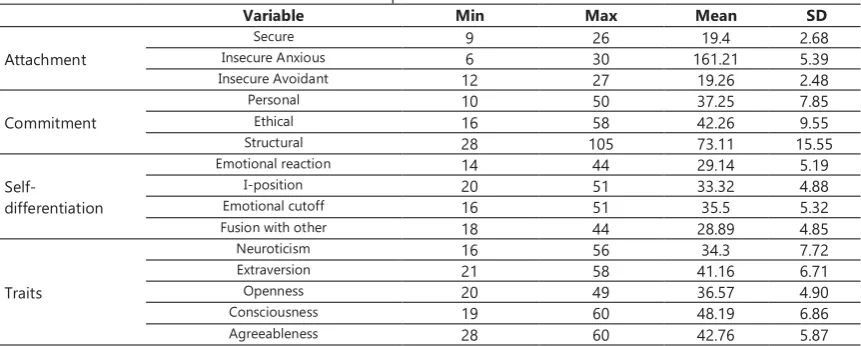
test, and the Kolmogorov-Smirnov test, the outlier data was detected and then corrected using Mahalanobis Distance test. Also, after verifying the data normality, the variables’ measurement model was assessed and confirmed. Additionally, results of Average Extracted Variances (AVE) showed that the values obtained by all subscales in the model were larger than the standard limit of 0.5, indicating convergent validity. Furthermore, the composite reliability (structural reliability) indicates that the values obtained from the components exceed the standard limit of 0.77, thus, AVE and CR of the questionnaires were confirmed. After aggregating questions about the sub-structure of each structure and correcting reverse scoring, descriptive indices for the variables are presented in Table 1.
Based on the assumed relations, the measurement model was established, corrected and reported in LISREL Platform (Table 2). Given the results, all variables have loading factor. Also, the third column presents symbols
for each variable which can be clearly seen in the coming diagrams.
General fitting indices for the model along with the corresponding threshold values are presented in Table 3.
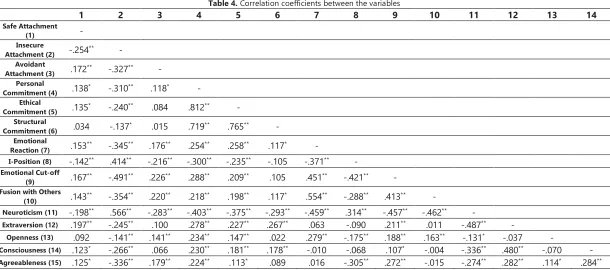
The correlation test was conducted to determine the presence/absence of concurrent changes among the variables. Since abnormal distribution of the variables scores was proved, Spearman’s correlation test was used due to having less sensitivity to the scores distribution. The results of this analysis are presented in Table 4. The correlations between variables presented in Table 4 support concurrent changes among most of the variables. Hence, the causative relations will be considered to analyze the research hypothesis.
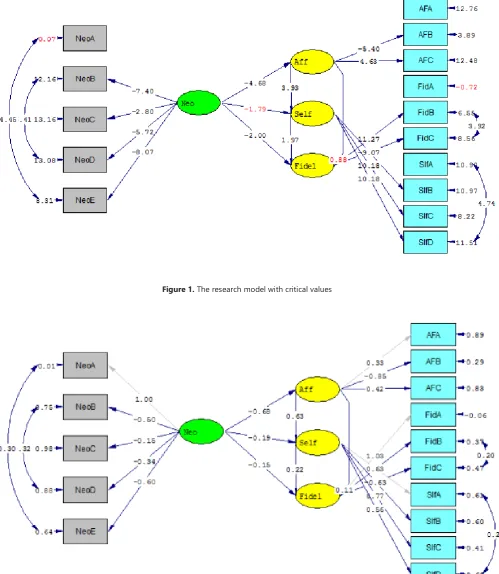
The following diagram depicts the final corrected model in the form of critical values.Additionally, in the following diagram, the research model is presented with path coefficients
Table 1. Descriptive indices for variables
Variable Min Max Mean SD
Attachment
Secure 9 26 19.4 2.68
Insecure Anxious 6 30 161.21 5.39
Insecure Avoidant 12 27 19.26 2.48
Commitment
Personal 10 50 37.25 7.85
Ethical 16 58 42.26 9.55
Structural 28 105 73.11 15.55
Self-differentiation
Emotional reaction 14 44 29.14 5.19
I-position 20 51 33.32 4.88
Emotional cutoff 16 51 35.5 5.32
Fusion with other 18 44 28.89 4.85
Traits
Neuroticism 16 56 34.3 7.72
Extraversion 21 58 41.16 6.71
Openness 20 49 36.57 4.90
Consciousness 19 60 48.19 6.86
Agreeableness 28 60 42.76 5.87
Table 2. Measurement model results
Structure Variable Symbol of Variable Loading Factor Critical Value
Attachment
Secure AFA .33 Fixed
Insecure anxious AFB -.85 -5.40
Insecure avoidant AFC .42 4.63
Commitment
Personal FidA .63 Fixed
Ethical FidB .79 11.27
Structural FidC .73 10.76
Self-differentiation
Emotional reaction SlfA .63 Fixed
I-position SlfB -.63 -9.07
Emotional cutoff SlfC .77 10.18
Fusion with others SlfD .56 10.10
Traits
Neuroticism NeoA 1 Fixed
Extraversion NeoB -.50 -7.40
Openness NeoC -10.15 -2.80
Consciousness NeoD -.34 -5.72
Agreeableness NeoE .60 -8.07
Table 3. General fitting indices for the model
Index Threshold Score for this Model Result
Goodness of fit index (GFI) .90 .91 Good fitness
Comparative fit index (CFI) .90 .94 Good fitness
Chi-square on degree of freedom 3 3.17 Acceptable fitness according to high sample size
The Root Mean Square Error of Approximation (RMSEA)
By .05= good fitness
Table 4. Correlation coefficients between the variables
1 2 3 4 5 6 7 8 9 10 11 12 13 14
Safe Attachment
(1) -
Insecure
Attachment (2) -.254** -
Avoidant
Attachment (3) .172** -.327** -
Personal
Commitment (4) .138* -.310** .118* -
Ethical
Commitment (5) .135* -.240** .084 .812** -
Structural
Commitment (6) .034 -.137* .015 .719** .765** -
Emotional
Reaction (7) .153** -.345** .176** .254** .258** .117* -
I-Position (8) -.142** .414** -.216** -.300** -.235** -.105 -.371** -
Emotional Cut-off
(9) .167** -.491** .226** .288** .209** .105 .451** -.421** - Fusion with Others
(10) .143** -.354** .220** .218** .198** .117* .554** -.288** .413** -
Neuroticism (11) -.198** .566** -.283** -.403** -.375** -.293** -.459** .314** -.457** -.462** -
Extraversion (12) .197** -.245** .100 .278** .227** .267** .063 -.090 .211** .011 -.487** -
Openness (13) .092 -.141** .141** .234** .147** .022 .279** -.175** .188** .163** -.131* -.037 -
Consciousness (14) .123* -.266** .066 .230** .181** .178** -.010 -.068 .107* -.004 -.336** .480** -.070 -
Agreeableness (15) .125* -.336** .179** .224** .113* .089 .016 -.305** .272** -.015 -.274** .282** .114* .284**
Marital Commitment Prediction based on Personality Traits
Figure 1. The research model with critical values
Figure 2. The research model with path coefficients The analysis results indicate that the model’s fitness
indices are in a good status, providing necessary support for the research hypothesis.
Besides, the structural model means the relation between structures. The results of this evaluation are presented in Table 5.
Accordingly, Table 6 presents the results of evaluating structural model which includes mediating structures, as
well.
Table 5. Evaluation of the structural model (Direct relations)
Independent variable Dependent Variable Critical Value Path coefficient Direct relation
Personality traits Marital commitment -.15 -2.00 Yes
Personality traits Attachment styles -.68 -4.68 Yes
Personality traits Self-differentiation -.19 -1.79 No
Attachment styles Marital commitment -.11 .88 No
Attachment styles Self-differentiation -.15 -2 Yes
Self-differentiation Marital commitment .22 1.97 Yes
Table 6. Evaluation of the structural model (including mediating structures)
No. Independent Variable Dependent Variable Coefficient Path Critical Value Relation Direct Relation Indirect
1 Attachment styles Personality traits Marital commitment Attachment styles -.68-.11 -4.68.88 YesNo No 2 Self-differentiation Personality traits Marital commitment Self-differentiation -.19.22 -1.791.97 YesNo No 3 Self-differentiation Attachment styles Marital commitment Self-differentiation -.15.22 1.97-2 YesYes Yes
Discussion
The results of this research showed that the prediction model of marital commitment based on personality traits is fitted with the mediating role of attachment styles and self-differentiation. It is consistent with the structural model of marital commitment prediction based on attachment styles, self-control mediators and early maladaptive schemas [16, 17], the prediction of marital commitment based on self-differentiation, family correlation and consistency and marital intimacy [23], the relationship between attachment style and marital commitment through mediation of self-differentiation and guilt [25], marital commitment prediction based on self-consciousness emotions and self-differentiation [19], interdependence model for marital virtue and attempt to make the relationships by investigating the correlation between commitment, forgiveness, and individual perception of the spouse’s relative self-regulation [26], and marital commitment model based on the results of a relationship [27].
In this study, the direct relation between personality traits and marital commitment was approved. This finding is consistent with previous studies [4, 7, 9, 10]. In general, regarding the relationship between personality traits and marital commitment, evidence suggests the personality traits as empirical predictions for the presence/absence of marital commitment. The presence of relationships between personality traits and marital outcomes of couples is confirmed using different longitudinal and cross-sectional designs [38]. Most studies [4, 9, 10, 38] argue that the personality traits are predictors for marital adaptability, and the lower difference in the personality traits of couples, the greater success in marital relationship and marital satisfaction, followed by a greater marital commitment. Studies conducted in this area show that the personality traits of both sides play an important role in shaping various processes of relationships [39] including sexual ones [40].
In general, it can be argued that relations are inherently interdependent on both sides of the relationship so that it is very difficult or even impossible understanding the behavior of one side of the relationship, regardless of the
aspects of the other side [41]. Accordingly, regarding the partner’s personality, the relationship between a wide range of researches on the role of positional factors in the correlation between personality and behavior, the opposite party’s personality is a powerful positional factor and the individuals’ behavior depends on not only their own personality, but also the partner’s personality [42].
Here, a direct relation exists between personality traits and attachment styles but not between attachment styles and marital commitment. Therefore, the indirect relation between personality traits and marital commitment through the mediating role of attachment styles was not confirmed.
Attachment styles are also argued to be of individual and relationship characteristics [43]. Plenty of studies show that attachment styles are determinants for personal attitudes and formation of personality [44]. Actually, the individual differences may be resulted from personality [45] or difference in attachment orientation [46]. In this regard, personality theories emphasize the explanation of the systematic dispersion in the individuals’ recognition, affection and behavior in different situations and areas, while attachment theory mostly emphasizes on the processes occurring in close individual relationships. The integration of these two models is of high importance[47]. Considerable studies confirm the relationship between personality traits and attachment styles. Nevertheless, most studies focus on one or two personality traits, and little research has been done on the relationship between attachment styles and the five personality traits [6].
Marital Commitment Prediction based on Personality Traits
and significant relationship with marital commitment, in contrast, avoidant attachment style has a significant negative relationship with marital commitment [49]. Besides, those having avoidant and dyadic attachment styles show a low level of marital commitment [49]. In fact, most studies report a negative correlation between insecure attachment styles and marital commitment as well as a positive correlation between secure attachment style and marital commitment. The results of the above mentioned studies are not in line with those of the present study accordingly. However, no correlation is reported between secure attachment style and marital commitment other studies [16]. Additionally, in another study [23], no correlation was found between an attachment style and marital commitment; this finding is congruent with the results of the present study.
Such a consequence may be the result of the differences in research tools or the type of measurement of structures, as well as research method and characteristics of the sample group, including lack of separation on the relationship between secure and insecure attachment styles and marital commitment and also lack of gender segregation in this study. Although surveys show that people with different attachment styles tend to be more oriented toward particular styles, this does not mean that the marital life of spouses who are less interested in each other in terms of their attachment styles has little sustainability and their lives are continued without satisfaction and commitment [50]. This argument can be explained as a cause for the absence of a correlation between attachment styles and marital commitment. Therefore, necessarily and permanently, the attachment style does not predict marital commitment, because it takes place in a relational and mutual context, and naturally the attachment style of both sides contributes in it, particularly when gender differences and different attitudes of women and men with special attachment styles are identified in researches towards specific attachment styles on the opposite party. For instance, in another study [51], the correlation between attachment styles and support demands are shown in couples’ conflicts. Actually, secure men provide more support, while men with avoidant attachment styles do not deliver such a support. Also, women with secure attachment require more support than those having avoidant attachment. Furthermore, given the studies, a dyadic wife with an avoidant husband report the lowest level of marital satisfaction and commitment [13]. Additionally, the women with an avoidant attachment style tend to stimulate less intimate relationships, resulting in lower sexual satisfaction and lack of sexual intimacy in their partner [52]. Similarly, the findings of other studies show that dyadic women are less likely to be drawn to avoided men; for such women, secure and dyadic men are more attractive [53]. Studies show that men with avoidance style are more attracted by secure and dyadic people [54].
The findings of this study also revealed that there was an absence of a correlation between personality traits and self-differentiation and a presence of a correlation between self-differentiation with marital commitment. As
a result, the relationship between personality traits and marital commitment is not confirmed by the mediating role of self-differentiation.
Some studies report the correlation between personality traits and self-differentiation, but the number of such studies is very limited. For example, a significant correlation has been reported between personality traits and sub-scales of self-differentiation in previous studies [55]. Also, a significant correlation is found between the subscales of self-differentiation and personality traits, and neuroticism and agreeableness can predict self-differentiation negatively [56]. These findings are inconsistent with the present study's findings.
Besides, many studies confirm the relationship between self-differentiation and marital commitment. For example, studies showing the couples with a higher level of self-differentiation have a greater marital adjustment in marital life, lower sexual dysfunction and, consequently, a higher marital commitment [20]. In a study [19], self-differentiation shows a significant and positive correlation with marital commitment. In another study [57], a negative and strong correlation is reported between high self-differentiation and marital conflicts. Self-differentiation has a positive correlation to marital commitment and can predict it [24]. These findings are consistent with the results of this study.
Maser believes that self-differentiation is a personality trait that appears at various levels of the intrapsychic [58]– i.e. a process that occurs existing or occurring within the mind- and exopsychic-i.e. a process that occurs in interpersonal relationships. Personality is actually defined as the behavioral patterns’ determinant. This argument can be used as an explanation for the absence of a correlation between the five personality traits and self-differentiation, inasmuch as both variables are considered as personality factors, while the five-factor personality traits are inherited, but self-differentiation is most often created through training in the family of origin based on the characteristics of the original family. Indeed, in self-differentiation, the interpersonal aspect is considered as a more important factor, but in personality traits, the intrapersonal aspect is more important and dominant among individuals.
Conclusion
characteristics that are often inherited and intrinsic and that can transfer to one of the attachment styles upon interaction with the family, can enhance mental health and the person’s natural evolution. It also affects the level of emotional maturity, which appears either intra-personally or inter-intra-personally, influencing self-differentiation. The combination of these personality traits and the two mediating variables help to increase marital commitment, although the personality traits can also alone make such an effect.
According to the findings of this study, such personality traits as extraversion can lead to an increased marital satisfaction, due to providing the possibility of examining possible solutions for conflict resolution between couples, which is an important factor to create an individual commitment for marriage. Better interaction between couples, which is partly a result of such trait as conscientiousness, will highlight the trust and increase the person’s willingness for commitment. A significant portion of marital commitment is revealed through personal commitment.
In regards to the limitations of this study the following can be stated:
Limited statistical population and sample group
Lack of separation of attachment styles in analyzes
Lack of gender segregation.
This research is recommended for samples having more heterogeneity. Considering the importance of the mediating variables such as betrayal and guilty feelings, such topics are suggested to be discussed in future research, so that the effective dimensions on marital commitment can also be considered from this angle. Due to the difference in the impact of individual characteristics of women and men on marital commitment and attachment styles, which are sometimes divided into two separated groups, gender is suggested be considered in future studies. Finally, since this research has implications for research on couples’ mental health, the role of self-differentiation dimensions is suggested to be seen independently.
Acknowledgement
The authors would like to express their gratitude to the participants from the Islamic Azad University, Science and Research Branch.
References
1. Amato P. The impact of family formation change on the cognitive, social, and emotional well-being of the next generation. Future Child. 2005;15(2):75-96.
2. Dean DG, & Spanier, G. B.,. Commitment: An overlooked variable in marital adjustment. . Sociological Focus. 1974;7:113–8.
3. Costa PT, & MacCrae, R. R.,. Four ways five factors are basic. Personality and Individual Differences. 1992;13:653-65. 4. Happiness Ihuoma I, Awopetu, R.G., & Ekoja, O.C. Relationship
between Duration of Marriage, Personality Trait, Gender and Conflict Resolution Strategies of Spouses. Procedia - Social and Behavioral Sciences. 2015;190:490 – 6.
5. Daljeet KN, Bremner, N.L., Giammarco, E.A., Meyer, J.P., & Paunoen, S.V. Taking a Person-Centered Approach to Personality: A Latent-Profile Analysis of the HEXACO Model of Personality. Journal of Research in Personality. 2017;70:241-51.
6. Both LEB, L. A. A comparison of two attachment measures in relation to personality factors and facets. Personality and Individual Differences. 2017;112:1-5.
7. Boyce CJ, Wood, A. M., & Fergoson, E. For better or for worse: The moderating effects of personality on the marriage-life satisfaction link. Personality and Individual Differences. 2016;97:61–6.
8. Malouff JM, Thorsteinsson, E. B., Schutte, N. S., Bhullar, N., & Rooke, S. E. The Five Factor Model of personality and relationship satisfaction of intimate partners: A meta-analysis. Journal of Research in Personality. 2010;44:127-.
9. Hosseini A, Zahrakar, K., Davarnia, R., Shakarami, M., & Mohammadi, B. The Relationship between Marital Commitment with Personality Traits. Journal of Sabzevar University of Medical Sciences. 2015;22(5):788-96.
10. Izatti UA, Suhariadi, F., & Hadi, C. Personality trait as predictor of affective commitment. Social Science. 2015;3:34-9. 11. Morgan JH, & Shaver, P. Attachment Processes and
Commitment to Romantic Relationships. In: Adams J.M. JWH, editor. Handbook of Interpersonal Commitment and Relationship Stability Perspectives on Individual Differences. Boston, MA: Springer; 1999.
12. Simpson JAR, W. S. Adult attachment, stress, and romantic relationships. Current Opinion in Psychology. 2017;13:19-24. 13. Feeney JAN, P. Attachment style as a predictor of adult romantic
relationships. Journal of Personality and Social Psychology. 1990;58:281-91.
14. Hazan C, & Shaver, P. Conceptualizing romantic love as an attachmentprocess. Journal of Personality and Social Psychology. 1987;52:511-24.
15. Muraru A, & Turliuc, M Predictors of Marital Adjustment: Are There Any Differences Between Women and Men? Europe’s Journal of Psychology. 2013;9:427-42.
16. Hadi S, Eskandari, H., Sohrabi, F., Motamedy, A., & Farrokhi, N. Relationship between attachment styles and marital commitment in people with marital infidelity. Journal of counseling research. 2017;15(60):42-59.
17. Hadi S, & Eskandari, H.S. tructural models predict marital commitment based on attachment styles and mediator variables self-control and early maladaptive schemas (in people with emotional extramarital relations). Counseling Culture and Psychotherapy. 2017;7(28):33-60.
18. Peleg O, Deutch, Ch., & Dan, O. Test anxiety among female college students and its relation to perceived parental academic expectations and differentiation of self. Learning and Individual Differences. 2016;49:428-36.
19. Zarei S, & Hossingholi, F. Predicting marital commitment based on conscious emotions (shame and sin) and self-differentiation among married students. Family Counseling and Psychotherapy. 2014;4(1):113-33.
20. Burri A, Schwezer, R., & O` Brein, J. Correlates of Female Sexual Functioning: Adult Attachment and Differentiation of Self. Sex Medicine. 2014;11:2188-95.
21. Karami J, Zakiei, A., & Alikhani, M. Explanation of self-differentiation in accordance with attachment styles and alexithymia. International Journal of Behavioral Sciences. 2014;8(2):139-48.
22. Skowron EA, & Dendy, A. K. Differentiation of self and attachment in adulthood: relational correlates of effortful control. Contemporary Family Therapy. 2004;3(26):337-57.
23. Ghanbari Hashem Abadi B.A. HVA, Esmaili M., & Farahbakhsh, K. 2011. Women’s Sociology. Relationship between parenting styles, attachment and marital commitment among married women of Allameh Tabatabaee University;2(3):39-61.
24. Momeni K, Kavoosi Omid, S., & Amani, R. Predicting marital commitment on the basis of differentiation of self, family adaptability and cohesion, and marital intimacy. Family Pathology, Counseling and Enrichment Journal. 2015;1(2):46-58.
25. Aslani K, Abdollahi, N., & Amanollahi, A. The relationship between attachment style and marital commitment with the mediation of differentiation of self and feeling of guilt on female married students in Ahvaz. Journal of counseling research. 2017;15(61):191-220.
Marital Commitment Prediction based on Personality Traits
Virtues and Relationship Effort in Couple Relationships. Journal of Marital and Family Therapy. 2017;4:1-13.
27. Veldorale-Brogan A, Bradford, K., & Vail, A. Marital virtues and their relationship to individual functioning, communication and relationship adjustment. The journal of positive psychology. 2010;5(4):281-93.
28. Schumacker RE, & Lomax, R. G. A beginner's guide to structural equation modeling (3rd ed.). New York, NY, US: Routledge/Taylor & Francis Group; 2010.
29. Goekoop R, Goekoop, J.G, & Scholte, H.S. The network structure of human personality according to the NEO-PI-R: matching network community structure to factor structure. PLoS One. 2017;7(12):e51558.
30. McCrae RR, & Costa, P. T. A Five-Factor theory of personality. In: L.A. JOP, editor. Handbook of personality: Theory and research. New York, NY, US: Guilford Press; 1999. p. 139-53. 31. Anisi J, Majdiyan, M., Joshanloo, M., & Ghoharikamel, Z.
Validity and reliability of NEO Five-Factor Inventory (NEO-FFI) on university students. International Journal of Behavioral Sciences,. 2012;5(4):351-6.
32. Collins NL, & Read, S. J. Adult attachment, working models, and relationship quality in dating couples. Journal of Personality and Social Psychology. 1990;58:644-63.
33. Firoozabadi A, Abedi, Z., Aliyari, R., Zolfaghari, B., & Ghanizadeh, A. Psychometric characteristics of the persian (farsi) version of attachment style questionnaire. Iran J Med Sci. 2014;39(6):506-14.
34. Skowron EAS, T. A. Assessing interpersonal fusion: Reliability and validity of a new DSI fusion with others subscale. Journal of Marital and Family Therapy. 2003;29(2):209-22.
35. Younesi F. Standardization of DSI-R in Iran. Tehran: Allame Tabatabaei; 2006.
36. Adams JMJWH. The conceptualization of marital commitment: An integrative analysis. Journal of Personality and Social Psychology. 1997;72(5):184-94.
37. Karimian N, Karimi, Y., & Bahmani, B. The Relationship of Mental Health Dimensions and Guilt Feeling with Marital Commitment in Married People. Family Counseling and Psychotherapy. 2011;1(2):243-56.
38. Boertien D, & Mortelmans, D. Does the relationship between personality and divorce change over time? A cross-country comparison of marriage cohorts. Acta Sociologica. 2017;61:000169931770904.
39. Roberts BW, Kuncel, N. R., Shiner, R., Caspi, A., & Goldberg, L. R. The Power of Personality: The Comparative Validity of Personality Traits, Socioeconomic Status, and Cognitive Ability for Predicting Important Life Outcomes. Perspectives on Psychological Science. 2007;2:313-45.
40. Altgelt EE, Reyes, M. A., French, J. E., Meltzer, A. L., & McNulty, J.K Who is sexuality faitful? Own and psrtner personality traits as predictors of infidelity. Social and Personal Relationships. 2018;35(4):600-14.
41. Kelley HH, & Thibaut, J. W. Interpersonal relations: A theory of interdependence. New York, NY: Wiley; 1978.
42. Zayas V, Shoda, Y., & Ayduk, O. N. Personality in context: An interpersonal systems perspective. Journal of Personality and Social Psychology. 2002;70:851-900.
43. Nilforoushan P. ASA, Fatehizadeh, M., Abedi, M.R., & Ghasemi, V. The correlation between attachment styles and 5 big personality traits from individual and couple aspects. Family Research. 2010;6(2):257-72.
44. Sroufe L, & Watters, M. Attachment as an organizational construct. Child Development. 1977;48:1184.
45. Donnellan MB, Burt, S. A., Levendosky, A. A., & Klump, K. L. Genes, personality, and attachment in adults: a multivariate behavioral genetic analysis. Personality and Social Psychology Bulletin. 2008;34(1):3-16.
46. Mikulincer M, & Shaver, P. R. The attachment behavioral system in adulthood: Activation, Psychodynamics, and interpersonal processes. In: M.P Z, editor. Advances in Experimental Social Psychology. 35. Sandiego: Academic Press; 2003.
47. Sibley CG, & Overall, N. C. The boundaries between attachment and personality: Localized versus generalized effects in daily social interaction. Journal of Research in Personality. 2008;42:1394-407.
48. Bello R, Brandau-Brown, F. E., & Ragsdale, J. D. Attachment Style, Marital Satisfaction, Commitment, and Communal
Strength Effects on Relational Repair Message Interpretation among Remarrieds. Communication Quarterly. 2008;56(1):1-16. 49. Ghezelseflo M, Jazayeri, R., Bahrami, F., & Mohammadi Fesharaki, R. The Role of Relational Maintenance Behavior and Attachment Styles in Predicting Marital Commitment. Asian Social Science. 2017;12(9):223-9.
50. Kirkpatrick LA, & Hazan, C. Attachment styles and close relationships: A four-year prospective study. Personal Relationships. 1994;1(2):123-42.
51. Simpson JA, Rboles, W. S. & Nelligan, G. S. Attachment theory and close relationship. New York: Guilford Press; 1998. 52. Mark KP, Vowels, L.M., & Murray, S.H. The Impact of
Attachment Style on Sexual Satisfaction and Sexual Desire in a Sexually Diverse Sample. J Sex Marital Ther. 2018;44(5):450-8. 53. Noftle EE, & Shaver, H. P. R. Attachment dimensions and the big five personality traits: Associations and Comparative ability to predict relationship quality. Journal of Research in Personality. 2006;40(23):179-208.
54. Feeney JA, Noller, P., & Callan. Attachment style, Communication, and satisfaction in the early years of marriage. In: Barttholomew. P, D, editor. Advance in personal relationships. 5. London: Jessica; 2010. p. 269-308.
55. Mokhtari Mosayyebu M, Khavari, M., & Mahmoudi, K, editor The prediction of the level of self-differentiation and attachment styles based on personality traits. The international conference on human sciences and behavioral studies; 2014; Tehran. 56. Askari F. Psychometric properties of self-differentiation and its
correlation to personality characteristics of Tehran academic students. Tehran: Islamic Azad University, Central Tehran Branch; 2013.
57. Glad GE. The effect of self-differentiation on marital conflict. American Journal of Pastoral Psychology. 2000;8:65-76. 58. Maser MJ. A construc validity of differentiation of self measures