Effect of Polysorbate 20 on Nucleation Rate of Interferon Beta-1b Aggregation
Zahra Ebrahimi1, Hamid Rashedi1*, Ahmad Fazeli3
Abstract
Introduction
Interferon beta-1b (IFNβ1b) is a form of interferon beta which has shown biological activity in a variety of in vitro and in vivo systems. Interferon beta belongs to a class of proteins known as interferons (IFNs). Interferons were originally classified based on the cell type from which they were derived [1]. The non-glycosylated IFNβ1b (Betase-ron®) was the first IFNβ product approved by (United State Food and Drug Administration) FDA in 1994. The non-glycosylated IFNβ1b has an apparent molecular weight of 18.5 kDa. It is produced in Escherichia coli cells, and Cys-17 is mutated to Ser-17 to reduce misfolding and/or aggregation during the refolding process [2].
Aggregates have been observed to form in therapeutic pro-teins during purification and storage, and the administra-tion of proteins containing aggregates has been shown to stimulate immune responses, causing effects ranging from mild skin irritation to anaphylaxis [3]. Many studies have shown that aggregates in IFNβ1b products are a risk factor for immunogenicity [4]. In patients using formulated IFNβ protein, aggregates are a cause of Neutralizing Antibodies (NAbs). The therapeutic effect of IFNβ is influenced bythe formation of Binding Antibodies (BAbs) and NAbs with negative impact on its bioactivity. Therefore, the aggrega-tion is of great concern affecting the biological activity of IFNβs [4].
Furthermore the low solubility of hydrophobic proteins becomes an issue, when the target concentration for the formulation cannot be achieved. Hydrophobic proteins often show limited solubility. For example, solubility of IFNβ1b is 0.05 mg/ml at physiological pH [5]. One of the procedures that now are used to increase the solubility of
IFNβ1b is the adding Human Serum Albumin (HAS) to its formulation, but presence HAS in the formulation is a problem for development of significant analytical tools to characterize the protein and its degradation products, and furthermore might induce the risk of immunogenicity reactions in the patient. HSA itself exhibits a low risk for immunogenicity, however in presence of a second protein the formation of mixed aggregates can lead to immunoge-nicity reactions. So the investigation to use some excipients in the formulation can be an effective stage in the development of formulation of IFNβ1b without the HAS. In parenteral formulations of hydrophobic protein formulations (such as IFNβ1b), non-ionic surfactants, mostly Polysorbate 20 and 80, are frequently used [5]. Surfactants have been used not only to purify, isolate, or solubilize proteins, but also to maintain biological activity by binding to proteins through electrostatic and hydrophobic interactions [4].
Many nonionic surfactants have been tried or used in protein formulations. These nonionic surfactants have the hydrophobic tails, which can bind to hydrophobic patches on protein surfaces [6]. It has been extensively docu-mented that surfactants suppress protein aggregation against various stresses, including heating and agitation [7]. A commonly used type of nonionic surfactant for this purpose is Polysorbate. Also, Pluronic F-127 was successfully used to decrease the aggregation of some proteins such as Alcohol dehydrogenase [8]. Pluronic F-127 is the block copolymers of polyethylene oxide (PEO) and polypropylene oxide (PPO) represent a class of thermo responsive polymer materials approved by FDA and (United State Environmental Protection Agency) EPA as food additives, pharmaceutical excipients and The aggregation of protein is the most prevalent and the most disturbing kind of
instability and this challenge exists in almost every stage of the development of protein drug. The presence of insoluble aggregations in protein drugs will make the supply of the product a tough job. This study identifies the inhibition of the folded Interferon beta 1-b’s aggregation with the assistance of some excipients. It uses some thermal stress and mechanical methods to accelerate the aggregation, and also the spectroscopic method to identify the protein aggregation and its growth. Expe-rimental data of the tests show compliance with the autocatalytic model. This mod-el has been used to obtain the Kinetic constants of aggregation in different states and to make comparison with one another in the presence of some excipients. The kinetic constants were obtained by fitting the Autocatalytic model on data. Among these excipients, Polysorbate 20 of 0.01% (w/v) showed the best result in decreas-ing the aggregation. Usdecreas-ing this excipient of 0.01% (w/v) in thermal stress causes dramatic reduction of nucleation constant from 8.3 ×10⁻³ (min-1) to 4.14 ×10⁻⁶ (min-1), which indicates the reduction of protein aggregation in the solution.
Keywords: Aggregation, Interferon beta 1-b, Autocatalytic Model, Polysorbate 20
1. Department of Chemical Engineering, Faculty of Engineering, University of Tehran, Tehran, Iran 2. Biotechnology Group, Department of Chemical Engineering, Tarbiat Modares University, Tehran, Iran
* Corresponding Author Hamid Rashedi
Department of Chemical Engineering, Faculty of Engineering, University of Tehran, Tehran, Iran E-mail: [email protected]
agricultural products, which are available in different molecular weights or PPO/PEO ratios [8].
Protein aggregation can occur through a number of distinct mechanisms or pathways. These mechanisms are not mutually exclusive. However, more than one mechanism can occur for the same product. While it is certainly not essential that one understand the aggregation mechanism for a particular protein in order to develop an appropriate manufacturing process, a good formulation, or a method to suppress and remove aggregates, some mechanistic understanding can help point the way to solving aggregation issues (or at least to avoiding excipients and processes that are likely to make things worse) [9].
Understanding the mechanism of aggregation is an important task in manufacturing and developing formula-tion of IFNβ1b. Among different mechanisms and models, the nucleation is a frequent step proposed for the aggregation of proteins. This model holds kinetic physical meanings for nucleation, monomer loss, and fibril growth steps during aggregation [2]. We chose Autocatalytic (AC) model from different kinds of models to describe the aggregation of proteins which is explained by Bernacki et al [10]. In the AC reaction pathway, monomer M irreversibly converts to F1 with a rate constant of k1AC. F1 then catalyzes the formation of additional F1 from M with a rate constant of k2AC:
M F
M F F F
Because these modeling equations will be applied to monomer-loss kinetic data, fibril coalescence steps are not necessary in our formulation. In the AC model, one implicitly assumes that each monomer in a fibril retains its ability to catalyze further fibril formation [9]. The modeling equations for the AC reaction pathway are:
d M
dt k M k M F 1
d F
dt k M k M F
These equations have an analytic solution:
M
M k k M exp k k M t
k M exp k k M t k 2
This model also known as Finke-Watzky, was successfully used to fit variety aggregation kinetic data [11]. Morris et al., demonstrated this mechanism as a2-step mechanism
of slow continuous nucleation, (rate constant k1),
followed by typically fast, autocatalytic surface growth (rate constant k2) [11].
In this study, the suppressing effect of Polysorbate 20, 80 and Pluronic F-127 on the aggregation steps of IFNβ1b was inspected. This could help us in developing new formulations without HSA in the near future. Monomer
samples of IFNβ1b were induced by heating and shaking to study the effect of excipients on the kinetics of aggregation. The mechanism and the effect of the nucleation step during the aggregation of IFNβ1b were considered by the autocatalytic model.
Materials and Methods
Materials
IFNβ-1bwith a concentration of 1000 μg/mL at pH 10.5-10.6 was a kind gift from Zistdaru Danesh Co. Ltd. Polsorbate 20 and 80 was purchased from Merck, and Plronic F-127 was purchased from Sigma-Aldrich. One of the negative effects of non-ionic surfactant is the possible increase in the oxidation of proteins catalyzed by the residual alkyl peroxides in them [12]. For these reasons, the quality and storage conditions for non-ionic surfactants need to be well controlled, and their quantity used in a protein formulation needs to be kept at a minimum level, typically in a range between 0.005% and 0.02% [12]. However, in some references there are recommendations to use a specific kind of surfactant in the formulation, for example, between 0.005% and 0.2% [13] or 0.0003, and 0.3% [7] for Polysorbate. In this study, we used the surfatants in a range between 0.005- 0.1% w/v. Protein concentration was determined by UV absorbance measurements at a wavelength of 280 nm with an extinc-tion coefficient of 1.5 [14].
Inducing Aggregation
Aggregation or association can easily occur under a wide variety of conditions where several factors have an inflence on the aggregation rate, including protein concentration, temperature, mechanical stress such as shaking and stirring, pumping, freeze-thaw processes etc [15]. For the development of HSA-free formulations, a comb nation of various approaches can lead to a successful stabilization of the active protein [16]. Hydrphobic interaction is entropy dependent [2]; thus, an increase in the temperature of the system and the exertion of mechanical stress result in aggregation due to intramolecular interactions between monomer proteins.
Thermal stress
Exert a thermal stress to a protein solution is a procedure to speed up the aggregation [2]. Although thermally induced denaturation may be reversible for some proteins, most suffer irreversible denaturation and aggregation at high temperatures [17]. In addition to the inflence on protein stability, higher temperature increases protein diffusion, frequencies of molecular collisions, and hydrophobic interactions, promoting protein aggregation [18].
For this reason IFNβ1b samples with a concentration of 0.4 mg/ml were incubated at the temperature of 70°C and the kinetics of aggregation of IFNβ1b were studied in the presence or the absence of Polysorbate 20, Polysorbate 80, and Pluronic F-127.
Shaking stress
surfaces or air/water interfaces. Since shaking or other types of agitation increases the frequency of surface exposure [18].
In this experiment, the 40% filled vials by IFNβ1b samples with a concentration of 0.4 mg/ml were placed horizontally onto the shaker platform and were shaken. Shaking intensity of 150 rpm was used (the unit ‘‘rpm” corresponds to ‘‘shakes per minute” in our study), and the kinetics of the aggregation of IFNβ1b were studied in the presence or the absence of mentioned surfactants.
Aggregate Detection
The aggregate form of proteins can be observed as an increase in OD at 360 nm [19] and decrease in OD at 280 nm. The decrease in the OD280 nm means the decrease in monomer concentration of the protein and so aggregation in IFNβ1b solutions. To detect the turbidity, caused by the formation of protein aggregates, UV absorbance at wave-length of 360 nm was measured at 25°C in quartz cuvettes using a CECIL CE 1020 spectrophotometer to obtain the concentration of monomer in the samples, each sample was centrifuged at 14,000 rpm, and UV absorbance of the supernatant at 280 nm was read by using
Bio-Radspectrophotometer.
Data Analysis and Curve Fitting
MATLAB software version R2014 (8.0.532) (Math Works Inc., MA, USA) was used to numerically determine constant rates of aggregation by fitting experimental data in Eq. 2. Fminuncsolver was used to match the data with autocatalytic model.
Results and Discussion
Effect of excipients on Mechanism of Aggregation of
IFN β -1b induced from thermal stress
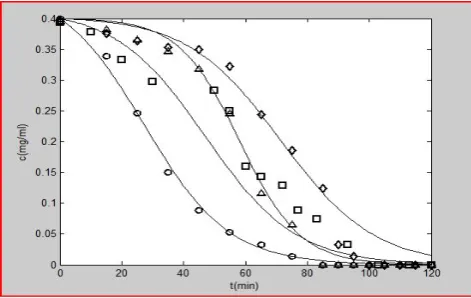
We first explored the influence of heating on IFNβ1b aggregation rates. Protein samples of 0.4 mg/ml were kept at 70°C. The data of IFNβ1b in the absence of surfactant (which are displayed with ○ in Fig. 1-3) were matched with an acceptable level to autocatalytic model. Values of 2.61×10⁻⁷ and 99.09 were obtained for Mean Square Error (MSE) and the coefficient of determination (R2). Therefore, this model was used to obtain the kinetic constant of all samples in the experiments.
In this study, IFNβ1b with and without surfactants, was treated with heat at 70˚C to determine the aggregation rate parameters and the effect of different concentrations of Polysorbate 20, Polysorbate 80, and Pluronic F-127. During aggregation, the monomer loss in solution was calculated at different time intervals. UV spectroscopy was used to determine the decrease in monomer concentration. The decrease in the optical density at 280 nm indicating the decrease in the monomer concentration. Experimental data collected during 120 h of incubation was fitted using an autocatalytic model. Samples in the presence of 0.005%, 0.01% and 0.1% of Polysorbate 80 showed more maintenance of monomer concentration in comparison with control samples (Fig. 1). Although it can be said that the concentration of 0.01% of Polysorbate 80 is the best among the other concentrations, but using 0.1% of Poly-sorbate 80 did not intensify the protein aggregation. However, this event happened in the presence of 0.1%
Polysorbate 20 (Fig. 2. Data that showed by ∆ symbol). The increase in the aggregation in the presence of 0.1% Polysorbate 20 might be happened due to the formation of micelles in this concentration above the Critical Micelle Concentration (CMC). The micelles might act as “heterogeneous nuclei”. In this assumed mechanism for the formation of aggregates, the critical nucleus (seed) is not a particle made of the product protein but rather a particle of an impurity [9]. So, in this case, lag phase that is derived from nucleation step was not seen. It should be noted that both Polysorbate 20 and 80 have been used at a concentration above their CMC, but the probable engagement of Polysorbate 80 in its binding to the protein or its competition with the protein in order to be adsorbed to the interface, has prevented the formation of micelle of Polysorbate 80 at 0.1% (Fig. 1. Data that showed by ∆ symbol).
Due to high tendency of Pluronc F-127 to form micelle, this material was used at a concentration below its CMC. According to Fig. 3, there is no significant difference between using 0.01% or 0.005% w/v of Pluronc F-127 in the solution to prevent the protein aggregation.
Figure 1. Effect of different concentration of Polysorbate 80 on thermal induced aggregation behavior of rhINF-β-1b. Samples without added Polysorbate 80 ○, with 0.005% □, with 0.01% ◊, and with 0.1% ∆. Lines are the best fit of experimental data to autocatalytic model given by Eq. 2.
Figure3. Effect of different concentration of Pluronic F127on thermal induced aggregation behaviorof INF-β-1b.Samples with-out added Pluronic F127○, with 0.005% □, with 0.01% ∆.Lines are the best fit of experimental data to autocatalytic model given by Eq. 2.
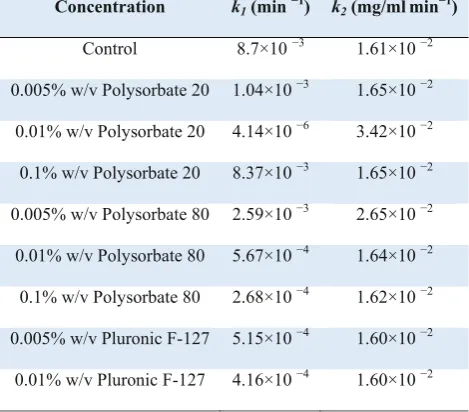
The rate constants values of the nucleation and the growth steps of aggregation IFNβ1b (k1, k2) with and without presence of mentioned the excipients has been showed at Table. 1. In the presence of 0.01% w/v Polysorbate 20, the nucleation rate constant of IFNβ1b was significantly reduced from 8.7×10 −3 to 4.14×10 −6 min −1. Autocatalytic model can’t detect the nucleation rate increase in the presence of 0.1% w/v Polysorbate 20, and the reason might be that the protein aggregation follows another mechanism in this state (likely nucleation-controlled aggregation) [9].
Table 1. Nucleation (k1) and Growth (k2) Rate Constants of Aggregation of IFNβ1b induced by thermal stress in the Presence of Different Concentrations of Polysorbate 20, Polysor-bate 80 and Pluronic F- 127.
Concentration k1 (min −1) k2 (mg/mlmin−1)
Control 8.7×10 −3 1.61×10 −2
0.005% w/v Polysorbate 20 1.04×10 −3 1.65×10 −2
0.01% w/v Polysorbate 20 4.14×10 −6 3.42×10 −2
0.1% w/v Polysorbate 20 8.37×10 −3 1.65×10 −2
0.005% w/v Polysorbate 80 2.59×10 −3 2.65×10 −2
0.01% w/v Polysorbate 80 5.67×10 −4 1.64×10 −2
0.1% w/v Polysorbate 80 2.68×10 −4 1.62×10 −2
0.005% w/v Pluronic F-127 5.15×10 −4 1.60×10 −2
0.01% w/v Pluronic F-127 4.16×10 −4 1.60×10 −2
Effect of excipients on the Mechanism of the Aggregation of IFN β 1b induced from shaking stress Since the surfactants can limit protein degradation during processes in which interfaces are created, e.g. liquid/air interfaces [16], and because of the existence of the steps in
developing the formulation of therapeutic proteins, that create such interfaces, we evaluated the effect of mentioned surfactants in the induction solubility under the shaking stress. The same type and size glass containers and filling degree (40%) were set to all samples because the different types of container were induced the different electrostatic interactions between the protein and the surface, and this can lead to the different protein adsorp-tion and formaadsorp-tion aggregates [16, 5], and the use of dif-ferent filling degrees leads to differences in stress intensity with the corresponding influences on protein stability that is related to slow and/or non-turbulent flow of the liquid and headspace as reported by Eppler et al., [18].
As expected, the samples became turbid during shaking due to the formation of large aggregates. The turbidity increased with increasing shaking time. The effect of dif-ferent concentration of Polysorbate 20, 80 and Pluronic
F-127 on IFNβ1b aggregation kinetic induced from shaking
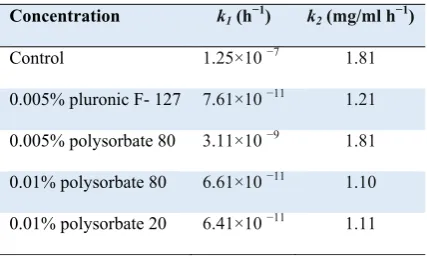
stress was studied. The results of the experiments and the best fit of experimental data to autocatalytic model given by Eq. 2 are shown at Figure 4. The results show that there is no significant difference between the effect of 0.01% Polysorbate 20, 0.01% Polysorbate 80 and 0.005% Pluronic F-127 regarding the ability to suppress the aggregate formation in IFNβ -1b solutions of 0.4 mg/ml.
Figure 4. Effect of 0.005% Polysorbate- 80 □, 0.01% Polysor-bate- 80 ٭,0.01% tween- 20 ∆, and 0.005% Pluronic F127 ◊, on shaking induced aggregation behavior of rhINF-β-1b.Samples without any added ○. Lines are the best fit of experimental data to autocatalytic model given by Eq.1.
Table 2. Nucleation (k1) and Growth (k2) Rate Constants of Aggregation of IFNβ1b induced by shaking stress in the Presence of Different Concentrations of Polysorbate 20, Polysorbate 80 and Pluronic F-127.
Concentration k1 (h−1) k2 (mg/ml h−1)
Control 1.25×10 −7 1.81
0.005% pluronic F- 127 7.61×10 −11 1.21
0.005% polysorbate 80 3.11×10 −9 1.81
0.01% polysorbate 80 6.61×10 −11 1.10
0.01% polysorbate 20 6.41×10 −11 1.11
Conclusion
In this study the mechanism of aggregation of IFNβ1b was determined by a good matching of data with Auto-catalytical model and was used to determine the kinetic rate constants. The process from native protein to physically aggregated protein can be considered as a nucleation step, which is often rate limiting. The constant rate of nucleation step was used as criterion to determine the best excipient and its concentration in the aggregation that induced by thermal and shaking stress. Protein stabilization by nonionic surfactants can often be observed by formulating with micromolar concentrations of surfactant. This is due to the high surface-activity of this class of excipients, which renders a higher effective concentration of surfactant molecules at interfaces than in the bulk solution .We showed that Polysorbate 20 with a concentration of 0.01% w/v was able to slow down IFNβ1b aggregation considerably. But using it in higher concentration at 0.1% w/v was caused the more aggregation that might be due to formation of the micelles that can act as heterogeneous nuclei.
The decrease in the nucleation rate constant in the presence of Polysorbate 20 not only means that it can decrease the surface tension of the IFNβ1b solution (as a mechanism that was described by Randolph and Hawe but also its ability to decrease the aggregation under both thermal and shaking stress shows the likely effect of Polysorbate 20in comparison with the IFNβ1b to adsorb at interfaces and/ or bind to the protein.
Acknowledgment
The authors would like to thank all colleagues in the Biotechnology group, School of Chemical Engineering of Tehran University and Drug Incubation Center of Tehran University for their kind contribution in this research.
References
1.Lin, L.S., Kunitani, M.G., Hora, M.S., Interferon-beta1b (Be-taseron®): a model for hydrophobic therapeutiv proteins,
Formu-lation, characterization, and stability of protein drugs, Pearlman, R., Wang, Y.J., Eds., New York: Kluwer Academic Publishers, 2002, Vol. 1, pp. 275-301.
2. Fazeli, A., Haji-Abdolvahab, M., Shojaosadati, S. A.,Schellekens, H., Khalifeh, K., Moosavi-Movahedi A. A., Fa-zeli, M.R.,Effect of arginine on pre-nucleus stage of interferon beta-1b aggregation, American Association of Pharmaceutical Scientists, 2014, Vol. 1, pp. 1619-1629.
3. Laurence, J. S., Middaugh, C.R., Fundamental Structures and Behaviors of Proteins, Aggregation of therapeutic proteins,
Wang, W., Roberts, C. J., Eds., New Jersey: John Wiley & Sons, Inc Publication, 2010, pp. 1- 62.
4. Haji-Abdolvahab, M., Fazeli, A., Fazeli, M.R., Brinks, V.,
Schellekens, H., The Effects of Dodecyl Maltoside and Sodium Dodecyl Sulfate Surfactants on the Stability and Aggregation of Recombinant Interferon Beta-1b, J Interferon Cytokine Res, 2014, Vol. 11, pp. 894-901.
5. Hawe, A., Frieß, W., Formulation Development for Hydro-phobic Therapeutic Proteins, Pharm Dev Technol, 2007, Vol. 12, pp. 223–237.
6. Wang, W., Li, N., Speaker, S., External Factors Affecting Protein Aggregation, Aggregation of therapeutic proteins, Wang,
W., Roberts, C. J., New Jersey: John Wiley & Sons, Inc Publica-tion, 2010, pp. 119- 204.
7. Ohtake, S., Kita, Y., Arakawa, T., Interactions of formulation excipients with proteins in solution and in the dried state, Adv
Drug Deliv Rev, 2010, Vol. 163, pp. 1053–107.
8. Pucciarelli, S., Bonacucina, G., Bernabucci, F., Cespi, M., Mencarelli, G., De Fronzo, G.S., Natalini, P., Palmieri, G. F., A Study on the Stability and Enzymatic Activity of Yeast Alcohol Dehydrogenase in Presence of the Self-Assembling Block Copo-lymer Poloxamer 407, Appl Biochem Biotechnol, 2012, Vol. 167,
pp. 298–313.
9. Philo, J.S., Arakawa, T., Mechanisms of Protein Aggregation, Curr Pharm Biotechnol, 2009, Vol. 10, pp. 348-351.
10. Bernacki, J.P., Murphy, R. M., Model Discrimination and Mechanistic Interpretation of Kinetic Data in Protein Aggrega-tion Studies, Biophys J, 2009, Vol. 96, pp. 2871–2887.
11. Morris, A. M., Watzky, M. A., Agar, J. N., Finke, R. G, Fit-ting Neurological Protein Aggregation Kinetic Data via a 2-Step, Minimal/“Ockham’s Razor” Model: The Finke-Watzky Mechan-ism of Nucleation Followed by Autocatalytic Surface Growth,
American Chemical Society Published, 2007,Vol. 47, pp. 2413-
2427.
12. Wang, W., Warne, N. W., Approaches to Managing Protein Aggregation in Product Development, Aggregation of
therapeu-tic proteins, Wang, W., Roberts, C. J., Eds., New Jersey: John
Wiley & Sons, Inc Publication, 2010, pp. 333- 366.
13. Warne, N. W., Formulation Development of Phase 1- 2 Bio-pharmaceuticals: An Efficient and Timely Approach, Formula-tion and process development strategies for manufacturing
bio-pharmaceuticals, Jameel, F., Hershenson, S., Eds., New Jersey:
John Wiley & Sons Inc Publication, 2010, pp. 147- 160.
14. Van Beers, M.M.C., Sauerborn, M., Gilli, F., Brinks, V., Schellekens, H., Jiskoot, W., Aggregated Recombinant Human Interferon Beta Induces Antibodies but No Memory in Immune-Tolerant Transgenic Mice, Pharm Res, 2010, Vol. 27, pp. 1812– 1824.
15. Kiese, S., Papppenberger, A., Friess, W., Mahller, H. C., Shaken, Not Stirred: Mechanical Stress Testing of An IgG1 An-tibody, J Pharm Sci, 2007, Vol. 97, pp. 4347- 4366.
16. Hawe,A., Studies on Stable Formulations for a Hydrophobic Cytokine, München: Ehrenwörtliche Versicherung, 2006, Vol. 13.
18. Eppler, A., Weigandt, M., Hanefeld, A., Bunjes, H., Relevant shaking stress conditions for antibody preformulation develop-ment, Europ J Pharm Biopharm, 2010, Vol. 74, pp. 139–147. 19. Peek, L. J., Brey, R. N., Middaugh, C. R., A Rapid Three-Step Process for the Preformulation of a Recombinant Ricin Tox-in A-ChaTox-in VaccTox-ine, J pharm sci, 2006, Vol. 96, pp. 44-60.