in the population sciences published by the Max Planck Institute for Demographic Research Konrad-Zuse Str. 1, D-18057 Rostock · GERMANY www.demographic-research.org
DEMOGRAPHIC RESEARCH
VOLUME 14, ARTICLE 14, PAGES 295-330
PUBLISHED 28 APRIL 2006
http://www.demographic-research.org/Volumes/Vol14/14/ DOI: 10.4054/DemRes.2006.14.14
Research Article
Second births in western Germany and France
Katja Köppen
2 Demographic and socio-economic changes since 1960 297
3 The institutional framework 299
3.1 Public childcare 299
3.2 Parental leave schemes 301
3.3 Monetary support for families 301
4 Theoretical considerations and hypotheses 302
5 Data and method 305
5.1 The data set 305
5.2 Method 306
5.3 Covariates 307
5.4 Descriptive analysis 311
6 Results 315
7 Conclusion 322
8 Acknowledgements 324
Second births in western Germany and France
Katja Köppen1
Abstract
We compare second birth risks in France and western Germany using data from the Family and Fertility Survey. Second birth risks are higher for highly educated women than for women with lower education in both countries. In western Germany, the positive effect weakens after controlling for the education level of the partner. The positive effect of French women’s education remains unchanged, even after controlling for the partners’ characteristics. We interpret this finding in the sense that work and family life are more compatible in France, where highly educated women can turn their education more often into work opportunities and income. West German women often have to make a decision between an employment career and motherhood as two exclusive life options. In such a situation, it is primarily the partners’ earning potential that influences fertility.
1. Introduction
Over the last three decades, female labor-force participation has been increasing in most European countries. At the same time, a decline in childbearing rates has been observed. Often a connection is made between these two developments: The increase in female activity rates is hypothesized to have led to a reduction in fertility. However, there have always been pronounced differences in the labor-market activity of women in Europe and in recent years; a new pattern seems to have emerged. In some countries where female labor-force participation is high, birth rates are also higher than in the rest of Europe (Brewster and Rindfuss, 2000; Adserà, 2004). To what extent, then, does a connection exist between these two developments?
Female emancipation and the associated changing role of women in society led to an increase in female employment and rose women’s awareness of life perspectives other than that of “being a mother and housewife”. Some countries actively supported and encouraged individual female autonomy and worked towards achieving compatibility between work and family life. In the Scandinavian countries, for example, female employment rates increased as a result and the number of children remained higher than in other countries. Other countries did not react to the social changes that emancipation brought in its wake, and this made it harder for women to combine both life domains. A large part of women stayed childless or opted to have a small family to avoid the strains involved in combining the two mutually exclusive roles of being a mother and a full-time employee (for example, in Southern Europe).
In this paper, the two neighboring countries western Germany and France are examined2. The literature classifies western Germany and France as conservative welfare states (Esping-Andersen, 1990). However, both countries differ in many respects in terms of demographic development. For several decades, birth rates in France have been higher than those in western Germany: A West German woman in the year 2000 had on average 1.38 children; this compares to an average of 1.89 children for French women (Council of Europe, 2001). The second difference concerns female employment rates. They, and especially the maternal ones, are higher in France than in western Germany.
Even children less than three years of age do not seem to be a reason for interrupting labor-market work (Reuter, 2002). Additionally, female full-time employment is much more common in France than in Germany. Finally, one can observe much higher rates of childlessness for West German women, especially for those with higher education.
2 Before reunification in 1990, the FRG and GDR had an entirely different political, cultural, and demographic background. Therefore we
The aim of this work is to compare the transition to second births in western Germany and France. We limit the analysis to second birth risks for two main reasons. First, French family policies have always had a stronger pro-natalistic orientation than West German policies. For this reason, it is particularly interesting to compare higher-order fertility in France and western Germany. Second, French family policies are supportive as regards the compatibility between work and family life, whereas German family policies tend to favor traditional family types, that is, the male partner is employed full-time, while the mother reduces her working hours to care for the children. The effect of education is of special interest here. Some authors argue that highly educated women in western Germany either stay childless or have more than one child. This is known as the “polarization” of family forms (Huinink, 1989, 1995, 2002; Grundmann, Huinink, and Krappmann, 1994). Under the existing incompatibility of work with family life, a great proportion of West German highly educated women stay childless because they opt for a career instead of a family. The rest accepts work and childbearing incompatibility and concentrates on family life. To France, by contrast, “polarization” of such kind does not seem to apply. In this context, second birth is especially worthwhile of study, because different causes might produce the same effect of education. Education may have a positive effect on second birth risks for highly educated West German women who are already mothers but it may also increase second birth risks for highly educated French women who can benefit from policies that promote compatibility between work and family life and support larger families.
The paper is structured as follows: In the next section, we go into some demographic and socio-economic details, looking at the similarities and differences in fertility behavior and female labor-force participation. In Section 3, we provide an overview of some of the most important public policies that influence the childbearing process, concentrating on the availability and quality of public childcare arrangements, parental leave schemes, and monetary support for families. In Section 4, we present our theoretical framework, focussing on the economic view of demographic behavior and some aspects of welfare state theory. We will also present our main hypotheses here. In the empirical part, Sections 5 and 6, the data sets and variables are introduced and the influence of education on the transition to second birth will be analyzed by using event-history techniques and estimating a piecewise-constant model. The paper closes with some concluding remarks in Section 7.
2. Demographic and socio-economic changes since 1960
the proportion of families with more than two children has decreased (Huinink, 1995). The number of divorces has increased as well as the number of non-marital unions. However, the share of extra-marital births is not very large in comparison to other European countries: Only 18% of all children were born out of wedlock in 1999. This compares to more than 40% of all new-born children in France who had no married parents (Le Goff, 2002). In the 1970s, the German Total Fertility Rate leveled off at around 1.4. The Completed Fertility Rate is also extremely low: The average number of children for women who were born in 1965 is estimated to be 1.47 per woman (Council of Europe, 2001). The very high rate of childlessness is a special German characteristic: 25 % of women born in 1960 will presumably stay childless (Kreyenfeld, 2002a). The more educated the women are, the more likely it is that they will forego childbearing – around 40% of all highly educated women are expected to remain childless (Kreyenfeld, 2004).
We find some similar but also some different characteristics for France. French women postpone childbearing also; the average age at first birth has increased from 24 in the 1970s to 27.4 in 1995 (Toulemon, 2001). Divorce rates have increased, too, and the number of families with more than three children has declined. However, the numbers of third births are still quite high in France when compared to western Germany. This and the fact that nine out of ten French women become mothers (Toulemon, 2001) provides France with the second highest fertility in the European Union (European Commission, 2002). Since 1975, the TFR remained more or less stable at 1.8 children per woman. Cohort fertility is even higher; the 1965 birth cohort has on average 1.99 children, which comes close to the replacement level of 2.1 children per woman (Council of Europe, 2001).
The development of female labor-force participation differs remarkably between the two countries, too. In both countries, the extent of female market work has been increasing since the early 1960s. Female labor-force participation in western Germany increased from 47% in 1970 to 60% at the end of the 1980s. In 1995, almost 70 % of all West German women in the age group 25-54 were employed, 40 % of them worked part-time (OECD, 2004). Today, if there is a child under three years of age in the household, the employment rate falls to 58% (Eurostat, 2003). French women, by contrast, are employed relatively continuously. Starting from 50% in 1970 and 70% at the end of the 1980s, nowadays around 80 % of all women aged 25-54 are economically active; most of them work full-time (OECD, 2004). The presence of children does not seem to be an obstacle for being employed. In the year 2002, 70% of all French women with one child under age three are employed (Eurostat, 2003).
explained. First, the institutional and cultural background in both countries will be examined in closer detail. Second, the findings will be embedded into a theoretical framework, particularly addressing the connection between education and childbearing.
3. The institutional framework
Some of the most important aspects of the institutional framework in France and western Germany – public childcare, parental leave schemes, and monetary support - will be described in this section to clarify whether they are part of an explanation that accounts for the different fertility and labor-market patterns. First, a general overview of the most important family policies in both countries from the 1970s to the 1990s will be provided (Table 1). Both countries expanded their support for families during the late 1970s and introduced paid parental leave in the middle of the 1980s. However, differences can be found in the design of these policies, particularly in the supply of public childcare and the support for large families.
3.1 Public childcare
The childcare system in France is well developed in that it facilitates the combination of family duties with employment. Children aged three to six are covered 100% by child care owing to the French pre-schooling (école maternelle) system, which is part of the education system since 1887 and free of charge. The provision rates for under-3-year-olds are higher than those for infants in the German Kinderkrippen. A large proportion of children (35%) attend école maternelle at an age as early as two. Another share, 9%, have places in so-called crèches, 15% are looked after by a licensed childminder and 3% by a private nanny (Letablier, 2002). Since the 1990s, licensed childminders have been strongly supported by the state through special allowances and tax reductions. The number of available places in crèches has been increasing since the 1970s from less than 50,000 to almost 200,000 in 1995 (Morgan, 2002).
realize. Children in compulsory education attend school all day in France, while in Germany they attend Halbtagsschulen, which usually finish between 1 and 2 o’clock p.m. Only 6% of all West German school-aged children have a place in the so-called Horte in the afternoon, the others are looked after by their parents, grandparents or private initiatives (Kreyenfeld, Spieß, and Wagner, 2002).
The differences in childcare provision in both countries are not only the result of different family policies but also of different popular attitudes towards caring for small children. The majority of West German women are convinced that a child under three years of age mainly needs its mother to grow up emotionally stable and that any separation during that period is traumatic for the child (Fagnani, 2002). This may also explain the low employment rates for West German mothers with smaller children. French mothers, by contrast, do not think that female employment is harmful to young children: Only 16% do not wish to take up a job when their children are below school age; this compares to 34% in western Germany (Fagnani, 2002).
Table 1: Family policy measures in Germany and France, 1972-1994
Policy
period Germany
Policy
period France
1975 Child benefit reform: income-independent child benefit for all children
1972 Income-dependent childcare
subsidy (AFG), introduction of pension claims for times of childcare
1979 Introduction of maternal leave (6 months) and maternity benefit until max. 750 DM per month
1976-78 Introduction of unpaid maternity leave, lone-parent-support (APJ), support for families (CF): income-dependent social benefits, official recognition of childminding as an occupation
1983 Cuts in maternity benefit to max. 510 DM per month
1982-83 General shortage in the national budget
1986 Introduction of paid parental leave, max. 600 DM per month
1984-86 Increased support for lone parents, income-independent child benefit from the third child on (APE), childminders support (AGED)
1990 Allowable deduction for home helps
1991-93 Tax reduction for home helps
1992 Increase of child benefit and
Kinderfreibetrag
3.2 Parental leave schemes
Parental leave is geared towards enabling parents to keep their salary and job while caring for young children. Especially in connection with flexible working hours and on-the-job-training during parental leave, this gives women and men the opportunity to care for their small children without loosing contact to their jobs.
In 1986 parents in western Germany were entitled to parental leave until the child reached 10 months of age. Leave was extended to 12 months in 1988, 15 months in 1989, 18 months in 1990, and finally in 1992 to the child’s third birthday (Gauthier and Bortnik, 2001). Parents receive childrearing benefit during most of that time (Erziehungsgeld), which is income-related and at most 307 € per month (for two years) or 460 € per month (for one year). It is not intended to be an income replacement but serves to acknowledge childrearing. Under parental leave regulations, West German parents can work part-time (until 2001 a maximum of 19 hours a week, 30 hours since 2001) and both can take parental leave at the same time. Nevertheless, only about 2% of the fathers entitled take this option.
France introduced parental leave in 1977. It entitled parents to unpaid leave of 24 months. In 1987, the duration of leave was extended until the child’s third birthday. The majority of persons in France using parental leave are female. Parents are able to work part-time as well and likewise can take time off together. Since 2001, fathers are entitled to take two-weeks of paternity leave, which is fully compensated. Child-rearing benefit (APE – l’allocation parentale d’èducation) was introduced in 1985 and was only paid to parents with at least three children. This clearly reveals the pro-natalistic aim behind this policy. Since 1994 it is paid from the second child onwards. APE is dependent on work experience previous to parental leave – the person who wishes to take leave must have been in gainful employment for at least two years within the five years preceding second birth (10 years before the third birth). It is paid independently of prior income (484, 97 € per month). As a result, the majority of recipients are women. This is because they earn less money on average than men do. Especially women with low qualifications and relatively low earnings or unemployed women do take parental leave in France (Reuter, 2002).
3.3 Monetary support for families
Child benefit in France (allocations familiales – AF) is paid from the second child on. It is paid until the 20th birthday of the child, provided that his or her income does not exceed a particular limit. The amount of benefit increases with the number and age of children. Needy families in France can also receive allocation pour jeune enfant (APJE) if the first child is less than 3 years of age. In Germany, child benefit is paid from the first child on. It is paid until the child reaches age 18 or when it is still in education or vocational training (until age 26) provided that his or her income does not exceed a particular limit, too.
Apart from child benefit, tax reliefs also support families with children. German parents, especially those with a higher income, benefit from the so-called Kinderfreibetrag – this tax allowance is charged against the child benefit drawn and is paid instead of child benefit. Besides, the German system especially supports married couples, with or without children. Tax relief in Germany is particularly high for married couples with a partner not employed or in part-time work (Ehegatten-Splitting). It therefore favors one-earner-families and strengthens the male breadwinner model. Besides, married housewives are automatically co-insured by the health insurance of their partners, and this also encourages women to stay at home and rely on their partner’s earnings. The French tax system, too, favors one-earner-families, however, only if there are no children in the household. Childless couples receive the highest tax relief when one of the partners is not involved in gainful employment or works part-time. French couples with children (since 1996 it does not matter whether they are married or not) benefit from the traditional system of family splitting (quotient familiale): The tax burden is reduced in relation to the number of children and it does not matter whether one partner is employed full- or part-time (Dingeldey, 2000).
4. Theoretical considerations and hypotheses
reflects her career and income possibilities, a negative correlation between female education and fertility is expected.
However, for some countries the opposite pattern has been observed. In the last years, a positive effect of female education on childbearing has been noted, especially for the Nordic countries (e.g., Hoem and Hoem, 1989; Kravdal, 1992; B. Hoem, 1993; Oláh, 1996). One explanation could be that a higher income also implies higher resources that can be allocated to a larger family. Moreover, highly educated parents are in a better position to make use of private childcare because they enjoy higher wages and possibly flexible working hours, too (Hoem, Prskawetz, and Neyer, 2001; Kravdal, 2001). This “income effect hypothesis” (Kreyenfeld, 2002b) indicates that family and working life can be made compatible. This applies particularly to Scandinavia or France because both countries have generous family support schemes and full-time day care is well developed. But it is unlikely that such considerations matter for western Germany, where no such encompassing policies exist.
Welfare state theoreticians have explained the intra-country differences in fertility and employment behavior with the different attitudes of states towards working mothers (e.g., Langan and Ostner, 1991; Lessenich and Ostner, 1995; Anttonen and Sipilä, 1996; Gornick, Meyers, and Ross, 1997, 1998; Esping-Andersen, 1999). By comparing institutional structures and public policies, they showed that state-aided measures help women to realize their potential income without foregoing their desire for children. Family policy as part of welfare state policies has an influence on the employment rates of mothers and may disburden them from some costs that go along with raising children. As has been shown in the comparison of the institutional frameworks, western Germany and France differ greatly in the extent to which the state supports families and the institutional framework is shaped. In western Germany, social and economic conditions favor the role of the male breadwinner and the female housewife while women in France are encouraged to return to the labor market after childbirth.
In western Germany, opportunity costs of childbearing are higher since the institutional and social conditions do not encourage the compatibility of family with working life. Especially well-educated women with higher income prospects therefore either stay childless or resign from their working career in favor of a family. In view of the very low public child care provision in western Germany, highly educated and better paid women are faced with making a decision between giving up employment and caring for a child or keeping their income but abstain from having children.
Huinink (2002) argues that the special German institutional framework leads to a ”polarized” fertility pattern among highly educated women. He expects such a pattern to prevail in all countries, where maternal employment and childrearing are not compatible. Some countries (such as Germany) have promoted female emancipation, for example, by providing greater opportunities for women to participate in higher education, but did not introduce sufficient measures to strengthen compatibility between work and family life. Particularly in these societies, highly educated women with good income prospects suffer from decision conflicts. If they opt for a career, they will mostly need to forego the benefits from having children. If they decide for a family, they accept the high opportunity costs of a foregone labor-market career or at least have to reduce their working hours drastically. The latter group will be rather selective – they accept the opportunity costs that arise from having children and devote themselves to family life, probably even having a larger family than on average. The consequence is a polarization of highly educated women between childlessness and having a larger family. Huinink (2002) found empirical evidence for this phenomenon. He analyzed the distribution of family size by education degree in various countries with the Family and Fertility Survey. Looking at the cohorts born 1950 and later, he finds that highly educated West German women either stay childless or have two children.
With regard to our observation on the second child, we conclude the following: In the West German context, highly educated women with one child are a rather select group. They manifest high preference for children by having a first child despite high opportunity costs of childrearing. Additional opportunity costs for the second child are only minor. One would therefore expect highly educated women to stay either childless or have two or more children. As a result, we expect the second birth risk for West German mothers with higher education to be higher than for women with a lower degree3.
In societies with greater opportunities of child caring outside the family, the decision in favor of a family and labor-force participation of both partners is made easier. Therefore, the group of highly educated mothers in France should not be as selective as in western Germany.
For that reason, we do not expect elevated second birth risks in France. However, there are other potential reasons why in France also we may find that higher education increases second birth risks. Against the background of the institutional framework, French women are encouraged to return to the labor market after childbirth. Especially highly educated women may be expected to do so because they encounter higher opportunity costs of childrearing. One assumption is that they try to space their births closely together to return to work as soon as possible and reduce the costs they have while they are out of employment (Kreyenfeld, 2002b; Ní Bhrolcháin, 1986). This means that they have their second child earlier than other women do, and this increases the second birth risk and indicates the existence of a timing effect. Another possible explanation is that they have a higher income and are therefore in a better position to support a larger family. We therefore also expect French women with higher education to have a higher second birth risk than their counterparts with lower education degrees.
5. Data and method
5.1 The data set
The study uses data from the “Family and Fertility Survey (FFS) in Countries of the ECE Region”. The FFS was conducted in the 1990s in selected member states of the United Nations Economic Commission for Europe (UNECE). 24 countries joined the FFS project. As of 1992, a standard FFS questionnaire has been available. The standardized FFS data files are mainly used for comparative research on fertility and family issues. We use the French and the West German standard record files. The survey was conducted in western Germany in 1992 and in France in 1994. In western Germany, 5,036 respondents were interviewed (2,024 men and 3,012 women). This compares to 4,885 respondents in France (1,941 men and 2,944 women).
(Toulemon and Guibert-Lantoine, 1998). Because of this, we used a given weighting factor to control for the bias.
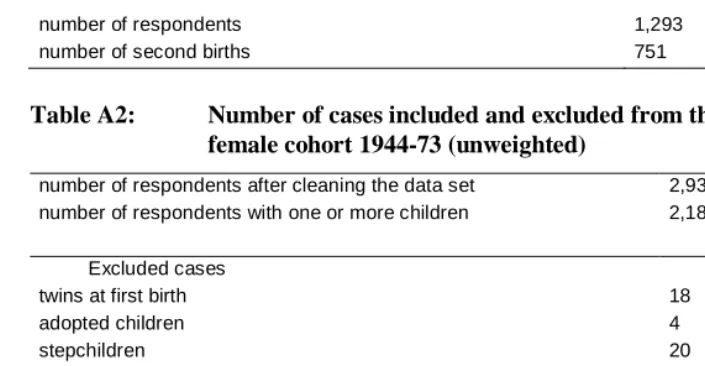
The French FFS includes foreigners while the German survey only contains German nationals. We would have excluded the foreigners from the French sample to make both data sets more comparable; however, it is not possible to identify foreigners in the French standard record file. We analyze German women born between 1952 and 1972, for France we have respondents born between 1944 and 1973. The sample consists of women who had at least one child and were at risk of having a second child. The total sample size (after cleaning our data, see Appendix) is 1,293 for Germany and 2,059 for France. Second births totals 751 in Germany and 1,398 in France4.
5.2 Method
The event under study is the occurrence of a second birth. We apply an event-history analysis, as it is suitable for studying events that occur during the life course. Multiplicative intensity-regression models are estimated to measure second birth intensities (µ) for West German and French women. These intensities are influenced by various covariates, such as the education level of the women or the age at first birth. The start of the process time is the date of birth of the first child. The process ends with the second child’s date of birth. It may also end with age 45 or at the date of interview respectively.
The baseline hazard (basic time factor) is the duration since the birth of the first child. We use a piece-wise constant model i.e. the basic time factor is defined as a categorical variable – the risk is constant over each set of time intervals. The other covariates are categorical, too. Our main analysis includes three time-fixed covariates and three time-varying covariates.
The model with our main effects can be written as follows:
µ
(t)
ijklmno= a
i(t)b
jc
k(t)d
le
mf
n(t)g
o(t)where a represents the effect of the time factor (duration since birth of the first child in months) and i (t) denotes the intervals in which the baseline hazard is kept constant (0-12, 13-24, 25-36, 37-48, 49-72 and 73-120)5.
Factor b is the effect of relative age at first birth (time constant),
4 Some cases were deleted before the start of the analysis, for example cases with missing data on the year of birth of the respondents or of the first
child. Also, births that appeared in an illogical order (second child born before the first child) did not enter into the analysis. We assume that these errors are randomly distributed and that therefore the results are not biased systematically.
Factor c(t) the effect of the highest education level of the respondent (time-varying), Factor d the effect of the highest education level of the partner (time constant), Factor e the effect of employment (time constant),
Factor f(t) the effect of marital status (time-varying) and Factor g(t) the effect of calendar time (time-varying). The software used for modeling is STATA 9.0.
5.3 Covariates
Our model contains three time-fixed covariates, three time-varying covariates and the baseline hazard.
5.3.1 The influence of the highest level of education of the respondent
The education degrees in the data sets were coded with the help of ISCED 76 (International Standard Classification of Education). We classified them into three groups:
1. no or low degree = no degree or at least in education until age 16,
2. medium degree = vocational degree (vocational training after secondary school), higher vocational degrees (so-called Meister or Techniker), Baccalauréat or Abitur (general qualification for university entrance),
3. higher degree = all university degrees or technical colleges.
Unfortunately, we do not have complete educational histories. In order to construct a time-varying covariate for education, we use information on the highest degree obtained at interview and on the age at the end of education6. We expect a positive
correlation between educational level and second birth risks, however, the
argumentation is different for both countries. In France, the income effect should be stronger than the substitution effect: highly educated women have greater financial resources to invest in a larger family. Besides, highly educated women in France may intend to return to work as soon as possible and therefore space their births close together in order not to loose contact to work after first childbirth (Ní Bhrolcháin, 1986). This should increase second birth risks as well. This argument does not apply to western Germany, however, where social and institutional conditions hamper the compatibility between maternal employment and childrearing. The “polarized” fertility
behavior of women with a university degree highlights these difficulties: Highly educated women who decided in favor of a family despite the high opportunity costs of childbearing have a much stronger family orientation than other women with one child and they should therefore give birth to a second child more often.
5.3.2 The influence of age at first birth
Education influences fertility also indirectly. Assuming that highly educated women have their first child later in life than their counterparts with lower qualifications (Blossfeld and Huinink, 1989, 1991), one can hypothesize that they have their second child shortly after the first one because of biological limitations (Kreyenfeld, 2002b). This should increase second birth intensities. However, one might neglect the different social meanings of age at first birth for different social groups if absolute age at first birth is used in a study that analyzes the effect of education on childbearing. We therefore followed a suggestion by B. Hoem (1996) who pointed out the relevance of using age at birth relative to the level of education at birth. Having a first child after the age of 28 has an entirely different social meaning for university graduates than for women with compulsory education only. Therefore a variable should be used that reflects this fact rather than disregards it (B.Hoem, 1996: 334). We defined four age groups, rather young, medium, rather old and oldest. We partitioned women’s ages at first birth into quartiles for each level of education and used this grouping as the corresponding age variable in the analysis7. We assume that women, who had their first child much later than other women with the same level of education, will have the lowest risk of getting another child, whereas those who became a mother comparatively early are more family-prone and therefore more likely to have a second child.
5.3.3 The influence of the partners’ highest education level
Women with higher education more often have partners with a university degree. This educational homogamy can be found in both countries (Blossfeld and Timm, 2003). One can assume the existence of a positive correlation between the education level of the partner8 and second birth. Men with higher education mostly enjoy a higher income. Especially in western Germany, where one-earner-marriages are more frequent than in
7 For France and western Germany, women with a low level of education are defined as rather young when they gave birth below age 20 and as
oldest at ages 25 and above. Women with a univeryity degree who had a first child before the age of 26 in western Germany and 24 in France are grouped as rather young, while those who became a mother after the age of 30 in western Germany (28 in France) were coded as oldest.
8 The educational level of the partner is measured at the time of interview because no other variable was available. We assume that most of them
France, the man should be able to invest his income into a larger family. Particularly the education of the partner should therefore influence the higher transition rates to a second child in western Germany. French women, by contrast, may support a larger family more autonomously.
5.3.4 The influence of the employment status
The employment status for both countries was measured as ever or never employed. Women who have never been employed should be very family-orientated. This group should have a higher second birth risk than those women who have ever been employed (more than three months of gainful employment). Especially women with higher education who were never employed may have a stronger orientation towards family life and as a result have high second birth intensities.
5.3.5 The influence of the marital status
We assume that marriage and having children are still closely connected in both countries. Contrary to western Germany, however, France has a high rate of children born out of wedlock. Nevertheless, we assume that after first childbirth it is more or less common for French women to marry, too. Besides, before 1996, unmarried couples with children did not benefit from the quotient familiale, which was an incentive to get married. We expect therefore the second birth risk for married women to be higher than for unmarried women. In western Germany, with its strong support for married couples, second birth risks of married women should be higher. Women who have married more than once should get a second child more often than women of first-order marriage. The desire to have a child with the new partner should be high (Vikat, Thomson, and Hoem, 1999). Being divorced, widowed or single affects childbearing negatively.
5.3.6 The influence of calendar time
exist for western Germany after 1986 (when paid parental leave was introduced) and France after 1994 (paid parental leave was extended to apply to the second child). Unfortunately, this effect is not measurable for France because the survey was conducted in 1994. The grouping of calendar time was chosen on the basis of various family policies (see also Table 1) to find possible effects that could be caused by changes in the institutional framework.
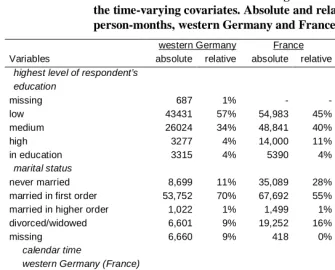
In Table 2, the distribution of the time-fixed covariates in absolute and relative numbers is displayed. Table 3 displays the distribution of the time-varying covariates for western Germany and France. As mentioned before, we used weights for the French sample because of the oversampling of lone mothers and blended families. We therefore show the unweighted and the weighted sample size in the two tables in order to exemplify how the weights change the distribution of the sample. This comparison suggests that one should prefer to use weights because of the overrepresentation of lone mothers that may otherwise exist. They are a select group who are probably younger and might have lower education degrees than other women do. If we ignore this effect, the results may be biased. Therefore, we decided to use weights for France not only in our descriptive analysis but also later in the multivariate analysis9.
Table 2: Distribution of respondents according to the various levels of
the time fixed covariates. Absolute and relative number of respondents, western Germany and France
western Germany France France (weighted)
Variables absolute relative absolute relative absolute relative
highest level of partner’s education
missing 108 8% 284 14% 227 12%
low or no degree 515 40% 267 13% 350 18%
medium 337 26% 663 32% 802 42%
high 140 11% 229 11% 290 15%
no partner in household 193 15% 616 30% 254 13%
ever worked: yes or no
missing 4 0% - - - -
no 131 10% 150 7% 146 8%
yes 1,158 90% 1,909 93% 1,776 92%
9Weights were provided by INED. The weighted number of cases (1,928) has been different than the unweighted equivalents (2,063). Tests of
Table 3: Distribution of time at risk according to the various levels of the time-varying covariates. Absolute and relative number of person-months, western Germany and France
western Germany France France (weighted)
Variables absolute relative absolute relative absolute relative
highest level of respondent’s education
missing 687 1% - - - -
low 43431 57% 54,983 45% 54,533 47%
medium 26024 34% 48,841 40% 45,665 39%
high 3277 4% 14,000 11% 12,927 11%
in education 3315 4% 5390 4% 3876 3%
marital status
never married 8,699 11% 35,089 28% 18,039 15%
married in first order 53,752 70% 67,692 55% 87,108 75%
married in higher order 1,022 1% 1,499 1% 1,678 1%
divorced/widowed 6,601 9% 19,252 16% 9,548 8%
missing 6,660 9% 418 0% 628 1%
calendar time
western Germany (France)
until 1974 (until 1973) 2,619 4% 8,659 7% 11,425 10%
1975-79 (1974-80) 9,438 12% 28,877 23% 31,453 26%
1980-82 (1981-83) 9,846 13% 15,669 13% 14,906 13%
1983-86 (1984-86) 18,450 24% 17,470 14% 15,511 13%
1987-89 (1987-90) 18,582 24% 27,125 22% 22,891 20%
1990-92 (1991-94) 17,799 23% 26,150 21% 20,813 18%
5.4 Descriptive analysis
Figure 2 shows the distribution of women with a higher education level (older cohorts) by their number of children. Here, we find support for the polarization hypothesis: In western Germany, we find a polarization between childless women and those with two children. We cannot find this effect in other educational groups (not shown). More than 28% of all highly educated women stay childless but also 34% have a second child. For France, this kind of polarization cannot be observed. French women with a high education level have a second child more often than West German women with a university degree (41 vs. 34%). But even though highly educated women stay childless to a greater extent than all French women do (18% vs. 10%), we cannot find such a polarization tendency as we see in western Germany.
Figure 1: Distribution of family size in western Germany (cohort 1953-57) and France (cohort 1955-59)
Source: West German FFS 1992, French FFS 1994
Figure 2: Women with higher education by number of children (in %).
Western Germany (cohort 1953-57) and France (cohort 1955-59)
0 5 10 15 20 25 30 35 40 45
w estern Germany France
%
childless one child tw o children three+ children
Source: West German FFS 1992, French FFS 1994
18 11
26
18 38
16 33
39
0 10 20 30 40 50 60 70 80 90 100 West Germany
France
%
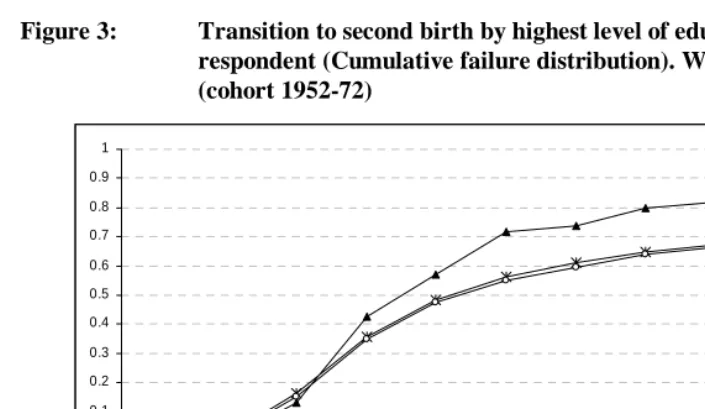
Figure 3: Transition to second birth by highest level of education of respondent (Cumulative failure distribution). Western Germany (cohort 1952-72)
0 0.1 0.2 0.3 0.4 0.5 0.6 0.7 0.8 0.9 1
0 12 24 36 48 60 72 84 96 108 120
age of first child in m onths
no or low degree m e dium high
Source: West German FFS 1992
Figure 4: Transition to second birth by highest level of education of
respondent (Cumulative failure distribution). France (cohort 1944-73)
0 0.1 0.2 0.3 0.4 0.5 0.6 0.7 0.8 0.9 1
0 12 24 3 6 48 60 72 84 96 1 08 120
age of first child in months
no or low degree m edium high
6. Results
First, we display the baseline hazard - the absolute second birth risk measured in months since the birth of the first child in both countries (Figure 5). We find that it is higher in France during the later time intervals. West German women have the highest risk of having a second child when the first child is between 2 and 3 years old. In France, the risk is highest when the first child is between 3 and 4 years of age.
Figure 5: Absolute risk per 1000 person-months.
0 5 10 15 20 25 30 35
0 12 24 36 48 72 120 180
age of fir s t child in m onths
wes tern Germ any France
Source: West German FFS 1992, French FFS 1994
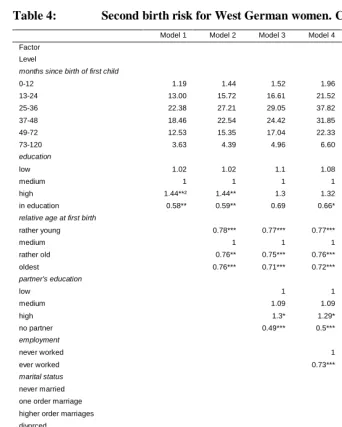
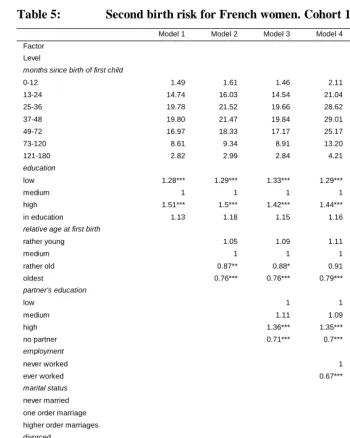
The results of our multivariate analysis are displayed in Tables 4 and 5. We estimated multiplicative models by means of step-wise event-history modeling.
to have a lower education (Tavan, 2005). Unfortunately it is not possible to identify them with our data. There seems to be no significant effect for French women who are still studying after first birth.
Next, we add to our model age at first birth relative to the educational level at the time of first birth to see whether the positive effect of education is mainly produced by late age at first birth. We find that the effect of education remains high in both countries (Model 2). The earlier a woman in western Germany starts with childbearing; the lower is her second birth risk. For France, we cannot find this significant effect. Late motherhood, on the contrary, reduces second birth intensities in both countries. If the higher risk of highly educated women had been connected to late age at first birth, the positive effect should have disappeared or at least weakened after controlling for age at first birth. This is not the case, however. The positive effect of education can therefore not be attributed to late age at first birth.
Table 4: Second birth risk for West German women. Cohort 1952-72
Model 1 Model 2 Model 3 Model 4 Model 5 Model 6 Factor
Level
months since birth of first child
0-12 1.19 1.44 1.52 1.96 2.00 1.60
13-24 13.00 15.72 16.61 21.52 21.69 17.14
25-36 22.38 27.21 29.05 37.82 38.07 29.93
37-48 18.46 22.54 24.42 31.85 32.38 25.30
49-72 12.53 15.35 17.04 22.33 22.73 17.52
73-120 3.63 4.39 4.96 6.60 7.00 5.16
education
low 1.02 1.02 1.1 1.08 1.078 1.12
medium 1 1 1 1 1 1
high 1.44**² 1.44** 1.3 1.32 1.28 1.27
in education 0.58** 0.59** 0.69 0.66* 0.76 0.86
relative age at first birth
rather young 0.78*** 0.77*** 0.77*** 0.83* 0.88
medium 1 1 1 1 1
rather old 0.76** 0.75*** 0.76*** 0.77** 0.75***
oldest 0.76*** 0.71*** 0.72*** 0.72*** 0.68***
partner's education
low 1 1 1 1
medium 1.09 1.09 1.09 1.1
high 1.3* 1.29* 1.33** 1.36**
no partner 0.49*** 0.5*** 0.63*** 0.64***
employment
never worked 1 1 1
ever worked 0.73*** 0.73*** 0.74***
marital status
never married 0.46*** 0.45***
one order marriage 1 1
higher order marriages 1.68** 1.62**
divorced 0.42*** 0.4***
period
until 74 0.79
1975-79 0.84
1980-82 1.09
1983-86 1
1987-89 1.04
1990-92 1.13
Log likelihood -1324.5 -1319.3 -1292.8 -1287.6 -1265.7 -1263.1
Initial log likelihood -1330.9
Notes: (1) Months since birth of first child are displayed as absolute risks per 1000 person-months. (2) ***p ≤ 0.01; **0.01≤ p ≤0.05; * 0.05≤ p ≤0.10
Table 5: Second birth risk for French women. Cohort 1944-73
Model 1 Model 2 Model 3 Model 4 Model 5 Model 6 Factor
Level
months since birth of first child
0-12 1.49 1.61 1.46 2.11 2.13 1.88
13-24 14.74 16.03 14.54 21.04 20.93 18.76
25-36 19.78 21.52 19.66 28.62 28.70 25.96
37-48 19.80 21.47 19.84 29.01 29.93 27.35
49-72 16.97 18.33 17.17 25.17 26.53 24.50
73-120 8.61 9.34 8.91 13.20 14.44 13.67
121-180 2.82 2.99 2.84 4.21 4.31 4.19
education
low 1.28*** 1.29*** 1.33*** 1.29*** 1.31*** 1.28***
medium 1 1 1 1 1 1
high 1.51*** 1.5*** 1.42*** 1.44*** 1.41*** 1.44***
in education 1.13 1.18 1.15 1.16 1.23 1.24
relative age at first birth
rather young 1.05 1.09 1.11 1.14* 1.12
medium 1 1 1 1 1
rather old 0.87** 0.88* 0.91 0.9 0.93
oldest 0.76*** 0.76*** 0.79*** 0.8*** 0.85**
partner’s education
low 1 1 1 1
medium 1.11 1.09 1.11 1.14*
high 1.36*** 1.35*** 1.39*** 1.41***
no partner 0.71*** 0.7*** 0.91 0.92
employment
never worked 1 1 1
ever worked 0.67*** 0.68*** 0.67***
marital status
never married 0.58*** 0.6***
one order marriage 1 1
higher order marriages 2.31*** 2.29***
divorced 0.33*** 0.34***
period
until 1973 1.37***
1973-80 1.09
1981-83 1.04
1984-86 1
1987-90 1.02
1991-94 1.04
Log likelihood -2272.1 -2260.5 -2236.5 -2228.3 -2167.6 -2162.5
Initial log likelihood -2287.9
Notes: (1) Months since birth of first child are displayed as absolute risks per 1000 person-months. (2) ***p ≤ 0.01; **0.01≤ p ≤0.05; * 0.05≤ p ≤0.10
When we employ an interaction between the education of a woman and her partner’s education level (Tables 6a and 6b), we find significant positive effects in western Germany only when both partners have a higher degree or the woman has a medium education and her partner is highly educated. The higher second birth intensity of highly educated women with a lowly educated partner is remarkable but not significant and the number is only marginal (0, 3%). French women with higher education have a 39% higher risk if the partner has a medium education and the risk is higher by 77% when both have a higher education. What is remarkable in the French context is the high second birth risk of women who have no or a lower degree and a partner with a university degree. This seems to indicate that in France, too, we find some features of the male breadwinner model, even though only a minority of women belongs to this group (4%).
Table 6a: Transition to second birth for West German women: Interaction
between woman’s level of education and partner’s level of education (controlled for age at first birth, employment status, marital status, calendar time)
highest level of partner’s education
highest level of woman’s education no or low degree medium high no partner
no or low degree 1 1.18 0.99 0.6***
medium 0.85 0.9 1.44** 0.66*
high 1.39 1.15 1.42* 0.75
in education 0.76 1.4 0.53 0.6
Note: ***p ≤ 0.01; **0.01≤ p ≤0.05; * 0.05≤ p ≤0.10 Source: West German FFS 1992
Table 6b: Transition to second birth for French women: Interaction
between woman’s level of education and partner’s level of education (controlled for age at first birth, employment status, marital status, calendar time)
highest level of partner’s education
highest level of woman’s education no or low degree medium high no partner
no or low degree 1 1.1 1.44** 1.05
medium 0.85 0.93 1.02 0.70**
high 1.05 1.39** 1.77*** 0.77
in education 1.42 1.66** 1.02 0.75
In both countries, the education of the partner plays a major role in explaining higher order fertility for women with a university degree. Especially when both partners have a higher education, the probability that both have higher incomes and are able to afford more children is high10. For France, we find evidence for a stronger independent effect of women with a higher education level: The positive second birth risk remains strongly significant even after controlling for the partner’s education (Table 5, Model 3) and it is higher also when the partner has a medium education only (Table 6b). French women seem to convert their level of education into gainful employment and a higher income more easily than do their West German neighbors. For western Germany, we find higher support for the model of the “male bread-winner” and the female housewife, even though the results are ambiguous to some extent. We find a weakening of the positive impact of higher education on second birth risks after adding the partner’s education to the model (Table 4, Model 3) and significant higher risks only when the partner or husband has a high level of education (Table 6a). However, second birth intensities of women with higher education remain high throughout the models. This finding lends some support to the hypothesis of a “polarized” fertility pattern among highly educated women in western Germany. Within the given institutional setting, these women are a rather select group of individuals who already showed a high preference for children in their life despite high opportunity costs of childrearing. In accordance with this hypothesis, we find a second birth risk that is higher for university graduates than for women in other educational groups.
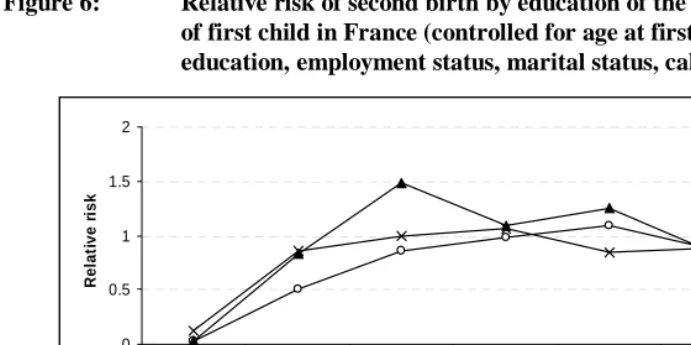
To analyze the possibility that the higher second birth risk in France might also be due to a timing effect, we apply an interaction between education of the woman and the age of the first child. Figure 6 shows that the positive effect of a higher education is especially pronounced at short duration since the first birth. The higher second birth risk is therefore not only due to the level of education itself, but we also find an indication of a tempo effect, meaning that college educated women in France try to space their births closer together. The reason for this is either the later age of childbearing and resulting biological limitations in comparison to their counterparts with lower qualifications, or because they try to return to work as soon as possible and therefore space their births close together in order not to loose contact to work after first childbirth.
10 Possibly, it would have been more advantageous to have more direct measures of labor market performance such as income at ones disposal.
Figure 6: Relative risk of second birth by education of the mother and age of first child in France (controlled for age at first birth, partners’ education, employment status, marital status, calendar time)
0 0.5 1 1.5 2
<1 1 2 3 4 5 6+
age of firs t child
R
e
la
ti
ve r
isk
low m edium high
Source: French FFS 1994
In Model 4 a variable was added that measures whether the woman was ever or never employed11. As expected, women who have never been employed in their life have a higher second birth risk in both countries than mothers who have worked before. In both countries, the group of women that were never employed consists mainly of the lowly educated. Around 9% of West German women with a relatively low education and 10% of their French counterparts have never been in gainful employment. Women with a university degree never worked to a very low number in both countries (3% in western Germany and 1% in France). Next, we control for marital status. In both countries, married women have a much higher risk than unmarried ones do (Model 5). This result confirms our assumptions. As expected, women in higher-order marriages have also higher second birth risks. Divorced women experience lower risks. The variable period is not significant in both countries (Models 6 and 7). In western Germany, there is an increase in second birth intensities over time – they are lowest in the 1970s and highest between 1990 and 1992 (reference category is the period
11 Only the West German FFS offered the possibility of generating a time-varying variable that measures the employment status after the birth of
1986). Before 1974, the oldest cohort was as young as around 22 years; this may explain the low second birth intensity. In France, the risks do not change at all, except before 1973, where the second birth risk was at a higher level than in the mid-eighties. It is hard to tell whether this may be due to family policy changes or general economic or social factors.
7. Conclusion
The paper aimed at comparing the second birth risks of French and West German women by concentrating on the effect of the education level. To measure the effect of education on the transition to the second child, we estimated a stepwise multiplicative intensity-regression model. A comparison of the institutional constraints in the two countries showed a stronger incompatibility between work and family life in western Germany than in France because of institutional constraints that hamper mothers’ employment. Especially women with a university degree suffer from decision conflicts. If they want to convert their accumulated human capital into gainful employment and income, they often need to forego childbearing. The opportunity costs concomitant to raising children and giving up employment are especially high for this group. Descriptive statistics showed a “polarization” between higher educated women in western Germany who stay childless and those who have more than one child. We therefore expected higher second birth risks for West German women with high education. They decided in favor of a family and against a career. Also for French women with a university degree, a higher second birth risk was assumed but for different reasons. French women with a high education should be able to support a larger family by investing their higher income into family size. Work and family life are compatible in France – inexpensive and widely accepted public childcare helps mothers to combine employment and childrearing.
second birth risk that is more than 40% higher than it is for medium educated women. Even after controlling for all other variables, this pattern does not change.
These results point into two directions. First, when analyzing the effect of a woman’s level of education on second birth risks, it is important to take the partner’s education into account as well. His level of education plays a major part in both countries in explaining higher order birth risks. The impact of the partner’s higher education on second birth risks is more pronounced in western Germany than in France. Because of strong educational homogamy, highly educated women in western Germany mostly have better educated partners who will probably have higher incomes and are in a better position to financially support another child. There is no strong independent effect of female education, but it is also the education degree of the partner that determines second birth risks. Contrary to western Germany, well-educated French women do not seem to be that strongly dependent on their partner’s education and income. They can rely on several state-aided measures that support female labor-force participation and family life. Inexpensive all-day-care for children aged three to six and all-day-schools for older children facilitate maternal employment. However, the risk is also highest for French women when they have a partner who has a better education and thus have a better economic position.
Second, despite the weakening influence of higher education on second birth intensities of West German women after controlling for the partner’s education, the risk did not disappear altogether; there is still an indication that education has an independent effect. Low child care provisions for children below age three and inadequate opening hours of Kindergärten for children aged between three and six make it hard for West German mothers to be employed. Connected with tax disadvantages for full-time working women, the institutional framework supports and prolongs the interruption of maternal gainful employment. This institutional setting makes it difficult for all West German women to reconcile their stay in the labor market with their desire for children, but women with higher education show the highest opportunity costs of childbearing. This leads to a polarization of highly educated women between childlessness and having a larger family. Our descriptive and multivariate results support the polarization hypothesis: Highly educated West German mothers who decided in favor of a family despite these opportunity costs have a second child more often than do other women.
work12. But all in all, there is an indication that it is easier for French women to combine work and family life than it is for their West German contemporaries.
8. Acknowledgements
I would especially like to thank Michaela Kreyenfeld, Gerda Neyer and the journal’s anonymous reviewers for their valuable comments and suggestions on earlier versions of this paper and Susann Backer for language editing. I also thank the Advisory Group of the FFS program of comparative research for its permission, granted under identification number 75, to use the FFS data on which this study is based.
12 In France, women in gainful employment spend more than twice as much time per week on domestic work (4 hours and 15 minutes a day) than
References
Adserà, A. (2004). ‘Changing fertility rates in developed countries. The impact of labor market institutions’, Journal of Population Economics 17 (1): 17-43.
Anttonen, A., Sipilä, J. (1996). ‘European social care services: is it possible to identify models?’, Journal of European Social Policy 6 (2): 87-100.
Becker, G. S. (1985). ‘Human Capital, Effort, and the Sexual Division of Labor’, Journal of Labor Economics 3 (1): 33-58.
Becker, G. S. (1993). A treatise on the family. Enlarged Edition. Cambridge/ Massachusetts: Harvard University Press.
Blossfeld, H-P., Huinink, J., (1989). ‘Die Verbesserung der Bildungs- und Berufschancen von Frauen und ihr Einfluß auf den Prozeß der Familienbildung’, Zeitschrift für Bevölkerungswissenschaft 45 (4): 383-404.
Blossfeld, H-P., Huinink, J. (1991). ‘Human capital investments or norms of role transition? How women’s schooling and career affect the process of family formation’, American Journal of Sociology 97 (1): 143-168.
Blossfeld, H-P. , Timm, A. (eds.) (2003). Who marries whom? Educational systems as marriage markets in modern societies. Dordrecht, Boston, London: Kluwer Academic Publishers.
Brewster, K.L., Rindfuss, R.R. (2000). ‚Fertility and Women’s Employment in Industrialized Nations’, Annual Review of Sociology 26: 271-296.
Council of Europe (ed) (2001). Recent demographic developments in Europe: Demographic Yearbook 2001.
Dingeldey, I. (2000). Begünstigungen und Belastungen familialer Erwerbs- und Arbeitszeitmuster in Steuer- und Sozialversicherungssystemen – Ein Vergleich zehn europäischer Länder. Gelsenkirchen: Institut Arbeit und Technik.
Ermisch, J. F. (1988). ‘Purchased child care, optimal family size and mother’s employment. Theory and econometric analysis’, Journal of Population Economics 2: 79-102.
Esping-Andersen, G. (1990). The three worlds of welfare capitalism. Cambridge: Polity Press.
European Commission (2000). Wie verwenden Frauen und Männer ihre Zeit? Drei europäische Studien. Luxemburg: Amt für amtliche Veröffentlichungen der Europäischen Gemeinschaften.
European Commission (ed) (2002.) Europäische Sozialstatistik - Bevölkerung. Luxemburg: Amt für amtliche Veröffentlichungen der Europäischen Gemeinschaften.
Eurostat (2003). Labour Force Survey results 2002. Luxembourg: Office for Official Publications of the European Communities.
Fagnani, J. (2002). ‘Why do French women have more children than German women? Family policies and attitudes towards child care outside home’, Community, Work and Family 5 (1): 103-120.
Gauthier, A. H., Bortnik, A. (2001). Comparative Maternity, Parental, and Childcare Database, Version 2. University of Calgary: On-line.
Glynn, P. (2004). ‘Weighting and Adjusting Weights: An Example’, available at: http://staff.washington.edu/glynn/adjweight2.pdf, 26.03.2004.
Gornick, J. C., Meyers, M. M., Ross, K. E. (1997). ‘Supporting the employment of mothers: Policy variation across fourteen welfare states’, Journal of European Social Policy 7 (1): 45-70.
Gornick, J. C., Meyers, M. M., Ross, K. E. (1998). ‘Public policies and the employment of mothers: a cross-national study’, Social Science Quarterly 79 (1): 35-54.
Grundmann, M., Huinink, J., Krappmann, L. (1994). ’Familie und Bildung. Empirische Ergebnisse und Überlegungen zur Frage der Beziehung von Bildungsbeteiligung, Familienentwicklung und Sozialisation’, in: P. Büchner et al. (eds), Kindliche Lebenswelten, Bildung und innerfamiliale Beziehungen. Materialien zum 5. Familienbericht, vol.4. München: Verlag Deutsches Jugendinstitut, pp. 41-104.
Hank, K, Kreyenfeld, M., Spieß, K. C. (2003). ’Kinderbetreuung und Fertilität in Deutschland’, MPIDR Working Paper, WP 2003-002, available at: http://www.demogr.mpg.de.
Hoem, B., Hoem, J. M. (1989). ‘The impact of women’s employment on second and third births in modern Sweden’, Population Studies 43: 47-67.
Hoem, B. (1996). ‘The Social Meaning of the Age at Second Birth for Third-Birth Fertility: A Methodological Note on the Need to Sometimes Respecify an Intermediate Variable’, Yearbook of Population Research in Finland 33: 333-339.
Hoem, J. M. (1996). ‘The Harmfulness or Harmlessness of Using an Anticipatory Regressor: How Dangerous Is It to Use Education Achieved as of 1990 in the Analysis of Divorce Risks in Earlier Years?’, Yearbook of Population Research in Finland 33: 34-43.
Hoem J. M., Prskawetz, A., Neyer, G. (2001). ‘Autonomy or conservative adjustment? The effect of public policies and educational attainment on third births in Austria, 1975-96’, Population Studies 55: 249-261.
Huinink, J. (1989). ’Das zweite Kind. Sind wir auf dem Weg zur Ein-Kind-Familie?’, Zeitschrift für Soziologie 18 (3): 192-207.
Huinink, J. (1995). Warum noch Familie? Zur Attraktivität von Partnerschaft und Elternschaft in unserer Gesellschaft. Frankfurt/Main and New York: Campus Verlag.
Huinink, J. (2002). ’Polarisierung der Familienentwicklung in europäischen Ländern im Vergleich’, in: N.F. Schneider and H. Matthias-Bleck (eds.), Elternschaft heute. Gesellschaftliche Rahmenbedingungen und individuelle Gestaltungsaufgaben. Opladen: Leske+Budrich, pp. 49-73.
Klein, T., Lengerer, A., Uzelac, M. (2002). ’Partnerschaftliche Lebensformen im internationalen Vergleich’, Zeitschrift für Bevölkerungswissenschaften 27 (3): 359-379.
Kravdal, Ø. (1992). ‘The emergence of a positive relationship between education and third birth rates in Norway with supportive evidence from the United States’, Population Studies 46 (3): 459-475.
Kravdal, Ø. (2001). ‘The High Fertility of College Educated Women in Norway: An Artefact of the Separate Modelling of Each Parity Transition’, Demographic Research 5 (6), available at: http://www.demographic-research.org/Volumes/Vol5/6.
Kreyenfeld, M. (2002a). ‘Parity Specific Birth Rates for West Germany: An Attempt to
Combine Survey Data and Vital Statistics’, Zeitschrift für
Kreyenfeld, M. (2002b). ‘Time-squeeze, partner effect or self-selection? An investigation into the positive effect of women’s education on second birth risks
in West Germany’, Demographic Research 7 (2), available at:
http://www.demographic-research.org/Volumes/Vol7/2.
Kreyenfeld, M. (2004). ‘Fertility decisions in the FRG and GDR: An analysis with data from the German fertility and family survey’, MPIDR Working Paper WP 2004-008, available at: http://www.demogr.mpg.de.
Kreyenfeld, M., Hank, K. (2000). ‘Does the availability of child care influence the employment of mothers? Findings from western Germany’, Population Research and Policy Review 19: 317-337.
Kreyenfeld, M., Spieß, K. C., Wagner, G. (2002). ’Kinderbetreuungspolitik in Deutschland. Möglichkeiten nachfrageorientierter Steuerungs- und Finanzierungs-instrumente’, Zeitschrift für Erziehungswissenschaften 5 (2): 201-221.
Langan, M., Ostner, I. (1991). ’Geschlechterpolitik im Wohlfahrtsstaat: Aspekte im internationalen Vergleich’, Kritische Justiz: 302-317
Le Goff, J. M. (2002). ‘Cohabiting unions in France and West Germany: Transitions to first birth and first marriage’, Demographic Research 7 (18), available at: http://www.demographic-research.org/Volumes/Vol7/18.
Letablier, M.-T. (2002). ’Kinderbetreuungspolitik in Frankreich und ihre Rechtfertigung’, WSI Mitteilungen 3: 169-175.
Lessenich, S., Ostner, I. (1995). ’Die institutionelle Dynamik „dritter Wege” – Zur Entwicklung der Familienpolitik in „katholischen“ Wohlfahrtsstaaten am Beispiel Deutschlands und Frankreichs’, Zeitschrift für Sozialreform 47: 780-803.
Mincer, J., Polachek, S. (1982). ‘Family Investments in Human Capital: Earnings of Women’, Journal of Political Economy 2 (2): 76-108.
Morgan, K. (2002). ‘Does Anyone Have a 'Libre Choix'? Subversive Liberalism and the Politics of French Child Care Policy’, in: S. Michel and R. Mahon (eds.), Child care policy at the crossroads. Gender and welfare state restructuring. New York/London: Routledge, pp. 143-167.
OECD (2004). ‘OECD Labour Market Statistics: Indicators’, available at: www.oecd.org.
Oláh, L. Sz. (1996). ‘The impact of public policies on the second-birth rates in Sweden: A gender perspective’, Stockholm Research Reports in Demography 96, Stockholm.
Reuter, S. (2002). ’Frankreichs Wohlfahrtsstaatsregime im Wandel? Erwerbsintegration von Französinnen und familienpolitische Reformen der 90er Jahre’, ZeS-Arbeitspapier 12, Zentrum für Sozialpolitik, Bremen.
Sell, S. (2002). ’“Bedarfsorientierte” Modernisierung der Kinderbetreuungsinfrastruktur in Deutschland’, WSI Mitteilungen 3: 147-153.
Tavan, C. (2005). ‘Les immigrés en France: une situation qui évolue’, INSEE Première 1042, Paris: INSEE.
Toulemon, L. (2001). ‘How many children and how many siblings in France in the last century?’, Population & Sociétés 374, Paris: INED.
Toulemon, L., de Guibert-Lantoine, C. (1998). Fertility and family surveys in countries of the ECE Region: Standard Country Report France. New York/Genf: United Nations.
Toulemon, L. (2004). ‘Fertility among immigrant women: new data, a new approach’, Population & Sociétés 400, Paris: INED.
Appendix
Table A1: Number of cases included and excluded from the analysis.
West German female cohort 1952-72
number of respondents after cleaning the data set 2,964
number of respondents with one or more children 1,336
Excluded cases
twins at first birth 10
adopted children 4
stepchildren 15 fosterchildren 6 first child born before the 14th birthday of respondent 3
respondent older than age 45 at first or second birth - first child died before the birth of the second child 2
first child born in month of interview 3
absolute number of excluded cases 43
number of respondents 1,293
number of second births 751
Table A2: Number of cases included and excluded from the analysis. French
female cohort 1944-73 (unweighted)
number of respondents after cleaning the data set 2,932
number of respondents with one or more children 2,189
Excluded cases
twins at first birth 18
adopted children 4
stepchildren 20
foster children 13
first child born before the 14th birthday of respondent 4
respondent older than age 45 at first or second birth 67
first child died before the birth of the second child -
first child born in month of interview 4
absolute number of excluded cases 130
number of respondents 2,059