Max Planck Institute for Demographic Research Konrad-Zuse Str. 1, D-18057 Rostock · GERMANY www.demographic-research.org
DEMOGRAPHIC RESEARCH
VOLUME 20, ARTICLE 30 PAGES 731-816
PUBLISHED 19 JUNE 2009
http://www.demographic-research.org/Volumes/Vol20/30/ DOI: 10.4054/DemRes.2009.20.30
Research Article
Leaving the parental home in post-war Japan:
Demographic changes, stem-family
norms and the transition to adulthood
Setsuya Fukuda
This publication is part of the proposed Special Collection "Strong Family Ties and Demographic Dynamics" edited by Gianpiero Dalla Zuanna and Laura Bernardi.
© 2009 Setsuya Fukuda.
This open-access work is published under the terms of the Creative Commons Attribution NonCommercial License 2.0 Germany, which permits use, reproduction & distribution in any medium for non-commercial purposes, provided the original author(s) and source are given credit.
1 Introduction 732
2 Leaving home in industrialized countries 734
3 Living arrangements of young adults in Japan 738
4 The patterns of leaving home in Japan 742
5 Determinants of leaving home in Japan 746
5.1 Demographic changes 747
5.2 Changes in socio-economic status of family of origin 750 5.3 Changing patterns of the transition to adulthood 754
5.3.1 Schooling 754
5.3.2 Employment 757
5.3.3 Marriage 761
6 Data and variables 763
6.1 Data 763
6.2 Definitions of event variables 764
6.3 Definitions of covariates 766
7 Methods and models 768
7.1 Methods 768
7.2 Models 771
8 Results 772
8.1 Descriptive statistics 772
8.2 Model estimations 777
8.2.1 Nested models of men’s leaving home 777 8.2.2 Nested models of women’s leaving home 781 8.2.3 Interaction effects of heir status and birth cohort 786 8.2.4 Interaction effects of life events and birth cohort 787
9 Summary 791
10 Discussions 797
11 Acknowledgements 799
References 800
Leaving the parental home in post-war Japan:
Demographic changes, stem-family norms
and the transition to adulthood
Setsuya Fukuda1
Abstract
Leaving home is a key life event in the transition to adulthood, but it has been relatively less explored in demographic studies of contemporary Japan. This paper examines the relationship between home-leaving intensities of young adults and the rapid social, economic, and demographic changes that took place in post-World War II Japan. By using event-history analysis, the study focuses on 1) family and socio-demographic characteristics, 2) stem-family norms, and 3) proximities of life events and leaving home as the main factors affecting the chances of leaving home. This study aims to explain cohort trends and sex differentials in home-leaving behaviors among young adults in post-war Japan.
1. Introduction
Leaving the parental home has been extensively studied in Western countries2. It is
often studied as a topic closely related to such issues as the independence of young adults (Goldscheider and Goldscheider 1987, Goldscheider and DaVanzo 1989, Goldscheider and Goldscheider 1993a), parent-adult child relationships (Goldscheider and Goldscheider 1989, 1993b, Jong Gierveld, Liefbroer, and Beekink 1991, Buck and Scott 1993), the changing roles of marriage as an adult status (Goldscheider and Goldscheider 1993a, Goldscheider and Goldscheider 1994), educational opportunities (Wagner 1990, Nilsson and Strandh 1999), increasing job insecurity among young adults (Keilmann 1987, Jacob and Kleinert 2008), and the availability of both the intra- and the extra-familial resources needed to establish a separate household (Avery, Goldscheider, and Alden 1992, Whittington and Peters 1996, Garasky, Haurin, and Haurin 2001). Some scholars have also argued that the patterns of leaving home reflect institutional settings inherent in the historical roots of the region, such as welfare regimes (Fussel and Gauthier 2004, Newman and Aptekar 2007), family ties (Reher 1998), and family systems (Kurosu 1996a, 1996b, van Poppel, Oris, and Lee 2004). In the field of demography, the emergence of non-traditional living arrangements, such as cohabitation and extramarital birth, are interpreted as a sign of the Second Demographic Transition (SDT) (van de Kaa 1987, 2001, Lesthaege 1995). Patterns of leaving home are compatible with such non-traditional family behaviors, and are considered to be important factors in explaining the regional divergence in the processes of the SDT (Lesthaege and Moors 2000). Therefore, leaving home, particularly its incidence before marriage, is one of the important indicators in understanding the current development of family behaviors.
Over the last half of the 20th century, Japan became highly industrialized, and achieved one of the highest living standards in the world. At the same time, Japanese families underwent enormous social and demographic changes during the post-World War II period. Family size became smaller as fertility rapidly declined, the population became more concentrated in urban areas than in rural areas, and the center of gravity of the labor force shifted away from the manufacturing and agricultural sectors, and towards the service industry. As a result, compositions of family characteristics varied significantly by successive cohorts. Furthermore, each cohort faced different macro contexts as a consequence of economic fluctuations, institutional changes, and erosion of the traditional norms regarding family and household formations. As shown in this paper, these changes in macro contexts facilitated important changes in the transitions
to adulthood in post-war Japan. For example, as in other industrialized countries, more young adults enrolled in tertiary education and more single women entered full-time employment, even as the employment of young adults became more insecure, and people began to marry later and less. There is, however, little research into how these social, economic, and demographic changes affected the living arrangements of young adults in post-war Japan.
Compared with other related topics, leaving home has received less attention in demographic studies of contemporary Japan. The research on the timing of leaving home was, until the late 1990s, largely hindered by the data availability and methodologies. A number of previous studies used cross-sectional data to analyze parent-child coresidence among single young adults (Kojima 1989, 1990, Iwakami 1999, Suzuki 2001, 2002, 2003) or among newlyweds (Tsuya 1990). These studies identified several social, economic, and demographic characteristics of both young adults and parents associated with the probabilities of intergenerational coresidence at a certain life stage. Studies of parent-adult child coresidence could not, however, make concrete conclusions about the behavioral aspects of household changes, since they did not model the transition rates of residential changes. Furthermore, these studies failed to make any causal inference regarding the formation of parent-adult child coresidence, as they were unable to set an appropriate time ordering between explanatory variables and dependent variables.
Studies of another type used descriptive methods of survival analysis, such as life tables and Kaplan-Meyer methods, to depict the trends in leaving home (Suzuki 1997, 2001, 2002, 2003, 2007, Ando 2001). They could favorably describe the age patterns of leaving home by a number of covariates, such as sex, birth cohort, and other socio-demographic variables. However, these methods have some limitations when it comes to explaining the complex mechanisms of leaving home behaviors. In sum, most previous studies did not model how the transition rate of nest-leaving is dependent on a broader set of covariates.
In 1999, the Society of Family Sociology of Japan conducted a survey known as the National Family Research of Japan 1998 (NFRJ-98). The release of the NFRJ-98 data in 2001 made it possible for the first time for researchers to analyze transition rates of leaving home in Japan in multivariate models, such as event-history analysis3. The
most recent studies of leaving home, such as Fukuda (2003) and Sawaguchi and
3 Another data set previously used for the analysis of leaving home is the National Survey on Household
Shimazaki (2004), analyzed the hazards of nest-leaving using the NFRJ-98 data. Fukuda (2003) gave detailed analyses of socio-demographic determinants of nest-leaving by sex and by reasons for nest-leaving home, while Sawaguchi and Shimazaki (2004) mainly focused on social strata differentials in the hazards associated with leaving home. Although the NFRJ-98 provides the first available nationally representative data for modeling nest-leaving behaviors in Japan, so far few papers on the survey have been made available in international languages, such as English4. This
study is primarily based on my previous paper (Fukuda 2003), but focuses to a greater extent on explaining cohort trends of home-leaving through the application of more sophisticated analytical methods. In addition, to cover the entire post-war period, the 1930s cohort has been added to the analysis.
The goal of this study is to investigate the trends and determinants of leaving home, a dynamic aspect of household changes among young adult ages. Using data from a nationally representative survey, the NFRJ-98, this paper addresses the following research questions through multi-variate event-history analysis:
1) Which socio-demographic factors explain nest-leaving behaviors in post-war Japan? 2) Does the norm of the traditional stem-family play a role in nest-leaving behaviors in contemporary Japan?
3) How do proximities of nest-leaving and other life events change by sex and cohort?
Each research question is designed to explain the cohort trends of nest-leaving in post-war Japan in terms of 1) the compositional changes in family characteristics, 2) the historical roots of the stem-family, and 3) the changes in the transition to adulthood. By addressing these research questions, the changes and degrees of stability in living arrangements among Japanese young adults can be extensively investigated. This study includes separate analyses for men and women, followed by a discussion of the distinct sex differentials in leaving home behaviors in Japan. Thus important sex differences in leaving home and household formation will also be revealed.
2. Leaving home in industrialized countries
Leaving the parental home is one of the key events during the transition to adulthood. Leaving home is an event which results in the residential independence of young adults
4 Ando’s (2004) paper may be the only exception written in English which examines leaving home and its
from their parents. It “signifies initial or sometimes final farewell to youth and which often entails the loosening of the spatial, financial and sometimes emotional ties between parents and children” (van Poppel and Oris 2004, p1).
In many industrialized countries, leaving home was closely linked with marriage up until the 1950s and early 1960s. Since then, however, many young adults have been leaving home before marriage to live on their own in separate households, often sharing with roommates or cohabiting with a sexual partner, especially in Northern Europe such as Great Britain, Scandinavia, and the Low Countries, as well as in much of Germany, Austria, and North America (Cordon 1997, Goldscheider 1997, Bianchi and Casper 2000, Lesthaeghe and Moors 2000, Billari, Philipov, and Baizan 2001, Aassve et. al. 2002, Corijn and Klijzing 2001, Fokkema and Liefbroer 2008). In these countries, leaving home has been often studied as a manifestation of the desire of young adults to be independent from their parents. The phase of social independence among young adults who are single is considered to be a new life stage which has emerged since the 1960s (Goldscheider and Goldscheider 1994, Rosenfeld 2006).
On the other hand, Southern European countries, such as Italy, Greece, Spain, and Portugal, show substantial delays in marriage, along with prolonged periods of living at home (Cordon 1997, Lesthaeghe and Moors 2000, Billari, Philipov and Baizan 2001, Corijn and Klijzing 2001, Aassve et. al. 2002, Fokkema and Liefbroer 2008). In these countries, leaving home is still strongly linked to marriage (Reher 1998, Billari et al. 2002, Fokkema and Liefbroer 2008). While the delay in marriage is part of the reason for the diversification of living arrangements among young adults in Northern European and North American countries, young adults in Southern Europe simply prolong the period of coresidence with their parents as marriage is delayed. Previous studies in Mediterranean Europe are, therefore, focused on such questions as why young adults do not leave the parental home until later ages (Rossi 1997, Scabini and Cigoli 1997, Cordon 1997, Holdsworth 1998, 2000, Holdsworth and Solda 2002, Tobío 2001, Viazzo 2003), or what the consequences are of prolonged periods spent at home (Dalla Zuanna 2001, Livi-Bacci 2001, Billari and Rosina 2004). Compared to the situation in other industrialized countries, the increase in coresidence with parents in these countries is sometimes seen as a psychological failure of young adults to become independent from their parents (Rossi 1997, Scabini and Cigoli 1997, Dalla Zuanna 2001)5.
5 A similar argument is also made when the delay in residential independence was observed during the 1980s
The north-south division in living arrangements of young adults in Western Europe is, however, not simply due to differences in perception and prevalence of youth independence in the two regions. The patterns of leaving home and living arrangements of young adults are closely related to the family and fertility behaviors of the populations within each country. Lesthaeghe and Moors (2000) perceive the destandardization of patterns of home-leaving and household formation to be the most salient characteristics of the SDT6. They have argued that country-specific differences in the living arrangements of young adults can be largely classified into two types: high prevalence of independent living and premarital cohabitation, or prolonged periods spent at home as singles (Lesthaeghe and Moors 2000). This classification perfectly overlaps with the aforementioned north-south division in living arrangements among young adults in Western countries. These north-south differences in living arrangements can, they insist, be explained by the historical context, which leads to variations in such factors as the following: 1) the type of welfare state, which determines the sources of subsidies for economic independence among young adults; 2) the prevalence of tertiary education, which increases the earning potential of young adults, while also fostering individualism and egalitarian gender roles; 3) the degree of post-materialist values, which are tolerant of alternative life styles; and 4) the degree of familistic values transmitted from the parental generation (Lesthaeghe and Moors 2000).
One of the historical roots which is deeply relating to the patterns of leaving home is family systems. Among several aspects of the family system, Reher (1998) has argued that the strength of family ties explains the north-south divide in living arrangements in Western Europe. He divides European countries into two categories, one with strong family ties, and another with relatively weak family ties. The connection between leaving home and marriage, and the degree of responsibility taken by families for caring for the most vulnerable family members, such as infants and the elderly, are suggested as being two good indicators of the distinction. The family system in a country is classified as having strong family ties, or vice versa, depending on the extent to which leaving home and marriage are related, and care responsibilities for vulnerable members are handled by families.
Reher (1998) made a simple geographical distinction between these two family systems in Europe. He characterized the central and northern regions of Western Europe, as well as the North American countries, as having relatively weak family
6 They refer to the destandardization as “the classic sequence of finishing school, entry into the labor force,
links, and the Mediterranean region as having strong family ties. The origins of the different family systems are then examined from several perspectives, such as history, religion, and descent routes. He also tries to explain various social differences that exist in European countries—for example, in the rates of divorce, extramarital birth, homelessness, unemployment, single parenthood, and suicides—in applying his definition of family systems. Reher (1998) insists that, although family and family forms are converging in a similar direction in Western European and North American countries, differences in family systems, which can be seen as outcomes of societies' own historical trajectories, will persist into the future.
Japan has a lot in common with Southern European countries in terms of the formation of families and households. For example, Japanese young adults, especially women, tend to live with their parents until marriage (Suzuki 2001, 2002, 2003, Ando 2001); cohabitation is uncommon in Japan, even as the average age at marriage continues to rise; marriage still plays a crucial role in childbearing among couples; and the fertility rate is one of the lowest in the world7. Furthermore, statistics show that 70% of elderly care was undertaken by coresidential family members in 2004 (Ministry of Health, Labor, and Welfare 2005). Therefore, Japan can certainly be classified as a country with strong family ties based on Reher’s (1998) definition. While it is widely known that the Japanese characteristics associated with strong family ties—such as prolonged parent-adult child coresidence, late marriage, low fertility rates, and care for the elderly by coresidential family members—are similar to those seen in Southern European countries, questions remain about how close these similarities are, whether these similarlities are substantial or only temporal, and whether these two regions have a common background.
One of the keys to understanding the similarity lies in patterns of leaving home and living arrangements among young adults in the two regions, Southern Europe and Japan. Although leaving home in pre-industrial Japan has been studied extensively in the field of historical demography in connection with the stem-family system in Japan (Kurosu 1996a, 1996b, 2004), the household dynamics of young adults in contemporary Japan were largely neglected until the late 1990s8. The topic became an increasingly important issue in Japan after it was shown that the number of young adults living with their parents had grown enormously over the last few decades (Yamada 1999, Nishi and Kan 2005). Research into leaving home can also provide insight into such issues as the
7 In the age group 18-34, proportions of never-married who are in consensual union are 1.9% and 2.3% for
men and women, respectively, in 2005 (NIPSSR 2007). Proportion of non-marital childbirth among total birth is 2.1% in 2006 Japan (Ministry of Health, Welfare, and Labor 2006). Total fertility rate in Japan was at a record low of 1.26 in 2005 but recovered afterwards and reached 1.37 in 2008.
8 The numbers of young adults coresiding with parents are not clear from official statistics until the Statistical
transition to adulthood, independence of young adults, parent-adult child relationships, household formation, and family systems in contemporary Japan. This paper does not intend to show any comparative results of living arrangements in Japan and Southern European countries. Instead, it aims to provide detailed examinations of the trends and determinants of the living arrangements of Japanese young adults in the post-war period, and, ultimately, to serve as a basis for future comparative studies.
3. Living arrangements of young adults in Japan
In this section, we review the trends in living arrangements among young adults in Japan since 1980. From 1970 to 2000, the proportion of never-married people increased dramatically in Japan. For example, according to the census, the proportion of the never-married in Japan aged 30-34 increased from 11.6% to 42.9% for men, and from 7.2% to 26.6% for women.Singulate mean age at first marriage (SMAM) also showed significant increases, from 27.5 to 30.8 for men, and from 24.7 to 28.6 for women (NIPSSR 2008). In the United States and some European countries, the trend towards later and less frequent marriage is linked with diversified living arrangements of young adults (Goldscheider 1997, Bianchi and Casper 2000). This is, however, not the case in Japan.
Figure 1 shows the distributions of living arrangements of never-married young adults in Japan in the period of 1980-20059. In Figure 1, all rates are standardized to the five-year group age structure of year 2000. Therefore, differences in age structures of each period do not affect these rates. It is clear from Figure 1, that a majority of the Japanese young adults live with their parents while they are single. Among never-married young adults, 60% of men and 70% of women aged 20-34 have lived with their parents over the past 25 years. These proportions seem noticeably higher than in the United States or in Northern and Central European countries10 but they are very close to those of Southern European countries (Fokkema and Liefbroer 2008). It is, however, rather surprising that the living arrangements of young adults are relatively stable in any
9 Young adults in the living arrangement “else” include persons in either non-relative households; institutional
households such as school dormitories, hospitals, social institutions, camps of self-defense forces, and reformatory institutions; persons living in other families, probably as servants; persons living with only brothers or sisters and persons in other types of living arrangements.
10 For example, in the United States, 45.3% of single men and 39.1% of single women ages of 20-29 lived
given period, while the proportions of the never-married in this age group increased substantially.11
Figure 1: Living arrangements of never-married men and women aged 20-34: 1980-2005*
a. men b. women
5.9 6.2 7.1
60.2
58.8 60.9 61.5 61.6 61.1 31.7 32.2 32.6 33.0 32.8 33.4 6.9 7.8 6.1 0 25 50 75 100 19
80 1985 1990 1995 2000 2005
Li vi ng A rr ang em ent s of N ev er -M ar ri ed 35 45 55 65 75 P rop or tion N ev er -m ar ried
Coresident with Parent(s) Living Alone
Else Never- married
19.6 20.3 22.1 23.7 6.5 6.9 7.6
73.3 71.0 68.7 73.6 69.9 72.1 21.2 20.1 6.8 9.0 7.9 0 25 50 75 100 19
80 1985 1990 1995 2000 2005
Li vi ng A rr an ge m en ts of N ev er -M ar ri ed 35 45 55 65 75 P rop or tion N ev er -m ar rie d
Coresident with Parent(s) Living Alone
Else Never- married
* Living arrangements are standardized to the age structure of the never-married population in 2000. * Proportions of never-married are standardized to the age structure of population in 2000. Sources: Author’s re-tabulation of the Population Census of Japan, various years, Statistics Bureau.
It should also be noted that only a few types of living arrangements are practiced by unmarried young adults who are not living in their parental home. The one-person household has been the dominant option for young adults who left home before marriage in the past 25 years. In contrast to Western countries, non-family living situations, such as room sharing, group living in college dormitories or military barracks, and cohabitation have not been common among single young adults in Japan. As Figure 1 shows, young adults who live in these non-family living situations are classified as “else,” and the shares of the population living in such arrangements are well below 10% for both sexes over the entire period12 (see Note 9 for the details of
11 Standardized proportions of the never-married increased from 55.8% to 70.5% for men, and 35.8% to
59.4% for women at this age group during 1980-2005 (based on author’s calculation of the Population Census of Japan).
12 Among those in residual living arrangements, however, the proportions of young adults in non-relative
“else” category). In addition, according to the latest survey in 2005, the percentages of never-married people in Japan aged 18-34 who are in consensual unions were 1.9% for men and 2.3% for women13 (NIPSSR 2007). In sum, about three-quarters of young adults living away from the parental home are essentially living alone in Japan. In line with this trend, the proportion of Japanese women aged 20-24 who live alone has been shown to be as high as in Western European and North American countries, such as the Netherlands, France, Canada, Austria, and Germany (Lesthaeghe and Moors 2000).
In contrast to the never-married, the majority of married young couples live in nuclear households. Figure 2 shows the living arrangements of married men and women aged 20-34 in the period from 1980-2005. Around 70%-80% of young couples settle in independent households away from their parents14. The percentages of couples who live with parents have decreased by half over the past 20 years. The figure shows that growing numbers of young couples have been choosing to live in their own households after marriage. This result is consistent with several surveys showing a stronger preference for a nuclear family household among younger cohorts15. In other words, traditional norms of intergenerational coresidence appear to be eroding among young married couples in recent years16.
(Nishi and Kan 2008). As evident from the population census, the share of young adults in non-relative households among “else” increases from 4.3% to 20.8% for men, and 5.5% to 25.8% for women in the period between 1980 and 2005 (based on author’s calculation of the Population Census of Japan).
13 However, some evidence suggests that cohabitation is slowly developing among younger generations in
Japan. According to Iwasawa (2005), about 20% of first married women ages 25-34 have ever experienced cohabitation in Japan. In addition, 30% of first consensual unions formed by women ages 25-34 were cohabitation. Furthermore, a half of women who have neither cohabited nor married at ages 20-24, expressed a wish to experience cohabitation in the future. Therefore, cohabitation may be more common in the future in Japan as it is perceived more positively by younger generations.
14 Married persons in the living arrangement “else” are persons in one-person households; non-relative
households; institutional households; other families’ households, probably as servants; and relatives’ households without parents.
15 Empirical results show decreasing support for intergenerational coresidence as a choice of post-marital
living arrangement in recent periods. In 1993, 61.5% of married women under 69 years old agreed to the statement, “It is better for elderly parent(s) to live with a married son” while 50.4% of them agreed with the idea in 1998 (Nishioka 2000).
16 The recent studies of post-marital living arrangement show, however, that low proportions of
Figure 2: Living arrangements of married couples aged 20-34: 1980-2005*
14.3 15.8 20.3 25.6 28.9 27.7
69.5 70.5 72.8
83.5 82.3 78.1
2.2 1.6
1.8 1.6 1.6 1.9
0 25 50 75 100
1980 1985 1990 1995 2000 2005
Li
vi
ng
A
rr
ang
em
ent
s of
M
ar
ri
ed
C
oup
le
Extended Family Nuclear Family Else
%
* Rates are standardized to the age structure of the married population in 2000.
Sources: Author’s re-tabulation of the Population Census of Japan, various years, Statistics Bureau.
The sharp contrast between the living arrangements of single and married young adults suggests that marriage is a strong determinant of leaving the parental home and of forming a separate household for Japanese young adults. On the other hand, the delay in marriage among younger cohorts implies continuity of coresidence with parents for the majority of young adults. The rapidly rising proportions of the never-married have led to a noticeable increase in the number of unmarried adults living with their parents in Japan. The population census shows that the number of never-married young adults who live with their parents has grown enormously, from 4.3 million to 5.7 million among men, and from 3.2 million to 5.2 million among women between 1980 and 199517. Their proportions also increased from 6.4% to 8.7% of the total population over
the same period. After 1995, these numbers and proportions remained around the same level until 2005, as the higher proportions of never-married were offset by smaller cohort sizes in younger cohorts. The rapid increase in the numbers of young adults living with their parents during the 1980s and the mid-1990s drew both public and
academic attention as a “new” phenomenon. Scholars have focused on the issues of why young adults are staying in the parental home longer (Takahashi and Voss 2000, Suzuki 2001, 2002, Fukuda 2003, Takada 2004) and what the demographic consequences of the late departure of adult children from the parental home are likely to be (Yamada 1999, Raymo 2003a, Suzuki 2003, Raymo and Ono 2004). It is, however, important to understand that the given increase in the number of young adults coresiding with their parents is a consequence of both delays in marriage, and the seemingly unchanged household formation patterns of unmarried young adults. While the proportion of the never-married is increasing, the living arrangements of this group do not show clear changes. Therefore, explaining the stability in living arrangements among singles is a key to understanding household patterns among Japanese young adults. In the next section, we turn our attention to the home-leaving patterns of young adults, a dynamic aspect of the household changes.
4. The patterns of leaving home in Japan
Figure 3: Age at leaving the parental home by sex and birth cohort* 22.6 21.0 20.8 20.9 21.1 21.5 22.2 22.0 20.9 20.0 19.8 19.6 19.9 20.6 20.5 21.7 19 20 21 22 23 1930-34 1935-39 1940-44 1945-49 1950-54 1955-59 1960-64 1965-69 Birth Cohort M ean A ge at H om e L eav ing women men
* Calculated from the five-year-old age-specific rates of first home-leaving at ages 15-34. Sources: Author’s analysis of the Fifth National Survey on Household Changes, 2004, NIPSSR.
Figure 4: Reasons for leaving the parental home by sex and birth cohort* 10.1 13.6 24.2 25.0 28.4 37.5 33.8 27.5 18.9 15.4 15.3 18.3 8.8 7.8 6.6 8.8 33.8 25.6 20.1 20.4
0% 25% 50% 75% 100%
1930- 39 1940- 49 1950- 59 1960- 69 Bi rt h Co ho rt
School Job 1) Marriage Other Never Left
3.6 6.5 14.9 17.7 13.5 25.0 22.6 14.7 53.6 47.0 46.3 46.2 5.0 5.0 4.2 8.2 24.3 16.5 11.9 13.2
0% 25% 50% 75% 100%
1930- 39 1940- 49 1950- 59 1960- 69 Bi rt h Cohor t
School Job 1) Marriage Other Never Left
1) Includes any kinds of job-related reasons, such as employment, transfer, job change, job search, retirement and unemployment. * Based on first home-leaving of all ages.
Sources: Author’s re-tabulation of the Fifth National Survey on Household Changes, 2004, NIPSSR.
of the men and 2% of the women surveyed in each cohort chose this as their reason for leaving home18. Thus, in most cases, the decision to leave the parental home is made to pursue one of these life events, and not solely to experience residential autonomy19. This is in contrast to the situation in the United States, where pre-marital nest-leaving is a norm (Goldscheider and Goldscheider 1994, Settersten JR. 1998), and young adults are increasingly leaving the parental home to become independent of their parents (Goldscheider and Goldscheider 1994, 1999).
The nest-leaving trends show distinct patterns by birth cohorts as well. For both men and women, the mean age at leaving the parental home shows the U-shaped pattern by birth cohort (see Figure 3). The age at leaving home is lowest among the 1940s and the 1950s cohorts, which experienced a large internal migration from rural towns to urban cities for the purposes of acquiring better education or employment. This large migration flow corresponds with the period of rapid economic growth between 1955 and 1973 (see Figure 6 in section 5). Thus it is not surprising that the shares of both men and women who left home for job-related reasons are the largest among the 1940s and the 1950s cohorts (see Figure 4). Thereafter, the age at nest-leaving shows delays among the 1960s cohorts. The delay is mainly due to a trend towards later marriage, and to the concentration of the youth population in metropolitan areas in the 1960s cohorts (Suzuki 2002). The delay in nest-leaving is especially pronounced among women in the 1960s cohorts. Women’s home-leaving directly reflects marriage trends, because their nest-leaving is closely linked to marriage.
It is a paradox, however, that the age at leaving home is increasing, while the living arrangements among unmarried young adults remain relatively stable for more than two decades. The key to understanding this paradox can be found by looking at cohort changes in the share of young adults who never left home. Figure 4 indicates that, for both sexes, leaving the parental home is less common among the 1930s cohorts. Among members of this group, one-third of men and one-quarter of women never left home during their young adulthood. The share of those who never left home gradually decreased and stabilized starting with the 1950s cohorts. In sum, leaving home is delayed among younger cohorts, but the proportion of young adults who
18 The proportions are calculated by excluding unknown reasons. Women in the 1960s cohort are the only
exception, as they reported that 5% of their home-leaving was to become independent from their parents.
19 The choice of “being independent from parents” is not mutually exclusive to other reasons. Therefore, one
eventually leave the parental home is increasing. This later but higher prevalence of leaving home among younger cohorts should, at least to some extent, explain the stable living arrangements of unmarried young adults.
Note also that the low incidence of nest-leaving implies that a substantial proportion of young adults, especially in older cohorts, never left home at all, and succeeded the family by forming extended households. Japan has a tradition of the stem-family (for a detailed discussion, see Ochiai (2000)). In a stem-family system, the heir is expected to stay at home and take over the family. As a result, leaving home was much more common among non-heirs. Using regional household registration data from the late 19th century Japan, Kurosu (1996b, 2004) confirms that the probability of
leaving home at a given age is very low through the life course of heirs, who are either the eldest sons or eldest daughters without male siblings, compared to that of non-heirs. In Figure 4, the proportion of those who never left is higher for men. This is most likely due to the fact that men are, by custom, more likely to be heirs than women. It is worth noting that the tradition of the stem-family norms may continue to influence nest-leaving behaviors in post-war Japan. If it still regulates young adults’ household formation patterns, the norm of the stem-family may provide some explanation for the high prevalence of coresidence with parents among single young adults in recent Japan. This study further examines the effects of stem-family norms on the nest-leaving behaviors of recent cohorts, and their implications for the living arrangements of young adults.
As nest-leaving in Japan is highly proximate to life events that typically take place during the transition to adulthood, the trends of home-leaving reflect both the opportunity and constraint structures of the life courses of Japanese young adults. The patterns of nest-leaving also suggest that those structures are specific to gender and cohorts. In the next sections, we will further investigate the effects of several social, economic, and demographic factors on young adults’ decisions to leave the parental home, and their relationships to nest-leaving trends in post-war Japan.
5. Determinants of leaving home in Japan
5.1 Demographic changes
One of the major demographic changes in relation to nest-leaving behaviors is the decline in the number of siblings in each family. The decline in sibling numbers is due to the fertility decline in the post-war period. The large fertility decline, or so-called fertility transition, took place in Japan between 1947 and 1957, with TFR declines from 4.54 to 2.04 in this period. The decline in the period fertility corresponded to the reduction in cohort fertility (Otani 1993). As a result, the average number of siblings declines significantly in successive cohorts.
Figure 5 shows the average number of siblings by birth cohort. The figure is based on the number of surviving siblings in 1994. Among the 1930s cohorts, young adults had an average of 4.6 siblings in adulthood. If we take mortality until age at the survey date into account, this number should be a little higher at young adult ages of this cohort. The numbers gradually decline in successive cohorts, and reached 2.5 in the 1960s cohorts. Previous studies in other countries consistently find that nest-crowding is positively correlated to the risk of nest-leaving, as crowding makes the prospect of privacy and independence from family more desirable for young adults (Golscheider and DaVanzo 1989, Haurin et. al. 1997, Goldscheider and Goldscheider 1998). The same relationship is also found in nest-leaving in Japan. Having large numbers of sibling is positively correlated to premarital home-leaving (Sawaguchi and Shimazaki 2004), especially leaving home for employment (Fukuda 2003). But sibling numbers negatively correlate to leaving home for schooling, and correlate positively to marriage for women only (Fukuda 2003).
Figure 5: Average number of siblings by birth cohort*
4.6 4.6
4.2 3.8
3.3 2.9
2.6 2.5
1 2 3 4 5
1930- 34 1935- 39 1940- 44 1945- 49 1950- 54 1955- 59 1960- 64 1965- 69 Birt h Cohort s
N
o
f S
ib
lin
gs
As the number of siblings decreases, the likelihood of being an heir increases inversely. Men are, however, much more likely to be an heir than women, since a woman can be an heir only when she does not have any male siblings in her family. As previously mentioned, in pre-industrial Japan, both heir sons and heir daughters have much lower probabilities of home-leaving than non-heirs, following the traditional household formation patterns of the stem-family (Kurosu 1996b, 2004). In contemporary Japan, the persistence of the stem-family norm provides social justification for both parents and adult children, especially heir child, to stay together, even after the marriage of the child. In fact, Morgan and Hiroshima (1983) pointed out that the extended family still fits well into modern aspects of family life in Japanese society, where housing is expensive and public supports for childcare are scarce. Previous studies found that heirs tend to have lower risks of leaving home than non-heirs (Sawaguchi and Shimazaki 2004), and that these effects persist weakly until the 1960s cohort (Fukuda 2003). Therefore, this study also expects that heirs will have lower risks of leaving home, given that nest-leaving in Japan is affected by the norm of the traditional stem-family.
The change in the geographical distribution of the youth population is another important factor affecting nest-leaving behaviors in post-war Japan. In previous studies, young adults living in small towns or in rural areas were found to have distinctively positive effects on nest-leaving risks in Japan (Fukuda 2003, Sawaguchi and Shimazaki 2004). In Japan, where leaving home before marriage is strongly associated with schooling or employment, the size of a city is one of the major factors that affect the likelihood of a young adult leaving the parental home. Urban-rural distributions of pre-leaving young adults are significantly different across cohorts. Census data shows that 35%-40% of young adults in the cohorts born before 1960 grew up in metropolitan areas, while these figures rise to around 50% in the subsequent cohorts (Nakagawa 2001). Therefore, more young adults in the 1960s cohorts and younger have grown up in large cities, and they are less likely to reside in rural areas than those in older cohorts. The geographical distributions of youth populations are consequences of migration behaviors in parental generations. Statistics on internal migration show a huge migration inflow to metropolitan areas between 1955 and 1970, during the period of rapid economic expansion (see Figure 6). As a result of the migration inflow, the percentages of population residing in the three biggest cities—Tokyo, Osaka, and
Figure 6: The number of net migrations in the three biggest metropolitan areas in Japan: 1955-2000*
-10 0 10 20 30 40 50 60 70
1955 1960 1965 1970 1975 1980 1985 1990 1995 2000 Year
N
um
ber
of
M
igr
ant
s
(in
10
,00
0)
Sum of 3 Areas Tokyo Area Chukyo Area Hanshin Area
* Tokyo Area: Saitama-ken, Chiba-ken, Tokyo-to and Kanagawa-ken. Chukyo Area: Gifu-ken, Aichi-ken and Mie-ken.
Hanshin Area: Kyoto-fu, Osaka-fu, Hyogo-ken and Nara-ken.
Nagoya—increased from 33.4% in 1960 to 44.2% in 2000 (Statistics Bureau, various years). Studies of internal migration and urbanization have shown that large numbers of young adults in the 1940s and the early 1950s cohorts moved from rural areas to large cities to enter the labor force during this period(Itoh 1984, Ishikawa 1999, Ezaki 2002, Inoue 2002). Many of those migrants started to settle down and form their families in the suburbs of these large cities (Tani 2002). For this reason, the proportions of young adults who reside in large cities are more pronounced in the 1960s cohort, the children of the migration cohorts. Therefore, members of the 1960s cohort, many of whom already live in or close to a large city, are expected to have less motivation to leave the parental home before marriage than their preceding cohorts.
5.2 Changes in socio-economic status of family of origin
The socio-economic status (SES) of families has also undergone a substantial transformation. First, as reflected by the industrial transformation that took place during the post-war period, fewer workers are employed in the primary sectors, such as agriculture, fishing and logging since 1950 (see Figure 7). Instead, we see strong increases in the numbers of workers in the secondary and tertiary industries (also see Figure 7). As a result, fewer young adults are from families employed in the primary sectors in successive cohorts. Second, industrial transformation also caused a change in the employment status of the family heads. Figure 8 also shows the shares of self-employed and family workers among the male self-employed population. The proportion of men who are self-employed or family workers has decreased in recent periods, while the proportion of men who are employees is increasing. This trend implies that young adults with self-employed fathers are also decreasing in successive cohorts. Finally, the educational backgrounds of fathers also vary across cohorts. As shown in Figure 10, the progression to university or junior college education has been increasing during the post-war period. Therefore, the share of fathers with tertiary education rises substantially in successive cohorts.
Figure 7: Employed population by industrial sectors: 1920-2000
0 1 2 3 4 5 6 7
1920 1930 1940 1950 1960 1970 1980 1990 2000
N
of
E
m
pl
oy
ed
W
or
ker
s(
10m
il.) Total
Primary Secondary Tertiary
Sources: Population Census of Japan, various years, Statistics Bureau.
Figure 8: Proportions of male labor force population by employment status: 1953-2005
Employee
Unemployed
Self-Employed Family Worker
0 25 50 75 100
1955 1960 1965 1970 1975 1980 1985 1990 1995 2000 %
employment, while women’s employment-related home-leaving is much more common among daughters with fathers who work in a primary sector, or with fathers whose occupational status is low or unknown (Fukuda 2003). Sawaguchi and Shimazaki (2004) combine the educational levels and occupations of fathers to reflect the social strata of the family of origin, and examine their effects on the risk of premarital and marital home-leaving. Their analysis shows that fathers with higher levels of education slightly facilitate men’s premarital home-leaving only.
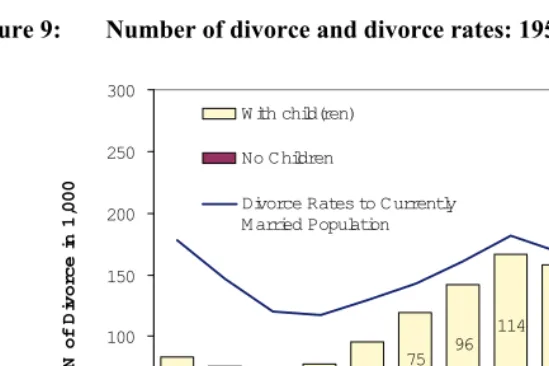
Family intactness also affects the timing and occurrence of nest-leaving. Parental divorce and remarriage tend to cause conflicts within family relationships, and are thus known to be strong factors that facilitate early nest-leaving or nest-leaving for cohabitation in Western countries (Aquilino 1991, Kiernan 1992, Goldscheider and Goldscheider 1998). As shown in Figure 9, both numbers and rates of divorce have increased significantly since 1960 in Japan. The incidence of divorce in Japan in 2000 was as high as the rates in France, Germany, and Sweden (Council of Europe 2005) but was still significantly lower than the divorce rate in the US (U.S. Department of Health and Human Services 2001). As the divorce rate increases, younger generations are more likely to experience parental divorce. Along with the rise in divorce rates, remarriage has become more common over the past 50 years. Although period trends of remarriage are not monotonic, the remarriage rates of, for example, divorced or widowed women in 2000 aged 25-29, 30-34, and 35-39 are, respectively, two times, three times, and five times higher than corresponding ages-specific rates in 1950 (see Table 1).
The rise in divorce and remarriage in parental generations certainly affects the nest-leaving behaviors of young adults in post-war Japan. There has been no research done, however, to examine the effects of parents’ marital dissolution on leaving the parental home in Japan. Unfortunately, our data also does not allow us to investigate the effects of family intactness because of the lack of information on the marital histories of parents. Instead of parental divorce or remarriage, the effects of parental death before young adults reach the age of 15 will be examined in this study. Children’s obligations towards the family and the amount of support they are expected to give to their family of origin are highly dependent on parental survivorship (Alter and Capron 2004). In two agricultural villages in northeastern Japan of the 18th and 19th centuries, when both
Figure 9: Number of divorce and divorce rates: 1950-2000
36 30 29 32 39 44 46 53 59
77 107
48 46 40 45 57
75 96
114 99 122
157
0 50 100 150 200 250 300
1950 1955 1960 1965 1970 1975 1980 1985 1990 1995 2000
Year
N o
f Di
vor
ce i
n 1
,00
0
0.0 0.5 1.0 1.5 2.0 2.5 3.0 3.5 4.0 4.5
Di
vor
ce R
at
es
(
‰
)
W ith child(ren)
No Children
Divorce Rates to Currently M arried Population
Sources: Vital Statistics, various years, Ministry of Health, Labour, and Welfare.
Table 1: Remarriage rates in divorced or widowed women by age: 1950-2000
1950 1960 1970 1980 1990 2000
20 - 24 87.95 144.77 141.00 271.39 193.75 140.49
25 - 29 68.39 96.69 163.72 218.71 185.20 148.50
30 - 34 30.12 38.00 69.93 99.69 114.59 107.17
35 - 39 10.62 14.16 28.07 40.37 49.50 54.66
40 - 44 4.78 4.75 11.11 16.92 23.67 25.67
45 - 49 2.42 2.32 4.63 7.88 13.93 15.52
and socially stable households are more likely to be protected from early departure from the parental home to take up outside employment20 (Kurosu 2004). If this pattern still exists, being raised in a one-parent family should correlate to a higher risk of nest-leaving than belonging to an intact family.
5.3 Changing patterns of the transition to adulthood
As shown in Figure 4, schooling, employment, and marriage are major life events corresponding to the occurrences of leaving home in Japan. The timings, occurrences, and proximities of these life events and nest-leaving strongly affect the levels and timing of leaving home within each cohort. Here, I refer to schooling, employment, and marriage as major life events constituting the transition to adulthood, and examine their trends and effects on the occurrences of leaving home in post-war Japan.
5.3.1 Schooling
Pursuing higher education is seen as one of the most promising strategies for climbing the social ladder in industrialized societies. The level of education is a major determinant of occupation and income opportunities in modern societies (Shavit and Müller 1998). Japan is not an exception. As shown in Figure 10, the proportion of young adults who enrolled in tertiary education, such as two-year junior colleges and four-year universities, increased dramatically by the middle of the 1970s21. Along with the increase in enrollment to tertiary education, the share of those leaving home for education among the 1950s and 1960s cohorts doubled from their preceding cohorts for both men and women (see Figure 4). The decision to pursue higher education facilitates the departure of young adults from the parental home, especially when the educational institution is not within a commutable distance.
20 In our data, over three-quarters of widowed one-parent families are due to the father’s death. Therefore,
using the one-parent family as a proxy of economic stability of the household may make sense. However, we must be careful that the reference group of one-parent families in our definition is both two-parent families and one-parent families caused by divorce. In particular, the presence of divorced one-parent families in the reference group can make our interpretation ambiguous although we have no information on their proportion in our data.
21 Among both men and women, high school education has been almost universal since the late 1970s
Figure 10: School enrollment rates by sex and type of schools: 1955-2000
0 10 20 30 40 50 60
M F M F M F M F M F M F M F M F M F M F
1955 1960 1965 1970 1975 1980 1985 1990 1995 2000 Year
Ter
ti
ar
y
Educ
at
ion
(%
)
Men- University Men- J. College Women- University Women- J. College
Sources: School Basic Survey, various years, Ministry of Education, Culture, Sports, Science, and Technology.
Note, however, that enrollments to tertiary education do not show a monotonic rise in post-war Japan. They stagnated during the 1980s, and started to resume in the 1990s. There is some evidence that progression to higher education is inversely related to the demand for a young labor force in the labor market in developed countries (Whitfield and Wilson 1991, Blanchflower and Freeman 2000, Card and Lemieux 2000). A study shows that the stagnation and resumption in progression to tertiary education in Japan also reflects the economic performance in the post-war period (Ohta 2002). Progression to university and junior college is especially high during a period of recessions, i.e., the oil shock recession in the mid-1970s, and Japan’s “lost decade” of the 1990s caused by the bursting of the babble economy in 1991. Therefore, young adults’ choices between work and higher education are affected by labor market conditions to some extent.
marriage aspirations are greater than their career aspirations (Raymo 1998). Relative to junior college graduates and those with lower levels of education, women who have graduated from university generally possess greater labor market skills, higher age-wage profiles, and slightly better chances of entry into large firms, which typically offer higher wages (Ishida 1998). Therefore, the sex differentials in progression to university education reflect the gender difference in human capital investment.
Under the male bread-winner family system, men are more strongly encouraged by society than women to obtain higher levels of education, to be employed by a large company, or to have a higher-status job. It is expected that attendance at four-year universities is more strongly related to the rates of nest-leaving than at two-year junior colleges because the former involves more investment in human capital and results in greater economic returns throughout the individual’s career. It is more rational for parents to send their children outside the home and to support them financially in pursuing a university education than it is for them to encourage attendance at a two-year junior college.
Education also has secondary effects on the timing of leaving home by legitimating the choice of occupation, earnings potential, preference for living arrangements, and the timing of marriage. Fukuda (2003) also found that highly educated men tend to leave home for employment more frequently than men with lower levels of education, while the opposite is true among women leaving home for employment. Highly educated men tend to gain entry into large firms (Ishida 1998), which typically have branches all over Japan. Therefore, they have a higher chance of leaving home after employment due to transfers. On the other hand, highly educated women are less likely to be employed by large firms than similarly educated men (Ishida 1998). In addition, women are less likely to work in a position which requires a transfer to other branches, since they tend to be seen as a supplemental labor force within a company (e.g. Ogasawara 1998).
Education also affects marriage timing in Japan. In Japan, high levels of education or income among women correlate negatively to marriage formation (Tsuya and Mason 1995, Ogawa 1997, Higuchi 2001, Retherford, Ogawa and Matsukura 2001, Ono 2003, Raymo 2003b, Raymo and Iwasawa 2005). This could be because women with high earnings potential do not fit in the traditional form of marriage, in which the husband specializes in labor market activities while the wife keeps the home and rears the children (Tsuya and Mason 1995). Yet stable employment, preferably with a high salary, is a crucial factor that influences whether men marry (Kato 2004). Therefore, it is expected that highly educated women will stay at home longer if they did not leave home during their education. On the other hand having a high level of education facilitates the trend towards men leaving home after education.
5.3.2 Employment
After graduation, the timing of entry into the labor market affects the timing of other life events in the transition to adulthood. In particular, the process by which individuals establish their careers and achieve economic independence has significant effects on family formation among young adults (e.g., Oppenheimer and Lewin 1999). The transition to the labor market is itself much affected by the macroeconomic situation, such as the business cycle or supply and demand in the labor market.
As displayed in Figure 11, the macroeconomic conditions in 1945-2001 can be briefly broken down into five phases: 1) the social disorder and recovery phase in 1945-1955, 2) the period of rapid economic growth in 1956-1973, 3) the stable economic growth era in 1974-1985, 4) the babble economy in 1986-1991, and 5) the “lost decade” recession in 1992-2001.
Figure 11: Macroeconomic conditions in Post-War Japan
1st Oil Shock 2nd Oil Shock Burst of the Babble Economy
↓ ↓ ↓
1930s Cohort
1940s Cohort
1950s Cohort
1960s Cohort
"The Lost Decade" Recession
(3.9%) (9.4%) (3.4%) (4.4%) (0.9%)
Social Disorder &
Recovering Rapid Economic Growth Stable Economic Growth EconomyBabble
1991 2001
1945 1955 1973 1985
Observation Period of Leaving Home between Ages 15-34.
The Period Young Adults reaches 18 Years Old.
* Numbers in parenthesis are average GDP growth rates (Maddison 2003) in respective periods.
It is, however, a particular phenomenon among the 1940s and the 1950s cohorts that so many young adults left home for employment. As shown in Figure 4, far fewer young adults left home for job-related reasons among the 1930s and 1960s cohorts than among the cohorts of the 1940-1950s. The expansion of tertiary education might partially decrease the proximity of leaving home and employment. Moreover, the labor demand in urban areas declined following the period of stable economic growth in the 1970s, largely due to the slowdown in economic growth after the two oil shocks, and the government’s move to localize the manufacturing industry (Tani 2002).
On contrary to the babble cohorts of the 1960s cohort, more recent cohorts suffered from the economic recession of the 1990s, which is often called Japan’s “lost decade.” The employment of young adults became increasingly insecure during the 1990s. As shown in Figure 12, the unemployment rates among young adults rose steeply after the collapse of the babble economy in 1991. The picture was similar for women, although unemployment rates among women aged 15-19 were lower than among men, while unemployment levels among women aged 25-29 and 30-34 were higher than among men. As unemployment rates are higher at younger ages, less-educated young adults who graduated only from junior high school or high school faced more severe labor market conditions than young adults with higher education.
Figure 12: Unemployment rates of men by age: 1968-2000
0 5 10 15
1968 1972 1976 1980 1984 1988 1992 1996 2000
U
nem
pl
oy
m
ent
R
at
e
(%
)
15- 19 20- 24 25- 29 30- 34
Sources: Annual Report of the Labor Force Survey, various years, Statistics Bureau.
voluntary taking up temporary jobs for such reasons as postponing the moratorium and waiting for better job prospects, the smooth transitions from school to work have no longer been assured since the last decade of the 20th century in Japan. In general, the
economic status of young adults has been declining in recent cohorts relative to preceding cohorts. Several surveys show that young adults with less secure jobs are more likely to live with their parents (Cabinet Office 2003, Oishi 2004, NIPSSR 2007). Therefore, the increase in job insecurity among young adults should negatively affect home-leaving in recent period.
Figure 13: Ratio of temporal job workers (freeters) among employed school graduates: 1980-2000
0 5 10 15 20 25 30 35 40
1980 1985 1990 1995 2000
Pr
op
or
tion
of
F
reet
er
(
%)
High School Graduates University Graduates
Sources: White Paper on the National Lifestyle Fiscal Year 2003, 2003, Cabinet Office.
5.3.3 Marriage
The proportions of the never-married aged 30-34 increased from 11.6% in 1970 to 42.9% in 2000 for men, and from 7.2% in 1970 to 26.6% in 2000 for women. The rapid development of later and less marriage is strongly related to the trends towards educational upgrading and job insecurity among young adults.
As for women, attaining higher education strongly increases women’s ages at the initial exposure to the risk of marriage (Blossfeld 1995). While marriage risks among Japanese women with a university education show some signs of catching up when these women reach their mid-twenties (Tsuya and Mason 1995), their lifetime probabilities of being never-married are estimated as being the highest among all educational levels (Ogawa 1997, Retherford et al. 2001, Raymo 2003b, Raymo and Iwasawa 2005). Panel studies of marriage further show that women with higher incomes are less likely to marry in Japan (Higuchi 2001, Ono 2003).
Other studies, however, also show that women whose employment status is unemployed, part-time, or fixed-term contract have lower risks of marriage than those in regular full-time employment (Nagase 2002, Sakai and Higuchi 2005). Iwasawa and Mita (2008) pointed out that the workplace used to function as a matchmaking system for young men and women. Women in these non-standard work arrangements have been excluded from this system. Thus women who do not have regular full-time positions may have lower risks of marriage. In Japan, therefore, high earning potential among women has been negatively correlated to marriage, while women’s entry into full-time regular employment facilitates marriage.
The effects of education on men’s marriage are rather complex because of different specifications of models across studies. Otani (1993) analyzed first marriage among men aged 18-34, and found a positive effect of university education on arranged marriage, although the effect becomes negative for love marriage and for overall first marriage. Looking only at men aged 23-34, Raymo (2003a) showed that men’s education has negative effects on marriage formation, assuming proportional effects of education during the risk ages. Kato (2004) set up separate models by age groups and allowed for the effects of education to be changed during the risk ages. He finds that men’s university education is negatively correlated to early marriage, while it has positive effects on marriage in the early thirties. Therefore, educational upgrading of men has delaying effects on men’s marriage formation.
the post-graduation period, decreases the likelihood of men’s marriage. Therefore, in addition to education, economic stability is an important factor in marriage rates among Japanese men.
As we have seen in Figure 1, the prolongation of single adulthood has not led to an obvious rise in the residential independence of young adults in Japan. Therefore, continuing delays in marriage also delay the departure of young adults from the parental home. The delaying effects of marriage on home-leaving are stronger for women than for men, since marriage is a major reason for leaving home among women. At the same time, coresidence with parents after marriage is a typical living arrangement for the heir of the traditional stem-family (Kurosu 1996a, 1996b, 2004). A study of post-marital living arrangements indicates, however, that increasing proportions of newlyweds in the 1960s cohort chose to live separately from their parents (Kato 2005). The later but higher prevalence of leaving home in the recent cohorts may suggest that young adults are more likely to leave home late for marriage.
Because more than 90% of nest-leaving by young adults occurs as a result of one of these life events, they are considered to be proximate determinants of leaving the parental home in Japan. The overall effects of these proximate variables on rates of home-leaving should be expressed as a function of the occurrences of proximate variables and the proximity of these variables to leaving home at a given age. Due to the rapid socio-economic changes in post-war Japanese society, the timing and occurrences of these events vary significantly according to the cohorts (Ando 2001). Also, given the high degree of gender role differences in the society, large sex differences in the patterns of the transition to adulthood can be seen (Ando 2001, Sawaguchi and Shimazaki 2004). It is, however, entirely not clear how strong the proximities of these life events and leaving home are, or how the proximities change over cohorts. The investigation of the proximities of these life events and nest-leaving is potentially important in understanding the implications of nest-leaving in the life courses of Japanese young adults. It also allows us to predict the timing and levels of nest-leaving within the cohorts. In the analysis, I examine the proximities of these life events and leaving home as immediate effects of life events, and allow their effects to be changed by each cohort.
6. Data and variables
6.1 Data
The data is from the survey of the National Family Research of Japan 1998 (NFRJ-98),22 which was conducted in January and February of 1999. The NFRJ-98 data is a nationally representative survey of men and women aged 28 to 77 at the time of December 1998. The samples are chosen by the stratified multi-stage random sampling technique from all over Japan. The survey was carried out with a self-administered questionnaire using a drop-off and pick-up method, which is a standard survey procedure in Japan. Out of 10,500 questionnaires distributed, 6,985 were successfully completed. The respondent rate is, therefore, 66.5%.
The NFRJ-98 survey is especially designed to gather information on the life course and family relationships of individuals in a wide range of cohorts. Respondents were asked retrospective information about the dates of life event experiences, such as graduation/drop-out from the highest level of education pursued, the timing of the first home-leaving, first job, first/current marriages, and the birth of children. The dates of event occurrences are measured by either calendar month or age23. This retrospective information made it possible for us to construct event-history models of nest-leaving with time-varying covariates, such as first employment and first marriage. Information on respondents’ family backgrounds is also asked retrospectively. It also allows us to use a broader set of covariates on characteristics of respondents’ family of origin. These features make data from the NFRJ-98 the most suitable for modeling and examining the transition rates of nest-leaving in Japan.
The birth cohorts of 1930-1970 are chosen for analyzing nest-leaving behaviors from April 1945 to December 1998. The observation period covers the era of substantial changes in social, economic, and demographic structures in post-war Japan. Thus, it is possible to study how determinants of nest-leaving differ across cohorts which have faced different social, demographic, and economic contexts during the transition to adulthood.
22 The author gratefully acknowledges the use of the National Family Research of Japan 1998 (NFRJ-98)
conducted by the National Family Research committee of Japan Society of Family Sociology. The data was provided by the Social Science Japan Data Archive, Information Center for Social Science Research on Japan, Institute of Social Science, the University of Tokyo.
23 Among the valid responses to the dates of each event occurrence, around 90% of answers are given by
The sample size is in total 5,885 (2,830 men and 3,055 women), which includes only samples with no missing values on the date of nest-leaving24. After eliminating the samples with left-censoring and with missing values on any of the covariates, the sample size is reduced to 5,297 (2,573 men and 2,724 women). Since men and women have distinct patterns of nest-leaving, models are constructed separately by sex.
6.2 Definitions of event variables
In the NFRJ-98, the question on the nest-leaving experience is formulated as follows: “Have you ever lived away from your parent(s) for one year or more to pursue education, employment, marriage, military service, etc.? If so, please indicate when you left (provide information about your first departure, even if you later returned to your parents’ home)”. In sum, the definition of the event is given as living apart from parents more than one year for a variety of life course reasons. Note also that only the dates of the initial departure from home are obtained in the survey. Therefore, we cannot treat nest-leaving as a repeatable event in our data. In addition, questions about the occurrences and dates of returning home are not asked at all in this survey.
I defined the risk of nest-leaving as starting from February in the year following the 15th birthday, and ending in the last month of age 34. Young adults are required to attend school until March following their 15th birthday in the post-war educational system. Thus, nest-leaving before the period of compulsory education has been completed is unlikely to be the result of the child’s own decision, or may even be due to misreporting25. These early nest-leavers make up 4.9% of the cohort of 1930-70. They are treated as left-censoring, and are simply excluded from the analyses. On the other hand, age 34 may be too old to serve as an end point in the transition to adulthood. Japanese young adults in recent cohorts are however, increasingly prolonging their coresidence with parents well beyond their 30s due to the later marriage trend. For these reasons, I set the maximum age of nest-leaving at 34, which also maintains comparability of risk periods across cohorts. In sum, the observation is right-censored whenever the following happens first: deaths of both biological parents, reaching age 35
24 136 respondents (49 men and 87 women) have missing values on the date of nest-leaving in subjective
cohorts.
25 The first half of the 1930s cohorts, however, were under the pre-war educational system and their