University of New Orleans University of New Orleans
ScholarWorks@UNO
ScholarWorks@UNO
University of New Orleans Theses and
Dissertations Dissertations and Theses
5-15-2009
Toward Visualizing Potential Policy Conflicts in eXtensible Access
Toward Visualizing Potential Policy Conflicts in eXtensible Access
Control Markup Language (XACML)
Control Markup Language (XACML)
William Domingo Rosa
University of New Orleans
Follow this and additional works at: https://scholarworks.uno.edu/td
Recommended Citation Recommended Citation
Rosa, William Domingo, "Toward Visualizing Potential Policy Conflicts in eXtensible Access Control Markup Language (XACML)" (2009). University of New Orleans Theses and Dissertations. 914.
https://scholarworks.uno.edu/td/914
This Thesis is protected by copyright and/or related rights. It has been brought to you by ScholarWorks@UNO with permission from the rights-holder(s). You are free to use this Thesis in any way that is permitted by the copyright and related rights legislation that applies to your use. For other uses you need to obtain permission from the rights-holder(s) directly, unless additional rights are indicated by a Creative Commons license in the record and/or on the work itself.
Toward Visualizing Potential Policy Conflicts in eXtensible Access Control
Markup Language (XACML)
A Thesis
Submitted to the Graduate Faculty of the
University of New Orleans
in partial fulfillment of the
requirements for the degree of
Master of Science
in
Computer Science
by
William Domingo Rosa
B.S. The University of West Florida, 2002
ii
Dedication
This thesis is dedicated to my family. Thank you Christine for the support you have
given me throughout my journey. I could have never done this without you. Thank you Willy,
Sammy, Dominic, and Eva-Marie for enduring this challenge and giving me some peace and
quiet (at times) to finish my research.
iii
Acknowledgment
I would like to thank my advisor Dr. Shengru Tu. The past year has been difficult since I
no longer live in Louisiana. Since the day I left Louisiana to embark in a new challenge in
Huntsville, Alabama, Dr. Tu has been there to ensure that I could still accomplish my goal of
finishing my degree from the University of New Orleans. This is a job he took upon and
followed through even when he was no longer the Computer Science graduate advisor.
I would also like to thank Ms. Amanda Athey of the graduate school. She was always
readily available to assist me with any issue ensuring that I had everything I needed to apply for
graduation.
Last but not least, I would like to thank the faculty in the Computer Science department
for the great job they do and for the support they show their students on a daily basis. Thank you
iv
Table of Contents
List of Figures ... v
Abstract ... vi
Chapter 1 Introduction ... 1
1.1 Main Goals ... 1
1.2 Objectives ... 2
Chapter 2 Background ... 3
2.1 Extensible Markup Language (XML) ... 5
2.2 Document Object Model (DOM) ... 6
2.3 XML Path Language (XPath) ... 7
2.4 XACML ... 7
2.4.1 Combining Algorithms ... 9
2.4.2 Policy Distribution and Indexing ... 10
2.4.3 XACML Data Flow Diagram ... 10
2.4.4 XACML Context ... 11
2.4.5 Policy Language Model ... 12
2.4.5.1 Rule ... 14
2.4.5.2 Policy ... 14
2.4.5.3 Policy Set ... 15
Chapter 3 Problem Statement ... 16
Chapter 4 Design and Prototype Implementation ... 32
4.1 Design ... 32
4.2 Prototype Implementation ... 35
Chapter 5 Experimental Results ... 43
5.1 Multiple Policies Experiment ... 43
5.2 PolicySet Experiment... 49
5.3 Further Development ... 51
Chapter 6 Discussion and Conclusion ... 52
References ... 53
v
List of Figures
Figure 1: Basic Requirements of a Policy Language ... 4
Figure 2: XML Document Example ... 6
Figure 3: DOM sample Java code ... 7
Figure 4: XPath sample Java code ... 7
Figure 5: XACML Data Flow Diagram ... 11
Figure 6: XACML Context ... 12
Figure 7: Policy Language Model... 13
Figure 8: XACML Documents Example ... 15
Figure 9: Sun's XACML Implementation TimeRange Policy ... 16
Figure 10: Sun's XACML Implementation TimeRange Policy (Continue) ... 17
Figure 11: Sun's XACML Implementation TimeRange Policy2 ... 18
Figure 12: Sun's XACML Implementation TimeRange Policy2 (Continue) ... 19
Figure 13: Sun's XACML Implementation SimplePDP ... 20
Figure 14: XACML Request Example ... 21
Figure 15: Sun’s XACML SimplePDP Indeterminate Response ... 22
Figure 16: rule-combining-algorithm:permit-overrides ... 24
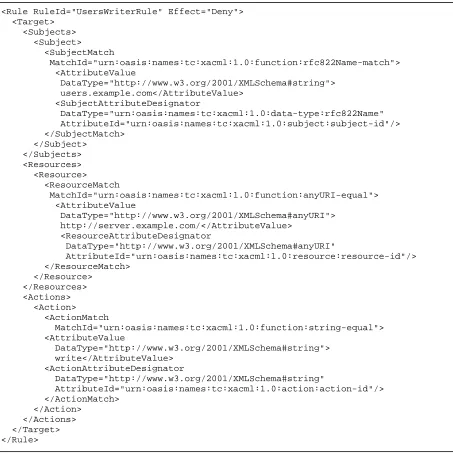
Figure 17: GeneratedPolicy4 RuleId = “UsersRule” ... 25
Figure 18: GeneratedPolicy4 RuleId = "WritersRule" ... 26
Figure 19: GeneratedPolicy4 RuleId = "UsersWriteRule" ... 27
Figure 20: [email protected] Write Request ... 28
Figure 21: Generated Request for permit-overrides ... 28
Figure 22: rule-combining-algorithm:deny-overrides ... 29
Figure 23: Generated Response for deny-override Read Request ... 30
Figure 24: Generated Response for deny-override Write Request ... 30
Figure 25: XACMLVizClass Diagram ... 32
Figure 26: XACMLVizClass Diagram Zoom-1 ... 33
Figure 27: XACMLVizClass Diagram Zoom-2 ... 34
Figure 28: XACMLVizClass Diagram Zoom-3 ... 35
Figure 29: ParseXACMLDocument Method Call ... 36
Figure 30: PolicySet Element Iteration ... 38
Figure 31: getXACMLPolicySetData Method ... 39
Figure 32: getPolicyData Method ... 40
Figure 33: Derby Table Information ... 41
Figure 34: Sun's XACML Generated Policy ... 44
Figure 35: Sun's XACML Generated Policy (Continue) ... 45
Figure 36: XACMLViz Potential Conflict Visualization Generated Policies ... 46
Figure 37: XACMLViz (Figure 36) GeneratedPolicy Tree Zoom ... 47
Figure 38: XACMLViz (Figure 36) GeneratedPolicy2 Tree Zoom ... 48
Figure 39: XACMLViz (Figure 36) GeneratedPolicy3 Tree Zoom ... 49
vi
Abstract
The eXtensible Access Control Markup Language (XACML) is allowing enterprises to
implement a standard way of access control to their resources. Security administrators no longer
need to duplicate their efforts in writing multiple policies for different resources since a XACML
policy can be applied to multiple resources. Companies such as IBM, Sun Microsystems,
Oracle, and Cisco are already providing integration of XACML in their products.
Although the introduction of XACML has provided enterprises with a better approach of
commonly realizing access control, there are still inconsistencies that policy administrators need
to be aware of. This thesis identifies some of the inconsistencies in XACML today and
introduces a new tool that can be used to visualize some of those inconsistencies. This new tool
could be used by a policy administrator to visualize possible conflicting data among a set of
policies.
1
Chapter 1 Introduction
With the focus in recent years to have data more accessible, it becomes more important to
find a common ground for resource access control. A way of enforcing access control is needed
at the enforcement level in order to provide a higher level of access control granularity.
Provided that a user level policy states that authorized personnel have access to personal
information, then the question arises at the enforcement level; who is authorized personnel and
what resources are personal information?
The popularity of the Extensible Markup Language (XML) has increased the need for a
common language that can protect different portions of an XML document. Since XML
documents are basically databases, it is vital to be able to protect the information they contain.
For instance, should a receptionist at a medical office be allowed to view the patient’s diagnosis
or just the patient’s contact and appointment information?
These kinds of questions are what the eXtensible Access Control Markup Language
(XACML) is able to address. In a world of Service Oriented Architecture (SOA), which
supports the exchanging of data among different applications, it is key to be able to control
access with a high degree of accuracy and fine degree of granularity.
1.1 Main Goals
As XACML provides a higher degree of access control granularity, there are possible
2
this thesis project is to experiment visualization of access policies in XACML and help us
identify possible inconsistencies among different policies. In doing so, I have prototyped a
simple visualization tool.
1.2 Objectives
In order to move toward providing a potential solution to inconsistencies among policies,
a Java Swing application has been developed. The objective of this prototype application is to
assist the user to determine if there are inconsistencies among policies or policy sets.
Additionally, a visualization of such inconsistencies is to be provided to the user. As a result, the
user does not need to carryout error-prone code inspection against multiple XACML documents.
Rather, by just a few mouse clicks, the policy comparison process can be achieved visually
3
Chapter 2 Background
The need for a common and general approach for industries to secure and control access
to data has allowed computing platform vendors to develop new products which can be used
universally throughout the enterprise. The idea of configuring multiple points of enforcement in
an enterprise to protect data is costly and can potentially be unreliable when it comes to
modifying the enterprise security policies. Further, it becomes extremely difficult to implement
a new security policy when the security measures in place are dispersed throughout the
enterprise.
These are some of the reasons why there is a need for a common language to express a
security policy. Because of the wide support from all of the main players in the computer
industry, XML is the language of choice.
The following are the basic requirements of a policy language according to the
Organization for the Advancement of Structure Information Standards (OASIS) access control
XACML 2.0 core specification [XACML Core]. Figure 1 was taken from the OASIS XACML
4
Figure 1: Basic Requirements of a Policy Language
The basic requirements of a policy language for expressing information system security policy are:
• To provide a method for combining individual rules and policies into a single
policy set that applies to a particular decision request.
• To provide a method for flexible definition of the procedure by which rules and policies are combined.
• To provide a method for dealing with multiple subjects acting in different capacities.
• To provide a method for basing an authorization decision on attributes of the subject and resource.
• To provide a method for dealing with multi-valued attributes.
• To provide a method for basing an authorization decision on the contents of an information resource.
• To provide a set of logical and mathematical operators on attributes of the
subject, resource and environment.
• To provide a method for handling a distributed set of policy components, while abstracting the method for locating, retrieving and authenticating the
policy components.
• To provide a method for rapidly identifying the policy that applies to a given action, based upon the values of attributes of the subjects, resource and action.
• To provide an abstraction-layer that insulates the policy-writer from the details of the application environment.
5
These requirements in conjunction with the common structure in the XML language are
what make XACML. Before providing detailed information on XACML, I will briefly discuss
some background information which may be beneficial in understanding my thesis.
2.1 Extensible Markup Language (XML)
XML is a standard adopted by the World Wide Web Consortium (W3C). XML in syntax
is very similar to the Hyper Text Markup Language (HTML) in that both are products of the
Standard Generalized Markup Language (SGML) International Organization for Standardization
(ISO) standard. However, XML is a stricter standard which allows users to write their own
document structure. Because of the well-formed nature and flexibility of XML, it has become a
major player in the development and configuration of computer software.
Essentially, XML is a set of guidelines that allows the user to structure its data. It uses
tags and attributes to delimit and describe the data within the document. Tags are the
hierarchical words enclosed in angle brackets “< >”. I use the term hierarchical because an XML
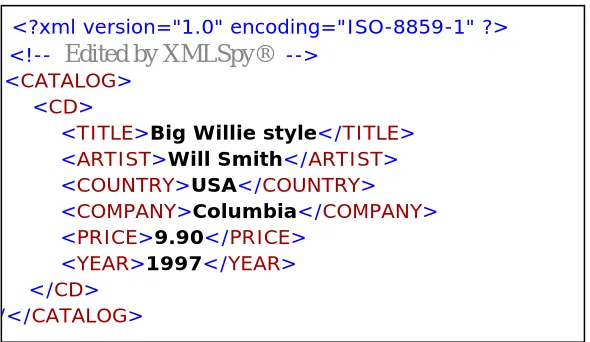
document is a hierarchy of the data it represents. Figure 2 is a basic example of an XML
document. This document represents a Compact Disk (CD) catalog. It states that the root
element <CATALOG> contains a child element <CD> which contains the description associated
6
Figure 2: XML Document Example
2.2 Document Object Model (DOM)
DOM, as defined by the W3C, is a platform and language neutral interface that will allow
programs and scripts to dynamically access and update the content, structure, and style of
documents [DOM ]. Theoretically, since the DOM specification is language neutral, it allows
users to easily work with DOM when applying DOM practices with different programming
languages.
Most common tasks when using DOM is to traverse, search, and retrieve information
from a document. This can be accomplished in Java by first getting a new instance of the
document factory method and calling its parse method. Figure 3 is an example of how to retrieve
the root element (<CATALOG>) from the displayed XML document in Figure 2.
<?xml version="1.0" encoding="ISO-8859-1" ?> <!-- Edited by XMLSpy® -->
<CATALOG> <CD>
<TITLE>Big Willie style</TITLE> <ARTIST>Will Smith</ARTIST> <COUNTRY>USA</COUNTRY> <COMPANY>Columbia</COMPANY> <PRICE>9.90</PRICE>
<YEAR>1997</YEAR> </CD>
7
Figure 3: DOM sample Java code
2.3 XML Path Language (XPath)
XPath, as defined by the W3C, is a language for addressing parts of an XML document
[XPath]. XPath uses an expression to locate information in an XML document. An expression
is a line of source code that returns a value. The syntax of an XPath expression is to separate the
location of each element with a slash “/”. To use XPath in Java, the programmer must first
obtain an XPath factory instance and then a path from its factory method. Figure 4 is an example
of how to retrieve the <TITLE> nodes from the above provided XML document.
Figure 4: XPath sample Java code
2.4 XACML
The acronym XACML stands for eXtensible Access Control Markup Language.
XACML is a declarative access control language based on XML. The current OASIS approved DocumentBuilderFactory factory = DocumentBuilderFactory.newInstance();
DocumentBuilder builder = factory.newDocumentBuilder();
File file = new File(fileName);
Document xacmlDoc = builder.parse(file);
Element root = xacmlDoc.getDocumentElement(); System.out.println(root.getTagName());
XPathFactory xpFactory = XPathFactory.newInstance(); XPath path = xpFactory.newXPath();
8
standard for the XACML specification is Version 2.0. The XACML specification version 3.0 is
expected soon.
XACML describes a policy and an access control decision request/response language.
The policy language defines general access control policies. The request language is based in the
form of a query asking if access to a particular resource is allowed. The response language is an
answer to the request granting or denying permission.
A policy may be composed of a single policy and a number of rules or multiple policies
and multiple rules. These policies and rules are what determine a request decision. To allow a
hierarchical model in which policies can be described, XACML defines the following top-level
elements: <Rule>, <Policy>, and <PolicySet>. The <Rule> element is basically a Boolean
expression with an “Effect” attribute that it is either “Permit” or “Deny”. This element can exist
in isolation but only for the purpose of re-use within multiple policies. The <Policy> element
contains either a <Rule> or a set of rule elements in addition to a rule-combining algorithm. The
rule-combining algorithm is used by the policy to provide an authorization decision based on its
rules. The <PolicySet> element can contain other <PolicySet> elements and/or a <Policy> or a
set of policies. The <PolicySet> element also contains an algorithm which combines the results
of the policy’s evaluation. Further, the <PolicySet> element is used to enclose multiple policies
9 2.4.1 Combining Algorithms
XACML provides two combining algorithms for determining an authorization decision.
The <Policy> element combining algorithm is identified by the attribute RuleCombiningAlgId.
The <PolicySet> element combining algorithm is identified by the attribute
PolicyCombiningAlgId. The rule-combining algorithm is used to evaluate set of rules within a
policy. The policy-combining algorithm is used to evaluate a set of policies. XACML defines
the following methods to be used with the combining algorithms:
Deny-overrides (Ordered and Unordered)
Permit-overrides (Ordered and Unordered)
First-applicable
Only-one-applicable
In the deny-overrides algorithm, the combined result is set to “Deny” if a single <Rule>
or <Policy> evaluates to deny within the applicable policy. In the permit-overrides algorithm,
the combine result is set to “Permit” if a single <Rule> or <Policy> evaluates to permit within
the applicable policy. If deny-overrides or permit-overrides are defined as Ordered, then the
rules must be evaluated in the order listed in the policy. The first-applicable algorithm evaluates
the result of the first <Rule>, <Policy>, or <PolicySet> within the applicable policy. Lastly, the
only-one-applicable algorithm ensures that only one <Policy> or <PolicySet> is applicable. This
algorithm only applies to policies. If more than one policy applies to a particular target, the
10
policy or policy set applies, then the result is based on the combining algorithm for the single
applicable policy or policy set.
2.4.2 Policy Distribution and Indexing
In an effort to allow policies to be easily managed, policies can be written as multiple
independent policy components by different policy writers and can be enforced at their particular
enforcement points. XACML does not provide a standard way of handling policies that are
distributed; however, the Policy decision point (PDP) is still required to examine the <Target>
element to determine if a policy is applicable to a decision request. Matching an applicable
policy to a request is what is known as policy indexing. XACML supports the following
approaches:
Storing Policies in a database. This approach requires the PDP to query the database and
retrieve the policies that are applicable to the request.
Loading the PDP with all policies. In this approach, the PDP is loaded with all policies
and is responsible for evaluating all of the policy <Target> elements to determine which
policies are applicable to the request.
2.4.3 XACML Data Flow Diagram
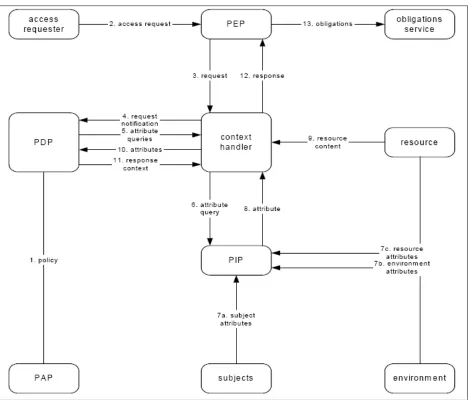
Figure 5 identifies the major actors in XACML. Figure 5 was taken from the OASIS
XACML 2.0 core specification document. As the diagram represents, the request for a resource
goes through a series of actions between the PDP and the Context handler before a response is
11
Figure 5: XACML Data Flow Diagram
2.4.4 XACML Context
The XACML context is an abstraction layer that allows the mapping of attributes from
different sources to XACML attributes. The context is basically a conversion mechanism
between native and XACML format. Figure 6 is a representation of the XACML context.
12
Figure 6: XACML Context
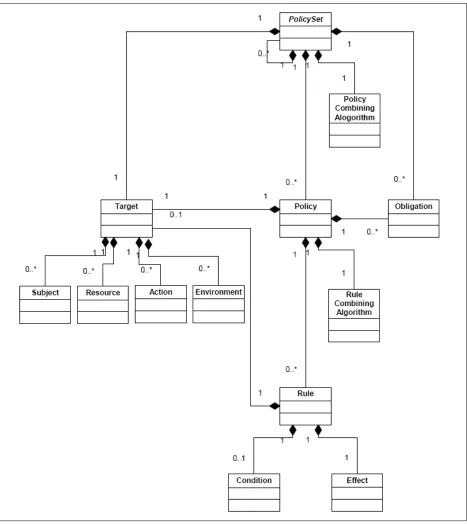
2.4.5 Policy Language Model
Policy set, Policy, and Rule are the main components of the Policy language model.
13
14 2.4.5.1 Rule
A <Rule> is contained within a policy and its main components are a target, an effect,
and a condition. The <Target> element contains resources, subjects, actions, and environment
which apply to a particular rule. These target attributes are what the PDP uses to match a request
context. If the <Target> element of a rule is empty then the target of the rule is the parent
<Policy> target. The effect is an attribute value of the <Rule> element which evaluates the rule
and can only contain the values of “Permit” or “Deny”. The <Condition> is an optional element
which if used must evaluate to true for the rule to be applicable.
2.4.5.2 Policy
The main components of a <Policy> are a target, a rule-combining algorithm-identifier, a
set of rules, and obligations. The <Target> element of a policy can be declared by the policy
writer or it can be calculated from all of the <Target> elements within a policy. One method of
target calculation is using the “outer component”, that is, targets from policy sets or policies as a
union of all of their targets. The other method is calculating the “outer components” as the
intersection of all of their targets. If any rule has the same <Target> element as the policy, then
the target for that rule may be omitted since rules inherit the target of its policy.
The rule-combining algorithm represents the rule by which a decision is made to a
particular request. <Obligations> are sets of instructions that must be performed by the PEP
concurrently with the authorization request. For example, if the effect of a rule is to allow access
to a server, an obligation could be to log the user in the server log as a successful login.
15 2.4.5.3 Policy Set
The main components of a <PolicySet> are a target, a policy-combining
algorithm-identifier, a set of policies, and obligations. The policy-combining algorithm is used to
determine how policies within a policy set will be combined when making a decision to a
request. Figure 8 is an example of a XACML document as found in the OASIS XACML 2.0
core specification document.
Figure 8: XACML Documents Example
<?xml version="1.0" encoding="UTF-8"?>
<Policy xmlns="urn:oasis:names:tc:xacml:2.0:policy:schema:os" xmlns:xsi="http://www.w3.org/2001/XMLSchema-instance" xsi:schemaLocation="urn:oasis:names:tc:xacml:2.0:policy:schema:os http://docs.oasis-open.org/xacml/access_control-xacml-2.0-policy-schema-os.xsd" PolicyId="urn:oasis:names:tc:example:SimplePolicy1" RuleCombiningAlgId="identifier:rule-combining-algorithm:deny-overrides">
<Description>Medi Corp access control policy</Description> <Target/>
<Rule RuleId= "urn:oasis:names:tc:xacml:2.0:example:SimpleRule1" Effect="Permit"> <Description>
Any subject with an e-mail name in the med.example.com domain can perform any action on any resource.
16
Chapter 3 Problem Statement
The inception of XACML has provided agencies with a common language which can be
used to safeguard and better manage access to their resources. This approach, however, has its
limitations when it comes to managing multiple policies for a single resource or a variety of
resources. XACML is based on XML which has been proven to be an industry favored mark-up
language. Figure 9 is a portion of an example of a time-range policy found in the Sun’s
XACML Implementation [Sun XACML] sample policy folder. The Sun’s XACML
Implementation is an open source implementation of the OASIS XACML standard written in
Java. This implementation provides complete support of the XACML mandatory standards and
some support to optional features.
Figure 9: Sun's XACML Implementation TimeRange Policy
<?xml version="1.0" encoding="UTF-8"?>
<Policy xmlns="urn:oasis:names:tc:xacml:1.0:policy" xmlns:xsi="http://www.w3.org/2001/XMLSchema-instance" PolicyId="TimeRangePolicy" RuleCombiningAlgId="urn:oasis:names:tc:xacml:1.0:rule-combining-algorithm:ordered-permit-overrides"> <Description>
17
Figure 10: Sun's XACML Implementation TimeRange Policy (Continue)
<Actions> <Action> <ActionMatch MatchId="urn:oasis:names:tc:xacml:1.0:function:string-equal"> <AttributeValue DataType="http://www.w3.org/2001/XMLSchema#string">open</AttributeValue> <ActionAttributeDesignator DataType="http://www.w3.org/2001/XMLSchema#string" AttributeId="urn:oasis:names:tc:xacml:1.0:action:action-id"/> </ActionMatch> </Action> </Actions> </Target>
<Rule RuleId="EveryoneDuringBusinessHours" Effect="Permit"> <Condition FunctionId="http://research.sun.com/projects/xacml/names/function#time-in-range"> <Apply FunctionId="urn:oasis:names:tc:xacml:1.0:function:time-one-and-only"> <EnvironmentAttributeDesignator DataType="http://www.w3.org/2001/XMLSchema#time" AttributeId="urn:oasis:names:tc:xacml:1.0:environment:current-time"/> </Apply> <AttributeValue DataType="http://www.w3.org/2001/XMLSchema#time">09:00:00</AttributeValue> <AttributeValue DataType="http://www.w3.org/2001/XMLSchema#time">17:00:00</AttributeValue> </Condition> </Rule>
<Rule RuleId="EmployeesAlways" Effect="Permit"> <Target> <Subjects> <Subject> <SubjectMatch MatchId="urn:oasis:names:tc:xacml:1.0:function:rfc822Name-match"> <AttributeValue DataType="http://www.w3.org/2001/XMLSchema#string"> users.example.com</AttributeValue> <SubjectAttributeDesignator DataType="urn:oasis:names:tc:xacml:1.0:data-type:rfc822Name" AttributeId="urn:oasis:names:tc:xacml:1.0:subject:subject-id"/> </SubjectMatch> </Subject> </Subjects> <Resources> <AnyResource/> </Resources> <Actions> <AnyAction/> </Actions> </Target> </Rule>
<Rule RuleId="DenyAllOthers" Effect="Deny"/>
18
This policy states that anyone has access to open the main door between the hours of
9:00am and 5:00pm. Only authorized personnel have access at other times, and in any other
circumstance, access to open the main door is denied. As Figures 9 and 10 illustrate, it is not
straight forward for a human to carryout code inspection for this document element tags by
element tags especially across multiple documents. Furthermore, this is just a very basic and
simple policy document. A policy document has multiple pages, it can also be contained within
a policy set or multiple policy sets. Doing code inspection for multiple policies can make it
extremely difficult to catch possible conflicts between multiple policies. Figures 11 and 12 are
modified versions of the Sun’s XACML Implementation time-range policy. This policy states
that anyone has access to open the main door between the hours of 7:00am and 3:00pm.
Figure 11: Sun's XACML Implementation TimeRange Policy2
<?xml version="1.0" encoding="UTF-8"?>
<Policy xmlns="urn:oasis:names:tc:xacml:1.0:policy" xmlns:xsi="http://www.w3.org/2001/XMLSchema-instance" PolicyId="TimeRangePolicy2" PolicyCombiningAlgId="urn:oasis:names:tc:xacml:1.0:policy-combining- algorithm:deny-overrides"> <Description>
19
Figure 12: Sun's XACML Implementation TimeRange Policy2 (Continue)
</ResourceMatch> </Resource> </Resources> <Actions> <Action> <ActionMatch MatchId="urn:oasis:names:tc:xacml:1.0:function:string-equal"> <AttributeValue DataType="http://www.w3.org/2001/XMLSchema#string">open</AttributeValue> <ActionAttributeDesignator DataType="http://www.w3.org/2001/XMLSchema#string" AttributeId="urn:oasis:names:tc:xacml:1.0:action:action-id"/> </ActionMatch> </Action> </Actions> </Target>
<Rule RuleId="EveryoneDuringBusinessHours" Effect="Permit"> <Condition FunctionId="http://research.sun.com/projects/xacml/names/function#time-in-range"> <Apply FunctionId="urn:oasis:names:tc:xacml:1.0:function:time-one-and-only"> <EnvironmentAttributeDesignator DataType="http://www.w3.org/2001/XMLSchema#time" AttributeId="urn:oasis:names:tc:xacml:1.0:environment:current-time"/> </Apply> <AttributeValue DataType="http://www.w3.org/2001/XMLSchema#time">07:00:00</AttributeValue> <AttributeValue DataType="http://www.w3.org/2001/XMLSchema#time">15:00:00</AttributeValue> </Condition> </Rule>
<Rule RuleId="EmployeesAlways" Effect="Permit"> <Target> <Subjects> <Subject> <SubjectMatch MatchId="urn:oasis:names:tc:xacml:1.0:function:rfc822Name-match"> <AttributeValue DataType="http://www.w3.org/2001/XMLSchema#string"> users.example.com</AttributeValue> <SubjectAttributeDesignator DataType="urn:oasis:names:tc:xacml:1.0:data-type:rfc822Name" AttributeId="urn:oasis:names:tc:xacml:1.0:subject:subject-id"/> </SubjectMatch> </Subject> </Subjects> <Resources> <AnyResource/> </Resources> <Actions> <AnyAction/> </Actions> </Target> </Rule>
<Rule RuleId="DenyAllOthers" Effect="Deny"/>
20
If policies, as depicted in Figure 9 and Figure 11, existed in a repository for a particular
resource; it will conflict and potentially can be an issue when determining if and when the
subject has access to the main door. Furthermore, maintaining policy integrity is a very crucial
aspect of being able to recognize if a duplicated policy is introduced with modified rules to gain
access to resources. For a policy administrator, the task of manually scanning through each
document for potential conflicts can be overwhelming if not impossible.
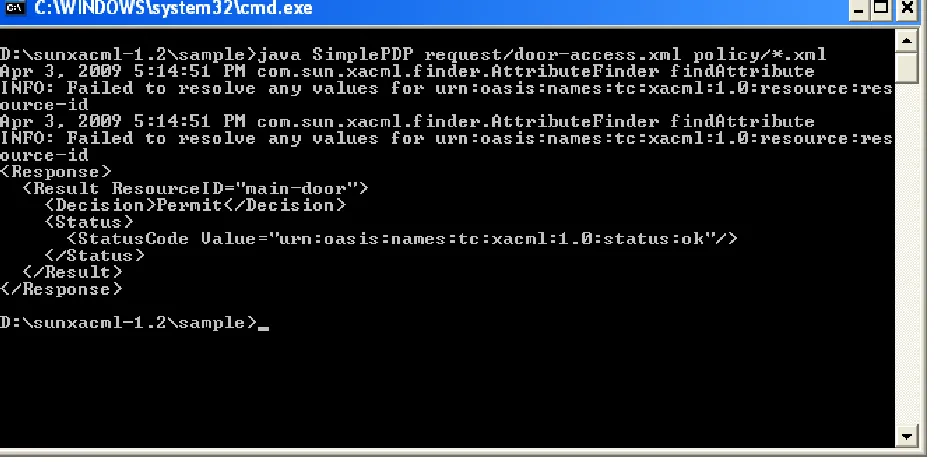
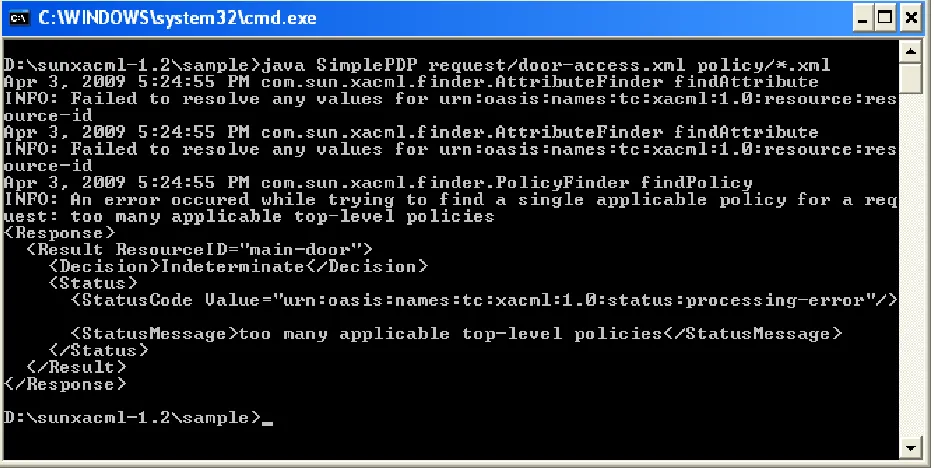
Figure 13 displays a sample demo application called SimplePDP from the Sun’s XACML
implementation. The request for this particular example is the door-access.xml and the
SimplePDP was instructed to scan through all XML documents located in the policy directory.
21
This command based application is included as part of the Sun’s XACML
implementation so the user can run policies, evaluate his/her request, and gain a better
understanding of XACML. This particular example is for the above mentioned policy to access
the main door. The response for this example is also displayed in Figure 13. The “INFO:” label
displayed in the SimplePDP (Figure 13) command prompt window, is simply telling the user that
some policies did not match the request. The “INFO:” label messages are part of a login
mechanism and can be removed at the user’s discretion. The response provided back to the user
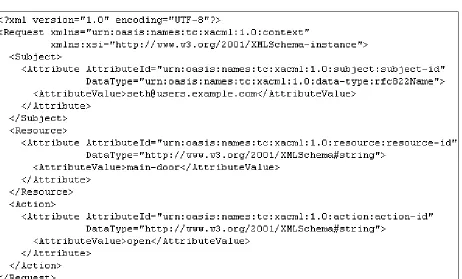
in this example states that access is allowed to the main door. Figure 14 shows the request that
was sent to the SimplePDP application.
22
Notice that the requested subject matches the subject of RuleId=”EmployeesAlways” in the
time-range policy document. This is a correct interpretation of the request where the matching policy
was found and the requested level of access was granted.
Figure 15 displays the same request; however, this time a second policy that matches the
same target was introduced. As stated, this is a copy of the same policy with a different policy id
and a slightly different time-range rule. The response for this request is coded as Indeterminate
because more than one policy applies.
Figure 15: Sun’s XACML SimplePDP Indeterminate Response
Because of the afore mentioned issues, it is important that the policy administrator is able
to visualize potentially conflicting targets. The basis of my research is to provide a way for the
policy administrator to quickly visualize a set of policies for potential conflicts. A visualization
23
reduce errors that potentially lead to security leaks and inconsistencies with providing required
access to legitimate users.
Another issue worth mentioning is the possibility of inconsistencies within the same
policy. This portion is not implemented in the prototype program; however, it should be an area
of focus for further research. Furthermore, this should be an area where policy administrators
pay close attention to when writing policies. In the following examples, the generated.xml files
from the Sun’s XACML Implementation sample and request folders were edited to introduce
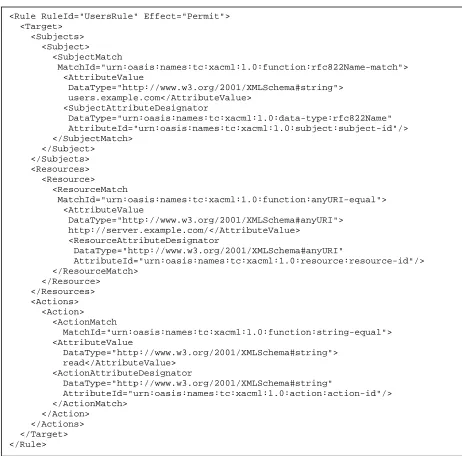
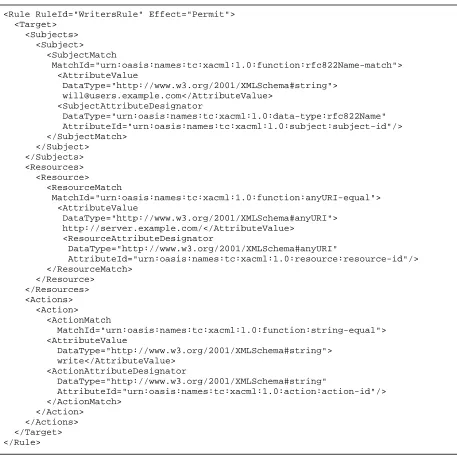
potential inconsistencies within the policy. Figure 16 illustrates the policy id and the combining
algorithm for this policy. Figures 17, 18 and 19 depict the rules for policy GeneratedPolicy4.
Figure 20 is the request against this policy. The policy applies to any accounts at
users.example.com accessing server.example.com. Accounts that belong to users.example.com
can read from server.example.com. The account [email protected] can read and write to
server.example.com. As depicted in Figure 16, this policy implements the permit-overrides
24
Figure 16: rule-combining-algorithm:permit-overrides <?xml version="1.0" encoding="UTF-8"?>
<Policy xmlns="urn:oasis:names:tc:xacml:1.0:policy" xmlns:xsi="http://www.w3.org/2001/XMLSchema-instance" PolicyId="GeneratedPolicy4"
RuleCombiningAlgId=
"urn:oasis:names:tc:xacml:1.0:rule-combining-algorithm:permit-overrides">
<Description>
This policy applies to any accounts at users.example.com accessing server.example.com. Accounts that belong to users.example.com can read server.example.com. Account [email protected] can read or write to server.example.com.
</Description> <Target>
25
Figure 17: GeneratedPolicy4 RuleId = “UsersRule”
26
Figure 18: GeneratedPolicy4 RuleId = "WritersRule"
27
Figure 19: GeneratedPolicy4 RuleId = "UsersWriteRule"
28
Figure 20: [email protected] Write Request
The request is asking to allow write access to the server http://server.example.com/ for
[email protected]. Figure 21 displays the response from the SimplePDP command line
application.
29
The PDP arrived at the “Permit” decision because of the three rules identified in the
GeneratedPolicy4 XACML document. One of the rules applied, since the rule-combining
algorithm used for the policy was permit-overrides. The rule-combining algorithm was changed
to deny-override for the next test. Figure 22 displays the new change. The request for this
example was also changed to request read access to the resource. Figure 23 is the result returned
from the SimplePDP command line program for the read request. Figure 24 is the result from
the write request.
Figure 22: rule-combining-algorithm:deny-overrides <?xml version="1.0" encoding="UTF-8"?>
<Policy xmlns="urn:oasis:names:tc:xacml:1.0:policy" xmlns:xsi="http://www.w3.org/2001/XMLSchema-instance" PolicyId="GeneratedPolicy4" RuleCombiningAlgId= "urn:oasis:names:tc:xacml:1.0:rule-combining-algorithm:deny-overrides"> <Description>
30
Figure 23: Generated Response for deny-override Read Request
Figure 24: Generated Response for deny-override Write Request
The response displayed in Figure 23 is as expected “Permit” since the subject belongs to
the users group and such group is allowed read access. The response displayed in Figure 24 may
not be as expected since there is a specific rule for [email protected] to allow write
access to the resource. However, since [email protected] belongs to users.example.com
the last rule applies which states that users who belong to users.example.com do not have write
access to the resource. This is one of the possibly conflicting issues that can be found in
XACML. In this example, there are three different rules within the policy for a subject in the
31
part of the users group. Rule “WritersRule” should also apply because the rule is specific to
[email protected]. Rule “UsersWriteRule” should also apply since
[email protected] belongs to the users group.
As previously stated, inconsistencies within the same policy are not being addressed as
32
Chapter 4 Design and Prototype Implementation
In order to find a possible solution to some of the issues stated in Chapter 3, a prototype
implementation named XACMLViz was created. This prototype implementation is based on the
Java language. It uses Java Swing components for the Graphical User Interface (GUI) and the
Document Object Model (DOM) XML parser and XPath to locate and extract significant data.
4.1 Design
The design is based on a simple concept of extracting data from the policy files,
populating the data in class objects, and saving the data in a database table where it can be
queried for potential conflicts. The database used for the prototype is the bundled Java DB based
on Apache Derby. Figure 25 is the class diagram of the XACMLViz prototype program.
Figures 26, 27, and 28 are the zoomed version of the classes in Figure 25.
33
34
35
Figure 28: XACMLVizClass Diagram Zoom-3
4.2 Prototype Implementation
The XACMLViz prototype is a Java Swing GUI application where the user, via a menu,
can select which policy files need to be scanned for potential policy conflicts. If no potential
conflicts are found, a dialog message is presented to the user with a “No potential conflicts
found.” message.
When the user selects the files to be scanned and clicks the “Open” button, the files are
scanned one-by-one by instantiating the XACMLPolicyParser class with the filename and calling
its ParseXACMLDocument method. Figure 29 displays the portion of the code inside the
36
Figure 29: ParseXACMLDocument Method Call
Inside the XACMLPolicyParser, an instance of the DocumentBuilderFactory and
XPathFactory are created to allow for the parsing of the XACML document. Since the top level
root element of a XACML document is either a <PolicySet> or <Policy> element, the
XACMLPolicyParser retrieves the document root to identify if the particular document is a
private void jMenuItem1ActionPerformed(java.awt.event.ActionEvent evt) {
JFileChooser chooser = new JFileChooser(); chooser.setCurrentDirectory(new File(".")); chooser.setMultiSelectionEnabled(true); chooser.setFileFilter(new XMLFilter()); chooser.setAcceptAllFileFilterUsed(false); int result = chooser.showOpenDialog(this);
if (result == JFileChooser.APPROVE_OPTION) {
File[] names = chooser.getSelectedFiles();
for (File f : names) {
try {
String s = f.getPath();
XACMLPolicyParser par = new XACMLPolicyParser(s); par.ParseXACMLDocument();
}
catch (IOException ex) {
Logger.getLogger(XacmlVizFrame.class.getName()).log(Level.SEVERE, null, ex); }
catch (ParserConfigurationException ex) {
Logger.getLogger(XacmlVizFrame.class.getName()).log(Level.SEVERE, null, ex); }
catch (SAXException ex) {
Logger.getLogger(XacmlVizFrame.class.getName()).log(Level.SEVERE, null, ex); }
catch (XPathExpressionException ex) {
Logger.getLogger(XacmlVizFrame.class.getName()).log(Level.SEVERE, null, ex); }
37
policy or a policy set. If the root node is a policy set, the method getElementsByTagName of the
Document object is called to get all policy sets within the document. All policy set elements are
subsequently passed to the XACMLPolicyParser method getXACMLPolicySetData. Here all
significant data is extracted and placed in the XACMLPolicySetData object. The information
inside the XACMLPolicySetData object will be used later in the process to insert the data into a
38
Figure 30: PolicySet Element Iteration
A similar process is followed if the root element is a policy and the extracted data is
placed inside the XACMLPolicyData object. The major distinction when parsing between the
policy set and the policy is that a policy has a <Rule> element that must be parsed all the time.
With the policy set, only if a policy set has a non empty <Target> element then the policy (or
public void ParseXACMLDocument() throws IOException, ParserConfigurationException, SAXException, XPathExpressionException
{
DocumentBuilderFactory factory = DocumentBuilderFactory.newInstance(); DocumentBuilder builder = factory.newDocumentBuilder();
File file = new File(this.xacmlDocument); Document xacmlDoc = builder.parse(file);
XACMLDatabaseHelper helper = new XACMLDatabaseHelper();
Element root = xacmlDoc.getDocumentElement(); String rootName = root.getTagName();
if (rootName.equalsIgnoreCase("PolicySet")) {
NodeList polSetNodes = xacmlDoc.getElementsByTagName("PolicySet"); for (int i = 0; i < polSetNodes.getLength(); i++)
{
Node pSetNode = polSetNodes.item(i); if (pSetNode instanceof Element) {
if (((Element) pSetNode).equals(xacmlDoc.getDocumentElement())) {
Vector<XACMLPolicySetData> data = this.getXACMLPolicySetData(pSetNode); helper.insertPolicySetData(data, null);
continue; }
Node pParent = pSetNode.getParentNode(); Element parentElement = (Element) pParent;
String parentId = parentElement.getAttribute("PolicySetId");
Vector<XACMLPolicySetData> data = this.getXACMLPolicySetData(pSetNode); helper.insertPolicySetData(data, parentId);
39
policies) is parsed and the <Rule> element is parsed as well. The reason for parsing policies and
policy sets differently is because a root policy set can be used as a method of enclosing multiple
policies or policy sets. Figure 31 illustrates a portion of the code for extracting the policy set
information. Figure 32 illustrates a portion of the code for extracting the policy information.
Figure 31: getXACMLPolicySetData Method
public Vector<XACMLPolicySetData> getXACMLPolicySetData(Node policySet) {
Vector<XACMLPolicySetData> rtnPolicySetVector = new Vector<XACMLPolicySetData>(); String policySetId = ((Element) policySet).getAttribute("PolicySetId");
XACMLPolicySetData policySetData = new XACMLPolicySetData(policySetId);
try {
this.AddSujectValues(policySet, policySetData); this.AddResourceValues(policySet, policySetData); this.AddActionValues(policySet, policySetData);
if (policySetData.getSubjects().size() != 0 || policySetData.getResources().size() != 0 || policySetData.getActions().size() != 0) {
NodeList policyNodes = (NodeList) path.evaluate("./Policy", policySet, XPathConstants.NODESET);
//add the policy id information for the policy data set so it can be retrieved later //during the database selection process.
Element pElement = (Element) policyNodes.item(0); if(pElement != null)
{
String id = pElement.getAttribute("PolicyId");
XACMLPolicyData pData = new XACMLPolicyData(id);
Vector<XACMLPolicyData> vecPData = new Stack<XACMLPolicyData>(); vecPData.add(pData);
policySetData.setPolicyData(vecPData); }
for (int i = 0; i < policyNodes.getLength(); i++) {
40
Figure 32: getPolicyData Method
It is important to note that the approach taken in identifying potential conflicts in policies
is based on the union of all <Target> elements within the policy sets. In addition, only the
information contained within the <Target> element is compared for equality in determining if
there is a potential conflict. Furthermore, this prototype is built to parse policy data that is
contained within the selected files. Files that are referenced outside the containing policy file are
not taken into consideration at this time.
public Vector<XACMLPolicyData> getXCMLPolicyData(Node policy) throws ParserConfigurationException, SAXException, IOException
{
Vector<XACMLPolicyData> rtnPolicyVector = new Vector<XACMLPolicyData>();
String policyId = ((Element) policy).getAttribute("PolicyId"); XACMLPolicyData policyData = new XACMLPolicyData(policyId); try { this.AddSujectValues(policy, policyData); this.AddResourceValues(policy, policyData); this.AddActionValues(policy, policyData); this.AddRuleValues(policy, policyData); this.AddRuleSubjectValues(policy, policyData); this.AddRuleResourceValues(policy, policyData); this.AddRuleActionValues(policy, policyData); this.AddRuleConditionValues(policy, policyData); }
catch (XPathExpressionException ex) {
Logger.getLogger(XACMLPolicyParser.class.getName()).log(Level.SEVERE, null, ex); }
rtnPolicyVector.add(policyData);
41
After extracting all of the desired information, the data is then inserted into a database
table. This table contains combined data, that is, the union of all of the targets and rules found
during the parsing of the XACML document. This table is then queried to determine if there are
any potential conflicts among policies. If there are potential conflicts, they are displayed in the
XACMLViz main frame. Figure 33 illustrates the table column information.
Figure 33: Derby Table Information
The visualization obtained by running the XACMLViz prototype is based on the prefuse
visualization toolkit [Prefuse]. Prefuse is written in Java and can be used freely. The type of
visualization chosen for this prototype is based on a prefuse Tree. The tree is populated by
iterating through the result set returned from the select query statement. After the tree is
populated, the database table rows are deleted. Next, there is a check to ensure that there is more
than one tree populated. If there is more than one tree, the trees are then passed to the
SelfArisenTree [PAP] class to make the view for each tree. The SelfArisenTree is a sample class
which shows the user how to create visualizations with prefuse by using a prefuse tree. This create table POLICYINFO
(
ID INTEGER NOT NULL GENERATED ALWAYS AS IDENTITY, POLICY_SET_PARENT_ID VARCHAR(50),
42
class was slightly modified to serve the purposes of the XACMLViz prototype. If there are less
than two trees, a message is displayed to the user as previously mention. When conflicting
policies are found, each tree is placed in a TableLayout [Barbalace] inside a JScrollPane
arranged by rows and columns. Once the trees are displayed, they can be moved around their
visualization area by clicking the mouse and dragging. In addition, the user can click on a tree
leaf node and if there are any children the tree expands. The visualization area of the tree can
also be zoomed in and out by using the mouse wheel. The tree can also be made to fit its
43
Chapter 5 Experimental Results
In order to test and verify the XACMLViz prototype a set of policy files was needed.
The Sun’s XAMCL Implementation contains a few policy examples which were used during my
research.
5.1 Multiple Policies Experiment
The generated.xml policy contained in the sample folder of the Sun’s XACML
Implementation was used. Figures 34 and 35 are the generated.xml policy. This policy states
that a developer who belongs to users.example.com can commit to the server
server.example.com. Two copies of this policy were made with what can be determined as
potentially conflicting information. The first copied policy was named generated2.xml. The
PolicyId attribute of the <Policy> element was changed to GeneratedPolicy2. The rule for this
policy was changed to be interpreted as allowing read access to server.example.com if the
subject belonged to users.example.com. The second copied policy was named generated3.xml.
The PolicyId attribute of the <Policy> element was also changed to GeneratedPolicy3. The rule
for this policy was changed as well to allow write access to server.example.com if the subject
44
Figure 34: Sun's XACML Generated Policy
<?xml version="1.0" encoding="UTF-8"?>
<Policy xmlns="urn:oasis:names:tc:xacml:1.0:policy" xmlns:xsi="http://www.w3.org/2001/XMLSchema-instance" PolicyId="GeneratedPolicy" RuleCombiningAlgId=”urn:oasis:names:tc:xacml:1.0: rule-combining-algorithm:ordered-permit-overrides"> <Description>
45
Figure 35: Sun's XACML Generated Policy (Continue)
<Rule RuleId="CommitRule" Effect="Permit"> <Target> <Subjects> <AnySubject/> </Subjects> <Resources> <AnyResource/> </Resources> <Actions> <Action> <ActionMatch MatchId="urn:oasis:names:tc:xacml:1.0:function:string-equal"> <AttributeValue DataType="http://www.w3.org/2001/XMLSchema#string"> commit</AttributeValue> <ActionAttributeDesignator DataType="http://www.w3.org/2001/XMLSchema#string" AttributeId="urn:oasis:names:tc:xacml:1.0:action:action-id"/> </ActionMatch> </Action> </Actions> </Target> <Condition FunctionId="urn:oasis:names:tc:xacml:1.0:function:string-equal"> <Apply FunctionId="urn:oasis:names:tc:xacml:1.0:function:string-one-and-only"> <SubjectAttributeDesignator DataType="http://www.w3.org/2001/XMLSchema#string" AttributeId="group" Issuer="[email protected]"/> </Apply> <AttributeValue DataType="http://www.w3.org/2001/XMLSchema#string"> developers</AttributeValue> </Condition> </Rule>
46
The expected result for this particular test is for the XACMLViz prototype to point out
that these three policies can be potentially conflicting policies. The expected results are
displayed in Figure 36. As expected, the XACMLViz prototype tool identified all three policies
as having potentially conflicting data. The highlighted trees in the XACMLViz visualization
area depict the possibly conflicting policies. Figures 37, 38, and 39 are a zoomed version of the
trees in Figure 36.
47
48
49
Figure 39: XACMLViz (Figure 36) GeneratedPolicy3 Tree Zoom
5.2 PolicySet Experiment
Another test was done with the time-range policy (see Figure 9). This policy was
modified by including the original policy and a copied policy as part of a policy set. The copied
policy was changed to reflect a different time range in the <Condition> element. The expected
result of this test was to show that there are potential conflicts when non-authorized personnel
50
within the policy set as containing potentially conflicting data. The expected results are
displayed in Figure 40.
Figure 40: XACMLViz Potential Conflict Visualization TimeRange PolicySet
The potentially conflicting policies are displayed where the conditions from PolicyId
TimeRangePolicy states that access is permitted to open the door between the hours of 0900 and
1700; whereas in PolicyId TimeRangePolicy2, it allows access to the main door between the
51
5.3 Further Development
This prototype can be further enhanced by allowing the scanning of single policies for
rule inconsistencies as demonstrated in Chapter 3. One can potentially take advantage of the
Sun’s XACML Implementation classes and use some of the matching functions to match
52
Chapter 6 Discussion and Conclusion
In conclusion, the issue of potentially conflicting policies was addressed in this thesis.
Possible solutions to these conflicts were discussed as part of a new prototype or as part of a
further enhancement to this prototype. Additionally, the testing command line program from the
Sun’s XACML Implementation project was discussed and executed to test possible issues that
can be encountered by a PDP when parsing through conflicting policies.
During my research, I achieved a wealth of knowledge about XACML and how to
programmatically work with XML by using the Document Object Model (DOM) and XPath.
This was a valuable experience since the skills I learned during this process are a welcome
addition to any developer’s tool box.
In addition, the ease and practicality of the XACMLViz prototype program could be a
great resource to anyone wishing to scan through a set of policies for potential inconsistencies
53
References
[XACML Core] OASIS XACML 2.0 Core: eXtensible Access Control Markup Language (XACML) Version 2.0
http://docs.oasis-open.org/xacml/2.0/access_control-xacml-2.0-rbac-profile1-spec-os.pdf
[Sun XACML] Sun’s XACML Implementation http://sunxacml.sourceforge.net/
[Prefuse] The Prefuse Visualization Toolkit http://prefuse.org/
[SDN] Sun Developer Network (SDN), Article
XACML: A new Standard Protects Content in Enterprise Data Exchange
http://java.sun.com/developer/technicalArticles/Security/xacml/xac ml.html
[IBM] Effective XML processing with DOM and XPath in Java http://www.ibm.com/developerworks/xml/library/x-domjava/
[W3C] World Wide Web Consortium http://www.w3.org/
[XPath] W3C, XML Path Language (XPath) http://www.w3.org/TR/xpath
[DOM] W3C, Document Object Model (DOM) http://www.w3.org/DOM/
[PAP] Perfuse Assistance Pool (PAP)
http://goosebumps4all.net/34all/bb/showthread.php?tid=46
[Barbalace] TableLayout Tutorial, Part 1
https://tablelayout.dev.java.net/articles/TableLayoutTutorialPart1/ TableLayoutTutorialPart1.html
[Anderson] OASIS eXtensible Access Control Markup Language (XACML), XML Community of Practice, 21 June 2006
Anne Anderson, Senior Staff Engineer
Sun Microsystems Laboratories
54
Université du Québec en Outaouais
[Hwang] XACML Access Control Policy Testing
JeeHyun Hwang
[Montemayor] Information Visualization for Rule-based Resource Access Control Jaime Montemayor, Andrew Freeman, John Gersh, Thomas
Llanso, Dennis Patrone
55
Vita
William Domingo Rosa was born in Bronx, New York on February 27, 1970. He was
raised by his paternal grandparents on the island of Puerto Rico in the western town of Aguada.
He enlisted in the United States Navy in March of 1990 and served honorably until July of 2001.
He received an Associate in Arts Degree in Computer Information Systems from Pensacola
Junior College, Pensacola, Florida in May of 2000. He received a Bachelor of Science Degree in
Computer Science/Information Systems from The University of West Florida, Pensacola, Florida
in August of 2002.
His software development professional experiences include working for the Defense
Finance and Accounting Services (DFAS) Technology Services Organization Pensacola
(TSOPE), Pensacola, Florida as an Information Technology Specialist; the Space and Naval
Warfare Systems Command (SPAWAR) Systems Center New Orleans, New Orleans, Louisiana
as a Technical Specialist; and currently Intergraph Corporation, Process, Power & Marine,