B R I E F R E P O R T S
Open Access
[COMMODE] a large-scale database of
molecular descriptors using compounds from
PubChem
Andreas Dander
1,2,3, Laurin AJ Mueller
1, Ralf Gallasch
1,2,3, Stephan Pabinger
2, Frank Emmert-Streib
4,
Armin Graber
1and Matthias Dehmer
1*Abstract
Background: Molecular descriptors have been extensively used in the field of structure-oriented drug design and structural chemistry. They have been applied in QSPR and QSAR models to predict ADME-Tox properties, which specify essential features for drugs. Molecular descriptors capture chemical and structural information, but investigating their interpretation and meaning remains very challenging.
Results: This paper introduces a large-scale database of molecular descriptors called COMMODE containing more than 25 million compounds originated from PubChem. About 2500 DRAGON-descriptors have been calculated for all compounds and integrated into this database, which is accessible through a web interface at http://commode.i-med. ac.at.
Keywords: Chemical databases, Molecular descriptors, PubChem, QSAR, QSPR
Background
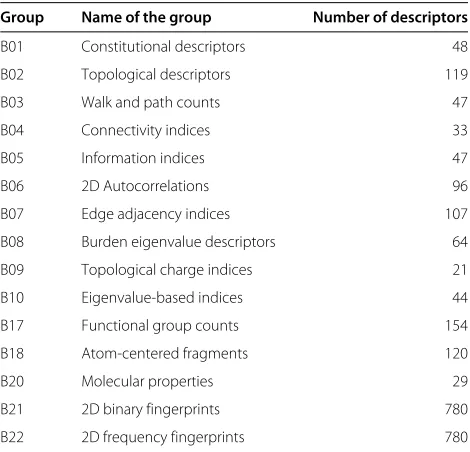
Molecular descriptors have been proven essential in drug design, structural and mathematical chemistry, bioin-formatics, and related disciplines [1-7]. Descriptors can be understood as functions to map chemical or struc-tural properties of chemicals to positive real numbers. The latter often results in so-called topological or struc-tural descriptors [7,8] by deriving strucstruc-tural features of molecular structures. Following Todeschini et al. [7], we realize that a vast amount of molecular descriptors have been developed; surprisingly, many of their properties have not yet been properly explored. Table 1 lists the exist-ing categories of molecular descriptors calculated usexist-ing DRAGON [9].
The main contribution of this paper is to provide a large-scale, online available database, containing over 25 million
chemicals downloaded from the database PubChem
[10,11]. Our database, called COMMODE (COMpilation of MOlecular DEscriptors), provides a valuable source
*Correspondence: [email protected]
1UMIT, Division for Bioinformatics and Translational Research, Eduard Wallnoefer Zentrum 1, A-6060 Hall in Tyrol, Austria
Full list of author information is available at the end of the article
containing descriptor data, which is usually not avail-able at a large scale. As we have already mentioned, the present paper can be regarded as an application explaining the database as well the underlying tool in brief. It would go far beyond the scope of the paper to explain the features and the application of COMMODE in in depth. COMMODE also allows researchers to examine the interpretationor meaning [5] of molecular descriptors.
In the context of topological descriptors [1,3,5,6], this relates to exploring thestructural interpretationof such measures. Exemplarily, branching, cyclicity, connectiv-ity and symmetry are plausible interpretations of such indices that have been investigated, see [5,12-15]. Never-theless, one is far away from possessing a general frame-work to tackle this problem by using a large number of available descriptors. We believe that COMMODE will prove to be useful to resolve this challenging task suc-cessfully. Also, researchers who are active in QSPR and QSAR [16,17] and those developing chemometrics-driven models [18] using descriptor data might utilize this database.
The paper is organized as follows. In the section ‘Implementation’, we explain the database scheme, and
Table 1 Groups of molecular descriptors
Group Name of the group Number of descriptors
B01 Constitutional descriptors 48
B02 Topological descriptors 119
B03 Walk and path counts 47
B04 Connectivity indices 33
B05 Information indices 47
B06 2D Autocorrelations 96
B07 Edge adjacency indices 107
B08 Burden eigenvalue descriptors 64
B09 Topological charge indices 21
B10 Eigenvalue-based indices 44
B17 Functional group counts 154
B18 Atom-centered fragments 120
B20 Molecular properties 29
B21 2D binary fingerprints 780
B22 2D frequency fingerprints 780
This table lists the different groups for all computed molecular descriptors created by DRAGON. In total 2,489 molecular descriptors were calculated and integrated into COMMODE.
details of the data generation and integration process. The section ‘Results and discussion’ outlines the usage of our tool with a standard web browser. The article finishes with ‘Conclusions’.
Implementation
Molecular and structural descriptors
Molecular descriptors encode certain information about chemicals. As a result, special classes of such measures have been developed to emphasize particular aspects of chemicals, e.g., atom types, bond types or struc-tural properties. In particular, molecular descriptors have been proven essential for designing QSPR/QSAR mod-els efficiently [16,17]. In this application, we calculated descriptors using of DRAGON [9]. A class of descrip-tors that has been investigated extensively are topological (or structural) descriptors [5-8]. Clearly, this class itself can be divided in different subcategories such as graph entropy [8,19] representing information-theoretic indices, eigenvalue-based measures [20,21], distance-based mea-sures [7,22] and symmetry-based descriptors [7]. Note that DRAGON has its own categorization of molecu-lar descriptors and, for instance, it does not consider information-theoretic descriptors representing the struc-tural information content of a chemical structure as topo-logical descriptors.
From a practical point of view, molecular descriptors have been used extensively to predict melting and boil-ing points [23]. Also, other chemical properties such as properties that are important in the drug design process have been used in combination with molecular
descriptors. Crucial properties can be ADME-Tox prop-erties (absorption, distribution, metabolism, excretion, and toxicity) influencing different essential aspects of drugs [24]. Examples for molecular descriptors infulenc-ing ADME-Tox properties are the octanol/water partition coefficient (LogP) [25], the aqueous solubility descrip-tion (LogS) [26] and the blood-brain barrier permeadescrip-tion (LogBB) [27].
Large-scale database of molecular descriptors
This section describes the MySQL database scheme and the process of data integration with Java routines, as well as the calculation of the molecular descriptors by using DRAGON. Moreover, the web page, which pro-vides access to the large scale database and is essential for querying the database, and the implemented descriptive analysis, is explained.
COMMODE contains about 25 million chemicals downloaded from the databasePubChemand about 2,500 molecular descriptors, which have been calculated for all of those compounds using DRAGON [9]. The database can be accessed through a php-based web application at http://commode.i-med.ac.at [28], where different queries can be started, files with compounds of interest can be uploaded, and results can be exported. Furthermore, addi-tional descriptive values can be calculated and statistically analyzed by means of statistical measures, correlation and uniqueness.
Compounds
As we used compounds fromPubChem, the first step was to download the complete set provided as SDF-files [29] (Structure Data Format). Those files contain 25,051,770 compounds, which vary largely in their size and structure. The mass of the downloaded compounds ranges from 1 to 59750 Dalton with a median value of 383 Dalton, whereby 45 compounds are heavier than 10,000 Dalton. Also the number of heavy atoms (anything other than hydrogen) varies dramatically between 0 and 576 with a median at 27. Other constitutional information about the com-pounds integrated in COMMODE are number of atoms (min=1, max=982, median=48), number of bonds (min=0, max=990, median=50) and the number of rings (min=0, max=19, median=3) per molecule.
Integration of compounds
B06
PubChem_CID
ATS1m
ATS2m
ATS3m
ATS4m
...
B05
PubChem_CId
ISIZ
IAC
AAC
IDE
...
Compound
PubChem_CID
EXACT_MASS
HEAVY_ATOM_COUNT
Name
Openeye_Name
CAS_Name
Systematic_Name
Traditional_Name
Inchi_Value
Inchi_Key
Formula
XLogP3
CAN_Smiles
B04
PubChem_CID
X0
X1
X2
X3
...
Error
PubChem_CID
error
B03
PubChem_CID
MWC01
MWC02
MWC03
MWC04
...
B02
PubChem_CID
ZM1
ZM1V
ZM2
ZM2V
...
B01
PubChem_CID
MW
AMW
Sv
Se
...
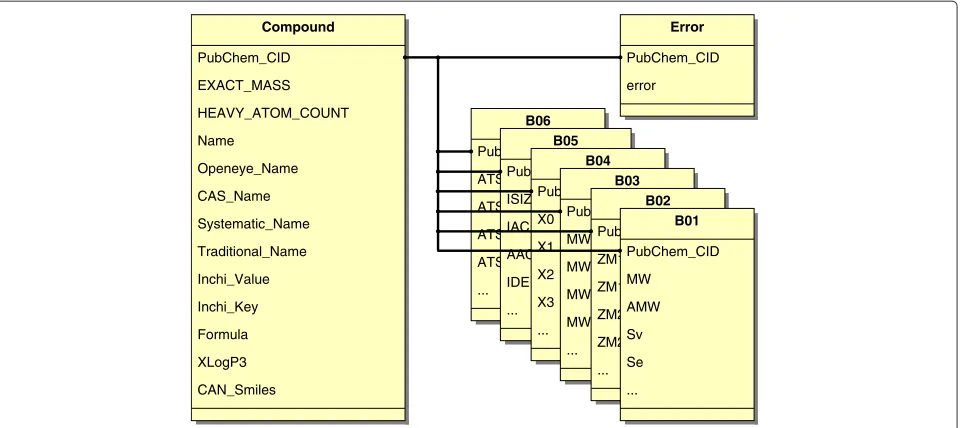
Figure 1Database scheme for compounds.The main relation in COMMODE is the relationCompoundincluding attributes loaded from PubChem. This relation is linked by using thePubChemidentifier with one relation for each of the 15 groups of descriptors (B01-B10, B17, B18, B20-B22) calculated using DRAGON. Each group contains a variety of molecular descriptors (listed in Table 1). For simplification just the first six groups with their corresponding first four descriptors are shown here. Furthermore, the relationErrorholds a Boolean value, which is true if a problem occurred using DRAGON for this molecule.
compounds including the central relation Compound
containing attributes obtained fromPubChem. A second Java routine creates one relation for each single DRAGON group, including molecular descriptors as attributes and thePubChemidentifier. All of the mentioned relations are connected toCompoundby usingPubChem_CID, which is the primary key in those relations.
Computation and integration of molecular descriptors
After the successful completion of the compound inte-gration, 2,489 molecular descriptors have been calculated
by applying DRAGON to all SDF-files. Table 1 lists all 15 calculated groups, their name, and their correspond-ing number of descriptors. DRAGON produces one file per input file and per group, thereby, numerous files were created holding a huge number of positive real numbers. It appears that DRAGON was not able to calculate the descriptors for 950,688 compounds, due to different errors. These errors can have different causes, like there is just one atom (e.g. hydron H+ (id 1038), bromide Br- (id 259)), or the downloaded molecule represents
GroupNames
group_id
Name
DescriptorNames
group_id
nr
originalName
mySQLName
changed
description
an unconnected graph and therefore those molecular descriptors can not be computed (e.g. [3-(dimethylcar-bamoyloxy)phenyl]-trimethyl-ammonium; methyl sulfate (id 5824)). As DRAGON fails to calculate molecular descriptors for these compounds, the relationErrorwith the Boolean attribute error was introduced. As 3D infor-mation of the compounds is not available using the pro-vided SDF-files, the corresponding 3D descriptors have not been calculated. To handle the large number of result files, an additional Java routine was developed, which inte-grates those files into the previously generated database relations, where the first attribute for each group contains the identifier fromPubChem.
Meta-data about molecular descriptors and their cor-responding groups can also be found in the database scheme. Therefore, the relationDescriptorNamescontains
attributes describing a molecular descriptor. Descrip-torNames is associated with the relation GroupNames, which stores the name of all DRAGON groups. Figure 2 depict those two relations with their corresponding attributes.
Results and discussion
Querying COMMODE
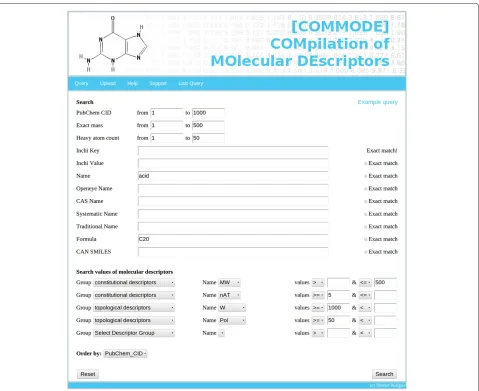
A php-based web application has been developed, which manages the access to the MySQL database. The user can search COMMODE in two different ways. The first way is based on providing different search criteria like the PubChemidentifier, exact mass, heavy atom count, different types of name, molecular formula, and ranges for various molecular descriptors. All search criteria are concatenated using a Boolean “AND”, which means that
all found molecules must fulfill any given search cri-teria. Figure 3 shows a screen-shot of the web page including attributes, which are provided for querying the database. The second more flexible way is to provide a CSV-file of interesting compounds using their corre-spondingPubChemidentifier. COMMODE uses this list and is able search for corresponding values of all inte-grated molecular descriptors. As the database contains around 25 million compounds the resulting tables can be huge, for performance reasons we limit the query result to 1,000 tuples.
Views on the data
After querying COMMODE various views displaying the results are provided. The first view shows a list with general information about the resulting compounds. Each single molecule can be selected from this list and explored. Therefore, a view was implemented showing different names and values for each molecule as well as a link to the correspondingPubChempage. This view also shows a 2D and a 3D plot from the molecule derived fromPubChem. The user can further see the values of all molecular descriptors for the compound of interest or the values
from a single molecular descriptor for all compounds of the given query.
Statistical analysis
When analyzing data of molecular descriptors on a large-scale, a statistical analysis is crucial. For example, this relates to estimating the correlations between descriptors to examine whether they capture chemical or structural information of compounds similarly. Note that this prob-lem has been already tackled by Basak et al. [12] and Todeschini et al. [32]; but we would like to emphasize that in their analysis they have only used small subsets of compounds and descriptors. COMMODE offers now the opportunity to investigate this problem on a large-scale without the need to having access to a stand-alone application that computes molecular descriptors. This might be particularly interesting for researchers who want to analyze properties of molecular descriptors by using existing compounds.
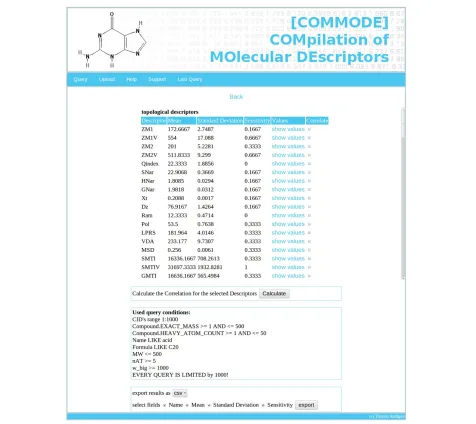
The same reason described above applies to the anal-ysis of the discrimination power of molecular descrip-tors. Figure 4 depicts a screen-shot showing molecular descriptors with observed statistical values for the given query. COMMODE is able to estimate Pearson’s cor-relation coefficient. The analysis of the discriminating power of molecular descriptors has not yet been tack-led by using large data sets; except for Hu et al. [33], who investigated the discrimination power of over 4 million structures by calculating EAID numbers. To our knowledge, similar studies have been performed only applying pure structural descriptors by putting the emphasis on rather small sets of compounds [34-36]. Hence, the database system also provides a statistical data analysis part to explore this problem more thor-oughly by using a large number of compounds and descriptors.
Data export
The usage of results within other applications is nec-essary for scientists, as a lot of downstream analysis can be performed on the integrated data. Therefore, the application supports the following file-formats to export:
SDF, SMILES, CSV, MS-Excel® and XML format. The
connection table of the SDF-file is converted from the stored SMILES code using the Chemistry Development Kit (CDK) [37] and opencsv [38] in a specific Java routine. The exported files can further be used in QSPR and QSAR models.
Conclusions
This work introduces a large chemical database contain-ing chemical compound data and their correspondcontain-ing molecular descriptor values. These molecular descrip-tors can be used in QSPR and QSAR models to predict
different chemical parameters using the structure of the compounds, and are utilized in drug design.
The published database, COMMODE, includes more than 25 million compounds and about 2,500 computed descriptors. Clearly, COMMODE extends MOLEdb as this database contains only 1,124 molecular descriptors and 234,773 molecules [39,40]. To use our database in QSPR or QSAR models, compounds of interests can be queried either by using different search attributes or by providing a list of PubChemidentifiers. Afterwards, results for molecular descriptors can be exported in dif-ferent file-formats. These results can further be combined with investigated attributes or properties of the given compounds. New models can be designed using these combinations, which can further be used to predict these attributes and properties for other compounds.
As not all molecular descriptors are necessary for the downstream analysis the introduced application is able to calculate descriptive values for each molecular descriptor representing the discrimination power or the correlation coefficient between chosen descriptors.
An additional research area supported by COMMODE is the field of chemical graph theory [7]. COMMODE can be used to analyze the chemical meaning of molec-ular descriptors [41]. Therefore, descriptive analysis of all descriptors can be performed for all integrated com-pounds as well as on a particular subset. Also the degener-acy [36,42,43] of all computed and integrated descriptors can be analyzed on different sets of compounds.
Overall, this novel database provides a flexible access to compounds and their related molecular descriptors, which can be used in different research areas.
Availability and requirements
• Project name:COMMODE (COMpilation of MOlecular DEscriptors)
• Project home page:http://commode.i-med.ac.at
• Operating system(s):Platform independent
• Programming language:Java, php
• Other requirements:Web Browser
• Any restrictions to use by non-academics:none
Competing interests
The authors declare that they have no competing interests.
Authors’ contributions
The conceptual idea for COMMODE by using molecular descriptors goes back to MD. Calculation of all molecular descriptors using DRAGON was performed by MD. Furthermore, MD, AD and FES wrote the manuscript. AD and LM performed the implementation of the database. AD and SP implemented Java routines. RG and AG reviewed the database scheme and performed tests. In summary, the project was initiated and coordinated by MD. All authors contributed to the interpreation of the results and read and approved the final manuscript.
Acknowledgements
P22029-N13). Also, Matthias Dehmer also gratefully acknowledges funding from the Standortagentur Tirol (formerly Tiroler Zukunftsstiftung).
Author details
1UMIT, Division for Bioinformatics and Translational Research, Eduard
Wallnoefer Zentrum 1, A-6060 Hall in Tyrol, Austria.2Biocenter Innsbruck,
Division for Bioinformatics, Innsbruck Medical University, Innrain 80-82, A-6020 Innsbruck, Austria.3Oncotyrol, Center for Personalized Medicine,
Karl-Kapferer-Straße 5, A-6020 Innsbruck, Austria.4Computational Biology and
Machine Learning Laboratory, Center for Cancer Research and Cell Biology, School of Medicine, Dentistry and Biomedical Sciences, Queen’s University Belfast, 97 Lisburn Road, Belfast, BT9 7BL, UK.
Received: 30 August 2013 Accepted: 29 October 2013 Published: 13 November 2013
References
1. Kier LB, Hall LH:Molecular Connectivity in Chemistry and Drug Research. New York, USA: Academic Press; 1976.
2. Mazurie A, Bonchev D, Schwikowski B, Buck GA:Phylogenetic distances are encoded in networks of interacting pathways.Bioinformatics 2008,24(22):2579–2585.
3. Basak SC, Magnuson VR:Molecular topology and narcosis.
Arzeim-Forsch/Drug Design1983,33(I):501–503.
4. Varmuza K, Demuth W, Karlovits M, Scsibrany H:Binary substructure descriptors for organic compounds.Croat Chem Acta2005,
78:141–149.
5. Dehmer M, Varmuza K, Borgert S, Emmert-Streib F:On entropy-based molecular descriptors: statistical analysis of real and synthetic chemical structures.J Chem Inf Model2009,49:1655–1663. 6. Bonchev D, Rouvray DH:Complexity in Chemistry, Biology, and Ecology.
New York, NY, USA: Mathematical and Computational Chemistry, Springer; 2005.
7. Todeschini R, Consonni V, Mannhold R:Handbook of Molecular Descriptors. Weinheim, Germany: Wiley-VCH; 2002.
8. Bonchev D:Information Theoretic Indices for Characterization of Chemical Structures. Chichester: Research Studies Press; 1983.
9. SRL T:Talete: Dragon.[http://www.talete.mi.it/products/ dragon_description.htm]. Accessed: 11/2012.
10. Bolton EE, Wang Y, Thiessen PA, Bryant SH:PubChem: Integrated platform of small molecules and biological activities.InAnnual Reports in Computational Chemistry, Volume 4. Edited by Wang W, Barker N, Simmerling C, Madura JD, Cornell W: American Chemical Society; 2008. 11. NLM:The PubChem project.[http://pubchem.ncbi.nlm.nih.gov].
Accessed: 11/2012.
12. Basak SC, Balaban AT, Grunwald GD, Gute BD:Topological indices: their nature and mutual relatedness.J Chem Inf Comput Sci2000,
40:891–898.
13. Dehmer M, Mowshowitz A:A history of graph entropy measures.
Inform Sci2011,1:57–78.
14. Devillers J, Balaban AT:Topological Indices and Related Descriptors in QSAR and QSPR. Amsterdam, The Netherlands: Gordon and Breach Science Publishers; 1999.
15. Nikoli´c S, Trinajsti´c N:Complexity of molecules.J Chem Inf Comput Sci 2000,40:920–926.
16. Bajorath J:Chemoinformatics: Concepts, Methods, and Tools for Drug Discovery. Totowa, NJ, USA: Methods in Molecular Biology, Humana Press; 2004.
17. Guha R:On the interpretation and interpretability of quantitative structure-activity relationship models.J Comput Aided Mol Des2008,
22(12):857–871.
18. Varmuza K, Filzmoser P:Introduction to Multivariate Statistical Analysis in Chemometrics. Boca Raton, FL, USA: Francis & Taylor, CRC Press; 2009. 19. Dehmer M:Information processing in complex networks: graph
entropy and information functionals.Appl Math Comput2008,
201:82–94.
20. Dehmer M, Sivakumar L, Varmuza K:Uniquely discriminating molecular structures using novel eigenvalue-based descriptors.MATCH Commun Math Comp Chem2012,67:147–172.
21. Estrada E:Characterization of the folding degree of proteins.
Bioinformatics2002,18:697–704.
22. Skorobogatov VA, Dobrynin AA:Metrical analysis of graphs.Commun Math Comp Chem1988,23:105–155.
23. Wiener H:Structural determination of paraffin boiling points.J Amer Chem Soc1947,69:17–20.
24. Talevi A, Goodarzi M, Ortiz EV, Duchowicz PR, Bellera CL, Pesce G, Castro EA, Bruno-Blanch LE:Prediction of drug intestinal absorption by new linear and non-linear QSPR.Euro J Med Chem2011,46:218–228. 25. Platts JA, Oldfield SP, Reif MM, Palmucci A, Gabano E, Osella D:The RP-HPLC measurement and QSPR analysis of logPo/w values of several Pt(II) complexes.J Inorgan Biochem2006,100(7):1199–1207. 26. Duchowicz PR, Castro EA:QSPR Studies on aqueous solubilities of
drug-like compounds.Int J Mol Sci2009,10(6):2558–2577.
27. Fan Y, Unwalla R, Denny RA, Di L, Kerns EH, Diller DJ, Humblet C:Insights for predicting blood-brain barrier penetration of CNS targeted molecules using QSPR approaches.J Chem Inform Model2010,
50(6):1123–1133.
28. Rudigier T:Analytical Molecular Database Search - Eine Web-Applikation zur Analyse molekularer Deskriptoren. Austria: Bachelor Thesis, UMIT; 2011. 29. Dalby A, Nourse JG, Hounshell WD, Gushurst AKI, Grier DL, Leland BA,
Laufer J:Description of several chemical structure file formats used by computer programs developed at molecular design limited.
J Chem Inform Comput Sci1992,32(3):244–255.
30. Oracle:MySQL : The world’s most popular open source database.
[http://www.mysql.com]. Accessed: 11/2012.
31. Gasteiger J, Engel T(Eds):Chemoinformatics: A Textbook.InChap. Representation of Chemical Compounds. Weinheim, Germany: WILEY-VCH; 2008:401–437.
32. Todeschini R, Cazar R, Collina E:The chemical meaning of topological indices.Chemomet Intell Laboratory Syst1992,15:51–59.
33. Hu CY, Xu L:On highly discriminating molecular topological index.
J Chem Inform Comput Sci1996,36:82–90.
34. Diudea MV, Ili´c A, Varmuza K, Dehmer M:Network analysis using a novel highly discriminating topological index.Complexity2011,16:32–39. 35. Konstantinova EV, Vidyuk MV:Discriminating tests of information and
topological indices. Animals and trees.J Chem Inf Comput Sci2003,
43(6):1860–1871.
36. Konstantinova E:Information-Theoretic Methods in Chemical Graph Theory.InTowards an Information Theory of Complex Networks. Edited by Dehmer M, Emmert-Streib F, Mehler A. Boston: Birkhäuser; 2011:97–126. 37. Steinbeck C, Han Y, Kuhn S, Horlacher O, Luttmann E, Willighagen E:The chemistry development kit (CDK): an open-source java library for chemo- and Bioinformatics.J Chem inform Comput Sci2003,
43(2):493–500.
38. Smith G:opencsv.Accessed: 11/2012.
39. Ballabio D, Manganaro A, Consonni V, Mauri A, Todeschini R:
Introduction to MOLE DB - on-line molecular descriptors database.
MATCH Commun Math Comput Chem2009,62:199–207. 40. Ballabio D:MOLE db - Molecular Descriptors Data Base.
[http://michem.disat.unimib.it/mole_db]. Accessed: 11/2012 41. Todeschini R, Cazar R, Collina E:The chemical meaning of topological
indices.Chemomet and Intell Laboratory Syst1992,15:51–59. 42. Dehmer M, Grabner M, Varmuza K:Information indices with high
discriminative power for graphs.PLoS ONE2012,7:e31214. 43. Hunter PR, Gaston MA:Numerical index of the discriminatory ability
of typing systems: an application of Simpson’s index of diversity.
J Clin Microbiol1988,26(11):2465–2466.
doi:10.1186/1751-0473-8-22