Brock Education
A Journal of Educational Research and Practice
Volume 16 (2) Fall 2007
Faculty of Education
A Systematic Process for Educational Policy Development: Based on a Systems Approach to Training and Project Management
Catherine M. F. Bates Brock University
Abstract
In the Canadian Forces leadership is considered to be the paramount skill of all members. For Training Development Officers, one method of displaying leadership is through the careful consideration of educational policy and its skilful implementation. If we do not take the time to write carefully considered policy, then students and their issues are managed according to the values and beliefs of individual decision makers. Normally this is fine, but when it negatively impacts students or teachers then neither equality nor equity is achieved.
In the Canadian Forces we follow a systematic process for training development, but not for training and education policy development. The five characteristics of systematic policy development are discussed following a brief discussion of the different types of educational policy. The paper expands upon the five characteristics grouped under the following topics: an academic approach, communities of practice, educational leadership, change agentry, and an integrated model. An integrated model of policy development is proposed that is based on the consolidation of an environmental scanning model, the Canadian Forces Systems Approach to Training, the Project Management Institute Project Management Model, and Delaney’s phases of policy implementation. It is recommended that the resulting model serve as a guide for Canadian Forces policy developers. Brock Education Vol 16, No. 2, 2007
Catherine M. F. Bates is a Ph.D. student in the Joint Ph.D. program at Brock University, in the Policy and Leadership stream.
The Canadian Forces (CF) follows a systematic process for training development, but not for training and education policy development. In spite of this, we do training and education policy development. Our training and education policy developers require the same support and tools that we use as training developers. In this paper I will discuss how existing CF Individual Training and Education System (CFITES) and Department of National Defence (DND) Project Life Cycle processes, tools, and skills are applicable to the challenging but rewarding field of training and education policy development.
Approach
C. Bates
equity. Educational equity is described by Delaney (2002) as “equality of educational opportunity” (p. 98). If we do not take the time to write carefully considered policy, then students and their issues are helped according to the values and beliefs of individual decision makers. Normally this is fine, but when it negatively impacts students or teachers then neither equality nor equity is achieved. My position is that educational equity can best be achieved through carefully considered and skillfully implemented policy.
Purpose
An integrated model of policy development is proposed as one method of policy development in the service of educational equity. A project management/ systems approach with which most instructional designers and project managers are familiar could form the basis for fair policies that promote justice in the education and training system. The practice of developing and implementing individual models for complementary processes does not take advantage of wider opportunities. Fullan (1993) reports that structural changes to existing processes require changes in ideas, beliefs, and attitudes, a willingness to examine the interconnectedness of all parts and to expend the effort needed to address the details of complexity, and a flexible process orientation. He cautions that the change required to affect policy requires a “complete change in organizational culture and in the organization’s relation to other agencies” (p. 54). The CF is currently undergoing an organization-wide Transformation Initiative that aims to take advantage of any and all opportunities for change while recognizing that cultural change will have to go along with any recommendation for process change. The proposed new policy development model built from existing models described in this paper is timely given the CF’s favourable attitude to organizational change.
Assumptions
A discussion of the differences between practices, regulations, procedures, policies, and philosophies will ensure a common understanding of the terms used in the discussion that follows. Delaney (2002) differentiates between: practices (something everyone does, but they are not recorded anywhere), regulations (something specific and recorded to guide practice), procedures (how things are to be done, not what is to be done), mega-policies (a policy that sets guidelines for other lesser policies), meta-policies (how a policy will be developed), and philosophy (an approach towards a mandate or goal). The policy development model in the paper is intended mainly for the development of mega-policies.
The requirement for new or revised training and education policies in the CF are assumed to be in reaction to one or more of the following issues:
1. Needs assessment. One of the first steps in any systems approach to training is needs assessment. Needs assessment is defined as
Policy development
needs that may best be addressed by training or by solutions other than training. (Department of National Defence [DND], 2006b, p. 19)
Needs assessment incorporates environmental scanning concepts and the problem definition stage of the policy development cycle.
2. Reaction to incident. From time to time, an organizational knee-jerk reaction is generated to a triggering event that raises an issue and necessitates hasty policy development. A recent CF example was the Somalia Inquiry and the generation of a zero tolerance policy on harassment and racism.
3. Emerging issue. Ideally, environmental scanning, demographic trend analysis, and careful research reveal emerging issues well in advance of the need for policy. The CF Recruiting System is very good at this, and collects huge amounts of data that are carefully analyzed to predict Canadian recruiting trends and to react to them with fair and comprehensive policy. An example of this was changes to entry level education standards in reaction to both higher levels of potential candidates’ education and the requirement for higher levels of education to match increasingly difficult technology jobs (e.g. Aviation Systems Technicians, Fire Control Systems Technicians, and Naval Control of Shipping).
4. Due diligence. Due diligence is a legal concept widely promoted in environmental protection, responsibility, and sustainable development. By removing reference to the environment, the definition is as follows: “Due diligence is the reasonable standard of care of others that individuals shall exercise in the course of their actions and duties” (DND, 2006c, Definitions). Sometimes policies are required to protect corporate and individual interests. A triggering event may have occurred that highlighted the need for a policy to explain the organization’s position, regardless of whether the event is likely to happen again. This is the training version of malpractice insurance.
5. Correction from processes to policy. Every organization has processes that are treated as de facto policies. Occasionally they must be converted to policies when these processes generate public examination. Public scrutiny in the CF could be in the form of Ministerial Inquiry, Redress of Grievance, or informal complaint. A formalization of course reporting procedures was required in Support Training Group when a student complained through his Member of Parliament after failing a course. He complained that his course report did not clearly state if he would be allowed to retake the course, and at which point he would re-enter the course.
Building the Model
C. Bates
systems are made accessible to people other than the specialists who promote and manage the system.
Ten years ago the promotion and management of a system by a small group of specialists was the order of the day within the CF through its systematic approach to training. Within the last ten years, the Manual of Individual Training, which is the process guide for the systems approach, was mainly written and used by Training Development Officers. When we responded to requests from our instructors, training managers, and standards officers for a more accessible guide, we rewrote it and supported it with ongoing training. While the elitism of the old manuals and process were unintentional, the outcome served to isolate the Training Development Officers who were meant to promote the widespread use of the systems approach. Most professional groups have unique and specialized processes. By looking outward and integrating these models, it might be possible for us as a profession of training developers serving the military community to combine the best aspects of each model and create something new that serves a wider community. The discussion that follows presents many different models, but compares and aligns them into one final cohesive model that represents a potential best practice for systematic policy development.
One method of detecting trends early enough to react to them is called environmental scanning. The process of environmental scanning is the first model that will build into the final systematic policy development model. The concept of environmental scanning is a method of collecting data, defining issues, and
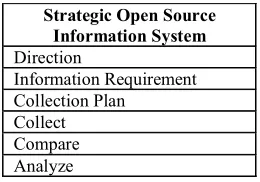
benchmarking. Benchmarking is defined as “the process of comparing and measuring an organization’s operations or its internal processes against those of a best-in-class performer from inside or outside its industry” (Alstete, 1995, p. 1). After many years of fiscal restraint and the corresponding downsizing, the CF has finally reached a point where it is indeed impossible to do less with less. The CF Transformation Initiative has been launched to explore fundamental changes to the culture of our military to ensure a fully integrated and unified approach to operations (DND, 2006a). To support Transformation, environmental scanning has been re-introduced using strategic open source information. At a recent Human Resources Seminar on Environmental Scanning, I was encouraged by the message from both military and civilian intelligence professionals that we are fully committed to using open sources of information to scan the environment to define issues and develop policies. The converse of this process is exploring other system models and integrating them with our existing models. The result of this examination of social and political trends, market and competition trends, and technological trends is more informed policy (Bisson, 1997). DND, and the CF in particular, have no shortage of process models however none are currently integrated. The Strategic Open Source Information System model, shown below in Table 1, is the first step in a proposed policy development model. As the model builds, preceding models (such as the first one) will be shown in italics.
Strategic Open Source Information System
Project Life Cycle Model
Direction Concept
Information Requirement Planning
Collection Plan Design
Collect Development
Compare Implementation
Analyze Closeout
Strategic Open Source Information System Direction
Information Requirement Collection Plan
Collect Compare Analyze
Policy Development
Table 1. Integrated Model of Policy Development – Phase 1
Table 2. Integrated Model of Policy Development – Phase 2
The Book of Knowledge is also the basis for a much sought after Project Management Professional Designation. There are many general textbooks on project management each promoting a version of this cycle. One popular book titled 5-Phase Project Management: A Practical Planning and Implementation Guide (Weiss & Wysocki, 1992) divides the phases into planning and implementation that includes; define, plan, organize, control, and close. This model is similar to Delaney’s and collapses the Design and Development phases into one called Organize. There is ample scholarly research conducted based on the Project Life Cycle Model, however, few university libraries hold the Journal of Project Management in which the articles are published. In reviewing the abstracts of the many journal articles discussing the practical application of the Project Life Cycle Model, it is clear that integration has not yet been attempted. In fact, most articles are of the case study variety.
The Canadian Forces Individual Training and Education System (CFITES) Manual of Individual Training is a thirteen-volume process guide that covers all of the six phases of our systematic approach to training (DND, 2006b). Some phases such as development and design have more than one volume to support it. There are additional volumes on prior learning
Project Life Cycle Model CFITES Systematic Approach to Training Model
Concept Analysis
Planning No similar process
Design Design
Development Development
Implementation Conduct
Closeout Evaluation and Validation
CFITES Systematic Approach to Training Model
Policy Development Cycle
Analysis Identification of need
Review existing policies No similar process Gather information
Study, deliberate and determine basic issues
Design Draft, revise and rewrite. Discussion
and deliberation by stakeholders Development Final revision and legal review
Conduct Communication and Implementation
Evaluation and Validation Evaluation and revision, updating, and improvement
C. Bates
show below in Table 3 beside the applicable phases of the Strategic Open Source Information System and the Project Life Cycle Model.
Delaney’s Educational Policy Studies: A Practical Approach (2002) similarly promotes a systematic approach to policy development. While each chapter discusses a phase in the Policy Development Cycle (analysis, development, implementation, evaluation, dissemination), the consolidated list of the steps in the Policy Development Cycle described by Delaney (pp. 53-54) are more descriptive. This model is shown below in Table 4 beside the third model.
A similar policy development and research cycle was investigated for the Southern Africa Consortium for Monitoring Educational Quality. It starts with policy concerns, moves through a highly systematic and focused applied research cycle, and then is completed with research-based suggestions about how to address the initial policy concerns (Saito, 1999, p. 3). This study employed project management methods to manage the research, but did not report on any integration with their proposed policy development cycle. The concept of appropriating best practices from the business world into education is proposed in Glatter’s article From Juggling to Struggling (1999) on head teacher training in the UK. One of the article’s conclusions is that the management of people and human relationships is of vital importance in all
Table 3: Integrated Model of Policy Development – Phase 3
n
n
Policy Development
business concerns as well as educational leadership. Within this same article, Fullan is quoted as recommending that:
Leaders for change get involved as learners in real reform situations. They craft their own theories of change, constantly testing them against new situations. They become critical consumers of management theories, able to sort out promising ideas from empty ones. They become less vulnerable to and less dependent on external answers. (cited in Glatter, p. 9)
I believe that this lends support to the practice of looking outward discussed in environmental scanning and again, while not recommending a preferred management practice applied to educational leadership, it does support the concept especially in terms of benchmarking our own practices. Wallace (2001) injects a note of caution regarding benchmarking leadership practices to other organizational models. He comments that a culture of realism within the educational organization is necessary when looking outward. He notes that this culture must:
Encompass the nature of the task we are setting ourselves; our complementary and contradictory interests; the compromises that all partners will have to make and how to make them; the debates where we may agree to differ and the ones where we must agree to agree; and the extent and limits of what we can expect to achieve. (p. 2)
Realistic expectations when looking to general management models for their applicability to education would seem a wise move, however the endorsement of looking at other models was again echoed in Ribbins (1999) with recommendation number six to enable a “redefinition of the field of education management and leadership in the light of the major changes in practice that have taken place since the 1980s” (p. 3). This recommendation is “to assess and redefine the contribution of general management theory to practice in educational contexts” (p. 3, italics in original).
Critical Analysis
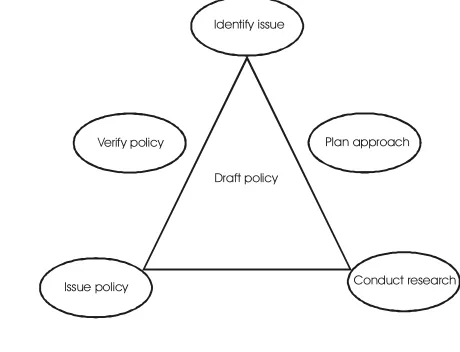
An Integrated Policy Development Model is described in Table 5. This model shows the interrelated phases of the Strategic Open Source Information System as a contrast to a third model, the Project Lifecycle Model and the CFITES Systematic Approach to Training Model. A rough approximation of the phases of these models is contrasted with the Policy Development Cycle. The purpose of this table is to show the similarities of all of these models. A common nomenclature of these phases is assigned based on the reasons why policy might be required (discussed above in assumptions). An integrated model applied to policy would be termed a meta-policy by Delaney as one in which the method of policy development is described. This model is suitable for mega-policies that depict the performance of other minor policies, and could also serve as a guide to developing regulation, processes, and practices. The intent here is to demonstrate that the approaches used by similar professionals are related and the same skills that are brought to bear on projects and training apply to policy development.
Policy Development Cycle Integrated Policy Development Model (common nomenclature) Identification of need
Review existing policies
Identify issue
Gather information
Study, deliberate, and determine basic issues
Plan approach
Draft, revise, and rewrite Discussion and deliberation by stakeholders
Conduct research
Final revision and legal review Draft policy Communication and Implementation Issue policy Evaluation and revision, updating, and
improvement
Verify policy C. Bates
Synthesized Resolution
Policy development is too critical a task to leave to chance. While most policy developers follow an intuitive method, the adoption of a systematic approach will satisfy the concept of due diligence in the performance of the task of policy development and result in policy that can not be confused with process, regulation, practice, procedure, or philosophy. As Delaney (2002) states, “systemic reform approaches offer another possibility for those disappointed by policy, an approach to policy that combines centralized leadership around outcomes with decentralized decision making about practice” (p. 112). The integrated systems approach to policy development recommended in Table 5 and Figure 1 applies the tasks of different
Table 5. Integrated Model of Policy Development – Integration
Draft policy Identify issue
Plan approach Verify policy
Conduct research Issue policy
ment ture)
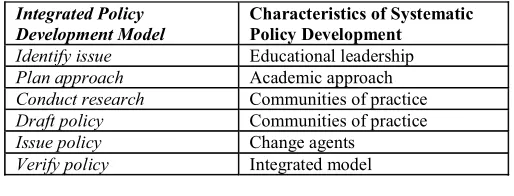
Integrated Policy Development Model
Characteristics of Systematic Policy Development
Identify issue Educational leadership
Plan approach Academic approach
Conduct research Communities of practice Draft policy Communities of practice
Issue policy Change agents
Verify policy Integrated model Characteristic Impact on policy development
Academic Approach Research based goals for changes in educational practice and organization through researching, reporting and publishing.
Communities of Practice Working models of new practice and professionally accessible knowledge attained through
benchmarking, networking, collecting best practises (usually positive), and collection lessons learned (sometimes negative).
Educational Leadership A centralized/ decentralized process that recognizes the issues and triggering events that indicate a need for new or revised policy.
Change Agentry A coherent, sustained, change oriented political process. Uses skills of legal advisor, subject matter experts, stakeholders, and sponsors.
Integrated Model Promoted through the regular assessment of educational inputs, outcomes, and processes.
Policy Development
disciplines to the profession of policy development. Professionals from the fields of training development and project management already possess the skill and knowledge necessary to successfully develop policy. These might include; facilitation skills, research skills, communication skills, problem solving skills, knowledge management, and interviewing skills. An integrated model supports them by taking advantage of the five characteristics of policy development based on Delany (2002, p. 112) and de-scribed in Table 6.
The five characteristics of systematic policy development can be well managed by a clearly assigned Policy Development Team Leader/Manager. This person must be identified early to attend to the group dynamics of a team this diverse. When the five characteristics are compared with the Integrated Policy Development Model discussed throughout this paper, a final model emerges (Table 7).
Table 7: Integrated Policy Development Model - Final
Conclusion
The CF follows a systematic process for training development, but not for training and education policy development. This does not mean that we do not value
C. Bates
Alstete, J.W. (1995). Benchmarking in higher education: Adapting practices to improve quality. ASHE-ERIC Higher Education Reports, Report Number 5,
Washington DC: The George Washington University.
Bisson, B.G. (1997). Humanresource management concepts: Environmental scanning learning object. Retrieved August 26, 2007, from http://www.unb.ca/jhsc/ resourcectr/TME_courses/tme3113/human_resources
Delaney, J. (2002). Educational policy studies: A practical approach. Calgary, AB: Detselig Enterprises.
Department of National Defence. (2006a). A role of pride and influence in the world: Defence policy statement. Retrieved April 1, 2006, from http://
www.forces.gc.ca/site/reports/dps/main/intro_e.asp
Department of National Defence. (2006b). Canadian forces individual training and education system manuals of individual training. Ottawa, ON: Queens Printers in Right of Canada.
Department of National Defence. (2006c). Environmental protection and stewardship. Retrieved August 26, 2007, from http://www.admfincs.forces.gc.ca/admfincs/ subjects/daod/4003/intro_e.asp
Fullan, M. (1993). Change forces: Probing the depths of educational reform. London: The Falmer Press.
Fullan, M. (2005). Leadership & sustainability: Systems thinkers in action. Thousand Oaks, CA: Corwin Press.
policy development. We do appreciate that our training and education policy
developers require the same support and tools that we use as training developers. This approach reflects my belief that to promote equity and justice, policy should support the students and teachers and be fair and well researched. The regulations and processes can then be customized according to local needs and desires. This puts decision making back into the hands of educational leaders, but with guiding policies to support their decisions. The stove piping of individual systems does not take
advantage of wider opportunities and reflects Fullan’s (2005) call for an interconnected but flexible process orientation to policy development. The CF Transformation initiative aims to take advantage of any and all opportunities for change while recognizing that cultural change will have to go along with any recommendation for process change.
In this paper I proposed that the existing CF Individual Training and Education System (CFITES) and Department of National Defence (DND) Project Life Cycle processes, with inputs from other familiar models, represent tools and skills that are applicable to the challenging but rewarding field of training and education policy development. Through the integration of existing process models, the skills and knowledge of related professionals can be applied to the task of educational policy development through familiar and tested methods.
Glatter, R. (1999). From struggling to juggling: Towards a redefinition of the field of educational leadership and management. Educational Management and Administration, 27(3), 253-266.
Project Management Institute. (2006). Project management book of knowledge excerpts. In Project estimating and scheduling participant manual. Washington, DC: The George Washington University.
Ribbins, P. (1999). On redefining educational management and leadership. Educational Management and Administration, 27(3), 227-238.
Saito, M. (1999). A generalizable model for educational policy research in developing countries. Retrieved August 26, 2007, from http://home.hiroshima-u.ac.jp/cice/ saito.PDF
Wallace, M. (2001). Really good ideas? Developing evidence-informed policy and practice in educational leadership and management. Educational Management and Administration, 29(1), 27-34.
Weiss, J.W., & Wysocki, R.K. (1992). 5-phase project management: A practical planning and implementation guide. Reading, MA: Addison-Wesley.
Globalization and the social justice agenda for education: Moving from critique to possibilities
Yvette Daniel University of Windsor
Abstract
This paper analyzes the complexities of addressing the impact of globalization on educational policy. The intent is to engage in a constructive debate about education and equity in a globalized context. Although despair is sometimes inevitable, and is, oftentimes, manifested in a continuing critique of the detrimental effects of globalization on issues of equity and social justice in education, it is not the end. It could serve as the beginning of something that is not just different and redemptive but also forward thinking. There are three parts to this paper: the first offers multiple perspectives for viewing globalization followed by an analysis of the impact on issues of equity and social justice. Lastly, an abridged version of a conceptual model adapted from Ghosh (2004) aims at renegotiating cultural space in an ever-shifting milieu is discussed as a viable possibility.
The paper presentation at the Joint Ph.D conference in beautiful Thunder Bay, in keeping with the conference theme, Globalization, Equality and Education was a wonderful opportunity to engage in, as Ball (2006) would call it, “theoretical heurism” – to underscore and analyze the complexities of addressing the impact of globalization on education in the North American context. The challenge was, not only to critique the effects that globalization has had on issues of equity and social justice, but also to forward possibilities for intervention and change using a conceptual and theoretical framework to guide future policy initiatives. Much has been written by way of critiquing the New Right (both the neo-conservative and the neo-liberal variants) agenda that has driven educational restructuring for more than two decades. It is essential to engage in a more constructive and a politically honest and challenging debate about education, efficiency and equity as we close the first decade of the new millennium.
The intent of this paper, therefore, is to argue that, although despair is sometimes inevitable, and is, oftentimes, manifested in a continuing critique of the detrimental effects that globalization has had on issues of equity and social justice in education, it is not the end. It could serve as the beginning of something that is not just Brock Education Vol 16, No. 2, 2007
Globalization and Social Justice
different and redemptive but also forward thinking. First, a brief overview of the multiple perspectives on the contested terrain of globalization and its impact on educational policy-making in general is provided. The reader is forewarned that it is not possible to be comprehensive and discuss all the facets of the phenomenon labeled globalization in this short essay. Next, a discussion of the debate over equity and social justice issues in education in the context of globalization is entertained. Lastly, in order to underscore the argument, that it is possible to be difficult and constructive at the same time, I adopt an abridged version of the conceptual model developed by Ratna Ghosh (2004), a constructive approach for socio-cultural integration, to rethink education for citizenship and democracy in the context of the global and the local.
Globalization: The all-pervasive phenomenon
Dale (2000) argues that globalization is a promiscuous label for all sorts of phenomena. Rizvi (2000) states that a diversity of references makes it impossible to pin down a clearly defined understanding of the phenomenon of globalization that permeates the discourse of our times, befitting the post-modern conditions of our existence. It is, therefore, an essentially contested term that refers to diverse processes embracing the political, social, technological and cultural exchanges among people and states.
Kellner (2002) claims “there is no such thing as globalization per se. Rather; the concept is used to understand a heterogeneity of processes. The term is neither innocent nor neutral...” (p. 301). Every nation state and every local context is affected differently by the conditions of globalization depending upon its historical context, geography, and culture (Torres, 2002). The concept of globalization must be approached through an understanding of its three main interrelated dimensions: economic, cultural, and political (Taylor, Rivzi, Lingard, & Henry, 1997). The transnational processes, the shortening of distances, the weakening of geopolitical borders, the links established through faster communication processes, and others have impacted all spheres of activity, economic, political, and cultural, in very complex and interrelated ways. Globalization is arguably a phenomenon that has brought about changes “in the rules of eligibility, engagement and wealth creation” (Ball, 1998, p. 119).
These changes in the rules of eligibility mean that as the multinational corporations have become more powerful,1 the ability of governments to intervene is limited. The rules of market engagement have changed from the ideals of a Keynesian capacity in which spending on social services such as health, education and welfare was perceived to be a useful economic regulation to a market model based upon cost-efficiency and profits that govern most institutions. However, Ball (1998) cautions us not to succumb to the myth of the powerless State and not to use the globalization thesis to explain everything; he refers to this as “globaloney” (p. 120). As capitalism becomes reorganized, the impact of new market models upon educational institutions has been far-reaching. In the new rules of wealth creation the increasing emphasis on the human side of enterprise means that all nations now look to their educational
Y. Daniel
governments, regardless of their political persuasions look to their educational institutions to respond to the increasing competition presented by a globalized economy.
The Discourse of Crisis in Education
The rightist ideology has been most influential in the sphere of education mainly through the crisis discourse. Dale (1989) states that “the ‘panic’ over falling standards and illiteracy, the fear of violence in schools, and the concern with the destruction of family values and religiosity, have all had an effect” (p. 7). The fears created by this crisis discourse have been used effectively to move educational
restructuring toward increased standardization and cost effectiveness. Parents, naturally being concerned about the future of their children in a milieu of increasing economic instability, were able to relate to this argument. Thus, the crisis discourse in education has had a wide electoral appeal and was used to recruit public support by creating a normative discourse that focused on improving failing standards and the need for more accountability and value for money that paved the way for much of the restructuring initiatives in education.
The emphasis on educational failure gave impetus the movement termed the rightward turn or the conservative restoration which Apple (2001) perceives as a successful struggle by the political right to form a broad-based alliance between two very different political ideologies; conservatism and liberalism. The neo-conservative political vision is one of a strong state with a nostalgic longing for a past in which the purpose of education was clear, and everyone knew his/her place in the larger scheme of things. Neo-conservatism supports a strong standardized curriculum, calls for better educational standards and a more stringent regulation of the education system. The work of teachers is increasingly standardized and monitored closely in a move from licensed autonomy to a regulated autonomy (Apple) leading to a loss of professional authority and respect while the neoconservative educational agenda has become enmeshed in an articulation of a language of crisis (Ball, 1994).
The neo-liberal vision perceives a close relationship between education and the economy within a larger framework of global competition. This relationship influences the drive to higher educational standards and increased student testing as a preparation for entry into the marketplace. The neo-liberal perspective draws on the language of liberty, free choice, and individualism. It endorses fierce competition between schools alongside cutbacks to expenditure in education, health and social welfare services. The introduction of the market into public services has shifted more of the fiscal and moral responsibility from governments to individuals and families.
Whither Art Thou, Equity?
form of parental choice and competition among schools. Even in compulsory education, quasi-markets have been created (Brown & Lauder, 1996) through standardized testing, ranking and other such reform initiatives (Daniel, Edge, & Griffith, 2002). Such congruent policies in education have emerged all across North America, the U.K., Australia, and New Zealand. Wallace (2004) states that the educational purposes have been shaped by the discourse of globalization through the consensus of policies characterized by five key elements: neo-liberalism that emphasizes market rules; new institutional economies characterized by devolution targets and incentives;
performativity characterized by measurable outcomes; public choice theory; and new managerialism emphasized by efficiency and excellence. Globalization has become a legitimizing discourse and as Blackmore (2000) argues there is a globalization metanarrative that “has a discursive force in that it may produce the very effects it seeks to describe” (p. 469).
On the surface it might appear that choice and competition improve the quality of education for all. Schools are forced to compete in the market; whereby good schools will thrive while failing schools, will either be forced to improve or will be shut down thus benefiting all children. This utilitarian line of logic usually employed to defend neo-liberal ideologies and policies is flawed. “Where this involves an unequal distribution of resources, it is based upon the ability of people to profit from those resources and it is assumed that the resulting increased productivity eventually will provide benefits for all” (Olssen, Codd, & O’Neill, 2004, p. 220). However, as the discussion below will show, the anticipated trickle-down effect is ethically wrong in terms of equity and fairness for those most disadvantaged.
The Quest for Equity and Social Justice in Public Education
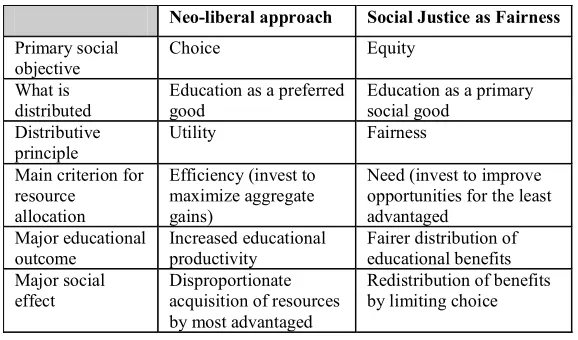
The concept of social justice is open to a variety of interpretations. Olssen et al. (2004) state that there are two distinct ethical frameworks that guide educational policies: the current neo-liberal utilitarian framework and the social justice as fairness framework that that had traditionally informed education policies. In the former, education is an exchangeable commodity, the distributive principle is utility, and the major social effect is a disproportionate acquisition of resources by those in positions of advantage. In the latter, education is perceived to be a primary social good, the distributive principle is fairness, and the major social effect is redistribution of benefits by limiting choice. Figure 1 below, Ethical framework for educational policy, abridged from Olssen et al. allows us to compare and contrast these two approaches.
Bates (2006) discusses the “hierarchies of access” (p. 276) within the context of market, choice, and competition in education. In this hierarchy of access, individual-ism and competition for resources have replaced the principles of equity and social justice that gained prominence in policy decisions following the post-war period. Bates uses Nancy Fraser’s conceptual framework of social justice and equity that is well established in the educational literature. Fraser, herself, builds upon John Rawls’s conception of social justice where social justice is achieved when public resources are directed toward the socially and economically disadvantaged. Fraser, as quoted by Bates identifies three dimensions: distribution, recognition, and representation. The latter two address the relational characteristics of social justice (Gewirtz, 2001).
Neo-liberal approach Social Justice as Fairness Primary social
objective
Choice Equity
What is distributed
Education as a preferred good
Education as a primary social good
Distributive principle
Utility Fairness
Main criterion for resource
allocation
Efficiency (invest to maximize aggregate gains)
Need (invest to improve opportunities for the least advantaged
Major educational outcome
Increased educational productivity
Fairer distribution of educational benefits Major social
effect
Disproportionate acquisition of resources by most advantaged
Redistribution of benefits by limiting choice Y. Daniel
Table 1: Ethical framework for educational policy (abridged from Olssen et al., 2004, p. 217)
The first dimension is the mal-distribution of resources in education underscored by three basic issues of money, power, and curriculum (Martell, 2006). The focus on markets, choice, and competition has created a greater gap between schools in lower socio-economic areas and those in richer neighborhoods. In an era of fiscal restraint, it is not difficult to see that those with social, cultural, and economic capital are better able to access resources and define the curriculum for the schools their children attend. The second dimension to be redressed is misrecognition occurring through institutionalized practices of exclusion in our schools. Even as we tout the notion of inclusion in our schools, the considerably high drop-out rate in Ontario, despite improvements (28 % according to the recent King Report, Ministry of Education, 2005) is evidence of these systemic inequities. Thirdly, there is a crisis of representation manifested in institutional and systemic obstacles that leave some on the margins of schooling. Unless, these are addressed by structural reorganization that will facilitate fuller participation of all in the knowledge economy, social justice remains a distant goal.
Renegotiating Cultural Space
The impediments to attaining the objectives of social justice and equity in education largely discernible through maldistribution, misrecognition and
ss
t
s
to be significant. However, various trade agreements, such as the GATS treaty of 1995, force open public services toward increased privatization and to the vagaries of the market-place. The second analogy, that of the ratchet, refers to a tool that always pulls in one direction, as in a globalized economy toward liberalizing rules. In order to keep with the notion of forward thinking Torres (2002) states:
If our contemporary discussion of education is to have meaning, it must move beyond assumptions about national boundaries and goals internal to national agendas. It must address the questions raised by the globalization of the two traditional bases of formalized educational systems: governance and economies. These questions are very straightforward: Will globalization make human rights and democratic participation more universal, or will globalization redefine human enterprise as market exchanges invulnerable to traditional forms of civic governance? (p. 364)
The time has come to redefine and restructure education, beyond the conventional practices of testing, standardization, and competition to address the changing needs of an interconnected and multi-faceted new economy. Rigor and standards work alongside as our educational systems seek different ways to foster the ability to operate, collaborate, and work in diverse cultural contexts. Ratna Ghosh (2004) proposes a conceptual model that places integration at the helm of a new paradigm-”…the intelligent organization (Landier, 1995), which is characterized by pluralism and freedom, a redistribution of power so that the role of the center is to act on behalf of the parts, and being at the middle of things rather than at the top” (p. 94).
Ghosh (2004) proposes the third space model, a constructive approach characterized by a renegotiation of cultural space, and a redefinition of values in which the notions of knowledge, cultural differences, and identity are transformed. Although her model is built upon the notion of interdependency among the three NAFTA partners, I found that this model could easily be broadened to include educational systems in general. Below, I pick out key ideas from Ghosh’s model to explore ways to address issues of equity and social justice, with a particular focus on the three
dimensions, in an ever-changing and complex globalized world in which we live and work.
The notion of what counts as knowledge has been challenged for quite some time. However, in this model, it is not about replacing one form of knowledge with another, “but rather to validate and learn about other forms of knowledge” (Ghosh, 2004, p. 96). In acknowledging and validating diverse forms of knowledge, we begin to redress the issue of misrecognition in school practices that reproduce culturally entrenched patterns of exclusion and unwillingness to engage with others across cultural and social boundaries (Bates, 2006). This openness to interconnectedness in a
networked milieu is at the forefront of transforming knowledge and learning in a globalized world.
Y. Daniel
politics of location confines people, in that the social construction of people creates hierarchies that affect their access to and success in education through misrecognition and misrepresentation that in turn affects distribution of resources. Transformation is needed in the politics of location in a globalized context in which differences are acknowledged to redress misrecognition (one of the forms of oppression in our system).
In our changing global context, the notion of quality is also contested terrain. What counts as quality and who defines it? Rigor, quality, standards are defined by the value systems that favor the dominant culture. Ghosh (2004) recommends: “Standards must be established which take the differences of cultures, knowledge,
multi-disciplinary ways of learning into consideration. Different languages and histories will be significant” (p. 97). Such a move would go a long way in redressing issues of misrepresentation to democratize access to knowledge and validation of different forms of knowledge in the measurement of standards.
Furthermore, in any discussion on globalization, the significance of the uses of technologies takes precedence. Interdependence among people is facilitated through information and communication networks. With regards to education, despite attempts to close the digital divide, the issue of mal-distribution is glaring, and much work needs to be done to attain equitable outcomes in our schools. There is a great variation among schools in terms of technological skills and resources that prevent certain groups from participating as full partners in a globalized economy, while others get a head start due to their ease of access to technological knowledge and ability to keep abreast of the latest innovations.
The conceptual model proposed above calls for powerful coalitions in education that connect people and places to the larger social purpose of our education system (Martell, 2006). Progressive-minded people who believe in and understand the need for a “renegotiation of cultural space and a reconceptualization of the way we think about learning systems” (Ghosh, 2004, p. 90) have to reject the human capital theory that is driving current policy changes in education. Globalization, itself, can be used effectively to form these coalitions in renegotiating cultural space in which the three basic issues of money, power, and curriculum are integrated into one platform (Martell) becoming the agenda for reform1 that gives priority to democratic processes and programs.
Conclusion
One of the main challenges of this essay is the attempt to encompass key ideas and concepts in a concise yet logical and comprehensible manner within the constraints of space and time. The intent, here, was to argue that globalization in all its forms, along with its positive and negative characteristics is very much a part of our landscape. Further, this acknowledgement should enable us to engage in forward thinking in our quest to attain social justice and equity in our educational systems.
economy. The impact of globalization on issues of equity were analyzed, followed by a brief description of an adaptation of a conceptual model for renegotiating cultural space to address the various dimensions of equity and fairness. Globalization, thus, can become a tool for change in attempts to move away from regressive notions in which diversity and difference are treated as individual issues, in a move toward a larger vision of a globalized society in which equity, efficiency, and progress are not mutually exclusive.
Endnotes
1 51% of the world’s largest economies are global corporations and not nation states. Wal-Mart is bigger than the economies of 161 countries.
2 Human capital theory postulates that education and training is costly, and should be considered to be an investment since it is undertaken with a view to increasing value (and personal incomes) - it becomes a value-added product by which the economy is improved. 3 The reader will note that I have used the terms “restructuring” and change throughout. Reform, in my understanding, refers to a change for the better.
References
Apple, M. (2001). Educating the “right way”: Markets, standards, god, and inequality. London & New York: RoutledgeFalmer.
Ball, S. (1994). Some reflections on policy theory: A brief response to Hatcher and Troyna. Journal of Education Policy, 9(2), 171-182.
Ball, S. (1998). Big policies/small world: An introduction to international perspectives in education policy. Comparative Education, 34(2), 119-130.
Ball, S. (2006). What is policy? Texts, trajectories and toolboxes. In S. Ball (Ed.), Education, policy and social class: The selected works of Stephen J. Ball (pp. 43-53). London & New York: Routledge.
Bates, R. (2006). Public education, social justice and teacher education. Asia Pacific Journal of Teacher Education, 34(3), 275-286.
Blackmore, J. (2000). Warning signals or dangerous opportunities? Globalization, gender and educational policy shifts. Educational Theory, 50(4), 467-486. Brown, P., & Lauder, H. (1996). Education, globalization and economic development.
Journal of Education Policy, 11(1), 1-25.
Dale, R. (1989). The state and education policy. Philadephia: Open University Press. Dale, R. (2000). Globalization and education: Demonstrating a “common world
educational culture” or locating a “globally structured educational agenda”? Educational Theory, 50(4), 427-452.
Daniel, Y., Edge, K., & Griffith, A. (2002). Educational research, globalization and change: Exploring issues. In C. Reynolds & A. Griffith (Eds.), Equity and globalization in education (pp. 27-52). Calgary, AB, Canada: Detselig Enterprises.
Gewirtz, S. (2001). Rethinking social justice: A conceptual analysis. In J. Demaine (Ed.), Sociology of education today (pp. 49-64). England, UK: Palgrave. Ghosh, R. (2004). Globalization in the North American region: Toward renegotiation of
cultural space. McGill Journal of Education, 39(1), 87-101.
Globalization and Social Justice
Kellner, D. (2002). Globalization and new social movements: Lessons for critical theory and pedagogy. In N. Burbules & C. Torres (Eds.), Globalization and education: Critical perspectives (pp. 299-322). New York: Routledge. Kuehn, L. (2005, November). Resistance to making education a tradable commodity.
Presentation to ‘Education Forum of the People’s Summit of the Americas’ – Mar del Plata, Argentina, November 2005. Retrieved June 10, 2006, from http://www.bctf.bc.ca/Social
Martell, G. (2006, Spring). Introduction. Education’s iron cage and its dismantling in the new global order, Our schools/Our selves, Special Issue, 1-14.
Ministry of Education. (2005). The king report. Retrieved November 12, 2005, from http://www.premier.gov.on.ca/news/Product.asp?ProductID=489
Olssen, M., Codd, J., & O’Neill, A. (2004). Education policy: Globalization, citizenship & democracy. London: Sage.
Rizvi, F. (2000). Globalization and education: Complexities and contingencies. Educational Theory, 50(4), 419-426.
Taylor, S., Rivzi, F., Lingard, B., & Henry, M. (1997). Educational policy and the politics of change. London & New York: Routledge.
Torres, C. (2002). Globalization, education and citizenship: Solidarity versus markets? American Educational Research Association, 39(2), 363-378.
Vally, S., & Spreen, C. (2006). The globalization of education policy and practice in South Africa. Our Schools, Our Selves, 15(3), 57-74.
The Education Rights of Street-Involved Children
Sonja Grover Lakehead University
Abstract
This paper provides an overview of certain key aspects of the practical and legal situation of street-involved children globally. The inadequate protection of these children under both domestic and international law is addressed. The diversity of the population of street-involved children is considered as is the fact that this group is composed of both legally stateless and de facto stateless children. The relationship of street involvement to child labor, various health risks and victimization is discussed. The educational needs of older street-involved children are addressed including their right to participate in deci-sion-making regarding aspects of educational service design and delivery. The overall objective of this paper is to encourage those who are involved in, or could impact upon educational policy to include street-involved children in their educational planning, imple-mentation and advocacy efforts.
Incidence and Demographics of Street-Involved Children
UNICEF (2005) notes that though millions of children globally live on the street for all to see, they are at the same time among the most invisible given that their dire circumstance is in large part or completely ignored and their most basic needs neglected. This paper is intended to highlight certain key aspects of the practical and legal situation of street-involved children globally and to address their educational needs in particular.There is no single description of the so-called street child hence the term street-involved child. The latter term includes any child who spends a good portion of his or her time working and/or living on the street. Some street-involved children, though they are alone on the street, still maintain regular contact with family. They may even be working on the street to support or contribute to the support of the family. Indeed, globally a significant proportion of street-involved children, often more than half, are working on the street to support their families (Consortium for Street Children, 2001).Others have been trafficked by abductors or for financial gain by parents who have little or no other means of survival for the family. The latter cases
Dr. Sonja Grover is Associate professor at Lakehead University in the Graduate Studies Department. Her research interests include special education, children’s rights, cognitive developmental psychology, clinical psychology, and social policy, law & judicial decisions affecting children’s rights. She can be reached at [email protected]
S. Grover
have been documented in developed as well as in developing nations. Some have no family having been orphaned as their parents succumbed to HIV/AIDS or the children have run away or been displaced due to civil war or other factors such as familial violence. Yet others are ex-child solders ostracized by their communities, for example, for having fought for groups of which the community disapproves despite their having been forced to serve by armed forces or circumstance.
A recent United Nations report on the state of the world’s children estimates the number of street- involved children at tens of millions globally though precise estimates vary as a result of controversy regarding definitions (UNICEF, 2005). One hundred and fifty million street-involved children, as estimated in some international reports, translates into one of every 60 people on the planet being a child living on the street most or all of the time (Berezina, 2006). We know also from U.N. data that there are an estimated 115-120 million children of primary school age out of school at present and a significant proportion of these are street-involved children (International Council on Social Welfare, 2006;UNESCO, 2007; UNESCO Consortium for Street Children and Child Hope Asia, 2006; UNESCO Institute for Statistics, 2006; UNICEF). In many countries (such as Canada) there is no national census of people -including children-who live or otherwise spend most of their time on the street. Hence, any available estimates of the numbers of street-involved children are probably gross underestimates. The general consensus of front-line workers, however, is that the numbers are growing. This is the case also in Canada. Over the last five years, for example, twenty-four hour snapshot surveys of the streets and shelters in major Canadian cities such as Vancouver show dramatic and steady increases in the numbers of persons on the street including children (Social Planning and Research Council of B.C., 2005). The failure to adequately monitor the numbers of homeless and street-involved children in Canada indicates a lack of sufficient governmental commitment to this highly vulnerable child group. Without knowing the number of street-involved children; service and policy planning within any particular jurisdiction is most difficult. Indeed, the United Nations Committee on the Rights of the Child (UNCRC) has in its response to Canada’s country reports repeatedly criticized Canada for its lack of accurate national monitoring of this marginalized group. For instance, in 2003, the Committee stated:
The committee regrets the lack of information on street children in the State’s party’s report, although a certain number of children are living on the street. Its concern is accentuated by statistics from major urban centers indicating that children represent a substantial portion of Canada’s homeless population. (UNCRC, 2003, p. 12)
Consortium for Street Children and Child Hope Asia, 2006). It should be noted that the higher the level of education, the lower the HIV/AIDS prevalence rate. For example, in 2001 in rural Uganda, 18 to 21 year olds with secondary school education had an HIV rate under 2%; those with primary school had a rate of just over 6% while those with no formal education had an HIV rate of just over 12% (World Bank Human
Development Network, as cited in Lewis, 2005, pp. 93-94). However, the majority of youth who are street-involved in Canada and globally have not finished their basic education (Covell & Howe, 2001; Grover, 2002, 2007; UNESCO, 2007), and while on the street, the majority do not attend school at all (Schimmel). Despite these facts, interview studies in Canada, Africa and globally provide evidence that street -involved and marginalized poor children and youth aspire to an education, but often simply have no resources to pursue that dream (Anderson-Levitt, 2005; Pare, 2003; Tonkin, 2001; Weigel, 2001). Lewis reports also that U.N. experts such as Graca Machel who studied the impact of armed conflict on children and interviewed children in various war zones-many of whom had been displaced from their communities and were stateless refugees-found that the most highly prioritized wish of these marginalized children was to be in school. Street-involved children generally do not fit the stereotype of “alienated youth,” but rather are more often the victims of marginalization and circumstance (Grover, 2007; Schimmel). Further, as Schimmel explains, street life is rarely an autonomous, unconstrained life choice for the street-involved child where the child is aware of, and has access to viable alternatives.
Legally versus De Facto Stateless Street-Involved Children
A large segment of the population of street-involved children are treated by the State governments as if they were de facto stateless. That is, these children are largely abandoned by their domestic governments (the State) and the international community with neither acting to protect their fundamental human rights. This is the case despite their having legal status in the country in question. Aside from the de facto stateless, some children on the street, especially those in developing countries, are in fact stateless under the law (i.e. their birth may never have been registered, they may have escaped from a territory that no longer exists but have not been granted refugee status, and/or they may have no identity papers and may live in legal limbo for indefinite periods).
Intervention with street-involved children, where it does occur, is often limited to dealing with their immediate crises regarding medical issues, food, and shelter rather than dealing also with issues such as education that contemplate longer range goals. This is typical unfortunately of development work with populations in crisis (Walters & Leblanc, 2005).
International Law and the Street-Involved Child
Street-involved children are not specifically or explicitly mentioned in any international human rights convention as a distinct and especially vulnerable group. This is in contrast to other highly vulnerable groups such as indigenous children and children of other ethnic minority groups. While it is the case that there is some degree of overlap between the category of street-involved child and other vulnerable child
S. Grover
groups, street-involved children in addition have special distinct needs that need to be recognized (Pare, 2003). The lack of State support for street-involved children is contrary to Article 39 of the International Convention on the Rights of the Child(CRC) (1989) which requires that States which are parties to the Convention take all
appropriate measures to assist and re-integrate children who have been exploited, abused and neglected. That lack of support also infringes Article 20 of the CRC which requires that the State offer the child special assistance and protection where the child is unable to live with family. In addition, there is a State violation of Article 28 of the CRC which requires the State to support and facilitate children’s regular attendance at school. Despite State violations of their fundamental human rights, the street-involved children in most countries which are signatories to the Convention cannot turn to the State courts for enforcement of the protections guaranteed under the CRC. This is the case since the CRC is not part of domestic law in those States (i.e. Canada). Thus, States are not being adequately held accountable where there is State failure to meet the basic needs of street-involved children or even when there is systematic maltreatment and persecution of these children. Further, to date there have been only a handful of cases brought to an international tribunal such as the Inter-American Court concerning the systematic victimization of street children by State authorities. In addition, surprisingly under the CRC (1989) there is no mechanism for filing complaints against the State on behalf of specific individual or groups of street-involved children (or any other victimized child population).
Not only are street-involved children inadequately protected by international human rights law but also under international refugee law. Thus, despite street-involved children often being the victims of significant persecution by authorities in their home country, even many developed States frequently refuse street and/or trafficked children asylum and/or refugee status (Grover, 2006). This denial is frequently based on a refusal to recognize these children as belonging to a persecuted “social group” under
international refugee law (Grover, 2005b).
Canadian Law and the Street-Involved Child
In Canada it is especially difficult for older adolescents who are street-involved to access social assistance. For example, to receive social assistance, the child 16 or over in Ontario must prove he or she has left home through no fault of his or her own. Further, to qualify he or she must be in a government-approved education or training program (Grover, 2005a). It may be difficult for a youth 16 and over to establish that he or she cannot live at home unless the government is willing to do a home assessment, and the child is able to negotiate the intricacies of the social services bureaucracy. The child may be suffering psychological, physical, and substance abuse problems that make it impossible for him or her to meet the education and/or training screening criteria for social assistance established in certain provinces. Without social assistance, such children frequently are doomed to continue life on the street interspersed only by brief stays at emergency shelters.
and Saskatchewan, the legislatively mandated age for leaving the government care system is normally 16 years. This is the situation despite evidence that children leaving care at age 16 are most often ill-prepared for a successful independent living situation. In British Columbia, government child protection services extend to 19 years, and in certain other jurisdictions the service is provided until children reach 18 years of age (Covell, 2006). However, even in jurisdictions where child protection service can be provided to over 16s, often such services are provided to older youth only at the discretion of the caseworker and/or if the child has been in government care prior to age 16. Provincial child protection legislation does not set out clear standards to ensure older street-involved children receive the longer term help they need; including the support needed to complete and further their education.. Thus, children on the street aged 16 and over are most often not designated as children in need of protection and are thus not offered continued government care and/or support even though they may have no alternative to the street (Grover, 2007).
Educators Advocating for the Street-Involved Child
Street–involved youth require outreach service and flexible education programs if they are to realize their dream of returning to school and in due course escaping the streets. Schools and health clinics set up in facilities located close to where street–involved children congregate are essential if children without a minimal stable living situation (i.e. those not in a longer term shelter for instance) are to be reached. In developing countries, it is essential that public school fees at the basic education level be abolished wherever these exist. State financial incentives to families must be provided which make the abolition of child labor feasible. Yet, Stephen Lewis, former Deputy Executive Director to UNICEF and U.N. special envoy on HIV/AIDS in Africa reports that precious little progress has been made in abolishing school fees in most States with a history of such fees (Lewis, 2005).
Street-involved older youth must have the opportunity to complete educational programming in a reasonable period that will give them a base to earn at least a minimally decent living and, if they wish, to continue their education and/or training. One such model has been implemented by Street Kids International, a non-governmental organization which has developed strategies for teaching street-involved children basic business skills and helping them to acquire small loans and set up their own small businesses (Street Kids International, 2007; see also Grover, 2004). Literacy problems require creative solutions and must not be used as a bar to street-involved children accessing realistic, meaningful alternative educational programming (Grover, 2004). Currently, there is little if any participation of the street-involved child either directly or through advocates in the planning or delivery of educational or other service where such service exists. It is essential that older street-involved children especially be participants at some meaningful level in the design and delivery of service (i.e. through consultative processes, and through participation in decision-making about
individualized curricula and strategies). Such an approach is consistent with Article 12 of the Convention on the Rights of the Child (1989).That CRC article stipulates that the child must be permitted to express his or her views on matters that will have an impact
S. Grover
on their lives and that these views must be assigned reasonable weight taking into consideration the child’s age and maturity level.
In both developed and developing countries street-involved children require stable, longer term and safe housing situations if they are to finish even a basic education. Their life situation (psychological and health issues including drug problems where they exist) must be addressed. At present, street-involved children are often unable to readily access social assistance, educational, or health services if they can access these at all. It is long past the time that Canada and other States meet their obligation in regards to the protection and education of street-involved children. These children’s effective lack of access to education (given the absence of appropriate supports and unrealistic education strategies for children who have spent extended periods on the street) leaves them powerless and marginalized. In considering the situation of the street-involved child in this regard the words of Walters and Leblanc (2005) on development work ring especially true “…as always education is a tool with which interested groups seek to exploit or extend power” (p. 145). Thus, we as educators must through our professional organizations demand of our domestic governments that they proactively extend educational and protection services to street-involved children up to age 18. We must also urge educational administrators to include street-involved children in their educational planning, implementation and advocacy efforts. Further, when such children are enrolled, we must seek to meet their unique educational and personal needs in accord with the highest educational and ethical standards.
References
Anderson-Levitt, K. (2005) The schoolyard gate: Schooling and childhood in global perspective. Journal of Social History, 38(4), 987-1006.
Berezina, E. (2006) (Youth Advocate Program International resource report)
Victimization and abuse of street children worldwide. Retrieved August 14, 2007, from http://www.yapi.org/rpstreetchildren.pdf
Consortium for Street Children. (2001). A civil society forum for South Asia on promoting and protecting the rights of street children. Colombo, Sri Lanka. Retrieved August 14, 2007, from
http://www.streetchildren.org.uk/reports/southeastasia.pdf
Covell, K. (2005). Violence against children in North America. (North American regional consultation for the United Nations Secretary-General’s study on violence against children). Retrieved August 14, 2007, from http:// discovery.uccb.ns.ca/children/images/uploads/UN_book_Final.pdf
Covell, K. (2006). The Rights of the child part four: Child protection and youth on the street. Retrieved August 14, 2007, from http://www.aboutkidshealth.ca
Gaetz, S. (2004). Safe streets for whom? Homeless youth, social exclusion, and criminal victimization. Canadian Journal of Criminology and Criminal Justice46(4): 423-456.
Grover, S.C. (2002). On meeting Canada=s Charter obligations to street youth. The International Journal of Children=s Rights, 10(4), 313-344.
Grover, S.C. (2004). Democratizing education: A theoretical case example of innovative pedagogy with street children. Journal of Children and Poverty, 10(2), 119-130.
Grover, S.C. (2005a). Pushing under 18s onto the street: A Canadian charter analysis of Ontario’s welfare-to-work scheme. International Journal of Human Rights,
9(1), 37-48.
Grover, S.C. (2005b). The systemic persecution of street children as a crime against humanity: Implications for their right to asylum. Journal of Migration and Refugee Issues, 1(4), 118-130
Grover, S.C. (2006). Denying the right of trafficked children to be classed as convention refugees: The Canadian case example. International Journal of Children’s Rights, 14(3), 235-249.
Grover, S.C. (2007). Homeless children and street involved children in Canada. In K. Covell, & R. B. Howe, (Eds.), A question of commitment: Children’s rights in Canada. (pp. 321-342). Waterloo, Ontario, Canada: Wilfred Laurier Press. International Convention on the Rights of the Child. (1989). Adopted by the United
Nations General Assembly Resolution 44/25 of 20 November, 1989 and entering into force September 2, 1990. Retrieved August 14, 2007, from http://www.unhchr.org
International Council on Social Welfare. (2006). Statement to United Nations
Commission for Social Development,44thSession, New York, February 8-17.
Retrieved August 14, 2007, from http://www.icsw.org/un/un.htm
Lewis, S. (2005). Race against time. Toronto, Ontario, Canada: House of Anansi Press. Pare, M. (2003). Why have street children disappeared? The role of international human
rights law in protecting vulnerable groups. The International Journal of Children’s Rights, 11(1), 1-32.
Schimmel, N. (2006). Freedom and autonomy of street children. International Journal of Children’s Rights,14(3), 211-233.
Social Planning and Research Council of B.C. (2005). On our streets and in ourshelters
(The 2005 Greater Vancouver homeless count). Retrieved August 14, 2007, from http://www.gvrd.bc.ca/homelessness/pdfs/HomelessCount2005Final.pdf Street Kids International. (2007). Retrieved August 14, 2007, from http://
www.streetkids.org
Tonkin, R. (2001). Street youth not just an urban issue in B.C. (Study for the McCreary Center Society). Retrieved August 14, 2007, from
http://www.mcs.bc.ca/march26.htm
UNESCO. (2007). The state of the world’s children: A call for equality. Retrieved August 14, 2007, from http://www.unicef.org/sowc07