51
Sybil Attack Multiple Identification Security Mechanism in MANET
Priyanka Patware
1, Prof. S. R. Yadav
2MITS, Bhopal, India
1
[email protected], [email protected]
Abstract—The mobile nodes in MANET (Mobile Ad
Hoc Network) continuously move with different
mobility speed. Due to that links between the nodes
are created and destroyed in an unpredictable way,
which makes quite challenging the determination of
routes between a pair of nodes that want to
communicate with each other. The attacker presence
in network is another one challenge. The Sybil
attacker is the routing layer active attacker that
replies with multiple identification number to nearby
nodes. The Sybil attacker forward request in a
different time instant and drop the data forwarded to
attacker after link establishment. The proposed
research work is provides the novel security
mechanism against routing misbehavior of Sybil
attack in MANET. The proposed existing security
scheme will detect the attack identification in network
and block their whole misbehavior activity. The basic
idea behind this method is that even though malicious
dropping may result in a packet loss rate that is not
comparable to normal losses. The attacker loss is
more than the other losses like collision and out of
range. The proposed security mechanism is detecting
attacker node that reply with multiple security
mechanism and broadcast the particular attacker
original identity that generate fake identity.
Therefore, by detecting the malicious or attacker loss
percentage is decided whether the packet loss is
purely due to a combined effect of fake. The attacker
detection is confirmed by TPR and FPR. The
proposed security scheme is improves the routing
performance and blocks the attacker existence in
network.
Keywords— Sybil attacker, MANET, Security,
Routing, Multiple Identities.
I.INTRODUCTION
In some situations when there is an urgent need for
network communication between collection of hosts
in absence of centralized administrator and fixed
infrastructure are unavailable or difficult to deploy
that means it is time for mobile ad hoc network.
MANET [1] has many characteristic which make it
suitable for some important applications and it can
provide services well in such cases. Mobile ad hoc
network have become an important part of our life
due to its vital services which provided to the
population and society. It used at home, work,
emergency situation, and natural disaster. On the
other hand, the threats of MANET have flourished
too. The security mechanism for MANET, on one
hand, must require low computation complexity and
a small number of appended messages to save the
node energy. On the other hand, it should also be
competitive and effective in preventing
misbehaviors or identifying misbehaving nodes from
normal ones. There are several types of attacks and
intrusions targeting wireless networks as general
especially mobile ad hoc network because of the
nature of its work [1]. These attacks directly affect
the performance and the survivability of MANETs.
There are many efforts have done to surviving
MANETs and keep them to provide services even in
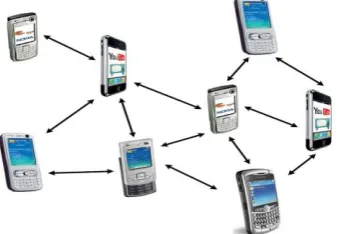
the presence of intrusion and attacks. Figure 1
represents communication between the nodes in
MANET environment.
52
Fig. 1 Mobile Ad hoc Network
Routing is essential service for end-to-end
communication in MANET, attacks on routing
protocol disrupt the reliability and performance of
MANET. It can be divided into two categories, first
is routing disruption attack which the attacker trying
to change the course of packets. Second resource
consumption attack, the attacker inserts packet into
the network to consume resources [2]. Attacks on
MANET are classified as Active and Passive attacks
[3], passive attacks are not dangerous if the
delivering data is important than its security, because
it does not affects the normal operation of MANET,
while active attacks affecting the normal operation
of MANET In several ways. This survey focusing on
initiatives which make MANET survives against
active attacks. Malicious node causes packet
dropping, false routing and etc. Effects of malicious
nodes are given below:
• Malicious node reduces the network
connectivity in MANETs.
• The result is defragmented networks,
isolated nodes, and drastically reduced
network performance.
• No intention for bandwidth utilization. • Launch all kinds of attacks replaying,
reordering or/and dropping packets from
time to time, and even by sending fake
routing messages but their attack
mechanisms are different.
II.ROUTING IN MANET
According to how the information is acquired, the
routing protocols can be classified into proactive,
reactive and hybrid routing [4, 5].
A. Proactive (table-driven) Routing Protocol
The proactive routing is also known as table-driven
routing protocol. In this routing protocol, mobile
nodes periodically broadcast their routing
information to the neighbor’s nodes. Each node
needs to maintain their routing table of not only
adjacent nodes and reachable nodes but also the
number of hops. Therefore, the disadvantage is the
rise of overhead due to increase in network size, a
significant big communication overhead within a
larger network topology. However, the major
advantage is of knowing the network status
immediately if any malicious attacker joins. The
most familiar types of the proactive routing protocol
are: - Destination sequenced distance vector (DSDV)
routing protocol and Optimized link state routing
(OLSR) protocol.
B.Reactive (on-demand) Routing Protocol
The reactive routing protocol is equipped with
another appellation named on-demand routing
protocol. In compare to the proactive routing, the
reactive routing is simply starts when nodes desire to
transmit data packets. The major advantage is the
reduction of the wasted bandwidth induced from the
cyclically broadcast. The disadvantage of reactive
routing protocol method is loss of some packet. Here
we briefly describe two prevalent on-demand routing
protocols which are: - Ad hoc on-demand distance
vector (AODV) and Dynamic source routing (DSR)
53
C.Hybrid Routing Protocol
The hybrid routing protocol as the name suggests
have the combine advantages of proactive routing
and reactive routing to overcome the defects
generated from both the protocol when used
separately. Design of hybrid routing protocols are
mostly as hierarchical or layered network
framework. In this system initially, proactive routing
is employed to collect unfamiliar routing
information, and then at later stage reactive routing
is used to maintain the routing information when
network topology changes. The familiar hybrid
routing protocols are: - Zone routing protocol (ZRP)
III.LITERATURE SURVEY
The attackers are degrades the network
performance at different layers. In this survey we
focus on the misbehavior of Sybil attack in MANET.
Authors (Sohail Abbas, Madjid Merabti, David
Llewellyn-Jones, and Kashif Kifayat) [6]
“Lightweight Sybil Attack Detection in MANETs”
in this title we discuss a lightweight scheme to detect
the new identities of Sybil attackers without using
centralized trusted third party or any extra hardware,
such as directional antennae or a geographical
positioning system. Through the help of extensive
simulations and real-world test bed experiments, we
are able to demonstrate that our proposed scheme
detects Sybil identities with good accuracy even in
the presence of mobility.
Author (Nitish Balachandran) [7] “A Review of
Techniques to Mitigate Sybil Attacks” In this title,
we discuss the different kinds of Sybil attacks
including those occurring in peer-to-peer reputation
systems, self-organizing networks and even social
network systems. In addition, various methods that
have been suggested over time to decrease or
eliminate their risk completely are also analyzed
along with their modus operandi.
Authors (Chris Piro Clay Shields Brian Neil Levine)
[8] “Detecting the Sybil Attack in Mobile Ad hoc Networks” In this title, we show that mobility can be
used to enhance security. Specifically, we show that
nodes that passively monitor traffic in the network
can detect a Sybil attacker that uses a number of
network identities simultaneously. We show through
simulation that this detection can be done by a single
node, or that multiple trusted nodes can join to
improve the accuracy of detection. We then show
that although the detection mechanism will falsely
identify groups of nodes travelling together as a
Sybil attacker, we can extend the protocol to monitor
collisions at the MAC level to differentiate between
a single attacker spoofing many addresses and a
group of nodes travelling in close proximity.
Authors (Sarosh Hashmi, John Brooke) [9]
“Towards Sybil Resistant Authentication in Mobile Ad hoc Networks” In this tile we present an
authentication mechanism for MANETs that utilizes
hardware id of the device of each node for
authentication. An authentication agent is developed
that verifies the hardware id of the authenticate node.
A comprehensive defense model is employed to
protect the authentication agent from various static
and dynamic attacks from a potentially malicious
authenticate node. Security of authenticate node is
assured by involving a TTP that signs the
authentication agent, verifying that it will perform
only intended function and is safe to execute. With
this minimal involvement of the TTP, the proposed
authentication scheme offers increased resistance to
the Sybil attack. The attacker is now required to
54
acquire multiple devices with different hardware ids,
in order to gain multiple identities.
Authors (Mohamed Salah Bouassida, Gilles Guette,
Mohamed Shawky, and Bertrand Ducourthial) [10]
“Sybil Nodes Detection Based on Received Signal Strength Variations within VANET” We present in
this context a Sybil detection approach, based on
received signal strength variations, allowing a node
to verify the authenticity of other communicating
nodes, according to their localizations. In addition,
we demean estimated metric of the distinguish
ability degree between two nodes, allowing to
determine Sybil and malicious ones within VANET.
The applicability of our contributions is validated
through geometrical analysis, simulations and real
measurements.
Authors (James Newsome, Elaine Shi, Dawn Song,
Adrian Perrig) [11] “The Sybil Attack in Sensor
Networks: Analysis & Defenses” This title
systematically analyzes the threat posed by the Sybil
attack to wireless sensor networks. We demonstrate
that the attack can be exceedingly detrimental to
many important functions of the sensor network
such as routing, resource allocation, misbehavior
detection, etc. We establish a classification of
different types of the Sybil attack, which enables us
to better understand the threats posed by each type,
and better design countermeasures against each type.
We then propose several novel techniques to defend
against the Sybil attack, and analyze their
electiveness quantitatively.
IV.PROPOSED WORK
The problem of multiple identities is degrades
network performance by that we focus on to detect
Sybil attack and protect against that attack, so first
we deploy Sybil attack scenario in two ways same
time more identification and scenario -2 different
time different identification and both case we deploy
reputation-based protector system. In our Sybil
attack scheme, we will consider both types of Sybil
attacks. The strategy of our detection mechanism is
to detect every new identity created by a Sybil
attacker; it does not matter if the intention of the
attacker is to use that identity for whitewashing or
simultaneous Sybil attacks. Hence, in this thesis, we
will refer to the new Sybil identity and whitewash
identity where they completion of data receives or
simulation end. We assume that the attacker joins
the network with its single identity, and that
malicious nodes do not collide with one another. We
also assume that nodes do not increase or decrease
their transmit power. The attackers can get identities
by two ways. First, they can fabricate identities
(Second, they can use stolen identities, i.e., spoof the
identities of legitimate nodes (masquerading) in the
network. We assume the first case where nodes can
create arbitrary identifiers because in MANETs,
there are no restrictions on identity creation. After
attack module we generate profile table during
simulation and apply IP header checking base
technique through abstract window tool kit and
detect misleading node and number of packet
captured by the Sybil attacker node in both scenario.
And lastly we design reputation-based, protection
system in that system check all neighbour node IP
address and if any node adversely sends different
identification into more than two different sender so
protector nodes is identify that particular node and
more than one protector node collaboratively make
decision for blocking that path and true information
all sender node so they cannot sends any data
55
A.Proposed algorithm
The Here we define algorithm for how the Sybil
attack spread onto the network, basically according
to definition number of different way Sybil attack
spread into the network There are two flavours of
Sybil attacks. In the first one, an attacker creates new
identity while discarding its previously created one;
hence only one identity of the attacker is up at a time
in the network. This is also called a join-and-leave or
whitewashing attack and the motivation is to
clean-out any wrong history of malicious activities. This
attack potentially promotes lack of accountability in
the network. In the second type of Sybil attack, an
attacker concurrently uses all its identities for an
attack, called simultaneous Sybil attack and defines
through algorithm bases very first we set normal
ad-hoc network parameter and set criteria of Sybil
attack scheme and spread attack onto the network.
Number of Nodes = MN; // Mobile Nodes
Number of Sender Nodes = Sn; // Sn € MN ;
Destination Nodes = Dn; // D € MN;
Routing Protocol Considered = Reactive (AODV);
Set Simulation Time = Tt // taken Tt= 100
Set Radio Range = RR of MN; // Initialize Nodes Radio
Range
Set Sybil Attcaker = Sn;
Sn_RREQ_B ( D, RR ) // broadcast RREQ for nodes that
are in range.
{
If ((RR<=550) && (next hop >0))
{
Forward Route Request;
{
rtable->insert(rtable->rt_nexthop); // nexthop to RREQ
source
if (next_hop = = destination )
{
Store minimum next_hop(S,next_hop,D)
Minimum_hop_rtable=rtable; //RREP Sends via
shortest link//
}
Else
{
Send ACK to source Si by Dn node entered in rtable1;
Data_packet_send (s_no, nexthop, type)
}
else
{
Destination not found;
}
}
}
Attacker Detection and Prevention
{ // Sybil Node spread route misbehaver module ;
Set Sybil node = Sn; // Sn Sybil Attacker Node
If (Sn in radio range && active)
{
Update routing Table;
Set Dn_id = Self_id (SAn);
// Mis identification
Increase Hop count++;
Send SAn certainly RREP to Sn;
}
Data_packet_send (s_no, nexthop, type)
{
if (Data forwarding from SAn == Pessimistic)
{
Capture data SAn;
Block that particular SAn nodes;
}
Else
{
forwarded data packets no attacker exist
}
}
else {
destination un-reachable ;
}
}
56
V.SIMULATION ENVIRONMENT AND
RESULT DISCUSSION
Network simulator 2 (NS2) is the result of an
on-going effort of research and development that is
administrated by researchers at Berkeley [12]. It is a
discrete event simulator targeted at networking
research. It provides substantial support for
simulation of TCP, routing, and multipath protocol.
The simulator is written in C++ and a script
language called OTCL2. Ns use an OTCL interpreter
towards the user. This means that the user writes an
OTCL script that defines the network (number of
nodes, links), the traffic in the network (sources,
destinations, type of traffic) and which protocols it
will use. This script is then used by ns during the
simulations. The result of the simulations is an
output trace file that can be used to do data
processing (calculate delay, throughput etc) and to
visualize the simulation with a program called
Network Animator.
A.Simulation Parameters
The some simulation parameters mentioned in
table1. These parameters are also change based on
requirement so, this table only gives the estimation
of it.
Table -1 simulation parameters
Number of nodes 30
Dimension of simulated area 800×800
Routing Protocol AODV
Simulation time (seconds) 100
Attack Module Sybil Attack
Transport Layer TCP ,FTP
Antenna Type Omni Antenna
Traffic type CBR,FTP
Packet size (bytes) 1000
Number of traffic connections 10
Maximum Speed (m/s) Random
B.Performance Evaluation
There are following different performance metrics
[4] has been considered to make the
comparative study of these routing protocols through
simulation.
1) Infection Rate: Rate of infection in network
w. r. t time.
2) Routing overhead: This metric describes
how many routing packets for route
discovery and route maintenance need to be
sent to propagate the data packets.
3) Average Delay: This metric represents
average end-to-end delay and indicates how
long it took a packet to travel from the
source to the application layer of the
destination. It is measuring in mille seconds.
4) Throughput: This metric represents the
total number of bits forwarded to higher
layers per second.
5) Packet Delivery Ratio: The ratio between
the amount of incoming data packets and
actually received data packets.
C.Packet Delivery Ratio
The Packet delivery ratio is very important
parameter for data analysis in network
communication because that parameter gives the
information about percentage of data receiver by the
receiver out of actual data packet sends by the
sender, here we analyze that packet delivery value
and evaluated in normal network as well as in Sybil
attack scenario and proposed protection system. The
percentage of data receives is nearly 9 to 92 percent
up to end of simulation in normal routing and
57
but Sybil attack1 and Sybil attack2 has shows the
performance degradation in the whole network.
The PDR performance in presence of attacker is in
scenario reaches from 23% to1% is negligible mark
but reaches to 55 % at the start of Sybil attacker 2.
The performance of scenario-2 is also same
maintain3ed at 10 % as one except the end time
simulation performance.
Fig.2 PDR Analysis
D.Routing Load Analysis
The sender is flooding the packets in network for
finding the destination. Every node in network is
forwarded the routing packets in network till the
destination is not found. In this graph we analyze
our routing overhead in case of normal time, attacker
and security scheme but both Sybil attack scenario
routing overhead is lower because if sender search
actual receiver and same time any nearby of Sybil
attacker is present that certainly gives the
misidentification number of receiver and route reply
message send to sender by receiver. In that case
actual sender cannot search any of the paths and
actual data packets are dropped by attacker. The
routing packets in normal and proposed security
scheme are high but data receiving is also high with
minimum overhead.
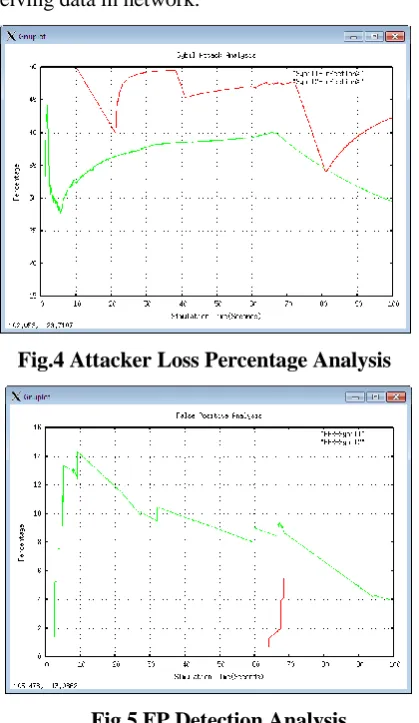
E.Attack Data Loss Percentage
The attacker in network is degrading the whole
routing performance by that the network
performance is drastic effected. Sybil attack is very
big challenge in MANET environment because
trustiness is very essential requirement for Ad hoc
network, without the trust we cannot search actual
receiver node, and that situation if any node spread
Sybil attack our all data receives by mislead node, in
that graph we shows two different situation and
analyze the data receives percentage by the
unauthorized user, in scenario-1 if different time
node gives different identification and scenario-2
same time gives more than two identification and
found both case about 50% and 40% data receives
by malicious nodes.
Fig.3 Routing Packets Analysis
F.False Positive Detection
False positive it means wrong detection, where node
is normal but behaves like abnormal or attacker,
while false positive is greater it means detection
mechanism not correctly identifies or separate
between the attacker or normal nodes. In this graph
shows that false positive analysis in both Sybil
attacker scenario and identifies that scene 2 case
initial time 7% normal node treat like attacker
58
average case nearly 6% and the scene1 Sybil case
nearly 2% till the 75 seconds and after that the
percentage is 65, here false positive value is less
than 10% so that is considerable for detection
process.
G.True Positive Detection
In the Sybil attack scenario, attacker node is gives
false identification for gaining network resources
and data from sender nodes. True positive is a
mechanism to positively detection (node really
misbehave and identifies them) of attacker nodes
with the help of available information of sending and
receiving data in network.
Fig.4 Attacker Loss Percentage Analysis
Fig.5 FP Detection Analysis
In this graph shows that Sybil attack in the network
in same time as well as different time and analyze
that both Sybil scenarios greater than 80 percentage
of truly attacker detected.
Fig. 6 TP Detection Analysis
VI.CONCLUSION & FUTURE SCOPE
Mobile Ad hoc Network (MANET) are liable from
routing attacks due absence of centralized
monitoring and management, so it is crucial to
protect them. Sybil attack, an attacker node behaves
as if it were a group of nodes by showing multiple
Identities in network. There are, basically two ways
by which a Sybil attacker node/s can be possible to
get an identity of other nodes i.e. by abducting other
normal node’s identity and creating false identities
itself. In this research we use the second way to
identify the Sybil attacker in network. Routing
protocol independent attacks are not prone to occur
for specific routing protocol this attack can take
place irrespective of the routing protocol. The
routing protocol dependent attacker identification is
basically limited and for other routing protocol
identification is not possible. The main advantage of
proposed security scheme is it is protocol
independent .The proposed security mechanism is
identified the false identity information of attacker
and improves the routing performance of network in
presence of attacker. The security mechanism
improves the throughput, PDF, FPR and reduces
routing load, packet dropping, reduces TPR value in
59
security mechanism completely removes malicious
drop percentage that confirms the no attacker
existence of attacker contamination and provides
attacker free secure routing in MANET. The future
scope of this research is to identify the other attacker
like wormhole attack and remapping attack on the
basis of attacker identification and also try to work
on the dynamic topology control system. In This
scheme we observe higher mobility of mobile nodes
and forward the message to control their mobility to
reduce the chances of link in network and the second
option is to try to ignore that nodes selection in
routing.
REFERENCES
[1] Macro Conti, Silvia Giordano and Ivan
Stojmenovi “Mobile Ad Hoc Networks”,
Stefano Basagni, IEEE press, A john Wily &
Sons, INC. publication, 2003
[2] A.K. Rai, R. R. Tewari and S. K. Upadhyay,
“Different Types of Attacks on Integrated
MANET-Internet Communication,”
International Journal of Computer Science and
Security, Vol. 4, No. 3, 2010, pp. 265-274.
[3] B. Wu, J. M. Chen, J. Wu and M. Cardei, “A
Survey on Attacks and Countermeasures in
Mobile Ad Hoc Networks,” Wireless/Mobile
Network Security, Springer, Berlin, pp.
103-135, 2007.
[4] Sunil Taneja and Ashwani Kush “A Survey of
Routing Protocols in Mobile Ad Hoc
Networks”, International Journal of Innovation,
Management and Technology, Vol. 1, No. 3, pp.
279-285, August 2010.
[5] Ipsita Panda “A Survey on Routing Protocols of
MANETs by Using QoS Metrics” International
Journal of Advanced Research in Computer
Science and Software Engineering, Volume 2,
Issue 10, pp. 121-129, 2012
[6] Sohail Abbas, Madjid Merabti, David
Llewellyn-Jones, and Kashif Kifayat
“Lightweight Sybil Attack Detection in Manets”
IEEE Systems Journal, Vol. 7, No. 2, June
2013.
[7] Nitish Balachandran “A Review of Techniques
to Mitigate Sybil Attacks” Int. J. Advanced
Networking and Applications 11 July 2012.
[8] Chris Piro Clay Shields Brian Neil Levine
“Detecting the Sybil Attack in Mobile Ad hoc Networks” NSF grants 0133055,
CNS-0534618, and CNS-0087639.
[9] Sarosh Hashmi, John Brooke, “Towards Sybil
Resistant Authentication in Mobile Ad hoc
Networks” 2010 Fourth International
Conference on Emerging Security Information,
Systems and Technologies.
[10] Mohamed Salah Bouassida, Gilles Guette,
Mohamed Shawky, and Bertrand Ducourthial
“Sybil Nodes Detection Based on Received Signal Strength Variations within VANET”
International Journal of Network Security,
Vol.9, No.1, PP.22-33, July 2009.
[11] James Newsome, Elaine Shi, Dawn Song,
Adrian Perrig, “The Sybil Attack in Sensor Networks: Analysis & Defenses” IPSN’04,
April 26–27, 2004, Berkeley, California, USA.