471
TECHNICAL ISSUES EVALUATED ON GRID AND OFF GRID PV SYSTEM
1Ritesh Tirole,
2R. R. Joshi
PhD Research Scholar, 2Professor & Head Electrical Engineering, CTAE, Udaipur, India
1
[email protected]
Abstract: - This work aims to investigate and emphasize the importance of the grid-connected PV system regarding the intermittent nature of renewable generation, and the characterization of PV generation with regard to grid code compliance. The technical requirements from the utility power system side need to be satisfied to ensure the safety of the PV installer and the reliability of the utility grid. Identifying the technical requirements for grid interconnection and solving the interconnect problems such as islanding detection, harmonic distortion requirements and electromagnetic interference are therefore very important issues for widespread application of PV systems. In this paper is discussed the importance of analysis for electromagnetic compatibility of the photovoltaic generation systems components. A review of the existing and future standards that addresses the technical challenges associated with the growing number of grid Connected Photovoltaic systems presented.
Keywords: - Grid, Photovoltaic system, electromagnetic interference.
1. INTRODUCTION
By the increasing growth in the population of the world, the demand for new energy sources is significantly increasing. Today, fossil fuel resources are the major energy sources used for generating electricity. These resources include petroleum, natural gas, coal, etc. [1], which also result in serious environmental pollution and contribute to global warming by releasing the harmful carbon dioxide into the atmosphere. In addition, such resources are non-renewable limited energy sources that cannot fulfill the ever increasing demand for energy. Renewable sources of energy such as biomass, wave energy, wind power, hydroelectricity, and solar power could be alternative sources to replace fossil energy resources. Renewable resources provided for about 18% of global energy consumption in 2006 [2]. Wind power is currently widely used in the United States and Europe. It is installed capacity
present, the main PV-powered products include solar street, traffic signal, garden and lawn lamps, calculators and solar toys etc. China has become the largest producer of PV-powered products in the world. The annual usage of solar cells for these products has reached 20MWp and there is a great deal of exportation [7]. With so many additional functions being allocated to the inverter, the inverter becomes ever more critical to the system function, and the reliability of current technology inverters becomes a significant issue of concern. This investigation aims to emphasize the importance of the grid-connected PV system regarding the intermittent nature of renewable generation, and the characterization of PV generation with regard to grid code compliance. Also, will focus on the technical requirements for grid interconnection and solving the interconnect problems such as islanding detection, harmonic distortion requirements and electromagnetic interference.
2. GRID-CONNECTED PV SYSTEMS
Grid-connected PV systems include building integrated PV (BIPV) systems and terrestrial PV systems (including PV power plants in saline-alkali land, tideland and desert). At the scale of the entire interconnected electric power grid, generated electric power must be consumed within milliseconds of being generated. Excess power can be accumulated with energy storage systems such as pumped hydro, but conventional energy storage systems respond much more slowly than the load changes so throttling back on peaking generation is used to stabilize the power flow into and out of the grid. In addition, when the load on the utility grid reaches new peak levels, the system operators must start activating every available generating source and even minor throttling back of generation may cause the grid voltage to collapse.
2.1. Photovoltaic device
Several energy sources are available for energy conversion systems, including batteries, PV devices, fuel cells and wind generators. Each energy source is connected to its inverter through a specific integration technique; sometimes, additional devices and extra steps may also be needed. For instance, a wind turbine generator needs an extra AC/DC converter (e.g. rectifier) to connect to an inverter [8], since it generates an AC instead of a DC current. On the contrary, a PV panel creates DC
power; thus, it can be linked to the inverter directly or through a DC/DC converter. Favorably, this will decrease the total cost [9]. Essentially, a PV cell has a semiconductor P-N junction diode cell that directly transforms light into electricity. When sunlight hits common junctions of a P-N diode, comprising of photons, the electron system of the material absorbs the energy and produces electron-hole pairs (charge carriers). These are detached by the potential wall, generating a voltage that uses an external circuit to drive a current through, known as the photovoltaic effect. Different cell arrangements, such as series-parallel, parallel and series create a PV module that has a specific power capacity [10]. Likewise, modules are linked in series-parallel arrangement to gain higher power capacity and make a panel or array. The solar cell’s output voltage is function of the photocurrent that is contingent on the level of solar irradiation throughout the process. Shortcomings of a PV device include low energy conversion efficiency and high cost of initial-installation. The control system has an important role in a PV system that uses power converters, such as DC/DC converters and DC/AC inverters to safeguard the system’s overall operation [11].
2.2. DC/DC power converter
DC/DC power converters are employed in PV systems to change the output voltage. Normally, a DC/DC converter is sequentially inserted between the load and the PV panel to gain the power available from the panel through tracking methods. It is useful for a PV system with unstable and fluctuating output. If the PV system uses both AC and DC converters, a DC-link capacitor can enhance the DC output voltage stability, and therefore, reduce the effect of fluctuation on the AC output [12]. DC converters may be boost converters (step-up), buck converters (step-down), or a combination of both, like CUK converters and buck-boost converters.
2.3. DC/AC inverter
3. DESIGN OF GRID-TIED PV INVERTER
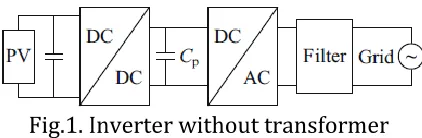
The inverter in the grid-tied PV system acts as an interface between energy sources: the utility grid on one side and the PV module on the other. As the inverter transforms DC power into AC power, it is in control of power quality that should be met as required by different standards. Based on the galvanic isolation between the grid and the PV module, the grid-tied PV inverters are grouped into isolated and non-isolated types. A high frequency transformer or a line frequency transformer can be used to observe the galvanic isolation that adjusts DC voltage of the converter [14]. Usually, this galvanic isolation is realized through a transformer that has a great effect on DC/AC efficiency of grid-connected PV systems. In a grid grid-connected PV system, the existence of galvanic isolation depends on the regulations of each country. In countries, such as Italy and UK, it is a requirement and is implemented either by a high-frequency transformer on the DC side or by a low-frequency step-up transformer on the grid side, as shown in Fig. 1. Due to weight, size and cost problems, line frequency transformers are usually preferred to be removed when designing a new converter. Moreover, a high-frequency transformer requires numerous power stages, which makes it difficult to increase efficiency and reduce the costs [15].
Fig.1. Inverter without transformer
Figure 2 & 3, depicts a typical transformer-less PV system, which decreases installation complexity, weight cost and size of the whole system. One drawback of these systems is that DC currents may be produced in the injected AC current by the inverter because of the missing line-frequency transformer, causing overheating and failure [16]. One of the advantages of these systems is 2%increase in the total efficiency [17].
Fig.2. Grid connected PV system with high
frequency transformer
Fig.3. Grid connected PV system with low
frequency transformer
4. IMPACTS OF GRID-CONNECTED PV SYSTEM ON ELECTRICAL NETWORKS
The photovoltaics systems can also impose several negative impacts on electrical networks, especially if their penetration level is high. These impacts are dependent on the size as well as the location of the photovoltaics system.
4.1 Reverse power flow
In distribution system, the power flow is usually unidirectional from the medium voltage system to the low voltage system. However, at a high penetration level of photovoltaics systems, there are moments when the net production is more than the net demand, especially at noon, and as a result, the direction of power flow is reversed, and power flows from the low voltage side to the medium voltage side.
4.2 Electromagnetic interference problem
The high switching frequency of Photovoltaic system inverters may result in electromagnetic interference with neighboring circuits such as capacitor banks, protection devices, converters, and DC links leading to mal-function of these devices [18].
4.3 Power losses
Distributed Generation (DG) systems in general reduce system losses as they bring generation closer to the load. This assumption is true until reverse power flow starts to occur. A study showed that distribution system losses reach a minimum value at a penetration level of approximately 5%, but as the penetration level increases, the losses also increase and may exceed the no-DG system case [19].
4.4 Voltage control difficulty
and voltage regulators are designed to operate in a system with unidirectional power flow [20].
4.5 Phase unbalance
Inverters used in small residential photovoltaic system installations are mostly single phase inverters. If these inverters are not distributed evenly among different phases, phase unbalance may take place shifting the neutral voltage to unsafe values and increasing the voltage unbalance [21].
4.6 Power quality problems
Power quality issues are one of the major impacts of high photovoltaics penetration level on distribution networks; power inverters used to interface PV arrays to power grids are producing harmonic currents; thus, they may increase the total harmonic distortion of both voltage and currents at the point of common coupling. However, voltage harmonics are usually within limits if the networks stiff enough with low equivalent series impedance.
4.7 Increased reactive power
Photovoltaics system inverters normally operate at unity power factor for two reasons. The first reason is that current standards, according to IEEE 929-2000, do not allow Photovoltaics system inverters to operate in the voltage regulation mode. The second reason is that owners of small residential PV systems in the incentive-programs are revenue only for their kilowatt-hour yield, not for their kilovolt-ampere hour production.
4.8 Overvoltage along distribution feeders
Reverse power flow leads to overvoltage along distribution feeders. Voltage regulators and capacitor banks used to boost voltage slightly can now push the voltage further; above the acceptable limits. Voltage rise on MV networks is often a constraining factor for the wide spread adoption of wind turbines. Voltage rise in LV networks may impose a similar constraint on the installation of PV systems.
5. CONCLUSIONS
Following conclusions and recommendation, we observed in the study of literature. Balanced conditions occur very rarely for low, medium and high penetration levels of PV systems. The probability that balanced conditions are present in the power network and that the power network is disconnected at that exact time is virtually zero.
Islanding is therefore not a technical barrier for the large-scale deployment of PV system in residential areas. The penetration level of PV systems does not significantly influence how often and for how long balanced conditions between the load and the PV systems occurs. Balanced conditions between active and reactive load and the power generated by the PV systems do occur very rarely for low, medium and even high penetration levels of PV systems. The probability of a balanced condition does not depend on the number of houses connected to a feeder. The probability of encountering an island is virtually zero. It was found that failure in inverter is the most frequent incidents. This is mostly caused by the lack of experience in first production stage and newly designed inverters have good reliability. Some unexplained inverter failure might be caused by disturbance from grid, reclosing, and other interconnecting issues. Distributed generation is an emerging technology that has the potential to offer improvements in power system efficiency, reliability and diversity, and to help contribute to making renewable a greater percentage of the generation mix. While a great amount of knowledge has been gained through past experience, the practical implementation of distributed generation (DG) has proved to be more challenging than perhaps originally anticipated. Passive methods for detecting an islanding condition basically monitor selected parameters such as voltage and frequency and/or their characteristics and cause the inverter to cease converting power when there is sufficient transition from normal specified conditions. The effects on harmonics in case of multiple PV systems operation need further investigation.
REFERENCES
[1]. Demirbas A, “Global renewable energy projections”. Energy Sources Part B Econ Plan Policy 4(2):pp.212–224, 2009.
[2]. Fulekar MH, “Environmental biotechnology”. CRC Press, Boca Raton, 2010.
[3]. Kamalasadan S, Al-Olimat KS, “Modeling and control of a micro-grid set up using photovoltaic arrays”. In: Proceedings of 45th southeastern symposium on system theory, Waco, USA, pp.1-8, 11 March 2013.
society summer meeting, Seattle, USA, pp.16– 20, July 2000.
[5]. Schaefer JC, “Review of photovoltaic power plant performance and economics”. IEEE Trans Energy Convers 5(2):232–238, 2009.
[6]. Ishikawa T. Grid-connected photovoltaic power systems: survey of inverter and related protection equipment’s. Report IEA (International Energy Agency) PVPS T5-05; 2002.
[7]. Zhao Y, Wang S, Li X, Wang W, Liu Z, Song S. China renewable energy development project. Report on the development of the photovoltaic industry in China. NDRC/GEF/WB, August; 2006.
[8]. Coelho RF, Schmitz L, Martins DC (2011) Grid-connected PV wind-fuel cell hybrid system employing a super capacitor bank as storage device to supply a critical DC load. In: Proceedings of IEEE 33rd international telecommunications energy conference (INTELEC), Amsterdam, Netherlands, pp. 9–13, Oct 2011.
[9]. Molina MG, Mercado PE, “A new control strategy of variable speed wind turbine generator for three-phase grid connected applications”, IEEE/PES transmission and distribution conference and exposition, pp.13-15, 2008. [10]. Geoffrey PCS, Walker R, “Cascaded DC–DC
converter connection of photovoltaic modules. IEEE Trans Power Electron19 (4):pp.1130– 1139, 2004.
[11]. Amrani AE, Mahrane A, Moussa FY, “Solar module fabrication. Int J Photoenergypp.136– 151, 2007.
[12]. Liu X, Wang P, Loh PC optimal coordination control for stand-alone PV system with nonlinear load. In: Proceedings of 9th international power and energy conference, Singapore, 27–29 Oct 2010.
[13]. Haeberlin H., “Evolution of inverters for grid connected PV-systems” Proceedings of 17thEuropean photovoltaic solar energy conference, Munich, Germany, 22–26 October 2001.
[14]. Islam M, Mekhilef S, “High efficiency transformer less MOSFET inverter for grid-tied photovoltaic system. In: Proceedings of IEEE applied power electronics conference and exposition (APEC), Fort Worth, USA, 16–20 March 2014.
[15]. Mekhilef S, Omar AM, Muhammad KS, “An improved topology of digitally-controlled single-phase single-stage high DC voltage converter”, In: Proceedings of IEEE power electronics specialist’s conference, Jeju, South Korea, 18–22 June 2006.
[16]. Gertmar L, Karlsson P, Samuelsson O, “On DC injection to AC grids from distributed generation. In: Proceedings of European conference on power electronics and applications, Dresden, Germany, 11–14 Sept 2005.
[17]. Gu B, Dominic J, Lai JS, “High reliability and efficiency single-phase transformer less inverter for grid-connected photovoltaic systems. IEEE Trans Power Electron28 (5):2235–2245, 2013.
[18]. Cobben S., B. Gaiddon and H. Laukamp. “Impact of photovoltaic generation on power quality in urban areas with high PV population”, 2008. [19]. MillerN. And Z. Ye. “Distributed generation
penetration study. National Renewable Energy Laboratory, 2003.
[20]. Whitaker C., New miller J., M. Ropp, and Norris B.2008. Distributed photovoltaic systems design and technology requirements. Sandia Laboratories.