DOI: 10.30954/0974-1712.04.2018.18
©2018New Delhi Publishers. All rights reserved
Resource Use Efficiency of Crops in North-Eastern Dry Zone of
Karnataka
G.V. Rohith*, Jaganath Olekar, K.S. Rashmi and P.S. Dhananjaya Swamy
Department of Agricultural Economics, University of Agricultural Sciences, Bengaluru-5600 65, Karnataka, India *Corresponding author: [email protected] (ORCID ID: 0000-0003-0978-6049)Paper No. 689 Received: 19-11-2017 Accepted: 21-03-2018
ABSTRACT
This study is to analyze the extent of efficiency in resource use of major crops cultivated in North-Eastern Dry Zone (NEDZ) of Karnataka. The study was conducted by selecting 30 farmers each under rainfed condition, borewell irrigation and canal irrigation in Manvi and Raichur taluks of Raichur district in NEDZ of Karnataka. The resource use efficiency of crops was estimated using Cobb- Douglas production function. The result shows that the ratio of MVP to MFC was away from one, in most of the crops highlighting the inefficiency in resource use. Resources were not economic optimally utilized in most of the crops. There is great scope for use of human labour (MVP to MFC ratio was 2.13) and nitrogen (10.39) in rainfed cotton, human labour (1.79) and groundwater (8.93) irrigation in cotton crop irrigated with groundwater. The human labour (0.945) was optimally utilized and there is great scope to use of machine labour (8.57) in canal paddy. There is scope for use of human labour (2.09), bullock labour (3.28), machine labour (4.44), nitrogen (0.29) and capital cost (2.51) in rainfed redgram.
Highlights
mThe ratio of MVP to MFC was differed from unity in all major crops, indicating scope for reallocation of expenditure among various resources.
mAmong the different inputs, machine labour has the grater scope for its enhanced usage to augment the output and substantial use of groundwater will enhance productivity of the crops.
Keywords: Resource use efficiency, Cobb-Douglas production function, MVP to MFC ratio
The extent of economic inefficiencies differs depending upon the crop, region, farmers, access to irrigation and other factors. There are no compelling reasons to accept that prima facie there is efficiency across all farmers and all crops. The cropping pattern of study area was influenced by factors such as rainfall, climate, soil conditions, subsidized inputs and other market distortions and also growing demand of the food for rural and urban people.
This is resulting in over utilization /under utilization of resources, which in-turn is adversely affecting long term food production prospects of the region. Currently the efficiency analysis is under the limelight and is imperative factor to enhance the crop productivity without increase the resource base.
Meanwhile the estimation of extent of inefficiency helps to understand the criticality of resources, mean through increasing the farm productivity, it improves the economic condition of the farmers. Consequently, this study is aimed at exploring the resources use efficiency for profitability of crops in Karnataka in general and in North-Eastern Dry Zone of Karnataka in particular.
METHODOLOGY
The study to analyze the resource use efficiency of major crops was carried out in Manvi and Raichur taluks of Raichur district in North-Eastern Dry Zone (NEDZ) of Karnataka. Random sampling technique was employed in the selection of 90 farmers for the study i.e., 30 rainfed farmers, 30 farmers who are
using groundwater and 30 farmers who are using canal irrigation.
Analytical tools
Cobb-Douglas production function
The resource use efficiency in cotton (both rainfed & bore well condition), paddy (canal), redgram (rainfed) were estimated by fitting the Cobb-Douglas production function to the farm level data. The specification of the equation as follows:
Y = a X1bl X
2b2 X3b3 X4b4 X5b5 eu …(1) where,
Y = Output per farm (quintals) X1 = Human labour (man days)
X2 = Nitrogen (kgs) in cotton production under rainfed, bullock labour (pair days) in borewell irrigated paddy and rainfed redgram
X3 = Water (per acre inch) for borewell irrigated cotton, machine labour (`) in paddy with canal irrigation and rainfed redgram cultivation X4 = Capital cost (`) in canal irrigated paddy, nitrogen (kgs) in paddy with canal irrigation, rainfed redgram cultivation
X5 = Fertilizers (kgs) in canal irrigated paddy, capital cost (`) in rainfed redgram cultivation a = Constant
u = Random variable
b1 to b4 elasticity coefficients of respective inputs.
The equation (3) was converted into the logarithmic form and estimated as under:
log Y = log a+ b1 log X1 + b2 log X2 + b3 log X3 + b4log X4 + b5 log X5 + u log e …(2)
The estimated coefficients were used to compute the MVP and its ratio (r) with MFC to determine the economic efficiency of resource used. The model was estimated as follows:
r = MVP/MFC …(3)
where, r = efficiency ratio;
MVP = marginal value product of variable inputs; MFC = marginal factor cost (price per unit inputs).
Marginal Value Productivity of Xi, the ith input is estimated by the following formula:
MVP = bi * . .
( )
( )
. . i G M Y
G M X …(4)
G.M. (Y) and G.M. (Xi) represent the geometric means of output and input respectively and bi is the regression co- efficient of ith input.
Based on economic theory, a firm maximizes profits with regards to resource use when the ratio of the marginal return to the opportunity cost is unity. The values are interpreted thus, if r is <1; resource is excessively used or over utilized hence decreasing the quantity use of resource increases profits. If r > 1; resource is under used or being underutilized hence increasing its rate of use will increase profit level. If r = 1; it shows the resource is efficiently used, that is optimum utilization of resource hence the point of profit maximization.
RESULTS AND DISCUSSION
In order to obtain the resource use efficiency of inputs used in cultivation of crops, Cobb-Douglas production functional analysis was performed for cotton grown under both rainfed & borewell , paddy under canal and redgram under rainfed situation.
Resource use efficiency in rainfed cotton
Resource use efficiency of cotton under bore
well situation
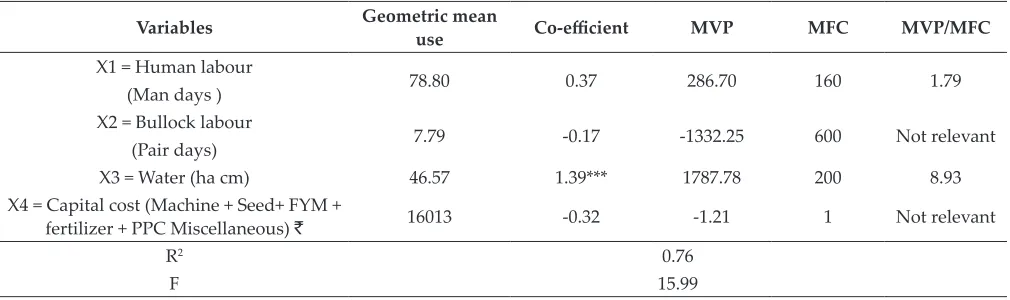
As in the previous the case, the Cobb Douglass production function was estimated from evaluating the resource use efficiency in the bore-well irrigated cotton cultivation and the results are furnished in the Table 2. Model adequacy was examined with the help of the coefficient of multiple determination (R2) (0.76) and the F value 15.99. The estimated Cobb Douglas function of the borewell irrigated cotton cultivation is as follows, cotton output per farm (LnY) = 0.43+0.37 (LnX1 )-0.17(Ln X2 ) +1.39 (LnX3) – 0.32(Ln X4), Where, Y= cotton output, X1= human labour (man days), X2=bullock labour pair days), X3=water (ha cm), X4=capital cost (machine + seed + farm yard manure+fertilizer + plant protection chemical + miscellaneous) in `.
The results of resource use efficiency in cotton showed that, the MVP to MFC ratio for human labour (man-days) is around 1.8, while it was 8.93 for water. The higher positive value of MVP to MFC ratio of water indicates that enhanced availability and utilization of water helps to attain the optimum
level of output in cotton cultivation in borewell condition. Further there is great scope to use higher volume of groundwater for cotton that the present level of 47 ha cm per farm (1.1 ha).
This indicates that the human labour use can be enhanced and similarly the groundwater use can be enhanced in order to obtain the optimal output since the MVP is more than MFC in both the inputs (Table 2).
Resource use efficiency in canal paddy
cultivation
The fitted model was found significant as the calculated F value is greater than the table F value for resource use efficiency of inputs used in the canal paddy production. Besides, variables used in the model explains about 93 per cent variation in the paddy production. The fitted model for the canal paddy function is depicted as follows. Paddy output per farm (LnY) = 0.036-0.010(LnX1) + 0.041(LnX2 )+ 0.731(LnX3 ) + 0.19(LnX4) -0.09(LnX5 ), Where, Y = cotton output, X1= human abour (man days), X2= bullock labour (pair days), X 3= machine
Table 1: Resource use efficiency in rainfed cotton cultivation in Raichur district (North-Eastern Dry Zone) of
Karnataka
Variables Geometric mean Co-efficient MVP MFC MVP/MFC
X1 = Human Labour (Man
days) 95.46 0.475* 344 160 2.15
X2 = Nitrogen (Kg) 106.25 0.370* 241 23.2 10.39
R2 0.50
F 22.80
Note: * significant @5%, Average farm area = 1.90 ha.
Table 2: Resource use efficiency of cotton production in bore-well situation in Raichur district (North-Eastern Dry
Zone) of Karnataka
Variables Geometric mean use Co-efficient MVP MFC MVP/MFC X1 = Human labour
(Man days ) 78.80 0.37 286.70 160 1.79
X2 = Bullock labour
(Pair days) 7.79 -0.17 -1332.25 600 Not relevant
X3 = Water (ha cm) 46.57 1.39*** 1787.78 200 8.93
X4 = Capital cost (Machine + Seed+ FYM +
fertilizer + PPC Miscellaneous) ` 16013 -0.32 -1.21 1 Not relevant
R2 0.76
F 15.99
labour (`), X4 = Capital cost (seed + plant protection chemicals + farm yard manure in (`) , X5 = fertilizer (`). The ratio of MVP to MFC is positive for bullock pair and is close to unity (0.94) indicating that the current level of bullock pair use is economically optimal and there in no scope for using additional use of bullock pair in the production. For machine labour the MVP/MFC ratio was as high as 8.57 which shows that still higher use of machine labour than at present is permissible in order to realize economically optimal output. Similarly, the MVP/ MFC for capital was `. 3.04 indicating the scope for increasing use of variable capital to realize optimal output of canal paddy (Table 3).
Resource use efficiency in rainfed redgram
cultivation
The estimated model was examined and it was
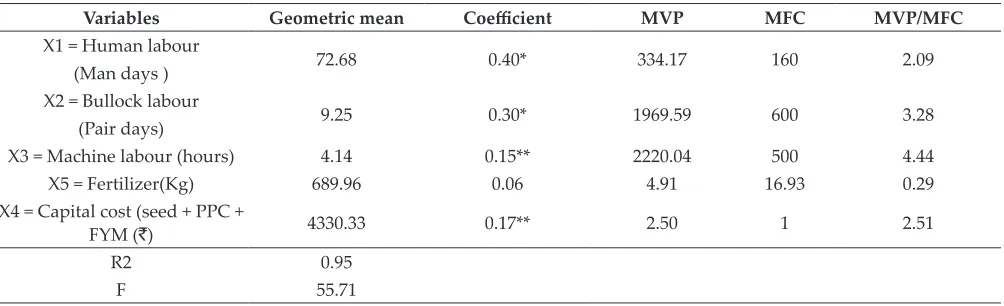
found significant for rainfed redgram cultivation. The coefficient of multiple determination (R2) was 0.95. The estimated Cobb Douglass model for the rainfed redgram cultivation is furnished below redgram output per farm Ln Y = 0.19+ 0.40(Ln X1) + 0.30(Ln X2) + 0.15 (Ln X3 + 0.06(LnX4) + 0.17(Ln X5), where,Y = cotton output, X1= human labour (man days), X2= bullock labour (pair days), X3= machine labour (hours), X4= fertilizer (Kg), X5= capital cost (`) (seed + plant protection chemicals + miscellaneous + farm yard manure) in `. The results of the production function analysis showed that, the positive influence of human labour, bullock labour, machine labour, fertilizer and capital used in the redgram production in rainfed situation. The ratio of MVP to MFC is positive for fertilizer and is close to unity (0.29) indicating that the current level of Fertilizer use is economically optimal and there in
Table 3: Resource use efficiency in canal paddy cultivation in Raichur district (North-Eastern Dry Zone) of
Karnataka
Variables Geometric mean Coefficient MVP MFC MVP/MFC
X1 = Human labour
(Man days) 109.14 -0.010 -0.008 160 Not relevant
X2 = Bullock labour
(Pair days) 10.23 0.041 567.17 600 0.945
X3 = Machine labour (`) 11921.76 0.731* 8.57 1 8.575
X4 = Capital cost (seed + PPC +
FYM (`) 9044.88 0.190* 3.04 1 3.040
X5 = Fertilizer (`) 11367.72 -0.09 -8.74 1 Not relevant
R2 0.93
F 88.29
*: Significant @ 5%, Average farm Area =2.19 ha.
Table 4: Resource use efficiency in rainfed redgram cultivation in Raichur district (North-Eastern Dry Zone) of
Karnataka
Variables Geometric mean Coefficient MVP MFC MVP/MFC
X1 = Human labour
(Man days ) 72.68 0.40* 334.17 160 2.09
X2 = Bullock labour
(Pair days) 9.25 0.30* 1969.59 600 3.28
X3 = Machine labour (hours) 4.14 0.15** 2220.04 500 4.44
X5 = Fertilizer(Kg) 689.96 0.06 4.91 16.93 0.29
X4 = Capital cost (seed + PPC +
FYM (`) 4330.33 0.17** 2.50 1 2.51
R2 0.95
F 55.71
no scope for using additional use of bullock pair in the production. The MVP to MFC ratio for all inputs are positive and greater than one except fertilizers which indicates that there is scope for realizing economic optimum output by increasing human labour (given the MVP/MFC ratio of 2.09) bullock labour (3.28) machine labour (4.44) and capital cost (2.51). Among the different inputs, machine labour has the grater scope for its enhanced usage to augment the output (Table 4.)
CONCLUSION
Resources are not optimally utilized in most of the crops, there is need for reallocation of the resources as the MVP to MFC ratio was more than one for most of the inputs. This component needs to be further strengthened by educating/training/capacity building of farmers with regard to efficient use of resource in most of the crops by comparing the marginal productivity of each resource with the relative price ratio of input to output. Especially this is required for use of inputs such as human labour, bullock labour and irrigation water. Among the different inputs, machine labour has the grater scope for its enhanced usage to augment the output and substantial use of groundwater will enhance productivity of the crops.
REFERENCES
Chapke, R.R., Biswajit Mondal and Mishra, J.S. 2011. Resource-use Efficiency of Sorghum (Sorghum bicolor) Production in Rice (Oryza sativa)-fallows in Andhra Pradesh. Indian Journal of Human Ecology, 34(2): 87-90.
Dey, G. 2011, Optimum allocation of resources in vegetable
cultivation. Journal of Crop and Weed Science, 7(1): 77-80.
Gamanagatti, P.B., Dodmani, M.T. and Menasinahal, A.S., 2013. Resource use efficiency in Bt.cotton cultivation across different farm size holders in northern transitional zone of Karnataka. International Research Journal of Agricultural Economics and Statistics, 4(2): 131-134. Ganeshkumar Rede, D., Kakde, S.J. and Vanita Khobarka,
2013. Resource use efficiency in gram production of Amravati division. Indian Journal of Applied Research, 3(9).
Karthick, K., Alagumani, T. and Amarnath, J.S. 2013. Resource–use efficiency and technical efficiency of turmeric Production in Tamil Nadu-A stochastic frontier approach. Agricultural Economics Research Review, 26(1): 109-114.
Lokanadha Reddy, E. and Radhakrishna Reddy, D. 2013. A Study on Resource use efficiency of input factors with reference to farm size in paddy cultivation in Nellore District. Journal of Humanities and Social Science, 17(1): 48-55.
Manjunath, K., Dhananjaya Swamy, P.S., Jamkhandi, B.R. and Nadoni, N.N. 2013. Resource use efficiency of Bt cotton and non-Bt Cotton in Haveri District of Karnataka.
International Journal of Agriculture and Food Science Technology, 4(3): 253-258.
Mevlut Gul, Besir Koc, Erdal Dagistan, Goksel Akpinar M. and Ouz Parlakay, 2009. Determination of technical efficiency in cotton growing farms in Turkey: A case study of Cukurova region. African Journal of Agricultural Research, 4(10): 944 -949.
Mukesh Kumar, Singh, S., R., Jha, S., K., Shamna, A., Sonali Mazumdar, P., Amarpreet Singh, D., K. and Mahapatra, B.S. 2014. System, productivity, profitability and resource use efficiency of jute (Corchorus olitorius) based cropping systems in eastern Indo-gangetic plain. Indian Journal of Agricultural Sciences, 84(2): 209-213.
Patil, S.M., Kunnal, L.B. and Gaddi, G.M. 1997. Resource use efficiency in Groundnut production. Karnataka Journal of Agricultural Sciences, 10(3): 807-810.
Pawar, B.R. and Pawar, D.B. 2007. Technique of evaluation in economics of rainfed blackgram and greengram production. International Journal of Agricultural Sciences, 3(1): 21-24.
Ravender Singh., Kundu, D.K. and Bandyopadhyay, K.K. 2010. Enhancing agricultural productivity through enhanced water use efficiency. Journal of Agricultural Physics, 10: 1-15.
Suresh, A. and Keshava Reddy, T.R. 2006, Resource-use efficiency of paddy cultivation in Peechi command area of Thrissur District of Kerala: An economic analysis.
Agricultural Economics Research Review, 19: 159-171. Thennarasu, R. and Banumathy, V. 2011. Economics of