Eukaryon
Eukaryon
Volume 3
Article 26
2-1-2007
Evolutionary Antibiotic Resistance as Documented in Multiple
Evolutionary Antibiotic Resistance as Documented in Multiple
Strains of Staphylococcus
Strains of Staphylococcus
Michelle McKinzey
Lake Forest College
Follow this and additional works at:
https://publications.lakeforest.edu/eukaryon
Part of the
Alternative and Complementary Medicine Commons
,
Bacterial Infections and Mycoses
Commons
,
Immunology of Infectious Disease Commons
,
Medical Molecular Biology Commons
, and the
Skin and Connective Tissue Diseases Commons
Disclaimer:
Eukaryon is published by students at Lake Forest College, who are solely responsible for its
content. The views expressed in Eukaryon do not necessarily reflect those of the College.
Articles published within Eukaryon should not be cited in bibliographies. Material contained
herein should be treated as personal communication and should be cited as such only with the
consent of the author.
Eukaryon, Vol. 3, February 2007, Lake Forest College Review Article
Evolutionary Antibiotic Resistance as Documented in Multiple
Strains of
Staphylococcus
Michelle McKinzey*
Department of Biology Lake Forest College Lake Forest, Illinois 60045
Summary
Staphylococcus (staph) is a genus of bacteria found almost everywhere including in the soil and on the skin of many animal species. Staph species are responsible for a considerable number of diseases ranging from carbuncles, bacteremia, and endocarditis. Treatment of these illnesses is becoming increasingly difficult due to developing resistance. Genes thought to be responsible for the resistance of Staphylococcus species may have originated in the species S. scuiri, possibly an ancestral species, and later transferred to other species. Horizontal transfer of resistance genes is possible due to the close evolutionary relationship of one species of staph to another. The emergence of antibiotic resistant bacteria, such as some strains of staph, can be attributed to the increase in use of antibiotics. Recently, resistance to medicines such as vancomycin has manifested. Antibiotic resistance of staph can be attributed to the transfer of the genes mecA, pls, and more by transduction. This creates large problems for the medical community as new treatments against antibiotic resistant strains must be engineered.
Prevalence of Staphylococcus
Staphylococcus (staph) is a genus of bacteria found almost everywhere including in the soil, and on the skin of many animal species. Staphylococcus aureus is commonly found on skin and in nasal passages of humans (Darini et. al., 2004). It is widespread throughout the human community but strains acquired by individuals in hospitals are often highly pathogenic (Ewald 1994). Recent studies have shown that the overall isolation rate of Staphylococcus sciuri in hospital environments is 10.5% (Stepanovic et. al., 2005). Invasive procedures in hospitals are generally accompanied with special precautions to prevent the transmission of this bacterium from one patient to another, however post-procedure infection cannot be avoided.
Other species, such as S. intermedius, are commonly found in horses, pigeons, dogs and other animals (Cookson et. al., 2004). In dogs, S. intermedius is recognized as common skin flora that can also cause invasive disease in humans. The isolation rate of S. intermedius is 18.5% from canine inflicted wounds (Cookson et. al., 2004).
Staphylococcus species are responsible for a variety of diseases ranging from carbuncles and food poisoning to bacteremia and endocarditis (Parkhill et. al., 2004). Furthermore, it can be responsible for infections of the breast, in new mothers, and impetigo (Ewald 1994).
Staphylococcus can even be the source of life-
*This paper was written as part of an independent study with Dr. Anne Houde
threatening Toxic Shock Syndrome (Bauman). Some strains can be resistant to antibiotics causing complications in treating the associated illnesses.
Evolutionary Tree of Staph Species
Studies have suggested that many species of
Staphylococcus have only recently diverged from a common ancestor. Comparative analyses have shown, for example, that S. intermedius closely resembles S. aureus and S. epidermidis genetically (Cookson et. al., 2004). Thus, the term intermedius. (Fig. 1)
Genes thought to be responsible for the resistance of staphylococci species may have originated in the species S. scuiri, possibly an ancestral species, and later transferred to other species (aureus, intermedius, and epidermidis) or vice-versa (Stepanovic et. al., 2005). Transfer of resistance genes is possible due to the close evolutionary relationship of one species of staph to another. Genetic similarities interfere with a bacterium’s ability to distinguish its own species from another species, which facilitates gene transfer.
Mechanisms of Antimicrobial Activity
There are several mechanisms by which antimicrobials can function against bacteria. Each mechanism interferes with some vital process or structure of the cell. These include interference of protein synthesis, nucleic acid synthesis, metabolic activity, cell membrane function, or cell wall synthesis (Krasner). The first three mechanisms require the antimicrobial agent to enter the cell for success. Examples of these drugs include sulfa drugs, erythromycin, and polymyxin B. These types of drugs work on mostly on gram-negative bacteria that do not have a thick layer of peptidoglycan.
Staphylococci, though, are gram-positive and are coated with a very thick layer of peptidogylcan. Antibiotics, such as penicillin and cephalosporin-based medicines, target this type of bacteria by interfering with synthesis of the cell wall. Their molecular structures contain beta-lactam rings that interfere with the enzymes responsible for cell wall construction (Krasner).
Resistance to these antimircobials can exist naturally within a population or random variants may arise through genetic mutation.
Antibiotic Resistance
The emergence of antibiotic resistant bacteria, such as some strains of staph, can be attributed to the increase in humans’ use of antibiotics. For example, bacteria isolated from patients 65 years ago, before the introduction of antimicrobial agents, show almost no resistance to antibiotics (O’Brien 2002). As the use of antimicrobial agents becomes more frequent, the appearance of bacterial resistance becomes more common and more rapid.
Figure 1
.
Evolutionary Tree of Staphylococcus species discussed in this paper. Question marks indicate that this is not a complete tree and does not contain other species.
or by gene transfer from other bacteria of the same or different species.
Gene swapping is fairly regular in bacteria and genomic similarities allow for highly facilitated gene transfer since some species of bacteria can partake in gene transfer only within their own species (Bauman). Genomic similarities allow for this barrier to be circumvented. This can be highly detrimental for the medical community as resistance to one antibiotic can develop in one species and be transferred to another. This is then perpetuated by the introduction of a new antibiotic for the first species, which develops new resistance and passing it to the next creating a revolving door for the engineering of antimicrobial agents.
Emergence of Staph Resistance
A study conducted in 1989 by Talan et al. showed that only 79% of S. intermedius isolates were susceptible to penicillin, one of the first known antibiotics. Since then, many strains of staph have been identified as resistant to penicillin derivatives such as oxacillin and methicillin. (Cookson et. al., 2004). Resistance level of S. intermedius to oxacillin-based drugs is documented as 60 to 85%, meaning that higher dose levels of the drug are needed to eradicate the bacteria. S. intermedius is also beginning to show signs of methicillin resistance.
Methicillin resistant S. aureus (MRSA) were first noted in 1961 in Europe only two years after the introduction of the drug (Dohar et. al., 2005). At first, only 3% of isolates were MR. This number soon increased to 38%. As it stands now, MR strains are still less common than methicillin susceptible (MS) strains. Thus, resistance to antibiotics is more costly in competition between strains. Furthermore, patients who developed MR strains have had increased exposure to broad-spectrum antibiotics.
Of Staphylococcus scuiri isolates obtained from hospital sampling in 2002, 73% showed resistance to one or more types of antimicrobial agents (Stapnovic et. al., 2005; 62.5% were resistant to penicillin, 64.3% were resistant to oxacillin, 3.5% were resistant to tetracycline, and 4.3% were multiresistant, among others).
Reports of vancomycin resistant staphylococci from Brazil surfaced in 2004 (Darini et.
al., 2004) and of MRSA coexisting with vancomycin resistant enterococci in 2005 (Samore et. al., 2005).
The emergence of these resistant strains is exemplar to the theory of evolutionary antibiotic resistance in infectious diseases.
Source of Resistance in Staph
The administration of antimicrobials for nontheraputic purposes is one proposed source of resistance in bacteria. It has been shown to select for resistance in multiple strains of pathogenic bacteria coexisting in concentrated animal feeding operations (Schwab et. al., 2005) making food products a source of resistant bacteria for humans.
Strains of Staphylococcus exhibiting resistance to beta-lactam antibiotics have a common resistance gene. This gene has been identified in an evolutionary precursor to S. scuiri, and as a homolog of a resistance gene, vanA, found in other bacterial species (Parkhill et. al., 2004). This gene, denoted as
mecA, is involved in the normal process of cell wall synthesis and does not contribute to resistance in the wild. However, overexpression of the gene is shown to increase antibiotic resistance (Cookson et. al., 2004).
Isolates of resistant strains acquired in hospitals have much larger regions of this gene and tend to show more resistance to the antibiotics (Samore et. al., 2005).
MecA, which codes for penicillin-binding protein 2A, works in conjunction with immune evasion genes, such as pls, to give Staph strains resistance.
The mecA Gene
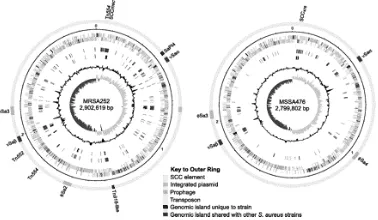
A study conducted by Parkhill et al. (2004) showed that a genomic stretch in several strains of MRSA was absent in methicillin susceptible strains of
Staph. This stretch contains the mecA gene as well as other genes that have not been identified thus far. (Fig. 2)
MecA, when active, increases resistance to beta-lactam antibiotics (Tomasz, 2005). Tomasz and colleagues demonstrated that a mecA homolog from MR S. scuiri introduced into methicillin susceptible S. aureus generated MRSA. They confirmed this result by documenting that elimination of the plasmid containing
mecA, resulting in methicillin susceptible strains. This shows that the transfer of resistance genes between species confers resistance. This also supports the idea that a close evolutionary relationship between staph
species leads to increased ability to transfer genes.
Additionally, when MR strains of staphylococciare stored for long periods of time, they lose the mecA gene and show signs of susceptibility to beta-lactam antibiotics (Kluytmans et. al., 2005).
Tomasz et. al. (2001), also saw that, in conjunction with the mecA, staphylococci strains showed greater resistance to antimicrobials when penicillin-binding protein 2A (PBP2A) was expressed. He suggests that mecA codes for the expression the protein and overexpression of mecA leads to an increased production of PBP2A.
Penicillin-Binding Protein 2A
PBP2A is implicated in the production of the peptidoglycan layer (Tomasz et. al., 2001). The strategy of normal beta-lactam antibiotics is to acetylate the transpeptidase domain of normal PBPs thereby inhibiting cell wall synthesis. MecA expression, nonetheless, leads to the assembly of PBP2A as well as normal PBP2. PBP2A is an extra subunit of transpeptidase. PBP2 only is composed of both a transpeptidase and transglycolase subunit. The production of PBP2A allows for the transpeptidation of the peptidoglycan layer, in the presence of antibiotics, to regain its normal funcion (Tomazs et. al., 2001). The function of PBP2A in non-antimicrobial conditions is unknown.
The pls Gene
Resistance in Staphylococcus is characterized not only by the abnormal function of cell processes, but an abnormally low adherence rate to a host’s extracellular proteins (Kuusela et. al., 2001). This often gives a negative result when testing for MRSA. By introducing a point mutation into the gene coding for pls, Kuusela et. al. (2001), illustrated that pls
is responsible for negative test results. The idea that
pls prevents adhesion of resistant staph to cell is highly favored. Previoius studies showed that susceptible
staph strains do not code or express the pls gene or its protein.
Pls is found in the same regional DNA fragment as mecA. Homologs of the pls gene are found in other species of antibiotic resistant bacteria, including multiple species of resistant staph. This indicates that the species of bacteria that first developed novel mecA genes and swapped them with
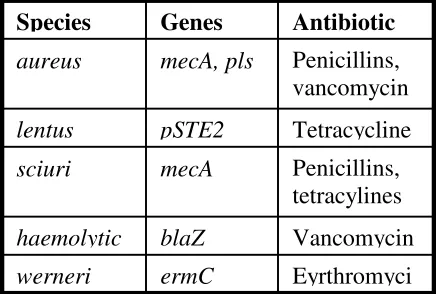
Table 1. Species exhibiting resistance to antibiotics and the
corresponding genes.
another species also transferred natural or mutated pls genes.
Different Resistance, Different Genes
Resistance to other antibiotics, such as tetracycline and vancomycin, has been documented in various species of Staphylococcus
(
Schwarz et. al., 2006). S. lentus, for example, has some strains which exhibit tetracycline resistance. This resistance is caused, at least in part, by the plasmid pSTE2 (Table 1). Sequencing of the plasmid has shown that it has similarities to other known resistance plasmids. Given what is already known about evolutionary antibiotic resistance, this plasmid, along with others, can be transferred easily to other species of bacteria leading to an allover increased resistance level.Acquisition of Resistance
A study conducted by van Strijp and colleagues (2005) describes two newly discovered immune modulators: chemotaxis inhibitory protein of
Staphylococcus aureus (CHIPS) and staphylococcal complement inhibitor (SCIN). These genes also carry genes for immune evasion molecules. They showed that 90% of S. aureus carry these genes, or variants of them, in the same stretches of DNA in the genome. All forms of these genes have some effect on the human immune system.
Furthermore, van Strijp demonstrated that β -hemolysin converting bacteriophages transfer these genes from one microbe to another.
Given that these genes are easily transferred via bacteriophage, it is possible that transduction is the method of resistance gene transfer among staphylococcal species. Whether or not the virus responsible for resistance in staph is able to infect other species, it may play a role in the number of resistance genes transferred and which bacteria they come from.
Precautionary Steps
Common Sense
One way to combat the spread of antibiotic resistant bacteria is simply the exercise of common knowledge such as washing your hands before you touch a patient in the hospital or hand washing between patients by staff. For example, of the staph isolates in Stepanovic’s study (2005), none were found on the hands of medical personnel. The reason was that all doctors and nurses at all medical institutions are required to wash their hands between patients; a practice started in 1848 by Ignaz Semmelweis who eventually got fired for implementing the routine even though the rate of post-procedure infection declined dramatically (Bauman).
A second exercise of common knowledge is one that most people have been hearing for years: elimination of the overuse of antibiotics. The hog farming industry uses 10.3 million pounds of antibiotics regularly and have been found to produce high-level drug resistance in staph species as well as other bacteria species (Schwab et. a., 2005). Without the presence of antimicrobials in the environment, there would be no selection for antibiotic resistance. Lacking
Eyrthromyci
ermC
werneri
Vancomycin
blaZ
haemolytic
Penicillins,
tetracylines
mecA
sciuri
Tetracycline
pSTE2
lentus
Penicillins,
vancomycin
mecA, pls
aureus
Antibiotic
Genes
this pressure for selection, on staph strains harboring resistance genes, the bacteria are likely to kick out the plasmid (Kluytmans).
Natural Remedies
Due to the rapid development of resistance in bacteria to all antibiotics, synthetic or not, other alternatives must be found. A study conducted by Molan et al. (2005) examines the antibacterial activity of honey against Staphylococcus. They found that a concentration of 2.7-5% inhibited the growth of 18 staph
isolates with no significant differences between honey type, antibiotic resistant vs. antibiotic susceptible, or species. Furthermore, Molan showed that the inhibitory effect of natural honey as opposed to simulated honey was 5.5-11.7 times greater and that it could be diluted 20 fold without losing its ability to behave as an antimicrobial. They speculate that this activity is due to the enzymic production of hydrogen peroxide or some other phytochemical element.
A second option is to use a compound not based on existing antibiotics. Plant extracts can be one source of these. S. aureus shows susceptibility to plants used in Columbian folkloric medicinal practices (Munoz et. al., 2006). These plants include Bixa orellana, Gliricidia sepium, Jacaranda mimosifolia, and
Piper pulchrum. Such plants are used to treat a number of illnesses from gingivitis to bronchitis to infected wounds. Extracts from this flora taken using distilled water, ethanol, and hexane all exhibited antimicrobial activity against S. aureus as well as other species of bacteria. By creating new treatments from these plants, the likelihood of previously acquired resistance is lower.
“Artificial” Fixes
One quick fix used to surmount the antibiotic resistance in bacterial species is to develop new antibiotics. For example, new cephalosporin antibiotics interfere with the actions of PBP2A, consequently inhibiting cell wall synthesis in MRSA (Mobashery et. al., 2006). Cephalosporins facilitate a conformational change in the active site of PBP2A. This change decreases the affinity for the protein to help piece together segments of the cell wall. As a result, osmotic pressure on the cell causes it to collapse and die.
However, this is not the best method of controlling antibiotic resistance in light of the ability of bacteria to rapidly develop resistance. Often, new antibiotics are based off of existing antimicrobials for which bacteria may already exhibit resistance. It is likely that many new developments would not be viable methods of treatment for a considerable amount of time.
Nevertheless, this process can be deterred with the advancement of detection methods. Given that many strains of staph have developed resistance, it is suggested that all patient samples should be immediately tested for penicillin, oxacillin, and vancomycin resistance. The problem comes with results from phenotypic assays, such as disk diffusion, which take at least 24-48 hours to incubate (Appelbaum et. al., 2006). Microassays, such as PCR and gene probing, have been shown to give accurate detection rates in S. aureus and S. epidermidis (Unai et. al., 2005) for the mecA gene. Rapid detection can reduce administration of unnecessary or incorrect antibiotics,
which will lower the exposure of the bacteria and decrease the probability of resistance acquisition.
Scientists have recently begun studying the use of bacteriophages in the reduction of the spread of resistant Staphylococcus strains (O’Flaherty et. al., 2005). Phage K, one such virus, affects nine different species of Staphylococcus including S. aureus and S. epidermidis. In the case of newly emerged resistant strains, 39 of the 53 strains tested showed sensitivity to unmodified Phage K and the other 14 were sensitive to modified Phage K. Phage K infects the bacteria and ultimately causes death. It is important to note that a Phage K wash reduces staphylococcal cells on the skin but does not completely eliminate the bacteria, which leads one to believe that it may be possible to develop some resistance. The effects of Phage K in vitro have not been established.
Conclusion
Emerging antibiotic resistance can be the product of close evolutionary relationships between bacterial species and the administration of antimicrobial agents. Isolates collected before the use of antibiotics harbor no resistance genes (O’brien 2002). Many strains of Staphylococcus show not only resistance but also mulit-drug resistance. Evolutionary ties between species add complication to this task. Many bacterial species can transfer genes within a species; close ties between two species may stop them from recognizing their differences and allow transfer. In some cases, such as that of staph, the host range of a bacteriophage may play a part in gene transfer between closely tied species.
Close monitoring of the use of antibiotics through diagnostics can aid in combating resistance. This will aid in reducing unnecessary exposure of bacteria to antimicrobials. Reduced exposure can decrease the acquisition of resistance genes. Newly discovered natural treatments, such as the use of plant extracts and honey, in conjunction with the use of engineered bacteriophages, Phage K, can also discourage these developments.
Note: Eukaryon is published by students at Lake Forest College, who are solely responsible for its content. The views expressed in Eukaryon do not necessarily reflect those of the College. Articles published within Eukaryon should not be cited in bibliographies. Material contained herein should be treated as personal communication and should be cited as such only with the consent of the author.
References
Bauman R. 2003. Microbiology. Boston, MA: Benjamin Cummings.
Chapin, A., Rule, A., Gibson, K., Buckley, T., and Schwab, K. Airborne Multidrug-Resistant Bacteria Isolated from a Concentrated Swine Feeding Operation. Environ Health Perspect. 2005 February; 113(2): 137–142.
Coban, A. Y., Bozdogan, B., Cihan, C. C., Cetinkaya, E., Bilgin, K., Darka, O., Akgunes, A., Durupinar, B., Appelbaum, P. C. Two new colorimetric methods for early detection of vancomycin and oxacillin resistance in Staphylococcus aureus.
J Clin Microbiol 2006 Feb;44(2):580-2.
placement. Arch Otolaryngol Head Neck Surg 2005 Oct;131(10): 868-73.
Dakic, I., Morrison, D., Vukovic, D., Savic, B., Shittu, A., Jezek, P., Hauschild, T., Stepanovic, S. Isolation and molecular characterization of Staphylococcus sciuri in the hospital environment. J Clin Microbiol. 2005 Jun;43(6):2782-5.
Ewald, P. Evolution of Infectious Diseases. Oxford University Press. NY. 1994.
French, V. M., Cooper, R. A., Molan, P. C. The antibacterial activity of honey against coagulase-negative staphylococci. J Antimicrob Chemother. 2005 Jul;56(1):228-31. Epub 2005 Jun 7.
Fuda, C., Hesek, D., Lee, M., Heilmayer, W., Novak, R., Vakulenko, S. B., Mobashery, S. Mechanistic basis for the action of new cephalosporin antibiotics effective against methicillin- and vancomycin-resistant Staphylococcus aureus. J Biol Chem. 2006 Apr 14;281(15):10035-41. Epub 2006 Feb 3. Hauschild, T., Luthje, P., Schwarz, S. Staphylococcal tetracycline-MLSB resistance plasmid pSTE2 is the product of an RSA-mediated in vivo recombination. J Antimicrob Chemother. 2005 Aug;56(2):399-402. Epub 2005 Jun 24. Holden, M. T., Feil, E.J., Lindsay, J. A., Peacock, S. J. , Day, N. P., Enright, M. C., Foster, T. J., Moore, C. E., Hurst, L., Atkin, R., Barron, A., Bason, N., Bentley, S. D., Chillingworth, C., Chillingworth, T., Churcher, C., Clark, L., Corton, C., Cronin, A., Doggett, J., Dowd, L., Feltwell, T., Hance, Z., Harris, B., Hauser, H., Holroyd, S., Jagels, K., James, K.D. , Lennard, N., Line, A., Mayes, R., Moule, S., Mungall, K., Ormond, D., Quail, M. A., Rabbinowitsch, E., Rutherford, K., Sanders, M., Sharp, S., Simmonds, M., Stevens, K., Whitehead, S., Barrell, B. G., Spratt, B. G., Parkhill, J. Complete genomes of two clinical Staphylococcus aureus strains: evidence for the rapid evolution of virulence and drug resistance. Proc Natl Acad Sci U S A. 2004 Jun 29;101(26):9786-91.
Jhon, J. R., Ochoa V. J.,Ocampo, S. A, and Muñoz, J. F. Screening for antimicrobial activity of ten medicinal plants used in Colombian folkloric medicine: A possible alternative in the treatment of non-nosocomial infections. BMC Complement Altern Med. 2006; 6: 2.
Krasner, R. I. 2002. The Microbial Challenge: Human-Microbe Interactions. Washington D.C. American Society for Microbiology Press.
Metan, G., Zarakolu, P., Unal, S. Rapid detection of antibacterial resistance in emerging Gram-positive cocci. J Hosp Infect 2005 Oct;61(2):93-9.
O'Brien, T. F. Emergence,Spread,andEnvironmentalEffectof AntimicrobialResistance:HowUseofanAntimicrobialAnywhere
CanIncreaseResistancetoAnyAntimicrobialAnywhereElse.
Clinical Infectious Diseases. 2002;34:S78-S84.
O'Flaherty, S., Ross, R. P., Meaney, W., Fitzgerald, G. F., Elbreki, M. F., Coffey, A. Potential of the polyvalent anti-Staphylococcus bacteriophage K for control of antibiotic-resistant staphylococci from hospitals. Appl Environ Microbiol.
2005 Apr;71(4):1836-42.
Palazzo, I. C., Araujo, M. L., Darini, A. L..First Report of Vancomycin-Resistant Staphylococci Isolated from Healthy Carriers in Brazil. J Clin Microbiol 2005 Jan;43(1):179-85. Pinho, M. G., de Lencastre, H., Tomasz, A. An acquired and a native penicillin-binding protein cooperate in building the cell wall of drug-resistant staphylococci. Proc Natl Acad Sci U S A. 2001 Sep 11;98(19):10886-91.
Pottumarthy, S., Schapiro, J. M., Prentice, J. L., Houze, Y. B., Swanzy, S. R., Fang, F. C., Cookson, B. T. Clinical isolates of Staphylococcus intermedius masquerading as methicillin-resistant Staphylococcus aureus. J Clin Microbiol 2004 Dec;42(12):5881-4.
Savolainen, K., Paulin, L., Westerlund-Wikström, B., Foster, T. J., Korhonen, T. K., Kuusela, P. Expression of pls, a gene closely associated with the mecA gene of methicillin-resistant Staphylococcus aureus, prevents bacterial adhesion in vitro.
Infection and immunity. 2001 May; 69(5): 3013-20.
Severin, A., Wu, S. W., Tabei, K., Tomasz, A. High-level (beta)-lactam resistance and cell wall synthesis catalyzed by the mecA homologue of Staphylococcus sciuri introduced into Staphylococcus aureus. J Bacteriol 2005 Oct;187(19):6651-8. Stevenson, K. B., Searle, K., Stoddard, G. J., and Samore, M. H. Methicillin-resistant Staphylococcus aureus and Vancomycin-resistant Enterococci in Rural Communities, Western United States. Emerging Infectious Diseases • www.cdc.gov/eid • Vol. 11, No. 6, June 2005. p 895-903. van Griethuysen, A., van Loo, I., van Belkum, A., Vandenbroucke-Grauls, C., Wannet, W., van Keulen, P., Kluytmans, J. Loss of the mecA gene during storage of methicillin-resistant Staphylococcus aureus strains. Journal of clinical microbiology. 2005 Mar; 43(3): 1361-5.
Talan, D. A., Staatz, D., Staatz, A., and Overturf, G. D.. Frequency of Staphylococcus intermedius as human nasopharyngeal flora. J Clin Microbiol. 1989 October; 27(10): 2393.
van Wamel, W. J., Rooijakkers, S. H., Ruyken, M., van Kessel, K. P., van Strijp, J. A. The innate immune modulators staphylococcal complement inhibitor and chemotaxis inhibitory protein of Staphylococcus aureus are located on beta-hemolysin-converting bacteriophages. Journal of bacteriology