Morpho-Physiological and Growth Parameter Changes Associated with Improved
Sprouting of Sugarcane Bud Chips Treated with Growth Regulator and Nutrient
Solutions
Author’s Details: (1)
R. Anitha*, (2)S.Thiruvarassan, (3)P.Christy Nirmala Mary, (4)M. Shanmuganathan, (5)M.Jayachandran [email protected]
Sugarcane Research Station, Cuddalore-Tamil Nadu Agricultural University, Coimbatore
Abstract
A field experiment was conducted to evaluate the efficacy of different chemicals on improved sprouting of sugarcane bud chips.The study consisted of nine treatments (T1 - Untreated check, T2 - Foliar spray of 1%Urea
in 15 th and 25 th day after planting, T3 - Foliar spray of marco and micronutrients solution weekly twice from
10th DAP to 25th DAP, T4 - Soaking of bud chips in 10% Seaweed extract for 2 hrs, T5 - T3+ Soaking of bud
chips in 0.01% Ethrel for 2 hrs, T6 - T3+ Soaking of bud chips in 0.01% Ethrel and 0.1% Calcium chloride for 2
hrs, T7 - Soaking of bud chips in 20% Seaweed extract for 2 hrs, T8 - Soaking of bud chips in 0.01% Ethrel for 2
hrs, T9 - T3+ Soaking of bud chips in 0.1% Calcium chloride for 2 hrs). In this study, CoC 24 variety was
selected and three replications laid out in randomized block design. Significant variation in morphophysiological characters viz., survival percentage, leaf area, seedling vigour index, shoot length and root length was observed with different chemical treatments. Application of foliar spray of micro and macronutrient solution in weekly twice to each portray seedlings from 10th DAP to 25th DAP + soaking of bud chips in 0.01% etherl and 0.1% calcium chloride for 2 hrs registered significantly maximum mean values of growth parameters in plant and ratoon crop viz., tiller population, millable cane, cane length, cane girth, single cane weight and number of nodes. The same treatment significantly registered the maximum cane yield and sugar yield.
Keywords: Ethrel, macro and micronutrients, bud chip, seedling vigour, cane yield
Introduction
June 30, 2019
rate and activation of essential biochemical reactions prerequisite for the establishment and survival of bud chip plantlets in the soil.
Material and methods
Field investigations were carried out during early seasons of 2015-2018 with the cane cultivar CoC 24 at Sugarcane Research Station, Cuddalore to ascertain the effect of growth promoting nutrient for chip bud raised sugarcane seedlings, and to standardize the pretreatment methods in sowing of the portray chip bud seedlings, nine treatments by adapting randomized block design with three replications. The treatments viz. T1 - Untreated check, T2 - Foliar spray of 1%Urea in 15 th and 25 th day after planting, T3 - Foliar spray of marco and micronutrients solution weekly twice from 10th DAP to 25th DAP, T4 - Soaking of bud chips in 10% Seaweed extract for 2 hrs, T5 - T3+ Soaking of bud chips in 0.01% Ethrel for 2 hrs, T6 - T3+ Soaking of bud chips in 0.01% Ethrel and 0.1% Calcium chloride for 2 hrs, T7 - Soaking of bud chips in 20% Seaweed extract for 2 hrs, T8 - Soaking of bud chips in 0.01% Ethrel for 2 hrs, T9 - T3+ Soaking of bud chips in 0.1% Calcium chloride for 2 hrs.
(Note: Full strengthmacronutrients- KNO3 (202 g/l) + Ca(NO3)2 (236 g/0.5l)+ MgSO4.7H2O(493 g/l) + 1M NH4NO3(80 g/l) + FeSO4.7H2O (15 g/l) and Micronutrients- H3BO3 (2.86 g/l) + MnCl2 4H2O (1.81 g/l ) + ZnSO4.7H2O (0.22 g/l ) + CuSO4.5H2O (0.051 g/l) + H3MoO4.H2O (0.09 g/l )).
The soil of the experimental site was sandy loam in texture with low available nitrogen, phosphorus, potassium, organic carbon with a soil PH of 6.2 and the EC of 0.22dSm-1. The portray seedlings of 30 days old were transplanted to the main field and maintained as per the treatment schedule. Regarding NPK fertilization, while the entire quantity of phosphorus was applied as basal, the doses of phosphorus and potassium were applied in 3 equal splits on 30 and 60 days after planting The chip buds of sugarcane variety CoC (SC) 24 were raised in portrays and the pre-treatment seedlings were planted on 30 days after its sowing in portrays under randomized block design with three replications.
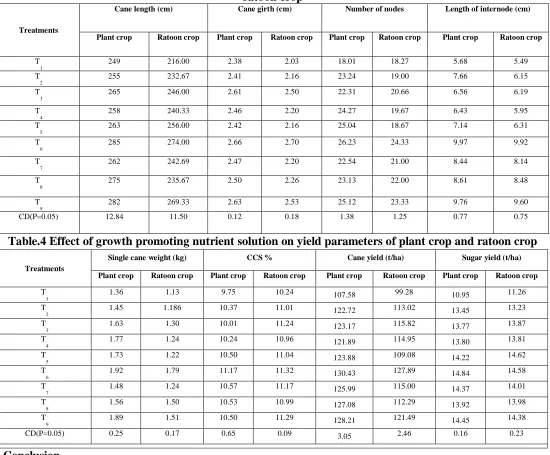
All the crop management practices were adopted for all the treatment plots. The data on germination, the population of tillers, leaf area, leaf area index, millable canes, cane length, cane girth, single cane weight, commercial cane sugar percent, cane yield, and sugar yield were documented and presented in Tables 1,2,3 and 4. The documented data on various observations were analyzed statistically by adopting the procedures of MSTAT – C (1991).
Result and discussion Germination (%)
The effect of growth promoting nutrient solution on germination percentage of both I and II plant crop are presented in Table 1. Significantly higher mean germination 76% was observed with the foliar application of macro and micronutrient solution in weekly intervals twice from 10th DAP and 25th DAP + soaking of bud chip in 0.01% ethrel and 0.1% calcium chloride for 2 hrs (T6) and it was closely followed by foliar spraying of 1% urea at 15th and 25th days after planting (T2) treatment. This significant enhancement in germination with the above treatments is due to ethrel application which would fourfold increase in acid invertase (AI) and ATPase enzymes activity during bud sprouting by growth promoting chemicals. (Jain et al., 2007) also found that the acid invertase hydrolyses sucrose into hexoses and the ATPase liberated inorganic phosphorus to provide cells with carbon and energy for the synthesis of different compounds essential for sprouting and subsequent growth of the underground buds. The lowest germination percentage of 59% was recorded with (control) T1.
Shoot and root length (cm)
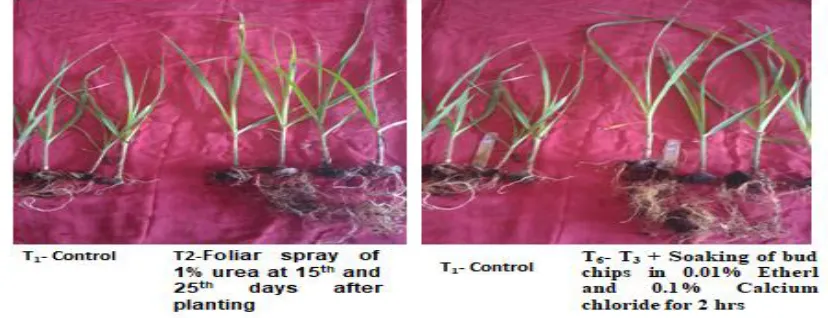
(T6 ) with 63.41 cm and 16.23cm respectively. It was followed by the foliar spray of 1% urea at 15th and 25th days after planting (T2), with 58.97cm of shoot length and 14.64cm root length respectively. The control (T1) recorded the lowest shoot and root length in both the crops.
The consistent uptake of plant growth regulators along with the macro and micronutrients might have attributed for the significant physiological role of iron in chlorophyll formation and its subsequent stimulatory effect on various metabolic process of the plant to increased nutrient absorption through roots to shoots which in turn increased both the root and shoot of sugarcane.
Leaf Area
The significant influence of various treatments imposed on leaf area in both plant crops I and II are presented in Table 1. The mean leaf area values were found to be significantly higher with the foliar application of macro and micronutrients weekly interval twice from 10th DAP and 25th DAP + soaking of bud chip in 0.01% ethrel and 0.1% calcium chloride for 2 hrs (T6 ) with 16.06 cm2. However, the data were on par with the foliar spraying of 1% urea at 15th and 25th days after planting (T2) with 15.68cm2. The lowest leaf area of 12.57 cm2 was recorded in control (T1) during the same stage.
Seedling vigor
The effect of varied treatments on seedling vigor of both the crop is presented in Table 1. The resulted in the mean performance of treatments revealed that the seedling vigor was maximum with the foliar application of macro and micronutrient solution in weekly interval twice (from 10th DAP and 25th DAP) + soaking of bud chip in 0.01% ethrel and 0.1% calcium chloride for 2 hrs (T6) with 6052.64. Exogenous application of Ethrel, calcium chloride, macro, and micronutrients might have facilitated better rooting, enhanced uptake of more nutrients and resulted with initiation and further progress of the various physiological and biochemical process, leading to higher values of growth and morphological characteristics, especially the seedling vigor. It was followed by foliar spraying of 1% urea at 15th and 25th days after planting (T2) with 5276.88. Among the treatments, the control (T1) registered the least seedling vigor of 3482.18.
Tiller population
The effect of growth promoting nutrient solution on mean tiller population of both plant and ratoon crops are presented in Table 2. The application of macro and micronutrient solution as foliar spraying in weekly interval twice from 10th DAP and 25th DAP + soaking of bud chip in 0.01% ethrel and 0.1% calcium chloride for 2 hrs (T6) significantly registered the maximum mean tiller population of 1,86,710/ha and 1,55,000/ha in plant and ratoon crop respectively. Ethrel applications might have strengthened the root activity and effectively utilized the nitrate-nitrogen for proper tiller growth. Results are in consonance with the findings of Rao et al., (2005) who reported that the exogenous application of ethrel has the ability to promote the axillary bud break and increases initial shoot numbers in several species. The early and enhanced sprouting with ethrel soaked setts could have also provided an additional 25 days for physiological growth of shoots at tillering stage as reported by Rai et al., (2017) moreover, Wu et al., (2008) found that the enhancement in tillering of sugarcane requires energy, protein, carbon, and nutrients for development of new shoots from the mother shoot and the combined application of macro and micronutrients with the above treatment would have compensated the overall nutrients requirement of sugarcane and results in higher population of tillers.
The soaking of bud chips in 10% sea weed extract (Ascophyllum nodosum sps.) for 2 hrs (T4) stands next with the mean tiller population of 1,80,750/ha and 1,53,690/ha in ratoon crop respectively. The control (T1) recorded the minimum mean tiller population of 1,52,500/ha and 1,35,080/ha in ratoon crop respectively.
Leaf Area and Leaf Area Index
June 30, 2019
productivity is closely related to the amount of intercepted radiation, largely determined by leaf area index. The higher ethylene evolution led to higher leaf area and it resulted in greater light interception and photosynthesis (Mir et al., 2010).
The treatment consisting the soaking of bud chips in 0.01% Etherl for 2 hrs (T8) stands next with the 114.15cm2 of leaf area and it was comparable with the application of T3 (Foliar spray of ½ strength of macro and micronutrient solution will be added weekly twice to each portray from 10th DAP to 25th DAP) treatment. The control (T1) recorded the minimum mean leaf area of 64.73cm2 and leaf area index of 3.8.
Millable canes
The effect of growth promoting nutrient solution on the millable cane of plant and ratoon crop is presented in Table 2. Among the treatments, the foliar application of macro and micronutrient solution in weekly interval twice from 10th DAP and 25th DAP + soaking of bud chip in 0.01% ethrel and 0.1% calcium chloride for 2 hrs (T6) significantly registered the maximum mean millable cane of 1,20,930/ha and 1,19,080/ha in ratoon crop respectively. The treatment T9 (foliar application of macro and micronutrient solution in weekly interval twice from 10th DAP and 25th DAP +soaking of bud chips in 0.1% calcium chloride for 2 hrs) stands next with the population of 1,18,760/ha and 1,16,090/ha in plant and ratoon crop respectively. Ethrel induced the early emergence and establishment of tillers which eventually resulted in a higher number of mature stalks. Improvement in millable canes in the corresponding treatments might be attributed to early and higher emergence due to setts treatment with an ethrel solution and better photosynthetic efficiency resulted in the production of a higher number of tillers and its subsequent conversion to millable canes at harvest. Similar results were reported by Kumar (2016).
However, it was comparable with the application of T2 treatment (foliar spray of 1% urea at 15th and 25th days after planting). The control (T1) recorded the minimum mean millable cane population of 1,09,080/ha and 1,10,320/ha in plant and ratoon crop respectively.
Cane Length (cm)
The effect of growth promoting nutrient solution on cane length of plant and ratoon crop is presented in Table 3. Among the treatments evaluated, the foliar application of macro and micronutrient solution in weekly interval twice from 10th DAP and 25th DAP + soaking of bud chip in 0.01% ethrel and 0.1% calcium chloride for 2 hrs (T6) significantly registered the maximum mean cane length of 285cm and 274cm in plant and ratoon respectively increase in the length of the stalk which resulted from foliar application of macro and micronutrient solution as foliar spray in weekly interval twice from 10th DAP and 25th DAP + soaking of bud chip in 0.01% ethrel and 0.1% calcium chloride for 2 hrs that increased the leaf area index resulting in enhanced photosynthetic activity and assimilates production in the leaves which later on translocate into internodes and thus increased internode elongation and also internode numbers as reported by Rai et al., (2017).
However, it was on par with the treatment T9 (foliar application of macro and micronutrient solution in weekly interval twice from 10th DAP and 25th DAP +soaking of bud chips in 0.1% calcium chloride for 2 hrs) with a cane length of 282cm and 269.3cm in plant and ratoon crop respectively. The control (T1) recorded the minimum mean cane length of 249 cm and 216 cm in ratoon crop respectively.
Cane girth (cm)
into internodes, thus increased internode elongation and also internode numbers as reported by Rai et al., (2017).
It was on par with the treatment T9 (foliar application of macro and micronutrient solution in weekly interval twice from 10th DAP and 25th DAP +soaking of bud chips in 0.1% calcium chloride for 2 hrs) with the cane length of 2.63cm and 2.53cm in plant and ratoon respectively. The control (T1) recorded the minimum mean cane length of 2.38cm and 2.03cm in plant and ratoon crop respectively.
Number of nodes
The effect of growth promoting nutrient solution on a number of nodes of plant and ratoon crop is presented in Table 3. Among the treatments evaluated the foliar application of macro and micronutrient solution in weekly interval twice from 10th DAP and 25th DAP + soaking of bud chip in 0.01% ethrel and 0.1% calcium chloride for 2 hrs (T6) significantly registered the maximum mean number of nodes of 26.23 and 24.33 in plant and ratoon crop respectively. It might be due to increase in the length of the stalk which resulted from foliar application of macro and micronutrient solution as foliar spray in weekly interval twice from 10th DAP and 25th DAP + soaking of bud chip in 0.01% ethrel and 0.1% calcium chloride for 2 hrs that ethephon significantly increased ethylene production and positively correlated with the sucrose percent in the internodes of sugarcane.
It was followed by the treatment T9 (foliar application of macro and micronutrient solution in weekly interval twice from 10th DAP and 25th DAP +soaking of bud chips in 0.1% calcium chloride for 2 hrs) and T5 (foliar application of macro and micronutrient solution in weekly interval twice from 10th DAP and 25th DAP + Soaking of bud chips in 0.01% Etherl (Ethephon) for 2 hrs) with the mean number of nodes of 25.12 and 23.33 in plant and ratoon crop respectively and 25.04. The control (T1) recorded the minimum mean number of nodes with 18.27 and 17.34 in plant and ratoon crop respectively.
Length of internodes (cm)
Among the treatments (Table 3) the application of macro and micronutrient solution as foliar spray in weekly interval twice from 10th DAP and 25th DAP + soaking of bud chip in 0.01% ethrel and 0.1% calcium chloride for 2 hrs (T6) significantly registered the maximum mean length of internodes 9.97cm and 9.92cm in plant and ratoon crop respectively. Yao et al. (2005) pointed out that 400 mg/L ethephon raised the activities of acid and neutral invertases in internode 2 at the late growth stage, which was, therefore, promoting the sucrose accumulation in the stalks.
However, it was on par with the treatment T9 (foliar application of macro and micronutrient solution in weekly interval twice from 10th DAP and 25th DAP +soaking of bud chips in 0.1% calcium chloride for 2 hrs) with the length of internodes of 9.76cm and 9.6cm in plant and ratoon crop respectively. The control (T1) recorded the minimum mean length of internodes of 5.68cm and 5.49cm in plant and ratoon crop respectively.
Single cane weight (kg)
June 30, 2019
1.89kg, 1.77kg, 1.73kg and 1.51kg, 1.50kg and 1.49 in plant and ratoon crop respectively. It might be attributed to the effect of foliar application of macro and micronutrient solution as a foliar spray in weekly interval twice from 10th DAP and 25th DAP + soaking of bud chip in 0.01% ethrel and 0.1% calcium chloride for 2 hrs which enhanced the individual cane weight at harvest due to more accumulation of photosynthates. The control (T1) recorded the minimum mean single can weight of 1.36kg and 1.13kg in plant and ratoon crop respectively.
Commercial Cane Sugar
Among the evaluated treatments (Table 4) the foliar application of macro and micronutrient solution in weekly interval twice from 10th DAP and 25th DAP + soaking of bud chip in 0.01% ethrel and 0.1% calcium chloride for 2 hrs (T6) significantly registered the maximum mean commercial cane sugar of 11.17% and 11.32% in plant and ratoon crop respectively. Being the juice quality of sugarcane is a dependent genetic factor of cane cultivars, the significant increase might be due to the positive effects of ethrel and calcium chloride as ethrel increases the activities of acid and neutral invertases thereby enhancing the sugar accumulation in the stalks. Rao et al., (2005) recorded the maximum CCS percent when treated with 100 mg/L ethephon over the other treatments including control. However it was on par with the treatment T7 (Soaking of bud chips in 20% seaweed extract for 2 hrs) and T8 (Soaking of bud chips in 0.01% Etherl for 2 hrs) with on CCS% of 10.57% and 10.53% respectively in plant crop and in ratoon crop it was on par with the treatment T9 (foliar application of macro and micronutrient solution in weekly interval twice from 10th DAP and 25th DAP +soaking of bud chips in 0.1% calcium chloride for 2 hrs) and T3 (foliar spray of ½ strength of macro and micronutrient solution (given in note) will be added weekly twice to each portray from 10th DAP to 25th DAP) with on CCS% of 11.29% and 11.24% respectively. The control (T1) recorded the minimum mean CCS% of 9.75% and 10.24% in plant and ratoon crop respectively.
Cane Yield
The effects of growth promoting nutrient solution on cane yield of plant and ratoon crop are presented in Table 4. Among the evaluated treatments the foliar application of macro and micronutrient solution in weekly interval twice from 10th DAP and 25th DAP + soaking of bud chip in 0.01% ethrel and 0.1% calcium chloride for 2 hrs (T6) significantly registered the maximum mean cane yield of 130.43 t/ha and 127.89 t/ha in plant and ratoon crop respectively. The highest cane yield was obtained in this treatment was due to the higher number of millable canes, cane length, length of internode as well as cane weight. Cane yield was increased in all the treatments over conventional planting, though the response was different in different treatments. The results are in consonance with the findings of Kumar (2016).
However it was on par with the treatment of T9 (foliar application of macro and micronutrient solution in weekly interval twice from 10th DAP and 25th DAP +soaking of bud chips in 0.1% calcium chloride for 2 hrs) with a cane yield of 128.29 t/ha and 121.49 t/ha in plant and ratoon crop respectively. The control (T1) recorded the minimum mean cane yield of 107.58 t/ha and 99.28 t/ha in plant and ratoon crop respectively.
Sugar yield
The effects of growth promoting nutrient solution on sugar yield of plant and ratoon crop are presented in Table 4. Among the evaluated treatments the foliar application of macro and micronutrient solution in weekly interval twice from 10th DAP and 25th DAP + soaking of bud chip in 0.01% ethrel and 0.1% calcium chloride for 2 hrs (T6) significantly registered the maximum mean sugar yield of 14.84 t/ha and 14.58 t/ha in plant and ratoon crop respectively. The yield was found to be progressively increased with the treatment T6 - (Foliar spray application of macro and micronutrient solution in weekly twice + soaking of bud chips in 0.01% etherl and 0.1% calcium chloride by the application of calcium chloride might have favored the faster cell division and cell elongation which ultimately resulted in higher tiller production and yield. The plant growth is also improved by the ability of the plant to uptake and receives more nutrients.
in plant crop and in ratoon crop treatment T4 (soaking of bud chips in 10% seaweed extract (Ascophyllum
nodosum sps.) for 2 hrs with on sugar yield of 13.01 t/ha. The control (T1) recorded the minimum mean sugar yield of 10.95 t/ha and 11.26 t/ha in plant and ratoon crop respectively.
Low concentration of ethephon promoted the differentiation of vascular bundles and enlarged the areas of epigenetic vessels and phloem in the leaves thereby improving the inner transport system of the plants, increased the root activity and promoted the absorption ability, differentiation of chloroplasts and increasing total photosynthetic area and the chlorophyll content and the activities of the important enzymes related to photosynthesis, affected many important enzymes that were related to growth and sugar accumulation and produced more tillers, more rapid plant growth and finally higher cane and sugar yield.
Table.1 Effect of growth promoting nutrient solution on growth and physiological parameters on pooled data of both I and II plant crop
Table.2 Effect of growth promoting nutrient solution on growth parameters of Plant crop and ratoon crop
Treatments Tiller population (‘000/ha) Leaf Area (cm2) Leaf Area Index Millable Cane (‘000/ha)
Plant crop Ratoon crop Plant crop Plant crop Plant crop Ratoon crop
T 1
152.50 135.08 64.73 3.80 109.08 110.32
T 2
165.06 147.16 80.05 4.31 117.66 113.25
T 3
156.71 151.63 112.90 3.93 116.26 112.67
T 4
180.75 142.76 107.05 3.91 111.87 113.07
T 5
154.30 151.71 97.68 3.97 115.14 115.89
T 6
186.71 155.00 122.88 4.36 120.93 119.08
T 7
170.10 139.17 103.58 3.94 114.14 116.09
T 8
175.06 153.69 114.15 3.96 116.61 112.92
T 9
173.36 141.07 106.69 4.19 118.76 117.30
CD(P=0.05) 2.14 1.84 7.62 0.144 1.17 1.09
Treatments Germination (%) Shoot length (cm) Root length (cm) Leaf Area (cm
2
) Seedling vigor
T1
59
46.67 12.35 12.57 3482.18
T2 72 58.97 14.32 15.68 5276.88
T3 63 55.71 13.21 13.24 4341.96
T4 62 52.89 12.56 12.99 4057.90
T5
60
53.80 13.25 14.60 4023.00
T6 76 63.41 16.23 16.06 6052.64
T7 61
51.34 14.36 14.54 4007.70
T8 65
55.79 14.53 15.41 4570.80
T9 61
56.32 14.64 14.57 4328.56
June 30, 2019
Table.3 Effect of growth promoting nutrient solution on physiological parameters of plant crop and ratoon crop
Treatments
Cane length (cm) Cane girth (cm) Number of nodes Length of internode (cm)
Plant crop Ratoon crop Plant crop Ratoon crop Plant crop Ratoon crop Plant crop Ratoon crop
T 1
249 216.00 2.38 2.03 18.01 18.27 5.68 5.49
T 2
255 232.67 2.41 2.16 23.24 19.00 7.66 6.15
T 3
265 246.00 2.61 2.50 22.31 20.66 6.56 6.19
T 4
258 240.33 2.46 2.20 24.27 19.67 6.43 5.95
T 5
263 256.00 2.42 2.16 25.04 18.67 7.14 6.31
T 6
285 274.00 2.66 2.70 26.23 24.33 9.97 9.92
T 7
262 242.69 2.47 2.20 22.54 21.00 8.44 8.14
T 8
275 235.67 2.50 2.26 23.13 22.00 8.61 8.48
T
9 282 269.33 2.63 2.53 25.12 23.33 9.76 9.60
CD(P=0.05) 12.84 11.50 0.12 0.18 1.38 1.25 0.77 0.75
Table.4 Effect of growth promoting nutrient solution on yield parameters of plant crop and ratoon crop
Conclusion
Application of foliar spray of micro and macronutrient solution in weekly twice to each portray seedlings from 10th DAP to 25th DAP + soaking of bud chips in 0.01% etherl and 0.1% calcium chloride for 2 hrs registered significantly maximum mean values of varied physiological and growth parameters in plant and ratoon crop viz., leaf area of 122.88 cm2 in plant crop, millable cane of 1,20,930/ha and 1,19,080/ha, cane length of 285cm and 274cm, cane girth of 2.66cm and 2.70cm, single cane weight of 1.92kg and 1.79 kg and number of nodes of 26.23 per plant and 24.33 per plant. The same treatment significantly registered the maximum cane yield of 130.43 t/ha and 127.89 t/ha and sugar yield of 14.84 t/ha and 14.58 t/ha.
Fig 1 Effect of growth promoting nutrient solution on germination percentage on 35DAP at shade net Treatments
Single cane weight (kg) CCS % Cane yield (t/ha) Sugar yield (t/ha) Plant crop Ratoon crop Plant crop Ratoon crop Plant crop Ratoon crop Plant crop Ratoon crop
T
1 1.36 1.13 9.75 10.24 107.58 99.28 10.95 11.26
T 2
1.45 1.186 10.37 11.01 122.72 113.02 13.45 13.23
T 3
1.63 1.30 10.01 11.24 123.17 115.82 13.77 13.87
T 4
1.77 1.24 10.24 10.96 121.89 114.95 13.80 13.81
T 5
1.73 1.22 10.50 11.04 123.88 109.08 14.22 14.62
T 6
1.92 1.79 11.17 11.32 130.43 127.89 14.84 14.58
T 7
1.48 1.24 10.57 11.17 125.99 115.00 14.37 14.01
T 8
1.56 1.50 10.53 10.99 127.08 112.29 13.92 13.98
T 9
1.89 1.51 10.50 11.29 128.21 121.49 14.45 14.38
Fig 2 Effect of growth promoting nutrient solution on the shoot and root length on 45th DAP
Reference
i. Jain R, Solomon S, Chandra A. Some discernible physio-biochemical changes associated with improved sprouting of sugarcane setts treated with ethephon. Sugar Tech. 2011;13:123–128. doi: 10.1007/s12355-011-0079-z. [CrossRef] [Google Scholar]
ii. Jain R, Shrivastava AK, Solomon S, Yadav RL. Low temperature stress-induced biochemical changes in stubble bud sprouting in sugarcane (Saccharum spp. hybrid). Plant Growth Regulation. 2007; 53:17-23. iii. Kumar N. (2016). Use of plant growth regulators for enhanced growth and yield of sugarcane (Saccharum species hybrid complex). In: Extended Summaries, Fourth International Agronomy Congress on Agronomy for Sustainable Management of Natural Resources, Environment, Energy and Livelihood Security to Achieve Zero Hunger Challenge, November, Indian Society of Agronomy, New Delhi, India. 22-26:1310-1312.
iv. Mstat-C (1991). Michigan State University, East Lansing, USA
v. Mir MR, Mobin M, Khan NA, Bhat MA, Lone NA, Bhat KA et al. (2010). Crop response to interaction between ethylene sources and nitrogen with special reference to oilseed crops. Journal of Phytology. 2(10):23-33.
June 30, 2019
vii.Rai.R.K, Nidhi Tripathi, Deeksha Gautam and Pushpa singh 2017. Exogenous application of ethrel and gibberellic acid stimulates physiological growth of late planted sugarcane with short growth period in sub-tropical India. Journal of plant growth Regulation. DoI 10.1007/s00344-016-9655-5.