44 Trans. Phenom. Nano Micro Scales, 4(1): 44-51, Winter - Spring 2016 DOI: 10.7508/tpnms.2016.01.006
MHD Boundary Layer Flow of a Nanofluid over an Exponentially Permeable
Stretching Sheet with radiation and heat Source/Sink
N.Kishan1,C.Kalyani2,*, M.Chenna Krishna Reddy 1
1
Department of Mathematics, Osmania University, Hyderabad Telangana, India 2
Department of Mathematics, R.B.V.R.R. women’s college, Hyderabad Telangana, India
Received 7 March 2015; revised 7 December 2015; accepted 20 December 2015; available online 5 January 2016 ABSTRACT: The problem of steady Magnetohydrodynamic boundary layer flow of an electrically conducting nanofluid due to an exponentially permeable stretching sheet with heat source/sink in presence of thermal radiation is numerically investigated. The effect of transverse Brownian motion and thermophoresis on heat transfer and nano particle volume fraction considered. The governing partial differential equations of mass, momentum, energy and nanoparticle volume fraction equations are reduced to ordinary differential equations by using suitable similarity transformation. These equations are solved numerically using an implicit finite difference scheme, for some values of flow parameters such as Magnetic parameter (M), Wall mass transfer parameter(S), Prandtl number(Pr), Lewis number (Le), Thermophoresis parameter (Nt), Brownian motion parameter(Nb), Radiation parameter (R). The numerical values presented graphically and analized for velocity, temperature and nanoparticle volume fraction.
KEYWORDS: Keller box; MHD; Nanofluid; Stretching permeable sheet; thermal radiation
INTRODUCTION
The analysis of boundary layer flow of viscous fluid and heat transfer due to stretching sheet has important application in Industry and engineering process and polymer industry, such as in polymer extrusion drawing of copper wires, artificial fibres, paper production, wire drawing, hot rolling, glass fibres, metal exclusion and metal spinning etc. Sakiadas [1] was probably the first to study the two dimensional boundary layer flow due to stretching wire in a fluid at rest. Crane[2] first studied the boundary layer flow due to linearly stretching sheet. The experimental result of TSOU et.al [3] confirmed that the mathematically described boundary layer problem on a continuous moving surface is physically reasonable. The flow and heat transfer over an exponentially stretching surface were investigated by Elbashbeshy [4] taking wall mass suction. Magyari and Keller [5] considered the boundary layer flow and heat transfer due to an exponentially stretching sheet.
Partha et al. [6] reported a similarity solution for mixed convection flow past an exponentially stretching surface. Ishak [7] studied the magneto hydrodynamic (MHD) boundary layer flow over an exponentially shrinking sheet in presence of thermal radiation. Bhattacharyya [8] discussed the boundary layer flow and heat transfer caused due to an exponentially shrinking sheet. N. Kishan and Kavitha [9] studied MHD Non-Newtonian power Law Fluid flow and HeatTransferpost a Non-Linear stretching
*Corresponding Author Email: [email protected] Tel.: +919346433343
surface. Bhattacharyya and Pop [10] showed the effect of external magnetic field on the flow over an exponentially shrinking sheet.
The study of utilizing heat source or sink in moving fluids assume a great significance in all situations which deals with exothermic and endothermic reactions and those concerned with dissociating fluids. For physical situations, the average behaviour of heat generation or absorption can be expressed by some simple mathematical models because its exact modelling is quite difficult.
Heat source or sink has been assumed to be constant, space dependent. When technology processes take place at high temperatures thermal radiation heat transfer become very important and it effects cannot be neglected. Recent developments in hypersonic flights, missile re-entry rocket combustion chambers and gas cooled nuclear reactors, have focussed attention of researchers on thermal radiation as a mode of energy transfer and emphasize the need for inclusion of radiative transfer in these processes. For these many studies have appeared concerning the interaction of radiative flux with thermal convection flows. In certain porous media applications, working fluid heat generation (source) or absorption (sink) effects are important. Representative studies dealing with these effects have been reported by authors such that as Gupta and Sridhar [11], Abel and Veen [12] and Sharma [13]. In recent years, the flow analysis of Nanofluids has been topic of extensive research due to characteristic in increasing thermal conductivity heat transfer process.
N.Kishan et al.
45
The term nanofluid was proposed by Choi[14] referring to
the dispersion of nanoparticle in base fluid such as water, glycol, ethylene, propylene glycol. The nanofluid is an advance type of containing nano meter sized particle(diameter < 10 nm) are fibres suspended in the base fluid. Undoubtedly the nano fluids are advantages in the sense that they are more stable have an acceptable viscosity and better wetting, spready and dispersion properties on a solid surface. Nanofluids are used in different engineering applications such as microelectronics, micro fluidics, transportation, biomedical and manufacturing research on heat transfer in nanofluids has been receiving increased attention. Many researchers have found unexpected thermal properties of nanofluids and have proposed new mechanism behind the enhanced thermal properties of nanofluids. . The thermal conductivity enhancement characteristic of nanofluid was observed by Masuda et al. [15]. Buongiorno [16] discussed the reasons behind the enhancement in heat transfer for nanofluid and he found that Brownian diffusion and thermophoresis are the main causes. Later, Nield and Kuznetsov [17] and Kuznetsov and Nield [18] investigated the natural convective boundary layer flow of a nanofluid employing Buongiorno model. In 1827 the Scotish botanist Robert Brown observed that Microscopic pollen grains suspended in water move in a erratic, highly irregular, zig zag pattern. Following Brown’s initial report other scientist verified the strange phenomenon. Brownian motion was apparent whenever very small particles were susupended in a fluid medium. For example smoke particles in air. It eventually determined that finer particles move more rapidly, that their motion is stimulated by heat, and that the movement is more active when the fluid viscosity is reduced. . It has a wide range of applications, including modeling noise in images, generating fractals, growth of crystals and stock market simulation. Thermophoresis is a phenomenon observed in mixtures of mobile particles where the different particle types exhibit different responses to the force of a temperature gradient. The term thermophoresis most often applies to aerosol mixtures, but may also commonly refer to the phenomenon in all phases of matter.
In recent years, it is found that thermophoresis phenomenon has many practical application in removing small particle gasstrings in determing exhaust gas particle trajectories from combustion devices, and in studying the particle material deposition on turbine Blades. Rosmila[19] et al. theoretically studied the problem of steady boundary layer flow of nanofluid past a porous stretching surface with variable stream conditions and chemical reaction. Rosca[20] et.al. have studied the steady forced convection stagnation point flow and mass transfer past a permeable stretching/shrinking sheet placed in a copper (cu) water based nanofluid. The boundary layer flow of nanofluid past a linearly stretching sheet was first studied by Khan and Pop[21] introducing the model of Nield and Kuznetsov[22]. The boundary layer flow induced in a nanofluid due to a
linearly stretching sheet with convective boundary condition was described by Makinde and Aziz [23]. Kandasamy et al. [24] investigated the MHD boundary layer flow of a nanofluid past a vertical stretching permeable surface with suction/injection. Rana and Bhargava [25] illustrated the steady, laminar boundary layer flow due to the nonlinear stretching of a flat surface in a nanofluid. Later, Hady et al. [26] analysed the boundary layer flow and heat transfer characteristics of a viscous nanofluid over a nonlinearly stretching sheet in the presence of thermal radiation and variable wall temperature. Hunegnaw and Naikoti Kishan[ 27] studied the MHD boundary layer flow and heat transfer of a nanofluid past a non-linearly permeable stretching/shrinking sheet with thermal radiation and suction effect in the presence of chemical reaction. N.Kishan et.al[28] studied MHD Boundary Layer Flow and Heat Transfer of a Nanofluid Over a Shrinking Sheet with Mass Suction and Chemical Reaction
Recently Krishnedu Bhattacharyya and G.C.Layek [29] studied the MHD boundary flow of nanofluid due to an exponentially permeable stretching sheet. Thus the motivation of this study is to examine the influence of thermal radiation and internal heat generation on magneto hydrodynamic boundary layer flow of nanofluid due to an exponentially stretching permeable sheet. The effects of Brownian motion and thermophoresis on heat transfer and nanoparticle volume fraction are considered. The governing equations are solved numerically using an implicit finite difference scheme known as Keller box method.
MATHEMATICAL FORMULATION
Consider the steady boundary layer flow of a nanofluid over an exponentially stretching sheet in presence of a transverse magnetic field. The governing equations of motion and the energy may be written as
+ = 0 (1)
+ = – (2)
+ = + (( )) +
- (
)
(3)
+ = + (4)
Where and are the velocity components in x- and y- directions, respectively, is the kinematic Viscosity, ρf , is
the density of the base fluid ,T is the temperature, T∞ is
constant temperature of the fluid in the in viscid free stream,α is the thermal conductivity, ( )p is the effective
heat capacity of nanoparticles, ( )f is heat capacity of the
Trans. Phenom. Nano Micro Scales, 4(1) 44-51, Winter - Spring 2016
46 Brownian diffusion coefficient, and DT is the thermo
phoretic diffusion coefficient. Here, the variable magnetic field ( ) is taken in the form
( ) = exp ( ) , Where is a constant.
Using Rosseland approximation for radiation:
= − 4
3 ∗ ′ (5)
Where ∗ is the mean absorption coefficient and is
the Stefan Boltzmann constant. is expressed as a linear function of temperature by using Taylor series expansion about is:
= 4 T - 3
The boundary conditions are given by
= ( ), = w at = 0, → 0 as → ∞ ,
= = + exp at = 0, → as
→ ∞,
= = + exp at = 0, →
as → ∞,
(6)
Where is the variable temperature at the sheet with being a constant which measures the rate of temperature increase along the sheet, is the variable wall nanoparticle volume fraction with being a constant and is constant nanoparticle volume fraction in free stream. The stretching velocity is given by
( ) = exp , (7)
here c > 0 is stretching constant. Here νw is the variable
wall mass transfer velocity and is given by
( ) = (8)
where is a constant with < 0 for mass suction and
> 0 for mass injection.
Now, we introduce the similarity transformations:
= √2 ( )exp ( ) , ( )= ,
( ) = , = exp ( ) (9)
Where φ is the stream function with = and = − and η is the similarity variable
In view of relations in (6) we finally obtain the following self- similar equations:
+ − 2 − = 0 (10)
(1 + ) + Pr( − + +
) =0 (11)
+ ( − ) + = 0 (12)
Where M = 2 / is the magnetic parameter, Pr =
/ is the Prandtl number and
Le = / is the Lewis number, R= ∗ is the Radiation parameter. The dimensionless parameter Nb (Brownian motion parameter) and Nt (thermophoresis parameter) are defined as
Nb = ( )
( )
( )
, Nt = ( )
( )
( )
,
R = ∗ ,
The boundary conditions (6) reduce to the following forms:
( ) = , ( ) = 1 = 0
( ) → 0 as → ∞,
( ) = 1 = 0, ( ) → 0 as → ∞,
( ) = 1 = 0, ( )→ 0 as → ∞,
(13)
Where S = - / / is the wall mass transfer parameter, S > 0 ( < 0) corresponds to mass suction and S < 0
( > 0 ) corresponds to mass injection.
The quantities of physical interest for this problem are the local skin friction coefficient , the local Nusselt number , and the local Sherwood number ℎ , which are respectively defined as
= / | , √2 = ′′(0),
= − ,
√ = − (0) ,
ℎ = − ( ) ,
√ = − ∅ (0)
where R = / is the local Reynolds number.
RESULTS AND DISCUSSION
g ( L B F v v
p m
t i m
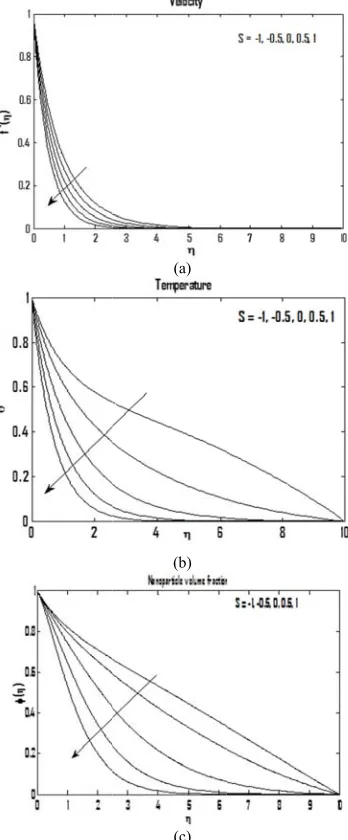
governing flow (M), wall mas Lewis numbe Brownian mot For different f velocity profile volume fractio
From Figur parameter is to magnetic param
Fig. 1. Effects
The compar M ′′(0)
This is due transport proc increase of Lo magnetic and e
w parameter ss transfer para er (Le), therm
tion parameter flow parameter es ′, tempera on are shown
e 1 it is seen o reduces the v meter leads to
of Magnetic param nanoparticle v
Ta rison of values o Magyari and Ke 1.281808
e to the magn cess. Actually orentz force ar
electric fields f
such as Mag ameter(S), Pra mophoresis r(Nb), radiation r the evolution ature profile ,
n in Figures 1-that the influe elocity profiles enhance the te
(a)
(b)
(c)
meter on Velocity, volume fraction
able 1
of ′′(0) for M Pr ller [29]
1
netic field, wh the increase rising because
for the motion
N
gnetic parame andtl number(P parameter (N n parameter (R n of the similar
and nanoparti 7 respectively. ence of magne s ′ where as t emperature fiel
, Temperature and
M = 0 and S = 0. resent study 1.28180838
hich opposes t of M leads of interaction of an electrica
N.Kishan et al.
47 eter Pr), Nt), R). rity cle . etic
the ld .
d
the to of ally
conduc much m other e fraction The enhanci the tend volume In Fi volume heat sou
Fig. 2
From velocity volume of heat strength
ting fluid. Th more resistance
end, the temp n increase with resistance off ing the temper dency to incre e fraction in na
igure 2, the v e fraction profi urce paramete
2. Effects of Mass na
m the figure i y profile f', te e fraction φ are t sink (S >0) h (S < 0) the v
he stronger L e to the transpo erature and th h .
fered to the f rature. Moreov ease the tempe anofluid motion velocity, tempe iles are present er.
(a)
(b)
(c) transfer parameter anoparticle volum
it is observed emperature pro e decreases for and due to i velocity, temp
Lorentz force ort phenomena
he nanoparticl
flow is respo ver, the Lorentz
erature and na n.
erature and na ted for selected
r S on Velocity, T me fraction
that the dim ofile and na r increasing th increase of he erature and na
produces . From the le volume
onsible in z force has anoparticle
anoparticle d values of
emperature a
v m r h T t t v t T n l f P l a o t a t n i n l
volume fract momentum bo reduces for th heat source par This result is transfer is give The Figur temperature f various values
Fig. 3. Effects o
As Pr increa the thermal b The thermal b number it is d larger Prandt fraction overs Pr.
It is also not leads to increa adjacent to th observed from the temperatur are depicted temperature p number Le and is evident tha number Le, t significantly, layer thickness
tion profile de oundary layer he increase of
rameter. s very signific
en prime impor re 3 is rep field and nano of Prandtl num
f Prandtl number P volum
ases the dimen boundary layer oundary layer due to decrease l value num shoot near the
tice that with in ases the nanop he sheet and m the sheet. Th re and nanopa
in Figure 4 profiles increa d the effect is v at for the inc the nanopartic and also the n s reduce sharpl
Trans. Phenom
ecreases. So, r and thermal
heat sink but
cant for the f rtance. presented the oparticle volu mber Pr. (a) (b)
Pr on Temperatur me fraction
nsionless tempe r thickness de thickness redu e of thermal d mber.The nano boundary for
ncrease of Pran particle volume the opposite he influence o article volume 4a and b re ase with inc very meager. F creasing the v cle volume fr
nanoparticle v ly.
m. Nano Micro S
the thickness boundary lay it increases w
flow where h
e dimensionle ume fraction
re and nanopartic
erature as well ecreases quick uces with Pran diffusivity for t oparticle volum
higher values
ndtl number Pr e fraction prof phenomenon of Lewis numb
fraction profi espectively. T
rease of Lew From Figure 4b values of Lew raction decreas volume bounda
Scales, 4(1) 44-5
48 of yer with eat ess for le l as kly. ndtl the me of r is file is ber iles The wis b it wis ses ary As P the the The the number larger fraction Pr. It is a leads to adjacen observe the tem are de tempera number is evid number signific layer th Fig. 4 The dimens fraction respecti It can increase The Fig decreas the na
51, Winter - Spri
Pr increases the ermal boundar
ermal boundary r it is due to d
Prandtl value n overshoot n
also notice tha o increases the nt to the shee ed from the sh mperature and
epicted in Fi ature profiles r Le and the ef dent that for r Le, the nan cantly, and als hickness reduce
4. Effects of Lewi
impact of Bro ionless temp n profiles ar
ively.
n be seen from es with the inc gure 5b reveals ses with the in anoparticle vo
ing 2016
e dimensionles ry layer thickn
y layer thickne decrease of the e number. Th near the bound
at with increase e nanoparticle et and the op heet. The influ nanoparticle v igure 4a and s increase wi ffect is very me
the increasing noparticle volu so the nanopa e sharply.
(a)
(b) is number Le on T
volume fractio
ownian motion perature and
re depicit in
m the figure tha crease Brownia s that the nano ncrease of Bro olume of bou
ss temperature ness decreases ess reduces wi ermal diffusivi he nanoparticl dary for higher
e of Prandtl num volume fracti pposite pheno uence of Lewi volume fractio d b respectiv ith increase eager. From Fi g the values ume fraction article volume
Temperature and na on
n parameter N nanoparticle n Figure 5a
at the temperatu an motion para oparticle volum ownian motion
undary layer
as well as s quickly. ith Prandtl ity for the le volume r values of
mber Pr is ion profile omenon is is number on profiles vely. The of Lewis igure 4b it
of Lewis decreases boundary
anoparticle
Nb on the e volume
and 5b
d N
t i t
decrease with Nb.
Fig. 5. Effects
The nano the Brownian is affected wit transfer charac
Fig. 6. Effects
0 0 0.2 0.4 0.6 0.8 1
(
)
0 0 0.5 1 1.5 2 2.5 3
(
)
the increase i
of Brownian param particle vo
fluid system d motion takes p th changes in N cteristic of a flu
of thermophoresis nanoparticle
2 4
Te
1 2 3 4
Nanopar
if Brownian m
(a)
(b)
meter Nb on Tem lume fraction.
due to the prese place and the B Nb, and conse uid changes.
(a)
(b)
s parameter Nt on volume fraction
6 8
emperature
Nt = 0, 0.1, 0.3
5 6 7 8
rticle volume fraction
Nt = 0, 0.1, 0.3, 0.5, 1
N
motion parame
mperature and nano
ence nanoparti Brownian moti equently the h
Temperature and
10 3, 0.5, 1
9 10
N.Kishan et al.
49 eter
o
cle ion eat
d
Figur tempera thermop It is o increase that the with the
Fig .
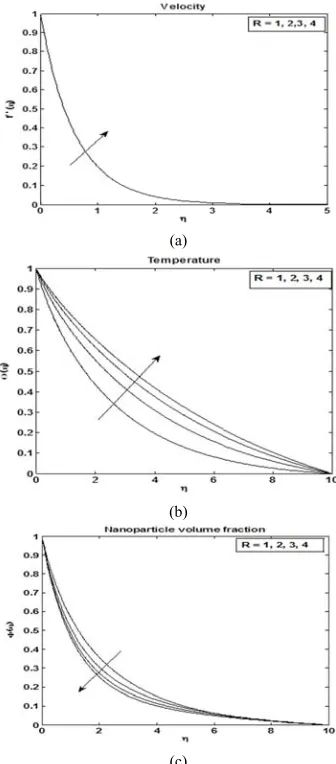
It is oversho increme nanopa increase volume Nt lea nanopa Here tempera radiatio tempera
re 6a and 6b ature and n phoresis param observed that t e of thermopho e nanoparticle v e increase of N
7. Effects of Radia p
s also found oot near the wa ent in the therm article from ho
es the magnit e fraction profi ads to the l article boundary e from 7(a-c ature profiles on parameter
ature and nan
shows the var nanoparticle v meter Nt.
the temperatur oresis paramet volume fractio Nt.
(a)
(b)
(c) ation parameter R particle volume fr
d the nanopa all, this is due mophoresis for ot to cold are tude of tempe iles. Interesting
arge changes y layer. c) demonstra
for the vari r R, respe noparticle vol
riation of dim volume fract
re profiles incre ter Nt . Figure on increases sig
R on Temperature raction
article volume to increase in rce which take eas and conse erature and na gly, for slightl s in the thic
ates the var ious values o ctively for ume fraction
mensionless tion with
eases with 6b reveals gnificantly
and nano
e fraction Nt causes es to move equently it anoparticle ly increase ckness of
riation of of thermal
Trans. Phenom. Nano Micro Scales, 4(1) 44-51, Winter - Spring 2016
50 plots it is evident that the effect of thermal radiation is to analyze the velocity and temperature profiles while the nanoparticle volume fraction reduces with the increase of radiation.
CONCLUSION
The present paper is to analyze the laminar MHD boundary layer flow of nanofluid past and exponentially permeable stretching sheet. The main focus is to predict the effects of Brownian motion, thermophoresis, and radiation on heat of mass transfer in boundary layer flow of nanofluid. The finding of the present study is conclude as.,
1.Due to the increase of magnetic field the velocity profile decreases and the temperature and nanoparticle volume fraction reduces.
2.With the increase of velocity, temperature and nanoparticle volume fraction decreases the heat Source whereas increases with heat sink.
3.For Brownian motion the temperature of the fluid increases and the nanoparticle volume fraction decreases the effect of thermophoresis parameter is to enhance the temperature profiles and nanoparticle volume fraction significantly.
4.With the increase of Prandtl number and Lewis number the nanoparticle volume fraction decreases, the temperature profile decreases with Prandtl number and decreases with Lewis number.
5.The effect of radiation parameter is to enhance the velocity and temperature and reduces the nanoparticle volume fraction.
REFERENCES
[1] B.C.Sakiadas: Boundary layer behaviour on continous solid surface, AICHEJ 7 (1961) 21- 28. [2] L. J. Crane: Flow past a stretching plate, Zeitschrift
fur Angewandte Mathematik und Physik ZAMP 21(1970) 645–647.
[3] F.K. TSOU, E.M sparrow, V. Goldstein: Flow and heat transfer in the boundary layer flow on a continous moving surface, Int.Journal of Heat and Mass Transfer 10 (1967) 219-235.
[4] E. M. A. Elbashbeshy: Heat transfer over an exponentially stretching continuous surface with suction, Archives of Mechanics 53 (2001) 643–651. [5] E. Magyari, B. Keller: Heat and mass transfer in the
boundary layers on an exponentially stretching Continuous surface, Journal of Physics D 32(1999) 577–585.
[6] M.K. Partha, P. V. S. N. Murthy, G. P. Rajasekhar: Effect of viscous dissipation on the mixed convection heat transfer from an exponentially stretching surface, Heat and Mass Transfer 41(2005) 360–366.
[7] A. Ishak: MHD boundary layer flow due to an exponentially stretching sheet with radiation effect, SainsMalaysiana 40 (2011) 391–395.
[8] K. Bhattacharyya: Boundary layer flow and heat transfer over an exponentially shrinking sheet, Chinese Physics Letters 28, Article ID 074701 (2011).
[9] N. Kishan, P. Kavitha: MHD Non-Newtonian Power Law Fluid Flow and Heat Transfer Past a Non-Linear Stretching Surface with Thermal Radiation and Viscous Dissipation, International Journal of Applied Mathematics 29 (2014)1318- 1332 . [10] K. Bhattacharyya , I. Pop: MHD boundary layer
flow due to an exponentially shrinking sheet, Magnetohydrodynamics 47 (2011) 337–344.
[11] R.K. Gupta, T. Sridhar: Visco-elastic effects in non-Newtonian flow through porous media, Rheol Acta 24 (1985) 148-51.
[12] S. Abel, PH. Veena: Visco-elastic fluid flow and heat transfer in a porous medium over a stretching sheet, Int.J Non-Linear Mech 33 (1998) 531-8. [13] R. Sharma: Effects of Viscous- elastics fluid flow
and heat source on unsteady boundary layer flow and heat transfer past stretching surface embedded in a porous medium using element free Galerkin method, Appl. Math Comput 219 (2012) 976 -87. [14] S. U. S. Choi: Enhancing thermal conductivity of
fluids with nanoparticles, in Proceedings of the ASME International Mechanical Engineering Congress and Exposition 66 (1995) 99–105.
[15] H. Masuda, A. Ebata, K. Teramae, N. Hishinuma: Alteration of thermal conductivity and viscosity of liquid by dispersing ultra-fine particles, Netsu Bussei 7 (1993) 227–233,.
[16] J. Buongiorno: Convective transport in nanofluids, Journal of Heat Transfer 128 (2006) 240–250. [17] D. A. Nield, A. V. Kuznetsov: The
Cheng-Minkowycz problemfor natural convective boundary-layer flow in a porous medium saturated by a nanofluid, International Journal of Heat and Mass Transfer 52 (2009) 5792–5795.
[18] A. V. Kuznetsov, D. A. Nield: Natural convective boundarylayer flow of a nanofluid past a vertical plate, International Journal ofThermal Sciences 49 (2010) 243–247.
[19] Rosmila et. As theorectically studied the problem of steady boundary layer flow of a nanofluid past a porous stretching surface with variable stream conditions and chemical reaction (2011).
N.Kishan et al.
51 /shrinking sheet in a nano fluid, Sains Malaysiana 41(2012) 1271-1279.
[21] W. A. Khan, I. Pop, Boundary-layer flow of a nanofluid past a stretching sheet, International Journal of Heat and Mass Transfer53 (2010) 2477– 2483.
[22] D. A. Nield, A. V. Kuznetsov: The Cheng-Minkowycz problemfor natural convective boundary-layer flow in a porous medium saturated by a nanofluid, International Journal of Heat and Mass Transfer 52 (2009) 5792–5795.
[23] O.D.Makinde, A. Aziz: Boundary layer flow of a nanofluid past a stretching sheet with a convective boundary condition, The International Journal ofThermal Sciences 50 (2011) 1326–1332.
[24] R. Kandasamy, P. Loganathan, P. Puvi Arasu: Scaling group transformation for MHD boundary-layer flow of a nanofluid past a vertical stretching surface in the presence of suction/injection, Nuclear Engineering and Design 241 (2011) 2053–2059. [25] P. Rana, R. Bhargava: Flow and heat transfer of a
nanofluid over a nonlinearly stretching sheet: a numerical study, Communications in Nonlinear Science and Numerical Simulation 17(2012) 212– 226.
[26] F. M. Hady, F. S. Ibrahim, S. M. Abdel-Gaied, M. R. Eid: Radiation effect on viscous flow of a nanofluid and heat transfer over a nonlinearly stretching sheet, Nanoscale ResearchLetters 7 article 229 (2012).
[27] H. naw, N. Kishan: MHD boundary layer flow and heat transfer of nanofluid past a nonlinearly with stretching / shrinking sheet with thermal radiation Journal Nanofluids 3 (2014) 1-9.
[28] C. Srinivas Reddy, N. Kishan, B. Chandra Shekar: MHD Boundary Layer Flow and Heat Transfer of a Nanofluid Over Shrinking Sheet with Mass Suction and Chemical Reaction, Journal of Nanofluids 4 (4) 518-527.