Please cite this article as: N. Farhadi, H. Saffari, and P. Torkzadeh, Evaluation of Seismic Behavior of Steel Moment Resisting Frames Considering Nonlinear Soil-structure Interaction, International Journal of Engineering (IJE), IJE TRANSACTIONS A: Basics Vol. 31, No. 7, (July 2018) 1020-1027
International Journal of Engineering
J o u r n a l H o m e p a g e : w w w . i j e . i rEvaluation of Seismic Behavior of Steel Moment Resisting Frames Considering
Nonlinear Soil-structure Interaction
N. Farhadi, H. Saffari*, P. Torkzadeh
Department of Civil Engineering, Faculty of Engineering, Shahid Bahonar University of Kerman, Kerman, Iran
P A P E R I N F O
Paper history:
Received 25 December 2017
Received in revised form 16 February 2018 Accepted 18 February 2018
Keywords:
Soil-structure Interaction Inter-story Drift
Beam on Nonlinear Winkler Foundation Radiation Damping
Non-Linear Response History Analysis
A B S T R A C T
In structural analysis, the base of structures is usually assumed to be completely rigid. However, the combination of foundation and the subsurface soil, makes in fact a flexible-base for the soil-structure system. It is well-known that the structural responses can be significantly affected by incorporating the Soil-structure Interaction (SSI) effects. The aim of the present study is to provide more accurate structural responses analysis by considering the influence of SSI. It is noteworthy that the input ground motion records imposed to the combination of the soil, foundation and structure were selected in a such way that their characteristics were completely matched with the subsurface soil of structures. For this purpose, 3, 6, 9, 12, 15, 18 and 20-storey structures resting on a shallow foundation were selected and the concept of Beam on Nonlinear Winkler Foundation (BNWF) model is employed. The seismic responses of these structures were calculated based on the five different types of soil and the outcomes were compared with those from fixed-base structures. A set of 35 ground motion excitations recorded on different soil types, is selected which categorized to 5 sets consist of 7 records. Non-Linear Response History Analysis (NL-RHA) was performed and radiation damping considered for all of the structures and soil types. The results clearly showed that the inter-storey drift ratio was reduced in lower stories considering SSI effects. These effects are strongly increased, especially with increasing the slenderness ratio of the structures and softening the subsurface soil. Finally, the period lengthening ratio of studied structures, for various soil types was investigated.
doi: 10.5829/ije.2018.32.07a.03
1. INTRODUCTION1
Considering SSI effects in comparison with the state within the base of the structure considered to be fix, can have significant effects on the structural seismic responses. By considering the base flexibility, it is expected that the structural seismic responses change with the altered dynamic system of soil-foundation-structure. In some cases, the SSI effects can be ignored while in some other cases these are significant. Various models inclusive of spring and damper have been introduced for considering SSI effects. To consider the accurate effects of SSI on the seismic demands of structures, various investigations have been performed. Raychowdhury and Hutchinson [1] evaluated the performance of the shallow foundation model based on
*Corresponding Author Email: [email protected] (H. Saffari)
nonlinear winkler springs by means of centrifuge test results. The results showed that the proposed model is able to predict the foundation responses such as shear, moment, settlement and rotation with acceptable accuracy. Gheyratmand [2] studied nonlinearity of foundation to evaluate the seismic demand in structures. Kalatjari et al. [3] investigated the behavior of structures with different in foundation levels with considering SSI effects in two types of soil. Behnamfar and Fathollahi [4] studied the seismic design spectra considering SSI effects. Sarlak et al. [5] investigated experimental and numerical of SSI using laminar shear box. They concluded that neglecting the SSI effects, leads to inaccurate design of structures.
(from stiff to soft soils) and subjected to five categories ground motion including seven ground motion records were employed. Also in modelling the SSI effects, the radiation damping is considered. The results showed that considering the SSI effects, the net inter-storey drifts at the structures reduce in comparison with fixed-base condition.
2. ADOPTED SSI SIMULATION MODEL
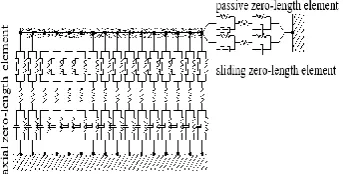
In this study, the interface between soil and foundation is modelled using combination of nonlinear winkler springs. This model is named BNWF that is able to simulate the behavior of a half-space semi-infinite homogeneous medium for interface between the soil and foundation. In this method, an arrangement of vertical springs (QZ) is used to consider the vertical and rotational resistances. Two other springs were used to consider passive (PX) and sliding (TX) resistances of the foundation, respectively in accordance to Figure 1 [1].
To determine the characteristics of the above mentioned springs, the nonlinear backbone curves were
used which developed by Raychowdhury and
Hutchinson [1] to the BNWF form and implemented in Open System for Earthquake Engineering Simulation (Open SEES) software [6]. The behaviour of vertical and horizontal springs, is illustrated in Figure 2. The equations used to introduce the behaviour curve of vertical and horizontal springs are similar to each other. In the linear elastic region, the load q is assumed to be linearly proportional with the displacement z according to Equation (1):
in
qk z (1)
In the above equation, kin is the initial elastic stiffness. The upper limit of the elastic region is defined as q0 by the following equation:
0 r ult
q C q (2)
In Equation (2) the range of the elastic range is controlled by
C
r.Figure 1. BNWF model
(a) (b) (c) Figure 2. Hysteretic seismic response of: (a) Q-Z spring behaviour (b) P-X spring behaviour c) T-X spring behaviour [1]
The nonlinear region of the backbone is defined by Equation (3):
50
0
50 0
n
ult ult p p
cz q q q q
cz z z
(3)
In the above equation qult is the ultimate load, z50 andzp0
are the displacement at which 50% of ultimate load is activated and displacement at yield point. The shape of the post-yield region of the backbone is controlled by c and n parameters.
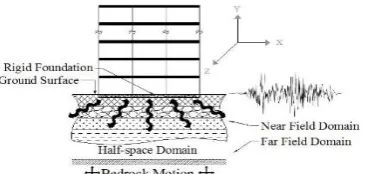
In the far-field domain of soil, energy dissipated through radiation damping. Radiation damping is defined as energy dissipated by propagation of waves away from the foundation in vibration condition. Figure 3 illustrates the reflection and radiation of ground motion waves during an earthquake.
3. GROUND MOTION RECORDS
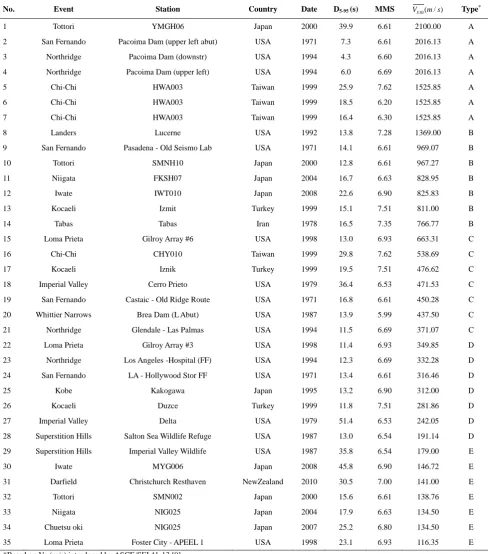
The follow points are considered to select the ground motion records: a) In the process of selecting the records, it is important that significant duration of the records (D5-95(S)) should be the maximum of 10 s or 3T1fixed(s). The duration is defined as the time needed to build up between 5 and 95 percent of the total arias intensity. b) The amount of Moment Magnitude Scale (MMS) of the ground motions records is tried to be more than 6. c) It is tried that the PGA (Peak Ground Acceleration) of ground motion to be more than 0.1 times acceleration due to gravity (g). Details of selected records are provided in Table 1 adopted from Pacific Earthquake Engineering Research (PEER) ground motion database website (PEER, [7]).
In Table 1, VS30is the average of the shear wave
TABLE 1. Characteristics of the selected ground motions on soil types A to E used in the NL-RHA
No. Event Station Country Date D5-95 (s) MMS VS30( / )m s Type
*
Figure 3.Schematic representation of reflection and radiation of ground motion waves
Figure 4. The 5% damped design spectra used in this study for different soil types
For more information about the spectral curve, refer to ASCE/SEI 41-13 [9].
4. CHARACTERISTICS OF THE STUDIED SOIL-STRUCTURE SYSTEMS
In this section, to investigate the SSI effects on the seismic demands of the steel MRF, a category of seven structures with different dimensions are selected according to Karavasilis et al. [10]. These structures have 3, 6, 9, 12, 15, 18 and 20-storiey resting on a shallow foundation and all of them are three-bay frames. Span lengths and the storey heights are equal to 5 m and 3 m meters, respectively. The plan dimensions are 15 m×15 mthat are shown in Figures 5-6. The fundamental time period of the mentioned structures are 0.79, 1.25, 1.68, 2.00, 2.35, 2.64 and 2.66 s. It is assumed that these structures are located in Seattle city, USA. The height of the floor i from the foundation surface is displayed by hi as shown in Figure 6.Due to the symmetricity of all structures, 2-D models including first axis of the frames are considered. The dead and live loads at stories are equal to 27.5 kN/m and all structures were generated from A36 steel with the yielding strength equal to 235 MPa. The distributed nonlinearity is used for the elements through nonlinear beam-column element in OpenSEES software [6]. Post yielding slope for kinematic material hardening without degradation assumed to be 3% of the elastic slope in the structural elements (Figure 7).
Figure 5. Plan of the structures
Figure 6. Typical section of the n-storey structure
Figure 7. Constitutive model for Strength-hardening
P-Δ effects were considered but the influences of the panel zones were ignored. Inertia SSI was considered in this study and the effects of the kinematic SSI were also ignored. The seismic mass value can be calculated trough dividing each storey load to the ground motion acceleration. The Special Moment Resisting Frame (SMRF) was also selected as the lateral resisting system. The rayleigh damping of 5% for 1th and 2nd modes was considered for the studied structures. The behaviour of structural elements without stiffness degradation
poisson's ratio and internal friction angle for all 5 soil types with sandy soil assumption are assumed to be 0.3 and 30º, respectively. The mass density values of soil types that are considered in this study, listed in accordance to Table 2.
It is important to note that the foundation for all structures are assumed to be shallow and rigid. The foundation material density which is used in SSI calculations is also considered equal to 23.6 KN/m2. The initial shear modulus of soil (G0) is obtained from Equation (2).
2
0 s
TABLE 2. Mass density of considered soils
Site Class 2 4
( .N S /m)
A 1900
B 1850
C 1800
D 1750
E 1700
In the above equation ρ is the soil mass density. More details about the structures were reported by Karavasilis et al. [10].
5. NUMERICAL RESULTS AND DISCUSSION
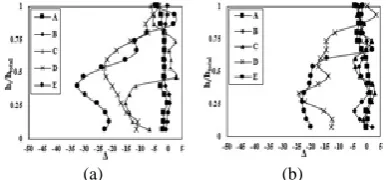
As mentioned before, in order to investigate the effects of considering SSI, soils with different stiffness are modelled and the inter-storey drifts have been studied. According to this pointof view,each structure is analysed 70 times by means of NL-RHA (35 state with fixed-base and 35 times with flexible base). The peak inter-storey drift with positive and negative signs subjected to each category of 7 ground motion records, are computed and the mean values are obtained. As shown in Figures 8-14, the peak positive and negative drifts for flexible base are compared with fixed-base ones, using the following equation:
(%) SSI Fixed
Fixed
(3)
In Equation (3), SSI and Fixedare the inter-storey drift in the flexible and fixed conditions, respectively. Also,
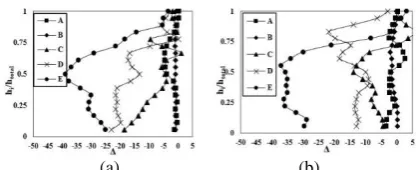
is the difference percentage in two these conditions in each storey of the studied structures and named inter-storey drift ratio reduction factor. It is to be noted that since the rigid body rotations of the foundation do not contribute in the stresses of beams and columns; it should be subtracted from the total drift ratios. In this study, the net rotation at each storey for inter-storey drift calculations is considered. For this purpose, the rotation of the rigid body is reduced from the total rotation. Figure 8 shows the dimensionless variations of the positive and negative peak inter-storey drifts with 5 different soil type for 3-storey structure. The peak value of these variations are equal to 3.7% in soil type E which is negligible.
Figure 9 shows the mentioned values for the 6-storey structure. It is obvious that the influences of the SSI incorporation, increases with the structural height. However, these effects are usually meaningful for the soft soils (types D and E). Also, it seems that there is no necessary need to consider SSI for the stiff soils types A and B.
(a) (b)
Figure 8. Inter-storey drift ratio reduction factor for 3-storey (a) peak maximum positive (b) peak minimum negative
(a) (b)
Figure 9. Inter-storey drift ratio reduction factor for 6-storey (a) peak maximum positive (b) peak minimum negative
(a) (b)
Figure 10. Inter-storey drift ratio reduction factor for 9- storey (a) peak maximum positive (b) peak minimum negative
(a) (b)
Figure 11. Inter-storey drift ratio reduction factor for 12-storey (a) peak maximum positive (b) peak minimum negative
(a) (b)
(a) (b)
Figure 13. Inter-storey drift ratio reduction factor for 18-storey (a) peak maximum positive (b) peak minimum negative
(a) (b)
Figure 14. Inter-storey drift ratio reduction factor for 20-storey (a) peak maximum positive (b) peak minimum negative
Figure 10 illustrates the inter-storey drift variations with negative and positive signs for the 9-storey structure.
As mentioned previously, with an increase in structural height, the effects of considering SSI in seismic demands of structures, are increased and this increment is more important for the soft soils. These values for the inter-storey drifts of the 9-storey structure and for soil type E and at the lower stories is visible up to 25%, while for the soil types A and B does not exceed more than than 2%. Figure 11 contains the responses variations with and without SSI effects for 12-storey structure.
When the height of structures is increased, the importance of considering SSI effects in stiff soils (type A and B) is visible. Figures 12-14 show the variations of the structural seismic responses considering SSI effects for 15, 18 and 20-storey structures. In such structures the variation is also important with soil type C.
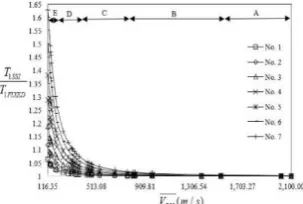
In the 15-storey structure the changes the SSI effects with soil types A and B are ignorable. This effect is observable more than ever seen with structural height increment. Figure 14 provide evidence for the mentioned point in 20-storey structure. In this structure the variations are very visible in C, D and E soil types. The period lengthening ratio (T1SSI /T1FIXED) versus shear wave velocity (
30( / )
S
V m s ) in various soil classifications is depicted in Figure 15 for considered structures.
It is evident that softening the soils result in lengthen the fundamental period of the structures.Table 3 shows the increment in average values (%) of fundamental period considering SSI effects in comparison with fixed-base condition. It is evident that the average values of fundamental period are increased
with softening the soil. This phenomenon is especially substantial in high-rise structures. and B. Figure 10 illustrates the inter-storey drift variations with negative and positive signs for the 9-storey structure.
As mentioned previously, with an increase in structural height, the effects of considering SSI in seismic demands of structures, are increased and this increment is more important for the soft soils. These values for the inter-storey drifts of the 9-storey structure and for soil type E and at the lower stories is visible up to 25%, while for the soil types A and B does not exceed more than than 2%. Figure 11 contains the responses variations with and without SSI effects for 12-storey structure.
When the height of structures is increased, the importance of considering SSI effects in stiff soils (type A and B) is visible. Figures 12-14 show the variations of the structural seismic responses considering SSI effects for 15, 18 and 20-storey structures. In such structures the variation is also important with soil type C.
In the 15-storey structure the changes the SSI effects with soil types A and B are ignorable. This effect is observable more than ever seen with structural height increment. Figure 14 provide evidence for the mentioned point in 20-storey structure. In this structure the variations are very visible in C, D and E soil types. The period lengthening ratio (T1SSI /T1FIXED) versus shear wave velocity (VS30(m s/ )) in various soil classifications
is depicted in Figure 15 for considered structures. It is evident that softening the soils result in lengthen the fundamental period of the structures. Table 3 shows the increment in average values (%) of fundamental period considering SSI effects in comparison with fixed-base condition. It is evident that the average values of fundamental period are increased with softening the soil. This phenomenon is especially substantial in high-rise structures. and B. Figure 10 illustrates the inter-storey drift variations with negative and positive signs for the 9-storey structure.
As mentioned previously, with an increase in structural height, the effects of considering SSI in seismic demands of structures, are increased and this increment is more important for the soft soils. These values for the inter-storey drifts of the 9-storey structure and for soil type E and at the lower stories is visible up to 25%, while for the soil types A and B does not exceed more than than 2%. Figure 11 contains the responses variations with and without SSI effects for 12-storey structure.
TABLE 3. The increment in average values (%) of fundamental period considering SSI effects in comparison with fixed-base condition
No. height categorization* A B C D E
1 low-rise < 1 < 1 1 2 5
2, 3 mid-rise < 1 < 1 1 4 11
4, 5, 6, 7 high-rise < 1 1 5 10 33
*Based on classification introduced by CTBUH [11]
In such structures the variation is also important with soil type C.
In the 15-storey structure the changes the SSI effects with soil types A and B are ignorable. This effect is observable more than ever seen with structural height increment. Figure 14 provide evidence for the mentioned point in 20-storey structure. In this structure the variations are very visible in C, D and E soil types. The period lengthening ratio (T1SSI /T1FIXED) versus shear wave velocity (
30( / )
S
V m s ) in various soil classifications is depicted in Figure 15 for considered structures.
It is evident that softening the soils result in lengthen the fundamental period of the structures.Table 3 shows the increment in average values (%) of fundamental period considering SSI effects in comparison with fixed-base condition. It is evident that the average values of fundamental period are increased with softening the soil. This phenomenon is especially substantial in high-rise structures. and B. Figure 10 illustrates the inter-storey drift variations with negative and positive signs for the 9-storey structure.
As mentioned previously, with an increase in structural height, the effects of considering SSI in seismic demands of structures, are increased and this increment is more important for the soft soils. These values for the inter-storey drifts of the 9-storey structure and for soil type E and at the lower stories is visible up to 25%, while for the soil types A and B does not exceed more than than 2%. Figure 11 contains the responses variations with and without SSI effects for 12-storey structure.
When the height of structures is increased, the importance of considering SSI effects in stiff soils (type A and B) is visible. Figures 12-14 show the variations of the structural seismic responses considering SSI effects for 15, 18 and 20-storey structures. In such structures the variation is also important with soil type C.
In the 15-storey structure the changes the SSI effects with soil types A and B are ignorable. This effect is observable more than ever seen with structural height increment. Figure 14 provide evidence for the mentioned point in 20-storey structure. In this structure the variations are very visible in C, D and E soil types.
The period lengthening ratio (T1SSI/T1FIXED) versus shear wave velocity (
30( / )
S
V m s ) in various soil classifications is depicted in Figure 15 for considered structures.
It is evident that softening the soils result in lengthen the fundamental period of the structures.Table 3 shows the increment in average values (%) of fundamental period considering SSI effects in comparison with fixed-base condition. It is evident that the average values of fundamental period are increased with softening the soil. This phenomenon is especially substantial in high-rise structures.
Figure 15. Period lengthening ratio (T1SSI/T1FIXED) versus shear
wave velocity (VS30(m s/ )) for considered structures
6. CONCLUSIONS
SSI are overestimated and at the upper stories have no meaningful different with the responses obtained from the situation with considering SSI. Also, it is observed that the effects of considering the SSI in low-rise structures on stiff and soft soil, are negligible at all stories and it is not necessary to consider (as much as 10~15% in 3 and 6-storey structures). The reduction in maximum variation is about 40% in high-rise structures (18 and 20-storey). The results indicate that about 33% increase in fundamental period in high-rise structures constructed on soft soil in comparison with fixed-base conditions. These case studies confirm that the SSI effects should be taken into account and it is important to consider during structural analysis and design especially in high-rise structures.
7. References
1. Raychowdhury, P. and Hutchinson, T.C., "Performance evaluation of a nonlinear winkler‐based shallow foundation model using centrifuge test results", Earthquake Engineering & Structural Dynamics, Vol. 38, No. 5, (2009), 679-698. 2. Gheyratmand, C., "Employing foundation nonlinearity to
mitigate seismic demand in superstructure", International Journal of Engineering, Transactions B: Applications, Vol. 29, No. 5, (2016), 606-614.
3. Kalatjari, V.R., Naghizadeh, A., Naderi, R. and Talebpour, M.H., "Base level evaluation in buildings with different foundation levels by soil-foundation-structure interaction", International Journal of Engineering, Transactions C: Aspects, Vol. 30, No. 9, (2017), 1288-1297.
4. Behnamfar, F.a.F., A., "Soft soil seismic design spectra including soil-structure interaction", International Journal of Engineering, Transactions A: Basics, Vol. 30, No. 10, (2017), 1443-1450.
5. Sarlak, A., Saeedmonir, H. and Gheyretmand, C., "Numerical and experimental study of soil-structure interaction in structures resting on loose soil using laminar shear box", International Journal of Engineering, Transactions B: Applications, Vol. 30, No. 11, (2017), 1654-1663.
6. "Opensees, open system for earthquake engineering simulation, California, USA, University of Berkeley, (2017).
7. "Peer, the pacific earthquake engineering research center, California, USA, University of Berkeley, (2017).
8. Engineers, A.S.o.C., Buildings, S.E.I.M.D.L.o. and Committee, O.S.S., "Minimum design loads for buildings and other structures, American Society of Civil Engineers., (2013). 9. Pekelnicky, R. and Poland, C., "Seismic evaluation and retrofit
of existing buildings", in SEAOC 2012 Convention Proceedings, CA, USA. (2012).
10. Karavasilis, T., Bazeos, N. and Beskos, D., "Maximum displacement profiles for the performance based seismic design of plane steel moment resisting frames", Engineering Structures, Vol. 28, No. 1, (2006), 9-22.
11. "CTBUH. Council on tall buildings and urban habitat chicago, Illinois, USA.
Evaluation of Seismic Behavior of Steel Moment Resisting Frames Considering
Nonlinear Soil-Structure Interaction
N. Farhadi, H. Saffari, and P. Torkzadeh
Department of Civil Engineering, Faculty of Engineering, ShahidBahonar University of Kerman, Kerman, Iran
P A P E R I N F O
Paper history:
Received 25 December 2017
Received in revised form 16 February 2018 Accepted 18 February 2018
Keywords:
Soil-structure Interaction Inter-story Drift
Beam on Nonlinear Winkler Foundation Radiation Damping
Non-Linear Response History Analysis
هدیکچ
لیلحت رد هزاس هیکت لاومعم اه یم هتفرگ رظن رد رادریگ لاماک هزاس هاگ
نآ ریز کاخ و نویسادنوف ،تیعقاو رد هک تسا یلاح رد نیا .دوش
فاطعنا رتسب کی لیکشت یم لیکشت هزاس و کاخ شنکردنا متسیس یارب ار ریذپ
هک تسا راکشآ لاماک .دنهد خساپ
هزاس یاه زا رثاتم یا
یم هزاس و کاخ نیب شنکردنا قیقد یسررب ،رضاح هعلاطم زا فده .دنشاب
هزاس خساپ رت یم هزاس و کاخ شنکردنا رثا نتفرگ رظن رد اب اه
-باتش هک تسا نیا قیقحت نیا رد مهم هتکن.دشاب تشاگن
ا یوحن هب ،نآ ریز کاخ و نویسادنوف ،هزاس هعومجم هب هدراو یاه باختن
هدیدرگ نآ تاصخشم هک دنا یم هزاس ریز کاخ اب قبطنم لاماک اه
نامتخاس روظنم نیا یارب .دشاب تاقبط دادعت اب ییاه
3 ، 6 ، 9 ، 12 ، 15 ، 18 و 20 هدش هتفرگ رظن رد دنراد رارق یحطس نویسادنوف یور هک .دنا
هدیدرگ هدافتسا رلکنیو یطخ ریغ نویسادنوف رب ریت لدم زا نینچمه
تسا خساپ . هزرل یاه هزاس نیا یا خساپ اب و هبساحم فلتخم کاخ هتسد جنپ یور رب اه هزاس یاه
هدش هسیاقم رادریگ هیاپ اب یا کی .دنا
لماش هعومجم 35
باتش کاخ یور رب هک تشاگن هدش تبث فلتخم یاه
بلاق رد ،دنا 5 هتسد 7 هقبط ییات هدیدرگ یدنب هزاس نیا.دنا اه
هچخیرات لیلحت تحت یم رارق یسررب دروم ،یعاعش ییاریم نتفرگ رظن رد اب یطخ ریغ یکیمانید ینامز
یم ناشن جیاتن.دنریگ تبسن هک دهد
هقبط نیب تفیرد یم شهاک ،هزاس و کاخ شنکردنا تارثا نتفرگ رظن رد اب نییاپ تاقبط رد یا
هزاس یرغلا تبسن شیازفا اب .دبای و اه
مرن نینچمه نآ نیریز کاخ ندش رت ه
مشچ تارثا نیا ،ا یم رتریگ
هزاس بوانت هرود شیازفا تبسن تیاهن رد .دنوش کاخ رد اه
فلتخم یاه
یم رارق یسررب دروم .دریگ
doi: 10.5829/ije.2018.31.07a.03