Exploring L2 Learning Potential through
Computerized Dynamic Assessment
Saman Ebadi1
Associate Professor,Department of English Language and Literature, Razi University, Kermanshah, Iran
Abdulbaset Saeedian
MA Graduate, Department of English Language and Literature, Razi University, Kermanshah, Iran
Abstract
Dynamic Assessment (DA) is theoretically derived from Vygotsky's Zone of Proximal Development (ZPD). This study seeks to investigate the effect of Computerized Dynamic Assessment (C-DA) on assisting learners to realize their latent potential in learning reading comprehension. A group of 32 adult EFL students studying English as their BA major in a University in Iran participated in the study. In order to measure the students' potential for learning, Kozulin and Garb's (2002) formula which is called the Learning Potential Score (LPS) was used. The LPSs represented how much mediation was likely required for an individual or a group of individuals to develop or move forward. The results showed that learners with the same pretest scores might turn out to have different or even drastically different DA posttest scores and hence different LPSs. On account of the LPS obtained through the C-DA principles at-risk students are provided with opportunities that might result in overcoming some of the challenges they faced in traditional testing.
Keywords: Dynamic Assessment, Computerized Dynamic Assessment,
Learning Potential Score, Sociocultural Theory of Mind, Zone of Proximal Development
Received on December 28, 2018
Accepted on August 20, 2019
1. Introduction
Derived from the writings of prominent Russian psychologist, Vygotsky (1896-1934), Dynamic Assessment (DA) focuses on learners' potential for future learning and development (Lidz, 1987 as cited in Ebadi, 2014) and
seeks to enable individual learners in its inchoate period and more cohorts of individuals over time to outperform their current performance level by making use of mediation which is sensitized to the needs of learners. The theoretical basis of DA, namely, Sociocultural Theory of Mind (SCT) was developed by Vygotsky (1987) which proposes that learners will be cognizant of their potential abilities owing to taking part in some organized activities in which mediation plays a key role.
In recent years, the growing importance of DA in L2 (Ableeva, 2008; Aljaafreh & Lantolf, 1994; Poehner & Lantolf, 2005; Poehner, 2008) in general, and L2 reading comprehension (Antón, 2009; Kozulin & Garb, 2002, 2004) in particular has been recognized. Improving students' progress in certain abilities, for example, reading comprehension in this study, and to make them aware of their potentiality for learning by focusing on the cognitive processes of learning are two principal purposes of DA. As it is also been confirmed by (Dörfler, Golke, & Artelt, 2009) for the development of tasks and feedbacks within dynamic reading-competence tests, a conception of inferential processes and interventions is required to construct and apply suitable instructional techniques. Hence, "dynamic assessments in the domain of reading comprehension rely on instruction and practice in metacognitive knowledge (including strategies) which is specific to certain reading tasks and goals" (Dörfler, et al., p. 80). That is why the 'reading comprehension' skill has been chosen to be examined in this study and its first question is dedicated to exploring the effects of C-DA on promoting Iranian EFL students' reading strategies.
program, in this study CDRT developed by Pishghadam and Barabadi (2012). Yet, these are not the only shortcomings of DA which have been overcome utilizing the C-DA procedures. Haywood and Tzuriel (2002), Haywood and Lidz (2007) and Poehner (2008) all agree upon two more shortcomings of DA: first, in addition to being time-consuming, it needs a hyperactive and energetic teacher (mediator) to take charge of such classes. Second, DA practitioners worry about its reliability and validity. Of course, Pishghadam and Barabadi (2012) have done a study which alleviated the concerns in terms of DA reliability and validity. In addition, because most of the English classes in Iran are large in size, applying the DA procedure (i.e., providing human-to-human mediation to each individual learner can be unrealistic). Unknown number of instruction sessions or not having "equal time-on-task in DA experimental designs” is another problem of DA because in research viewpoint it is preferred to have a certain number showing equal time-on-task" (Nassaji, & Swain, 2000, p. 48).
DA is different from nondynamic assessment (NDA) in some regards. One of the differences between dynamic and nondynamic assessment is in their orientation, that is, they are process-oriented and product-oriented respectively (Carney & Cioffi, 1992). While citing the aforementioned study based on which DA differs from other traditional assessment with regard to orientation, procedure and interpretation, Birjandi, Estaji, and Deyhim (2013, p. 61) stated that "DA focuses on the evaluation process as well as the product." The researchers, therefore, chose DA as the assessment type of his study due to its feasibility in dealing with process and product.
(Feuerstein & Falik, 2010), DA takes individuals' modifiability and potential to change into consideration and believes that they will improve to their best of their potential if they are provided with an appropriately-mediated learning environment (Teo, 2012).
There are generally two approaches to do DA (i.e., interventionist & interactionist). In the interventionist approach to DA, the same mediation is used with every learner. Therefore, it is easier to manage a larger number of participants (Poehner, 2008). In the interactionist approach to DA, the mediator cooperates separately with each learner to coconstruct ZPDs during different one-on-one sessions and the mediation provided for each student may be (is) different from the one provided for the others (Aljaafreh & Lantolf, 1994). It is true that a larger number of students can be examined in Interventionist DA in comparison to the number to be investigated in Interactionist DA. Because the number of participants in the this study is more than those in other studies, such as Aljaafreh and Lantolf (1994), Antón (2009), to name just a few, the interventionist approach to DA was preferred over the interactionist one.
Tzuriel & Shamir, 2002; Summers, 2008; Pishghadam et al., 2011). This study utilizes Computerized Dynamic Reading Comprehension Test (CDRT) because this software can show those questions which have not been answered by students, thus it helps the interventionist mediator explore the students' problems and solve them by applying appropriate strategies.
Hence, they can help the learners overcome their problems by providing sufficient feedback and even mediators can motivate learners to do their best to achieve their best latent potential by providing a picture of their abilities. This can even be more tangible while dealing with reading and reading strategies because if the mediator helps learners apply the reading strategies appropriately, they can to a large extent maintain the same strategies even after the mediation.
This study sought to investigate the effect of (C-DA) - which is a type of DA- on assisting a group of adult EFL students studying English as their BA major in a University in Iran to realize their latent potential in learning reading comprehension.
2. Review of Related Literature
2.1 Theoretical Background of the Study
DA is framed within Sociocultural Theory (SCT) of mind which was initially proposed by the Russian psychologist Vygotsky and includes two crucial concepts: mediation and the Zone of Proximal Development (ZPD). SCT deals with the role of social context in learning and underscores the central role that social relationships and participation in culturally organized practices play in learning. In L2 research, SCT emphasizes the role that social interaction plays in learning and the nature of language as a communicative activity rather than as a formal linguistic system.
determined by independent problem solving and the level of potential development as determined through problem solving under adult guidance, or in collaboration with more capable peers. For example, two 8 years old children may be able to complete a task that an average 8 years old can do. Next, more difficult tasks are presented with very little assistance from an adult. In the end, both children were able to complete the task. However, the styles methods they chose depended on how far they were willing to stretch their thinking process (Vygotsky, 1978, p. 86).
This means that there is a difference between learners' actual and proximal development and one can understand a learner's actual (current) level by exploring what he/she can do on his/her own, but only through exploring what the learner is able to do with a more-skilled other (e.g., parents, peers, teachers) is it possible to explore his/her potential development. Hence ZPD, based on Ableeva (2010), is comprised of the difference between what a learner can today do with the help of others (more skillful than him/her) and what he/she can do without help tomorrow.
Taking this into consideration, the present researchers attempted to help the at-risk advanced students participate in this study to be aware of their ZPD and try to activate and gain the best of their potential. De Beer (2006, p. 9) remarked that ZPD "reflects development itself", that is, "it is not only about what one is, but what one can become; it is not only what has developed but what is developing and can be viewed as a means to improve the testing of individual mental functioning."
individual's potential development which is of importance in ZPD whereas mediation paves the way for the individual to achieve such development (Shrestha & Coffin, 2012). Development of mediation is also of high significance (Lantolf, 2000). For Vygotsky, development occurs if individuals move from other regulation to self-regulation. This type of development which was also underscored by Birjandi and Ebadi (2012) is referred to as microgenesis. Microgenetic development, based on Birjandi and Ebadi (p. 35) is actually "the development of mediation between expert and novice in a short time period."
2.2 Dynamic vs. NonDynamic (Static) Assessment
DA is a kind of assessment which is interactive. Lidz and Gindis (2003, p. 99) defined DA as "an approach to understanding individual differences and their implications for instruction that embeds intervention within testing procedure". Haywood and Lidz (2007, p. 1) defined DA as follows: "an interactive approach to conducting assessments within the domains of psychology, speech/language, or education that focuses on the ability of the learner to respond to intervention." Sternberg and Grigorenko (2002, p. vii), in a similar manner, discussed DA as a form of assessment that "takes into account the results of an intervention. In this intervention, the examiner teaches the examinee how to perform better on individual items or on the test as a whole." Though the last two definitions of DA provide a similar “conceptual footing of the current DA approaches" (Ableeva, 2010, p. 98), they fail to determine theoretical profiles of different approaches to DA. The directly drawn definition of DA based on the theoretical and methodological underpinnings of Vygotsky's SCT is as follows:
some cases a group's) current abilities. In essence, DA is a procedure for simultaneously assessing and promoting development that takes account of the individual's (or group's) zone of proximal development (Lantolf & Poehner, 2004, p. 50).
This definition takes the ZPD, mediation, and development which are the central aspects of SCT into account and is a conceptual and theoretical basis for SCT-oriented DA.
According to Lidz and Gindis (2003), there are three main differences between dynamic and nondynamic procedures. They are as follows: the view of abilities, the purpose of assessment, and the role of the examiner. Lidz and Gindis (p. 100) believed that in DA, in contrary with NDA which is also called Static Assessment (SA), the abilities are not fixed and stable instead they can be changed because they are "the result of the individual's history of social interactions in the world". Regarding the purpose of conducting assessment, again DA and NDA are in contradictory. Because the purpose of assessment in DA is to diagnose the abilities that are fully matured and those that are still in the process of maturing. While in NDA or the same traditional methods of assessment only fully matured abilities and the product of development are reported. With regard to the third difference, namely, the role of the examiner, collaboration with examinee is crucial to development in DA in order to have a true picture of their abilities, but this is not the case in NDA and any aid from the examiners' side is to be avoided during the completion of assessment tasks. The last point has been synopsized by (Sternberg & Grigorenko, 2002, p. 29) who stated that the "conventional attitude of neutrality" characteristic of traditional assessments "is thus replaced by an atmosphere of teaching and helping."
individuals’ solo performance and according to Lidz (1987, as cited in Birjandi & Ebadi, 2012) DA is at odds with NDA in that the former focuses on the learning processes and serves as a means of measuring the ZPD, but the latter focuses on already learned products.
2.3 Computerized Dynamic Assessment (C-DA)
Similar to DA, the central concept of the C-DA is grounded in Vygotsky's theoretical framework (1978) as well. Some studies have been conducted within DA scope while taking computer into very close considerations.
One of the studies conducted in the domain of C-DA was done by Jacobs (2001) in which preschoolers' potential language disorders were identified by a C-DA program called KIDTALK. The children were of culturally and linguistically diverse backgrounds. Jacobs aimed to examine the effect of the C-DA training and scoring on the individual children's performance. In this program, a series of questions assess understanding of the language after the video is played. Whenever a learner answers incorrectly, the test pauses and the relevant portion of the introductory video is played again and the test resumes. If the leaner responds incorrectly again, the video is played for the final time. This means that each learner can have three attempts. Jacob's (2001) KIDTALK and Guthke and Beckmann's (2000) Lerntest have one thing in common. Instead of providing a graduated series of hints for learners who fail to answer correctly, they both allow only one form of mediation. In KIDTALK, the introductory video is replayed and in Lerntest, a tutorial module was used.
metacognitive reading strategies in making inferences. To do so, he used the Viewlet Quiz 3 software to develop a C-DA program which lets the learners respond to the preprogrammed computerized intervention. Similar to other studies, its four levels of mediation in the C-DA procedure moves from implicit to explicit. That is, if a learner answers a question incorrectly, the computerized hints are presented to them in order of increasing explicitness.
The most recent research on the field of C-DA, to the best of the researchers' knowledge, was done by Teo (2014). She used an interventionist approach to DA by providing preprogrammed mediation during assessment for learners. Similar to his previous study, he conducted the study in a Taiwanese college and investigated the reading skills of 137 non-English major students, having divided them into a control and an experimental group. He investigated three reading skills (i.e., identifying main ideas or FMI), using contextual clues (CC), and making inferences (MI) using a C-DA program which provided the learners with preprogrammed mediation without having to rely on one-on-one mediation. The mediations provided in her C-DA program, similar to the ones used in this study, are consistent with the guidelines of Aljaafreh and Lantolf (1994) and range from the most implicit to the most explicit.
This study aimed to assess the degree the C-DA procedures could help individuals be cognizant of their latent abilities by offering prescripted mediation. To do so, the following question guided the study:
To what extent does computerized dynamic assessment help the participants realize their learning potential?
3. Methodology
because it follows interventionist DA (Poehner & Lantolf, 2005). In other words, both qualitative and quantitative research have been used in the study. 3.1 Participants
The participants were selected from among all 47 undergraduates of Bachelor of Arts (BA) who studied Teaching English as a Foreign Language (TEFL) at a university in Iran. Of these 47 students, 32 were selected non-randomly to take part in the study on availability basis. The mean age of the sample which was 27 years ranging from 26 to 33 indicated that the participants were adults. English was the second language of these adult participants, so this study was carried out in an L2 context. The homogeneity of the participants was taken for granted by claiming this statement (also being contended by Poehner, 2005) that the number of semesters the students have spent studying a language shows their proficiency level in that language. Of course, the results obtained from the DIALANG, a free online assessment system to determine learners’ proficiency level, were also indicative of the homogeneity of the participants. In addition to Poehner's claim, the researchers also made use of DIALANG to make sure about their status. Among the 32 participants, the results showed that 24 were at the B2 English reading comprehension level, seven were at the B1 proficiency level, and only one participant was at the C1 level.
reason for selecting them to take part in this study is clear. Of course, the educational system of this university, its professors, the students, their aim of studying, and so forth may also be responsible for these students' very low proficiency but for the aim of this research only the students themselves were investigated.
The importance of using this study lies in the contradiction between the terms 'advanced', and 'at-risk' learners which are representative of the 'should-be' level and ‘actual’ status of the participants of the present study respectively. Because the participants were seniors, they were considered as
‘advanced’ students but due to their low proficiency, based on the results
obtained from the Placement Test of DIALANG which is the primary outcome of an EU funded project to deliver an instrument for aligning language learners on the Common European Framework of Reference for Languages (CEFR), they were called 'at-risk' too. That is why these two contradictory terms have been used to refer to the participants of the present study. That the number of semesters can be indicative of the proficiency of students has also been given priority by Poehner (2005). Therefore, it is of really high importance to reiterate that the tests which have been used in this study were all suitable for advanced level students and that using DIALANG was just to reassure that students were 'at-risk'. In other words, the tests were not designed based on the results obtained from DIALANG but instead they were designed for advanced students by taking this for granted that the number of semesters indicates the proficiency of students.
3.2Instrumentation
3.2.1 Computerized Dynamic Reading Test (CDRT)
Computerized Dynamic Reading Test (CDRT). With regard to the software, it is worth mentioning that it can easily run on any PC given that the NET Framework software is installed on it. Students have to enter some information such as their name, age and major (students can choose a pseudonym to remain anonymous for other people but they should say it to the mediator) and after reading the software description go directly into the passage and answer the items while consulting the preplanned hints which are automatically shown if a wrong response is chosen. It takes about two hours to complete responding the test and after completing it a scoring file is created on the desktop to know about the test taker's performance.
3.2.2 DIALANG
DIALANG is an online assessment system which is free and is intended for individual adult language learners who aim to obtain diagnostic information about their linguistic proficiency for three of the four main skills, i.e. Reading, Listening and Writing and two subskills (i.e., Grammar and Vocabulary in fourteen languages). Having instructions and tests in all these languages has made DIALANG a practical way at identifying learners’ proficiency level. DIALANG's Assessment Framework and self-assessment statements are based on the Common European Framework of Reference (CEFR) for Languages; thus, it also gives feedback on the strengths and weaknesses of the learner's proficiency and advises about how to improve language skills. To determine the participants' proficiency level in this study, they were asked to visit the following address: http://dialangweb.lancaster.ac.uk. Because each test took about two hours for
each individual to complete, the whole process took two days until the results
3.3 Data Collection Procedure
Upon the completion of the CDRT, the participants were reported of their performance which was saved in a scoring file on desktop to be analyzed later by the researchers. In addition to determining the total amount of time spent on responding the test, three more parts of information were provided as well: (a) individual student's first try of each item (NDA score), (b) Score gained with the use of hints (DA score), and (c) The number of hints used in each item.
was their dynamic score and their score gained with no hint (i.e., their first try) was called their nondynamic score.
4. Data Analysis
In order to measure the students' potential for learning, Kozulin and Garb's (2002) formula which is called the Learning Potential Score (LPS) was used. Based on Poehner and Lantolf (2013), LPS shows how much mediation is likely required for an individual or a group of individuals to develop or move forward. Of course, through running the Pearson product moment correlation coefficient between nondynamic and gain scores, it is also possible to estimate the students' potential for learning. An interesting aspect of using Kozulin and Garb's (2002) formula lies in the way in which the outcomes of the DA procedure are reported. Instead of creating a qualitative report of each individual's performance for all stages of the study, a single score (or the LPS) is obtained through the difference between the learner's pretest and posttest scores which shows the learners' abilities. What follows is the Learning Potential Score (LPS) formula:
Adopted from Kozulin and Garb (2002, p. 119)
(Where S post = dynamic scores; S pre = nondynamic scores; and S Max = the highest dynamic score gained in this test)
5. Results
performance, namely, their abilities might improve during the assessment course (Poehner & Lantolf, 2013). Though she showed little growth in the posttest, it was not surprising at all as in conjunction with Poehner et al.'s (2015) study she did not have adequate room for development within the test. Table 1
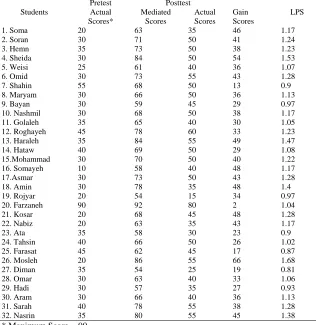
Participants, Actual, and Mediated Scores, Gain Scores, and Learning Potential Scores (LPSs)
Students
Pretest Posttest
Gain Scores LPS Actual Scores* Mediated Scores Actual Scores
1. Soma 20 63 35 46 1.17
2. Soran 30 71 50 41 1.24
3. Hemn 35 73 50 38 1.23
4. Sheida 30 84 50 54 1.53
5. Weisi 25 61 40 36 1.07
6. Omid 30 73 55 43 1.28
7. Shahin 55 68 50 13 0.9
8. Maryam 30 66 50 36 1.13
9. Bayan 30 59 45 29 0.97
10. Nashmil 30 68 50 38 1.17
11. Golaleh 35 65 40 30 1.05
12. Roghayeh 45 78 60 33 1.23
13. Haraleh 35 84 55 49 1.47
14. Hataw 40 69 50 29 1.08
15.Mohammad 30 70 50 40 1.22
16. Somayeh 10 58 40 48 1.17
17.Asmar 30 73 50 43 1.28
18. Amin 30 78 35 48 1.4
19. Rojyar 20 54 15 34 0.97
20. Farzaneh 90 92 80 2 1.04
21. Kosar 20 68 45 48 1.28
22. Nabiz 20 63 35 43 1.17
23. Ata 35 58 30 23 0.9
24. Tahsin 40 66 50 26 1.02
25. Farasat 45 62 45 17 0.87
26. Mosleh 20 86 55 66 1.68
27. Diman 35 54 25 19 0.81
28. Omar 30 63 40 33 1.06
29. Hadi 30 57 35 27 0.93
30. Aram 30 66 40 36 1.13
31. Sarah 40 78 55 38 1.28
32. Nasrin 35 80 55 45 1.38
* Maximum Score = 90
the high achievers in the pretest also had high mediated scores but their gain scores were not as high the others. For instance, the second highest scorer in the pretest (participant 7) was among the low performers in the posttest as she gained only 13 points. Plus, participant 20 who gained the highest score in the pretest did not gain as well as she was supposed to. Therefore, in line with Poehner et al. (2015, p. 12) it can be stated that outperforming a participant in the pretest does not necessarily (or generally as they say) imply that his/her performance will be higher than that of the others in the posttest. In this regard, the participants who outperformed others (participants 7 & 20) in the pretest were taken into account. Though they scored 55 and 90 respectively in the pretest (i.e., their performance was actually better than their counterparts', their mediated scores were 68 and 92 respectively). This is indicative of the fact that simply one's better performance in the pretest does not imply his/her superiority in the posttest too. For example, the lowest number in the posttest, 54, belonged to participant 27 who scored 35 in the pretest and gained only 19 points upon reception of mediation.
order to build upon the above short descriptions of the participants' performance, the research question is answered as follows:
As Table 1 shows there is an improvement in the participants' posttest scores in comparison to that of their pretest. This indicates the effectiveness of the C-DA program on the participants in that it helped them recognize that they could ameliorate. Though Table 1 in itself can be representative of this fact, the researchers measured the participants' LPS through adopting the formula created by Kozulin and Garb (2002).
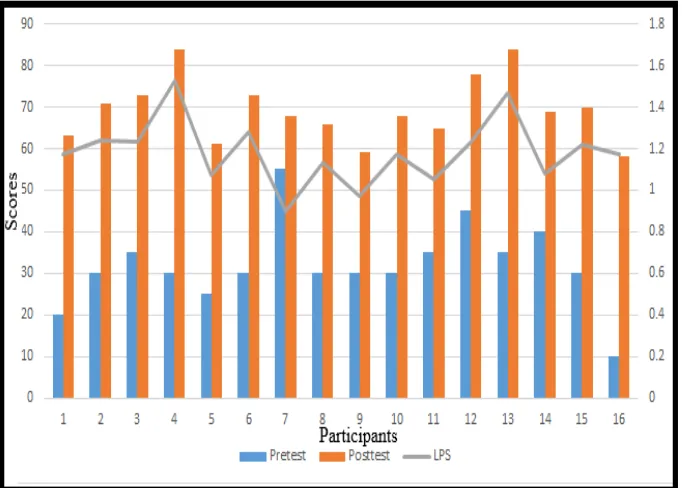
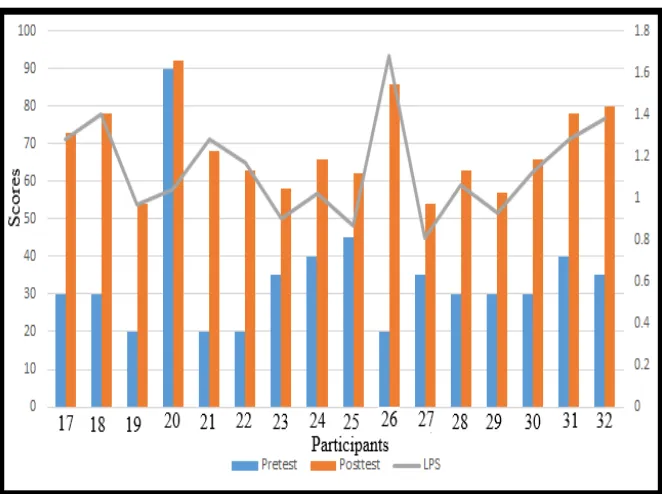
By applying the above formula which provides a basis for differentiating between low and high learning potential students (Kozulin & Garb, 2002), the researchers measured the participants' LPS. As shown in Table 1 and illustrated in Figures 1 and 2, the participants all showed to have high LPS based on Kozulin and Garb (2002) who asserted that in case LPS≥1.0, then that student has a high learning potential, if a student's LPS is between 0.71– 0.8, they have mid LPS and if it is less than 0.71 (LPS≤0.71), that student has low LPS; proposing that each student's requirement of instructional support varies depending on that student's LPS.
Figure 1. The participants' pre- and posttest scores along with their LPS The range is 0 to 100 in pre- and posttest.
The range is 0 to 2 in the LPS.
(Poehner et al., 2015), the mediated (posttest) scores were used to provide the researchers with the range of the participants' capabilities. In addition to the scores, the participants' LPSs were used to reassure about their progress and learning potential. As shown in Table 1 and Figures 1 and 2, their LPS scores range from 0.81 to 1.68; a point which indicates their high LPS (Kozulin & Garb, 2002).
Figure 2. The participants' pre- and posttest scores along with their LPS The range is 0 to 100 in pre- and posttest.
The range is 0 to 2 in the LPS.
(2013, p. 335) is also "an indication that the learner responded more favorably to mediation."
The least pretest score (10) belonged to participant 16 who achieved an incredible gain score of 48 in the posttest yielding a high LPS of 1.17 which is identical to participants 1, 10, and 22 whose actual scores were 20, 30, and 20 anew respectively but ameliorated their performance by gaining 43, 38 and 43 scores upon reception of mediation respectively. This proves that in case students are provided with sufficient and ZPD-based mediation, they can enhance their performance (Tajeddin & Tayebipour, 2012). In the same vein, in addition to participants 1 and 22, three more (participants 19, 21, and 26) scored 20 in the pretest which was the second least score amongst all. Their mediated or (DA) posttest scores were 54, 68, and 86 respectively which represents their high LPSs as well.
However, this is not true about all of the other participants. For instance, participants 20 and 7 whose actual scores were the first two top scores (90 and 55 respectively) gained no more points than 2 and 13 under mediation and yielded their LPSs to be 1.04 and 0.9. As in Poehner et al. (2015) and Poehner and Lantolf (2013), the results of this study show that those who performed less well in the pretest have taken more advantages from the mediation presented in the EP sessions in comparison to those who outperformed others. This point was supported by Poehner et al. (2015) who referred to the existence of less room for improvement in learners with high actual scores in the pretest.
receiving mediation. The same is true about the ones whose actual score was identical, the only difference was that their mediated scores were not the same. That is, they all progressed significantly but their scores, except in some cases such as participants 4, 13, 26, and 32, are not drastically different from each other. Mardani and Tavakoli (2011, p. 691), similarly, stated that "it is confirmed that students with a similar performance level demonstrate different, and in some cases dramatically different ability to learn and use new text comprehension strategies." A point which has frequently been confirmed in DA research by the above-mentioned researchers as well.
5. Discussion and Pedagogical Implications
score; this paved the way for the researchers to involve them in conditions contributive of their development concerning reading comprehension.
Like any other studies this study had some shortcomings as well which beg for further exploration. The study only involved a group of 32 advanced at-risk Iranian students regardless of taking their gender, age, learning styles, so on into consideration. Although they could simply be measured and included in the results of the study, the aims were far beyond these factors. Other sources of mediation provision such as novice-expert and peer-peer interactions and other human or physical tools can be controlled to gain a better interpretation of the results. Anyway, these variables can be explored to see whether a more comprehensive picture of the impacts of the C-DA procedure on individuals' learning can be gained.
agreement with Antón (2009) who concluded that teachers might end with misrepresentations of individuals' learning abilities provided that they only make use of traditional test results.
In conclusion, the C-DA principles helped the researchers identify the learners' potentiality in reading comprehension. Actually, this is what DA seeks for. According to Feuerstein et al. (2000), the most appealing point which distinguishes DA from other ways of assessment is, without a doubt, its optimistic view towards human beings (regardless of having primary or secondary disabilities, based on Gindis, 2003); it strongly believes in their development in case of being provided with more ZPD-oriented tasks, even if to a small extent. As just mentioned, Gindis (2003) reported from Vygotsky that primary disabilities are the same biological problems such as visual or auditory ones, whereas secondary disabilities are caused by the manner people in a particular society react to primary disabilities, namely, their expectations, culture, attitudes towards disable (mentally or physical) individuals greatly influence on providing the opportunities for them to whether take part in activities with their friends or not. Even nowadays, in different cultures disable people are neglected to a great extent, but thanks to DA (C-DA) principles they are granted to have access to opportunities whose taking might result in overcoming some of the challenges they have always coped with.
References
Ableeva, R. (2008). The effects of dynamic assessment on L2 listening comprehension. In J. P. Lantolf & M. E. Poehner (Eds.), sociocultural
theory and the teaching of second languages (pp. 112-134). London:
Equinox.
Ableeva, R. (2010). Dynamic assessment of listening comprehension in
second language learning (Unpublished Doctoral dissertation).
Pennsylvania State University, Pennsylvania, the USA.
Antón, M. (2009). Dynamic assessment of advanced second language learners. Foreign Language Annals, 42(3), 576-598.
Birjandi, P., & Ebadi, S. (2012). Microgenesis in dynamic assessment of L2 learners’ socio-cognitive development via web 2.0. Procedia-Social and Behavioral Sciences, 32, 34-39.
Birjandi, P., Estaji, M., & Deyhim, T. (2013). The impact of dynamic assessment on reading comprehension and metacognitive awareness of reading strategy use in Iranian high school learners. Iranian Journal of Language Testing, 3(2), 60-77.
Carney, J. J., & Cioffi, G. (1992). The dynamic assessment of reading abilities. International Journal of Disability, Development and Education, 39(2), 107-114.
De Beer, M. (2006). Dynamic testing: Practical solutions to some concerns. SA Journal of Industrial Psychology, 32(4), 8-14.
Dole, J., Brown, K., & Trathen, W. (1996). The effects of strategy instruction on the comprehension performance of at-risk students. Reading Research Quarterly, 31(1), 62-88.
Dörfler, T., Golke, S., & Artelt, C. (2009). Dynamic assessment and its potential for the assessment of reading competence. Studies in
Educational Evaluation, 35(2), 77-82.
Ebadi, S. (2014). L2 private speech in online dynamic assessment: a sociocultural perspective. Iranian Journal of Applied Linguistics, 17(1), 49-70.
Ebadi, S., & Saeedian, A. (2014). The role of l1 in online l2 dynamic assessment mediation. The Iranian EFL Journal, 13(1), 96-120.
Ebadi, S., & Saeedian, A. (2015). The effects of computerized dynamic assessment on promoting at-risk advanced Iranian EFL students' reading skills. Issues in Language Teaching, 4(2), 26-1.
Ebadi, S., & Saeedian, A. (2016a). Exploring transcendence in EFL learners' reading comprehension through computerized dynamic assessment.
Iranian Journal of Language Teaching Research, 4(1), 27-45.
Ebadi, S., & Saeedian, A. (2016b). Planning future instructional programs through computerized L2 dynamic assessment. Teaching English with Technology, 16(4), 12-32.
Feuerstein, R., Feuerstein, R. S., & Falik, L. H. (2010). Beyond smarter:
Mediated learning and the brain's capacity for change. New York, NY:
Teachers College Press.
Feuerstein, R., Y. Rand, and J. E. Rynders. (2000). Don't accept me as I am.
Helping retarded performers excel. New York: Plenum.
Guthke, J., & Beckmann, J. F. (2000). The learning test concept and its applications in practice. In C. S. Lidz & J. G. Elliott (Eds.), Dynamic
assessment: prevailing models and applications (pp.17–69). Amsterdam,
The Netherlands: Elsevier.
Haywood, H. C., & Lidz, C. S. (2007). Dynamic assessment in practice:
Clinical and educational applications. Cambridge University Press.
Haywood, H., & Tzuriel, D. (2002). Applications and challenges in dynamic assessment. Peabody Journal of Education, 77(2), 40–63.
Jacobs, E.L. (2001). The effects of adding dynamic assessment components to a computerized preschool language screening test. Communication Disorders Quarterly, 22 (4), 217–226.
Kozulin, A., & Gindis, B. (2007). Sociocultural theory and education of children with special needs, from defectology to remedial pedagogy. In H. Daniels, M. Cole, & J. V. Wertsch (Eds.), The Cambridge companion to
Vygotsky (pp. 332-336).Cambridge: Cambridge University Press.
Kozulin, A., & Garb, E. (2002). Dynamic assessment of EFL text comprehension of at-risk students. School Psychology International, 23(1), 112-127.
Mardani, M., & Tavakoli, M. (2011). Beyond reading comprehension: The effect of adding a dynamic assessment component on EFL reading comprehension. Journal of Language Teaching and Research, 2(3), 688-696.
Lantolf, J. P. (2000). Second language learning as a mediated process.
Language Teaching, 33(2), 79-96.
Lantolf, J. P., & Poehner, M. E. (2004). Dynamic assessment of L2 development: bringing the past into the future. Journal of Applied Linguistics, 1(2), 49-72.
Lantolf, J. P., & Poehner, M. E. (2013). The unfairness of equal treatment: objectivity in L2 testing and dynamic assessment. Educational Research
and Evaluation, 19(2-3), 141-157.
Lantolf, J. P., & Thorne, S. L. (2006). Sociocultural theory and the genesis of
second language development. Oxford: Oxford University Press.
Lidz, C. S., & Gindis, B. (2003). Dynamic assessment of the evolving cognitive functions in children. In A. Kozulin, B. Gindis, V. S. Ageyev, S. M. Miller (Eds.), Vygotsky's Educational Theory in Cultural Context (pp. 99-116). Cambridge: Cambridge University Press.
Nassaji, H., & Swain, M. (2000). A Vygotskian perspective on corrective feedback in L2: The effect of random versus negotiated help on the learning of English articles. Language Awareness, 9(1), 34-51.
Pishghadam, R., Barabadi, E. (2012). Constructing and validating computerized assessment of l2 reading comprehension. Iranian Journal of Applied Linguistics, 15(1), 73-95.
Poehner, M. E. (2005). Dynamic assessment of oral proficiency among advanced L2 learners of French (Unpublished doctoral dissertation). Pennsylvania State University, University Park.
Poehner, M, E. (2008). Dynamic assessment: A Vygotskian approach to
understanding and promoting L2 development. New York: Springer.
Poehner, M. E. (2011). Dynamic assessment: Fairness through the prism of mediation. Assessment in Education: Principles, Policy & Practice, 18(2), 99-112.
Poehner, M. E., & Lantolf, J. P. (2005). Dynamic assessment in the language classroom. Language Teaching Research, 9, 233-265.
Poehner, M. E., & Lantolf, J. P. (2013). Bringing the ZPD into the equation: Capturing L2 development during computerized dynamic assessment (C-DA). Language Teaching Research, 17(3), 1-21.
Poehner, M. E., Zhang, J., & Lu, X. (2015). Computerized dynamic assessment (C-DA): Diagnosing L2 development according to learner responsiveness to mediation. Language testing, 32(3), 337-357.
Shrestha, P., & Coffin, C. (2012). Dynamic assessment, tutor mediation and academic writing development. Assessing Writing, 17(1), 55-70.
Sternberg, R. J., & Grigorenko, E. L. (2002). Dynamic testing. New York: Cambridge University Press.
Summers, R. (2008). Toward an online model of dialogic engagement. In J. P. Lantolf and M. E. Poehner (Eds.), sociocultural theory and the
teaching of second languages (pp. 91-112). London: Equinox.
Tajeddin, Z., & Tayebipour, F. (2012). The effect of dynamic assessment on EFL learners' acquisition of request and apology. The Journal of
Teaching Language Skills, 4(2), 87-118.
Teo, A. (2012). Effects of dynamic assessment on college EFL learners' reading skills. The Journal of Asia TEFL, 9(1), 57-94.
Teo, A. (2014). Beyond traditional testing: Exploring the use of computerized dynamic assessment to improve EFL learners' reading.
Arab World English Journal, 5(1), 42-58.
Tzuriel, D., & Shamir, A. (2002). The effects of mediation in computer assisted dynamic assessment. Journal of Computer Assisted Learning, 18(1), 21–32.
Vygotsky, L. S. (1978). Mind and society: The development of higher