[Satheesh P et al., 3(6): June, 2016] ISSN 2349-4506
Impact Factor: 2.545
G
lobal
J
ournal of
E
ngineering
S
cience and
R
esearch
M
anagement
DE-SPECKLING OF SAR IMAGES BASED ON OPTIMAL BASIS WAVELET VIA
PATCH ORDERING
Anakha Satheesh P*, Dr. D. Loganathan
*
Final year M. Tech-CSE, MET’S School of Engineering, Mala, Trissur, Kerala, India
Head and Professor, Department of CSE, MET’S School of Engineering, Mala, Trissur, Kerala, India
DOI:
10.5281/zenodo.55960
KEYWORDS
:
Synthetic Aperture Radar, Speckle noise, De-speckling, Optimal wavelet basis (OWB), Adaptivethresholding, Image de-noising, noise reduction.
ABSTRACT
Synthetic Aperture Radar (SAR) technology has mainly used for capturing high quality images from higher altitudes. SAR imagery has become an important application over optical satellite imagery because of its ability to operate in any whether condition. The SAR image acquired via coherent imaging are associated with a noise called speckle noise, which is multiplicative in nature. The presence of speckle noise degrades the quality of SAR image then leads to loss of crucial information. So it has become very important to remove the speckle noise from SAR images using suitable techniques. Many different SAR image-despeckling techniques proposed over past few years. In this paper, proposed a new idea for de-speckling the SAR image to the maximum and the proposed method achieves state-of-the-art de-speckling performance.
INTRODUCTION
The Synthetic Aperture Radar (SAR) used to capture high-resolution images from higher altitudes. SAR is capable of operating under any climatic changes like day and night, sunny and cloudy, has become more and more popular in our daily lives and in military tasks. SAR system takes the advantage of complex information processing capability of modern digital electronics and long-range propagation characteristics of radar signals to provide high quality imagery. There are many applications of SAR in different areas like in Geology, Ecology, Hydrology, Oceanography, Surface surveillance, Mine detection and automatic target recognition [2]. Whereas unfortunately SAR images acquired via coherent imaging are associated with a noise-like phenomenon called, ground clutter or speckle noise.
The presence of speckle will affect the performance in various applications of SAR image processing. For example, it decreases correct classification rate in terrain classification [6] and increases the false alarm rate in target/edge detection [12].
To solve this problem, the multiplicative model converted into additive model by taking the logarithm of the noisy image. Then, the image de-noising methods like wavelet shrinkage, total variation, sparse representation etc. and it can applied to the logarithmic SAR image. Another way is to write the multiplicative noise in an additive but signal dependent way.
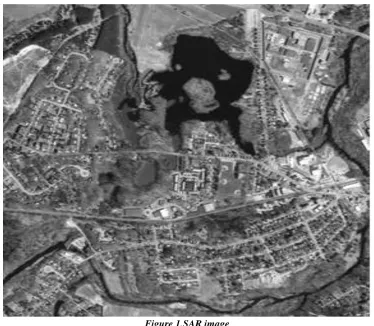
Many classical de-speckling techniques use this model and perform filtering in the spatial domain based on Minimum Mean Square Error (MMSE) criterion or Maximum A Posteriori (MAP) criterion. Some advanced methods also adopt the additive signal dependent model, but operate in the wavelet domain or no subsampled shearlet transform domain. An example of SAR image shown in Fig 1.
SPECKLE NOISE MODEL
[Satheesh P et al., 3(6): June, 2016] ISSN 2349-4506
Impact Factor: 2.545
G
lobal
J
ournal of
E
ngineering
S
cience and
R
esearch
M
anagement
information. The speckle noise in SAR image is associated with multiplicative noise with unit mean and variance. A multiplicative speckle noise represented by:
f (x, y) =s (x, y). n (x, y) (1)
Apply logarithmic operator to both sides of equation, and obtained the following equation.
ln (Y)=ln(S)=ln(N) (2)
This equation can written as,
y (x, y) =s (x, y) +e (x, y) (3)
Here y (x, y), s (x, y) and e (x, y) represent logarithmically transformed noisy data, signal and speckle noise respectively. Now this nonlinear transform changes the statistics of speckle noise. The pixels of log-transformed images are mutually independent makes extraction of information easier.
Figure 1.SAR image
LITURATURE SURVEY
[Satheesh P et al., 3(6): June, 2016] ISSN 2349-4506
Impact Factor: 2.545
G
lobal
J
ournal of
E
ngineering
S
cience and
R
esearch
M
anagement
Multi look integration technique has a drawback, there is an increase in computation when number of looks (L) is increased and degradation of image resolution happens with smoothing of uniform areas. Adaptive image restoration on the other hand uses post image formation technique, which makes use of filters like Lee filter, point wise linear filters Maximum A Posteriori (MAP filter and Local statistics filters.
In [8], Non-Local Means is a new method for de-noising. It has based on non-local averaging of all pixels in the image. Local averaging filters like anisotropic filtering, Gaussian smooth filtering, total variation minimization approach and neighborhood filtering exhibit their own limitations. Gaussian has a problem that it is optimal in flat parts of the image but the texture and edges are blurred. The anisotropic filter and total variation minimization approach are preserving edges while flat and textured regions are degraded. The drawback of neighborhood filtering is that it compares only gray level values in a single pixel, which is not advisable. The alternative to this local approach is NL – means, which is, not only compares grey level in a single point but also whole neighborhood and performs well than local method in terms of method noise, visual quality and MSE.
In [3], propose a synthetic aperture radar (SAR) image de-speckling method based on patch ordering and transform-domain filtering. The multiplicative noise model transformed into the additive model by applying logarithmic transformation with bias correction to the original SAR image. Then, a two-stage filtering strategy has adopted.
The first stage is coarse filtering, which can suppress speckle effectively. In this stage, patches are extracted, ordered and filtered using SSC. Then apply inverse permutation and sub image averaging. The second stage is refined filtering. The small artifacts generated by coarse filtering is eliminate in this stage. Same procedure can used here but uses 2D wavelet hard thresholding instead of SSC.
Merits and demerits
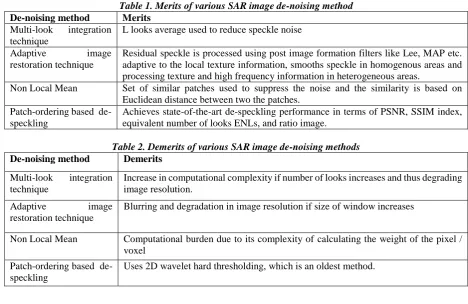
Every de-noising methods has lots of advantages and disadvantages. Some de-noised methods and its merits and demerits are discuss in Table 1 and Table 2.
Table 1. Merits of various SAR image de-noising method
De-noising method Merits
Multi-look integration technique
L looks average used to reduce speckle noise
Adaptive image restoration technique
Residual speckle is processed using post image formation filters like Lee, MAP etc. adaptive to the local texture information, smooths speckle in homogenous areas and processing texture and high frequency information in heterogeneous areas.
Non Local Mean Set of similar patches used to suppress the noise and the similarity is based on Euclidean distance between two the patches.
Patch-ordering based de-speckling
Achieves state-of-the-art de-speckling performance in terms of PSNR, SSIM index, equivalent number of looks ENLs, and ratio image.
Table 2. Demerits of various SAR image de-noising methods
De-noising method Demerits
Multi-look integration technique
Increase in computational complexity if number of looks increases and thus degrading image resolution.
Adaptive image restoration technique
Blurring and degradation in image resolution if size of window increases
Non Local Mean Computational burden due to its complexity of calculating the weight of the pixel / voxel
Patch-ordering based de-speckling
[Satheesh P et al., 3(6): June, 2016] ISSN 2349-4506
Impact Factor: 2.545
G
lobal
J
ournal of
E
ngineering
S
cience and
R
esearch
M
anagement
PROPOSED WORK
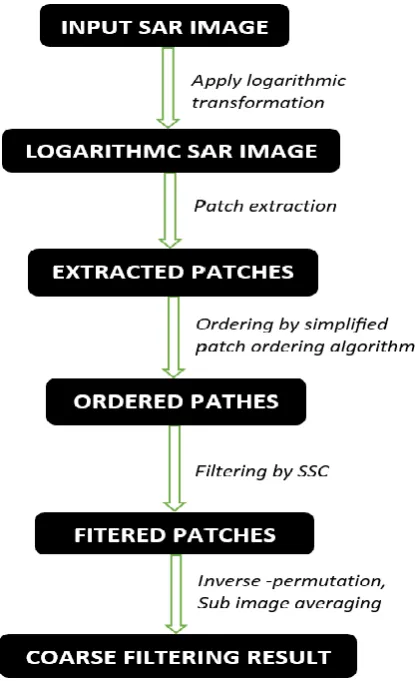
Here proposes a synthetic aperture radar (SAR) image de-speckling method. Firstly, the multiplicative noise model has converted into the additive model by applying Logarithmic transformation with bias correction to the original SAR image. Then, a two-stage filtering strategy has adopted. First stage is coarse filtering which can used to suppress speckle effectively. In this stage, we have to extract the sliding patches from the logarithmic SAR image, after that order them in a smooth way by applying simplified patch ordering algorithm especially for SAR images. The ordered patches have filtered by learned simultaneous sparse coding (SSC). SSC is a recent technology and is one of the best image filtering methods more over it has very strong noise reduction ability.
Then, the coarse filtering result reconstructed from the filtered patches using inverse permutation and sub image averaging. The flowchart for coarse filtering has given in the Fig 2. Main actions performed in coarse filtering are application of logarithmic transformation, extraction of sliding patches, ordering by simplified patch ordering algorithm, filtering by SSC, inverse permutation and sub-image averaging.
Figure 2. Coarse filtering framework.
[Satheesh P et al., 3(6): June, 2016] ISSN 2349-4506
Impact Factor: 2.545
G
lobal
J
ournal of
E
ngineering
S
cience and
R
esearch
M
anagement
ALGORITHM
We propose a new SAR image de-speckling algorithm in this paper. The algorithm consists of two stages. In the first stage, the log-intensity SAR image is filtered by patch ordering and SSC. Although de-noising via SSC can suppress speckle effectively, it produces small artifacts, which caused by the learned dictionary [11]. Thus, the first stage is a coarse filtering stage. The artifacts generated by sparse representation can alleviated by other transform domain methods. To handle this, we adopt a refined filtering stage. The complete procedure for first stage has summarized in the Algorithm 1.
Algorithm 1: Coarse filtering
Input: The input SAR image I, the ENL E.
Step 1: Apply a 3×3 Boxcar filter into input SAR image I, and obtain the boxcar filtering result IB. Step 2: Apply logarithmic transformation with bias correction to I for calculating the log-intensity image I(ln).
Step 3: Extract sliding patches GB and G1 of size√n1 ×√n1 from IB and I(ln), respectively.
Step 4: Order the patches GB by simplified patch ordering algorithm, and obtain the set Ω1. Then calculate the ordered patches H1 by H1=G1ZΩ1.
Step 5: De-noise H1 by SSC, and obtain the filtering result Ĥ1. Then perform inverse permutation on Ĥ1, i.e. Ĝ1 = Ĥ1Z−1 Ω1.
Step 6: Reconstruct the filtering result Î1(ln) from Ĝ by sub-image averaging.
Step 7: Calculate the coarse filtering result x1 by applying exponential transformation to Î1(ln). Output: Course filtering result.
To improve the de-noising efficiency OWB has employed. It is a top-down search method for selecting optimal basis. To Find an optimal threshold value is not an easy task. Here we have to estimate the image noise variance. The noise is additive, then the observation model can be written as below.
Ys
i,j = Xsi,j + ηs i,j (4)
where Ys
i,j is the noise coefficients of sub band S, Xsi,j is the coefficients of the clean sub-band, and ηsi,j is noise
coefficients. The noise and coefficients of the clean image are independent, So σ2
Y,s =σ2X,s +σ2η (5)
where σ2Y,s is the variance of coefficients (Y
i,j) in sub band S. From this, the value of σ2 X,s can be derived as
σ2
X,s =max(σ2Y,s −σ2η , 0) (6)
The obtained value of threshold λs is infinite when the value of σ2
X,s is zero. The complete procedure has given in
Algorithm 2.
Algorithm 2: De-noising with OWB
Step 1: Perform WP decomposition to obtain OWB of a noisy image up to four levels (L = 4) by using Shannon entropy.
Step 2: Calculate the noise variance using (4).
Step 3: For each sub band S in level d, estimate the threshold value and statistical parameters: a) variance of sub band (σ2 Y, s);
b) mean of sub band(μs);
c) estimate the variance of clean image using (6); d) term αd,s using ;
e) term β ;
f) Threshold value.
[Satheesh P et al., 3(6): June, 2016] ISSN 2349-4506
Impact Factor: 2.545
G
lobal
J
ournal of
E
ngineering
S
cience and
R
esearch
M
anagement
EXPERIMENTAL RESULT
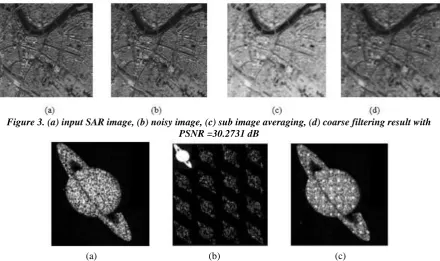
In this paper, both simulated images and real SAR images used to test the filtering performance of the proposed technique. The proposed method has compared with three state-of-the-art de-speckling methods such as, MIDAL [4], SAR-BM3D [7] and PPB [5] and we compare the proposed method with the homomorphic version of the original patch ordering method (H-PO) [10]. Fig 3 shows coarse filtering result with very good PSNR value and Fig 4 shows the experimental result using OWB.
Figure 3. (a) input SAR image, (b) noisy image, (c) sub image averaging, (d) coarse filtering result with PSNR =30.2731 dB
(a) (b) (c)
Figure 4. (a) noisy image, (b) OWB, (c) de-noised image.
CONCLUSION
This paper proposes a novel framework for reducing speckle noise in SAR images. First, we apply homomorphic transformation and speckle filtering has implemented in the logarithmic domain. Then coarse filtering and OWB de-noising performed to get the noise free SAR image. The proposed method has strong speckle reduction ability and computational cost is modest. So it is suitable for many image processing applications, such as display systems, noisy texture analyzing systems, digital multimedia broadcasting and medical image analyzing systems.
REFERENCES
1. Abdolhossein Fathi and Ahmad Reza Naghsh-Nilchi, “Efficient Image Denoising Method Based on a New Adaptive Wavelet Packet Thresholding Function,” IEEE transactions on image processing, vol. 21, no. 9, September 2012.
2. Alin Achim, Panagiotis Tsakalides and Anastasios Bezerrianos 2003, SAR Image denoising Via Bayesian wavelet shrinkage based on Heavy tailed modeling,” IEEE trans on GARS,pp1-32.
3. Bin Xu, Yi Cui, Zenghui Li, Bin Zuo, Jian Yang and Jianshe Song, “Patch Ordering-Based SAR Image Despeckling Via Transform-Domain Filtering,” IEEE Journal of Selected Topics in Applied Earth Observations and Remote Sensing, Vol. 8, No. 4, April 2015.
4. Bioucas-Dias J. M and M. A. T. Figueiredo, “Multiplicative noise removal using variable splitting and constrained optimization,” IEEE Trans. Image Process., vol. 19, no. 7, pp. 1720–1730, Jul. 2010. 5. Deledalle C, Denis L., and Tupin F, “Iterative weighted maximum likelihood denoising with probabilistic
[Satheesh P et al., 3(6): June, 2016] ISSN 2349-4506
Impact Factor: 2.545
G
lobal
J
ournal of
E
ngineering
S
cience and
R
esearch
M
anagement
6. Lee J. S, Grunes M. R, and De Grandi G, “Polarimetric SAR speckle filtering and its impact on terrain classification,” IEEE Trans. Geosci. Remote Sens., vol. 37, no. 5, pp. 2363–2373, Sep. 1999.
7. Parrilli S, Poderico M, Angelino C.V, and Verdoliva L, “A nonlocal SAR image denoising algorithm based on LLMMSE wavelet shrinkage,” IEEE Trans. Geosci. Remote Sens., vol. 50, no. 2, pp. 606–616, Feb. 2012.
8. Pengcheng Han and Jumping Du, “spatial image Feature extraction based on Bayesian Non Local Means Filter and Improved Contourle transform,” Journal of Applied mathematics, 2012.
9. Rajamani A and Krishnaveni V “Performance Analysis Survey of Various SAR Image Despeckling Techniques,” International Journal of Computer Applications (0975 – 8887) Volume 90 – No 7, March 2014.
10. Ram I, Elad M, and Cohen I, “Image processing using smooth ordering of its patches,” IEEE Trans. Image Process., vol. 22, no. 7, pp. 2764– 2774, Jul. 2013.
11. Ron Rubinstein, Bruckstein A. M., and Michael Elad, “Dictionaries for sparse representation modeling,” Proc.IEEE, vol.98, no.6, pp.1045–1057, Jun. 2010.
12. Touzi R, Lopes A, and Bousquet P, “A statistical and geometrical edge detector for SAR images,” IEEE Trans. Geosci. Remote Sens., vol. 26, no. 6, pp. 764–773, Nov. 1988.
Anakha Satheesh P received the B.Tech degree in computer science from Calicut University, Kerala, India, in 2014 and currently doing M.Tech in computer science and Engineering in MET’S School of Engineering, Calicut University, Kerala, India.
[1] Dr.D.Loganathan is a Professor and Head of Computer Science and Engineering