15 |
P a g e
Asian Journal of Pharmaceutical Science & Technology
e-ISSN: 2248 – 9185
www.ajpst.com
Print ISSN: 2248 – 9177
FORMULATION AND EVALUATION OF FAST DISSOLVING TABLET
BY INCLUSION COMPLEXATION
Narendra Rajput, VM Thakare*, BW Tekade, KP Chaudhari, UT Jadhao
TVES’s Honorable Loksevak Madhukarrao Chudhari College of Pharmacy, Faizpur Dist, Jalgoan-425503, India.
ABSTRACT
Glimepiride (GMP) is third Generation sulphonyl ureas used for treatment of type 2 diabetes. Poor water solubility is the main constant for its oral bioavailability. The rationale of this study to enhance solubility and dissolution of the drug by preparing its complex with β cyclodextrin. In the present study attempt has been made to prepare, formulate and characterize inclusion complex of glimepiride with β cyclodextrin. The inclusion complex prepared by kneading method. The inclusion complex containing Glimepiride:β cyclodextrin (1:5) was further formulated into fast dissolving tablet by direct compression technique using superdisintegrant like sodium starch glycolate. The prepared complex were characterize using FT-IR, DSC and finally fast dissolving tablet were evaluated for various pharmaceutical characteristics viz. Hardness, % Friability, Weight variation, Wetting time, Drug content and in-vitro dissolution profiles.
Key words: Fast dissolving tablet, Glimepiride, Kneading method, β cyclodextrin superdisintegrants.
INTRODUCTION
Fast disintegrating or orodispersible tablets (ODTs) are one such novel approach to increase consumer acceptance by virtue of rapid disintegration, self-administration without water or chewing. This delivery system offers convenience for treatment-resistant population who has difficulty in swallowing unit oral dosage form, namely tablets and capsules [1,2]. The demand for these formulations is particularly beneficial to pediatric and geriatric patients. It is estimated that 50 % of the population is affected by dysphagia which results in high incidence of on compliance and ineffective therapy. To overcome this problem it is necessary to design a formulation which rapidly disperse / dissolve in the oral cavity without the need of water for swallowing. Such dosage form should disintegrate when placed in the mouth and can be swallowed in the liquid form [3,4].
MATERIALS AND METHODS Material
Glimepiride drug was procured from Dr.Reddy’s Pvt Ltd, Hydrabad. Sodium starch glycolate and Crosscarmellose sodium from Shreeji chemicals, Mumbai gift sample.
EXPERIMENTAL
Fast dissolving tablets of Glimepiride were prepared using the complex forming agent β cyclodextrin by kneading method, Sodium starch glycolate, Crosscarmellose sodium use as superdisintegrants, mannitol as sweetening agent, the drug and other ingredients were mixed together by using a glass mortar and pestle, and then passed through sieve no. 60. Then directly compressed by using 7 mm punch of rotary tablet machine.
Pre compression parameters Angle of repose
Angle of repose was determined using fixed funnel method. The blend was poured through a funnel that can be raised vertically until a maximum cone height (h) was obtained. Radius of the heap (r) was measured and angle of repose was calculated using formula [5].
θ = tan-1 h/r
Where, θ is angle of repose, h is height of pile and r is the radius of the base pile.
Kneading Method
GLI with β -CD in different molar ratios (i.e. 1:5M) were taken. First cyclodextrin is added to the mortar; small quantity of 50% ethanol is added, while triturating to get slurry like consistency. Then slowly drug is incorporated into the slurry and trituration was further continued for one
16 |
P a g e
hour. Slurry was then air dried at 25 °C for 24 hours, pulverized and passed through sieve No. 60 and stored in desiccators over fused calcium chloride [6].
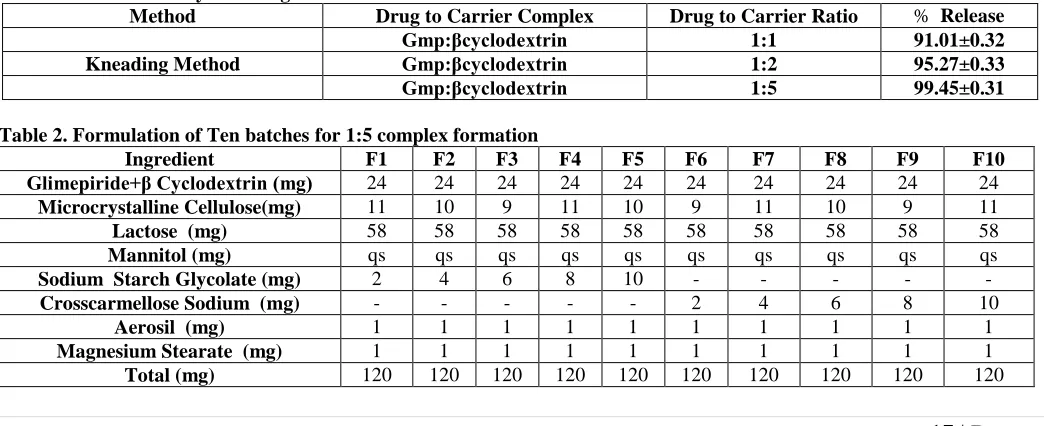
By using Glimepiride and β cyclodextrin (1:5M) ratio, it gives better solubility and drug release. Therefore as per the drug to carrier ratio(1:5M), to prepare the formulation which are given table no 1.2 In this 1:5 ratio means 4mg drug & 20mg β Cyclodextrin total weight use is 24mg
Phase Solubility Studies of Pure Drug:
Phase solubility studies of pure drug (GLI) with different concentrations of β- cyclodextrins (3-15 millimoles) were performed by the method described by Higuchi and Connors. An excess of Glimepiride (200 mg) was added to 15ml of triple distilled water containing various concentrations of cyclodextrins such as 0, 1, 3, 6, 9, 12, and 15 x 10-3 moles/liter taken in a series of 25ml stopped conical flask and the mixture was shaken for 72 hours at room temperature on a rotary flask shaker. After 72 hrs of shaking to achieve equilibrium, 2ml aliquots are withdrawn at 1 hr interval and filtered through whatman no.1 filter paper. The filtered samples are diluted suitably and assayed for the drug GLI content by specific UV method. Shaking is continued until the consecutive estimations are the same. The solubility experiments are conducted in triplicate [7-9].
Bulk Density
Apparent bulk density (ρb) was determined by pouring blend into a graduated cylinder. The bulk volume (Vb) and weight of powder (M) was determined. The bulk density was calculated using the formula [10].
ρb = M/Vb
Tapped Density
The measuring cylinder containing known mass of blend was tapped for a fixed time. The minimum volume (Vt) occupied in the cylinder and weight (M) of the blend as measured. The tapped density (ρt) was calculated using the formula [4].
ρt = M/Vt
Carr’s compressibility index
The simplex way of measurement of the free flow of powder is compressibility, an indication of the ease with which a material can be induced to flow is given by compressibility index of the granules was determined by Carr’s compressibility index (I) which is calculated by using the following formula [11].
I = {(Vo – Vt)/ Vo} X 100
Hausner ratio
Hausner ratio is an indirect index of ease of powder flow. It is calculated by the following Formula
Hausner ratio = ρt/ρb
Where ρt is tapped density and ρb is bulk density. Lower hausner ratio (< 1.25) indicate better flow properties than higher ones (>1.25).
Post compression parameters
All the batches of tablets were evaluated for various parameters like weight variation, friability, hardness, drug content, disintegration and dissolution and results reported in Table no 1.3
Weight variation test
Twenty tablets were taken and their weight was determined individually and collectively on a digital weighting balance. The average weight of one tablet was determined from the collective weight [12].
Hardness test
The hardness of the tablet was determined using Monsanto Hardness Tester [13].
Friability test
Six tablets from each batch were examined for friability using Roche Friabilator (Tropical Equipment Pvt. Ltd. Mumbai, India) and the equipment was run for 4min at 25 revolutions per minute. The tablets were taken out, dedusted and reweighted and % friability was calculated [13].
%Friability = (Loss in weight/Initial weight) x 100
Water absorption ratio
A piece of tissue paper folded twice was kept in a Petri dish (internal diameter 5.5cm) containing 6ml of purified water. The tablet was placed on the tissue paper and allowed to wet completely. The wetted tablet was removed and reweighted. Water absorption ratio, R was determined according to the following equation [14].
R = 100 (Wa – Wb)/Wb
Where Wb and Wb are the weight before and after water absorption, respectively.
Wetting time
A piece of tissue paper folded twice was kept in a Petri dish (inter diameter 5.5cm) containing 6ml of purified water. The tablet was placed on the tissue paper and allowed to wet completely. The time required for complete wetting of the tablet was then recorded.
Uniformity of Content
17 |
P a g e
In vitro disintegration timeThe disintegration test was performed using an USP disintegration apparatus, with distilled water at 24±0.50C. The time reported to obtain complete disintegration of six tablets were recorded and average was reported
In vitro dissolution testing
Dissolution study was conducted for all the formulation using USP type-II apparatus (Electolab, Mumbai, In-dia.). The dissolution test was performed using 900 ml of phosphate buffer (PH 7.4) was taken as the dissolution medium at 50 rpm and 37C±0.5C. 10 milliliters of aliquots were periodically withdrawn and the sample volume was replaced with an equal volume of fresh dissolution medium. The samples were analyzed spectrophotometrically at 228nm.
RESULTS AND DISCUSSION Physical evaluation of tablets
All the tablet preparations were evaluated for various physical parameters and content uniformity before proceeding further. Table1.3 includes the values (mean SD) of weight variation, hardness, diameter and thickness of 10 tablet batches prepared using different combinations of functional excipients. Tablet weights in all batches varied between 120.98 to 121.46, thickness between 2.86 mm to 2.95 mm and tablet hardness between 3.18 to 3.59 kg /cm2. Thus all the physical parameters of the manually compressed tablets were quite within control. The percentage friability, as depicted in Table1.3 was in the range of 0.550 – 1.03. The tablets of F3 & F9 formulation with low concentration had a friability of more than 1% as compared to tablets of F4 to F10 having a comparatively high medium concentration of superdisintegrant. The reason behind this was that, because of higher percentage subliming ingredient used, the porosity of tablets increased
thus giving tablets which were friable. However, for orodispersible tablets the percentage friability up to or slightly above 1% is permissible.
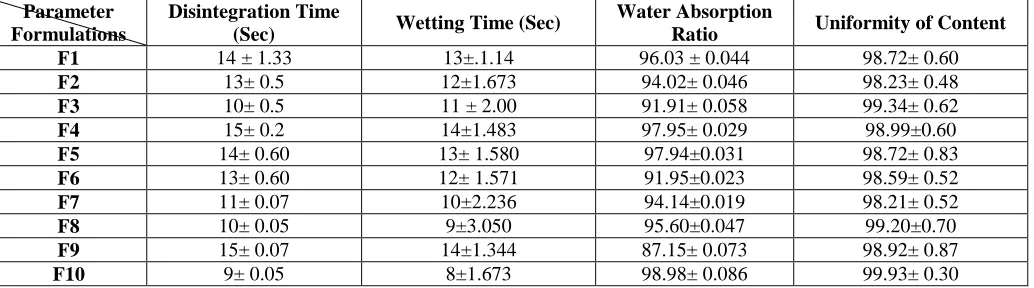
Wetting time: The wetting time, as shown in Table 1.4 of all ten formulations was in the range of 8 to 15 seconds. The wetting time is closely related to the disintegration time. There is a direct relationship between the wetting time and disintegration time, which is: faster the wetting time, faster is the disintegration time.
Uniformity of Content
The drug content for tablets of all formulations was found to be in the range of 98.23 – 99.90. Thus all formulation batches of Glimepiride found to be contain the drug within the acceptable range [16-17].
Dissolution Studies
In pH 7.4 phosphate buffer
The dissolution studies were carried out on optimum formulations are shown in Figure 1.1, 1.2 The release of drug was largely depended on the disintegration time. That is faster the disintegration of tablets, better and faster is the release. F6 of SSG releases 95.19% of drug after 60 min. while F10 of CCS showed 99.27 % release after 60 minutes. Hence, CCS showed most efficient drug release than SSG formulation in 7.4 phosphate buffer [18].
Differential Scanning Calorimetry
The thermal behavior GMP - β-CD complex was studied using DSC in order to confirm the formation of complex. DSC thermogram of GLI and βCD formulation is shown in fig. 7.13 and 7.14 respectively. The DSC thermogram of GMP showed an endothermic peak at 214°C corresponding to its melting point. The thermogram of β CD showed endothermic peak at 114°C which is different from the pure drug, which gives clear evidence that there is formation of the complex [19-21].
Table 1. Formulation by kneading method
Method Drug to Carrier Complex Drug to Carrier Ratio % Release
Gmp:βcyclodextrin 1:1 91.01±0.32
Kneading Method Gmp:βcyclodextrin 1:2 95.27±0.33
Gmp:βcyclodextrin 1:5 99.45±0.31
Table 2. Formulation of Ten batches for 1:5 complex formation
Ingredient F1 F2 F3 F4 F5 F6 F7 F8 F9 F10
Glimepiride+β Cyclodextrin (mg) 24 24 24 24 24 24 24 24 24 24
Microcrystalline Cellulose(mg) 11 10 9 11 10 9 11 10 9 11
Lactose (mg) 58 58 58 58 58 58 58 58 58 58
Mannitol (mg) qs qs qs qs qs qs qs qs qs qs
Sodium Starch Glycolate (mg) 2 4 6 8 10 - - - - -
Crosscarmellose Sodium (mg) - - - 2 4 6 8 10
Aerosil (mg) 1 1 1 1 1 1 1 1 1 1
Magnesium Stearate (mg) 1 1 1 1 1 1 1 1 1 1
18 |
P a g e
Table 3. Physical Evaluation of Tablets Prepared by using β cyclodextrinsParameters Formulations Thickness (mm) Hardness ( kg/cm2 ) Weight Variation % Friability
F1 2.91±0.045 3.59±0.31 120.54±0.43 0.703±0.21
F2 2.96±0.035 3.51±0.29 121.25±0.70 0.687±0.33
F3 2.93±0.040 3.54±0.56 120.50±0.50 1.03±0.30
F4 2.95±0.090 3.45±0.11 121.46±0.44 0.549±0.56
F5 2.89±0.080 3.35±0.37 120.77±0.81 0.674±0.64
F6 2.92±0.032 3.49±0.40 120.69±0.92 1.01 ±0.51
F7 2.90±0.075 3.35±0.49 121.10±0.85 0.550±0.36
F8 2.86±0.050 3.33±0.52 121.15±0.35 0.575±0.35
F9 2.87±0.043 3.27±0.22 121.13±0.77 1.03±0.33
F10 2.92±0.036 3.15±0.51 119.87±0.35 0.527±0.32
(n=3)
Table 4. Values of Disintegration time, Wetting time, Water absorption ratio and Uniformity of content orodispersible tablet formulation of Glimepiride prepared employing complexation technique (F1-F10). (n = 3)
Table 5. Results of In-vitro Dissolution Study of F1-F5 Formulation
Sr.No. Time (min) Formulation
F1 F2 F3 F4 F5
1 0 0.00 0.00 0.00 0.00 0.00
2 5 12.43±0.37 14.44±0.30 16.23±0.44 13.72±0.33 11.93±0.44
3 10 28.55±0.34 29.05±0.45 28.58±0.41 28.53±0.34 27.97±0.33
4 15 35.38±0.35 36.97±0.33 38.27±0.45 35.43±0.45 34.34±0.44
5 20 40.12±0.36 44.46±0.48 40.99±0.34 41.90±0.34 42.29±0.32
6 25 45.55±0.31 48.25±0.46 48.05±0.45 48.44±0.45 48.06±0.34
7 30 55.00±0.33 62.20±0.47 60.70±0.33 62.38±0.44 53.12±0.45
8 35 65.44±0.41 68.70±0.44 64.42±0.55 67.11±0.33 64.30±0.34
9 40 70.45±0.38 72.49±0.49 72.21±0.34 70.64±0.33 72.56±0.44
10 45 78.58±0.39 75.82±0.40 75.52±0.44 75.45±0.44 77.88±0.43
11 50 82.48±0.41 80.69±0.48 82.40±0.55 80.81±0.45 84.00±0.42
12 55 88.71±0.43 84.84±0.43 86.31±0.34 82.94±0.33 89.43±0.43
13 60 92.19±0.44 89.28±0.50 92.77±0.44 88.62±0.44 94.15±0.34
(n=3)
Table 6. Results of In-vitro Dissolution Study of F6-F10Formulation
Sr.No. Time(min) Formulation
F6 F7 F8 F9 F10
1 0 0.00 0.00 0.00 0.00 0.00
2 5 13.45±0.34 16.48±0.33 17.23±0.44 15.72±0.44 16.48±0.33
3 10 29.50±0.32 31.05±0.34 32.58±0.43 29.53±0.43 31.81±0.32
Parameter Formulations
Disintegration Time
(Sec) Wetting Time (Sec)
Water Absorption
Ratio Uniformity of Content
F1 14 ± 1.33 13±.1.14 96.03 ± 0.044 98.72± 0.60
F2 13± 0.5 12±1.673 94.02± 0.046 98.23± 0.48
F3 10± 0.5 11 ± 2.00 91.91± 0.058 99.34± 0.62
F4 15± 0.2 14±1.483 97.95± 0.029 98.99±0.60
F5 14± 0.60 13± 1.580 97.94±0.031 98.72± 0.83
F6 13± 0.60 12± 1.571 91.95±0.023 98.59± 0.52
F7 11± 0.07 10±2.236 94.14±0.019 98.21± 0.52
F8 10± 0.05 9±3.050 95.60±0.047 99.20±0.70
F9 15± 0.07 14±1.344 87.15± 0.073 98.92± 0.87
19 |
P a g e
4 15 37.40±0.32 38.97±0.33 41.27±0.34 37.43±0.34 39.74±0.31
5 20 43.12±0.34 45.46±0.44 43.99±0.44 43.90±0.31 44.72±0.34
6 25 49.65±0.31 51.25±0.42 52.05±0.43 50.44±0.30 53.54±0.35
7 30 57.00±0.33 66.20±0.41 61.70±0.31 65.38±0.44 60.93±0.36
8 35 67.46±0.43 70.70±0.34 68.42±0.30 69.11±0.34 69.16±0.33
9 40 73.49±0.31 74.49±0.32 75.21±0.33 73.64±0.42 75.96±0.43
10 45 82.60±0.44 79.82±0.43 77.52±0.42 77.45±0.41 85.10±0.41
11 50 86.50±0.41 83.69±0.42 84.40±0.33 82.81±0.44 88.27±0.44
12 55 92.71±0.43 86.84±0.45 88.31±0.43 85.94±0.33 94.50±0.33
13 60 95.19±0.43 92.28±0.40 93.77±0.42 90.62±0.33 99.27±0.34
( n=3)
Figure 1. Dissolution Profile of F1-F5 Formulation Figure 2. Dissolution Profile of F6-F10 Formulation
Figure 3. DSC Thermogram of Glimepiride Figure 4 :DSC Thermogram of β Cyclodextrin
20 |
P a g e
CONCLUSIONThe Cyclodextrins like β -CD can be used to prepare inclusion complexes of GLI with improved solubility of the drug by kneading method. GLI formed inclusion complexes with β -CD in 1:5 M ratio shows highest solubility and dissolution rate. The inclusion complex prepared with β -CD by kneading method formulation (F10) showed highest solubility and enhancement in dissolution profile by increasing concentration of CCS.
FUTURE SCOPE OF FDT’s
Fast Dissolving Tablets can offer several biopharmaceutical advantages such as improve deficiency over conventional dosage forms. For example, they require smaller amount of active ingredient to be effective, improve
absorption profiles and offer better drug bioavailability than regular tablets and capsules. In addition FDT’s may be suitable for oral delivery of drugs such as protein and peptide based therapeutics that has limited bioavailability when administered by conventional tablets. These products usually degrade rapidly in stomach. Because drugs delivered in FDT’s may be absorbed in the pregastric sites of highly permeable buccal and mucosal tissues of oral cavity, they may be suitable for delivering relatively low-molecular weight and highly permeable drugs. Future possibilities for improvements in FDT’s and drug delivery are bright but technology is still relatively new. Several drug delivery technologies that can be leveraged on improving drug therapy from FDT’s have yet to be fully realized.
REFERENCES
1. Lalla JK, Mamania HM, Fast dissolvingrofecoxib tablets. Indian J Pharm Sci, 59(4), 2004, 23-26.
2. Gulve HN, Rane DR, Patil VV, Thakare VM, Patil VR. Formulation and evaluation of ondansetron hydrochloride fast disintegrating tablet. F.S J. Pharm. Res, 1(3), 2012, 24-28.
3. Abdelbary G, Eouani C, Prinderre P, Joachim J, Reyneir J, Determination of the in-vitro disintegration profile of rapidly disintegrating tablets and correlation with oral disintegration. Int. J. Pharm, 292 (1-2), 2005, 29-41.
4. Shu T, Suzuki H, Hironaka K, Studies of rapidly disintegrating tablets in the oral cavity using co-grinding mixtures of mannitol with crospovidone. Chem. Pharm. Bull, 50, 2002, 193-198.
5. Sinko PJ. In, Martin’s, Physical Pharmacy and Pharmaceutical Sciences, fifth ed. Noida, B. I. publisher, 2006, 550-560. 6. Shinde A. Design, preparation and characterisation of cyclodextrin inclusion complex of Glimepiride. Am. J. Pharm Tech
Res, 2(3), 2012, 1-12.
7. HiguchiT, Connors KA, Phase solubility techniques, Adv. Anal. Chem.Inst, 1965, 4: 117-213.
8. Rawat S, Jain SK, Solubility enhancement of celecoxib using β cyclodextrin inclusion complexes. Eur. J. Pharm. Biopharm, 57, 2004, 263-267.
9. Narang, S.A., and Srivastav, KA. Evaluation of solid dispersions of clofazimine. Drug Dev.Ind. Pharm, 28(8), 2002, 1001-1013.
10. Lachman L, Liberman H, Kanig J, The Theory and Practice of Industrial Pharmacy, Varghese Publication Bombay, 4th Edn, 1991, 316-317.
11. Venturella VS and Genarao AR. Nineteenth ed in Remington. The Science and Practice of pharmacy, 2001, 605-1609. 12. Indian Pharmacopoeia. Government of India, Ministry of Health and Family Welfare, Published by the Controller of
Publication, New Delhi. II, 2007442.
13. Ansel HC. Introduction to Pharmaceutical Dosage Form, fourth ed., KM Varghese Company, Bombay, 2005, 146-158. 14. Bhandari S, Mittapalli RJ, Gannu R, Rao YM. Orodispersible Tablets: An Overview. Asian J. Pharma, 2008, 1-2.
15. Biradar SS, Bhagavati ST, Kuppasad. Fast dissolving drug delivery system, A brief overview. Internet J. Pharmcol, 4(2), 2006, 87.
16. Patil J, Thakare VM, Tekade BW, Chaudhari KP, Patil VR. Formulation and evaluation of fast disintegrating tablets of Cinnarizine, Int. J.Univ. Phaar. Bio Sci.,2(4), 2013, 619-625.
17. Koizumi K, Watanabe Y, Morita K, Utoguchi N, Matsumoto M, New method for preparing high porosity rapidly saliva soluble compressed tablets using mannitol with camphor, a subliming material, Int.J.Pharm, 152, 1997, 127-131.
18. Dyas A, Shah U. Dissolution and dissolution testing. In: Swarbrick J., Boylon J.C. (Eds.), Encyclopedia of Pharmaceutical Technology. 3rd Edn. vol. 2. Marcel Dekker Inc. New York, 2007, 908- 928.
19. Mehramizi A, Alijani B, Pourfarzib M, Dorkoosh FA, Rafiee TM. Solid carriers for improved solubility of glipizide in osmotically controlled oral drug delivery system. Drug Dev. Ind. Pharm, 33(8), 2007, 812-823.
20. Ansari MT, Pervez H, Shehzad MT, Mahmood Z, Razi MT, Ranjha NM, Khanum N, Improved physicochemical characteristics of artemisinin-nicotinamide solid dispersions by solvent evaporation and freeze dried methods. Pak. J. Pharm. Sci, 5(2), 2012, 447-456.