77
Iranian Journal of Chemical Engineering Vol. 12, No. 3 (Summer), IAChE
Isothermal Reactor Network Synthesis Using Coupled
Non-Dominated Sorting Genetic Algorithm-II (NSGAII) with Quasi
Linear Programming (LP) Method
Hadi Soltania,b, Sirous Shafieia,b,*
a Faculty of Chemical Engineering, Sahand University of Technology
b Environmental Engineering Research Center (EERC), Sahand University of Technology, Tabriz, Iran
Abstract
In this study a new and robust procedure is presented to solve synthesis of isothermal reactor networks (RNs) which considers more than one objective function. This method uses non-dominated sorting genetic algorithm II (NSGAII) to produce structural modification coupled with quasi linear programming (LP) method for handling continuous variables. The quasi LP consists of an LP by adding a search loop to find the best reactor conversions as well as split and recycle ratios which are much easier to solve. To prevent complexity and ensure optimum solution, only ideal continuous stirred tank reactors (CSTRs), plug flow reactors (PFRs) and PFR with recycle stream are considered in producing reactor networks. Also, to avoid differential equations which appear in design equations of PFR reactors, CSTRs in series are replaced for each PFR. Results show that the proposed method finds better solutions than those reported in the literature.
Keywords: Isothermal reactor networks synthesis, NSGAII, Quasi linear programming method, Multi objective function, structural and continuous variables
1. Introduction 1
In contrast to the other synthesis problems such as heat exchange networks (HENs) and splitters networks (SNs), in the synthesis of reactor networks (RNs), presence of complex reactions and differential equations appearing in design equation of PFR complicates
* Corresponding author: [email protected]
models and so their solution becomes tedious. As reactor network is the core of any integrated design, any procedure which considers correct design of RN leads to a more economic and integrated design of whole plant [1].
volume, type of connections between reactors (reactor configuration), yield or selectivity of desired product of complex reactions consisting of series or parallel reactions, etc.
In the last three decades various procedures for RNs synthesis consisting of complex reactions have been proposed by researchers, which can be classified in three major groups:
The first group involves graphic methods which are called attainable region (AR). This method was proposed by Horn [2]. In this method an attempt is made to find the best combination of ideal reactors using graphic methods in the concentration space. This approach was used later in other problems such as optimal control, combined reaction and separation by researchers such as [3-9].
The second group of RNs synthesis is based on definition of superstructures. Although very important works were done by [10-13], the first work was by Chitra and Govind [14]. Their model involved two PFR with recycle stream and recycle ratio was the variable to be optimized. Superstructure optimization involving feasible configuration of ideal reactors along with all possible connections often leads to nonlinear programming (NLP) [15] or mixed integer nonlinear programming (MINLP) [10]. Although various attempts
have been made to increase efficiency and effectiveness of both groups, drawbacks and disadvantages can still be observed in both groups of methods. The problem in AR method is that considering three dimensions (three constituents in the problem) is really difficult and often impossible graphically and the method is also quite time
consuming. To solve the first problem, a multi-dimensional problem can be converted into several two dimensional problems which has been suggested by Rooney [7] and involves a four step algorithm. To solve the time consuming difficulty, the research was centered on computer structures. The result was infinite dimensional state-space (IDEAS) which appeared in the work of [16-20].
On the other hand, methods based on super structure confront the question of whether all potential feasible configurations are involved in the formulation. To overcome this problem, complex structures were considered [10]. As the structure becomes more complex the number of variables increases and the solution becomes complicated. The second problem concerns the NLP and MINLP models, which arise from the governing equations of the model. Reaching the best solution is not guaranteed [12]. To reduce the size of the superstructure the structures smaller than that of Kokossis and Floudas [10] were considered by [21-23]. To overcome the second problem and reduce the complexity of NLP and MINLP models several methods have been proposed. The first is to replace PFR by a series of CSTRs which eliminates differential equations from the model [10-12]. The second is to use stochastic methods along with mathematical ones, which is the third class of methods [21-28].
Hadi Soltania,b, Sirous Shafieia,b,*
Iranian Journal of Chemical Engineering, Vol. 12, No. 3 79
methods while continuous variables are treated with classic mathematical methods. In this way the complexity of the problem is reduced and probability of reaching optimum solution is increased. It must be noted that in all these procedures a single criteria is used in the objective function.
These procedures find applications in industrial cases too. Modeling a microwave plasma thermal decomposition of H2S (as a chemical reactor network) into hydrogen and sulfur (by Sassi and Amira [29]), and application of RN in integrated modeling of an SOFC system (by Vourliotakis et al. [30](can be mentioned as industrial
application of these methods.
The method used in this paper uses the third class of methods but uses multiple criteria and therefore the problem leads to multi objective function problem. This arises from the fact that factors in the RNs synthesis sometimes have adverse effects, for example, selectivity against conversion, maximum concentration of a product against the volume of the reactor, etc. In this paper, to handle the problem non-dominated sorting genetic algorithm-II (NSGAII) was used which can be used in multi objective functions. NSGAII is the enhanced version of NSGA which considers elitism. It has been used to solve several optimization problems in chemical engineering [31,32].
NSGAII is a computationally efficient algorithm implementing the idea of a selection method based on classes of dominance of all the solutions. It incorporates an elitist and a rule for adaptation assignment that takes into account both the rank and the distance of each
solution regarding others (sharing mechanism for solution diversification).
In this paper this algorithm is used to find the best RN configuration (integer variables of the problem) considering objective functions. The networks produced by this algorithm will involve CSTR, PFR and PFR with recycling. The other innovation in this paper is classification of continuous variables in two groups: normal variables (group (A)) and variables which make expressions non- linear (group (B)).
To reduce complexity of the problem these two groups are handled in two steps. In the outer loop group (B) variables are optimized and normal variables (group (A)) are optimized in inner loop considering objective functions. In this way a NSGAII-quasi LP model replaces a NLP or MINLP model which is easier to converge to the optimum.
This paper is organized in the following manner: problem statement is first presented in section 2, while section 3 describes the proposed methodology that is used in this paper. Structural optimization, as well as NSGAII operators will be explained in section 4. Then Mathematical model of superstructure and quasi LP procedure are explained in section 5 and application of the approach is illustrated by two examples in Section 6. Section 7 concludes and gives some suggestions for improving the method.
2. Problem statement
Feed data (flow rate, concentration, temperature).
Kinetics of chemical reactions occurring in RN.
Desired products data.
Objective function of such systems is determined from the desired products. For example, selectivity of one component to another one or maximum conversion of a reactant in the least volume of the reactor can be taken as optimization objective. In this way some assumptions are made to simplify and reduce complexity of the problem as:
Using only ideal reactors PFR and CSTR.
Assuming isothermal and isobar conditions inside reactors.
Ignoring volume change resulting from mixing of streams or passing through reactors (assuming ideal solutions).
Reactions take place in liquid phase or gas phase but total number of moles remains constant.
Reactions take place homogeneously. Solving the problem gives us the following data:
The position of reactors.
The number and type of reactors.
The volume of each reactor.
The conversion of material in each reactor.
The optimal flow rate and concentration of streams.
3. Methodology
In this paper instead of obtaining values of both continuous and integer variables
simultaneously, a combination of NSGAII and a quasi LP method was used to find the best configuration for RNs (integer variables) and optimum values for continuous variables. Therefore the problem is converted from a MINLP into NLP by using NSGAII which is easier to solve. And NLP is replaced by a quasi LP which guarantees reaching optimum solution. To do this, continuous variables are classified into two groups: normal variables (group (A)) such as flow rate of streams and concentration of components and group (B) variables which make expressions non- linear such as reactor conversions, recycle ratios and streams split ratios. Optimum values of groups (A) and (B) are obtained in inner and outer loops of quasi LP respectively.
To evaluate fitness function of structures produced by NSGAII, these structures are sent to quasi LP where after obtaining objective functions, they are returned to NSGAII as fitness function.
An advantage of the proposed method is converting a NLP problem into quasi LP by definition of two groups of continuous variables and obtaining their values according to optimized objective functions in two nested loops. Multi objective functions also are treated with NSGAII procedure.
4. Structural optimization
4-1. Representation of a network
Hadi Soltania,b, Sirous Shafieia,b,*
Iranian Journal of Chemical Engineering, Vol. 12, No. 3 81
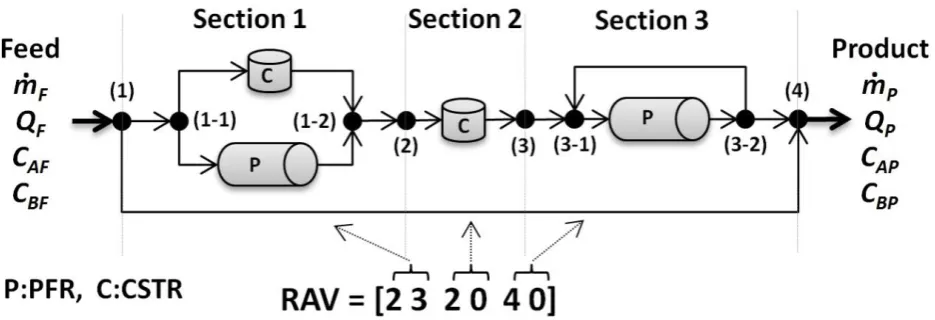
the RNs a reactor address vector (RAV) is defined in which each two elements of the array defines a section of the network. In this paper each reactor network consists of
three sections. Figure 1 shows a sample of reactor network involving PFR and CSTR with corresponding RAV.
Figure 1: A typical RN with three sections and four reactors and its RAV
As can be seen in this figure, zero 1, 2, 3 and 4 mean no stream, presence of stream, presence of CSTR, presence of PFR and presence of PFR with recycle stream respectively. Although elements of RAV are produced randomly, the whole array is examined so as not to produce infeasible structures (arrays with only zero and 1 elements which means no reactor). With this type of encoding, each section has the ability to contain one of 14 possible structures shown in Fig. 2. This ensures producing any possible reactor network. Besides, to involve some
constraints as initial concentrations of reactants in output streams of the RNs, a side stream is included in all produced networks. In all figures C and P stand for CSTR and PFR respectively.
4-2. NSGAII procedure
Figure 2: Possible structures for each section of the network
Isothermal Reactor Network Synthesis Using Coupled Non-Dominated Sorting Genetic Algorithm-II (NSGAII) with Quasi Linear Programming (LP) Method
83 Iranian Journal of Chemical Engineering, Vol. 12, No. 3
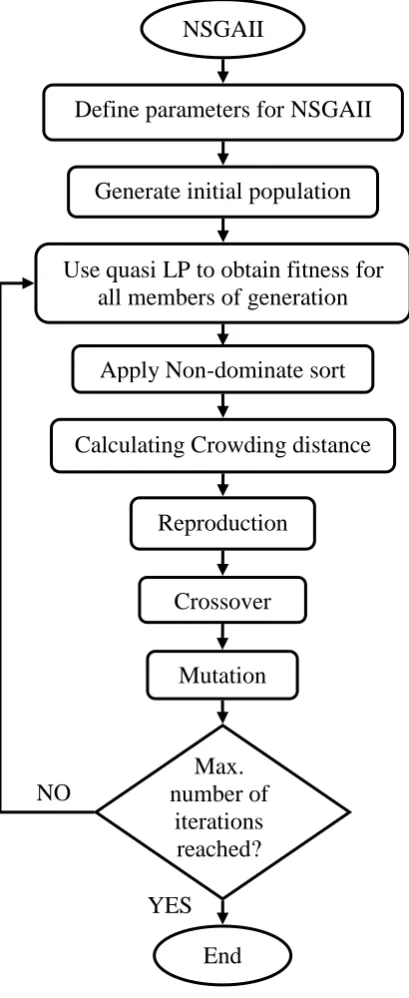
Figure 3: The NSGAII Algorithm
In the next step each member of the population is evaluated according to the procedure described in the next section. Next, a non-dominated sorting is applied to the members and after placing members in groups according to their fitness, a control parameter called crowding distance is defined for each member in each group. This parameter is the distance of each member in each group to other members of the group. Large value of this parameter means divergence and extent between the members of the population. Next, selection, cross-over and mutation is done to produce the next generation and finally criterion to stop the algorithm is checked. In this paper the criterion is reaching maximum number of generations which is defined initially and is taken as 40.
5. Mathematical model of superstructure and quasi LP procedure
5-1. Mathematical model of superstructure
Noting the assumptions made in section 2 for synthesis of RN, mass balances (or volume balances if density is constant) and mole balances for mixing and splitting points and also around the reactors in the configuration proposed by NSGAII will be as follows. Note that B means all components other than B. NSGAII
Define parameters for NSGAII
Generate initial population
Use quasi LP to obtain fitness for all members of generation
Apply Non-dominate sort
Calculating Crowding distance
Reproduction
Crossover
Mutation
End NO
YES Max. number of
Figure 4: A schematic of (A) mixing points, (B) splitting point in ith gene
Mass and mole balances around one of the mixing points in the ith section (see Fig. (4-A)):
, 1 , , 2
i j i j i j
m m m
, 1 , , 2
i j i j i j
if cst Q Q Q
, 1 , 1 , , , 2 , 2
i j A i j i j A i j i j A i j Q C Q C Q C
, 1 , 1 , , , 2 , 2
i j B i j i j B i j i j B i j Q C Q C Q C
(1)
Mass and mole balances around one of the splitting points in the ith section (see Fig. (4-B)):
, 1 , , , , 2 1- , , i j i t i j i j i t i j
m y m m y m
, 1 , , , , 2 1- , ,
i j i t i j i j i t i j
if cst Q y Q Q y Q
, , 1 , 2
A i j A i j A i j
C C C
, , 1 , 2
B i j B i j B i j
C C C
(2)
Figure 5: A schematic of (A) mth CSTR reactor (B) zth PFR reactor and (C) CSTR reactors in series to simulate zth PFR reactor in ith gene
Mass and mole balances around the mth CSTR in the ith section (see Fig. (5-A)):
, , 1
i j i j
m m
, , 1
i j i j
if cst Q Q
, 1 1 , , ,
A i j AC i m A i j
C x C
, 1 , 1, , , ,
B i j A i j A i j B i j
C G C C C
(3)
Mass and mole balances around the zth PFR in the ith section (see Fig. (5-B)):
, , 1
i j i j
m m
, , 1
i j i j
if cst Q Q
, 1 1 , , ,
A i j AP i z A i j
C x C
,
P B
i j B
dV dC
Q r
(4)
Hadi Soltania,b, Sirous Shafieia,b,*
Iranian Journal of Chemical Engineering, Vol. 12, No. 3 85
Mass balances:
1 2 1
, , , , , ... , , , , , 1
n n
i j i j z i j z i j z i j z i j
m m m m m m
1 2 1
, , , , , ... , , , , , 1
n n
i j i j z i j z i j z i j z i j
if cst Q Q Q Q Q Q (5)
Mole balance for component A:
1 1 , , , ,2 2 1
, , , , ,
1 1 2
, , , , ,
1
, 1 , , , , ,
1
1
...
1
1 Ai j z ACi z A i j
Ai j z ACi z Ai j z
n n n
Ai j z ACi z Ai j z
n n n
A i j Ai j z ACi z Ai j z
C x C
C x C
C x C
C C x C
(6)
Mole balance for component B:
1 1 , , , , , , ,2 2 1 1
, , , , , , , , , ,
1 1 2 2
, , , , , , , , , ,
1 1
, 1 , , , , , , , , , ,
, ,
, ,
...
, ,
, ,
B i j z Ai j z A i j B i j
B i j z Ai j z Ai j z B i j z
n n n n
B i j z Ai j z Ai j z B i j z
n n n n
B i j B i j z Ai j z Ai j z B i j z
C G C C C
C G C C C
C G C C C
C C G C C C
(7)
Volume of mth CSTR reactor in ith gene:
, , 1
, ,
A i j A i j Ci m i j
A C C V Q r (8)
Volume of zth PFR reactor in ith gene noting its simulation by CSTRs in series:
, ,
1 n
k Pi z Ci z
k
V V
(9)In the above equations,mi j, , Qi,j, CAi,j and
CBi,j are mass flow rate, volume flow rate,
concentration of components A and B of the jth stream of the ith section respectively, k, ,
i j z
m
, k, , i j z
Q , k , , A i j z
C and k , ,
Bi j z
C are mass flow rate, volume flow rate, concentration of components A and B of the jth stream in the output of the kth CSTR in series (in modeling
of zth PFR) in the ith section, respectively. Also, xAC,i,m, xAP,i,z and xAC i zk , , are conversions
of A in the mth CSTR, in the zth PFR and conversions of A in the kth CSTR in series(in modeling of zth PFR) of the ith section respectively. yi,t is the tth split and/or recycle ratio in the ith section, VCi,m, Vpi,z and VCi zk, are
volume of the mth CSTR, volume of the zth PFR and volume of the kth CSTR in series (in modeling of zth PFR) in the ith section respectively and -rA and –rB represent reaction
rate of component A and B respectively. Further, Gfunction represents reaction
function for output concentration of other components other than A (i.e. Ф: B, C, D and etc.) which will differ according to the reaction equation. For example functionality of GΦ for Van der Vusse reaction will be as
follows: 1 2 3 2 1 3 1 2 2 2 3 2 2
k A A A
k B A B
k C B
D A
r k C k C
A B
r k C k C
B C
r k C
A D
r k C
(10)
The outlet concentration of components B, C and D in any CSTR could be expressed as:
( ) ( )
B out
B Bout Bin A out A in A out
r
G C C C C
r (11)
( ) ( ) C outC Cout Cin A out A in
A out
r
G C C C C
r (12)
( ) ( ) D outD Dout Din A out A in A out
r
G C C C C
r
(13)
5-2. Quasi LP procedure
Considering governing equations of RN (equations 1 to 13) two types of continuous variables can be distinguished. Group (A) variables which are normal such as streams flow rates and their concentrations and group (B) variables which cause expressions to be non-linear such as conversion of a component in each reactor, split ratio or recycle ratio. Therefore if all variables are solved simultaneously it will be very difficult, but if two groups are separated and solved in steps the solution procedure will be much easier.
So in this paper quasi LP formulation which consists of two nested loops is used. In the outer loop first initial values are assumed for continuous variables of group (B). With these estimated values for variables of group (B), the continuous variables of group (A) are calculated by the following steps:
First step- finding volume flow rate of streams (considering constant density) and concentration of an inside them:
Ignoring volume change by mixing or passing through reactor and having estimated values of split ratios and recycle ratios as well as values of conversions of CSTRs which are obtained from outer loop, the equation of flow rates and concentration of A in the streams will be linear. Therefore, by calling a LP procedure the objective of which is maximizing conversion of species in RN (i.e. x) and which is defined as:
Max. x = 1- CAP/CAF (14)
All values of flow rates and concentrations of species A in the streams of RN are obtained. Furthermore, this step has been programmed to embed any constraint (for any reason such as safety or environmental consideration) on conversion of A and flow rate in each stream.
Second step-obtaining other components concentrations of the streams: Since these equations are nonlinear, (functions GФ in the
governing equations), a nonlinear set of equations should be solved. However, convergent behavior of the set of equations makes the solution straightforward.
Note that solving the set of nonlinear equations simultaneously for all concentrations of other species in RNs may be time consuming if not impossible. But regarding encoding of RNs by sections, which is consequential, it is possible to solve the set of nonlinear equations by Newton’s method for variables of each section. Having obtained the values of the section, the values are used as initial guess for the input variables of the next section and so on. The ability of Newton’s method to obtain values of the concentrations of other species of streams is reliable as demonstrated in the case studies. Furthermore, in this step there is the possibility to consider any constraint on concentration of components of each stream. After solving the system and obtaining the values of variables if there are constraints which are not satisfied, a penalty is calculated and added to the values of objective functions (OFs) which are calculated in the step 3.
Hadi Soltania,b, Sirous Shafieia,b,*
Iranian Journal of Chemical Engineering, Vol. 12, No. 3 87
Objective functions are formulated based on the conditions of the problem. There is possibility to define at least two different objective functions which can be based on maximum concentration of an intermediate or maximum selectivity or minimum volume of reactors for concentration of desired product, etc.
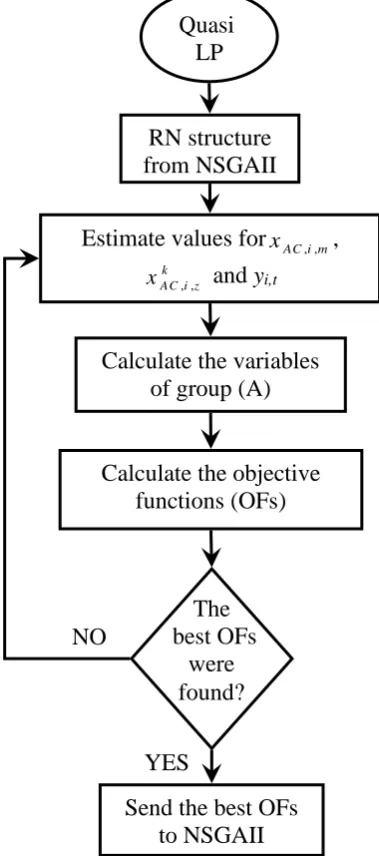
If there are any penalties in step two they are added to the value of functions here in this step. After step three new values are considered for the variables of group (B) and all three steps are repeated until new values of OFs are obtained and these operations continue until satisfactory values are obtained for the optimum OFs. Penalty terms in step two, cause the OFs to change such that all these constraints are satisfied and optimum values are obtained based on satisfying these constrains. To reach the optimum solution faster, valid intervals are considered for the variables of group (B) which are [0.001 0.999] for single CSTR conversion and split and recycle ratios and [0.001 0.3] for CSTRs conversion in series CSTRs replaced for PFR. Consideration of different intervals for single CSTR and CSTRs in series conversion is because of the fact that less conversion in CSTRs in series results in less error in simulating PFR [10]. Also, considering interval of [0.001 0.999] for other variables instead of [0 1] helps convergence to the reasonable values. All the steps can be seen in the flow chart shown in Fig. 6.
6. Illustrative examples
Two kinds of complex reaction schemes from the literature were considered to validate the proposed approach. The first
example is Trambouze reaction and the second one is Van de Vusse reaction. Programming was done in MATLAB software. Although MATLAB is easy and user friendly, it is too slow for handling these types of problems. So the original codes were compiled to C language and final codes were loaded on a computer having 4 GB of ram memory and 3.4 GHz processor. The optimization time that corresponds to each case study was about 15-20 hours which may be reduced by improving the characteristics of computers used and/or using the number of slave computers with a master. In both examples density of streams was considered constant. Also, 50 reactors in series were used to replace a PFR. Increasing the number of CSTRs will help the accuracy but will increase calculation time.
6-1. Case study one-Trambouze
reaction scheme
The Trambouze reaction scheme is defined by the following reactions which involve four species and it involves three parallel reactions where C is the desired Product.
1 2 3
2 1 2 3 1 1 1 2 2 2 2 2 3 3 3 - -
-k A A A
k B A C A k A D A
r k k C k C
A B r k
r k A C r k C
r k C A D r k C
r k C
(15)
The information of the reaction is shown in Table 1. In all references the objective function is overall selectivity of component C with respect to other products which is defined as:
1
C CF AF
Figure 6: The procedure of quasi LP method.
In the above equation xCF and xAF are mole
fractions of components C and A in the output from RN respectively. In this paper, in addition to the above OF, minimum reactor
volume was also considered. The number of initial population in NSGAII is equal to 30 in this case study.
Table 1
The information of Trambouze reaction-case study one.
F
Q
lit/min
A F
C
mol/L
BF
C
mol/L
CF
C
mol/L
DF
C
mol/L
1
k
mol/L.min
2
k
min-1
3
k
lit/mol.min
100 1 0 0 0 0.025 0.200 0.400
The Pareto-optimal solution sets after 30 generations is shown in Fig. 7. Fig. 8 shows
the best configuration in which SC and overall volume are 0.5 and 374.95 lit RN structure
from NSGAII
Estimate values forxAC i m, , ,
, ,
k AC i z
x and yi,t
Calculate the variables of group (A)
خس
The best OFs
were found? NO
YES
Calculate the objective functions (OFs)
خس
Send the best OFs to NSGAII
Hadi Soltania,b, Sirous Shafieia,b,*
Iranian Journal of Chemical Engineering, Vol. 12, No. 3 89
respectively. Table 2 shows the comparison of specific optimization results with those in the literature. As seen in the table although
the selectivity obtained is the same, the volume obtained in this study is remarkable compared to those in the literature.
Figure 7: Pareto-optimal set of objective functions after 30 generation-case study one
Figure 8: The best RN obtained for the first case study
Table 2
Comparison with literature for case study one.
1th OF SC
RN Structure (VReactor lit)
2th OF
total volume of rectors (lit)
Kokossis and Floudas [10]
0.5 1-CSTR (750.325) 750.325
0.5 2-CSTR (747.977) + CSTR (1.822) 749.799
0.5 3-CSTR (600.637) + PFR (149.276) with recycle 749.913
Silva et al. [22] 0.5 CSTR (598.36)+ PFR (153.89) 752.25
This work 0.5 3-CSTR (374.95) with side stream 374.95
6-2. Case study two-Van de Vusse reaction scheme
The Van de Vusse reaction scheme is defined by the following reactions where B is the desired product.
1 2 3
2 1 3 1 1
1 2 2 2
2 2
2 3 3
3
- - 2
-2
-k A A A
A
k B A B
B
C B
k
A
D A
r k C k C A B r k C
r k C k C B C r k C
r k C A D r k C
r k C
(17)
The information given in reference [23] has been used in this paper and is given in Table 3. The objective function in the reference is the maximum of intermediate B component in the output. In this paper in addition to the
above OF, the minimum required reactor volume was considered. The number of initial population in NSGAII is equal to 40 in this case study.
Table 3
The information of Van de Vusse Reaction-case study two.
F Q
lit/s AF C
mol/L BF C
mol/L CF C
mol/L
DF C
mol/L
1
k
s-1
2
k
s-1
3
k
lit/mol.s
1 1 0 0 0 10 1 2.9
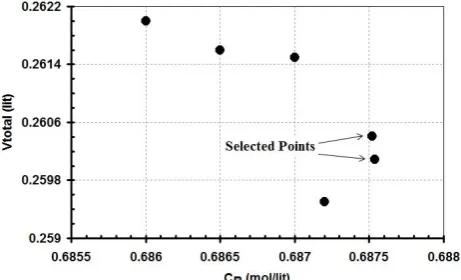
For this case study the Pareto-optimal solution sets were obtained after 40 generations. Two best solutions were obtained (see Fig. 9) where overall volume with respect to the intermediate concentration
B component was optimum. The
configurations are shown in Fig. 10 where maximum concentration of B are 0.68754 mol/lit and 0.68752 mol/lit and overall volume was obtained around 0.26lit.
Table 4 shows the comparison of specific optimization results with those in the
literature. As can be seen in this table both solutions are better than those in the literature considering either concentration of B component or overall reactor volume. This shows that the proposed method can achieve solutions which are in some cases better than the previous results reported in the literature. The reason for obtaining better solutions may be due to the new strategy to handle continuous variables which are treated in two nested loops.
Hadi Soltania,b, Sirous Shafieia,b,*
Iranian Journal of Chemical Engineering, Vol. 12, No. 3 91
Figure 10: The best configurations obtained for case study two
Table 4
Comparison with literature for case study two.
Max.CB
(mol/L) RN structure (VReactor lit)
total volume of reactors (lit) Kokossis and Floudas [10] 0.6344 CSTR (0.1138) + PFR (0.1699) 0.2837 Jin et al. [23] 0.6875 CSTR (0.0587) + PFR (0.202) 0.2607 this work (1) 0.68754 CSTR (0.03025) + PFR (0.1996) 0.2601 this work (2) 0.68752 CSTR (0.06125) with side stream +
PFR (0.19916) 0.2604
7. Conclusions
In this paper a new effective method to synthesize isothermal RNs by considering more than one objective function is proposed based on NSGAII-quasi LP method. Configuration of reactor networks is optimized by NSGAII.
To show the location of reactors and their types in the RNs a reactor address vector
reactor conversions, recycle ratios and stream split ratios. Group (A) and group (B) variables are treated in the inner and outer loops of quasi LP respectively. To remove differential terms in material balance equations for PFR, the PFR is replaced by a series of CSTRs. Although error is reduced by using more CSTRs in series, volume of calculations is also increased. In this study each PFR was replaced by fifty CSTRs in series which seems reasonable by reducing error and reducing volume of calculations. In this way a system of linear and non- linear equations, which converge faster, are solved to find continuous variables.
Regarding the performance of the proposed method noting that it uses quasi LP instead of NLP, the convergence for continuous variables is easier and also guaranteed. However, since it uses NSGAII to handle configuration variables which is time consuming, the overall time of running a special problem will depend on the number of initial populations and number of generations.
The proposed method can be easily upgraded to treat synthesis of adiabatic and non-isothermal RNs and can be applied to the industrial cases. This is the subject of the future research works. One of the advantages of this method is that it needs no initialization. The only variables that require initial guess are the conversion of component A in each CSTR as well as split and recycles streams ratios.
Acknowledgment
The authors would like to thank Sahand University of Technology (SUT) and Environmental Engineering Research
Center (EERC) for their support for this research work.
Nomenclature
CAF Concentration of component A in
feed stream
CBF Concentration of component B in
feed stream
, A i j
C Concentration of component A in the jth stream in the ith section
, Bi j
C Concentration of component B in the jth stream in the ith section
, ,
k A i j z
C Concentration of component A in the jth stream in the ith section in the output of the kth CSTR in series for zth PFR simulation
, ,
k Bi j z
C Concentration of component B in the jth stream in the ith section in the output of the kth CSTR in series for zth PFR simulation
GФ Reaction functions for Фth component (Ф: B, C and D)
QF Feed volume flow rate
Qi,j Volume flow rate of the jth stream in the ith section
,
k i j
Q Volume flow rate of the jth stream in the ith section in the output of the kth CSTR in series for zth PFR simulation
A
r
Rate of reaction of component A
, Ci m
V Volume of the mth single CSTR in the ith section
, Pi z
V Volume of the zth PFR in the ith section
,
k Ci z
V Volume of the kth CSTR in series used for zth PFR simulation in the ith section
, A Ci m
Hadi Soltania,b, Sirous Shafieia,b,*
Iranian Journal of Chemical Engineering, Vol. 12, No. 3 93
,
k ACi z
x Conversion of the component A in the kth CSTR in series used in zth PFR simulation in the ith section
yi,t the tth split and/or recycle ratios in the
ith section
Indices
F stands for the feed stream
i stands for the number of sections in stands for the inlet stream to CSTR j stands for the number of streams in each section
k stands for the number of STR in the series of CSTRs in PFR simulation
m stands for the number of single CSTRs in a section
out stands for the outlet stream from CSTR
P stands for the product stream
z stands for the number of PFR in a section
Ф stands for the all components except A
References:
[1] Smith, R., Chemical process design, McGraw-Hill, New York, P. 459 (1995).
[2] Horn F., "Attainable and non-attainable regions in chemical reactor technique", in 3ed European Symposium on Chem. Reac. Eng., London, Pergamon Press (1964).
[3] Glasser, Crowe, D., C. and Hildebrandt, D., "A geometric approach to steady flow reactors: the attainable region and optimization in concentration space", Ind. Eng. Chem. Res., 26 (9), 1803 (1987).
[4] Hildebrandt, D. and Glasser, D., "The attainable region and optimal reactor
structures", Chem. Eng. Sci., 45 (8), 2161 (1990).
[5] Hopley, F., Glasser, D. and Hildebrandt, D., "Optimal reactor structures for exothermic reversible reactions with complex kinetics", Chem. Eng. Sci., 51 (10), 2399 (1996).
[6] Glasser, D. and Hildebrandt, D.,
"Reactor and process synthesis", Comput. Chem. Eng., 21, 775 (1997).
[7] Rooney, W. C., "Convex attainable region projections for reactor network synthesis", Comput. Chem. Eng., 24 (2), 225 (2000).
[8] Kauchali, S., "Linear programming formulations for attainable region analysis", Chem. Eng. Sci., 57 (11), 2015 (2002).
[9] Khumalo, N., "The application of the attainable region analysis to comminution", Chem. Eng. Sci., 61 (18), 5969 (2006).
[10] Kokossis, A. C. and Christodoulos, F. A, "Optimization of complex reactor networks—I. Isothermal operation", Chem. Eng. Sci., 45 (3), 595 (1990).
[11] Kokossis, A. C. and Floudas, C. A., "Optimization of complex reactor networks—II. Nonisothermal operation", Chem. Eng. Sci., 49 (7), 1037 (1994).
[12] Floudas, C. A., Nonlinear and mixed-integer optimization: Fundamentals and Applications, 1st ed., Oxford University Press, New York, USA, P. 480 (1995).
[14] Chitra, S. P. and Rakesh, G. "Synthesis of optimal serial reactor structures for homogeneous reactions. Part I: Isothermal reactors", AIChE J., 31 (2), 177 (1985).
[15] Achenie, L. K. E. and Biegler, L. T., "A superstructure based approach to chemical reactor network synthesis", Comput. Chem. Eng., 14 (1), 23 (1990).
[16] Burri, J. F., Wilson, S. D. and Manousiouthakis, V. I., "Infinite DimEnsionAl State-space approach to reactor network synthesis: application to attainable region construction", Comput. Chem. Eng., 26 (6), 849 (2002).
[17] Abraham, T. K. and Feinberg, M., "Kinetic Bounds on Attainability in the Reactor Synthesis Problem", Ind. Eng. Chem. Res., 43 (2), 449 (2003).
[18] Manousiouthakis, V. I., Justanieah, A. M. and Taylor, L. A., "The Shrink–Wrap algorithm for the construction of the attainable region: an application of the IDEAS framework", Comput. Chem. Eng., 28 (9), 1563 (2004).
[19] Zhou, W. and Manousiouthakis, V. I., "Non-ideal reactor network synthesis through IDEAS: Attainable region construction", Chem. Eng. Sci., 61 (21), 6936 (2006).
[20] Zhou, W. and Manousiouthakis, V. I., "On dimensionality of attainable region construction for isothermal reactor networks", Comput. Chem. Eng., 32 (3), 439 (2008).
[21] Ashley, V. M. and Linke, P., "A Novel Approach for Reactor Network Synthesis Using Knowledge Discovery and
Optimization Techniques", Chem. Eng. Res. Des., 82 (8), 952 (2004).
[22] Silva, L. K. d., "Reactor network synthesis for isothermal conditions", Acta Sci-Techno., 30 (2), 199 (2008).
[23] Jin, S., Li, X. and Tao, S., "Globally optimal reactor network synthesis via the combination of linear programming and stochastic optimization approach", Chem. Eng. Res. Des., 90 (6), 808 (2012).
[24] Marcoulaki, E. and Kokossis, A., "Stochastic optimisation of complex reaction systems", Comput. Chem. Eng., 20, 231 (1996).
[25] Cordero, J. C., "Synthesis of optimal reactor networks using mathematical programming and simulated annealing", Comput. Chem. Eng., 21,47 (1997).
[26] Marcoulaki, E. C. and Kokossis, A. C., "Scoping and screening complex reaction networks using stochastic optimization", AIChE J., 45 (9), 1977 (1999).
[27] Linke, P. and Kokossis, A., "On the robust application of stochastic optimisation technology for the synthesis of reaction/separation systems", Comput. Chem. Eng., 27 (5), 733 (2003).
[28] Revollar, S., Lamanna, R. and Vega P., "Algorithmic synthesis and integrated design of chemical reactor systems using genetic algorithms", Proceedings on in Automation Cong., (2004).
[29] Sassi, M. and Amira, N., "Microwave plasma thermal decomposition of H2S", Int. J. Hydrog. Energy, 37, 10010 (2012).
Hadi Soltania,b, Sirous Shafieia,b,*
Iranian Journal of Chemical Engineering, Vol. 12, No. 3 95
network approach for integrated modelling of an SOFC system", Int. J. Hydrog. Energy, 36, 6112 (2011).
[31] Bhaskar, V. Gupta, S. K. and Ray, A. K., "Multi-objective optimization of an
industrial wiped-film pet reactor", AIChE J., 46 (5), 1046 (2000).