Design and Practice of Online and Classroom Programs that
Encourage Deep Learning
Xinyao Cheng
Logic Bridge Education & Technology (Beijing) Co.,Ltd
Xiuqin Yin
Logic Bridge Education & Technology (Beijing) Co.,Ltd
Abstract
This paper aims to design three online and classroom programs which focus on deep learning of high school mathematics and physics subjects, with the foundation of three levels of Bloom’s Taxonomy: understand, analyze and create. A design of learning tasks and scaffolding for classroom and online in-depth learning support that targets deep understanding as the first program and a design of thinking tasks and scaffolding for classroom and online problem-solving support system that targets at analysis and applications as the second program as well as the third program that designs action tasks and scaffolding aiming at knowledge innovation. Experienced teachers, technology experts, and pedagogue work together striving to help learners deepening self-learning and cooperative learning, encouraging motivation and improving system thinking ability. With on-going experiment in schools, the comparison data of experimental class and control classes on average scores and number of top-ranking students of midterm and final exam have shown the improvements in students’ deep learning.
1. Introduction
With the development of internet technologies such as artificial intelligence and big
Science Volume 3, 2020, Pages 35–46
data, Chinese education is exploring new rules for talent training that meets the requirements of social development in the new era. The focus of school information teaching reform and enterprise education information research and development are promoting from internet education to artificial intelligence education and applying information technology to build a platform such as smart classroom, MOOC, flip classroom.
At the practical level of the school, in order to cultivate students’ core literacy, the teaching method have also changed. The use of information technology to support student-centered teaching methods have gradually become dominant. However, in the mathematics and physics disciplines of junior high and high schools, especially in the high school stage, due to the substantial volume and difficulty of subject content and robust knowledge system, the teaching scaffolding provided is mainly to provide content support on the shallow goals in the “remember” of Bloom’s Taxonomy. There are very few programs that can provide support for Bloom’s high-level goals in terms of “understand”, “analyze” and “create”. When students’ self-exploration and independent thinking actions encounter obstacles, if there is a lack of expert-level knowledge system and supports for constructing knowledge system, in the process of solving complex problems or practical problems, without the scaffolding of independent exploration, guidance of thinking and feedback in the process of solving complex problems, students will in results being affected in the action of deep learning, the desire for active exploration, and the increase in learning interest and ability. Teachers will also tend to return to the traditional teaching mode in order to maintain the teaching effect and complete the teaching task, thus they may give up the student-centered approach. The fundamental reason is that the traditional mode will make the learning get better before it gets worse.
Our goal is to engage teaching design and information technology to more effectively support the student-centered teaching mode, to support students’ in-depth learning and thinking in mathematics and physics, and to improve their performance through the cultivation of thinking ability. By finding a small but effective high-leverage solution that helps students transform the learning style, we hope it can not only develop thinking ability, but also improve learning performance. The solution would also support students in actively learning, releasing learning interest, and promoting students-centered learning.
thinking system, such as integrity, relevance, hierarchical structure and time series. The project takes constructivism theory as the basic guiding ideology and applies three instruction methods: scaffolding instruction, anchored instruction and random-access instruction which are developed from constructivism theory to carry out our online and classroom project design and research.
2. Overview
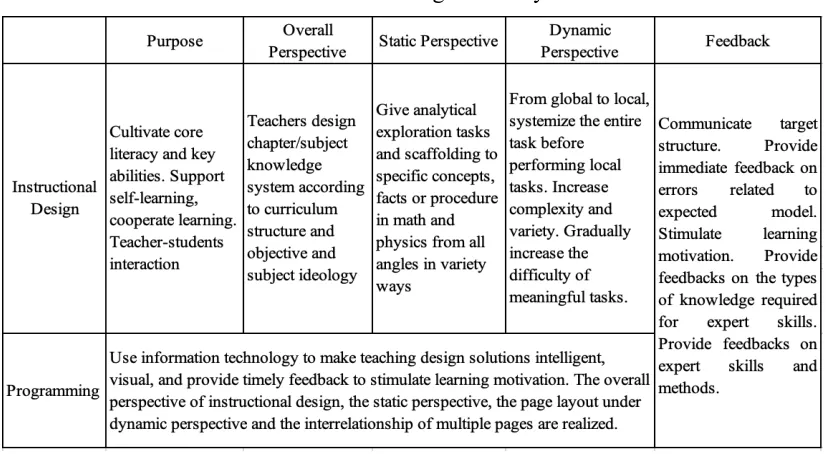
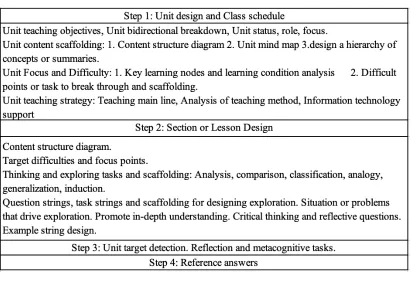
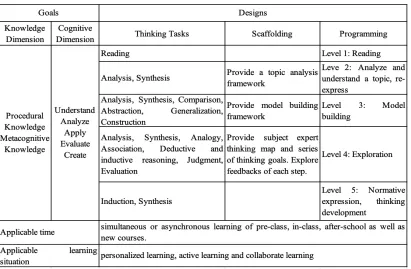
This paper discussed three programs designed in the system. All three programs target at high school mathematics and physics disciplines with the support of Bloom’s Taxonomy: “understand”, “analyze” and “create”. Each program that is designed with an overall task and scaffolding to support learning contains a classroom action plan and an online intelligent learning application. This will support students conduct in-depth active learning, cooperative learning, improve system thinking ability and encourage students’ learning motivation. Throughout the learning process, this system can be used to help learners deeply understand the learning content before class, improve the communication efficiency of group cooperative and teacher-student interaction in class, and the system can also support problem solving, reflection, expansion and application (table 1&2). The three programs can be combined flexibly and adaptable to various forms of teaching and learning.
Table 2. Overall classroom activity design
3. Programs
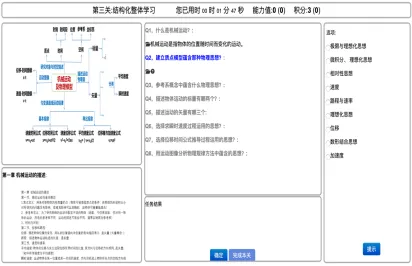
The first program is based on constructivism theory and the refined theory of Regulus. The program adopts the cognitive apprenticeship method, the six-level thinking target method (Anderson’s Bloom Taxonomy), design learning scaffolding (thinking task, content and methods) and feedback loops. The learning scaffolding is built by the knowledge network from subject expert, providing guidance and feedback to learners. The scaffolding can also be used to support learners to deeply understand the connections and structures between mathematics or physics concepts which will help learners analyze concepts from multiple perspectives and different methods to master structural thinking.
Figure 1. Online learning application
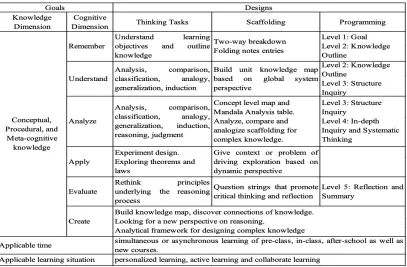
The foundation of the second program is constructed by the Procedural Knowledge and Metacognitive Knowledge in Anderson’s Bloom’s Taxonomy, as well as the higher order thinking abilities (Apply, Analyze, Evaluate and Create) in the Cognitive Processes. Meanwhile, the design refers to the teaching theories in Zankov’s Teaching and Development, G. Polya’s thinking in How to Solve it and Mathematical Discovery
and the TEC (Target – Expand – Contract) process in Dr. Edward de Bono’s CORT Thinking. The program designs a series of interrelated thinking tasks for challenging problem-solving process of high school mathematics and physics and adopts the problem-solving ideas from subject experts as scaffolding.
Table 4. Goal and design of second program
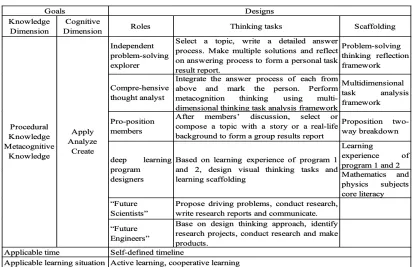
The third program is currently designed only for classroom activities of deep learning and thinking. The Program refers to the upper four levels of Bloom’s Taxonomy’ and sets six roles. These roles are independent problem-solving explorer, comprehensive thought analyst, proposition members, deep learning program designers, “Future Scientists” and “Future Engineers”. The program is designed to support thinking tasks and scaffolding for the six roles according to the core literacy of mathematics and physics, the evaluation criteria of college entrance examination and the cognitive task analysis theory. The overall design is below as Figure 6.
Table 5. Goal and design of the third program
4. Test & results
Learning outcome data is a basic manifestation of teaching effectiveness. Students’ learning outcome data analyzed in this experiment will verify the effectiveness of the three classroom activity designs for learning interventions.
The experimental data comes from six classes in the first year of a high school in China. The total number of students is 296. One of the classes was selected as an experimental class totaled 46 students. The rest five classed are control classes with an average 50 students per class. The junior high school graduation level test results of the six classes are basically the same in mathematics and physics subjects. That is, the average grade percentage is the same as the percentage of students in each test segment.
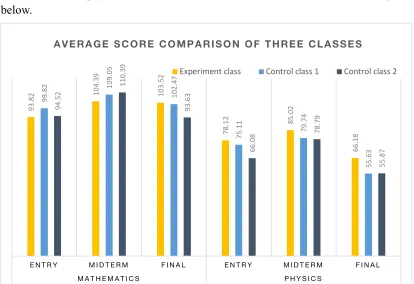
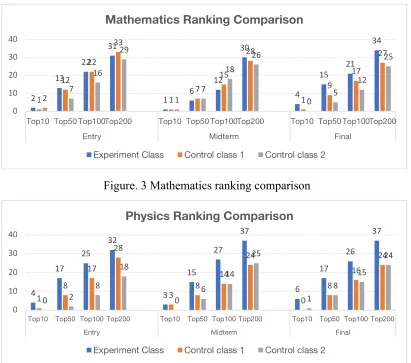
January 27th, 2019. During the data collection period, the mathematics and physics scores of the mid-term and final exams together with the entrance examination were selected as the analysis data. The analysis will mainly focus on the comparison of average scores of the three exams for mathematics and physics, and the number of students in each of the three class who rank in top 10, top 50, top 100 and top 200 of mathematics and physics in each exam. Detailed numbers are shown in the figures below.
Figure. 2 Average score comparison
93.
82 104.
39
103.
52
78.
12 85.02
66.
18
99.
82 109.
05
102.
47
75.
11 79.74
55.
63
94.
52
110.
39
93.
63
66.
08 78.
79
55.
87
E N T R Y M I D T E R M F I N A L E N T R Y M I D T E R M F I N A L
M A T H E M A T I C S P H Y S I C S
AVERAGE SCORE COMPARISON OF THREE CLASSES
Figure. 3 Mathematics ranking comparison
Figure. 4 Physics ranking comparison
From the data we collected and through comparison of average scores and top rankings, we validated the effectiveness of the intervention through the above two sets of comparison data of the three classes. The stability of the measures was validated by the average scores of the two exams in the experimental class and the number of people ranking top ten in the grade. At the same time, the effectiveness of the intervention measure is also validated as the change of the average and rankings of the experimental subjects (mathematics and physics) and non-experimental subjects in the experimental class. In summary, the three programs have reached Bloom’s three levels of “understand”, “analyze” and “create” through support for constructive, active learning and deep-thinking processes.
2 13 22 31 1 6 12 30 4 15 21 34 1 12 22 33 1 7 15 28 1 9 17 27 2 7 16 29 1 7 18 26 0 5 12 25 0 10 20 30 40
Top10 Top50 Top100Top200 Top10 Top50 Top100Top200 Top10 Top50 Top100Top200
Entry Midterm Final
Mathematics Ranking Comparison
Experiment Class Control class 1 Control class 2
4 17 25 32 3 15 27 37 6 17 26 37 1 8 17 28 3 8 14 24 0 8 16 24 0 2 8 18 0 6 14 25 1 8 15 24 0 10 20 30 40
Top10 Top50 Top100 Top200 Top10 Top50 Top100 Top200 Top10 Top50 Top100 Top200
Entry Midterm Final
Physics Ranking Comparison
5. Summary
This paper integrates subject content, teaching methods and information technology and designed programs with guidance and feedback by experienced teachers, technology experts, and pedagogue. The three classroom activity designs passed the semester experiment and verified the effectiveness of the program from the data analysis of students’ achievement. Currently, the online programs are still in test phase.
Three classroom activity designs can be applied to all forms of learning. Students can actively study before class, in class and after class, and the interaction between teachers and students can be improved. The two online programs have made up for the effectiveness of classroom activity programs to support personalized learning, and also solve the problem that the classroom activity programs cannot synchronize the learning process in time.
The online programs currently still need to be upgraded and improved in order to better support the inputs from teachers and students. There also has a need to improve the level of intelligence, the fun of gamification, the diversity of expressions, adaptability and interactivity.
This program will be in the process of practice, with feedbacks from students and participation in design, content and program iterations. On the basis of upgrading the application and accumulating data, in the repeated iterations of design, implementation, evaluation, redesign, re-implementation and re-evaluation, the optimization and improvement of the solution are realized.
References
[1] Reigeluth, C.M., & Darwazeh, A.N. The elaboration theory's procedure for designing instruction: A conceptual approach [J]. Journal of Instructional Development.1982,5(3) [2] Reigeluth, C.M. (1983). Instructional design: What is it and why is it? In C.M. Reigeluth (Ed.), Instructional-Design Theories and Models: An Overview of their Current Status[M]. Hillsdale, N.J: Erlbaum Associates
[3] Anderson, L. W. and Krathwohl, D. R., et al (Eds.) (2001) A Taxonomy for Learning, Teaching, and Assessing: A Revision of Bloom’s Taxonomy of Educational Objectives. Allyn & Bacon. Boston, MA (Pearson Education Group)
[5] [美]乔治.波利亚. 数学的发现: 对解题的理解、研究和讲授. 刘景麟, 曹之江, 邹青莲
译. 科学出版社, 2006
[6] [美] G.波利亚. 怎样解题:数学教学法的新面貌. 徐泓, 冯承天. 上海科技教育出版社,
2006
[7] [美] 费恩曼(R.F.Feynman), 莱顿(R.B.Leighton), 桑兹(M.Sands). 费恩曼物理学讲义.
郑水令等译. 上海科学技术出版社, 2013
[8] [美] 彼得.圣吉. 第五项修炼:学习型组织的艺术与实践. 张承林译. 北京中信出版社,
2018
[9] [加] J.D.斯洛塔, [美] M.C.林. 课堂环境中基于网络探究的科学教育. 赵建华译. 华东
师范大学出版社, 2015
[11] [俄]列夫.维果茨基. 思维与语言. 李维译. 北京大学出版社, 2010
[12] [俄]赞可夫. 教学与发展. 杜殿坤, 张世臣等译. 人民教育出版社, 1985
[15] [美]R.基思·索耶(2010). 剑桥学习科学手册[M].徐晓东等.北京:教育科学出版社
[16] [美]AECT.教育传播与技术研究手册(第三版)[M] .任友群,焦建利,刘美凤,
汪琼,主译.上海:华东师范大学出版社,2011.
[17] [美]AECT.教育传播与技术研究手册(第四版)[M] .任友群,焦建利,刘美凤,
汪琼,主译.上海:华东师范大学出版社,2015.
[18] [美]L.W.安德森等. 布卢姆教育目标分类学(完整版)分类学视野下的学与教及其测
评 [M]. 蒋小平. 外语教学与研究出版社, 2009.
[10] 程献伟, 尹秀琴. C3学习方法:C3思维总动员. C3超越行动. 北京出版社/北京少年
儿童出版社
[13] 林崇德. 思维发展心理学. 北京师范大学出版社, 1986