http://dx.doi.org/10.3926/jiem.1372
Research on the Support Model of Large Equipment
Emergency Spare Parts under Fuzzy Demand
Jianhua Yang, Zhichao Ma, Yang Song
Donlinks School of Economics and Management University of Science and Technology Beijing (China)
[email protected], [email protected], [email protected]
Received: January 2015 Accepted: April 2015
Abstract:
Purpose:
Aim at making a support scheme for emergency spare parts when large equipment
spare parts supply network faced with large-scale emergency events.
Design/methodology/approach:
In order to analyze the model, we establish the spare parts
security model under network supply conditions to respond emergency in case of fuzzy
demand. And in end of the paper, we adopt an improved genetic algorithm to solve the
problem.
Findings:
Considering emergency spare parts support problem from three aspects including
satisfaction of time, satisfaction of demand and emergency cost constraints, which makes
decision-making process more accord with reality condition, we can get a more realistic solution
for the decision makers.
Originality/value:
Considering the occurrence of emergency and adopting information
entropy theory to order the weight of emergency maintenance station in priority sequence, this
paper presented emergency response time and demand satisfaction function, which uses the
time, demand satisfaction and the cost restrictor as objective functions, we have constructed the
spare parts support model under fuzzy demand to solve emergency events, having expanded
the scope of solution.
1. Introduction
The reason for the complexity of maintenance spare parts for large equipment involves many complicated factors. Some attribute to the different types and large numbers of spare parts, others point to the intricacy of maintenance work. Spare parts management is a hot topic of the research field, and the supply of spare parts affects the exertion of the equipment support ability directly. Effective spare parts management can provide resources for equipment support in time, and ensure the stable operation of system that perform the maximum efficiently under the limited support cost. The decision maker is required to put forward the corresponding plan rapidly in an unexpected event, and spare parts’ supply requires fast response, accurate and reliable quantity. It is likely to miss the best opportunity of spare parts support and cause serious consequences if the decision making speed is slower. Therefore, in the process of support emergency spare parts, the improvement of equipment spare parts support work time and demand satisfaction should be considered for the problem of emergency resource optimization.
the least vehicle scheduling costs and minimization of loss as the target is established by Wang, Ma and Ruan (2013). This paper used the hierarchical thinking to reduce solution space, designed the genetic algorithm for this problem, the validity of the model is verified combining with realistic distribution scheme.
Many scholars at home and abroad who have made a lot of meaningful exploration for resource emergency support in an unexpected event, most of which support the resource allocation and transportation resources with demand certainty, and the study of the degrees of satisfaction in the field of emergency currently is more focused on distribution center location problem (Tzeng, Cheng & Huang, 2007), but demand of spare parts for large equipment is usually uncertain after the occurrence of actual emergency. Therefore, how to deal with problems of emergency spare parts support of large equipment in an unexpected event firstly need to estimate the demand of spare parts by the fuzzy method and to solve uncertainties. Aiming at problems of emergency spare parts support of large equipment in an unexpected event, a model of emergency spare parts support of large equipment is established under fuzzy demand in this paper. Considering the occurrence of emergency, the model estimates the demand of spare parts by the fuzzy method, based on the sorting of each maintenance station security priority, explores problems of emergency spare parts support from three aspects of satisfaction of time, satisfaction of demand and emergency cost constraints, which makes decision-making process more accord with the reality, so as to help decision makers to provide better emergency solution of effective maintenance resource allocation.
2. Model
2.1. Problem Description and Parameter Representation
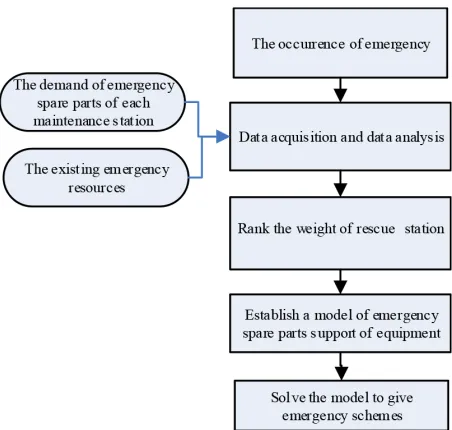
Figure 1. The flow chart of emergency response of large equipment spares
Set definition and description of model parameters:
• Emergency rescue point set: I = {1,2,...,n}, i I.
• The spare parts warehouse distribution center set: J = {1,2,...,m}, j J.
• tij denotes generalized temporal distance from the emergency rescue station i to the
spare parts warehouse distribution center j.
• denotes fuzzy demand of the emergency spare parts of the emergency rescue station
i in the initial time.
• xij denotes actual amount emergency spare parts delivery from the spare parts
warehouse distribution center j to the emergency rescue station i.
• cij denotes unit transportation cost from the spare parts warehouse distribution center j
to the emergency rescue station i.
• c* denotes emergency budget made by decision-making section.
• hj denotes emergency spare parts storage of spare parts warehouse distribution center j.
• Yij denotes that if spare parts warehouse distribution center j services the emergency
rescue station i, so Yij = 1,otherwise Yij = 0.
• Wi denotes the weights of emergency support priority of the emergency rescue station i.
2.2. The Weights Rank of Support Priority of Each Maintenance Station
When the emergency happens, spares demand of each maintenance station is different in the model of emergency spare parts support of equipment, and the distance from each maintenance station to the spare parts warehouse distribution center is also different. Maintenance personnel, transport vehicles and emergency budget are limited. So it needs to rank the weights of support priority of each maintenance station and determine the optimal allocation scheme.
Methods of determining the weight are usually applied by expert assignment method of subjectivity and analytic hierarchy process (AHP) of relative objectivity. The deficiency of expert assignment method is more optional, especially it leads to wrong evaluation results when the judgment of the experts and scholars is very different from the reality. For AHP method, due to the fluctuation of data information, imperfection and inaccuracy, the information got by further data mining which is likely to have big deviation with the real results. In order to overcome these problems, the information entropy theory based on indicators such as the spare parts demand and the existing resources etc. are applied to determine the weight, the process is as follows:
Measures belong to k categories of the sample xi made by observations xij of a sample with
particular attributes are set as:
ij,
ij,...,
ijk satisfies 0
ijk 1, . That is, the {
ijk} hasthe nature of a certain probability.
At this point the entropy is:
From the perspective of identification, various kinds of endings of randomized trials are
regarded as sample classification, and any kind of measure of sample xi being existed in k
categories by attribute Ij is . Thus it can be seen that attribute Ij has no effect on identifying
the classification of sample xi. Conversely, if one of the
ijk is one and the rest is zero, soH = 0, which shows that attribute Ij is important reflecting on the identification. So the value of
ijk about the kth classification is more concentrated, that is the smaller the H is, the moreimportant the classification of x identified by indicator Ij is. Therefore,
(1)
Obviously 0
ij 1, if the value of
ij is bigger, the value of H is smaller, the classification ofthe rest is zero. At this point, measures of sample x in the k1th classification made by the
observation of attribute Ij is one, the rest in the other classification is zero. That is, the sample
xi is certainly categorized into K categories by Ij, which indicates that Ij has the most
importance of identifying the classification of xi. If
ij = 0, that is each
ij = , measures of thesample xi have been divided into all kinds of classification by Ij as redundant attributes to
remove are the same. The more concentrated the value of
ij is, the bigger function of theattribute Ij acts on classification of xi. Set:
(2)
Consequently 0
ij 1, , and the bigger value of
ij is, the more important Ij toclassification of xiis. For that reason the weighting vector is
i = (
i1,
i2,...,
im)T.2.3. Time Satisfaction Degree and Demand Satisfaction Degree
2.3.1. Time Satisfaction Degree
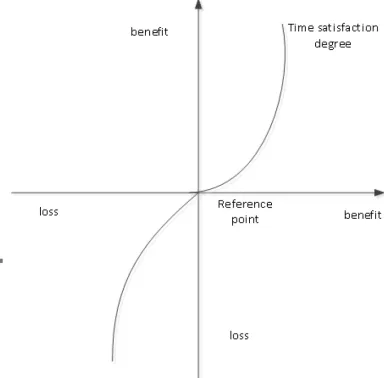
The spare parts emergency support satisfaction degree studied in this paper which is mainly time satisfaction degree and demand satisfaction degree. The customer satisfaction of emergency response time is the key factor for making decisions. In the process of handling emergency event, the distribution of the emergency spare parts may appear no symmetry information caused by the characters of emergency event. Among them, the information of timeliness is one of the key factors of emergency, and the customer satisfaction of emergency response time reflects the effect of emergency support to a certain extent. The value function is used to describe the customer satisfaction of emergency response time. The concave function of time satisfaction degree function is in incremental interval, and its convex function is in the negative incremental range. Generally, the same response time is different from different maintenance point of customer satisfaction.
The difference of emergency support objective condition leads to the value of the reference
point of varying sizes in Figure 2, and the reference point of emergency maintenance point i
Figure 2. The emergency response time satisfaction degree function
Consequently we take point i as an example, the deviation of emergency support time is
defined as:
The income function is used to measure the deviation of emergency response time for customers, which is:
(3)
2.3.2. Demand Satisfaction Degree
In the context of emergency spare parts support of large-scale unexpectedness case, the demand of maintenance point emergency spare parts is high and fuzzy, and the existing emergency resources are limited. So the higher spare parts demand satisfied rate is, the more the demand satisfaction degree is. The method of spare parts demand satisfaction degree in reference expresses the demand satisfaction degree by the relative demand rate function. The
demand satisfaction degree function of emergency maintenance point i is expressed as:
(4)
2.4. Model Construction
In the process of emergency support of unexpectedness case, emergency budget is also an important factor which needs to be considered. But for the timeliness of emergency spare parts support, the primary goal of the model is the least time of emergency support. Therefore, the primary goal of the model need to maximize the emergency time satisfaction degree when solving objective optimization, and then the needs of customer’s satisfaction degree and the cost of emergency are considered. The mentioned model is as following:
(5)
(6)
(7)
(8)
(9)
(10)
(11)
(12)
Equation (5) is time satisfaction degree objective function which express maximum customer revenue function with different weights. Equation (6) is demand satisfaction degree function which express overall maximum demand satisfaction degree of maintenance station. Equation (7) is the emergency cost of emergency budget constraint. Equation (8) is the definition of time deviation. Equation (9) denotes that the initial configuration of the emergency spare parts are in short supply of large- scale unexpectedness case. Equation (10) denotes that the amount of spare parts dispatched to various emergency maintenance point cannot exceed its own spare parts storage for each warehouse distribution center. Equation (11) denotes the
3. Solution of Model
The multiple maintenance point emergency resource allocation model which is made in this paper belongs to multi-objective fuzzy constraint programming problem, which firstly needs to deal with fuzzy constraints.
3.1. The Defuzzification of Model
Considering the triangular fuzzy number can intuitively and scientifically denotes the characteristics of fuzzy estimated by decision-makers by the way of the most pessimistic value, the most possible value, and the most optimistic value, this paper describes the demand of emergency spare parts of unexpectedness case using the triangular fuzzy number symbolized
by = (ai, bi, ci) ( ai bi ci), ai, bi and ci respectively denotes the most pessimistic value, the
most possible value, and the most optimistic value belonging to real number of emergency spare parts estimated by decision-makers of unexpectedness case), its fuzzy membership degree is:
(13)
The method that was used in (Liang, 2006) mentioned in this paper is adopted to deal with fuzzy constraints. Considering comprehensively the balance between the risk preference of
decision makers and possibility degree of attribute values, after confidence level is given by
the decision makers, [0,1], the weighted average method is adopted to translate triangular
fuzzy number to determine value. Emergency spare parts predict the demand of fuzzy:
(14)
w
1,w
2 andw
3 respectively denote the weight of the most pessimistic value, the most possiblevalue and the most optimistic value of emergency spare parts demand fuzzy number for decision makers. The most possible value, the most pessimistic value and the most optimistic value that appear in (Li & Lai, 2000) mentioned in this paper is adopted as boundary constraints of fuzzy number. The estimate of multiple fuzzy state is usually too pessimistic or optimistic, so a small weight is assigned to it. The most possible value is estimated according
to the experience of decision makers, so a higher weight is assigned to it. That is
w
1,w
2 andw
3Based on this, the right side of Equation (14) can be used to replace the corresponding fuzzy variables in the Equation (9), so as to realize the defuzzification of model. That is:
(15)
3.2. Algorithm Design
Based on the defuzzification, the establishment of the above the multiple maintenance point emergency resource allocation multi-objective fuzzy constraint programming model is changed to certain multi-objective programming model. There are many methods for the solution of the multi-objective programming problem. This paper adopts the main target method, the hierarchical ordering method and the genetic algorithm convergence in the heuristic algorithm to solve this problem, the solving process is as follows:
Firstly, the main target method is used to deal with the model. The time satisfaction degree objective function for the Equation (5) is taken as the main objective function, and the demand satisfaction degree objective function for the Equation (6) is constrained and transformed by a certain way. Equation (6) can be equivalent to the following three conditions:
(16)
(17)
(18)
Equation (16) denotes that spare parts which play a role on the condition of the initial configuration of the emergency spare parts are in short supply of large-scale unexpectedness case. Equation (17) denotes limited emergency spare parts distribution criterion. Equation (18) ensures the distribution of the spare parts, and SL denotes the proportion of the minimum requirements of every maintenance station need to be supported. The values of SL are determined according to specific situation of the emergency.
Secondly, the method of hierarchical ordering is utilized to order according to degree of significance of the rest two objective function. In the initial stage of the emergency, quick response is able to minimize losses, and the response time become one of the key elements for dealing with emergencies. Therefore, the time satisfaction degree function is taken as the primary goal. The demand satisfaction degree is taken as the second goal. The emergency
function is got from the optimal solution set S1 of the first objective function , and
the solution of S2 is taken as optimal solution.
Thirdly, genetic algorithm is a kind of solving technology to solve the optimal solution of the complex problem by using evolution and genetic, which has well features of high searching efficiency and solving the global optimal solution, and is widely used in the field of the current large-scale resource scheduling and allocation (Kim, Gen & Yamazaki, 2003; Mendes, Gonçalves & Resende, 2009; Su, Wu & Yu, 2006). In this paper, based on the method of (Yan, Che, Li & Yang, 2010), the method of introducing neighborhood search on the basis of crossover and mutation and chromosome filter search is proposed to improve the searching quality and efficiency of GA.
The main function of the algorithm is to filter chromosome not satisfy the constraint conditions before the operation of the choice of genetic algorithms.
Step 1. For generating initial population, the time cost of each chromosome of the population is compared with the maximum time cost. The service resource cost is compared with the largest service resources cost that customers are able to accept, and customer service satisfaction degree is compared with the minimum customer satisfaction degree. If there is a condition not satisfied, it will be removed from the population.
Step 2. If the exclusion of numbers of individuals is more than half of the population, it should be returned to Step 1. Otherwise, it should be returned to step 3.
Step 3. The remaining population individuals are ranked according to the individual fitness, and high fitness individuals are chosen to reproduce.
In order to improve the convergence speed of the GA, after the operation of crossover and mutation, the individual of the best fitness neighborhood is chosen as individuals of offspring which is taken as a basis for neighborhood search. Population size is set to pop number.
Step 1. To make i = 0, j = 0.
Step 2. If i > popnumber, it will turn to Step 9, or turn to Step 3.
Step 3. If the jth gene-bit is unable to meet the last of the current chromosome, it will turn to Step 4, or turn to Step 7.
Step 4. Starting with the first a chromosome of population, the jth genotypic value xj of it plus
one.
Step 5. The fitness value of the ith chromosome is fitnessij.
Step 7. If the fitness value of the transformed chromosomes is less than the fitness value of the previous transition chromosomes, it need to replace chromosomes.
Step 8. To make i = i + 1, j = 0, it will turn to Step 2.
Step 9. The neighborhood search is completed.
4. Simulation Example
There are ten emergency maintenance stations and four spare parts warehouse centers in a large equipment company, and the fuzzy demand vectors of all emergency maintenance stations (expressed by A~I) after the emergency events happen as shown in Table 1.
Emergency maintenance
station Spare parts fuzzy demand
A (10,13,15)
B (15,17,20)
C (16,18,20)
D (14,18,21)
E (11,13,16)
F (13,15,18)
G (15,17,19)
H (16,19,21)
I (14,17,20)
J (14,15,16)
Table 1. The fuzzy demand of spare parts
When the emergency happens, according to the statistics of the existing emergency resource and demand, the weight vector after sorting the determined support priority by using the above information entropy theory is:
wi= (w1,w2,w3,w4,w5,w6,w7,w8,w9,w10) = (0.1,0.1,0.05,0.15,0.15,0.05,0.2,0.05,0.05,0.1)
The existing storage for spare parts storage center are:
Based on (Kahneman & Tversky, 1984), to take SL = 0.3, = 0.88, b = 0.88, = 2.25,
c*=5000. Time distance and transportation costs from each storage center to the
maintenance station are presented in Table 2.
Warehouse
center Maintenance station
1 2 2 4 5 6 7 8 9 10
1 1/5 2/5 5/3 3/1 4/2 5/2 3/5 1/2 3/6 2/9
2 2/3 2/6 4/7 4/5 3/6 5/4 1/2 2/9 3/4 5/7
3 4/6 2/4 3/6 3/6 1/4 3/5 2/6 2/5 4/6 4/2
4 7/2 3/8 2/5 3/9 3/8 5/7 3/3 3/9 4/7 5/2
Table 2. The distribution table of time and transportation cost (t/c)
The above data is taken to the multiple maintenance point emergency resource allocation model built up in this paper, using MATLAB2007 language programming, and the optimized solution set got by genetic algorithm toolbox is:
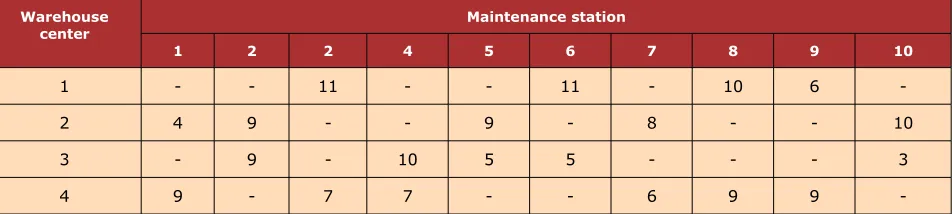
The values of the objective function time satisfaction degree and demand satisfaction degree were obtained by calculation, which are 0.92 and 0.85, respectively, and the emergency cost is 4785. The global optimal solutions of emergency spare parts allocation is as shown in Table 3.
Warehouse
center Maintenance station
1 2 2 4 5 6 7 8 9 10
1 - - 11 - - 11 - 10 6
-2 4 9 - - 9 - 8 - - 10
3 - 9 - 10 5 5 - - - 3
4 9 - 7 7 - - 6 9 9
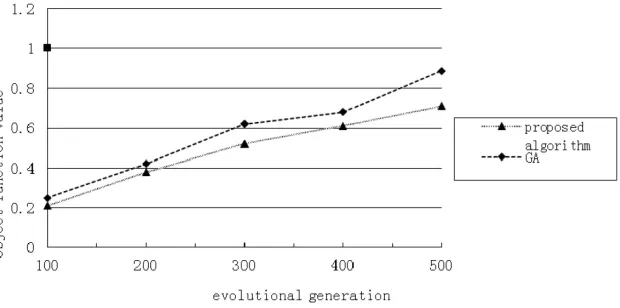
The calculation result indicates that the multiple maintenance point emergency spare parts support model was built up in this paper under the condition of fuzzy demand, which can effectively solve the emergency resource limited multiple maintenance point resource allocation scheme, and meet time and demand satisfaction degree of customer maximum. Comparing traditional GA with the algorithm proposed in this paper from two aspects of solving speed and the value of the objective function, it can be seen that the solution speed of the proposed algorithm is fast while the number of iterations change from 100 to 500, the result was shown in Figure 3. In terms of solving the optimal function values, the number of iterations of each algorithm is set by 100 to 500, and it can be seen from the Figure 4 that the proposed algorithm is superior to GA.
Figure 3. Efficiency comparisons among various algorithms
5. Conclusion
When the emergency event happens, it is very important to response rapidly for the work of maintenance spare parts for large equipment. The demand of spare parts is vague, and the existing resources such as maintenance personnel, spare parts storage and transportation tools are limited, so we need to conduct support prioritization according to the degree of urgency and the importance of maintenance station. In order to overcome the volatility and inaccuracy of information data. The theory of information entropy was used to conduct the weight sorting for emergency maintenance station support priority. The traditional method usually puts particular emphasis on the emergency decision making problems of the shortest response time, which is based on the method of quantified emergency response time and demand satisfaction degree, and the multiple maintenance points emergencies resource allocation model under the condition of fuzzy demand of considering time satisfaction degree and demand satisfaction degree, which combines the method of multi-objective programming with genetic algorithm The validity of the model is proved by a real instance, and the solution of emergency spare parts support is given under the condition of emergency events.
Acknowledgments
The work reported in this paper is supported by National Nature Science Foundation of China under grant NO. 71231001.
References
Dai, G.X., & Da, Q.l. (2000). The Study of Combinatorial Scheduling Problem in Emergency
Systems. Systems Engineering-theory & Practice, 20(9), 52-55.
Du, M., & Yi, H. (2013). Research on multi-objective emergency logistics vehicle routing
problem under constraint conditions. Journal of Industrial Engineering and Management,
6(1), 258-266. http://dx.doi.org/10.3926/jiem.670
Fiedrich, F., Gehbauer, F., & Rickers, U. (2000). Optimized resource allocation for emergency
response after earthquake disasters. Safety Science, 35(1), 41-57.
http://dx.doi.org/10.1016/S0925-7535(00)00021-7
Kahneman, D., & Tversky, A. (1984). Choices, values, and frames. American psychologist,
39(4), 341-349. http://dx.doi.org/10.1037/0003-066X.39.4.341
Kim, K.W., Gen, M., & Yamazaki, G. (2003). Hybrid genetic algorithm with fuzzy logic for
resource-constrained project scheduling. Applied Soft Computing, 2(3), 174-188.
Li, L., & Lai, K.K. (2000). A fuzzy approach to the multiobjective transportation problem. Computers & Operations Research, 27(1), 43-57. http://dx.doi.org/10.1016/S0305-0548(99)00007-6
Liang, T.F. (2006). Distribution planning decisions using interactive fuzzy multi-objective linear
programming. Fuzzy Sets and Systems, 157(10), 1303-1316.
http://dx.doi.org/10.1016/j.fss.2006.01.014
Liu, C.L., He, J.M., & Shi, J.J. (2001). The Study on Optimal Model for a Kind of Emergency
Material Dispatch Problem. Chinese Journal of Management Science, 9(3), 29-36.
Mendes, J.J.D.M., Gonçalves, J.F., & Resende, M.G. (2009). A random key based genetic
algorithm for the resource constrained project scheduling problem. Computers & Operations
Research, 36(1), 92-109. http://dx.doi.org/10.1016/j.cor.2007.07.001
Özdamar, L., Ekinci, E., & Küçükyazici, B. (2004). Emergency logistics planning in natural
disasters. Annals of operations research, 129(1-4), 217-245.
http://dx.doi.org/10.1023/B:ANOR.0000030690.27939.39
Shen, J.B. (2007). An emergency logistics distribution approach for quick response to urgent
relief demand in disasters. Transportation Research Part E: Logistics and Transportation
Review, 43(6), 687-709. http://dx.doi.org/10.1016/j.tre.2006.04.004
Su, P., Wu, N.Q., & Yu, Z.Q. (2006). Application of Improved Genetic Algorithm in Partner
Selection and Optimization for a Virtual Enterprise. Systems Engineering-theory & Practice,
26(12), 404-410.
Tzeng, G.H., Cheng, H.J., & Huang, T.D. (2007). Multi-objective optimal planning for designing
relief delivery systems. Transportation Research Part E: Logistics and Transportation Review,
43(6), 673-686. http://dx.doi.org/10.1016/j.tre.2006.10.012
Wang, X.P., Ma, C., & Ruan, J.H. (2013). Model and algorithm of relief materials dynamic
scheduling without sufficient vehicle quantity. Systems Engineering-theory & Practice, 33(6),
1492-1500.
Yan, P.Y., Che, A.D., Li, P. & Yang, N.D. (2010). Improved genetic algorithm for robotic cell
schedul ing problem with flexible processing times. Computer Integrated Manufacturing
System, 2, 404-410.
Journal of Industrial Engineering and Management, 2015 (www.jiem.org)
Article's contents are provided on a Attribution-Non Commercial 3.0 Creative commons license. Readers are allowed to copy, distribute and communicate article's contents, provided the author's and Journal of Industrial Engineering and Management's names are included.