A Reflective Analysis of 14 Regulation Structures
Marie-Andrée Girard MD FRCPC LLD(c)a
Abstract
Background: Interprofessional collaboration (IPC) is a key element of an efficient healthcare system. Are healthcare systems structured to facilitate IPC?
Methods and findings: Fourteen jurisdictions were chosen and researched using legal and social sciences databases. Generally, there was a lack of understanding of the legal principles in literature on policy and IPC. at aside, every jurisdic-tion had acts and regulajurisdic-tion specific to health professions. ere were numerous pathways to professional regulation and no clear consensus. Regarding IPC pres-ence in legal text, there were two main integration pathways: professional-based and organization-based approaches.
Conclusion: Although the practice of IPC is important, its presence in regulation is still discrete. If the aim is to strengthen IPC, there must be more socio-legal research to properly address and inform policymakers.
Keywords: Health regulation; Professional regulation; Interprofessional practice; Interprofessional collaboration
Introduction
Interprofessional collaboration (IPC) is now accepted as a key element of an effi-cient healthcare system. In that context, most policymakers and health professionals strive to develop and implement such a practice. Yet, they encounter resistance due to ingrained culture and structures. To allow IPC to flourish, researchers must put forward the importance of changing professional culture from its historically siloed mono-professional characteristics and call into question the dominant position held by the physician in the overall healthcare structure [1,2]. This is not conducive to an equal relationship among health professionals, with a horizontal leadership [3,4]. What social science literature tends to overlook is that these social constructs and paradigms gave birth to legal notions such as the scope of practice and the defini-tions of professional acts. These reguladefini-tions crystallize professional hierarchy and medicine dominance [1,5].
Siloed thinking and hierarchy are not only present in the culture and micro-level working relationships; they are embedded in the regulations structuring the health-care system itself. As researchers have already underlined, such a situation creates a dynamic based more on professional practice turf than on a care continuum [3,6,7,8]. To promote IPC and tackle this dynamic, stakeholders and policymakers, Journal of Research in
Interprofessional Practice and Education
Vol. 9.2 2019
Journal of Research in Interprofessional Practice and Education (JRIPE)
Vol. 9.2 © 2019
doi: 10.22230/jripe.2019 v9n2a285
Corresponding author: Marie-Andrée Girard. Email: marie-andree [email protected]
Journal of Research in
Interprofessional Practice and Education
Vol. 9.2 2019 2
IPC and Law: Analysis
Girard
while acknowledging the culture, have to address the siloed and linear structure that has arisen from an inherited healthcare profession-based structure. The actual conundrum is that stakeholders and policymakers have to challenge this structure while knowing very little about healthcare structural policy and the laws determin-ing it [9].
Yet, one can argue that most developed countries are burgeoning with IPC and interprofessional education (IPE) initiatives without introducing broad legislative changes. The main issue is that these initiatives are often linked to a pilot project or specific funding, which hinders their stability [10]. This is why it is important to study the law. Health law and health policies offer a hint about the potential of IPC. In fact, the law is the product of how political and social culture interact in one coun-try [11]. Regulation is then the expression of the will of either the government or the professionals themselves. Because of this performative nature, the legal presence of IPC is a good clue that the regulators want to implement further collaboration or interprofessional practice in a specific healthcare system [11,12,13]. When the will is strong enough to percolate into legal texts, IPC will be part of healthcare’s culture.
Aim
The objective of this article is to perform an analysis of the impact of interprofes-sional regulations and contribute to the creation of a research agenda on global IPC policy and regulation. The article comprises a descriptive study of 14 jurisdictions in 10 countries, focusing on legal texts in search of facilitators of or references to IPC. The aim is not to venture into the realm of comparative law but to present general principles embedded in healthcare regulation concerning IPC from specific devel-oped countries (14 states and provinces in total). This description of the current legal aspect aims to foster a discussion on IPC evolution and IPC legal structure support, especially when it comes to comparing initiatives from different countries and states.
Process and method
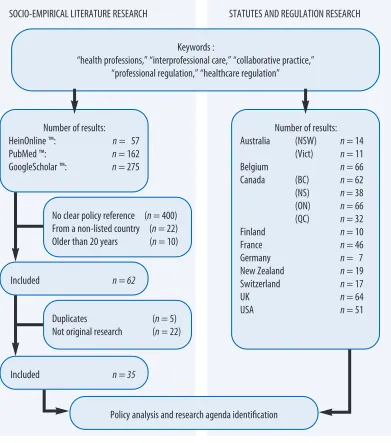
Figure 1: Method and process
Results
Fourteen states and provinces were chosen and researched: Canada (four provinces: British Columbia, Nova Scotia, Ontario, and Quebec), the United States of America, France, Belgium, Switzerland, United Kingdom, Australia (two states: New South Wales and the State of Victoria), New Zealand, Finland, Germany (see Figure 1). These countries were chosen based on data access, the availability of translated legal texts (English or French), and the existence of a searchable database. As stated ear-lier, the polymorphism of legal structures demands some caution from a strictly legal point of view: comparing those texts is hard since every law or act exists in a complex system of acts and decrees reflecting a specific society. Nonetheless, the results are separated into three themes: what is common, what is different, and what is the legal presence of IPC (see Table 1 for complete results).
Journal of Research in
Interprofessional Practice and Education
Vol. 9.2 2019 3
IPC and Law: Analysis
Girard
SOCIO-EMPIRICAL LITERATURE RESEARCH STATUTES AND REGULATION RESEARCH
Keywords :
“health professions,” “interprofessional care,” “collaborative practice,” “professional regulation,” “healthcare regulation”
Number of results: HeinOnline ™: n= 57 PubMed ™: n= 162 GoogleScholar ™: n= 275
Number of results: Australia (NSW) n= 14
(Vict) n= 11 Belgium n= 66 Canada (BC) n = 62 (NS) n = 38 (ON) n= 66 (QC) n = 32 Finland n= 10 France n= 46 Germany n= 7 New Zealand n= 19 Switzerland n= 17 UK n= 64 USA n= 51 Included n = 62
Included n = 35
Policy analysis and research agenda identification No clear policy reference (n= 400)
From a non-listed country (n= 22) Older than 20 years (n= 10)
Table 1: Legal review results
A common error and a common perspective
First, most social science studies—and even some doctrinal articles—recognized the importance of professional regulation as a key factor of IPC, task reallocation, or cross-boundary work [6,16,17,18,19,20]. Those studies are, however, bearers of a common misconception about the nature of healthcare’s legal framework and pro-fessional regulation [2,6,21,22]. The peculiar aspect of law is its specificity to a juris-diction, which is not necessarily determined by a country’s geographic frontiers. It is then important to pay attention to those jurisdictions. From a legal perspective, it is incorrect to say there is one Canadian healthcare system, one Swiss healthcare sys-tem, or one American healthcare syssys-tem, since their legal bases are provincial (Canada), cantonal (Switzerland), or state-based (America) and can vary [22,23]. These systems are plural and mandate a jurisdiction-specific approach. When it comes to the legal competence structure of healthcare, Québec, for example, is actu-ally as different from British Columbia or Nova Scotia as Australia is from New Zealand. To study those systems as one entity across one country would give the Journal of Research in
Interprofessional Practice and Education
Vol. 9.2 2019 4
IPC and Law: Analysis
Girard
New South Wales co Umbrella Status + Delivery role Code of conduct based
Victoria co Umbrella Status + Delivery role Code of conduct based
Belgium explicit Umbrella Status + Delivery role Healthcare-system based
British Columbia co Umbrella Status + Delivery role Profession-regulators based
Ontario co Umbrella Status + Delivery role Profession-regulators based
Quebec co Umbrella Status + Delivery role Code of conduct based
Nova Scotia co Umbrella Status + Delivery role Profession-regulators based
Finland co Umbrella Status + Delivery role Healthcare-system based
France co Umbrella Status + Delivery role Healthcare-system based
Germany quasi Profession
specific Status + Delivery role
IPE based co
New Zealand Umbrella Status + Delivery role Profession-regulators based
Switzerland co Profession
specific Status + Delivery role
IPE based co
United Kingdom Umbrella Status + Delivery role IPE based
United State of America quasi Profession
specific Status + Delivery role IPE based
Au
st
ra
lia
Ca
na
da
Philosophy of regulation
Type of professional
regulation
Healthcare professional
regulation
researcher or the policymaker a picture that is neither clear nor exact, and one that could lead to inefficient policy changes [9].
Exploring all 14 areas through the lens of jurisdiction specificity revealed a gen-eral tendency for robust regulations specific to healthcare or health professions in each place. They were either specific regulations about specific professions (Québec’s Medical Act [24], Québec’s Nurses Act [25], Ontario’s Medicine Act [26]), global acts about healthcare (Finland’s Health Care Act [27], British Columbia’s Health Act [28], New South Wales’s Health Services 1997 [29]), or global acts about professional practice (Québec’s Professional Code [30], Ontario’s Regulated Health Profession Act [31], New Zealand’s Health Practitioners Competence Assurance Act 2003 [32]). There are two dimensions to health regulation: the regulation of the professional title and the regulation of the healthcare delivery role. All jurisdictions studied had acts, statutes, or regulations monitoring both. In every jurisdiction, the inherent structure of these legal texts favours a mono-professional approach, which is congruent with the literature [1,3,6,8,33,34]. From both a legal and an organiza-tional perspective, this leads more toward supervision and deference than collabora-tion without hierarchy [35,36,37].
A difference in approach: Regulation type
After exploring what unites these jurisdictions, it is key to explore their differences (see Figure 2). In terms of professional regulation, it is important to first describe the philosophical approach behind professional regulation. Professional regulations can be classified into different categories on a spectrum determined by the participation levels of government and of professional authorities in the regulatory field [38]. An area where the government participates the least is called “quasi-regulation”; it is represented by two jurisdictions in this study: the United States of America and Germany. These jurisdictions are not free of regulation, but the central government is less actively involved in specific regulation, leading to both rigid professional boundaries and the potential for innovation at the same time [16,17,39,40]. In Germany, for example, the Federal Joint Committee is a legal entity outside of the Ministry of Health itself and it has the mandate to regulate healthcare (based on Germany’s Social Code, Book Five [41]). At the other end of the spectrum, explicit
Journal of Research in
Interprofessional Practice and Education
Vol. 9.2 2019 5
IPC and Law: Analysis
Girard
regulation has the least participation of professional authorities, and only one coun-try in the study fits such a profile: Belgium. Interestingly, it is the jurisdiction in Europe where nursing autonomy and IPC was “high” [42].
Between those two extremes is co-regulation, where there is shared ownership of the regulatory field between the government and the professional organization. It is the most common type of regulation found in this study, used by 11 of 14 jurisdic-tions. Co-regulation can take many forms. It can be closer to explicit regulation, with more institutional control of professional structure and practice, as in the United Kingdom with the Profession Authority Standard (as stipulated by Schedule 7 National Health Service Reform and Health Care Professions Act [43]). Or it can be closer to quasi-regulation, with greater autonomy by professional authorities, as in Québec, where professional authorities have the power to issue regulations (as stipulated by Quebec’s Professional Code [30]), or Australia with the Australian Health Practitioner Regulation Authorities (AHPRA) (as stipulated in New South Wales’ and Victoria’s Health Practitioner Regulation National Law [44,45]).
A difference in approach: Umbrella laws
Once the importance of regulation is determined, the importance of jurisdiction specificities established, and the types of regulation philosophy introduced, the next step is looking at what is promoted as a legal structure for IPC (see Figure 2). In the legal literature, one type of regulation is recognized as a more flexible legal environ-ment that can ease the impleenviron-mentation of IPC: the umbrella law [6,10,21,22]. As its name indicates, an umbrella law is meant to cover most healthcare professions under one single text and can be a solution to turf wars and professional siloes— both elements hindering IPC [3,16,21,35,46–48].
Most jurisdictions (11 of 14) have a type of umbrella law (either specific to health-care or not) (Québec’s Professional Code [30], Ontario’s Regulated Health Professions Act [31], Nova Scotia’s Regulated Health Professions Network Act [49], British Columbia’s Health Professions Act [50], France’s Code de Santé Publique Part IV [51], Belgium’s Loi coordonnée relative à l’exercice des professions des soins de santé [52], New South Wales,’ and the State of Victoria’s Health Practitioner Regulation National Law [44,45], New Zealand’s Health Practitioners Competence Assurance Act [32]) with the notable exception of the United States of America, Switzerland, and Germany. It does not mean that these jurisdictions have no laws or regulations specific to a given profession, but there is a predominance of the umbrella law in the profession regulation structures, giving rise to a common struc-ture in either care institutions, the professions, or both [2,23,40]. Since, according to legal specialists, all these texts overlap in different ways to include multiple profes-sions, they work by creating a common safe legal space to anchor IPC [6,21,22].
The presence of IPC in legal texts
A search for clear references to IPC was then conducted in the legal texts (see Figure 2). Only half of the states and countries studied (7 of 14) integrate collabora-tion in their main legal structure. These regulacollabora-tion attempts vary both in context and in linguistic form and can be divided into two—not necessarily mutually exclu-Journal of Research in
Interprofessional Practice and Education
Vol. 9.2 2019 6
IPC and Law: Analysis
sive—categories: those that choose to regulate professional individuals doing IPC and those that choose to regulate the interprofessional healthcare system structure. The first group, the “professional regulator avenue,” is quite diverse. For example, in 2018 New Zealand added a paragraph to the Health Practitioners Competence Assurance Act 2003 called “Functions of Authorities.” The act now states that pro-fessional authorities have a duty “to promote and facilitate interdisciplinary collab-oration and cooperation in the delivery of health services.” (Part 6 s 118) [32] Ontario chose the same approach in its Regulated Health Professions Act, integrat-ing collaboration in the subsection “Objects of College” (article 3 al.1, 4.1e and 3 al. 1, 9e of Schedule 2) [31]. The approach in Nova Scotia is quite similar, but a bit more robust. In 2012, lawmakers chose to issue specific statute, the Regulated Health Professions Network Act [49], to put forward IPC at all levels of professional regu-lation and practice. As in New Zealand and Ontario, this text primarily promotes a top-down approach to IPC implementation, with the advantage of being specifically constructed for IPC. British Columbia chose a slightly different approach with a multilevel obligation. First, the minister has the right to refer to an advisory panel to resolve interjurisdictional or collaborative practice issues (article 6 al.3 1a) [50]. Second, this statute includes a duty for colleges to both “promote and enhance” col-laboration and IPC (article 16 al.2k) [50].
The second group embeds IPC in the actual healthcare structure and is as diverse as the first group. For example, Finland’s lawmakers include IPC in the definition of a primary care unit in its Health Care Act[27], both in the objective of the act— which states that its goal is to “improve the operating conditions of primary health-care and strengthen cooperation between healthhealth-care providers” (section 2, a.5)[27]—and in outlining that primary healthcare units should “employ healthcare professionals with multidisciplinary competence and supports the planning of healthcare provision” (section 2, a.35) [27]. Contrary to the Finland global structure approach, Belgium anchored IPC in a specific treatment structure, in addition to the recurrent IPC duty included in the professional practice section of its statute (article 28, article 45 al.b/ii and article 68 al.2/1) [52].
The remainder can be separated into two groups. Three integrate IPC at the level of professional regulation (Québec and both Australian states), either in codes of con-ducts or in specific regulatory body directives for professionals. The four remaining countries (the U.S., Switzerland, the U.K., and Germany) have structured interpro-fessional education (IPE) only, regulated or not, with no clear legal initiatives found in the relevant legal texts. This choice is not clearly linked with weaker IPC but tends to promote a more “pilot-project” approach, limiting stability [19,39,53,54].
Discussion
Law is ubiquitous in professional practice. However, it is not always well understood or studied in the context of IPC. This descriptive presentation focused on 14 differ-ent jurisdictions, including countries, provinces, and states. Half the jurisdictions are truly trying to regulate IPC by introducing a clear notion in acts and statutes, show-ing a strong desire on behalf of lawmakers to solidify IPC implementation. Journal of Research in
Interprofessional Practice and Education
Vol. 9.2 2019 7
IPC and Law: Analysis
Incorporating IPC through a formal legal structure can be a sign that policymakers are more and more aware of the importance of regulation as a potential limiting fac-tor for the implementation of IPC—as social science literature has strongly suggested for many years [1,55,56]. A replication study in five to 10 years would be necessary to clarify the relationship between the strength of IPC and its legal presence.
Even though collaboration is starting to be incorporated into regulation, there seems to be a lack of research on what works in regulation and what fails to promote IPC. This absence might be due to the complexity of an interdisciplinary approach to socio-legal studies. Legal scholars and social science scholars need to collaborate and exchange methods and concepts to correctly apprehend the situation. Although there is little literature specifically on IPC, there is evidence specific to healthcare showing that legal texts offer an incomplete picture of the actual system and individ-ual behaviours [57,58,59]. In that context, both the published legal literature and the social science literature are insufficient to inform lawmakers and policymakers on how to efficiently regulate IPC. More publications combining legal and social data, either quantitative or qualitative, are required to explore the subject.
A second explanation for the paucity of research is the nature of the law-practice relationship. Healthcare legal studies are still missing theoretical frameworks to explain how the law actually alters health professionals’ behaviour toward IPC. The importance of the umbrella law is only put forward in legal studies. From a social science perspective, there is a lack of data to explain that impact. Other fields reveal that the interaction between a legal text and actual behaviour is far from simple [60,61,62]. Law and Society Association scholars produced conceptual models on these relationships, but there is a lack of data regarding IPC specifically, and it is dif-ficult to infer actual changes in professional practice from legal texts [58]. This research could not gather any studies on professionals’ perceptions of or knowledge about the legal structure of IPC. The gap needs to be filled.
One can argue that changing some part of the law would be enough to facilitate IPC from a policy standpoint and that the actual body of literature should be suffi-cient to inform policymakers. A broad perspective on law is essential for policymak-ers to overcome the anchoring nature of healthcare legal structures. All 14 jurisdictions included in this study showed a strong mono-professional orientation in terms of acts and statutes. This aligns with a study published in 2013 about three Commonwealth countries [2] and with the legal literature [6,8,17,21]. That structure is certainly not conducive to IPC, even though there is no written restriction to IPC. Limited knowledge of the nuts and bolts of existing statutes or legal texts will hinder the implementation of IPC. In accordance with concepts presented by the Law and Society Association, individuals, when lacking knowledge, will anchor their behaviours according to their social group’s vision and interpretation of the law, their social status, and their own experience of law [57]. In healthcare professional practice, all these factors are linked to the historical care structure. These elements can then create a tendency to interpret newly enacted laws and statutes in accor-dance with the professional’s perception of his or her traditional duties [58,59]. Since most healthcare systems addressed here have a structure rooted earlier than 1990, Journal of Research in
Interprofessional Practice and Education
Vol. 9.2 2019 8
IPC and Law: Analysis
that anchoring is congruent with the medical dominance and practice silos of that time [3,4,7]. In that light, in co-regulation or self-regulation structures, there might be a tendency in professional regulating organizations to interpret the law narrowly and to promote that narrow interpretation among their members [1,17]. A broader perspective on law and regulation would inform policymakers and allow them to effectively address change in behaviours using the most efficient legal instrument.
This study has several limitations. Only actual legal texts, the so-called law of the books or “hard law,” were investigated. Court decisions or other tribunal decisions were not examined and there was no way of testing the actual impact of the texts in the corresponding healthcare system. In addition, there were no studies about the social impact of large-scale regulation in healthcare regarding IPC or professional practice regulation. Also, “soft laws,” such as codes of ethics and statements from professional entities, were not incorporated, as only statutes and policies were thought to correspond to a strong expression of professional or social will.
Conclusion
Although the practice of IPC is recognized as important, the legal structure still has to catch up with this organizational trend. In that regard, regulatory fields in the countries and states studied here showed significant improvements in the last few years, with the creation of umbrella laws, regulation integration, and increased IPC presence in legal texts. Nonetheless, there is a lack of proper research to inform pol-icy development. If the aim of the IPC scientific community is to ensure stable IPC, law and social science scholars need to investigate more deeply how regulation and legal framing affect the enactment of IPC in practice. This would provide evidence-based insights to policymakers in order to guide them in drafting regulations that can have a positive impact on IPC.
Acknowledgement
The author would like to extend sincere thanks to Cecile Petitgand, Odile Gagnon, Laure Bagliniere, and Frederic Erard for their help in this endeavour.
Websites
Google Scholar, https://scholar.google.ca/ HeinOnline, https://home.heinonline.org/
PubMed, https://www.ncbi.nlm.nih.gov/pubmed/
References
Bourgeault, I. L., & Mulvale, G. (2006). Collaborative health care teams in Canada and the USA: 1.
Confronting the structural embeddedness of medical dominance. Health Sociology Review,
15(5), 481–495. doi:10.5172/hesr.2006.15.5.481
Bourgeault, I. L., & Grignon, M. (2013). A comparison of the regulation of health professional 2.
boundaries across OECD countries. The European Journal of Comparative Economics, 10(2), 199–224.
Hall, P. (2005). Interprofessional teamwork: Professional cultures as barriers. Journal of
3.
Interprofessional Care, 19(sup1), 188–196. doi:10.1080/13561820500081745
Thistlethwaite, J., Jackson, A., & Moran, M. (2013). Interprofessional collaborative practice: A 4.
deconstruction. Journal of Interprofessional Care, 27(1), 50–56. doi:10.3109/13561820.2012 .730075
Journal of Research in
Interprofessional Practice and Education
Vol. 9.2 2019 9
IPC and Law: Analysis
Abbott, A. (1988). The System of Professions: An Essay on the Division of Expert Labor. Chicago, 5.
IL: University of Chicago Press.
Lahey, W., & Currie, R. (2005). Regulatory and medico-legal barriers to interprofessional practice. 6.
Journal of Interprofessional Care, 19(sup1), 197–223. doi:10.1080/13561820500083188
Ries, N.M. (2017). Law matters: How the legal context in Canada influences interprofessional col-7.
laboration. Journal of Interprofessional Care, 31(4), 417–419. doi:10.1080/13561820.2017 .1310495
Laverdière, M., & Régis, C. (2016). Comprendre les conflits interdisciplinaires pour mieux y faire 8.
face: un défi pour le système professionnel québécois. In R.P. Kouri, C. Régis, & L. Khoury (Eds.), Les grands conflits en droit de la santé: les rencontres en droit de la santé, 1, 193–234. Safriet, B. J. (2002). Closing the gap between can and may in health-care providers’ scopes of prac-9.
tice: a primer for policymakers. Yale Journal on Regulation, 19, 301.
Nelson, S., Turnbull, J., Bainbridge, L., Caulfield, T., Hudon, G., et al. (2014). Optimisation des
10.
champs d’exercice: De nouveaux modèles de soins pour un nouveau système de soins de santé
(comité d’expert). Académie canadienne des sciences de la santé. URL: http://www.cahs-acss.ca /wp-content/uploads/2014/11/Optimisation-des-champs-d%23U2019exercice_RAPPORT -French1.pdf [September 24, 2018].
Levitsky, S.R. (2013). Integrating law and health policy. Annual Review of Law and Social Science, 11.
9(1), 33–50. doi:10.1146/annurev-lawsocsci-102612-133949
Stryker, R. (2012). Mechanisms of legal effect: Perspectives from the Law & Society Tradition(SSRN 12.
Scholarly Paper No. ID 2041527). Rochester, NY: Social Science Research Network. URL: https://papers.ssrn.com/abstract=2041527 [September 24, 2018].
Edelman, L.B., Fuller, S.R., & Mara‐Drita, I. (2001). Diversity rhetoric and the managerialization 13.
of law. American Journal of Sociology, 106(6), 1589–1641. doi:10.1086/321303
Grant, M.J., & Booth, A. (2009). A typology of reviews: an analysis of 14 review types and associ-14.
ated methodologies. Health Information & Libraries Journal, 26(2), 91–108. doi:10.1111/j.1471-1842.2009.00848.x
Gough, D., Thomas, J., & Oliver, S. (2012). Clarifying differences between review designs and 15.
methods. Systematic Reviews, 1(1), 28. doi:10.1186/2046-4053-1-28
Gavil, A.I., & Koslov, T.I. (2016). A flexible health care workforce requires a flexible regulatory 16.
environment: Promoting health care competition through regulatory reform. Washington Legal Review, 91, 147.
Dower, C., Moore, J., & Langelier, M. (2013). It is time to restructure health professions scope-of-17.
practice regulations to remove barriers to care. Health Affairs, 32(11), 1971–1976. doi:10.1377/hlthaff.2013.0537
Regan, S., Orchard, C., Khalili, H., Brunton, L., & Leslie, K. (2015). Legislating interprofessional 18.
collaboration: A policy analysis of health professions regulatory legislation in Ontario, Canada.
Journal of Interprofessional Care, 29(4), 359–364. doi:10.3109/13561820.2014.1002907 Butcher, D.L., MacKinnon, K., & Bruce, A.W. (2018). Producing flexible nurses: How institutional 19.
texts organize nurses’ experiences of learning to work on redesigned nursing teams (Préparer des infirmières polyvalentes : comment des documents officiels orientent les expériences d’ap-prentissage des infirmières en fonction du travail au sein d’équipes reconfigurées). Quality Advancement in Nursing Education — Avancées en formation infirmière, 4(1). doi:10.17483 /2368-6669.1132
Niezen, M.G.H., & Mathijssen, J.J.P. (2014). Reframing professional boundaries in healthcare: A 20.
systematic review of facilitators and barriers to task reallocation from the domain of medicine to the nursing domain. Health Policy, 117(2), 151–169. doi:10.1016/j.healthpol.2014.04.016 Ries, N.M. (2016). Innovation in healthcare, innovation in law: Does the law support interprofes-21.
sional collaboration in Canadian health systems? Osgoode Hall Law Journal, 54(1), 97–124. Lahey, W., & Fierlbeck, K. (2016). Legislating collaborative self-regulation in Canada: A compara-22.
tive policy analysis. Journal of Interprofessional Care, 30(2), 211–216. doi:10.3109/13561820 .2015.1109501
Lahey, W. (2013). Legislating interprofessional regulatory collaboration in Nova Scotia. Health
23.
Reform Observer — Observatoire des Réformes de Santé, 1(1). doi:10.13162/hro-ors.01.01.04 Government of Québec. Medical Act, CQLR c M-9. URL: http://legisquebec.gouv.qc.ca/en/Show 24.
Doc/cs/M-9 [September 20, 2018].
Government of Québec. Nurses Act, CQLR c I-8. URL: http://legisquebec.gouv.qc.ca/en/Show 25.
Doc/cs/I-8 [September 25, 2018].
Government of Ontario. Medicine Act, Pub. L. No. SO 1991, c 30. URL: https://www 26.
.canlii.org/en/on/laws/stat/so-1991-c-30/latest/so-1991-c-30.html [September 25, 2018].
Journal of Research in
Interprofessional Practice and Education Vol. 9.2 2019 10
IPC and Law: Analysis
Ministry of Social Affairs and Health, Finland. Health Care Act, Pub. L. No. No. 1326/2010. 27.
Government of British Columbia. Health Act, Pub. L. No. [RSBC 1979] c. 161.
28.
New South Wales Government. Health Services Act 1997, Pub. L. No. 1997 No 154. URL: 29.
https://www.legislation.nsw.gov.au/#/view/act/1997/154 [September 20, 2018].
Government of Québec. Professional Code, CQLR c C-26.URL: http://legisquebec.gouv.qc.ca/en 30.
/ShowDoc/cs/C-26 [September 20, 2018].
Government of Ontario. Regulated Health Professions Act, 1991, Pub. L. No. S.O. 1991, CHAPTER
31.
18.URL: https://www.ontario.ca/laws/statute/91r18 [September 20, 2018].
New Zealand Government. Health Practitioners Competence Assurance Act 2003, Pub. L. No. 2003
32.
No 48. URL: http://www.legislation.govt.nz/act/public/2003/0048/latest/DLM203312.html [September 20, 2018].
Masterson, A. (2002). Cross-boundary working: a macro-political analysis of the impact on pro-33.
fessional roles. Journal of Clinical Nursing, 11(3), 331–339.
Saks, M. (2012). The dilemmas of inter-professionalism in health and social care: The role of pro-34.
fessions in collaborative working. Niigata journal of health and welfare, 12(1), 25–28.
Fisch, D.M. (2012). Baby steps: The changing relationship between Michigan obstetricians and 35.
certified professional midwives. Marquette Elder’s Adviser, 14, 87.
Crocket, K., Cahill, F., Flanagan, P., Franklin, J., McGill, R., Stewart, A., & Mulcahy, D. (2009). 36.
Possibilities and limits of cross-disciplinary supervision. New Zealand Journal of Counselling,
29(2), 25–43.
Williams, J. (2013). From health care to population health: retooling legal structures for a new 37.
paradigm. Journal of Medical Regulation, 99(4), 27–37.
Australian Health Practitioner Regulation Agency. (2016, November). Comparison of interna-38.
tional accreditation systems for registered health professions. AHPRA. URL: https://www .ahpra.gov.au/publications/accreditation-publications.aspx [September 23, 2018].
Smith, D.C. (2016). Interprofessional collaboration in perinatal care. The Journal of Perinatal &
39.
Neonatal Nursing, 30(3), 167–173.
Cameron, A. (2011). Impermeable boundaries? Developments in professional and inter-profes-40.
sional practice. Journal of Interprofessional Care, 25(1), 53–58.
German Federal government. (1998). Sozialgesetzbuch (SGB) Fünftes Buch (V). , Pub. L. No. BGBl.
41.
Ip. 2477. URL: http://www.gesetze-im-internet.de/sgb_5/ [September 20, 2018].
Schönfelder, W., & Nilsen, E. A. (2016). An ideal-typical model for comparing interprofessional 42.
relations and skill mix in health care. BMC Health Services Research, 16(1), 633. doi:10.1186 /s12913-016-1881-9
United Kingdom Government. (2002). SCHEDULE 7 – The Professional Standards Authority for Health
43.
and Social Care – National Health Service Reform and Health Care Professions Act 2002, Pub. L. No. 2002 c. 17.URL: http://www.legislation.gov.uk/ukpga/2002/17/schedule/7 [September 25, 2018]. New South Wales Government. (2009). Health Practitioner Regulation National Law (NSW). ,
44.
Pub. L. No. 2009 No 86a. [September 20, 2018].
State of Victoria Government. (2009). Health Practitioner Regulation National Law (Victoria) Act
45.
2009, Pub. L. No. 79.[September 23, 2018].
Bertness, J.A. (2009). Rhode island nurse practitioners: are they legally practicing medicine with-46.
out a license. Roger Williams University Law Review, 14, 215.
Gerardi, D. (2007). The emerging culture of health care: Improving end-of-life care through collabo-47.
ration and conflict engagement among health care professionals. Ohio State Journal on Dispute Resolution, 23, 105.
Beckett, K., & Hoffman, B. (2005). Challenging medicine: Law, resistance, and the cultural politics 48.
of childbirth. Law & Society Review, 39(1), 125–170. doi:10.1111/j.0023-9216.2005.00079.x Nova Scotia Government. Regulated Health Professions Network Act. , Pub. L. No. 2012 c. 48.
49.
Government of British Columbia.Health Professions Act. , Pub. L. No. RSBC 1996 c. 183.
50.
Code de Santé Publique: Quatrième partie : Professions de santé. , Code de Santé Publique §
L4001-51.
1 à L4444-3. Paris, France. URL: https://www.legifrance.gouv.fr/affichCode.do?idArticle =LEGIARTI000033896634&idSectionTA=LEGISCTA000033894616&cidTexte=LEGIT EXT000006072665&dateTexte=20190726 [September 26, 2018].
Belgique & Chancellerie du Premier Ministre. (2015). Loi coordonnée relative à l’exercice des
pro-52.
fessions des soins de santé. , Pub. L. No. 2015A24141.
Barker, K.K., Bosco, C., & Oandasan, I.F. (2005). Factors in implementing interprofessional edu-53.
cation and collaborative practice initiatives: Findings from key informant interviews. Journal of Interprofessional Care, 19(sup1), 166–176. doi:10.1080/13561820500082974
Journal of Research in
Interprofessional Practice and Education Vol. 9.2 2019 11
IPC and Law: Analysis
Careau, E., Biba, G., Brander, R., Van Dijk, J. P., Verma, S., Paterson, M., & Tassone, M. (2014). 54.
Health leadership education programs, best practices, and impact on learners; knowledge, skills, attitudes, and behaviors and system change: a literature review. Journal of Healthcare Leadership, 39–50. doi:10.2147/JHL.S61127
San Martín-Rodríguez, L., Beaulieu, M.-D., D’Amour, D., & Ferrada-Videla, M. (2005). The deter-55.
minants of successful collaboration: A review of theoretical and empirical studies. Journal of Interprofessional Care, 19(sup1), 132–147. doi:10.1080/13561820500082677
Sicotte, C., D’Amour, D., & Moreault, M.-P. (2002). Interdisciplinary collaboration within 56.
Québec community health care centres. Social Science & Medicine, 55(6), 991–1003. doi: 10.1016/S0277-9536(01)00232-5
Silbey, S.S. (2005). After legal conciousness. Annual Review of Law and Social Science, 1(1), 323–368. 57.
doi:10.1146/annurev.lawsocsci.1.041604.115938
Kellogg, K.C. (2011). Challenging operations: Medical reform and resistance in surgery. Chicago, 58.
IL: University of Chicago Press.
Heimer, C.A. (1999). Competing institutions: Law, medicine, and family in neonatal intensive 59.
care. Law & Society Review, 33(1), 17–66. doi:10.2307/3115095
Tyler, T.R. (2013). Why people cooperate: the role of social motivations. Princeton, NJ: Princeton 60.
University Press.
Tyler, T.R. (2006). Why people obey the law. Princeton, NJ: Princeton University Press. 61.
Thaler, R.H., & Sunstein, C.R. (2009). Nudge: improving decisions about health, wealth, and
hap-62.
piness(Rev. and expanded ed.). New York, NY: Penguin Books.
Journal of Research in
Interprofessional Practice and Education
Vol. 9.2 2019 12
IPC and Law: Analysis