After Experiencing Interprofessional
Education Activities
Shane R. Tolleson, PharmD; Nadia J. Ismail, MD, MPH, MEd, FACP; Anne C. Gill, DrPH, MS; Rita A. Dello Stritto, PhD, RN, CNS, ENP, ACNP-BC; Mark D. Hatfield, MS, PhD Candidate; Cayla R. Teal, PhD;
Elizabeth A. Nelson, MD; & Catherine L. Hatfield, PharmD Abstract
Background: Interprofessional education (IPE) has become increasingly impor-tant among healthcare professionals. The purpose of this study was to assess the impact of IPE experiences on pharmacy students’ perceived level of comfort with and level of reliability regarding other healthcare professionals.
Methods and Findings: A survey of third- and fourth-year pharmacy students (N= 190) was analyzed using descriptive statistics and bivariate analyses to address the study objectives. Students experienced a significant increase in their level of comfort with questioning other professions after IPE (pre IPE: 5.45 ± 2.24 and post IPE: 7.22 ± 1.62,
p<0.01) and being questioned by other professions (pre IPE: 5.39 ± 2.24 and post IPE: 7.04 ± 1.68, p<0.01). Students also experienced a significant increase in the perceived reliability and accuracy of information from nurses after IPE (pre IPE: 5.91 ± 1.82 and post IPE: 6.41 ± 1.62, p = 0.01).
Conclusions: Pharmacy students who experienced any IPE perceived themselves as more comfortable with questioning and being questioned by other healthcare professionals than students without IPE. Additional research is needed to more clearly define the benefits of IPE and how it should be designed.
Keywords: Interprofessional education; IPE; Pharmacy student; Behaviour; Attitude
Introduction
With healthcare becoming more complex and with more emphasis placed on improved outcomes and safety, interprofessional collaboration among healthcare professionals is gaining more importance. The increased significance placed upon interprofessional collaboration has led to changes in the education of healthcare pro-fessionals, with greater focus aimed at developing interprofessional education (IPE) by accrediting bodies, such as the American Association of Colleges of Pharmacy (AACP) [1]. The Centre for the Advancement of Interprofessional Education defines Journal of Research in
Interprofessional Practice and Education
Vol. 6.1 April 2016
Journal of Research in Interprofessional Practice and Education (JRIPE)
Vol. 6.1 © 2016
Journal of Research in
Interprofessional Practice and Education
Vol. 6.1 April 2016 2
Changes in Pharmacy Students After Experiencing Interprofessional Education Activities
Tolleson, Ismail, Gill, Dello Stritto, Hatfield, Teal, Nelson, & Hatfield
IPE as occurring when two or more professions learn with, from, and about each other to improve collaboration and the quality of care [2]. Implementation of IPE is useful for developing the collaborative skills needed by healthcare professionals to work as members of interprofessional teams, in which each member has the com-mon goal of improving patient care [3].
Healthcare students who experience IPE in their curriculum are exposed to situ-ations that allow them to better understand their roles, other members’ roles, and team values when caring for patients [3]. IPE experiences should focus on students learning to collaborate seamlessly to improve patient care, while using their different knowledge bases and training from different areas of healthcare [4]. Students are able to take their IPE experience and apply it to future practice with the purpose of improving patient care [1]. These improvements stem from students learning impor-tant skills from IPE, such as communication, reflection, and acceptance of other opinions, and then applying those skills to their work [5]. Interprofessional experi-ences are prime opportunities for healthcare professionals to develop themselves and prepare for the current healthcare field, while still in a controlled and constructive environment.
The current AACP Accreditation Standards and Guidelines mention IPE as a focus, and list it in several of the standards and guidelines [6]. In 2009, AACP joined five other national health profession education associations to form the Interprofessional Education Collaborative (IPEC), with the purpose of helping pre-pare future health professionals for interprofessional patient care teams. Despite the emphasis on IPEs, many pharmacy schools still do not have IPE as part of their cur-riculum. In 2011, a survey conducted by faculty members from pharmacy schools in the US found that 45 percent (41 out of 91) of pharmacy schools that responded did not currently have IPE integrated into their Introductory Pharmacy Practice Experiences (IPPEs) [7].
Currently, limited data is available to support the belief that IPE translates to changes in healthcare practice [8]. Research regarding IPE has been conducted since the late 1970s, however, the conditions of the IPE experiences have been highly variable, mak-ing them difficult to compare and generalize [1,8]. Fortunately, literature regardmak-ing phar-macy students experiencing IPE is beginning to become available [9-11]. The primary objective of this study was to assess the impact of IPE experiences on pharmacy stu-dents’ perceived level of comfort with and level of reliability regarding other health-care professionals. The secondary objective was to investigate the differences in baseline perceptions among pharmacy students who experienced IPE versus stu-dents who did not.
Methods Study design
through the optional No Place Like Home (NPLH) Clinical Visit, which was part of the Longitudinal Ambulatory Clinical Experience course (LACE course) at Baylor College of Medicine (BCM), and/or a required interprofessional simulation experi-ence [12]. Three subgroups of IPE students (who experiexperi-enced only the LACE course, those who experienced only the P4 IPE, and those who experienced both) were com-pared with each other and with students who had no IPE.
The LACE course NPLH activity is an interprofessional education activity involv-ing medical students from BCM and pharmacy students from UHCOP. Durinvolv-ing this activity, two medical students and two pharmacy students are grouped with a geri-atric practitioner. The group travels together to make house calls to two patients who are unable to leave their home for a clinic visit. The students assess the patients with the practitioner and address the patients’ problems. The LACE course is an optional IPE for third-year pharmacy students because there are not enough slots to require the entire class to participate.
The required IPE for fourth-year students is a simulation exercise in which med-ical students from BCM, nursing students from Texas Woman’s University (TWU), and pharmacy students from UHCOP work as a team in a simulated patient-care experience. The teams are comprised of one medical student, one nursing student, and one pharmacy student. Each team must work together to communicate a med-ication error to a simulated patient family member. The IPE scenario was developed to create a shared error in which the physician wrote an inappropriate dose for a drug order, the pharmacist dispensed the order, and the nurse administered the med-ication. The IPE begins with the team getting to know each other. The students are then provided information about their roles in a medication error and have to pre-pare as a team to meet an emotional family member to divulge the error. After meet-ing with the family member, the team moves into a debriefing session led by educators from each discipline. The goals of this IPE are to recognize the individual expertise each profession brings to patient care delivery, foster respect and trust for members of an interprofessional working team, and broaden the scope of effective communication about challenging interprofessional team issues.
Data collection
IPE faculty and a fourth-year pharmacy student at UHCOP developed a 38-item instrument that faculty involved in IPEs in the study’s pharmacy, nursing, and med-ical schools determined to have face validity. The instrument was administered online to pharmacy students using Qualtrics
®
software (developed by Qualtrics in Provo, UT). The instrument incorporated a retrospective pre-test and post-test to capture pharmacy students’ perceived level of comfort with and level of reliability regarding other healthcare professionals before and after experiencing an IPE activ-ity. The retrospective pre-test method was used to minimize possible “response shift bias,” which could result using a traditional pre-test and post-test survey, thus threat-ening internal validity [13]. Response shift refers to the recalibration of a person’s basis for a particular dimension as a result of a deeper understanding of the dimen-sion after experiencing it first-hand [14].Journal of Research in
Interprofessional Practice and Education
Vol. 6.1 April 2016 3
Changes in Pharmacy Students After Experiencing Interprofessional Education Activities
At the time the survey was opened, approximately half of the fourth-year phar-macy students (P4s) had already completed their required IPE activity. Additionally, approximately one third of the P3 students and half of the P4 students experienced the LACE NPLH visit. The timing of the survey was designed to gather fairly bal-anced data from both groups of students. The survey was anonymous, with no iden-tifiers recorded. The survey collected demographic information, including gender, year in pharmacy school, age, current attitudes toward the medical and nursing fessions, and if students had any personal connection to the medical or nursing pro-fessions. The last question in the demographics section was used to sort students according to whether they had already taken part in IPE activities or not. Based on this response, students who previously participated in IPE (as a P3 and/or a P4) were directed to questions aimed to detect a change in perceived behaviour related to practice and changes in perceived attitude toward the medical and nursing profes-sions. Students who had not previously participated in IPE were directed to ques-tions designed to measure perceived attitudes toward the other professions.
To address the primary objective, four sliding scale questions were common to all students. The first question assessed the perceived level of comfort with questioning a member of another health profession. The second question assessed the perceived level of comfort with a member of another health profession questioning the phar-macy student. These responses were recorded on a sliding scale from 0 being the least comfortable to 10 being the most comfortable. The third question assessed the perceived level of reliability or accuracy of information from a nurse or nursing stu-dent. The fourth question assessed the perceived level of reliability or accuracy of information from a physician or medical student. These responses were recorded on a sliding scale from 0 being the least reliable to 10 being the most reliable. A copy of the questionnaire is included in the Appendix.
A link to the survey was emailed to each student. Reminder emails were sent and word of mouth was used to remind the students to complete the survey. A total of 222 students were included in the emails (107 fourth-year and 115 third-year stu-dents). The survey was closed after 10 days. The University of Houston Institutional Review Board approved this research.
Statistical analysis
Data collected by Qualtrics
®
was exported to an Excel®
(Microsoft Corp., Redmond, WA) spreadsheet and subsequently exported to SAS®
version 9.3 (SAS Institute Inc., Cary, NC) for descriptive statistics and statistical analysis. Chi-square tests or Fisher’s exact tests were performed on all categorical variables where appropriate. Independent t-tests were conducted for comparisons of means across subjects, and paired t-tests were conducted for comparisons within subjects. The level of signifi-cance was set at an a priorilevel of p ≤ 0.05.Results
The survey response rate was 85.6 percent (190/222). Most were female (62.1%) and 26.2 ± 4.1 years old, which is consistent with the class demographics. Additionally, Journal of Research in
Interprofessional Practice and Education
Vol. 6.1 April 2016 4
Changes in Pharmacy Students After Experiencing Interprofessional Education Activities
the responses were evenly divided between P3 or P4 years (49.5% and 50.5%, respec-tively). See Table 1 for demographic results.
Table 1. Demographic description of sample (n= 190)
Note: aPercentages may not sum to 100.0% due to rounding.
Table 2 compares characteristics of responses between students with no IPE expe-rience and students with any IPE expeexpe-rience. The only statistically significant find-ing was that IPE students expressed only positive or neutral attitudes toward the medical profession versus non-IPE students who had more neutral and some nega-tive attitudes. The other items were relanega-tively balanced across these two groups: pre-viously worked with nurses, nursing students, physicians, or medical students; know any nurses, nursing students, physicians, or medical students; and attitude toward the nursing profession.
Table 2. Descriptive characteristics for all respondents (n = 190)
Notes:aPercentages may not sum to 100.0% due to rounding; bNo statistically significant differences between the No IPE group and the Any IPE group using either Chi-square tests or Fisher’s exact test, as appropriate; cp=0.01. Statistically significant difference between the No IPE group and the Any IPE group using Chi-square test.
Journal of Research in
Interprofessional Practice and Education Vol. 6.1 April 2016 5 Changes in Pharmacy Students After Experiencing Interprofessional Education Activities Tolleson, Ismail, Gill, Dello Stritto, Hatfield, Teal, Nelson, & Hatfield
Item Category No IPE P3 LACE P4 IPE Any IPE Total
Gender, n (%)a
Male Female 43 (41.8) 60 (58.3) 6 (24.0) 19 (76.0) 18 (54.5) 15 (45.5) 5 (17.2) 24 (82.8) 72 (37.9) 118 (62.1) Year, n(%)a
P3 P4 81 (78.6) 22 (21.4) 12 (48.0) 13 (52.0) 0 (0) 33 (100.0) 1 (3.5) 28 (96.6) 94 (49.5) 96 (50.5) Age, Mean±SD (n)
26.1 ± 4.1 (103)
26.8 ± 4.7 (25)
25.6 ±2.9 (33)
26.7 ± 4.9 (29)
26.2 ± 4.1 (190)
Item Response No IPE,
N (%)a
Any IPE, N (%)a Previously worked with nurses or nursing studentsb Yes
No
33 (32.0) 70 (68.0)
39 (44.8) 48 (55.2)
Know any nurses or nursing studentsb Yes
No
87 (84.5) 16 (15.5)
65 (74.7) 22 (25.3)
Attitude towards nursing professionb Positive Neutral Negative 77 (74.8) 16 (15.5) 10 (9.7) 73 (83.9) 12 (13.8) 2 (2.3)
Previously worked with physicians or medical studentsb Yes
No
66 (64.1) 37 (35.9)
57 (65.5) 30 (34.5)
Know any physicians or medical studentsb Yes
No
86 (83.5) 17 (16.5)
73 (83.9) 14 (16.1)
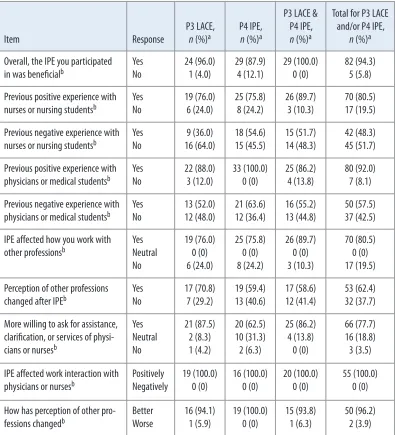
Table 3 compares the responses across the three different levels of IPE experience (LACE as P3, IPE as P4, and LACE as P3 and IPE as P4 combined). No statistically significant difference was found between the following items: IPE was beneficial (94.3% agreed overall); previous positive or negative experiences with nurses, nurs-ing students, physicians, or medical students; IPE experience affected how you work with other professions (80.5% agreed); perception of other professions changed after IPE (62.4% agreed); more willing to ask for assistance, clarification, or services of physicians or nurses (77.7% agreed); IPE affected work interaction with physicians or nurses (100% agreed); and how has the perception of other professions changed (96.2% responded “better” versus “worse”).
Table 3. Responses to questions for students who have participated in interprofessional education (IPE) activities
Notes:aPercentages may not sum to 100.0% due to rounding; bNo statistically significant differences between any of the 3 groups (P3 LACE, P4 IPE, or P3 LACE and P4 IPE) using either Chi-square tests or Fisher’s exact test, as appropriate.
Journal of Research in
Interprofessional Practice and Education Vol. 6.1 April 2016 6 Changes in Pharmacy Students After Experiencing Interprofessional Education Activities Tolleson, Ismail, Gill, Dello Stritto, Hatfield, Teal, Nelson, & Hatfield
Item Response
P3 LACE, n(%)a
P4 IPE, n(%)a
P3 LACE & P4 IPE, n(%)a
Total for P3 LACE and/or P4 IPE,
n (%)a
Overall, the IPE you participated in was beneficialb
Yes No 24 (96.0) 1 (4.0) 29 (87.9) 4 (12.1) 29 (100.0) 0 (0) 82 (94.3) 5 (5.8)
Previous positive experience with nurses or nursing studentsb
Yes No 19 (76.0) 6 (24.0) 25 (75.8) 8 (24.2) 26 (89.7) 3 (10.3) 70 (80.5) 17 (19.5)
Previous negative experience with nurses or nursing studentsb
Yes No 9 (36.0) 16 (64.0) 18 (54.6) 15 (45.5) 15 (51.7) 14 (48.3) 42 (48.3) 45 (51.7)
Previous positive experience with physicians or medical studentsb
Yes No 22 (88.0) 3 (12.0) 33 (100.0) 0 (0) 25 (86.2) 4 (13.8) 80 (92.0) 7 (8.1)
Previous negative experience with physicians or medical studentsb
Yes No 13 (52.0) 12 (48.0) 21 (63.6) 12 (36.4) 16 (55.2) 13 (44.8) 50 (57.5) 37 (42.5)
IPE affected how you work with other professionsb
Yes Neutral No 19 (76.0) 0 (0) 6 (24.0) 25 (75.8) 0 (0) 8 (24.2) 26 (89.7) 0 (0) 3 (10.3) 70 (80.5) 0 (0) 17 (19.5)
Perception of other professions changed after IPEb
Yes No 17 (70.8) 7 (29.2) 19 (59.4) 13 (40.6) 17 (58.6) 12 (41.4) 53 (62.4) 32 (37.7)
More willing to ask for assistance, clarification, or services of physi-cians or nursesb
Yes Neutral No 21 (87.5) 2 (8.3) 1 (4.2) 20 (62.5) 10 (31.3) 2 (6.3) 25 (86.2) 4 (13.8) 0 (0) 66 (77.7) 16 (18.8) 3 (3.5)
IPE affected work interaction with physicians or nursesb
Positively Negatively 19 (100.0) 0 (0) 16 (100.0) 0 (0) 20 (100.0) 0 (0) 55 (100.0) 0 (0)
How has perception of other pro-fessions changedb
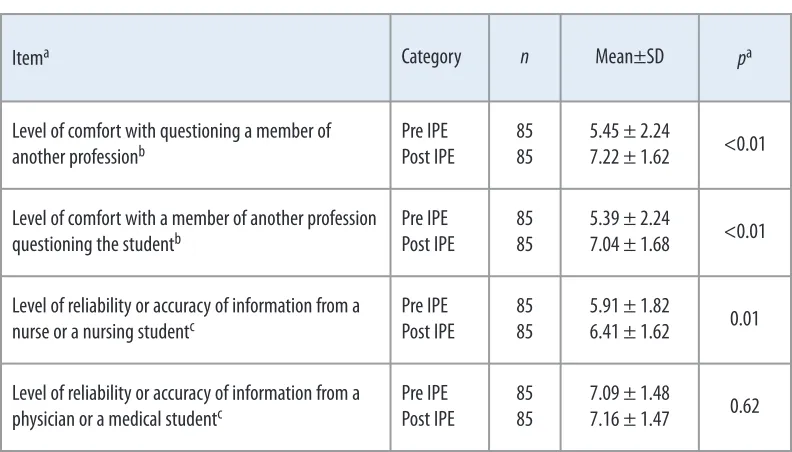
The results of the comparison for the four sliding scale questions among only IPE students on a pre-IPE versus post-IPE basis are found in Table 4. The levels increased on a pre- to post-IPE basis for each of the following questions: level of comfort with questioning a member of another profession, level of comfort with a member of another profession questioning the student, and level of reliability or accuracy of information from a nurse or a nursing student.
Table 4. Comparison between students before and after interprofessional education (IPE) activities (n= 85)
Notes:aPaired t-test; bScale: 0=least comfortable to 10=most comfortable; cScale: 0=least reliable or accurate to 10=most reliable or accurate
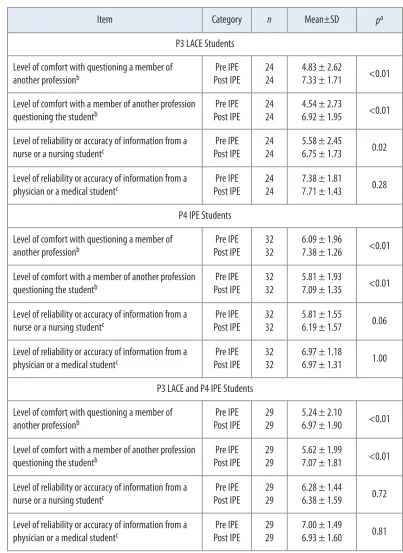
The results of the comparison for the four sliding scale questions among only IPE students on a pre-IPE versus post-IPE basis, with each of the three IPE groups ana-lyzed separately (P3 as LACE, P4 as IPE, and P3 as LACE and P4 as IPE combined) are found in Table 5. For the two questions: level of comfort with questioning a mem-ber of another profession and level of comfort with a memmem-ber of another profession questioning the student; the levels increased on a pre-IPE to post-IPE basis for each of three groups (P3 LACE, P4 IPE, and P3 LACE and P4 IPE combined). The stu-dents who experienced only P3 LACE showed an increase from pre-IPE to post-IPE regarding their perception of the level of reliability or accuracy of information from a nurse or nursing student.
No statistically significant results were found in the perceived level of comfort and level of reliability between students with no IPE experience (using a traditional pre-test) and students with IPE experience(s) (using a post-test).
Results from the response shift analysis are found in Table 6. For the two ques-tions: level of comfort with questioning a member of another profession and level of comfort with a member of another profession questioning the student: the baseline levels were higher for students with no IPE (using a traditional pre-test) than for stu-dents with IPE (using a retrospective pre-test).
Journal of Research in
Interprofessional Practice and Education
Vol. 6.1 April 2016 7
Changes in Pharmacy Students After Experiencing Interprofessional Education Activities
Tolleson, Ismail, Gill, Dello Stritto, Hatfield, Teal, Nelson, & Hatfield
Itema Category n Mean±SD pa
Level of comfort with questioning a member of another professionb
Pre IPE Post IPE
85 85
5.45 ± 2.24
7.22 ± 1.62 <0.01
Level of comfort with a member of another profession questioning the studentb
Pre IPE Post IPE
85 85
5.39 ± 2.24
7.04 ± 1.68 <0.01
Level of reliability or accuracy of information from a nurse or a nursing studentc
Pre IPE Post IPE
85 85
5.91 ± 1.82
6.41 ± 1.62 0.01
Level of reliability or accuracy of information from a physician or a medical studentc
Pre IPE Post IPE
85 85
7.09 ± 1.48
Notes: aPaired t-test; bScale: 0=least comfortable to 10=most comfortable; cScale: 0=least reliable or accurate to 10=most reliable or accurate
Journal of Research in
Interprofessional Practice and Education Vol. 6.1 April 2016 8 Changes in Pharmacy Students After Experiencing Interprofessional Education Activities Tolleson, Ismail, Gill, Dello Stritto, Hatfield, Teal, Nelson, & Hatfield
Item Category n Mean±SD pa
P3 LACE Students
Level of comfort with questioning a member of another professionb
Pre IPE Post IPE
24 24
4.83 ± 2.62
7.33 ± 1.71 <0.01
Level of comfort with a member of another profession questioning the studentb
Pre IPE Post IPE
24 24
4.54 ± 2.73
6.92 ± 1.95 <0.01
Level of reliability or accuracy of information from a nurse or a nursing studentc
Pre IPE Post IPE
24 24
5.58 ± 2.45
6.75 ± 1.73 0.02
Level of reliability or accuracy of information from a physician or a medical studentc
Pre IPE Post IPE
24 24
7.38 ± 1.81
7.71 ± 1.43 0.28
P4 IPE Students
Level of comfort with questioning a member of another professionb
Pre IPE Post IPE
32 32
6.09 ± 1.96
7.38 ± 1.26 <0.01
Level of comfort with a member of another profession questioning the studentb
Pre IPE Post IPE
32 32
5.81 ± 1.93
7.09 ± 1.35 <0.01
Level of reliability or accuracy of information from a nurse or a nursing studentc
Pre IPE Post IPE
32 32
5.81 ± 1.55
6.19 ± 1.57 0.06
Level of reliability or accuracy of information from a physician or a medical studentc
Pre IPE Post IPE
32 32
6.97 ± 1.18
6.97 ± 1.31 1.00
P3 LACE and P4 IPE Students
Level of comfort with questioning a member of another professionb
Pre IPE Post IPE
29 29
5.24 ± 2.10
6.97 ± 1.90 <0.01
Level of comfort with a member of another profession questioning the studentb
Pre IPE Post IPE
29 29
5.62 ± 1.99
7.07 ± 1.81 <0.01
Level of reliability or accuracy of information from a nurse or a nursing studentc
Pre IPE Post IPE
29 29
6.28 ± 1.44
6.38 ± 1.59 0.72
Level of reliability or accuracy of information from a physician or a medical studentc
Pre IPE Post IPE
29 29
7.00 ± 1.49
Table 6. Comparison between students with no interprofessional education (IPE) (traditional pretest) and students with IPE
(retrospective pretest) (n= 85)
Notes:aTrad Pre = Traditional Pretest. Retro Pre = Retrospective Pretest; bUnpaired t-test; cScale: 0=least comfortable to 10=most comfort-able; dScale: 0=least reliable or accurate to 10=most reliable or accurate
Discussion
This study assessed the impact of IPE experiences on pharmacy students’ perceived level of comfort and level of reliability regarding other healthcare professionals. Significant results were revealed regarding changes in self-reported perceptions on a pre- versus post-IPE basis. This could be a reflection of perceived change, rather than an actual change in attitude.
No significantly different results were found when comparing the perceptions of students who have not experienced IPE (using a traditional pre-test) with percep-tions of students who have experienced IPE (using a post-test), possibly due to a response shift. Students with no IPE do not have the experience to gauge or calibrate an informed perception versus students who have experienced IPE. We assume that the cohort of students with no IPE experience were comparable to the cohort of IPE students prior to their IPE experience(s). The demographic and descriptive charac-teristics of both cohorts help to support this assumption. We propose that the IPE students were able to more accurately calibrate their pre-test and post-test percep-tions through a response shift.
A retrospective pre-test was used in lieu of a traditional pre-test to minimize the effect of response shift bias among students with any IPE experience. Retrospective pre-tests have been studied extensively and have been shown to be effective in cases where a shift in the responder’s basis is possible [15]. Kim Nimon and Jeff Allen per-formed an extensive review of the retrospective pre-test, finding that it has relevant application when applied properly [13-15]. Theodore A. Lamb and Raymond Tschillard and Jennifer Martineau and Kelly Hannum argued that retrospective pre-tests should be used instead of traditional pre-pre-tests [16,17]. The results highlighted the potential for bias regarding certain items with the use of a traditional pre-test. This finding is corroborated by the study by Scott Bolesta and Joyce V. Chmil using Journal of Research in
Interprofessional Practice and Education
Vol. 6.1 April 2016 9
Changes in Pharmacy Students After Experiencing Interprofessional Education Activities
Tolleson, Ismail, Gill, Dello Stritto, Hatfield, Teal, Nelson, & Hatfield
Itema Categorya n Mean±SD pb
Level of comfort with questioning a member of another professionc
Trad Pre Retro Pre
101 85
7.00 ± 2.06
5.45 ± 2.24 <0.01
Level of comfort with a member of another profession questioning the studentc
Trad Pre Retro Pre
101 85
6.61 ± 2.20
5.39 ± 2.24 <0.01
Level of reliability or accuracy of information from a nurse or a nursing studentd
Trad Pre Retro Pre
101 85
6.07 ± 1.86
5.91 ± 1.82 0.55
Level of reliability or accuracy of information from a physician or a medical studentd
Trad Pre Retro Pre
101 85
7.30 ± 1.51
a similar methodology (retrospective pre-test and traditional pre-test) among a sim-ilar cohort of pharmacy students experiencing IPE [18].
When examining pre- and post-IPE, survey responses showed that students who have completed either or both IPE activities were significantly more comfortable with questioning other professions and being questioned by other professions. This is possibly due to the students seeing the other professions on a student-to-student level and being able to relate to the other disciplines through their common experi-ences. These changes in perception could translate to improved interprofessional communication as pharmacy students recognize that being questioned should not be taken personally, and questioning others should be thought of as a means to improve patient care. The analysis also shows that students who have had IPE expe-rience feel that nursing students and nurses provide significantly more reliable and accurate information than they thought before IPE. The results for the perceived reli-ability and accuracy of information from medical students and physicians also reveal an increase after IPE, but this was not significant. One explanation for the difference in significance of reliability or accuracy of information from the nursing profession versus the medical profession could be that fewer of the pharmacy students reported having previous working experience with nurses and nursing students (n= 72) than physicians and medical students (n = 123). Another explanation is that pharmacy students learned more about the nursing profession and found that nurses can pro-vide reliable and accurate information. Regarding perceptions toward medical stu-dents, the pharmacy students may still believe accurate and reliable information is provided, but they may be more cautious with that information because they now know physicians are capable of human error. It is also possible that prior to IPE, phar-macy students were already more likely to question the reliability and accuracy of information from a physician, and this remained the same after the IPE. Regardless of the reason, this finding reinforces a critical lesson in patient care: that when in doubt, one should not be reserved in questioning another healthcare professional.
Students’ responses to the four sliding scale questions after IPE experience (using a retrospective pre-test) were not significantly different than students who have not experienced IPE (using a traditional pre-test). However, in all four sliding scale ques-tions, students who have experienced IPE consistently scored their pre-IPE answers lower than students who have not experienced IPE. We propose the explanation for this is the ability for students who have had an IPE experience to recalibrate their responses based on their IPE experience, while students who have not had such an experience cannot accurately assess their baseline. The difference is the response shift. Similar results were revealed upon further analysis of the subgroups of students with IPE experience. All subgroups (students who only experienced the LACE class as a P3, students who only experienced the IPE activity as P4s, and students who experienced both) were more comfortable with both questioning other professionals and being questioned by other professionals. This perceived change demonstrates an increased willingness to communicate with other professionals about possible prob-lems related to patient care. While working with the other professions, the students likely realized that everyone was working toward the common goal of improving Journal of Research in
Interprofessional Practice and Education
Vol. 6.1 April 2016 10
Changes in Pharmacy Students After Experiencing Interprofessional Education Activities
patient outcomes. To reach their goal, the students had to work together as a health-care team, instead of as separate entities. The students were able to see that being questioned by other professions or questioning other professions is not meant to be personal, but rather is meant to clarify or ensure that correct decisions have been made for the patient, thus improving patient care. Students who have only experi-enced the LACE NPLH visit also demonstrated a significant increase in their feeling of reliability and accuracy of information from the nursing profession and a non-sig-nificant increase in their feeling of reliability and accuracy of information from the medical profession. Responses from students who participated in only the IPE activ-ity as a P4 showed an increase in the feeling of reliabilactiv-ity and accuracy of informa-tion for the nursing profession, though it was not significant. In the same group, the level of reliably accurate information from the medical profession remained rela-tively unchanged. Analysis of the responses from students who experienced both of the activities showed a non-significant increase in the feeling of reliability and accu-racy of information from the nursing profession and a non-significant decrease in the feeling of reliability and accuracy of information from the medical profession. The differences seen in these groups could be from different levels of experience with and exposure to the other professions. Fourth-year pharmacy students fre-quently work with medical students, physicians, and nurses while on their Advanced Pharmacy Practice Experience (APPE) rotations. Some students commented that past work-related or APPE experiences outweighed their IPE experiences in regards to their perceptions of the other professions.
Almost all (94.3%) of the IPE-experienced students felt their IPE was beneficial, and 80.5 percent of these students indicated that IPE affected how they work with other professions. To gain more insight into potential perceived changes, students were asked to explain how or why working with different professions has been affected. Many responses included more insight into the other professions and the knowledge they hold, along with feeling more like a team and being more comfort-able with communicating concerns. This is reflected in the responses to the ques-tions regarding the comfort level of questioning other professions or being questioned by other professionals. Most students (77.7%) were more willing to ask for assistance, clarification, or the services of the other professions. This further sup-ports that IPE during the education of healthcare professionals is beneficial to health-care teams through improvements in communications between professions.
There were some limitations to our study. Only pharmacy students were surveyed. Also, the IPE situations faced by the students in the LACE class had a high degree of variability due to the nature of home visits, while the P4 IPE activity was very simi-lar for each student. Another limitation of our study is that it only accounted for two IPE experiences at UHCOP, and no other experiences were considered. Many of the students responded that they have worked with physicians and nurses prior to their IPE experience at UHCOP, and these experiences may have impacted their IPE activ-ity. Lastly, the instrument had not been previously validated.
This study revealed that pharmacy students who have experienced any form of IPE feel more comfortable with questioning other healthcare professionals than stu-Journal of Research in
Interprofessional Practice and Education
Vol. 6.1 April 2016 11
Changes in Pharmacy Students After Experiencing Interprofessional Education Activities
dents with no IPE. Improved levels of communication among healthcare profession-als through questioning could improve patient outcomes, underscoring the benefits of incorporating IPE into healthcare education. Additional research is needed to more clearly define the benefits and design of IPEs.
Abbreviations
AACP American Association of Colleges of Pharmacy
BCM Baylor College of Medicine
IPE Interprofessional Education
IPEC Interprofessional Education Collaborative
IPPE Introductory Pharmacy Practice Experience
LACE Longitudinal Ambulatory Clinical Experience
NPLH No Place Like Home
UHCOP University of Houston College of Pharmacy
References
Buring, Shauna M., Bhushan, Alok, Broeseker, Amy, Conway, Susan, Duncan-Hewitt, Wendy, 1.
Hansen, Laura, & Westberg, Sarah. (2009). Interprofessional education: Definitions, student competencies, and guidelines for implementation. American Journal of Pharmaceutical Education, 73, 1–8.
Centre For The Advancement Of Interprofessional Education. (2002). Defining IPE. URL: 2.
http://caipe.org.uk/about-us/defining-ipe/ [July 26, 2015].
Bridges, Diane R., Davidson, Richard A., Odegard Peggy S., Maki Ian V., & Tomkowiak John (2011). 3.
Interprofessional collaboration: Three best practice models of interprofessional education.
Medical Education Online, 16, 1–21.
Baker, David P., Gustafson, Sigrid, Beaubien, Jeff, Salas, Eduardo, & Barach, Paul. (2005). Medical
4.
teamwork and patient safety: The evidence-based relation. Report prepared for the Center for Quality Improvement & Patient Safety, Agency for Healthcare Research & Quality (AHRQ). Burton, Andrea, Hammick, Marilyn, & Hoffman, Steven J. (2010). Framework for action on
interpro-5.
fessional education and collaborative practice. Geneva, Switzerland: Health Professions Network Nursing and Midwifery Office within the Department of Human Resources for Health, World Health Organization.
Accreditation Council for Pharmacy Education. (2011). Accreditation standards and guidelines for
6.
the professional program in pharmacy leading to the doctor of pharmacy degree. URL: www.acpe-accredit.org/pdf/FinalS2007Guidelines2.0.pdf [July 26, 2015].
Jones, Kim M., Blumenthal, Donald K., Burke, John M., Condren, Michelle, Hansen, Richard, 7.
Holiday-Goodman, Monica, & Peterson, Charles D. (2012). Interprofessional education in intro-ductory pharmacy practice experiences at US colleges and schools of pharmacy. American Journal of Pharmaceutical Education, 76, 1–15.
Remington, Tami L., Foulk, Mariko A., & Williams, Brent C. (2006). Evaluation of evidence for inter-8.
professional education. American Journal of Pharmaceutical Education, 70, 1–14.
Zorek, Joseph A., MacLaughlin, Eric J., Fike, David S., MacLaughlin, Anitra A., Samiuddin, 9.
Mohammed, & Young, Rodney B. (2014). Measuring changes in perception using Student Perceptions of Physician-Pharmacist Interprofessional Clinical Education (SPICE) instrument.
BMC Medical Education, 14, 1–7.
Michalec, Barret, Giordano, Carolyn, Arenson, Christine, Antony, Reena, & Rose, Molly (2013). 10.
Dissecting first-year students’ perceptions of health profession groups: Potential barriers to interprofessional education. Journal of Allied Health, 42, 202–213.
Bolesta, Scott, & Chmil, Joyce V. (2014). Interprofessional education among student health profes-11.
sionals using human patient simulation. American Journal of Pharmaceutical Education, 75, 1–9. Baylor College of Medicine. (2015). Baylor College of Medicine student handbook: Longitudinal
12.
ambulatory clinical experience. Houston, TX: Baylor College of Medicine. Journal of Research in
Interprofessional Practice and Education
Vol. 6.1 April 2016 12
Changes in Pharmacy Students After Experiencing Interprofessional Education Activities
Howard, George S., Ralph, Kenneth M., Gulanick, Nancy A., Maxwell, Scott E., Nance, Don W., & 13.
Gerber, Sterling K. (1979). Internal invalidity in pretest-posttest self-report evaluations and a re-evaluation of retrospective pretests. Applied Psychological Measurement, 3, 1–23.
Howard, George S. (1980). Response-shift bias a problem in evaluating interventions with pre/post 14.
self-reports. Evaluation Review, 4, 93–106.
Nimon, Kim, & Allen, Jeff. (2007). A review of the retrospective pretest: Implications for perform-15.
ance improvement evaluation and research. Workforce Education Forum, 44, 36–55.
Lamb, Theodore A., & Tschillard, Raymond. (2005). Evaluating learning in professional development 16.
workshops: Using the retrospective pretest. Journal of Research in Professional Learning, 1, 1–9. Martineau, Jennifer, & Hannum, Kelly (2004). Evaluating the impact of leadership development: A
17.
professional guide. Greensboro, NC: Center for Creative Leadership.
Bolesta, Scott, & Chmil, Joyce V. (2014). Interprofessional education among student health profes-18.
sionals using human patient simulation. American Journal of Pharmaceutical Education, 78, 1–9.
Journal of Research in
Interprofessional Practice and Education
Vol. 6.1 April 2016 13
Changes in Pharmacy Students After Experiencing Interprofessional Education Activities
Appendix Questionnaire for Pharmacy Students
Q1 Please answer the following questions honestly. This survey is anonymous.
Q2 What is your gender?
Male (1) Female (2)
Q3 What year are you?
P3 (1) P4 (2)
Q4 What is your age?
______ 1 (1)
Q5 Have you previously worked with nurses or nursing students? (excluding
during the LACE Project and the Interprofessional Education activity for APPEs)
Yes (1) No (2)
Q6 Do you know anyone on a personal basis that is a nurse or in nursing school? Yes (1)
No (2)
Q7 Overall, how would you rate your attitude toward the nursing profession? Positive (1)
Neutral (2) Negative (3)
Q8 Have you previously worked with physicians or medical students? (excluding
during the LACE Project and the Interprofessional Education activity for APPEs)
Yes (1) No (2)
Q9 Do you know anyone on a personal basis that is a physician or in medical
school? Yes (1) No (2) Journal of Research in
Interprofessional Practice and Education
Vol. 6.1 April 2016 14
Changes in Pharmacy Students After Experiencing Interprofessional Education Activities
Q10 Overall, how would you rate your attitude toward the medical profession? Positive (1)
Neutral (2) Negative (3)
Q11 Have you participated in any Interprofessional Education (IPE) activities? (Ex. LACE Project or IPE for APPE’s)
Yes, only LACE as a P3 (1)
Yes, LACE as a P3 AND IPE as a P4 (2) Yes, only IPE as a P4 (3)
No (4)
Q12 Overall, do you feel that the Interprofessional Activity(ies) you participated in was/were beneficial?
Yes (1) No (2)
Q13 Have you previously had a positive experience with physicians or medical students?
Yes (1) No (2)
Q14 Have you previously had a negative experience with physicians or medical students
Yes (1) No (2)
Q15 Have you previously had a positive experience with nurses or nursing students?
Yes (1) No (2)
Q16 Have you previously had a negative experience with nurses or nursing students?
Yes (1) No (2)
Q17 How comfortable were you BEFORE the IPE Activity with questioning a member of another profession, on a scale from 0-10, with 0 being the least comfortable and 10 being the most comfortable?
______ 1 (1) Journal of Research in
Interprofessional Practice and Education
Vol. 6.1 April 2016 15
Changes in Pharmacy Students After Experiencing Interprofessional Education Activities
Q18 How comfortable were you AFTER the IPE Activity with questioning a member of another profession, on a scale from 0-10, with 0 being the least comfortable and 10 being the most comfortable?
______ 1 (1)
Q19 How comfortable were you BEFORE the IPE Activity with a member of another profession questioning you, on a scale from 0-10, with 0 being the least comfortable and 10 being the most comfortable?
______ 1 (1)
Q20 How comfortable were you AFTER the IPE Activity with a member of another profession questioning you, on a scale from 0-10, with 0 being the least comfortable and 10 being the most comfortable?
______ Click to write Choice 1 (1)
Q21 How reliable/accurate did you believe information from a physician or medical student to be BEFORE the IPE Activity, on a scale from 0-10, with 0 being the least reliable/accurate and 10 being the most reliable/accurate? ______ Click to write Choice 1 (1)
Q22 How reliable/accurate did you believe information from a physician or medical student to be AFTER the IPE Activity, on a scale from 0-10, with 0 being the least reliable/accurate and 10 being the most reliable/accurate? ______ Click to write Choice 1 (1)
Q23 How reliable/accurate did you believe information from a nurse or nursing student to be BEFORE the IPE Activity, on a scale from 0-10, with 0 being the least reliable/accurate and 10 being the most reliable/accurate?
______ Click to write Choice 1 (1)
Q24 How reliable/accurate did you believe information from a nurse or nursing student to be AFTER the IPE Activity, on a scale from 0-10, with 0 being the least reliable/accurate and 10 being the most reliable/accurate?
______ Click to write Choice 1 (1)
Q25 Do you believe that the IPE Activity has affected how you work and will continue to work with members of these professions?
Yes (1) No (2) Neutral (3) Journal of Research in
Interprofessional Practice and Education
Vol. 6.1 April 2016 16
Changes in Pharmacy Students After Experiencing Interprofessional Education Activities
Q26 Has your perception of the professions you worked with changed due to your experience during the IPE Activity
Yes (1) No (2)
Q27 Do you feel that, after your experience, you are more willing to ask for assistance, clarification, or services from physicians or nurses?
Yes (1) No (2) Neutral (3)
Answer If Do you believe that the IPE Activity has affected how you … Yes Is Selected
Q28 How has Interprofessional Education affected how you work with members of the nursing and medical professions?
Positively (1) Negatively (2)
Answer If Do you believe that the IPE Activity has affected how you … Yes Is Selected
Q29 Please explain your previous answer.
Answer If Do you believe that the IPE Activity has affected how you … No Is Selected
Q30 Why do you think you were not affected by your Interprofessional Education experience?
Answer If Has your perception of the professions you worked with ch … Yes Is Selected
Q31 How has your perception of the professions changed? Better (1)
Worse (2)
Answer If Has your perception of the professions you worked with ch … Yes Is Selected
Q32 Please explain how your perception has changed. Journal of Research in
Interprofessional Practice and Education
Vol. 6.1 April 2016 17
Changes in Pharmacy Students After Experiencing Interprofessional Education Activities
Q33 Overall, how would your rate your attitude toward the nursing profession? Positive (1)
Neutral (2) Negative (3)
Q34 Overall, how would you rate your attitude toward the medical profession? Positive (1)
Neutral (2) Negative (3)
Q35 How comfortable are you with questioning a member of another profession, on a scale from 0-10, with 0 being the least comfortable and 10 being the most comfortable?
______ Click to write Choice 1 (1)
Q36 How comfortable are you with a member of another profession questioning you, on a scale from 0-10, with 0 being the least comfortable and 10 being the most comfortable?
______ 1 (1)
Q37 How reliable/accurate do you believe information from a physician or medical student to be, on a scale from 0-10, with 0 being the least reliable/accurate and 10 being the most reliable/accurate?
______ 1 (1)
Q38 How reliable/accurate did you believe information from a nurse or nursing student to be, on a scale from 0-10, with 0 being the least reliable/accurate and 10 being the most reliable/accurate?
______ 1 (1)
Journal of Research in
Interprofessional Practice and Education
Vol. 6.1 April 2016 18
Changes in Pharmacy Students After Experiencing Interprofessional Education Activities