Using an E-Learning Environment for
Developing Science Students’ Written
Communication: The Case of Writing
Laboratory Reports in Physiology
Helen Drury a and Meloni Muirb
aLearning Centre, University of Sydney, Sydney NSW 2006, Australia bSydney Medical School, University of Sydney, Sydney NSW 2006, Australia
Keywords: science report writing, genre pedagogy
International Journal of Innovation in Science and Mathematics Education, 22(4), 79-93, 2014.
Abstract
The laboratory report is a core assessment task in undergraduate science curricula that challenges students to concisely report laboratory activities using appropriate, discipline-specific genre conventions as well as integrating readings into their writing. In a crowded curriculum with a diverse student population, an online approach was developed to address supporting students in their writing in the discipline of physiology. A collaborative team comprising discipline staff, language and learning specialists and IT pedagogical designers came together to design, develop and implement the online report writing resource known as FLERT (Flexible Electronic Report writing Tool). FLERT is comprised of two interactive components: a literacy component and a discipline-specific component. Both are structured in a format similar to that of a laboratory report. While writing, students can move between report sections in FLERT as they perceive the need. This paper reports on the collaborative design and development approach of the team, the implementation process and evaluation of FLERT. Overall, users found both components of FLERT user-friendly and easy to navigate. Students rated the site strongly in terms of their increased understanding and confidence in report writing and content understanding. Students who used FLERT had significantly higher report marks than non-users.
Introduction
The expectation of employers and government is that science graduates will have developed high levels of written communication within their degree programs (ALTC, 2011; Business Council of Australia, 2011; DEEWR, 2011; Graduate Outlook Survey, 2013). However, developing science students’ writing skills within their discipline context continues to present challenges. Science curricula are typically content rich with little time to address issues of developing students’ science writing alongside their increasing knowledge and understanding of content. Science discipline staff may also feel they are ill-equipped to support students in developing their writing skills or that this is not their role. Given the diverse educational and language backgrounds of incoming students, it is not surprising that many students struggle with writing and it is clear that even English speaking background would benefit from interventions to support the development of their writing skills for science.
science curriculum outlined above, an online learning environment is a strategic way to develop students' report writing since they can access the learning resources in a flexible way according to their needs. Combining such an environment with resources to support students’ understanding of discipline content alongside the report genre used to communicate this content is a contextualised way of addressing writing issues. This approach means that students can access a comprehensive and relevant suite of resources, which enhance and make explicit their awareness of writing reports in their discipline. At the same time, the online resources can provide discipline staff with new opportunities for communicating with their students and support them in writing the laboratory report genre. The FLERT online learning environment has been developed to provide these online resources for second year students writing laboratory reports in physiology. This paper will report on the language theory and pedagogy which underpins the online writing resources, the collaborative approach to design and the implementation and evaluation processes and outcomes.
Teaching writing in the sciences: theory and practice
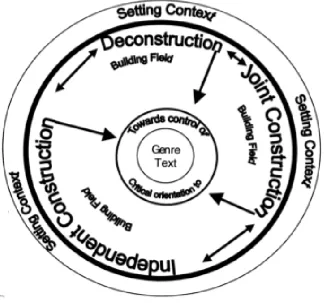
Teaching writing in the disciplines is informed by a wide range of research and practice in the area of ‘Writing to Learn’ and ‘Learning to Write’. The ‘Writing to learn’ approach is based on the belief that writing is a way of exploring how to know and learn (Scardamalia & Bereiter, 2006). In this way, writers can engage in many kinds of writing activity, from personal to creative to discipline-based writing in order to gain a deeper understanding of disciplinary concepts and ways of thinking (Reynolds, Thaiss, Katkin & Thompson, 2012; Rivard, 1994). This approach to writing emphasises the process of writing as a way of exploring ideas and developing thinking strategies and is often associated with the pedagogy of process writing and writing across the curriculum (WAC). In contrast, the ‘Learning to write’ approach emphasizes the contextual and purpose driven nature of writing and, in the university context, the discipline-based aspects of writing and is most often associated with writing in the disciplines pedagogy (Moskovitz & Kellogg, 2011). However, although a distinction is made between these approaches, in practice, both pedagogies are used to engage students in learning about disciplinary content and about writing processes and products (Keys 1999; McLeod & Maimon, 2000; Thaiss, 2001). One of the most influential teaching approaches in the Learning to Write tradition is genre pedagogy. Genre pedagogy draws on theories of language in context where language choices create and achieve the goal of the genre (Johns, 2002). Traditions of research and practice in this area have developed in the fields of new rhetoric (Berkenkotter & Huckin, 1996; Miller, 1984), discourse analysis (Swales, 1990), academic literacies (Lea & Street, 1998) and systemic functional linguistics (SFL) (Martin & Rose, 2008).
Figure 1. A genre-based teaching and learning model (Martin, 1999 p.131).
A genre based approach to teaching science writing apprentices students into the disciplinary practices and purposes associated with particular genres and genre sequences. It provides a developmental and scaffolded approach to support student writing (Zimbardi, Bugarcic, Colthorpe, Good & Lluka, 2013). At the same time, the structure and language of scientific argument is made explicit in the context of a whole of genre approach through the use of relevant examples. Genre pedagogy has also been adapted to online learning environments for teaching science writing (Drury, 2004; Ellis, 2004).
The Design Approach
The FLERT program
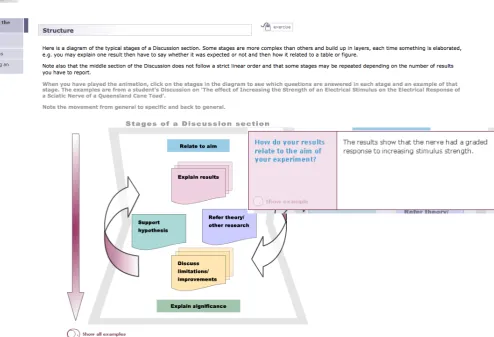
The aim of FLERT was to support students in writing their laboratory reports in second year physiology by providing online resources to address both writing and discipline content. Discipline staff and physiology students had already identified the particular challenge of writing laboratory reports, especially introductions and discussions, and these concerns had been addressed to some extent in face-to-face tutorials and through the trial of a draft feedback cycle for report writing. When the opportunity arose to apply for e-learning support to develop an online approach, physiology staff and language and learning specialists submitted a joint proposal to develop a comprehensive and systematic set of resources to address writing and content issues in the area of report writing, which students could access according to their needs. From the outset, the design was driven by the need to address student needs, both in terms of writing and understanding content. FLERT brings together learning materials for both report writing and understanding concepts in discipline content through the design of two core modules, ‘Help with Report Writing’ and ‘Help with Understanding Content’. To further reinforce the integration of writing and content through design, image and colour were used in a screen banner to represent the discipline of physiology throughout the site (Figure 2).
Developing the Help with Report Writing module
This module is designed around the typical sections of the laboratory report genre. In each section, the structure and language choices that fulfil the aims of that section are explained and exemplified, and students can check their understanding through exercises and feedback. Authentic student texts rather than lecturer models have been used for examples and exercises as these are the kinds of writing students can relate to and aim for. Lecturer commentary on the examples, which identifies their strengths and weaknesses, is included in the module. Each report section drafted by language and learning specialists went through a review by discipline specialists before redesign into an online format by the e-learning specialist. The redesign process enabled the properties provided by a computer-based medium of instruction to be used to highlight genre features. The use of visuals, colour and font together with animations and hyperlinks can scaffold students’ understandings of the structure and language of a particular laboratory report section (Figure 2).
Figure 2. Screen example from Help with Report Writing. This screen shot shows the Physiology image with the module banner and a hyperlinked example of the Relate to Aim stage of the discussion.
Developing the Help with Understanding Content module
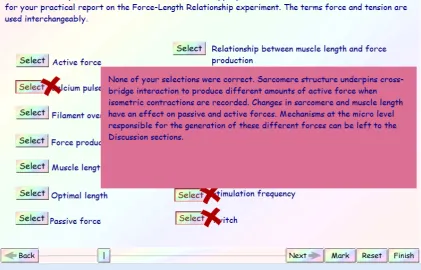
This part of FLERT was designed to improve student understanding of the concepts and discipline content of laboratory activities and reports. Because the laboratory topics change during the second year curriculum, this part of the site had to be based on a user-friendly software that discipline academics could learn to use so that they could easily change the module to align with the report students were currently writing. The software chosen, Question Tools (http://www.questiontools.org), enabled discipline staff to create interactive exercises to address content issues students were struggling with, particularly in the introduction, results and discussion sections (Figure 3).
Figure 3. Screen example from Help with Understanding Content module.
Methods for Trialling and Evaluation of FLERT
Participants
FLERT was progressively trialled and evaluated over 18 months at a large, research-focused university. During this period, second year Science students enrolled a physiology course self-selected to whether to use FLERT or not. This allowed for a comparison between users and non-users in the form of a quasi-experimental research design.
After its development, FLERT was trialled and evaluated over two semesters. Students in these semesters are referred to as Cohort 1 (Co1). Based on student and staff feedback, changes were made and then FLERT was integrated into the second year physiology curriculum. At the time of its integration, a second evaluation was undertaken. Students participating in this evaluation are referred to as Cohort 2 (Co2).
Student participants were invited to take part in the project by completing questionnaires, pre- and post-tests focused on report writing skills, participating in focus groups, contributing to think-aloud protocols and allowing observation of their interaction with the program. In addition, students were asked for permission to have their report marks recorded and their interactions with the website tracked. Staff also completed formal surveys, as well as providing informal feedback. This paper reports only on quantitative data from the student questionnaires, pre- and post-tests, report marks and website tracking.
Trial and Implementation of FLERT
experiences and, in particular, their difficulties with report writing. At the same time, they undertook a paper-based pre-test which was composed of the literacy component of FLERT. They then went on to write their first assessed lab report without the use of the FLERT. Later in semester, FLERT was made available to students before they wrote their second lab report. At this time, they undertook the post-test assessment focusing on the literacy component. After submission of their lab reports, students completed a questionnaire evaluating FLERT. Based on student feedback, changes were made and at the beginning of the following academic year, FLERT was made available to Co2 before their first assessed lab report. After their reports were submitted, these students completed an evaluation questionnaire. Lab report grades were collected from the two student cohorts. Tracking data for student use of FLERT was also recorded.
Instruments
Survey instruments consisted of questionnaires which included both closed and open ended questions. These questionnaires were based on those developed and administered in previous years for evaluation of discipline based online programs for supporting lab report writing in science and engineering (Drury, Langrish, & O'Carroll, 2006). In total, 5 questionnaires were administered, four to Co1 and the fifth to Co2. The aim of the first 3 questionnaires (Q1, Q2 and Q3) was to track student learning of report writing across the first semester which included writing without FLERT and after the introduction of FLERT. The fourth questionnaire (Q4) was the focus of another research project and will not be reported here (Muir, Drury, & Carroll, 2007). The aim of the fifth questionnaire was to evaluate student use of FLERT after full implementation and completion of the project.
The first questionnaire (Q1), ‘Previous Writing Experience’ was a base-line, one page survey, containing 3 sections; the first on students’ demographic backgrounds; the second on their writing history and the third on their self-evaluation of their written communication skills. The second questionnaire (Q2), ‘Writing the Nerve Report’, elicited information on students’ evaluation of their report writing skills.
The third questionnaire (Q3), ‘Writing the CV Report’, a two page survey, consisted of 5 sections. Only the first section, on students’ preparation for writing, applied to all students as well as a question on whether they had used FLERT and if not, why not. The last sections elicited information from student users of FLERT in terms of the parts of the program they used, how they moved through the program and their perceptions of learning from the program. There were 3 open-ended questions which asked students to comment on the program’s design. The fifth questionnaire (Q5) administered to Co2 , ‘Evaluation of the FLERT Online Program’, comprised 7 sections, 3 sections for all students to answer and four for those who had used FLERT . The first three sections elicited demographic data, data on writing history, preparation for writing the report and self-evaluation of skills for report writing, as well as reasons for not using FLERT. These sections used many of the same questions as those in Q3 so that comparisons could be made across the cohorts. The questions for users of FLERT were broadly similar to those of Q3 and asked student to identify the parts of the program they had used, how they moved through the program and their perceptions of the influence on their learning of various aspects of the program. In addition, students were invited to comment further through answering 6 open ended questions as well as adding their own comments.
‘Yes/No’ questions and one gap-filling exercise comprised the pre- and post-tests. These questions targeted the introduction, hypothesis, results and discussion sections of a report. Software tracking was used to identify how many times students accessed FLERT and also the length of time on the program.
Data analysis
Data were analysed using descriptive statistical analysis, correlation, t-tests and chi-squared tests using SPSS. Values of p<0.05 were considered statistically significant.
Outcomes and Discussion
The analysis of quantitative student data will be reported and discussed under the following themes; student demographics and writing history, the characteristics and performance of student users versus non-users and finally the perceptions of and evaluations by users.
Student demographics and writing experience
Participants in the two cohorts were similar demographically and had similar tertiary writing experiences (Table 1). The majority of students (86%) in both cohorts were between 18 and 22 years of age. Most students spoke English as their first language. Other than English, the most frequent first language spoken was Chinese (nominated as Chinese, Mandarin or Cantonese).
In terms of their writing experience at university, most students in both cohorts had written summaries, short answers, lab reports and essays, with a slightly higher proportion of the second cohort having written essays (86%) as opposed to the first (72%). Similar proportions of students reported being quite confident or very confident in their writing (Table 1).
Students’ perceptions of their areas of difficulty in report writing
The outcomes from an earlier study of students’ perceptions of their areas of difficulty in report writing were used in the design process for FLERT (Muir & Drury, 2006) as well as data from the two questionnaires (Q1 and Q2) completed by Co1 before having access to FLERT. The areas identified by students as being most difficult included comparing information from different sources, proposing further experiments, constructing logical arguments, interpreting results, writing hypotheses, writing/organizing introductions and discussions, writing conclusions and time management.
Table 1. Student demographics, writing history and self-reported confidence in writing. Data were collected via questionnaires completed in class. There were no significant differences for any of the parameters between the two cohorts.
Parameters Cohort 1 (n=205) Cohort 2 (n=163)
Gender 76% females
24% males
74% females 26% males
Spoke English as first language 68% 55%
Self-rated English fluency as a native/near native speaker 89% 80%
International students 11% 12%
Had written texts > 9 pages 57% 55%
Confident or very confident in their writing ability 66% 68%
The characteristics of student users versus non-users
In Co1, 63.9% of students used FLERT to prepare either their second or third laboratory report or both; while 59.5% of students in Co2 used FLERT. Although the introduction of FLERT to the two cohorts differed, it appears that this had little impact on student use. The reasons students provided for not using FLERT are summarized in Table 2.
Table 2. Students’ reasons for not using FLERT. The total percentage of students from both cohorts that did not use FLERT was 39.4%
Reason for non-use Percentage
Did not have time 29.5
Did not need it 27.4
Did not know about it 17.9
Used different resources 3.2
Technical difficulties 2.1
Forgot about FLERT 2.1
No reason 16.8
The two most common reasons given for not using FLERT were that students thought did not have time to use FLERT (29.5%) and that they did not need FLERT (27.4%). Technical difficulties (2.1%) and simply not remembering the resource was available (2.1%) were the least common reasons noted.
For both cohorts, there was no difference between users and non-users in terms of gender and language background. With regard to writing history, in both cohorts users and non-users did not differ in terms of either the length or types of academic text they had written. However for Co1, a composite score of the different types of texts produced indicated that on average, users had produced 3.24 (SD = 1.05, n = 131) different types of texts while non-users had produced 3.75 (SD = 1.33, n = 75). An independent samples t-test indicated that non-users had produced significantly more text types than users (t (123.21) = 2.85, p = 0.01).
On average, users in Co1 tended to be significantly less confident in their writing tasks (M = 2.42, SD = 0.64) than non-users (M = 2.11, SD = 0.58; t (135.08) = -3.34, p = 0.01) and rated themselves as less competent in writing skills (M = 2.58, SD = .84) than non-users (M = 2.20, SD = 0.77); t (165.44) = -3.32, p = 0.01). None of these significant differences were observed between users and non-users in Co2.
constructing a logical and clear argument, t (203) = -3.07, p < 0.01, expressing relationships between different pieces of information in writing, t (201) = -2.76, p < 0.01) and using formal academic writing style, t (203) = -2.78, p < 0.01) and accurate sentence level grammar, t (203) = -2.78, p < 0.01). No significant differences were observed in Co2 between users and non-users in these parameters.
In Co2, there was a significant association between web site use and the number of written assignments produced in the previous year. Significantly more users had completed fewer assignments (0-3) in the previous year than non-users, χ 21 = 4.00, n = 25, p = 0.04.
Although there were no significant differences in language and demographic backgrounds, Co 1 users tended to rate themselves as less confident and competent in their writing tasks and non-users tended to have had more writing experience. Since FLERT was created to be used by students according to their needs, the data suggest that, in fact, FLERT was successfully targeting students who may well have been less confident and less experienced in their writing.
The performance of student users versus non-users
Pre- and post-test data (Co 1 only) indicated that the average score of participants increased from 25.12 (SD = 3.9) to 27.71 (SD = 3.8) from a total of 37. The number of students who participated in the pre-test was 178 compared to 72 who undertook the post-test, 69 of whom had used FLERT. A paired-samples t-test showed that the difference between pre-test user scores (M = 25.44, SD = 3.853) and post-test user scores (M = 27.71, SD = 3.88) was significant, t (68) = -4.63, p = 0.0001.
With Co1, report marks were recorded on two occasions, before they had used FLERT (the Nerve report) and after using FLERT (the CV report). There was no significant difference in the average mark between users and non-users for either of the two reports. Tracking data showed a significant positive correlation between website hits and report marks, r = .22, n = 118, p < 0.05, suggesting that users who accessed the site more often had better report marks than those who had used it less often. Since we did not create categories for frequency of use, we do not know whether infrequent users obtained poorer report marks on average than non-users.
For Co2, comparisons were made between the report marks for users and non-users. Overall, those who used FLERT had a significantly higher report mark (M = 74.71, SD = 13.02) than non-users (M = 68.15, SD = 13.21), t (118) = 2.15, p = 0.03. Since FLERT was introduced to students early in the semester, before their first assignment, to some extent the difference in marks between users and non-users may be attributed to the FLERT intervention.
Approximately two thirds of users from both cohorts spent up to an hour per report on the website. Those from the Co2 spent more time and a chi-square test of independence indicated that there was an association between cohort and time spent, χ23 = 16.63, n = 144, p < 0.01.
User evaluations and perceptions of FLERT on learning
User preferred pathways through the website were either to move from screen to screen, scanning explanations and exercises and then choosing particular sections to work through in detail (49%) or to move from screen to screen through a whole section, reading explanations and doing exercises (37%). The most used sections of both the Help with Report Writing module and the Help with Understanding Content module by both cohorts were those relating to the introduction and discussion sections of the report. Students’ heavy use of these sections correlates with findings from an early study by the authors (2006) where students identified these two report sections as being the most challenging to write.
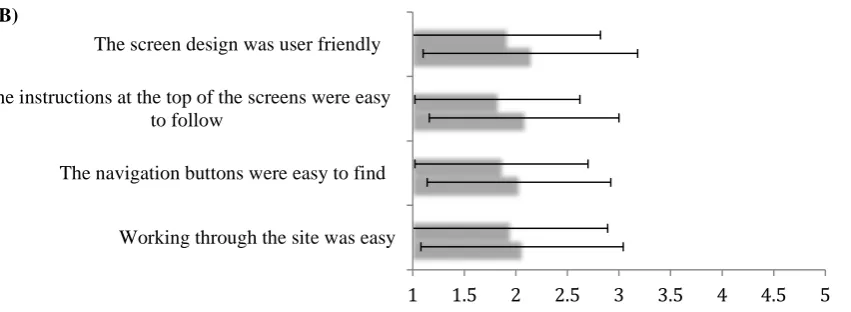
Users in both cohorts were asked to evaluate the user-interface in the Help with Report Writing module and the Help with Understanding Content module by rating four statements, (working through the site was easy; the navigation buttons were easy to find; the instructions were easy to follow and the screen design was user friendly) using a Likert scale. Overall, users found both interfaces user-friendly and easy to navigate (Figure 4).
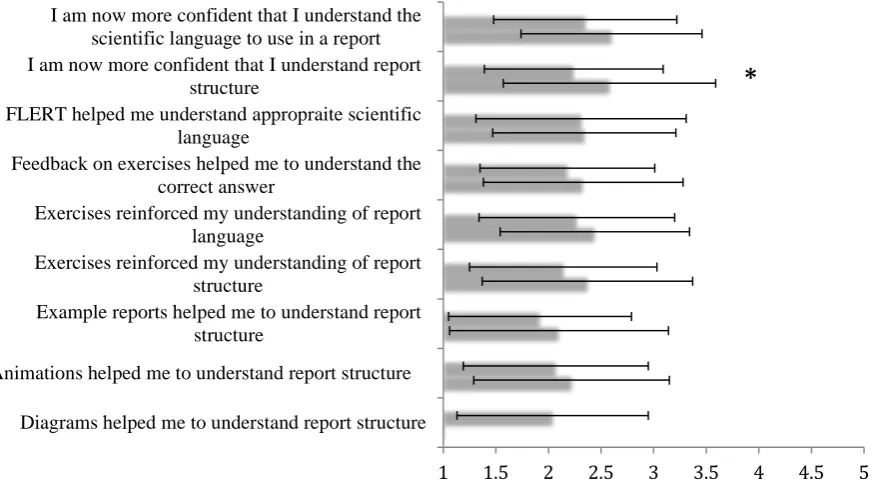
Users were asked to evaluate the effect of the Help with Report Writing module on their understanding of the structure and language of report writing and confidence in report writing using a Likert scale. Although both cohorts rated the site strongly in terms of increased understanding and confidence, Co2 rating for confidence in understanding report structure was siginificantly more postitive than Co1 (Figure 5).
Both cohorts rated the model student reports provided as the most helpful for understanding report structure, followed by diagrams (Co2 only) and animations. Exercises were rated higher in terms of understanding structure compared with understanding report language. This pattern was repeated in terms of confidence where students indicated that the module had improved their confidence in understanding report structure more than report language.
1 1.5 2 2.5 3 3.5 4 4.5 5 Working through the site was easy
The navigation buttons were easy to find The instructions at the top of the screens were easy
to follow
Figure 4. FLERT ease of use. A comparison of cohort ratings (mean + SD) for ease of use of Help with Report Writing (A) and ease of use of Help with Understanding Content (B) is provided. Likert scale: 1 = strongly agree, 5 = strongly disagree. Cohort 1; Cohort 2.
Users were asked to evaluate the effect of the Help with Understanding Content module on their improved understanding of the concepts and content of the report they were writing and their confidence about the content in the report using a Likert scale. Once again, both cohorts rated the site strongly in terms of their increased understanding and confidence, with Co2 ratings tending to be more positive than Co1 (Figure 6). Co2 ratings were significantly different from Co1 in the areas of hypothesis writing, identifying independent and dependent variables and the helpfulness of feedback.
Overall the highest ratings were those relating to understanding the content for the
introduction and features of the introduction such as identifying independent and dependent variables and writing the hypothesis. Examples and exercises for understanding scientific concepts (Co1 only) and feedback on exercises were not rated as highly. The Co2 rating for understanding content for the discussion was not so highly rated as that for the introduction. Similar to confidence ratings for the Report Writing module, students’ ratings of their improved confidence were the lowest of all ratings.
1 1.5 2 2.5 3 3.5 4 4.5 5 Working through the site was easy
The navigation buttons were easy to find The instructions at the top of the screens were easy
to follow
Figure 5. Comparison of cohort ratings (mean + SD) of improved understanding of and confidence in report writing for different aspects of the Help with Report Writing module. Likert scale: 1 = strongly agree, 5 = strongly disagree. Cohort 1; Cohort 2;
* p < 0.05.
Overall students were strongly positive about their perceived learning from using FLERT with more than 50% of Co1 students and almost three quarters of Co2 students strongly agreeing or agreeing with the rating statements for improved understanding and confidence from using the Help with Report Writing module. Their perceived learning from the Help with Understanding Content module was also positive with substantially more than 50% of Co1 students and more than three quarters of Co2 students strongly agreeing or agreeing with the rating statements for improved understanding and confidence.
Figure 6. Comparison of cohort ratings (mean + SD) of improved understanding of report writing content and confidence in report writing content for different aspects of the Help with Understanding Content module. Likert scale: 1 = strongly agree, 5 = strongly disagree. Cohort 1; Cohort 2; * p < 0.05.
1 1.5 2 2.5 3 3.5 4 4.5 5 Diagrams helped me to understand report structure
Animations helped me to understand report structure Example reports helped me to understand report
structure
Exercises reinforced my understanding of report structure
Exercises reinforced my understanding of report language
Feedback on exercises helped me to understand the correct answer
FLERT helped me understand appropraite scientific language
I am now more confident that I understand report structure
I am now more confident that I understand the scientific language to use in a report
*
1 1.5 2 2.5 3 3.5 4 4.5 5 The examples and exercises helped me understand
the scientific concepts
Feedback on exercises helped me to understand the correct answer
Helped me to understand content necessary for the introduction
Helped me to understand content necessary for the discussion
Helped me to identify the independent and dependent variables
Helped me write the hypotheses I am now more confident about the content in the
report
*
*
The difference in ratings between the two cohorts may be attributed to the different implementation strategies for FLERT as noted earlier as well as teaching staff being more familiar and confident with using the tool in their teaching.
Beyond FLERT
FLERT was the prototype for an Australian Learning and Teaching Council cross- institutional project for the development of a report writing website for the sciences and engineering, the Write Reports in Science and Engineering (WRISE) site.
(http://learningcentre.usyd.edu.au/wrise/ (Drury & Jones, 2009)).
Conclusions
The FLERT online learning environment has adapted a widely used and effective genre pedagogy to enhance the development of students’ written communication in terms of literacy and discipline understanding. The particular strength of this pedagogy is how it firmly embeds science communication, in this case laboratory report writing, within its discipline context. The data suggest that the use of FLERT contributed to improvements in student learning in the writing of laboratory reports in Physiology and the understanding of physiology concepts required for successful report writing. In addition, FLERT has for the most part been accessed by those students with less writing experience and confidence, and has brought about improvements in their performance. Student users have not been differentiated from non-users in terms of language background or other demographic criteria. This suggests that FLERT is not perceived by students to be only for those students with English as an additional language unlike many writing programs. The results also indicate that the more students make use of the resource, the greater their improvement in performance marks. Students’ perceptions of their learning also strongly support the performance data and have indicated which aspects of FLERT they have found most helpful. In particular, report examples and diagrams were rated highly in the Help with Report Writing module while information on specific aspects of content such as independent and dependent variables and hypothesis writing were most highly rated in the Help with Understanding Content module. The higher ratings and performance of users in Co2 indicate that design and implementation aspects had been improved and the effectiveness of the modules increased.
Acknowledgements
The authors gratefully acknowledge financial support from the office of the Deputy Vice-Chancellor (Education), University of Sydney, through an eLearning Strategic Development grant, Dr Miriam Frommer for discipline-specific content development and project review, Natassia Goode for statistical analyses, Dr Janet Jones for language and learning content design and development, Ms Gosia Mendrela and Helen Wozniak for pedagogical IT design and development and the 2nd year physiology students for their participation.
References
Australian Learning and Teaching Council (ALTC) (2011). Learning and teaching academic standards project Science downloaded May 2014 from http://www.olt.gov.au/resource-library.
Australian Government Department of Education, Employment and Workplace Relations (DEEWR) (2011).
Assessment of generic skills discussion paper 2011 downloaded May 2014
from http://www.innovation.gov.au/highereducation/Policy/Documents/AssessGenericSkills_Finaldiscussio npaper.pdf.
Business Council of Australia (BCA) (2011). Lifting the Quality of Teaching and Learning in Higher Education. Melbourne: Business Council of Australia.
Drury, H. (2004). Teaching academic writing on-screen: a search for best practice in Ravelli, L. and Ellis, R. (eds.) Analysing academic writing: contextualised frameworks. (pp. 254-273) London: Continuum. Drury, H. & Jones, J. (2009) Creating a student-centred online learning environment for report writing in
sciences and engineering. Final report for ALTC project. Downloaded May 2014 from http://www.olt.gov.au/resource-library
Drury, H., Langrish, T., & O'Carroll, P. (2006). Online approach to teaching report writing in chemial engineering:implementation and evaluation. International Journal of Engineering Education, 22(4), 858-867.
Ellis R. (2004). Supporting genre-based literacy pedagogy with technology - the implications for the framing and classification of the pedagogy, in Ravelli, L. and Ellis, R. (eds.) Analysing academic writing: contextualised frameworks. (pp. 254-273)
London: Continuum.
Graduate Careers Australia (2013). Graduate Outlook Survey 2013 downloaded May 2014 from http://www.graduatecareers.com.au/research/surveys/graduateoutlooksurvey/.
Johns, A. M. (2002). Genre in the classroom multiple perspectives. New Jersey: Lawrence Erlbaum.
Keys, C. W. (1999) Revitalizing instruction in scientific genres: connecting knowledge production with writing to learn science. Science Education, 83(2), 115-130.
Lea, M. R., & Street B. V., (1998). Student writing in higher education: An academic literacies approach.
Studies in Higher Education,32(2), 157-172.
Martin, J. R. (1999). Mentoring semogenesis:‘genre-based’literacy pedagogy. In F. Christie (Ed.). Pedagogy and the shaping of consciousness: Linguistic and social processes (pp. 123-155) London: Continuum International.
Martin, J. R., & Rose, D. (2008). Genre relations: Mapping culture. London & Oakland: Equinox.
McLeod, S., & Maimon, E. (2000). Clearing the air: WAC myths and realities. College English, 62(5), 573-583. Miller. C. R. (1984). Genre as social action. Quarterly Journal of Speech,70, 151-167.
Moskovitz, C., & Kellogg, D. (2011). Inquiry-based writing in the laboratory course. Science, 332, 919–920. Muir, M. and Drury, H. (2006). Pushing the Boundaries:Encouraging reflective learning using a draft-writing
and feedback cycle in report writing assessment. Paper presented at the Annual International Conference of the Higher Education Research and Development Society of Australasia, Sydney.
Muir, M., Drury, H., & Carroll, N. L. (2007). Introducing undergraduate science students and staff to an ePortfolio for report writing and feedback. Paper presented at the ePortfolio Australia: Imagining new literacies, Melbourne.
Reynolds, J.A., Thaiss, C., Katkin, W., & Thompson, R. J. (2012). Writing-to-Learn in Undergraduate Science Education: A Community-Based, Conceptually Driven Approach. CBE Life Sciences Education,11, 17-25. Rivard L. P. (1994). A review of writing to learn in science—implications for practice and research. Journal of
Research in Science Teaching, 31,969– 983.
Scardamalia M. & Bereiter C. (2006). Knowledge building: Theory, pedagogy, and technology. In K. Sawyer (Ed.), Cambridge Handbook of the Learning Sciences (pp. 97-118) New York: Cambridge University Press. Swales, J. (1990). Genre analysis. Cambridge: Cambridge University Press.
Taylor, C., & Drury, H. (2007) An integrated approach to teaching writing in the sciences. In A. Brew & Sachs, J. (Eds.), Transforming a University The scholarship of teaching and learning in practice. Sydney: Sydney University Press.
Thaiss, C. (2001). Theory in WAC: Where have we been, where are we going? In S. McLeod, E. Miraglia, M. Soven & C. Thaiss (Eds.), WAC for the newmillennium: Strategies for continuing writing across the curriculum programs. (pp. 299-325). Urbana, IL: NCTE.
Wenger, E., McDermott, R. & Snyder, W. (2002). Cultivating Communities of Practice Boston, MA: Harvard Business School Press.
Write Reports In Science and Engineering (WRISE) http://learningcentre.usyd.edu.au/wrise/