AUTHENTICATION -1
• ONE WAY AUTHENTICATION
• PASSWORD BASED AUHTENTICATION
• CERTIFICATION BASED AUHTENTICATION • MUTUAL AUHTENTICATION
Dictionary attacks
Attack types
•
Two types of dictionary attacks are on-line and off- line.
•
In online attacks, an intruder attempts to login to the victim’s account
by using the victim’s login name and a guessed password.
•
In online there is a limit on the number of failed login attempts.
•
In off-line attack leaves few fingerprints.
Cont…
Another possibility
is for the
attacker to eavesdrop on the
communication link during client authentication.
// let D be an array containing the dictionary
// let F denote f(pw,R) where pw is client’s password
// let n be the number of permissible guesses(size of D)
Found=false i=0
While(~found && i<n)
{ X=f(D[i],R) If(x==F) {
Print(“CORRECT
PASSWORD is D[i]”)
Found=true
Defeating Dictionary Attacks
•
One approach is to increase the cost of performing such an attack.
•
The cost is the time to successfully complete the attack.
•
The most time consuming operation in each iteration of the dictionary
attack program is f(D[i],R).
•
Hence to decrease the attacker’s chance of success, the function f(D[i],R)
could be made more computationally expensive.
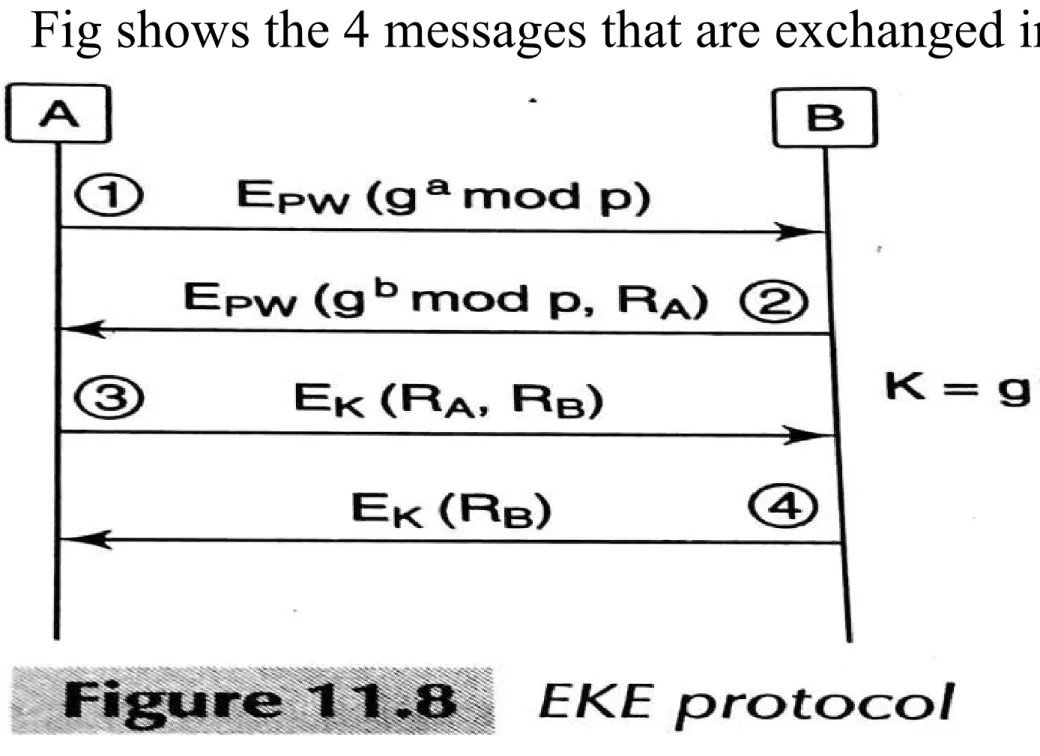
A protocol that eliminates off-line dictionary attack is the Encrypted
Key Exchange(EKE)
•
It is a password-based protocol.
•
It combines Diffie-Hellman key exchange with mutual authentication based
on a shared secret.
•
DHKE is vulnerable to a man-in the middle attack which is due to the
unauthenticated exchange of partial secrets g^a mod p and g^b mod p.
•
In EKE, each side transmits its partial secret after encrypting it. The
AUTHENTICATION –II
•
Advantages of secret key cryptography over public key cryptography.
•
First, DC and PKI are needed in support of public key cryptography. So there
is a substantial cost
to set up and maintain a PKI.
•
Second public/private key operation are relatively slow compared
to secret key operations.
•
Disadvantages of secret key cryptography
•
An entity must share a key with each party it wishes to communicate
with.
•
Suppose if entity communicates
with large number of other entities
over time, it must share a secret with each of those parties.
One approach is to use trusted third party
•
It function as a key distribution centre (KDC).
•
Each user registers with a KDC and chooses a password.
•
A long-term secret, which is a function of the password, is to be exclusively
shared by that user and the KDC .
•
The main function of the KDC is to securely communicate a fresh, common
The Needham-Schroeder protocol
• In this protocol, both sides proceed to challenge the other to prove Knowledge of the session key.
• The challenge is a nonce.
• The response involves decrementing the nonce and encrypting the nonce with the session key.
• MSG1:A informs the KDC that it intends to communicate with B.
• MSG2:KDC dispatches session key and the ticket to B[Encrypted with long term key shared b/w B & KDC] in its msg to A[ Encrypted with long term key shared b/ w A & KDC].
• MSG3:A then forwards the ticket together with her challenge to B.
• MSG4:B response involves decrementing the nonce and new challenge to A, both encrypted using a session key.
The Needham-Schroeder protocol
Man-in-the middle attack on preliminary version1
• The attacker, X, is an insider who shares a long-term key with the KDC.
• The attacker , X, intercepts MSG1, substitutes X for B and sends the modified msg to the KDC.
• In response, the KDC creates a ticket encrypted with X’s long-term key and send it to A.
• Now X intercepts MSG3.He decrypts the ticket using the long term secret he shares with the KDC. He thus obtains the session key.
• MSG 3 also contains A’s challenge R1.X uses the session key to decrypt the part of the msg containing A’s challenge. He successfully responds to A’s challenge in MSG 4.
Preliminary Version 2
•
Solutionto previous
problem
is to include B’s
identity in the encrypted message from the KDC to
A in MSG 2.
•
Now, after A receives and decrypts MSG2, she
checks whether B’s identity is contained inside the
msg.
•
The presence of B’s identity confirms to A that the
• X eavesdrops upon and meticulously records many of A’s sessions with the KDC and with B over a period of time.
• He then steals B’s password or long-term key.
• B recognizes that his password has been stolen and immediately reports the incident to the KDC. He obtains a new long-term key which he uses subsequently.
•
The following scenario shows X successfully impersonating B to A.
• A wishes to communicate with B and sends MSG1
• X intercepts the KDC’s response(MSG2) and instead plays a previous recording of MSG2. X is careful to replay a copy of MSG2, which he recorded before B’s key was
compromised(contains a ticket encrypted with B’s old key.
• X then intercepts MSG3 from A, which contains the old ticket and a fresh challenge to B. X has B’s old key, he can decrypt this ticket and recover the session key.
• X knows session key , he can respond to A’s challenge in MSG4.
• X’s response is exactly what A expected to receive from B. Hence A is
Preliminary Version 3
• Previous problem solved by ensuring the freshness of MSG2.
• X could still attack the protocol by recording previous messages and
selectively replaying them when the right opportunity presents itself.
• He attempts to steal A’s password or long-term key and success in it. • MSG2 was recorded by X before A’s key was compromised.
•
Using the compromised key, X can decrypt this msg and recover the
• Old session key used then and the old ticket dispatched to B.
•
To impersonate A, X does the following:
• X sends, in MSG1 to B, the old ticket and a challenge R1, encrypted with
the old
session key
.• B responds to X’s challenge and also communicates his own challenge,R2.
• Because X has the session key, he responds to the challenge by encrypting R2 with the old session key.