R E S E A R C H
Open Access
A constraint-based model of
Scheffersomyces
stipitis
for improved ethanol production
Ting Liu
1,2, Wei Zou
1,2, Liming Liu
1*and Jian Chen
1,2Abstract
Background:As one of the best xylose utilization microorganisms,Scheffersomyces stipitisexhibits great potential for the efficient lignocellulosic biomass fermentation. Therefore, a comprehensive understanding of its unique physiological and metabolic characteristics is required to further improve its performance on cellulosic ethanol production.
Results:A constraint-based genome-scale metabolic model forS. stipitisCBS 6054 was developed on the basis of its genomic, transcriptomic and literature information. The modeliTL885 consists of 885 genes, 870 metabolites, and 1240 reactions. During the reconstruction process, 36 putative sugar transporters were reannotated and the metabolisms of 7 sugars were illuminated. Essentiality study was conducted to predict essential genes on different growth media. Key factors affecting cell growth and ethanol formation were investigated by the use of
constraint-based analysis. Furthermore, the uptake systems and metabolic routes of xylose were elucidated, and the optimization strategies for the overproduction of ethanol were proposed from both genetic and
environmental perspectives.
Conclusions:Systems biology modelling has proven to be a powerful tool for targeting metabolic changes. Thus, this systematic investigation of the metabolism ofS. stipitiscould be used as a starting point for future experiment designs aimed at identifying the metabolic bottlenecks of this important yeast.
Keywords:Scheffersomyces stipitis, Genome-scale metabolic model, Constraint-based simulation, Xylose utilization, Ethanol production
Background
Along with the increasing stress on the shortage of oil reserves and the negative ecological impacts of green-house gas emissions, there is a trend for searching of the renewable clean fuels to substitute the traditional fossil fuels worldwide [1-3]. Currently, bioethanol produced from lignocellulosic biomass (second generation bioetha-nol) has been widely recognized as one of the most at-tractive alternatives [4]. However, owing to the complex components and rigid structure of plant biomass [5], it is particularly vital to get a robust industrial strain for the efficient bioconversion of lignocellulosic sugars to ethanol [6]. However, none of the screened or engi-neered strain has been capable of highly efficient bioethanol production from lignocellulosic biomass yet
[7]. Thus the searching of an optimal microbial host is still in process. Among the diverse exploited ethanol producers,Saccharomyces cerevisiaeis considered as the most suitable biocatalyst for industrial ethanol produc-tion from sugars or starch feedstocks for its well-characterized genetics, ample genetic tools, high ethanol productivity and so on [8]. Another intensively studied microorganism possessing several appealing characteris-tics for ethanol production isZymomonas mobilis. It was
reported that for Z. mobilisthe maximum yield of
etha-nol could reach 97% of the theoretical yield and the tol-erance of ethanol was up to 120 g/l [9]. However, an unnegligible drawback of the above-mentioned ethanolo-genic microbes is that they cannot naturally ferment pentose sugars, the main components of hemicellulose. Although many metabolic engineering strategies, typic-ally the introduction of xylose metabolic pathway to Z. mobilis and S. cerevisiae, have been carried out to
* Correspondence:[email protected] 1
State Key Laboratory of Food Science and Technology, Jiangnan University, 1800 Lihu Avenue, Wuxi, Jiangsu 214122, China
Full list of author information is available at the end of the article
develop more efficient ethanol producers, the success is not very satisfactory [10,11].
A naturally occurring xylose-fermenting yeast Scheffer-somyces stipitis, formerly known as Pichia stiptis [12], was proposed as one of the potential cellulosic bioetha-nol strain. The most dominant feature of this unconven-tional yeast is that it’s capable of catabolizing glucose, mannose, galactose, rhamnose, xylose, arabinose, cello-biose, and even some lignin-related compounds [13]. Other advantages include high production capability with a maximum ethanol yield of 0.48 g/g xylose [14], simple growth requirements, strong resistance to con-tamination and detoxification of the biomass-derived inhibitors [15]. However, some metabolic mechanisms
involved in the production of bioethanol in S. stipitis
were unclear, such as the slow sugar consumption rate [16] and the tough control of precise oxygenation [17]. Besides, the physiological and genetic features ofS. stipi-tiswere poorly characterized, which hinders the effective gene manipulation for strain improvement. Hence, a sys-tematic understanding of physiological features and metabolic capacities of S. stipitis is in great need and genome-scale metabolic model (GSMM) could provide such a platform.
Up to now, there are more than 80 published genome-scale metabolic models (http://systemsbiology.ucsd.edu/ InSilicoOrganisms/OtherOrganisms) and the number is still growing owing to the high-throughput genome se-quence technologies. GSMMs have been successfully ap-plied to many aspects, such as the design of the metabolic engineering strategies, the understanding of microbial physiology, the contextualization of various omics data, etc. [18,19]. Recently, A GSMM forS. stipitis has been reconstructed to investigate some key meta-bolic traits [20]. Using a different approach, a new
constraint-based model iTL885 is presented. Compared
with the previous model, our model captured more metabolic genes for the adoption of an integrated gen-ome annotation way. In addition, many carbohydrate metabolic pathways were included to represent the
unique characteristic of S. stipitis. Aside from the
study of the physiological changes of ethanol produc-tion, the new model was mainly used to make predic-tions in prior to experiment validation, which is one of the most important applications of constraint-based models. In this research, the proposed model was used to predict the essentiality of the genes and evaluate the capacity of ethanol production with xylose as car-bon source.
Results and discussion
Reconstruction and description of modeliTL885
Genome-scale metabolic network was reconstructed using an automated procedure in combination with the
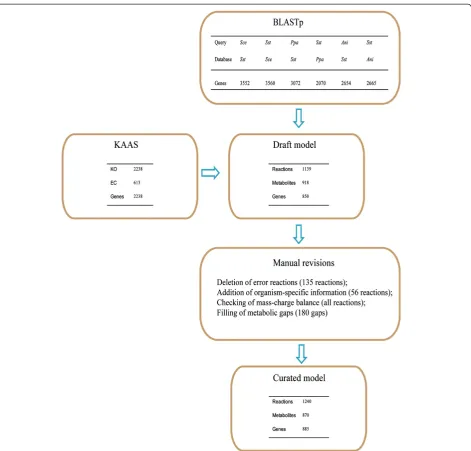
manual refinement (see Methods section). Following the main reconstruction steps described in Figure 1, func-tional annotation of the whole genome was firstly per-formed by two different sequence similarity search
programs. All the matched genes of S. stipitis were
retrieved from the genome of S. cerevisiae, Pichia
pas-toris, and Aspergillus niger respectively by the Basic Local Alignment Search Tool (BLAST). Meanwhile, a
‘KO list.xlsx’with KEGG ORTHOLOGY (KO) identifiers
corresponding to the assigned genes was obtained by KEGG Automatic Annotation Server (KAAS). By the in-tegration of the two genome annotation results, a draft model including 1139 reactions and 850 genes was achieved. Then, the draft model was curated with the biochemical information from databases and literature (Figure 1). Detailed genome annotation result was pro-vided in Additional file 1.
During model reconstruction, various sugar transport
reactions and metabolic pathways were manually
checked and added to the draft model for a better
understanding of the carbohydrate metabolism in S.
sti-pitis. By the combination of information from the sequenced genome, transcriptional expression [21] and experimental data [22], 36 putative sugar transporters were reannotated (Additional file 1). Of them, 22 were with detectible transcripts and 5 were experimentally characterized. The 8 disaccharide transporters exhibited
high homologues to the corresponding transporters inS.
cerevisiae, but not the remaining 28 monosaccharide transporters for some of which were unique toS. stipitis, such as the arabinose-proton symporter (AUT) and xy-lose transporters (XUT), reflecting the capabilities of pentose utilization [23]. The newly annotated sugars transporters not only give us a sight into the molecular basis of sugar transport but also could be used as foun-dation for the identification and functional illumination of the various sugar transporters supposed to exist inS. stipitis. A map illustrating the central carbohydrate me-tabolism is provided (Figure 2). Upon entry into the cell, hexose (glucose, mannose, and galactose) are easily phosphorylated to enter the central metabolism while the pentose (xylose and arabinose) must pass through oxidoreductase reactions before phosphorylation. For instance, L-arabinose must go through four oxidore-ductase steps via L-arabitol, L-xylulose, D-xylitol, and D-xylulose to enter pentose phosphate pathway (PPP). The additional steps in pentose converting pathways cause the loss of substrate carbon into the cell mass which may account for the less efficient of pentose than hexose for cell growth [23]. Except for the com-mon lignocellulose-derived sugars (glucose, mannose, galactose, xylose, and arabinose), the novel sugar meta-bolic pathways such as cellobiose metabolism encoded
metabolism encoded by four genes (LRA1-4) were also added to the model by extensive literature mining [23-25].
The resulting genome-scale metabolic model iTL885
comprises 885 metabolic genes, 1240 reactions, and 870 metabolites. The 1240 metabolic reactions were distribu-ted over 61 metabolic pathways and locadistribu-ted into three
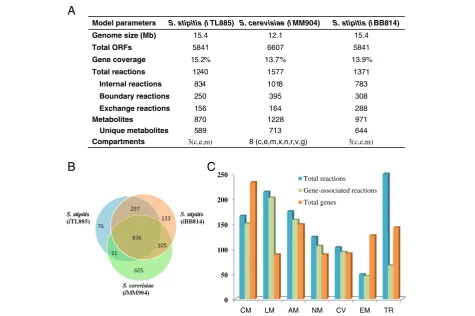
cellular compartments. Compared withiMM904 (13.9%)
and iBB814 (13.7%), the gene coverage of iTL885 is the highest, about 15.2% (Figure 3A). Altogether, there are 421 metabolites shared by the three models, and the
unique metabolites were 589, 644, and 713 for iTL885,
iBB814, and iMM904, respectively. The relatively small
number of metabolites in iTL885 was caused by the
ex-cluding of tRNA-charging and dipeptide metabolism be-cause of the presence of dead ends in these subsystems. For the reactions, 836 reactions are shared by the three models (Figure 3B), and the 76 unique reactions in iTL885 were mainly associated with the degradation of polysaccharide (chitin, xylan, mannan, and glycogen) and metabolism of glycerolipid and sphingolipid. In addition, nearly 92% of the metabolic reactions were associated with certain genes and the carbohydrate me-tabolism contained the largest percentage of metabolic genes, which was consistent with the physiological prop-erty of S. stipitis to use most of the sugars present in
biomass substrates [26]. Meanwhile, this model captured 252 non-gene associated reactions, among which 183 were transport reactions (Figure 3C). The numerous transport reactions were included to represent the ex-change of metabolites between different compartments
although most of them didn’t have known gene
associa-tions due to the insufficient gene annotaassocia-tions or litera-ture data. See Additional file 2 for the detailed description of the model structure.
Gene essentiality study
The essentiality of each gene to cell growth was evalu-ated by removing each individual reaction from the stoi-chiometry matrix (see Method section). In the model iTL885, 130 genes (14.7% of the total genes) were pre-dicted to be essential on a minimal medium with glucose as carbon source. This percentage was close to that ofS. cerevisiae (12.9%) [27]. As illustrated in Figure 4, ap-proximately 82% of the predicted essential genes were
focused on amino acid metabolism (49 genes), nucleo-tide metabolism (22 genes), lipid metabolism (18 genes), and carbohydrate metabolism (17 genes), highlighting the significance of them to cell growth. Compared with the glucose medium, four additional essential genes were identified on the xylose medium. The four
genes exclusively belonged to xylose metabolism
were XYL1(PICST_89614), XYL2 (PICST_86924), PGI1
(PICST_84923), and TAL1 (PICST_74289). Of them,
XYL1 (xylose reductase) and XYL2(xylitol
dehydrogen-ase) encode the two initial enzymes of xylose metabolic
pathway, which has been introduced toS. cerevisiae for
the production of lignocellulosic ethanol [28]. The other
two genes PGI1 (glucose-6-phosphate isomerase) and
TAL1 (transaldolase) link the pentose phosphate
path-way to glycolysis by the formation of key glycolysis inter-mediate D-fructose 6-phosphate (Figure 2). Many nonessential genes for cell growth could be explained by the existence of isoenzymes or alternative metabolic
pathways. For example, the five ethanol dehydrogenase genes (ADH1-5) were predicted to be nonessential on the xylose medium. Actually, two independent ethanol synthesis pathways were identified. One is the common cytoplasmic ethanol pathway, the other is the
mitochon-drial pathway encoded byADH3(PICST_88760), a
mito-chondrial alcohol dehydrogenase (absented in iBB814).
However, the latter pathway functioned only when the cytoplasmic pathway was eliminated, which had been ex-perimentally validated [29]. The list of essential genes was provided in Additional file 3.
Physiological characteristic of ethanol fermentation
Oxygen is a key factor that affects the production of ethanol in S. stipitis [14,30,31]. Here, the influence of oxygen on ethanol formation was studied by a computa-tional robustness analysis with xylose as carbon source and ethanol synthesis as the objective function. The pre-dicted result was illustrated in Figure 5. It was found that ethanol production rate increased sharply when oxygen uptake rate was at the range of 0.34 to 0.88 mmol/gDCW/h. The maximum ethanol production rate reached to 4.72 mmol/gDCW/h when oxygen consumption rate was 1.15 mmol/gDCW/h, in agree-ment with earlier experiagree-mental observation [14].
How-ever, when oxygen consumption rate exceeded
1.15 mmol/gDCW/h, ethanol production rate began to decrease, and eventually to zero (oxygen consumption
Model parameters S. stipitis (i S. stipitis (i
Genome size (Mb) 15.4 12.1 15.4
Total ORFs 5841 6607 5841
Gene coverage 15.2% 13.7 % 13.9%
Total reactions 1240 1577 1371
Internal reactions 834 1018 783
Boundary reactions 250 395 308
Exchange reactions 156 164 288
Metabolites 870 1228 971
Unique metabolites 589 713 644
Compartments 3(c,e,m) 8 (c,e,m,x,n,r,v,g) 3(c,e,m)
0 50 100 150 200 250
CM LM AM NM CV EM TR
Total reactions Gene-associated reactions Total genes
A
B
C
BB814) S. cerevisiae (iMM904)
TL885)
Figure 3Model characteristics ofiTL885. A) Model contents of twoS. stipitis(iTL885 andiBB814) and oneS. cerevisiae(iMM904).B) Venn diagram showing the number of total, shared and unique reactions in the three yeasts GSMMs.C) Statistics of the number of total reactions, gene-associated reaction and total genes in the seven cellular subsystems. Each reaction (except exchange reactions) in the model was assigned to a single subsystem. Abbreviations:CM (carbohydrate metabolism), LM (lipid metabolism), AM (amino acid metabolism), NM (nucleotide metabolism), CV (cofactors and vitamins metabolism), TR (transport reactions), and EM (energy metabolism).
38%
13% 14%
17%
7%1%
10%
AM
CM
LM
NM
EM
TR
CV
rate of 27.1 mmol/gDCW/h), due to the oxidation of ethanol in the presence of excessive oxygen [32]. The re-sult indicates that ethanol production is strongly affected by the intracellular reduction-oxidation status. The se-cretion of ethanol occurs under oxygen-limited condi-tions and the maximum ethanol production could be achieved only under the relatively low oxygen condition. Besides, the produced ethanol can be reassimilated when oxygen is excessive.
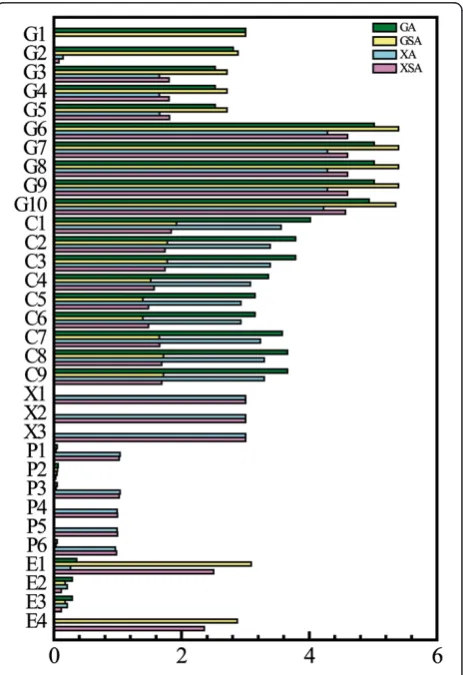
More specifically, the distributions of carbon flux under different oxygen levels (aerobic and semiaerobic) were investigated by flux balance analysis (FBA) (Figure 6). It was found that (i) the glycolytic flux wasn’t obviously affected by the oxygen levels by either glucose or xylose, but the flux channelled into tricarboxylic acid cycle (TCA cycle) increased about twofold when the cells were shifted from semiaerobic to aerobic, which were consistent with the reported results that genes involved in TCA cycle were downregulated as oxygen availability decreased [33]; (ii) at the node of pyruvate, the flux to acetaldehyde (leading to fermentation) increased about tenfold with the decreased oxygen level, which was in accordance with the experiment that the
expression of key fermentative genes (PDC, ALD and
ADH) for ethanol production were greatly improved under the oxygen-limited condition [34]. Meanwhile, the effects of different carbon sources (xylose and glucose) on the flux distribution of central metabolism were also analysed. Xylose greatly increased the carbon flux channelled into the PPP. The sufficient PPP activity in S. stipitis has spurred numerous studies on the
overex-pression of non-oxidative PPP genes (TAL1,RPE1, RKI1)
to improve the utilization of xylose in the recombinant S. cerevisiae[8] as well as inS. stipitis[35]. However, the
metabolic fluxes through TCA cycle do not change sig-nificantly with the two carbon sources, indicating the
ex-pression of the enzymes-coding genes remained
constant [21].
Ethanol production from xylose
Previous study of xylose utilization in S. stipitis was
mainly focused on the illustration of transport mechan-ism and metabolic pathway [36,37]. In the model iTL885, seven putative high-affinity xylose transporters (XUT1-7) were annotated, and one of them (XUT1) has
been biochemically characterized from S. stipitis [38].
However, the low-affinity xylose proton symport systems could not be found just by gene annotation. So, kinetics experiment was necessary to determine the low-affinity xylose transporters. Four Sut proteins (SUT1-4) with higher affinity for glucose than xylose had been charac-terized in this way, indicating this low-affinity system is
Figure 5Robustness analysis of oxygen uptake rate.By fixing the xylose uptake rate and cell growth rate, the production of ethanol was maximized at each oxygen uptake rates.
shared by glucose and xylose [16,38]. As a result, the in-flux of xylose could be attributed to the cooperation of the two xylose transport systems. Besides, sugar sensors (SNF3, RGT2, etc.) were also identified inS. stipitis gen-ome, which ensures the quick cellular response to the change of xylose in the environment, as the transcrip-tional data showed that the transcription of RGT2 with xylose could increase 65-fold [21].
The assimilated xylose can be metabolised via two catabolic routes: xylulokinase pathway and D-arabinose utilization pathway (Figure 2). Xylulokinase pathway is a well characterized pathway including three reactions
encoded by three genes XYL1 (PICST_89614), XYL2
(PICST_86924), and XKS (PICST_68734), respectively
[39]. Based on our simulation, this pathway is thought to be the only route redirecting carbon flux from xylose to PPP in the wild-type cell. The D-arabinose utilization pathway consists of three biochemical reactions cata-lyzed by D-arabinitol dehydrogenase (AAD1), D-ribulose reductase (ARD2) and D-ribulokinase (RKS1), which was found due to the fact that xylose still can be metabolised in the XKS disruption strain [40]. This pathway was also responsible for the degradation of D-arabinose, as illu-strated in Figure 2.
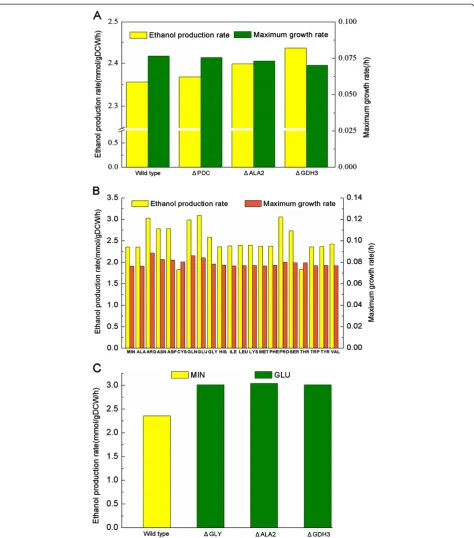
Efficient production of xylose-derived ethanol is of particular interest forS. stipitis[41,42]. To gain a higher productivity of ethanol, three promising gene knockout
strategies were identified by OptKnock algorithm
(Figure 7A). The first one was a straightforward strategy to increase the available pool of the acetaldehyde precur-sor by knocking out of two threonine aldolase (GLY) genes (PICST_7413 and PICST_71203), which blocked the flux from acetaldehyde to threonine. But this method showed only a slight increase of ethanol production rate. The second one was to enhance the mitochondrial pyru-vate pool through the deletion of alanine transaminase
gene ALA2(PICST_70108), which led to a considerable
increase of ethanol accumulation rate. The third effect-ive strategy was to augment the supply of NADPH by deleting the NADP-dependent glutamate dehydrogenase
geneGDH3 (PICST_82969). This optimization approach
not only increased ethanol production rate about 3.4%, but had a negligible influence on cell growth (with the maximum growth rate remain at 0.07 mmol/gDCW/h).
The optimization of organic nitrogen sources had been reported to be able to enhance the bioconversion of xy-lose [43], thus the influence of specific amino acids on the production of ethanol were computationally investi-gated (Figure 7B). The addition of 17 of the 20 amino acids could improve both cell growth and ethanol pro-duction. Of those positive additions, the addition of glu-tamate had the most significantly impact, leading to the ethanol production rate increased by 27.7% compared to the control. Combined the above two strategies, i.e. gene
deletion and glutamate addition, the production rate of ethanol was predicted to increase by over 20.0% for all the deletion strains, among which the addition of
glu-tamate to theALA2deletion strain could improve
etha-nol production rate up to 1.29 fold of the control (Figure 7C). The results suggested that future work for
the optimization of ethanol fermentation in S. stipitis
should also consider the availability of nutrients aside from carbon source, which perhaps will be more benefi-cial as the cost-effective media often contain complex mixtures of nutrient derived from natural substrates.
Conclusions
In summary, an in silico model named iTL885 was
developed representing a comprehensive knowledge of
the metabolism of S. stipitis. Compared with the
reportediBB814,iTL885 possessed a higher gene
cover-age rate in despite with a slightly smaller model size. Model-driven study of the gene essentiality validated the role of key metabolic genes in xylose metabolism and ethanol synthesis. Nevertheless, a further large-scale gene knockout study ofS. stipitis is necessary for a bet-ter elucidation of its genotype-phenotype relationships. Robustness analysis demonstrated the profile of ethanol formation and FBA pointed out the impacts of oxygen-ation and carbon sources on the flux distribution of central metabolism. In light of the fermentation charac-teristic, we suggested the well-controlled oxygen concen-tration to achieve the maximum production of ethanol. The investigation of xylose utilization from the perspec-tives of sugar transport and metabolism partly accounts for the high efficient bioconversion of xylose in S. stipi-tis. For the overproduction of ethanol from xylose, can-didate knockout targets were identified and the effects of amino acids addition were simulated, which proves that GSMM is capable of designing optimal culture con-ditions and metabolic engineering strategies. Therefore future work for S. stipitiscan be focused on the experi-mental testing of strain design hypothesis generated by the computational analysis.
Methods
Model reconstruction and refinement
The availability of whole genome of P. stipitis [44]
enables us to carry out the model reconstruction follow-ing the general workflow of GSMM reconstruction described before [45,46]. Firstly, the sequenced genome
data of P. stipitis CSB 6054 was downloaded from
Uni-Prot database [47]. Then, the functional annotation of genes was performed in two different ways. BLAST was
used to conduct the sequence homology search ofS.
have an e-value less than 1 × 10-30, an amino acid se-quence identity above 40%, and a matching length at least 70% of the query sequence. To obtain a original
reactions list, also called in-house model, GSMMs of S.
cerevisiae iMM904 [27], P. pastoris iPP668 [48] and A. niger iMA871[49] were selected as template frameworks to map the assigned genes. On the other hand, KAAS [50] was used for the functional annotation of all the query amino acid sequences. With the specific KO identifiers or Enzyme Commission (EC) numbers, par-ticular reactions were selected from the KEGG reaction database which was then integrated to the BLAST results. Special attention was paid on the most signifi-cant components of genome-scale network, the gene-protein-reaction (GPR) associations which details the relationships between genes, proteins and reactions using the Boolean logical representations (AND and OR operators). The various isoenzyms or enzyme com-plexes were identified with the help of KEGG Modules [51] and assignments of homologous genes inS. cerevisiae. As a result, a draft model was developed and used as a start point for subsequent network refinements. With the biochemical information acquired from public databases such as KEGG [51], MetaCyc [52], BRENDA [53], and TCDB [54], manual revisions including deletion of error reactions, addition of organism-specific information, checking of mass-charge balance and filling of metabolic gaps were conducted one by one. GapFind and gapFilling in the Constraint-Based Reconsruction and Analysis (COBRA) toolbox were performed to identify and bridge the gaps in the current version of model so as to match the genotype and phenotype [55]. A detailed model struc-ture was accomplished when a biomass formation reaction and certain exchange reactions were added to the network. Biomass equation is an artificial linear combination of all the known biomass constituents and their defined propor-tions. Exchange reactions describe the uptake of nutrients from the medium and the secretion of specific metabolites to the extracellular environment, thus defining the systems boundaries.
Modelling technique
All computational simulations were performed using COBRA toolbox [56] on Matlab (The MathWorks Inc., Natick, MA) with GLPK as the linear optimization solver. FBA was used as the main algorithm for network modelling and analysis. The mathematical formulation and numerous applications of FBA have been reviewed [57]. Briefly, FBA is an effective tool for the prediction of the maximal cell growth and metabolite production when given certain constraints. The output of FBA is an optimal flux distribution for each reaction in the model and a maximum value for the objective function. Gener-ally, the biomass equation is set as the objective function
for the simulation of optimal growth and other model evaluations such as essentiality study.
All the simulations were performed on a minimal medium with limited carbon source. The uptake rates of ammonia, sulphate, phosphate, sodium, kalium, and fer-rite were unconstrained with the lower and upper flux
bounds of −1000 and 1000 mmol/gDW/h respectively.
Xylose or glucose was set as sole carbon source with a uptake rate of 3 mmol/gDCW/h [14]. The robustness analysis of oxygen uptake was performed by fixing the xylose uptake rate and cell growth rate (0.01 h-1) to pre-dict the maximum ethanol production rate at each con-trolled oxygen uptake rate. The aerobic condition was simulated by uncostraining the oxygen uptake rate, and the semiaerobic condition by constraining the exchange
reaction of oxygen to −5 mmol/gDW/h. To modelling
the amino acids addition, each of amino acid was con-strained to have a maximum consumption rate of 0.1 mmol/gDCW/h.
Gene deletion simulations
The computational single gene deletion was conducted to predict the important genes for the synthesis of build-ing blocks of cellular biomass [58]. For a given gene, the in silico knockout was performed by constraining the flux value of its corresponding reaction to zero when maximizing the growth rate. This method also works for the complex GPRs such as isoenzymes and multiplex enzymes. If the maximum growth rate of the gene knockout strain is less than 1 x 10⁻⁶of the wild type, the deleted gene is defined as essential. Otherwise, it’s a nonessential gene. The OptKnock algorithm in COBRA toolbox identifies candidate genes that lead to the over-production of desired metabolite [59,60]. With ethanol as the target product, OptKonck was applied to discover target gene(s) knockouts. The scope of OptKonck was constrained to the nonessential genes in central metab-olism (glycolysis, TCA, and PPP) and amino acid metabolism.
Additional files
Additional file 1:Genome reannotation.This Excel workbook contains the detailed gene annotation results by BLAST and KAAS, as well as the 36 reannotated sugar transporters.
Additional file 2:Model structure.This Excel workbook contains detailed information ofS. stipitis iTL885, including all the reactions, metabolites, and GPRs.
Additional file 3:Essential genes.This Excel workbook is a list of the predicted essential genes with glucose as sole carbon source and the original reactions corresponding to the abbreviations in Figure 6.
Abbreviations
Phosphate Pathway; TCA cycle: Tricarboxylic Acid Cycle; GPR: Gene-Protein-Reaction; XYL1: Xylose reductase; XYL2: Xylitol dehydrogenase; XKS: D-xylulokinase; PGI1: Glucose-6-phosphate isomerise; TAL1: Transaldolase; ADH: Ethanol Dehydrogenase; PDC: Pyruvate Decarboxylase; ALD: Aldehyde Dehydrogenase; RPE1: D-ribulose-5-phosphate 3- epimerase; RKI1: Ribose-5-phosphate Ketol-isomerase; SNF3: High-affinity glucose transporter; RGT2: Glucose sensor; XUT: Xylose Transporters; SUT: Hexose Transporter; AAD1: arabinitol Dehydrogenase; ARD2: ribulose reductase; RKS1: D-ribulokinase; GLY: Threonine aldolase; ALA2: Alanine transaminase; GDH3: NADP-dependent glutamate dehydrogenase.
Competing interests
The authors declare that they have no competing interests.
Authors’contributions
TL constructed the model and drafted the manuscript. WZ provided suggestions for model analysis and simulations. LML designed the experiments and JC revised the manuscript. All authors read and approved the final manuscript.
Acknowledgements
The author would like to thank Dr. Jens Nielsen, professor at Chalmers University of Technology, for technological help on the model reconstruction. This work was supported by grants from the Outstanding Youth Foundation of Jiangsu Province (No.:BK2012002), the National Natural Science Foundation of China (31270079), the Program for Young Talents, and the national outstanding doctorate paper author special fund (No. 200962).
Author details 1
State Key Laboratory of Food Science and Technology, Jiangnan University, 1800 Lihu Avenue, Wuxi, Jiangsu 214122, China.2Key Laboratory of Industrial Biotechnology, Ministry of Education, Jiangnan University, 1800 Lihu Avenue, Wuxi, Jiangsu 214122, China.
Received: 10 July 2012 Accepted: 13 September 2012 Published: 21 September 2012
References
1. Wyman CE:What is (and is not) vital to advancing cellulosic ethanol. Trends Biotechnol2007,25(4):153–157.
2. Balat M, Balat H, Oz C:Progress in bioethanol processing.Prog Energ Combust2008,34(5):551–573.
3. Balat M, Balat H:Recent trends in global production and utilization of bio-ethanol fuel.Appl Energ2009,86(11):2273–2282.
4. Sanchez OJ, Cardona CA:Trends in biotechnological production of fuel ethanol from different feedstocks.Bioresource Technol2008,
99(13):5270–5295.
5. Himmel ME, Ding SY, Johnson DK, Adney WS, Nimlos MR, Brady JW, Foust TD:Biomass recalcitrance: engineering plants and enzymes for biofuels production.Science2007,315(5813):804.
6. Alper H, Stephanopoulos G:Engineering for biofuels: exploiting innate microbial capacity or importing biosynthetic potential?Nat Rev Microbiol 2009,7(10):715–723.
7. Weber C, Farwick A, Benisch F, Brat D, Dietz H, Subtil T, Boles E:Trends and challenges in the microbial production of lignocellulosic bioalcohol fuels.Appl Microbiol Biotechnol2010,87(4):1303–1315.
8. Matsushika A, Inoue H, Kodaki T, Sawayama S:Ethanol production from xylose in engineeredSaccharomyces cerevisiaestrains: current state and perspectives.Appl Microbiol Biotechnol2009,84(1):37–53.
9. Seo JS, Chong H, Park HS, Yoon KO, Jung C, Kim JJ, Hong JH, Kim H, Kim JH, Kil JI:The genome sequence of the ethanologenic bacterium
Zymomonas mobilisZM4.Nat Biotechnol2004,23(1):63–68.
10. Kuhad RC, Gupta R, Khasa YP, Singh A, Zhang YHP:Bioethanol production from pentose sugars: Current status and future prospects.Renew Sust Energ Rev2011,15(9):4950–4962.
11. Chandel AK, Chandrasekhar G, Radhika K, Ravinder R, Ravindra P: Bioconversion of pentose sugars into ethanol: A review and future directions.Biotechnol Mol Biol Rev2011,6(1):008–020.
12. Kurtzman CP, Suzuki M:Phylogenetic analysis of ascomycete yeasts that form coenzyme Q-9 and the proposal of the new generaBabjeviella,
Meyerozyma,Millerozyma,Priceomyces, andScheffersomyces.Mycoscience 2010,51(1):2–14.
13. Jeffries TW, Van Vleet JRH:Pichia stipitisgenomics, transcriptomics, and gene clusters.FEMS Yeast Res2009,9(6):793–807.
14. Skoog K, Hahn-Hägerdal B:Effect of oxygenation on xylose fermentation byPichia stipitis.Appl Environ Microbiol1990,56(11):3389–3394. 15. Agbogbo FK, Coward-Kelly G:Cellulosic ethanol production using the
naturally occurring xylose-fermenting yeast,Pichia stipitis.Biotechnol Lett 2008,30(9):1515–1524.
16. Weierstall T, Hollenberg CP, Boles E:Cloning and characterization of three genes (SUT1-3) encoding glucose transporters of the yeastPichia stipitis. Mol Microbiol1999,31(3):871–883.
17. Grootjen D, Van der Lans R, Luyben K:Effects of the aeration rate on the fermentation of glucose and xylose byPichia stipitisCBS 5773. Enzyme Microb Tech1990,12(1):20–23.
18. Feist AM, Palsson BO:The growing scope of applications of genome-scale metabolic reconstructions usingEscherichia coli.Nat Biotechnol2008, 26(6):659–667.
19. Osterlund T, Nookaew I, Nielsen J:Fifteen years of large scale metabolic modeling of yeast: Developments and impacts.Biotechnol Adv2012, 30(5):979–988.
20. Balagurunathan B, Jonnalagadda S, Tan L, Srinivasan R:Reconstruction and analysis of a genome-scale metabolic model forScheffersomyces stipitis. Microb Cell Fact2012,11:27.
21. Yuan T, Ren Y, Meng K, Feng Y, Yang P, Wang S, Shi P, Wang L, Xie D, Yao B:RNA-Seq of the xylose-fermenting yeastScheffersomyces stipitiscultivated in glucose or xylose.Appl Microbiol Biotechnol 2011,92(6):1237–1249.
22. Palma M, Goffeau A, Spencer-Martins I, Baret PV:A phylogenetic analysis of the sugar porters in hemiascomycetous yeasts.J Mol Microbiol Biotechnol 2007,12(3–4):241–248.
23. Preez JC, Bosch M, Prior B:The fermentation of hexose and pentose sugars byCandida shehataeandPichia stipitis.Appl Microbiol Biotechnol 1986,23(3):228–233.
24. Watanabe S, Piyanart S, Makino K:Metabolic fate of L-lactaldehyde derived from an alternative L-rhamnose pathway.FEBS J2008, 275(20):5139–5149.
25. Parekh S, Parekh R, Wayman M:Fermentation of xylose and cellobiose by Pichia stipitisandBrettanomyces clausenii.Appl Biochem Biotechnol1988, 18(1):325–338.
26. Nigam JN:Ethanol production from wheat straw hemicellulose hydrolysate byPichia stipitis.J Biotechnol2001,87(1):17–27.
27. Mo ML, Palsson BO, Herrgard MJ:Connecting extracellular metabolomic measurements to intracellular flux states in yeast.BMC Syst Biol2009, 3:37.
28. Kötter P, Ciriacy M:Xylose fermentation bySaccharomyces cerevisiae. Appl Microbiol Biotechnol1993,38(6):776–783.
29. Cho JY, Jeffries TW:Pichia stipitisgenes for alcohol dehydrogenase with fermentative and respiratory functions.Appl Environ Microbiol1998, 64(4):1350–1358.
30. Skoog K, Jeppsson H, Hahn-Hägerdal B:The effect of oxygenation on glucose fermentation withPichia stipitis.Appl Biochem Biotechnol1992, 34(1):369–375.
31. Klinner U, Fluthgraf S, Freese S, Passoth V:Aerobic induction of respiro-fermentative growth by decreasing oxygen tensions in the respiratory yeastPichia stipitis.Appl Microbiol Biotechnol2005, 67(2):247–253.
32. Skoog K, Hahn-Hägerdal B, Degn H, Jacobsen JP, Jacobsen HS: Ethanol reassimilation and ethanol tolerance inPichia stipitisCBS 6054 as studied by 13C nuclear magnetic resonance
spectroscopy.Appl Environ Microbiol1992,58(8):2552–2558. 33. Unrean P, Nguyen NHA:Metabolic pathway analysis ofScheffersomyces
(Pichia) stipitis: effect of oxygen availability on ethanol synthesis and flux distributions.Appl Microbiol Biotechnol2012,94(5):1387–1398.
34. Passoth V, Zimmermann M, Klinner U:Peculiarities of the regulation of fermentation and respiration in the crabtree-negative, xylose-fermenting yeastPichia stipitis.Appl Biochem Biotechnol1996, 57–58:201–212.
36. Kilian S, Uden N:Transport of xylose and glucose in the xylose-fermenting yeastPichia stipitis.Appl Microbiol Biotechnol1988, 27(5):545–548.
37. Rizzi M, Erlemann P, Bui-Thanh NA, Dellweg H:Xylose fermentation by yeasts.Appl Microbiol Biotechnol1988,29(2):148–154.
38. Du J, Li SJ, Zhao HM:Discovery and characterization of novel D-xylose-specific transporters fromNeurospora crassaandPichia stipitis.Mol Biosyst2010,6(11):2150–2156.
39. Jin YS, Cruz J, Jeffries TW:Xylitol production by aPichia stipitis D-xylulokinase mutant.Appl Microbiol Biotechnol2005,68(1):42–45. 40. Jin YS, Jones S, Shi NQ, Jeffries TW:Molecular cloning of XYL3
(D-xylulokinase) fromPichia stipitisand characterization of its physiological function.Appl Environ Microb2002,68(3):1232–1239.
41. Silva JPA, Mussatto SI, Roberto IC, Teixeira JA:Fermentation medium and oxygen transfer conditions that maximize the xylose conversion to ethanol byPichia stipitis.Renew Energ2012,37(1):259–265.
42. Agbogbo FK, Coward-Kelly G, Torry-Smith M, Wenger KS:Fermentation of glucose/xylose mixtures usingPichia stipitis.Process Biochem2006, 41(11):2333–2336.
43. Slininger PJ, Dien BS, Gorsich SW, Liu ZL:Nitrogen source and mineral optimization enhance D-xylose conversion to ethanol by the yeastPichia stipitisNRRL Y-7124.Appl Microbiol Biotechnol2006,72(6):1285–1296. 44. Jeffries TW, Grigoriev IV, Grimwood J, Laplaza JM, Aerts A, Salamov A,
Schmutz J, Lindquist E, Dehal P, Shapiro H,et al:Genome sequence of the lignocellulose-bioconverting and xylose-fermenting yeastPichia stipitis. Nat Biotechnol2007,25(3):319–326.
45. Feist AM, Herrgard MJ, Thiele I, Reed JL, Palsson BO:Reconstruction of biochemical networks in microorganisms.Nat Rev Microbiol2009, 7(2):129–143.
46. Liu LM, Agren R, Bordel S, Nielsen J:Use of genome-scale metabolic models for understanding microbial physiology.FEBS Lett2010, 584(12):2556–2564.
47. Apweiler R, Martin MJ, O’Donovan C, Magrane M, Alam-Faruque Y, Antunes R, Barrell D, Bely B, Bingley M, Binns D,et al:The Universal Protein Resource (UniProt) in 2010.Nucleic Acids Res2010,38:D142–D148. 48. Chung BK, Selvarasu S, Andrea C, Ryu J, Lee H, Ahn J, Lee DY:
Genome-scale metabolic reconstruction and in silico analysis of methylotrophic yeastPichia pastorisfor strain improvement.Microb Cell Fact2010,9:50. 49. Andersen MR, Nielsen ML, Nielsen J:Metabolic model integration of the
bibliome, genome, metabolome and reactome ofAspergillus niger. Mol Syst Biol2008,4:178.
50. Moriya Y, Itoh M, Okuda S, Yoshizawa AC, Kanehisa M:KAAS: an automatic genome annotation and pathway reconstruction server.Nucleic Acids Res 2007,35:W182–W185.
51. Kanehisa M, Goto S, Furumichi M, Tanabe M, Hirakawa M:KEGG for representation and analysis of molecular networks involving diseases and drugs.Nucleic Acids Res2010,38:D355–D360.
52. Caspi R, Altman T, Dreher K, Fulcher CA, Subhraveti P, Keseler IM, Kothari A, Krummenacker M, Latendresse M, Mueller LA,et al:The MetaCyc database of metabolic pathways and enzymes and the BioCyc collection of pathway/genome databases.Nucleic Acids Res2012,40:D742–D753. 53. Scheer M, Grote A, Chang A, Schomburg I, Munaretto C, Rother M, Sohngen
C, Stelzer M, Thiele J, Schomburg D:BRENDA, the enzyme information system in 2011.Nucleic Acids Res2011,39:D670–D676.
54. Saier MH Jr, Yen MR, Noto K, Tamang DG, Elkan C:The Transporter Classification Database: recent advances.Nucleic Acids Res2009, 37:D274–D278.
55. Satish Kumar V, Dasika MS, Maranas CD:Optimization based automated curation of metabolic reconstructions.BMC Bioinformatics2007,8:3212. 56. Schellenberger J, Que R, Fleming RM, Thiele I, Orth JD, Feist AM, Zielinski DC, Bordbar A, Lewis NE, Rahmanian S,et al:Quantitative prediction of cellular metabolism with constraint-based models: the COBRA Toolbox v2.0.Nat Protoc2011,6(9):1290–1307.
57. Orth JD, Thiele I, Palsson B:What is flux balance analysis?Nat Biotechnol 2010,28(3):245–248.
58. Thiele I, Vo TD, Price ND, Palsson BO:Expanded metabolic reconstruction ofHelicobacter pylori(iIT341 GSM/GPR): an in silico genome-scale characterization of single- and double-deletion mutants.J Bacteriol2005, 187(16):5818–5830.
59. Burgard AP, Pharkya P, Maranas CD:Optknock: a bilevel programming framework for identifying gene knockout strategies for microbial strain optimization.Biotechnol Bioeng2003,84(6):647–657.
60. Pharkya P, Burgard AP, Maranas CD:Exploring the overproduction of amino acids using the bilevel optimization framework OptKnock. Biotechnol Bioeng2003,84(7):887–899.
doi:10.1186/1754-6834-5-72
Cite this article as:Liuet al.:A constraint-based model of
Scheffersomyces stipitisfor improved ethanol production.Biotechnology for Biofuels20125:72.
Submit your next manuscript to BioMed Central and take full advantage of:
• Convenient online submission
• Thorough peer review
• No space constraints or color figure charges
• Immediate publication on acceptance
• Inclusion in PubMed, CAS, Scopus and Google Scholar
• Research which is freely available for redistribution