ISSN 2324-805X E-ISSN 2324-8068 Published by Redfame Publishing URL: http://jets.redfame.com
Analysis of Bridge Player Profiles According to Their Intelligence Areas
Fatma Pervin Bilir1, Yeliz Sirin2
1University of Çukurova of Physical Education and Sports High School of Department of Sports Management, Physical Education and Sport, Turkey
2University of Kahramanmaraş Sütçü İmam of Physical Education and Sports High School, Physical Education and Sport, Turkey
Correspondence: Yeliz Sirin, University of Kahramanmaraş Sütçü İmam of Physical Education and Sports High School, Physical Education and Sport, Turkey.
Received: July 5, 2017 Accepted: August 7, 2017 Online Published: August 8, 2017
doi:10.11114/jets.v5i9.2526 URL: https://doi.org/10.11114/jets.v5i9.2526
Abstract
The aim of this study is to figure out profiles of bridge players and analyzing them according to their intelligence areas. The sample of the study is consist of 100 volunteers out of 200 bridge players who have attended "Çukurova open double bridge championship" in Adana, Turkey at February 2016. Data have been collected via "Personal Information Form" and "Multiple Intelligence Areas Assessment Scale" developed by Gülşen (2015). Data have been analyzed not only via descriptive statistics but also Mann Whitney U test was used for double comparison and Kruskal Wallis H test for multiple comparison. The profile of the players contributed to the study is; 30% women, 70% men, 25% of the population is between 51 and 60 years age, 67% is married, 71% has bachelor degree, 57% is working for government sector and 33% for private sector. Most of the players are working as teacher, engineer, or medical doctor and 50% of the population is performing a physical activity like walking, football and basketball. It is found that players' internal intelligence area is the highest among all intelligence areas; additionally the lowest one is found as the rhythmic intelligence. It is determined that the players' from different business sectors have significant differences among internal, analytic, interpersonal, physical/kinesthetic intelligence areas, and significant difference is determined for the physical/kinesthetic intelligence among the players who perform physical activities and who do not.
Keywords: bridge, multiple intelligence areas, physical activity, physical/kinesthetic intelligence
1. Introduction
Mukaetova and Lawton (1999) were found to have a study on a 70-year-old acute psychosis patient playing bridge on the computer. No studies have been found on the multiple intelligences of bridge players. When studies about mind sports and athletes were examined, although studies were found in literature about chess athletes (Bilalic & Gobet, 2007), no national studies have been found in literature.
Intelligence, which was expressed with cognitive processes until 1950s, is also expressed with affective and emotional processes today, which brought up the idea that people can be intelligent in different areas. Based on this thought, arguments have focused on the idea that different abilities can be the product of intelligence. The most influential and comprehensive study on this issue was conducted by Howard and Gardner (1999). When Gardner came up with the “theory of Multiple Intelligences” in his book “frames of mind” published in 1983, first of all he introduced the presence of seven intelligences, later in his work “intelligences reframed”, he mentioned the presence of an “eighth” intelligence and added another dimension of intelligence (Gardner, 1999). Gardner defines intelligence as the capacity of a person to create products that are valued by one or more than one culture, the ability to create effective and efficient solutions to problems encountered in real life and the ability to discover new and complicated problems. The theory of Multiple Intelligences brought down the understanding of traditional IQ (Intelligent Quotient) and instead brought the understanding of an intelligence that favors and values the individual. That is, individuals are no longer considered as intelligent based on “verbal/linguistic” or “logical/mathematical” intelligences; on the contrary, individuals are assessed as multi-dimensional (Baş, 2011). According to Gardner (1997), each child is born having different intelligences and they can develop in those areas with experiences. Each individual can be more developed in one or more than one field of intelligence. Gardner (2006) stated that just as inheritance influences the development of these intelligence areas, the environment is also a supportive and inhibiting factor. The resources that the individual has, the cultural values of the society he/he lives in, geographical conditions, the state that the family is in and the state that the individual is in have an influence on the development of intelligence areas. Armstrong stated that different cultures are resources of the development of different intelligence areas (Armstrong, 2008). Unlike the classical theory, the theory of intelligence suggests that each person can have abilities in all intelligence areas and teaching arrangements should be made to develop these. Thus, when the literature is analyzed, studies which have associated students’ ways of learning and success with the theory of multiple intelligences can be seen (Yılmaz & Fer, 2003; Çelen, 2006; Bozkurt & Aydoğdu, 2009; Demir, 2010; Baş, 2011). Areas of intelligence put forward by Gardner which can be developed with experiences and which exists in different rates in all individuals consist of eight areas:
Verbal/Linguistic Intelligence; expresses the ability of an individual to use words effectively orally or in writing (Gürel& Tat 2010), to use concepts, grammar and syntax of a language (Gardner, 1999), and behaviors such as writing newspaper, novel, story, poem, article, report, letter, giving a speech in front of people, talking to people around, listening to them and understanding the intentions of people and what they say (Lazear, 1999).
Logical/Mathematical Intelligence; expresses an individual’s ability to make mathematical operations and to think logically (Gürel& Tat, 2010), to distinguish between logical or numerical patterns and to reason (Saban, 2005)
Musical/Rhythmic Intelligence; is the ability to understand and use rhythm, tone, melody and harmony (Gürel and Tat 2010:349), to comprehend and distinguish musically, to think about, to transform and to express the reason of an event musically (Saban, 2009).
Visual/Spatial Intelligence; is the ability to perceive the visual-spatial world accurately and to make conversions with these perceptions (Armstrong, 2008). It includes an individual’s ability to observe, perceive and assess his environment objectively, and to show the visual and spatial ideas he gets from the environment graphically (Saban, 2005).
Social/Interpersonal Intelligence; is the ability to perceive, understand and distinguish other people’s feelings and motivations (Gürel and Tat 2010:349; Armstrong, 2008:7). People whose social/interpersonal intelligence is developed learn through interaction and they are successful in making oral or non-oral communication with people (Gardner, 2006).
Bodily/Kinesthetic Intelligence; is an individual’s use of his body to express his ideas and feelings and his hands to produce things (Kuru, 2001). It expresses showing expertise in using the whole body to express ideas and feelings and developed abilities of coordination, balance, strength and flexibility (Armstrong, 2008).
Nature Intelligence; is the ability to know innumerable living beings in nature (Armstrong, 2008), understanding and associating things in nature, understanding, realizing and explaining the balance and symbols of nature (Saban, 2009).
Gardner (2006) stated that there is an association between individual’s mental processes and their outstanding intelligence, the individual’s dominant intelligence type influences the process of learning and thinking and the individual’s learning style can be developed according to his outstanding type of intelligence. In tests developed in line with the theory of Multiple Intelligences, weak and developed intelligence types are found and specific solutions for the individual are presented (Gürel & Tat, 2010). Gardner (2006) stated that applying the theory of Multiple Intelligences to employees would be useful for people, teams and institutions with a multifaceted environment. At the same time, when sport branches are taken into consideration, athletes’ sports types can be accepted as an environmental factor that influences the development of their intelligence areas. Until recently, sport was perceived as only the training of the body and its cognitive and affective aspects were mostly ignored. The theory of Multiple Intelligences is a good model to analyze the areas that need to be improved in addition to being a guide for instruction (Armstrong, 2008). While there are studies on students in the field of sports, studies on the multiple intelligences of athletes are not enough in the literature. In his study on athletes doing individual and team sports, Tekin (2009) found that athletes doing individual sports had higher social and intrapersonal intelligences when compared with athletes doing team sports. In their study on students of sports, Kutz, Dyer, and Campbell (2013)found that bodily/kinesthetic intelligence and social intelligence were on the forefront. In a study which examined types of intelligence in terms of the branches of university students, Oral (2001) found that students of physical education and sports had high bodily/kinesthetic intelligence. In a study on students of school of sports, Çağlayan and Sezen (2007) found that the students had predominantly visual, bodily and auditory styles of learning. Kutz, Dyer, and Campbell (2013) analyzed the multiple intelligences areas of athletes who did periodical and non-periodical sports and found that the athletes who did periodical sports had predominantly existentialist and intrapersonal intelligence areas, while those who did non-periodical sports had predominantly visual intelligence. Ermiş, İmamoğlu, and Erilli (2012) found in their study that sports had a positive influence on the bodily and social intelligence scores of university students. In their study, Bayrak et al. (2005) found a significant difference between students who did sports and those who did not. In Güllü and Tekin’s (2009) study, bodily intelligences of students of sport high school were found to be better than those of general high school students. Bavlı (2013) examined the intelligence areas of students of sports management department in terms of their year of study and found that except naturalistic intelligence, students had similar intelligence scores in terms of their year of study. In Kemeç’s (2016) study, differences were found between students of the school of physical education and sports in terms of their intelligences. In Ürgüp and Aslan’s (2015) study, students of the school of physical education and sports were found to have higher social intelligences in general.
1.1 Aim of the Study
Our literature review did not reveal any studies about the multiple intelligences of bridge players. The purpose of this study is to present the profiles of bridge players in terms of the theory of multiple intelligences and the study contributes to literature about athletes of bridge.
Answers were sought to the following questions in this study:
What are the demographic profiles of athletes who participate in the sport of bridge? How is the distribution of athletes of bridge in terms of their areas of multiple intelligences? Are there differences between areas of multiple intelligences in terms of gender?
Are there differences between areas of multiple intelligences in terms of the sectors athletes were in? Are athletes of bridge interested in other sports?
Are there differences between areas of multiple intelligences of athletes who do other sports and those who do not?
2. Method
2.1 Participants
This study is a descriptive quantitative study. The universe of the study consists of 200 athletes who participated in "Çukurova Open Couples Bridge Championship" held in Adana, Turkey in 2016, while the sample consisted of 100 athletes who participated voluntarily.
2.2 Data Collection Tools and Data Analysis
24-31=Developed, 32-40=Very developed. In the data analysis, descriptive statistics were used such as percentage, frequency, arithmetic mean and standard deviation. It is found that data do not have a homogeneous distribution and non-parametric tests were used for fundamental statistics. Due to non-parametric distribution, Mann-Whitney U Test was used for paired comparisons and Kruskal Wallis H Test was used for multiple comparisons. Cronbach’s Alpha (α) value of the whole scale, which is a measure of internal consistency, that is, how closely related a set of items are as a group, was determined as 0,87.
3. Findings
Table 1. Descriptive statistics related to demographical information of the participants
Variables f % Variables F %
Gender Educational status
Woman 30 30.0 Primary school 1 1.0
Male 70 70.0 High school 10 10.0
Marital Status University 71 71.0
Married 67 67.0 Graduate 18 18.0
Single 33 33.0 Success Status
Age No Success 74 74.0
<30 16 16.0 National 24 24.0
31-40 24 24.0 International 1 1.0
41-50 15 15.0 National and International 1 1.0
51-60 25 25.0 Year License
61-70 16 16.0 5 ve altı 45 45.0
70> 4 4.0 6-10 19 19.0
Institution Employed 11-15 14 14.0
Not working 10 10.0 16-20 10 10.0
Private sector 33 33.0 21-25 4 4.0
Public Institution 57 57.0 26-30 3 3.0
Table 1 shows that the athletes; 30% woman, 70'% male and about 67% were married, 33% were single. Athletes between the ages of 31 and 65 years. It is observed that the maximum age interval is 25% 51-60 and the minimum age interval is 4% to 70 and over. In terms of the variable of occupation, 57'% were working in public sector, 33% were working in private sector, 10% currently does not work in any institution and 24% of the athletes have national success. The athletes are 45% licensed athletes. It was determined that 47% of the athletes were from Adana, 20% from Mersin, 7% from Ankara and 6% from Ankara came from Istanbul to participate in the tournament.
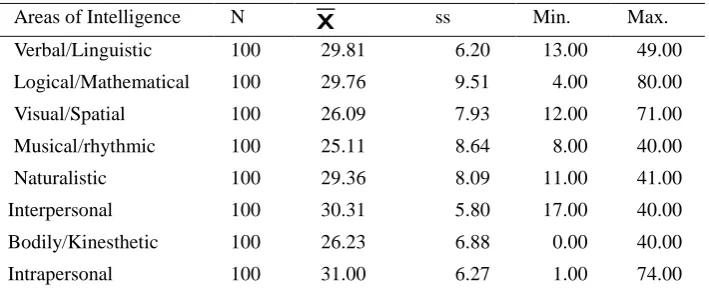
Table 2. Average Scores of Athletes in terms of their intelligence areas
Areas of Intelligence N ss Min. Max.
Verbal/Linguistic 100 29.81 6.20 13.00 49.00
Logical/Mathematical 100 29.76 9.51 4.00 80.00
Visual/Spatial 100 26.09 7.93 12.00 71.00
Musical/rhythmic 100 25.11 8.64 8.00 40.00
Naturalistic 100 29.36 8.09 11.00 41.00
Interpersonal 100 30.31 5.80 17.00 40.00
Bodily/Kinesthetic 100 26.23 6.88 0.00 40.00
Intrapersonal 100 31.00 6.27 1.00 74.00
When Table 2 is analyzed, it can be seen that the highest average values of athletes belonged to intrapersonal intelligence (31.00), while the lowest belonged to musical intelligence (25.11). Since the average values in all areas corresponded to the interval of “appropriate” according to multiple intelligences assessment scale, the athletes were found to have “developed intelligence level”.
Mann-Whitney U Test was used to analyze whether there were differences in the intelligence scores of athletes in terms of gender and the results were given in Table 3.
Table 3. Athletes’ Intelligences in terms of Gender
Intelligences Gender N Mean rank Z p
Logical/Mathematical
Women 30 33.77
-3.782 .000**
Men 70 57.67
Naturalistic Women 30 60.13
-2.182 .029*
Men 70 46.37
*p<0.05 **; p<0.01
Significant differences were found between women and men in terms of athletes’ logical and naturalistic intelligence areas. Mean ranks of men were found to be higher in logical intelligence, while the mean ranks of women were found to be higher in naturalistic intelligence.
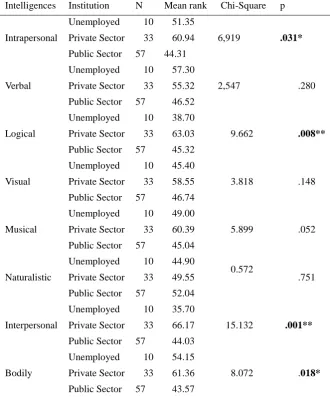
One of the questions in the study was the question of whether there were differences in the scores of athletes in terms of the sectors they worked in. The results of this question were given in Table 4.
Table 4. Athletes’ Intelligences in terms of the sector they work in Institution
Intelligences Institution N Mean rank Chi-Square p
Intrapersonal Unemployed Private Sector Public Sector 10 33 57 51.35 60.94 44.31
6,919 .031*
Verbal Unemployed Private Sector Public Sector 10 33 57 57.30 55.32 46.52
2,547 .280
Logical Unemployed Private Sector Public Sector 10 33 57 38.70 63.03 45.32
9.662 .008**
Visual Unemployed Private Sector Public Sector 10 33 57 45.40 58.55 46.74
3.818 .148
Musical Unemployed Private Sector Public Sector 10 33 57 49.00 60.39 45.04
5.899 .052
Naturalistic Unemployed Private Sector Public Sector 10 33 57 44.90 49.55 52.04 0.572 .751 Interpersonal Unemployed Private Sector Public Sector 10 33 57 35.70 66.17 44.03
15.132 .001**
Bodily Unemployed Private Sector Public Sector 10 33 57 54.15 61.36 43.57
8.072 .018*
*p<0.05**; p<0.01
According to Table 4, the results of the analysis between the variable of athletes’ sector and their intelligences showed significant differences in the areas of intrapersonal, logical, interpersonal and bodily intelligences. When all the intelligences were considered, except for the area of naturalistic intelligence, the mean ranks of athletes working in private sector are higher in all areas of intelligences.
Table 5. Other sports that the athletes are interested in
Sport branches f % Sport branches f %
Basketball 5 5.0 Running 4 4.0
Snooker 1 1.0 Table tennis 2 2.0
Cycling 1 1.0 Pilates 3 3.0
Mountain climbing 1 1.0 Tennis 3 3.0
Fitness 4 4.0 Volleyball 1 1.0
Football 8 8.0 Yoga 1 1.0
Wrestling 1 1.0 Walking 9 9.0
Swimming 6 6.0
When Table 5 was analyzed, it was found that half of the athletes were recreatively interested in other sports branches besides bridge. The groups with majority were found to be groups walking with 9% and groups playing football with 8%.
Differences were found between the bodily intelligence scores of the athletes who did other sports and those who did not based on the analysis results which are shown in Table 6.
Table 6. Bodily/Kinesthetic Intelligences of Athletes who do sports recreatively and those who do not
Intelligence Other sports N Mean rank Z p
Bodily/Kinesthetic
Yes 50 58.74 -2.846
.004**
No 50 42.26
**:p<0.01
According to Table 6, Mann-Whitney U Test, which was conducted to find out whether there were differences between the intelligences of athletes who did other sports and those who did not, differences were found in bodily intelligence scores. When the mean ranks are analyzed, it can be seen that the bodily intelligence averages of athletes who did sports (58.74) were found to be higher than those who did not (42.26).
4. Discussion and Conclusion
The fundamental philosophy of the theory of multiple intelligences is that everybody has all the intelligences; however, profiles are different, and each of these intelligences should be brought out and assessed in their own environments. Multiple intelligence areas should be developed by creating appropriate learning environment and doing appropriate activities (Altan, 2011). The purpose of this study is to analyze the profiles of athletes playing bridge in terms of the theory of multiple intelligences
According to the demographic findings of the study, the profiles of bridge players showed that they are mostly male, middle aged, married, university graduates with an undergraduate degree of 5 years and less, employees working in public sector and doing physical activity.
When the athletes’ intelligences were analyzed in terms of their gender, significant differences were found between female and male athletes in logical and naturalistic intelligences. Male athletes were found to have higher values in logical intelligence, while female athletes were found to have higher values in naturalistic intelligence. In terms of biological characteristics, these results can be in parallel with general sexist understanding. Tekin (2009) found that men had higher logical intelligence than women. In Kemeç's (2016) study, verbal, visual and musical intelligences were higher in women, while logical intelligence was higher in men. In Ermiş, İmamoğlu, and Erilli (2012), social intelligence was found to be higher in women. In a study by Bavlı (2013) on sport management students with regard to their year of study, it was found that except naturalistic intelligence, students had similar intelligence scores in terms of their year of study.
Another question answered by the study was the intelligences of athletes in terms of the sector they worked in. When all the intelligences were considered, intelligences except for naturalistic intelligence had high values, although the values were not very different from each other. Intrapersonal, logical, social and bodily intelligences of athletes working in private sector were significantly different than those of athletes working in public institutions or unemployed athletes. The athletes working in private sector had higher values. The results of private sector and these results can be said to correspond.
The perception in our study about bridge players that they do not move and just play cards at the table is widespread. The results of our study show that half of the athletes creatively walk, play football and basketball, swim, do fitness, run, play tennis, do Pilates, play table tennis, volleyball and snooker, go mountain climbing, wrestle, ride bicycle, play volleyball and do yoga, respectively, according to the results of the study. In addition, the results of the study show that the athletes interested in this sport have lower bodily intelligence when compared with those who are not. In literature, significant differences were found in studies conducted on individuals who do sports and those who do not in terms of their intelligences. Kemec, (2016); Kul, (2015); Kutz, Dyer, and Campbell (2013); Tekin et al., (2008); Bayrak, Çeliksoy, and Çeliksoy(2005) are in parallel with the results of our study.
When the results of the study are analyzed, it can be seen that bridge players have a developed intelligence, high intrapersonal intelligence, with high naturalistic intelligence in women, high logical intelligence in men, with high intrapersonal, logical, social and bodily intelligences of those working in private sector and with higher bodily intelligences in individuals who do sports.
Being interested in other sports besides the sport of bridge causes positive developments in terms of physical activity. In fact, just like the energy spent during physical activities, energy is spent for operating mental processes while playing bridge. However, physical development cannot be ensured by playing bridge, exercises including physical activity are obligatory for this. In order for athletes of bridge to advance their bodily intelligences, special physical activity programs are recommended to be implemented for all athletes or athletes should be directed or encouraged to these areas. In addition, for future studies, researchers can be recommended to comparatively analyze the multiple intelligences of athletes of bridge and athletes from other sports branches.
References
Altan, M. Z. (2011). The theory of multiple ıntelligences and values education. Journal of Education and Teaching,1(4), 53-57. https://doi.org/10.14527/C1S4M6
Armstrong, T. (2008). Multiple intelligences in theclassroom. 3rd Edition, Alexandria, VA: ASCD.
Aslan, C. S., Dalkıran, O., & Özer, U. (2015). Investigation of athletes’ multiple ıntelligence domains doing cyclic and acyclic sports: a pilot study. Journal of Contemporary Educational Studies (IntJCES),1, 26-33
Baş, G. (2011). The reflection of multiple intelligence theory on learning teaching processes. Education in Science and Intelligence, S. 138-139, Ağostos-Eylül, 14-28.
Bav, Ö. (2013). Investigation the multiple intelligence areas of sport management students. International Journal of Sport Studies, 3(4), 379-382.
Bayrak, Ç., Çeliksoy, M. A., & Çeliksoy, S. (2005). Intelligence related to physical education and sports school students in view of multiple ıntelligences theory and applied talent relationship between entrance examination.4th National Physical Education and Sports Teacher Symposium, Bursa/Turkey.
Bilalic, M., McLeod, P., & Gobet, F. (2007). Personality profiles of young chess players. Personality and Individual Differences, 42, 901-910. https://doi.org/10.1016/j.paid.2006.08.025
Çağlayan, H. S., & Sezen, M. (2007). Investigating the learning modality of school of physical education and sport students, Gazi Journal of Physical Education and Sports Sciences, 12(4), 35-48.
affective and psychomotor domains at the physical education lesson. (Master’s Thesis). Abant İzzet Baysal University, Bolu, Turkey.
Cuoco, A., Goldenberg, E. P., & Mark, J. (1996). Habits of mind: An organizing principle for a mathematics curriculum.
Journal of Mathematical Behavior, 15(4), 375-402. https://doi.org/10.1016/S0732-3123(96)90023-1
Dreber, A., Rand, D. G., Wernerfelt, N., Garcia, J. R., Vilar, M. G., Lum, J. K., & Zeckhauser, R. (2011). Dopamine and risk choices in different domains: Findings among serious tournament bridge players. J Risk Uncertain, 43, 19–38. https://doi.org/10.1007/s11166-011-9119-z
Ermiş, E., İmamoğlu, O., & Erilli, N. A. (2012). The effect of sports on the bodily-kinesthetics and interpersonal multiple intelligences scores of university students. Journal of Sports and Performance Researches,3(2), 23-29. Federico, B., Gabriele, P. W., & Capelli, G. (2014). Use of medicines and dietary supplements among Bridge players in
two world-class tournaments. Performance Enhancement & Health, 3, 130–134. https://doi.org/10.1016/j.peh.2015.11.001
Gardner, H. (1997). Multiple intelligences as a partner in school improvement. Educational Leadership, 55(1), 20- 21. Gardner, H. (1999). Intelligences Reframed: Multiple Intelligences for the 21st Century. New York: Basic Books.
Gardner, H. (2006). Multiple Intelligences: New Horizons. New York: Basic Books.
Güllü, M., & Tekin, M. (2009). Comparison of multiple intelligence areas of students at sports high schools and public high schools. Niğde University Journal of Physical Education and Sport Sciences, 3(3), 247-258.
Gülşen C. (2015). Multiple intelligences areas evaluation scale developing study. International Journal of Human Sciences,12(2), 1918-1930. https://doi.org/10.14687/ijhs.v12i2.3469
Gürel, E., & Tat, M. (2010). Multiple intelligence theory: From unitary intelligence conception to multiple intelligence approach. The Journal of International Social Research, 3(11), 336-356.
History of Bridge. Retrieved from : http://www.bridgebum.com/bridge_history.php). Date of access: 25.04.2017. Jones, M. K. (2006). Teaching of ballet: The application of multiple ıntelligence theory in ballet training: Dance alliance
global assembly.
Kemec, D. G. (2016). Comparison of multiple intelligence fields of physical education and sports college students.
Turkish Journal of Sport and Exercise, 18(1), 153-159. https://doi.org/10.15314/tjse.10358
Kul, M. (2015). Exploring the impact of sports participation on multiple intelligence development of high school female students. Educational Research and Reviews, 10(14), 2006-2011. https://doi.org/10.5897/ERR2015.2391
Kuru, E. (2001). Bodily/Kinesthetic intelligence and physical education. Gazi Üniversty Journal of Gazi Education Faculty,21(2), 217-229.
Kutz, M., Dyer, S., & Campbell, B. (2013). Multiple intelligence profiles of athletic training students. Internet Journal of Allied Health Sciences and Practice,11(1), 1-9.
Lazear, D. (1999). The intelligence curriculum: Using MI to develop your students’ full potential. Tucson, AZ: Zephyr Press.
Mukaetova, E. B., & Lawton, L. C. (1999). The bridge player-a brief acute psychotic episode in an elderly man due to
playing computer games. J. Geriat. Psychiatry, 14, 1075-1079.
https://doi.org/10.1002/(SICI)1099-1166(199912)14:12<1075::AID-GPS53>3.0.CO;2-X
Oral, B. (2001). An investigation of university students' intelligence as categories according to their fields of study.
Education and Science, 26(122), 19-31.
Saban, A. (2005). Multiple intelligence theory and education. 5th Edition, Ankara: Nobel Publication Distribution.
Saban, A. (2009). Content analysis of Turkish studies about the multiple ıntelligences Theory. Educational Sciences: Theory & Practice, 9(2), 859-876.
Tekin, M. (2009). Comparison of women–men sporty in terms of different intelligence level in individual and team sports’ branches. Atabesbd, 11(4), 29-51.
Tekin, M., Filiz, K., Taşğın, Ö., & Özmutlu, İ. (2008). Comparison of multiple intelligence areas of students who do and do not play in Secondary Education. Kafkas Üniversity Journal of Social Sciences Institute, 2, 1-10. Turkish Bridge Federation Retrieved from (http://www.tbricfed.org.tr/).
the school of physical education and sports. Educational Research and Reviews, 10(15), 2068-2075. https://doi.org/10.5897/ERR2015.2341
World Bridge Federation. Retrieved from: http://www.worldbridge.org/the-wbf/wbf-history/ Yaykın, E. (2011). Sorularda Briç. Retrieved from:http://www.tbricfed.org.tr/docs/sorularda_bric.pdf
Yılmaz, G., & Fer, S. (2003). The Effects of Activities Based on the Multiple Intelligence Theory on Students’ Academic Achievement and Retention Level. Hacettepe University Journal of Education, 25, 235-245.
Copyrights
Copyright for this article is retained by the author(s), with first publication rights granted to the journal.