PowerPoint® Lecture Presentations for
Biology
Chapter 42
Chapter 42
Copyright © 2008 Pearson Education, Inc., publishing as Pearson Benjamin Cummings
Overview: Trading Places
• Every organism must exchange materials with its environment
• Exchanges ultimately occur at the cellular level
• For most cells making up multicellular organisms, direct exchange with the environment is not possible
• Gills are an example of a specialized exchange
system in animals
Copyright © 2008 Pearson Education, Inc., publishing as Pearson Benjamin Cummings
Concept 42.1: Circulatory systems link exchange surfaces with cells throughout the body
• In small and/or thin animals, cells can
exchange materials directly with the surrounding medium
• In most animals, transport systems connect the organs of exchange with the body cells
• Most complex animals have internal transport
Gastrovascular Cavities
• Simple animals, such as cnidarians, have a body wall that is only two cells thick and that encloses a gastrovascular cavity
• This cavity functions in both digestion and
distribution of substances throughout the body
Fig. 42-2
Circular canal
Radial canal Mouth
(a) The moon jelly Aurelia, a cnidarian The planarian Dugesia, a flatworm
(b)
Mouth Pharynx
2 mm
Open and Closed Circulatory Systems
• More complex animals have either open or closed circulatory systems
• Both systems have three basic components:
– A circulatory fluid (blood or hemolymph)
– A set of tubes (blood vessels)
Copyright © 2008 Pearson Education, Inc., publishing as Pearson Benjamin Cummings
• In insects, other arthropods, and most
molluscs, blood bathes the organs directly in an open circulatory system
• In an open circulatory system, there is no
• In a closed circulatory system, blood is confined to vessels and is distinct from the interstitial fluid
• Closed systems are more efficient at
Fig. 42-3
Heart
Hemolymph in sinuses surrounding organs
Heart
Interstitial fluid
Small branch vessels In each organ
Blood
Dorsal vessel (main heart)
Auxiliary hearts Ventral vessels (b) A closed circulatory system
(a) An open circulatory system
Organization of Vertebrate Circulatory Systems
• Humans and other vertebrates have a closed circulatory system, often called the
cardiovascular system
• The three main types of blood vessels are
Copyright © 2008 Pearson Education, Inc., publishing as Pearson Benjamin Cummings
• Arteries branch into arterioles and carry blood to capillaries
• Networks of capillaries called capillary beds
are the sites of chemical exchange between the blood and interstitial fluid
• Vertebrate hearts contain two or more chambers
• Blood enters through an atrium and is pumped
Copyright © 2008 Pearson Education, Inc., publishing as Pearson Benjamin Cummings
Single Circulation
• Bony fishes, rays, and sharks have single circulation with a two-chambered heart
• In single circulation, blood leaving the heart
Fig. 42-4
Artery
Ventricle
Atrium Heart
Vein circulationSystemic
Gill
Copyright © 2008 Pearson Education, Inc., publishing as Pearson Benjamin Cummings
Double Circulation
• Amphibian, reptiles, and mammals have
double circulation
• Oxygen-poor and oxygen-rich blood are
Fig. 42-5
Amphibians
Lung and skin capillaries
Pulmocutaneous circuit Atrium (A) Ventricle (V) Atrium (A) Systemic circuit Right Left
Reptiles (Except Birds)
Lung capillaries Pulmonary circuit Right systemic aorta
Copyright © 2008 Pearson Education, Inc., publishing as Pearson Benjamin Cummings
• In reptiles and mammals, oxygen-poor blood
flows through the pulmonary circuit to pick up oxygen through the lungs
• In amphibians, oxygen-poor blood flows
through a pulmocutaneous circuit to pick up oxygen through the lungs and skin
• Oxygen-rich blood delivers oxygen through the
systemic circuit
Adaptations of Double Circulatory Systems
Copyright © 2008 Pearson Education, Inc., publishing as Pearson Benjamin Cummings
Amphibians
• Frogs and other amphibians have a
three-chambered heart: two atria and one ventricle
• The ventricle pumps blood into a forked artery that splits the ventricle’s output into the
pulmocutaneous circuit and the systemic circuit
Reptiles (Except Birds)
• Turtles, snakes, and lizards have a
three-chambered heart: two atria and one ventricle
• In alligators, caimans, and other crocodilians a septum divides the ventricle
• Reptiles have double circulation, with a
Copyright © 2008 Pearson Education, Inc., publishing as Pearson Benjamin Cummings
Mammals and Birds
• Mammals and birds have a four-chambered
heart with two atria and two ventricles
• The left side of the heart pumps and receives only oxygen-rich blood, while the right side
receives and pumps only oxygen-poor blood
Concept 42.2: Coordinated cycles of heart
contraction drive double circulation in mammals
Copyright © 2008 Pearson Education, Inc., publishing as Pearson Benjamin Cummings
Mammalian Circulation
• Blood begins its flow with the right ventricle pumping blood to the lungs
• In the lungs, the blood loads O2 and unloads CO2
• Oxygen-rich blood from the lungs enters the heart at the left atrium and is pumped through the aorta to the body tissues by the left
ventricle
• Blood returns to the heart through the superior vena cava (blood from head, neck, and
forelimbs) and inferior vena cava (blood from trunk and hind limbs)
Fig. 42-6 Superior vena cava Pulmonary artery Capillaries of right lung
3 7 3 8 9 2 4 11 5 1 10 Aorta Pulmonary vein Right atrium Right ventricle Inferior vena cava Capillaries of abdominal organs and hind limbs
Pulmonary vein Left atrium Left ventricle Aorta Capillaries of left lung Pulmonary
The Mammalian Heart: A Closer Look
• The heart contracts and relaxes in a rhythmic
cycle called the cardiac cycle
• The contraction, or pumping, phase is called
systole
• The relaxation, or filling, phase is called
• The heart rate, also called the pulse, is the number of beats per minute
• The stroke volume is the amount of blood
pumped in a single contraction
• The cardiac output is the volume of blood pumped into the systemic circulation per
Copyright © 2008 Pearson Education, Inc., publishing as Pearson Benjamin Cummings
• Four valves prevent backflow of blood in the heart
• The atrioventricular (AV) valves separate
each atrium and ventricle
• The “lub-dup” sound of a heart beat is caused by the recoil of blood against the AV valves (lub) then against the semilunar (dup) valves
Copyright © 2008 Pearson Education, Inc., publishing as Pearson Benjamin Cummings
Maintaining the Heart’s Rhythmic Beat
• The sinoatrial (SA) node, or pacemaker, sets
the rate and timing at which cardiac muscle cells contract
• Impulses from the SA node travel to the
atrioventricular (AV) node
• At the AV node, the impulses are delayed and
Copyright © 2008 Pearson Education, Inc., publishing as Pearson Benjamin Cummings
• Impulses that travel during the cardiac cycle can be recorded as an electrocardiogram
Fig. 42-9-5 Signals spread throughout ventricles. 4 Purkinje fibers Pacemaker
generates wave of signals to contract. 1 SA node (pacemaker) Signals are delayed at AV node. 2 AV node Signals pass to heart apex. 3
Bundle
Copyright © 2008 Pearson Education, Inc., publishing as Pearson Benjamin Cummings
• The pacemaker is influenced by nerves,
Concept 42.3: Patterns of blood pressure and flow reflect the structure and arrangement of blood
vessels
• The physical principles that govern movement
Copyright © 2008 Pearson Education, Inc., publishing as Pearson Benjamin Cummings
Blood Vessel Structure and Function
Copyright © 2008 Pearson Education, Inc., publishing as Pearson Benjamin Cummings
• Capillaries have thin walls, the endothelium plus its basement membrane, to facilitate the exchange of materials
• Arteries and veins have an endothelium, smooth muscle, and connective tissue
• Arteries have thicker walls than veins to accommodate the high pressure of blood pumped from the heart
Blood Flow Velocity
• Physical laws governing movement of fluids through pipes affect blood flow and blood pressure
• Velocity of blood flow is slowest in the capillary beds, as a result of the high resistance and
large total cross-sectional area
Blood Pressure
• Blood pressure is the hydrostatic pressure that blood exerts against the wall of a vessel
• In rigid vessels blood pressure is maintained;
Copyright © 2008 Pearson Education, Inc., publishing as Pearson Benjamin Cummings
Changes in Blood Pressure During the Cardiac Cycle
• Systolic pressure is the pressure in the arteries during ventricular systole; it is the highest pressure in the arteries
• Diastolic pressure is the pressure in the
arteries during diastole; it is lower than systolic pressure
Regulation of Blood Pressure
• Blood pressure is determined by cardiac output and peripheral resistance due to constriction of arterioles
• Vasoconstriction is the contraction of smooth muscle in arteriole walls; it increases blood
pressure
Copyright © 2008 Pearson Education, Inc., publishing as Pearson Benjamin Cummings
• Vasoconstriction and vasodilation help
maintain adequate blood flow as the body’s demands change
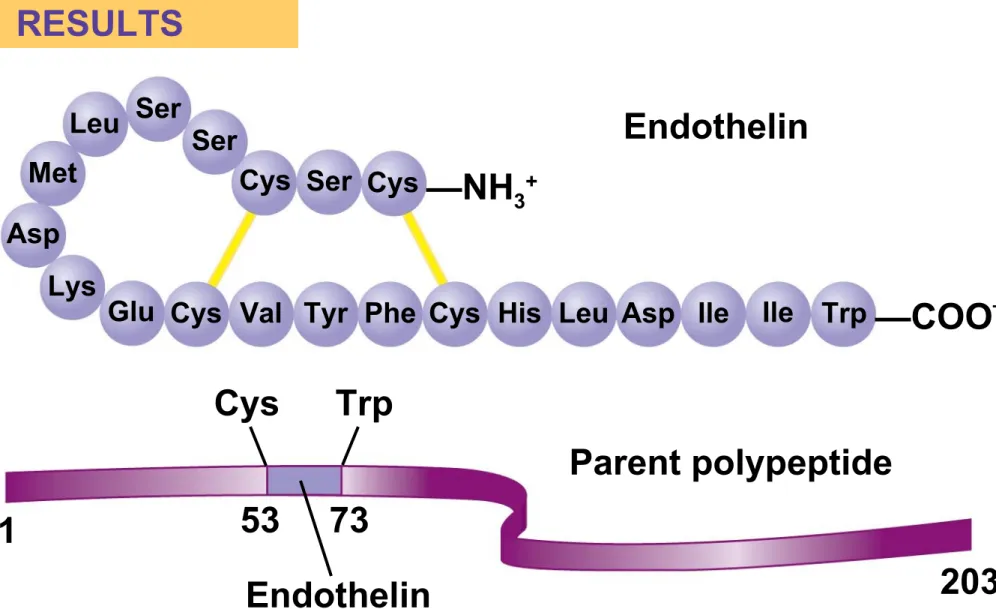
• The peptide endothelin is an important inducer
Fig. 42-12
Ser
RESULTS
Ser
Ser Cys
Cys —NH
3+
Leu Met
Asp Lys
Glu Cys Val Tyr Phe Cys His Leu Asp Ile Ile Trp —COO–
Endothelin
Parent polypeptide Trp
Cys
Copyright © 2008 Pearson Education, Inc., publishing as Pearson Benjamin Cummings
Blood Pressure and Gravity
• Blood pressure is generally measured for an artery in the arm at the same height as the heart
• Blood pressure for a healthy 20 year old at rest
Fig. 42-13-3
Pressure in cuff greater than 120 mm Hg
Rubber cuff inflated with air Artery 120 120
Pressure in cuff drops below 120 mm Hg
Sounds
Pressure in cuff below 70 mm Hg
70 Blood pressure reading: 120/70
Copyright © 2008 Pearson Education, Inc., publishing as Pearson Benjamin Cummings
• Fainting is caused by inadequate blood flow to the head
• Animals with longer necks require a higher systolic pressure to pump blood a greater distance against gravity
• Blood is moved through veins by smooth muscle contraction, skeletal muscle
contraction, and expansion of the vena cava with inhalation
Fig. 42-14
Direction of blood flow
in vein (toward heart) Valve (open)
Skeletal muscle
Copyright © 2008 Pearson Education, Inc., publishing as Pearson Benjamin Cummings
Capillary Function
• Capillaries in major organs are usually filled to capacity
• Two mechanisms regulate distribution of blood in capillary beds:
– Contraction of the smooth muscle layer in the
wall of an arteriole constricts the vessel
Fig. 42-15
Precapillary sphincters Thoroughfare channel
Arteriole
Capillaries
Venule
(a) Sphincters relaxed
(b) Sphincters contracted
• The critical exchange of substances between the blood and interstitial fluid takes place
across the thin endothelial walls of the capillaries
• The difference between blood pressure and
Fig. 42-16 Body tissue Capillary INTERSTITIAL FLUID Net fluid movement out Direction of blood flow Net fluid movement in Blood pressure Inward flow Outward flow Osmotic pressure
Arterial end of capillary Venous end
Fluid Return by the Lymphatic System
• The lymphatic system returns fluid that leaks out in the capillary beds
• This system aids in body defense
• Fluid, called lymph, reenters the circulation directly at the venous end of the capillary bed and indirectly through the lymphatic system
Copyright © 2008 Pearson Education, Inc., publishing as Pearson Benjamin Cummings
• Lymph nodes are organs that filter lymph and play an important role in the body’s defense
• Edema is swelling caused by disruptions in the
Concept 42.4: Blood components function in exchange, transport, and defense
• In invertebrates with open circulation, blood (hemolymph) is not different from interstitial fluid
Copyright © 2008 Pearson Education, Inc., publishing as Pearson Benjamin Cummings
Blood Composition and Function
• Blood consists of several kinds of cells
suspended in a liquid matrix called plasma
• The cellular elements occupy about 45% of the
Fig. 42-17
Plasma 55%
Constituent Major functions Water Solvent for
carrying other substances
Ions (blood electrolytes)
Osmotic balance, pH buffering, and regulation of membrane permeability Sodium Potassium Calcium Magnesium Chloride Bicarbonate Osmotic balance pH buffering Clotting Defense Plasma proteins Albumin Fibrinogen Immunoglobulins (antibodies) Separated blood elements
Cellular elements 45%
Cell type Number Functions per µL (mm3) of blood
Erythrocytes
(red blood cells) 5–6 million
Transport oxygen and help transport carbon dioxide
Leukocytes
(white blood cells) 5,000–10,000
Copyright © 2008 Pearson Education, Inc., publishing as Pearson Benjamin Cummings
Plasma
• Blood plasma is about 90% water
• Among its solutes are inorganic salts in the
form of dissolved ions, sometimes called electrolytes
• Another important class of solutes is the
plasma proteins, which influence blood pH, osmotic pressure, and viscosity
Cellular Elements
• Suspended in blood plasma are two types of
cells:
– Red blood cells (erythrocytes) transport oxygen
– White blood cells (leukocytes) function in defense
• Platelets, a third cellular element, are
Copyright © 2008 Pearson Education, Inc., publishing as Pearson Benjamin Cummings
• Red blood cells, or erythrocytes, are by far the
most numerous blood cells
• They transport oxygen throughout the body
• They contain hemoglobin, the iron-containing
protein that transports oxygen
Leukocytes
• There are five major types of white blood cells,
or leukocytes: monocytes, neutrophils, basophils, eosinophils, and lymphocytes
• They function in defense by phagocytizing
bacteria and debris or by producing antibodies
Copyright © 2008 Pearson Education, Inc., publishing as Pearson Benjamin Cummings
Platelets
Blood Clotting
• When the endothelium of a blood vessel is damaged, the clotting mechanism begins
• A cascade of complex reactions converts
fibrinogen to fibrin, forming a clot
Fig. 42-18-2
Collagen fibers
Platelet plug Platelet releases chemicals
that make nearby platelets sticky
Clotting factors from:
Platelets Damaged cells
Collagen fibers
Platelet plug Platelet releases chemicals
that make nearby platelets sticky
Clotting factors from:
Platelets Damaged cells
Plasma (factors include calcium, vitamin K)
Prothrombin Thrombin
Fibrin clot
Red blood cell
Copyright © 2008 Pearson Education, Inc., publishing as Pearson Benjamin Cummings
Stem Cells and the Replacement of Cellular Elements
• The cellular elements of blood wear out and are replaced constantly throughout a person’s life
• Erythrocytes, leukocytes, and platelets all
develop from a common source of stem cells
in the red marrow of bones
Fig. 42-19
Stem cells
(in bone marrow)
Myeloid stem cells Lymphoid
stem cells
Lymphocytes
B cells T cells
Erythrocytes
Platelets
Copyright © 2008 Pearson Education, Inc., publishing as Pearson Benjamin Cummings
Cardiovascular Disease
• Cardiovascular diseases are disorders of the heart and the blood vessels
• They account for more than half the deaths in
Atherosclerosis
• One type of cardiovascular disease,
Fig. 42-20
Connective tissue
Smooth
muscle Endothelium Plaque
Heart Attacks and Stroke
• A heart attack is the death of cardiac muscle tissue resulting from blockage of one or more coronary arteries
• A stroke is the death of nervous tissue in the brain, usually resulting from rupture or
Copyright © 2008 Pearson Education, Inc., publishing as Pearson Benjamin Cummings
Treatment and Diagnosis of Cardiovascular Disease
• Cholesterol is a major contributor to atherosclerosis
• Low-density lipoproteins (LDLs) are
associated with plaque formation; these are “bad cholesterol”
• High-density lipoproteins (HDLs) reduce the deposition of cholesterol; these are “good
cholesterol”
• The proportion of LDL relative to HDL can be decreased by exercise, not smoking, and
• Hypertension, or high blood pressure,
promotes atherosclerosis and increases the risk of heart attack and stroke
Copyright © 2008 Pearson Education, Inc., publishing as Pearson Benjamin Cummings
Concept 42.5: Gas exchange occurs across specialized respiratory surfaces
Partial Pressure Gradients in Gas Exchange
• Gases diffuse down pressure gradients in the lungs and other organs as a result of
differences in partial pressure
• Partial pressure is the pressure exerted by a
Copyright © 2008 Pearson Education, Inc., publishing as Pearson Benjamin Cummings
• A gas diffuses from a region of higher partial pressure to a region of lower partial pressure
• In the lungs and tissues, O2 and CO2 diffuse
Respiratory Media
• Animals can use air or water as a source of O2, or respiratory medium
• In a given volume, there is less O2 available in water than in air
Copyright © 2008 Pearson Education, Inc., publishing as Pearson Benjamin Cummings
Respiratory Surfaces
• Animals require large, moist respiratory
surfaces for exchange of gases between their cells and the respiratory medium, either air or water
• Gas exchange across respiratory surfaces takes place by diffusion
Gills in Aquatic Animals
Fig. 42-21
Parapodium (functions as gill) (a) Marine worm
Gills
(b) Crayfish (c) Sea star
Tube foot
Coelom
• Ventilation moves the respiratory medium over the respiratory surface
• Aquatic animals move through water or move
water over their gills for ventilation
• Fish gills use a countercurrent exchange
system, where blood flows in the opposite
Fig. 42-22
Anatomy of gills
Gill arch
Water
flow Operculum
Gill
arch Gill filamentorganization Blood vessels Oxygen-poor blood Oxygen-rich blood Fluid flow through gill filament Lamella
Blood flow through capillaries in lamella Water flow
between lamellae
Countercurrent exchange PO2 (mm Hg) in water
PO2 (mm Hg) in blood Net
diffu-sion of O2
from water to blood
150 120 90 60 30
110 80 20
Gill filaments
Tracheal Systems in Insects
• The tracheal system of insects consists of tiny branching tubes that penetrate the body
• The tracheal tubes supply O2 directly to body cells
• The respiratory and circulatory systems are separate
Fig. 42-23
Air sacs
Tracheae
External opening
Body cell
Air sac Tracheole
Tracheoles Mitochondria Muscle fiber
2.5 µm Body wall
Trachea
Lungs
• Lungs are an infolding of the body surface
• The circulatory system (open or closed)
transports gases between the lungs and the rest of the body
• The size and complexity of lungs correlate with
Copyright © 2008 Pearson Education, Inc., publishing as Pearson Benjamin Cummings
Mammalian Respiratory Systems: A Closer Look
• A system of branching ducts conveys air to the lungs
• Air inhaled through the nostrils passes through the pharynx via the larynx, trachea, bronchi,
bronchioles, and alveoli, where gas exchange occurs
• Exhaled air passes over the vocal cords to create sounds
Copyright © 2008 Pearson Education, Inc., publishing as Pearson Benjamin Cummings
Concept 42.6: Breathing ventilates the lungs
• The process that ventilates the lungs is
How an Amphibian Breathes
• An amphibian such as a frog ventilates its
Copyright © 2008 Pearson Education, Inc., publishing as Pearson Benjamin Cummings
How a Mammal Breathes
• Mammals ventilate their lungs by negative
pressure breathing, which pulls air into the lungs
• Lung volume increases as the rib muscles and
diaphragm contract
• The maximum tidal volume is the vital capacity
• After exhalation, a residual volume of air
Fig. 42-25 Lung Diaphragm Air inhaled Rib cage expands as rib muscles contract
How a Bird Breathes
• Birds have eight or nine air sacs that function as bellows that keep air flowing through the lungs
• Air passes through the lungs in one direction only
Fig. 42-26
Anterior air sacs
Posterior
air sacs Lungs
Air
Lungs
Air
1 mm Trachea
Air tubes
(parabronchi) in lung
EXHALATION
Air sacs empty; lungs fill
Control of Breathing in Humans
• In humans, the main breathing control
centers are in two regions of the brain, the medulla oblongata and the pons
• The medulla regulates the rate and depth of breathing in response to pH changes in the cerebrospinal fluid
Copyright © 2008 Pearson Education, Inc., publishing as Pearson Benjamin Cummings
• Sensors in the aorta and carotid arteries
monitor O2 and CO2 concentrations in the blood
Fig. 42-27
Breathing control centers
Cerebrospinal fluid
Pons
Medulla oblongata
Carotid arteries
Copyright © 2008 Pearson Education, Inc., publishing as Pearson Benjamin Cummings
Concept 42.7: Adaptations for gas exchange include pigments that bind and transport gases
• The metabolic demands of many organisms
Coordination of Circulation and Gas Exchange
• Blood arriving in the lungs has a low partial
pressure of O2 and a high partial pressure of CO2 relative to air in the alveoli
• In the alveoli, O2 diffuses into the blood and CO2 diffuses into the air
• In tissue capillaries, partial pressure gradients
Fig. 42-28
Alveolus
PO2 = 100 mm Hg
PO2 = 40 PO2 = 100
PO2 = 100 PO2 = 40
Circulatory system
Body tissue
PO2 ≤ 40 mm Hg PCO2 ≥ 46 mm Hg
Body tissue PCO2 = 46 PCO2 = 40
PCO2 = 40 PCO2 = 46
Circulatory system
PCO2 = 40 mm Hg Alveolus
Respiratory Pigments
• Respiratory pigments, proteins that transport oxygen, greatly increase the amount of oxygen that blood can carry
• Arthropods and many molluscs have
hemocyanin with copper as the oxygen-binding component
Copyright © 2008 Pearson Education, Inc., publishing as Pearson Benjamin Cummings
Hemoglobin
• A single hemoglobin molecule can carry four
molecules of O2
• The hemoglobin dissociation curve shows that
a small change in the partial pressure of
oxygen can result in a large change in delivery of O2
• CO2 produced during cellular respiration lowers blood pH and decreases the affinity of
Fig. 42-UN1
Chains
Fig. 42-29
O2 unloaded
to tissues at rest
O2 unloaded to tissues during exercise 100 40 0 20 60 80
0 40 80 100
O2 s at u ra ti o n o f h em o g lo b in ( % ) 20 60 Tissues during exercise Tissues at rest Lungs
PO2 (mm Hg)
(a) PO2 and hemoglobin dissociation at pH 7.4
O2 s at u ra ti o n o f h em o g lo b in ( % ) 40 0 20 60 80
0 20 40 60 80 100 100
PO2 (mm Hg)
(b) pH and hemoglobin dissociation pH 7.4
pH 7.2
Hemoglobin retains less O2 at lower pH
(higher CO2
Carbon Dioxide Transport
• Hemoglobin also helps transport CO2 and assists in buffering
• CO2 from respiring cells diffuses into the blood and is transported either in blood plasma,
bound to hemoglobin, or as bicarbonate ions (HCO3–)
Animation: O
Animation: O22 from Blood to Tissues from Blood to Tissues
Animation: CO
Fig. 42-30
Body tissue CO2 produced
CO2 transport
from tissues Capillary wall Interstitial fluid Plasma within capillary CO2 CO2 CO2 Red blood cell
H2O
H2CO3 Hb
Carbonic acid
Hemoglobin picks up CO2 and H+
CO2 transport
to lungs HCO3–
Bicarbonate H
+
+
Hemoglobin releases CO2 and H+
To lungs HCO3–
HCO3–
Hb H+
+ HCO3–
H2CO3
H2O
CO2
CO2
CO2
CO2
Elite Animal Athletes
• Migratory and diving mammals have
Copyright © 2008 Pearson Education, Inc., publishing as Pearson Benjamin Cummings
The Ultimate Endurance Runner
Copyright © 2008 Pearson Education, Inc., publishing as Pearson Benjamin Cummings
Diving Mammals
• Deep-diving air breathers stockpile O2 and deplete it slowly
You should now be able to:
1. Compare and contrast open and closed circulatory systems
2. Compare and contrast the circulatory systems of fish, amphibians, non-bird reptiles, and
mammals or birds
3. Distinguish between pulmonary and systemic circuits and explain the function of each
Copyright © 2008 Pearson Education, Inc., publishing as Pearson Benjamin Cummings
5. Define cardiac cycle and explain the role of the sinoatrial node
6. Relate the structures of capillaries, arteries, and veins to their function
7. Define blood pressure and cardiac output and describe two factors that influence each
9. Describe the role played by the lymphatic system in relation to the circulatory system
10. Describe the function of erythrocytes, leukocytes, platelets, fibrin
11. Distinguish between a heart attack and stroke
Copyright © 2008 Pearson Education, Inc., publishing as Pearson Benjamin Cummings
13. For humans, describe the exchange of gases in the lungs and in tissues