1
Problem Solving Ability Assessment Based
on Design for Secondary School Students
Krislada Chusinkunawuta, Kulthida Nugulthama, Tussatrin Wannagatesiria, and Witat Fakcharoenphola
Corresponding author: Krislada Chusinkunawut ([email protected])
aDepartment of Teacher Education, Kasetsart University, Kamphaeng Saen Campus, Nakhon Pathom 73140, Thailand
Keywords: problem solving ability, design, assessment, rubric score
International Journal of Innovation in Science and Mathematics Education, 26(3), 1–20, 2018
Abstract
This study aimed to develop and implement the Problem Solving Ability (PSA) test and PSA rubric score based on design. The PSA test and PSA rubric score were developed to assess students’ ability in identifying and defining a problem, creating a design solution by applying science to a problem, and giving reasoning to support the design solution. The PSA test consisted of ‘two-stepped’ open-ended questions on four daily-energy-problem situations. It was implemented in a science classroom of 41 tenth-grade students at a large public secondary school of a small town in Western Thailand. The students’ responses were analysed based on the patterns of design solutions and reasoning to support the design solutions using the PSA rubric score. The validity of open-encoding was 82.86%. The PSA test expressed students’ problem solving in three core abilities through the integration between drawing and writing reasons supporting a design sketch. The results demonstrated more clearly the students’ problem solving ability and application of scientific knowledge and understanding that were implicitly embedded in the procedures, products, and reasoning they used in solving the problems. The PSA rubric score also supported the judgment of the PSA to have more reliable scoring of PSA assessment.
Introduction
Problem solving ability has played a critical role in human history (Chi & Glaser, 1985; Ohlsson, 2012). Problem solving involves people’s efforts to find a solution to a problem using analytical thinking, critical thinking, creativity, reasoning, and experiences along with available information (Chi & Glaser, 1985; Schunk, 2004; Reeve, 2013). Since childhood, we actively solve problems presented by the world. We acquire information about people, objects, events, or phenomena and organise the information into the structure of knowledge that is stored in our memory. The structure of knowledge contains bodies of understanding, mental models, convictions and beliefs, and influences how we relate our experiences together and how we solve problems that we encounter in everyday life at school, work, even at play (Resnick & Glaser, 1975; Chi & Glaser, 1985).
2
the classroom demonstrates an adequate description of a student’s problem solving ability and understanding of scientific conceptions (Docktor & Heller, 2009; Schoenfeld, 1985).
Background research on problem solving assessment
Over 40 years, educational researchers have developed many useful instruments for assessment, even though, the published assessments have been little focused on the students’ problem solving skills (Adams & Wieman, 2016). However, researchers have been endeavouring to develop many instruments through representing a range of conceptual evaluations based on the key steps of problem solving. For instance, Heppner and Peterson (1978) focused on the assessment of problem solving skills using a Likert-type instrument. The instrument is developed based on the five main steps of problem solving that comprise general orientation, problem definition, generation of alternatives, decision-making, and evaluation. Docktor and Heller (2009) developed a rubric to assess the procedures of problem solving and reasons through writing. The emphasis of the rubric is on organising problem information into a useful description, selecting an appropriate principle, applying knowledge to specific conditions in the problem, using appropriate procedures (especially mathematics), and overall communication of an organised reasoning pattern. Chang (2010) developed a problem solving ability test (PSAT) using open-ended essay-questions based on the creative problem solving model of Osborn (as cited in Chang, 2010, p. 106). The PSAT determines the level of students’ problem solving in different stages: fact-finding, problem-finding, idea-finding, and solution-finding. The students are required to form their own problem solving strategies using information in the question and reach a solution from the given multi solutions to solve a problem. In Thailand, assessment approaches and formats are introduced in many conceptual evaluations. For instance, Kruatong (2011) developed a diagnostic instrument to evaluate students’ problem solving using a questionnaire. She focused on the levels of students’ abilities in solving problems including understanding a problem, identifying appropriate information and conceptions, sequencing of solving problem, constructing a solution, and evaluating the answer. Similarly, Purnakanishtha, Suwannatthachote, and Nilsook (2014) developed a problem solving skills test using multiple pre-set questions, tasks and situations. The test evaluates the performances of students’ problem solving that comprise identifying a problem, identifying and analysing the cause of the problem, proposing a problem solving method, and examining the problem solving result.
Based on the review of existing instruments, it is clear that the instruments are developed on a variety of problem solving processes and measurements. However, we summarise the core principles of an assessment model for the development of PSA assessment. The core principles are as follows:
1) The use of a situation to provide a problem, a task, and information in a question; 2) The problem must have multi solutions from which students can select appropriate
principles and apply knowledge to create their solutions; and 3) The assessment must emphasise the key steps of problem solving.
3
assessment which can classify the solutions and reasoning supporting the solutions within problem solving using a rubric score.
To support students in developing proficiency, at the beginning, the teacher needs to know what students can achieve and how to assess during and after learning has occurred. However, possible methods to assess problem solving require knowing both the procedures and the products demonstrated by students which reflect not only how they apply scientific conceptions to solve real-world problems, but also their scientific explanation, with sound reasoning, for the solution. Hence, this article is focused on creating specific open-ended problems that allow students to propose their own ways of solving problems through designing some kind of intervention and explaining in their own words how their design would work, and on developing a criteria of assessment to classify students’ solutions and reasoning supporting their solutions.
Focus on design
Design widely refers to any kind of human activities. The goal of design is either synthesizing a product that can solve an open-ended and ill-structured problem or specifying plans from which a product can be realised (Simon, 1996; Fortus, Krajcik, Dershimer, Marx, & Mamlok, 2004). We review relevant studies focused on instruction in engineering design as well as studies of design in the context of science education. We found that there are many reasons supporting design as a methodology for learning science. First, design has the rich real-world context of an authentic hands-on task that can deal with science-related real-world problems (Crismond, 2001; Fortus et al., 2004, 2005). Second, design is a practical real-world problem solving experience (ITEA, 2007). The design process includes six basic stages: defining the problem and identifying the need; collecting information; introducing alternative solutions; choosing the optimal solution; designing and constructing a prototype; and evaluating the result, that accord with the key steps of problem solving models (Doppelt, Mehalik, Schunn, Silk, & Krysinski., 2008; Sternberg, 2009; Shahat, Ohle, Treagust, & Fischer, 2013; Yu et al., 2014).
Third, design is a form of cognitive modeling that can crystallize a conceptual model into a physical embodiment (Sadler, Coyle, & Schwartz, 2000; Fortus et al., 2005). Design provides opportunities for externalizing ideas in the mind to concrete representations (physically visible outside the mind of a creator) (Silk, Schunn, & Cary, 2009; Roth, 2001; Stensel, 2013). So, using design in the science classroom can provide opportunities for students to clearly communicate their design ideas. Another reason supporting the use of design, is that it may have distinctive benefits for engaging students in scientific reasoning. When students are active problem solvers in a design context, they are accountable to justify alternative design solutions using prior science knowledge as a background resource for informing decisions and developing scientific explanations with sound reasoning (Silk et al., 2009). Design has the advantage of encouraging scientific reasoning to help students transition from their design ideas to reasoning scientifically. Thus, based on all of the reasons reviewed above, it is clear that design can deal with science-related real-world problems, compel students to propose ways to solve the problems through drawing, represent reasons, and demonstrate the core abilities of problem solving. Design therefore, has strong potential for supporting the PSA assessment.
Purpose of study
4
instruments to test on tenth-grade students at a secondary school in Western Thailand in the first semester of the 2016 academic year.
Methodology
The development of instruments based on design for PSA assessment
The development of the PSA test and PSA rubric score based on designcomprised two phases.
Phase I: The development of the PSA test The construction of the PSA test involved:
1) stating the purpose; this test was used for examining students’ problem solving ability; 2) defining content from the chemistry and physics textbooks of the Institute for
Promotion of Teaching Science and Technology (IPST) including materials from other countries (typically USA and Australia) aligned with the Thai National Science Curriculum in the Basic Education Core Curriculum B.E. 2551 (A.D. 2008) and objectives;
3) generating design contexts and questions in the Thai language;
4) verifying on correlation, correction, and validation by three science educator experts: two in physics and one in chemistry; and,
5) implementation with 41 tenth-grade secondary school students.
The design contexts were then improved by adjusting for the necessary changes. The PSA test included four open-ended questions as a two-stepped idea expression (the integration between drawing and writing reasons supporting a design sketch) that was not the standardized national test. Three questions focused on creating a design solution and giving reasons supporting the design solution related to science concepts. Another question focused on justifying alternative design solutions and giving explanation with sound reasoning scientifically. The test needed to be completed within 60 minutes. The objectives, design contexts, and questions are shown in Table 1.
Table 1: Four open-ended questions of the PSA test
Items Objectives Design contexts and questions
1 (1) Identify and define problem (2) Apply the concepts of electrical
quantity and circuits to solve a problem (3) Give reasoning supporting the drawing
solution related to electrical quantity and circuits
An information board needs nine light bulbs glowing. You have resources: nine 1.5-2.5 V light bulbs and four dry cells. A dry cell has a voltage of 1.5 V. If you need the nine light bulbs on for the signboard to shine most brightly, how would you create an electric system using these resources?
2 (1) Identify and define problem
(2) Apply the concepts of series-parallel connected cells and electrochemical cell and reaction to solve a problem
(3) Give reasoning supporting the drawing solution related to series parallel connected cells and parallel electrochemical cell and reaction
5 3 (1) Identify and define problem
(2) Apply the concepts of electromagnetic induction and simple machines to solve problem
(3) Give reasoning supporting the drawing solution related to electromagnetic induction and simple machines
You have a copper wire and six bar/rod magnets. A single bar magnet has dipole; North and South. The North Pole of the magnet will be opposite of the South Pole. In school Scout camp, a student needs equipment that generates electric energy or do work efficiently. If you can help the student to meet the need, how would you create the equipment using the copper wire and six bar/rod magnets?
4 (1) Identify and define problem
(2) Apply the concepts of electrical quantity, circuits, series-parallel connected cells, electrochemical cell, energy transform, visible light absorption, heat transfer,
electromagnetic induction, the basic working of a DC generator, and/or simple machines to solve a problem (3) Give reasoning supporting the drawing
solution related to electrical quantity, circuits, series-parallel connected cells, electrochemical cell, energy transform, heat transfer, visible light absorption, electromagnetic induction, the basic working of a DC generator, and/or simple machines
A farmer has a lot of products (rice and chili) and has kept the products for a long time in an agriculture warehouse that is far from the power supply system. The products become humid and are moldy. The products are dried all the time if the agriculture warehouse keeps warm at 50-60 oC. If you can help the farmer solve this problem, how would you create equipment and a system without using electricity on grid?
Phase II: The development of PSA rubric score
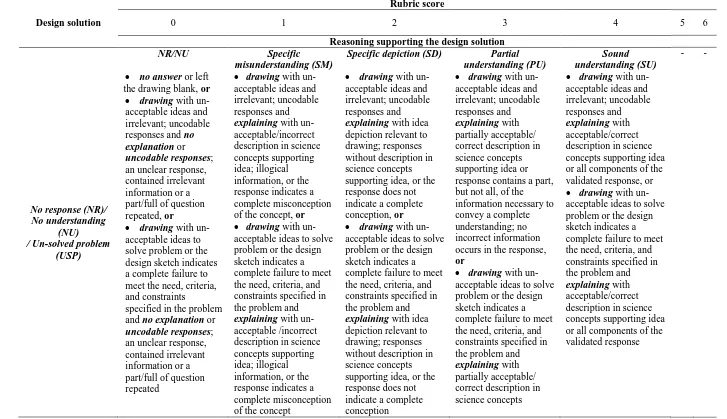
6 Table 2: PSA rubric score
Design solution
Rubric score
0 1 2 3 4 5 6
Reasoning supporting the design solution
No response (NR)/ No understanding
(NU) / Un-solved problem
(USP)
NR/NU
no answer or left the drawing blank, or
drawing with un-acceptable ideas and irrelevant; uncodable responses and no explanation or
uncodable responses; an unclear response, contained irrelevant information or a part/full of question repeated, or
drawing with un- acceptable ideas to solve problem or the design sketch indicates a complete failure to meet the need, criteria, and constraints
specified in the problem and no explanation or
uncodable responses; an unclear response, contained irrelevant information or a part/full of question repeated
Specific misunderstanding (SM)
drawing with un- acceptable ideas and irrelevant; uncodable responses and
explaining with un-acceptable/incorrect description in science concepts supporting idea; illogical information, or the response indicates a complete misconception of the concept, or drawing with un- acceptable ideas to solve problem or the design sketch indicates a complete failure to meet the need, criteria, and constraints specified in the problem and
explaining with un-acceptable /incorrect description in science concepts supporting idea; illogical information, or the response indicates a complete misconception of the concept
Specific depiction (SD)
drawing with un- acceptable ideas and irrelevant; uncodable responses and
explaining with idea depiction relevant to drawing; responses without description in science concepts supporting idea,or the response does not indicate a complete conception, or drawing with un- acceptable ideas to solve problem or the design sketch indicates a complete failure to meet the need, criteria, and constraints specified in the problem and
explaining with idea depiction relevant to drawing; responses without description in science concepts supporting idea,or the response does not indicate a complete conception
Partial understanding (PU)
drawing with un- acceptable ideas and irrelevant; uncodable responses and
explaining with partially acceptable/ correct description in science concepts supporting ideaor response contains a part, but not all, of the information necessary to convey a complete understanding; no incorrect information occurs in the response, or
drawing with un- acceptable ideas to solve problem or the design sketch indicates a complete failure to meet the need, criteria, and constraints specified in the problem and
explaining with partially acceptable/ correct description in science concepts
Sound understanding (SU)
drawing with un- acceptable ideas and irrelevant; uncodable responses and
explaining with acceptable/correct description in science concepts supporting idea or all components of the validated response, or drawing with un- acceptable ideas to solve problem or the design sketch indicates a complete failure to meet the need, criteria, and constraints specified in the problem and
explaining with acceptable/correct description in science concepts supporting idea or all components of the validated response
7 Design solution
Rubric score
0 1 2 3 4 5 6
Reasoning supporting the design solution supporting ideaor
response contains a part, but not all, of the information necessary to convey a complete understanding; no incorrect information occurs in the response
Partial solved problem (PSP)
- NR/NU
drawing with partially acceptable ideas to solve problemor the design sketch contains a part, but not all, of the information necessary to convey a complete
accomplishment; can achieve a part of the need, criteria, and/or constraints specified in the problem and no explanation or
uncodable responses; an unclear response, contained irrelevant information or a part/full of question repeated
Specific misunderstanding (SM)
drawing with partially acceptable ideas to solve problemor the design sketch contains a part, but not all, of the information necessary to convey a complete accomplishment; can achieve a part ofthe need, criteria, and/or constraints specified in the problem and
explaining with un-acceptable/incorrect description in science concepts supporting idea; illogical information, or the response indicates a complete misconception of the concept
Specific depiction (SD)
drawing with
partially acceptable ideas to solve problemor the design sketch contains a part, but not all, of the information necessary to convey a complete accomplishment; can achieve a part ofthe need, criteria, and/or constraints specified in the problem and
explaining with idea depiction relevant to drawing; responses without description in science concepts supporting idea,or the response does not indicate a complete conception
Partial understanding (PU)
drawing with partially acceptable ideas to solve problemor the design sketch contains a part, but not all, of the information necessary to convey a complete accomplishment;can achieve a part ofthe need, criteria, and/or constraints specified in the problem and explaining with partially acceptable/ correct description in science concepts supporting ideaor response contains a part, but not all, of the information necessary to convey a complete understanding; no incorrect information occurs in the response
Sound understanding (SU)
drawing with partially acceptable ideas to solve problem or the design sketch contains a part, but not all, of the information necessary to convey a complete
accomplishment;can achieve a part ofthe need, criteria, and/or constraints specified in the problem and
explaining with acceptable/correct description in science concepts supporting idea or all components of the validated response
8 Design solution
Rubric score
0 1 2 3 4 5 6
Reasoning supporting the design solution
Solved problem (SP)
- - NR/NU
drawing with acceptable ideas to solve problem or the design sketch indicates a complete
accomplishment and achieves the need, criteria, and
constraints specified in the problem and no explanation or
uncodable responses; an unclear response, contained irrelevant information or a part/full of question repeated
Specific misunderstanding (SM)
drawing with acceptable ideas to solve problem or the design sketch indicates a complete
accomplishment and achieves the need, criteria, and constraints specified in the problem and explaining with un- acceptable /incorrect description in science concepts supporting idea; illogical information, or the response indicates a complete misconception of the concept
Specific depiction (SD)
drawing with acceptable ideas to solve problem or the design sketch indicates a complete
accomplishment and achieves the need, criteria, and constraints specified in the problem and explaining with idea depiction relevant to drawing; responses without description in science concepts supporting idea,or the response does not indicate a complete conception
Partial understanding (PU)
drawing with acceptable ideas to solve problem or the design sketch indicates a complete
accomplishment and achieves the need, criteria, and constraints specified in the problem and explaining with partially acceptable/ correct description in science concepts supporting ideaor response contains part, but not all, of the information necessary to convey a complete understanding; no incorrect information occurs in the response
Sound understanding (SU)
drawing with acceptable ideas to solve problem or the design sketch indicates a complete
9
Table 3: Answer keys of specific design solution of the PSA rubric score for item 1-4
Items Design solution
Un-solved problem (USP) Partial solved problem (PSP) Solved problem (SP)
1 Drawing an opened circuit, a shot circuit, or an undefined circuit
Drawing an closed circuit, but it can solve the given problem partly
Drawing an closed circuit, and completely solve the given problem
2 Selecting “design 2 is higher efficient than design 1” as a result of consideration design 1 has not current or selecting “design 1 is higher efficient than design 2” as a result of
consideration design 2 has not current
Selecting “design 2 is higher efficient than design 1” as a result of consideration design 2 has two cells
Selecting “design 1 is the same efficiency as design 2” as a result of consideration the factors affecting rates of chemical reactions (the concentration and nature of the reactants and surface area of electrodes) of design 1 resemble the factors of design 2. The factors have affected the current and voltage of cells. The current and voltage of design 1 are equal to the current and voltage of design 2 or selecting “design 2 is higher efficient than design 1” as a result of consideration design 1 is a cell and may have lower concentration of reactants than design 2. Design 2 is two parallel connected cells that has affected its current. The design 2 has higher current than design 1, but design 2 is the same voltage as design 1.
3 Drawing the North Pole of a magnet is on the opposite side of the North Pole of another magnet/ the South Pole of a magnet is on the opposite side of the South Pole of another magnet, the North Pole of a magnet and the North Pole of another magnet adhere to together/ the South Pole of a magnet and the South Pole of another magnet adhere to together, all of the magnetic field are parallel to a coil of copper wire, or have not a main element such as a magnet or a coil of copper wire.
Drawing an equipment dose not annotate the magnetic poles, but it may be occurred any change in the magnetic environment of a coil of wire that causes a voltage (emf) to be induced in the coil if the magnetic poles are identified correctly.
Drawing the North Pole of a magnet is on the opposite side of the South Pole of another magnet. The equipment can occur the phenomenon of inducing a current through changing the magnetic field in a coil of copper wire, for instance, moving the magnet toward or away from the coil, moving the coil into or out of the magnetic field, and rotating the coil relative to the magnet.
4 Drawing an equipment and a system have not important components, function, or features, and do not work and solve the given problem.
Drawing an equipment and a system have not some components, but they can do work and solve the given problem partly.
10
The implementation of instruments based on design for PSA assessment
To test students’ problem solving ability, the PSA test was implemented in a science classroom of tenth-grade students at a large public secondary school of a small town in Western Thailand in the first semester of the 2016 academic year. Forty one students including 27 females (65.85%) and 14 males (34.15%) were selected through purposive sampling. They had overall achievements in a variety of subjects (science, mathematics, language, etc.) on a scale of GPA 0 – 4.00 in the second semester of the 2015 academic year from different lower secondary schools (GPA 3.51 – 4.00, n = 11, 26.83%; GPA 3.00 – 3.50, n = 27, 65.85%; and GPA 2.5 – 2.99, n = 3, 7.32%). 80% of the students were from the same school. The students had learned science concepts in the Thai language aligning with the Thai National Science Curriculum in the Basic Education Core Curriculum B.E. 2551 (A.D. 2008): heat transfer, visible light absorption, chemical reaction, electricity, electrical quantity and circuits, basic electronic components, and energy transform. They acquired experiences in learning series-parallel connected cells, electrochemical cell, simple machine, and principle of dynamo from the learner development activities in the special programs of school. The Thai National Science Curriculum has been validated for the correct science concepts and provide goals, learning standards, essential science knowledge, skills, capacities, and desired characteristics to all educational service area offices and schools with an appropriate framework and guidance for preparing the pertinent science curriculum and instruction in basic level (Grades 1-12).
Students’ problem solving was analysed based on three core abilities: 1) identifying and defining a problem, 2) creating a design solution by applying science to a problem, and 3) giving reasoning supporting the design solution. First, the ability of students’ in identifying and defining a problem was assessed by checking a design solution according to a problem and a need provided in the design context and question. One point was given when the design solution was consistent with the problem and need. Thus, if the design solution was not consistent with the problem and need, or students did not respond, zero point was given for this ability. Other abilities were assessed by the PSA rubric score. The maximum attainable score was 28 points.
Students’ responses to the four ended questions were encoded by means of an open-encoding method in a qualitative dimension. In open-open-encoding, all of the students’ responses were examined by researchers. The validity of the open-encoding was verified by peer checking among three experts; two science educator experts (one in chemistry and one in physics) and one educator expert in technology education. The validity was 82.86%.
Results
Problem solving ability of secondary school students
11
Table 4: A number of students’ responses to item 1-4 (N=41 students)
Ability of problem solving A number of students’ responses (%)
Item 1 Item 2 Item 3 Item 4
1. Identifying and defining problem 36 (87.80) 36 (87.80) 40 (97.56) 38 (92.68) 2. Creating a design solution to a
problem
2.1 Solved problem (SP) 5 (12.20) 3 (7.32) 12 (29.27) 16 (39.02) 2.2 Partial solved problem (PSP) 16 (39.02) 0 20 (48.78) 7 (17.07) 2.3 Un-solved problem (USP) 20 (48.78) 38 (92.68) 9 (21.95) 18 (43.90)
2.4 No understanding (NU) 0 0 0 0
3. Giving reasoning supporting the design solution
3.1 Sound understanding (SU) 11 (26.83) 1 (2.44) 16 (39.02) 14 (34.15) 3.2 Partial understanding (PU) 11 (26.83) 13 (31.71) 5 (12.20) 15 (36.59) 3.3 Specific depiction (SD) 8 (19.51) 0 11 (26.83) 4 (9.76) 3.4 Specific misunderstanding (SM) 9 (21.95) 26 (63.41) 5 (12.20) 7 (17.07) 3.5 No understanding (NU)/
no response (NR)
2 (4.88) 1 (2.44) 4 (9.76) 1 (2.44)
4. No response (NR) 0 1 (2.44) 0 0
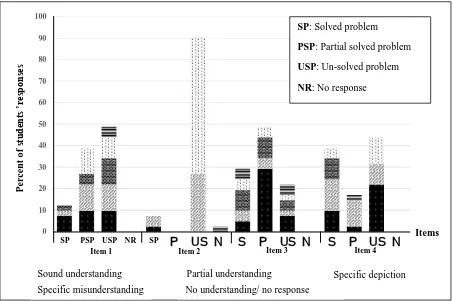
From an analysis of the design solutions and reasoning, the results showed that students’ scientific knowledge application and understanding were implicitly embedded in their procedures, products, and the reasoning they used in solving the four open-ended problems. These results also indicated that most of the students could not relate to scientific conceptions they had learned in the classroom to solve real-world problems (see in Figure 1).
Figure 1. The proportion of students’ design solution and reasoning supporting the design solution (N=41 students)
0 10 20 30 40 50 60 70 80 90 100
Sound understanding Partial understanding
Specific depiction Specific misunderstanding
SP PSP USP NR SP P US N S P US N S P US N
Item 1 Item 2 Item 3
P
er
ce
nt
o
f
st
ud
ent
s
’re
spo
ns
es
Item 4 SP: Solved problem PSP: Partial solved problem USP: Un-solved problem NR: No response
Sound understanding
Specific misunderstanding No understanding/ no response
Partial understanding Specific depiction
12 Assessing students’ problem solving ability for item 1
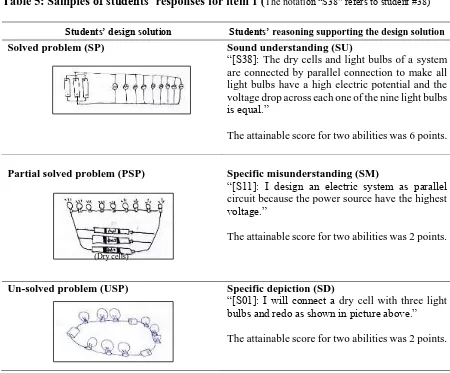
The first question could be solved using electrical quantity and circuits. For a design solution to a problem, 12.20% of students were able to apply electric circuits to create an electric system that made all bulbs shine most brightly with acceptable ideas. 39.02% of them created the system with partially acceptable ideas. For solving a problem related to circuits, the result revealed 48.78% of students drew solutions with unacceptable ideas, for instance, drawing a system as an opened circuit and an undefined circuit. In acceptable design solutions, 7.32% of students were able to explain how an electric system worked in terms of circuits and electrical quantities such as current and electric potential difference correctly. 2.44% of them responded with partial correct explanation and responded through depiction about idea according to the drawing. In partially acceptable design solutions, 9.76% of students were able to explain reasons related to the principle of circuits and electrical quantities correctly. 12.20% of them explained reasons with partial correct description and 4.88% of them depicted their ideas without these concepts. 12.20% of students’ reasoning related to circuit and electrical quantities were specific misunderstanding. In unacceptable design solutions, 9.76% of students were able to explain reasons with correct description. 12.20% of them responded with partial correct description and depiction relevant to their drawing. 9.76% of students gave reasons supporting the design solutions as specific misunderstanding in term of electrical quantities of a series circuit. Moreover, the result showed that 4.88% of students’ reasons could not be interpreted as what they were thinking about circuits. For samples of student reasons supporting the design solution see Table 5.
Table 5: Samples of students’ responses for item 1 (The notation “S38” refers to student #38) Students’ design solution Students’ reasoning supporting the design solution
Solved problem (SP) Sound understanding (SU)
“[S38]: The dry cells and light bulbs of a system are connected by parallel connection to make all light bulbs have a high electric potential and the voltage drop across each one of the nine light bulbs is equal.”
The attainable score for two abilities was 6 points.
Partial solved problem (PSP) Specific misunderstanding (SM)
“[S11]: I design an electric system as parallel circuit because the power source have the highest voltage.”
The attainable score for two abilities was 2 points.
Un-solved problem (USP) Specific depiction (SD)
“[S01]: I will connect a dry cell with three light bulbs and redo as shown in picture above.”
13 Assessing students’ problem solving ability for item 2
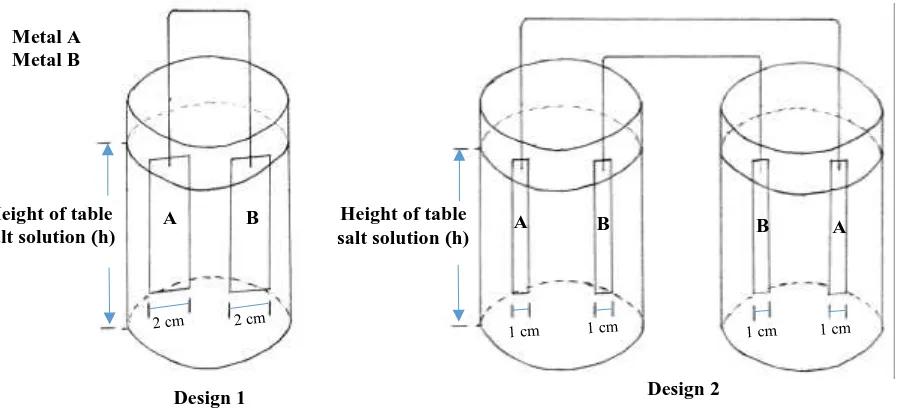
The second question could be solved using a chemical reaction, simple electrochemical cell, and series-parallel connected cells to justify design solution 1 or/and 2 and explain which had highest efficiency and why. 63.41% of students selected an optimal design solution and also explained how the selected design solution had the highest efficiency as specific misunderstanding. 26.83% of them selected the optimal design solution and gave reasons with partial correct description. However, the result showed that 2.44% of students were able to apply a chemical reaction, simple electrochemical cell, and series-parallel connected cells to justify the selected design solution with correct and acceptable ideas. She/he could describe factors affecting rates of electrochemical reaction (nature of the reactants, concentration, and surface area) and series-parallel connected cells that had affected the efficiency of design solution as sound understanding.
Figure 2. Design solutions for item 2
In accomplishing solving the problem, for example, students explained reasons with a completely correct explanation and a partially correct explanation. The attainable score for two abilities was 6 and 5 points as shown in sequence. Sample student explanations were:
I choose both design 1 and 2 (design 1 is the same efficiency as design 2) because both use the table salt solution as electrolyte and the metal A, B as electrodes (the nature of reactants has affected voltage). The cells of design 2 are connected by parallel connection. This power supply will contribute its maximum allowable current to the line. If design 1 is the same concentration of solution as design 2, both have not different efficiency (the concentration of solution has affected current). If design 1 has higher concentration of solution than design 2, design 1 will contribute more allowable current to the line than design 2. [S10]
Metal A Metal B
Height of table salt solution (h)
A B Height of table A B B A
salt solution (h)
14
Design 1 and 2 can cause chemical reaction which electrons can transfer from one metal to another and generate current. Design 2 may be higher efficient than design 1 because design 2 is two electrochemical cells which connect their metallic electrodes and design 1 is an electrochemical cell. Design 1 may have lower concentration than design 2. So that design 2 has the highest efficiency. [S25]
In un-solving the problem, for example, students explained with incorrect explanations that represented a misunderstanding of electrochemical cell. The attainable score for two abilities was 1 point. A sample student response was:
Design 1 has the highest efficiency because the metal A and B do chemical reaction with the table salt solution. Design 1 can generate current. In contrast to design 1, design 2 cannot generate current because it connects the metal A to A and B to B which electrons cannot transfer from the metal A to B. So, design 1 is higher efficient than design 2. [S31]
Assessing students’ problem solving ability for item 3
The third question could be solved using electromagnetic induction and simple machines. On a design solution to a problem, 29.27% of students were able to apply electromagnetic induction to create equipment that generated electrical energy with acceptable ideas. 48.78% of them drew the equipment with partially acceptable ideas. 21.95% of them drew it with unacceptable ideas, for instance, drawing internal equipment as the neutral point of a magnetic field (see in Table 6).
15 Table 6: Samples of students’ responses for item 3
Students’ design solution Students’ reasoning supporting the design solution Solved problem (SP) Sound understanding (SU)
“[S39]: I design an equipment using the principle of dynamo operation. In designing, I place four magnetic bars around a rectangular coil and move the coil through the magnetic field. We can measure a voltage difference two-ended points of the copper wire at the fulcrums. A current flows when the circuit closes.”
The attainable score for two abilities was 6 points. Partial solved problem (PSP) Sound understanding (SU)
“[S41]: The equipment will use a number of turns of a copper wire in a coil and places magnetic bars beneath the coil to increase the strength of magnetic field. If the coil is moved through stronger magnetic field, the induced current will be more produced.”
The attainable score for two abilities was 5 points.
Un-solved problem (USP) Sound understanding (SU)
“[S21]: I design an equipment using a number of turns of a copper wire around the six magnetic bars because a number of magnetic bars will increase stronger magnetic field that has an effect on the voltage and current.”
The attainable score for two abilities was 4 points.
Assessing students’ problem solving ability for item 4
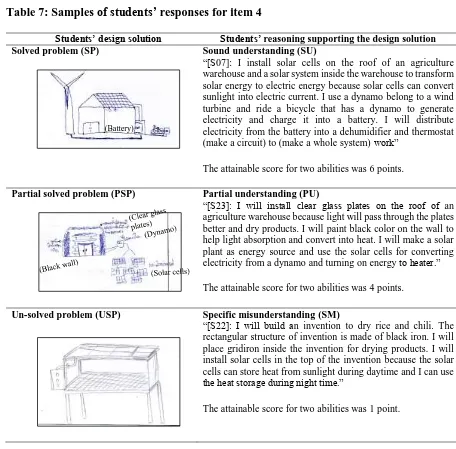
The last question could be solved using a wide range of science concepts including electrochemical cell, energy transform, heat transfer, visible light absorption, the basic working of a DC generator, and simple machines. On a design solution to a problem, 39.02% of students were able to apply energy transform, heat transfer, simple dynamo, and simple machine (gears and pulley) to create equipment and a system to keep an agriculture warehouse warm all the time and products dry without using electricity on grid with acceptable ideas. 14.63% of them drew the equipment and system with partially acceptable ideas. 43.9% of students drew their equipment and system with unacceptable ideas, for example, drawing the equipment and a system that did not have an important element that could help the system work completely and solve the problem (see in Table 7).
In acceptable design solutions, 9.76% of students could explain how equipment and a system worked in term of energy transform using dynamo and electrochemical cells including solar cells and wind turbines correctly. 14.63% of them explained reasons with partially correct descriptions and 9.76% of them described reasons through depiction relevant to their drawing. Furthermore, 4.88% of students gave reasons supporting ideas as specific misunderstanding in terms of energy transform. In partially acceptable design solutions, 12.2% of students explained reasons related to visible light absorption of materials, energy transform, and heat transfer and materials, especially thermal insulators, with a partially correct description. 2.44% of students could give reasons supporting his/her ideas related to transforming solar energy to electric energy correctly. In unacceptable design solutions, the results showed that 21.95% of students
N
S
(A rectangular coil)
(Magnet)
(Magnetic bars) (Magnet above a coil)
16
were able to describe reasons with completely correct explanations. 9.76% of them explained with partially correct descriptions. 12.2% of students gave responses as specific misunderstanding in terms of energy transform using solar cells.
Table 7: Samples of students’ responses for item 4
Students’ design solution Students’ reasoning supporting the design solution Solved problem (SP) Sound understanding (SU)
“[S07]: I install solar cells on the roof of an agriculture warehouse and a solar system inside the warehouse to transform solar energy to electric energy because solar cells can convert sunlight into electric current. I use a dynamo belong to a wind turbine and ride a bicycle that has a dynamo to generate electricity and charge it into a battery. I will distribute electricity from the battery into a dehumidifier and thermostat (make a circuit) to (make a whole system) work”
The attainable score for two abilities was 6 points. Partial solved problem (PSP) Partial understanding (PU)
“[S23]: I will install clear glass plates on the roof of an agriculture warehouse because light will pass through the plates better and dry products. I will paint black color on the wall to help light absorption and convert into heat. I will make a solar plant as energy source and use the solar cells for converting electricity from a dynamo and turning on energy to heater.” The attainable score for two abilities was 4 points.
Un-solved problem (USP) Specific misunderstanding (SM)
“[S22]: I will build an invention to dry rice and chili. The rectangular structure of invention is made of black iron. I will place gridiron inside the invention for drying products. I will install solar cells in the top of the invention because the solar cells can store heat from sunlight during daytime and I can use the heat storage during night time.”
The attainable score for two abilities was 1 point.
From an assessment of students’ problem solving ability, the result showed that 6.1% of students were able to create design solutions in light of invention designs and could justify the given design solutions using science knowledge that seemed more likely to solve the four open-ended problems. They could also explain reasons supporting their own design solutions clearly with strong linkages to scientific conceptions. Most of all, however, the design solutions of students seemed less likely to solve the problems and were accompanied with unclear reasons that did not strongly relate to science concepts. In addition, some reasons revealed that these students still misunderstood science concepts they had learned in the classroom.
17
Discussion and conclusion
In this article, we report on the successful development of the PSA test and PSA rubric score based on design. The PSA test was implemented with tenth-grade students at a secondary school, in Western Thailand in the first semester of the 2016 academic year. Three core abilities (identifying and defining problems, creating solutions by applying science to real-world problems, and giving reasoning supporting the design solutions) were classified and evaluated from students’ responses to the PSA test using the PSA rubric score. The validity of open-encoding then was verified using peer checking among three experts.
The PSA test proved to be productive for assessing students’ problem solving in three core abilities and demonstrates strong connection to scientific conceptions. We believe that there is a significant reason for this. The PSA test supports students in proposing their own solutions to solve real-world problems and lets them explain their ideas, problem solving processes, and science ideas behind the solutions in their own words, using integration between drawing and writing reasons supporting a design sketch. The integration between drawing and explaining their reasons with the support of a design sketch is the combination of illustration and corresponding written explanation that represents the application and understanding of scientific knowledge. According to previous studies, it is a highly effective scaffold in the expression of meaning and understanding of science (see, for instance, studies done by Ring, 2006; Libarkin & Ording, 2012; Reynolds, Thaiss, Katkin, & Thompson, 2012; Mynlieff, Manogaran, St. Maurice, & Eddinger, 2014). It is a powerful tool for thinking, communicating (Quillin & Thomas, 2015), and reasoning (NRC, 2012). It is also an effective strategy for accessing and assessing students’ learning in order to give feedback to students (Köse, 2008; Glynn & Muth, 2008). According to Johnson and Reynolds (2005), when students are actively engaged in drawing and writing explanations of their ideas, they are forced in a meaningful way to create a solution. These clearly take a deeper level of mental processing to break down a larger concept into their constituent pieces, judge what is important or not, think about relationships between a problem and a need, concepts, and the function/features of invention design, and convey these relationships on a paper. In addition, the rubric score is a more comprehensive framework of validity. This study attempts to develop a PSA rubric score for classifying students’ design solutions and their reasoning in support of the design solutions. The PSA rubric score does not only correspond to a revised form of the concept evaluation scheme (CESCH) of Westbrook and Marek (1991, 1992) in term of the ‘sound understanding’ category but also contrasts to it. We strongly add the ‘problem solving’ category to the CESCH to make it more comprehensive. So, using the PSA rubric score helps interpret student’s responses, increases consistency of scoring, and facilitates valid judgment of complex abilities according to the use of a scoring rubric as discussed by Jonsson and Svingby (2007). Therefore, we believe that having the PSA rubric score supports the judgment of the PSA to be more reliable in the scoring of the PSA assessment.
18
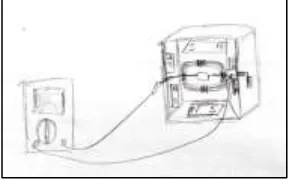
efficiently in the school Scout camp using a copper wire and six bar/rod magnets. S22’s equipment design and reasons for supporting the idea are shown in Figure 3.
Figure 3. S22’s design solution and reasons for item 3
First, I will turn a copper wire around 200 times and shape it as rectangular form. Second, I will hang the coil on two axles. Then, I will connect two axles with foam rod. Next, I will create a wood box and place the magnetic bars inside of the box and around it (the rectangular coil). The box has a rectangular coil in the middle. [S22]
To make better use of these instruments and support students to become better at real-world problem solving, teachers should focus on scaffolding students to connect science knowledge to real-life situations and explain their ideas, problem solving processes, and reasoning in their own words. The school science curriculum should build around real-life contexts relevant to the students’ live. Teaching practices should provide students’ experiences in practical real-world problem solving and use a variety of communication tools/ teaching strategies such as drawing/sketching, writing, and talking which are strong potential for helping students communicate their ideas and learn science content.
In conclusion, the PSA test based on designis an instrument to assess students’ problem solving ability related to the application and understanding of scientific knowledge in a wide range of conceptions and expose students’ mental models so that teachers can understand students’ learning. The PSA rubric score based on design also facilitates reliable scoring of PSA assessment. These instruments provide teachers with a valuable resource for assessing students both at the beginning of science instruction and at the end. The four open-ended questions in the PSA test can be used to generate in-class discussion on teaching and learning, for example, energy. Teachers can apply or improve the four daily-energy-problem situations appropriately in accordance with the actual context in the classroom.
Acknowledgement
This research was supported from a graduate scholarship provided by the Institute for Promotion of Teaching Science and Technology (IPST). It also was funded by the Special Program of Doctor of Philosophy in Science Education, Department of Teacher Education, Faculty of Education and Development Sciences, Kasetsart University. The authors would like to thank the referee for his/her kind and encouraging suggestions addressed to improve the manuscript content.
References
American Association for the Advancement of Science (AAAS). (1990). Science for all Americans. New York: Oxford University Press.
19
February 14, 2017, from
http://www.colorado.edu/physics/EducationIssues/papers/Adams/Problem%20Solving%20Validation%20P ERC%20edited%20final.pdf.
Chang, C.Y. (2010). Does problem solving = prior knowledge + reasoning skills in earth science? An exploratory study. Research Science Education 40, 103–116. doi: 10.1007/s11165-008-9102-0 Chi, M.T.H., & Glaser, R. (1985). Problem solving ability. The Education Resources Information Center.
Retrieved July 31, 2017, from http://files.eric.ed.gov/fulltext/ED257630.pdf
Crismond, D. (2001). Learning and using science ideas when doing investigate-and- redesign tasks: A study of naive, novice, and expert designers doing constrained and scaffolded design work. Journal of Research in Science Teaching 38(7), 791–820.
Docktor, J., & Heller, K. (2009). Robust assessment instrument for student problem solving. Proceedings of the NARST 2009 Annual Meeting, Garden Grove, CA: NARST. Retrieved from
http://groups.physics.umn.edu/physed/Talks/Docktor_NARST09_paper.pdf
Doppelt, Y., Mehalik, M. M., Schunn, C. D., Silk, E., & Krysinski, D. (2008). Engagement and achievements: A case study of design-based learning in a science context. Journal of Technology Education 19(2), 22–39. Fortus, D., Dershimer, R.C., Krajcik, J., Marx, R.W., & Mamlok, R. (2004). Design-based science and student
learning. Journal of Research in Science Teaching 41(10), 1081–1110. doi: 10.1002/tea.20040
Fortus, D., Krajcik, J., Dershimer, R.C., Marx, R.W., & Mamlok, R. (2005). Design-based science and real- world problem-solving. International Journal of Science Education 27(7), 855–879. doi:
10.1080/09500690500038165
Glynn, S., & Muth, K.D. (2008). Using drawing strategically, drawing activities make life science meaningful to Third- and fourth-grade students in methods and strategies. Science and Children, 48–51.
Heppner, P.P., & Peterson, C.H. (1978). The development, factor analysis, and initial validation of a problem- solving instrument: A final paper presented at the annual meeting of the American Education Research Association. Commissioned by the American Education Research Association. Toronto, America: Author. International Technology Education Association (ITEA). (2007). Standards for technological literacy: Content
for the study of technology.Retrieved March 13, 2015, from http://www.iteea.org/TAA/Publications/TAA_Publications.html
Johnson, J.K., & Reynolds, S.J. (2005). Concept sketches – using student and instructor generated, annotated sketches for learning, teaching, and assessment in geology courses. Journal of Geoscience Education 53(1), 85–95.
Jonsson, A., & Svingby, G. (2007). The use of scoring rubrics: Reliability, validity and educational consequences. Educational Research Review 2, 130–144. doi: 10.1016/j.edurev.2007.05.002. Retrieved March 13, 2015, from http://drjj.uitm.edu.my/DRJJ/MQAGGPAS-Apr2011/Rubrics-Reliability-Validity-JonssonandSvingby2007.pdf
Köse, S. (2008). Diagnosing student misconceptions: Using drawings as a research method. World Applied Sciences Journal 3(2), 283–293.
Kruatong, T. (2011). Development and validation of a diagnostic instrument to evaluate secondary school students’ conceptions and problem solving in mechanics. The International Journal of Learning 17(10), 51–69.
Libarkin, J., & Ording, G. (2012). The utility of writing assignments in undergraduate bioscience. CBE Life Science Education 11, 39–46.doi: 10.1187/cbe.11-07-0058
Ministry of Education. (2001). Basic education curriculum B.E. 2551 (A.D.2008). Bangkok: The Agricultural Cooperative Federation of Thailand Limited.
Mynlieff, M., Manogaran, A.L., St. Maurice, M., & Eddinger, T.J. (2014). Writing assignments with a metacognitive component enhance learning in a large introductory biology course. CBE Life Science Education 13, 311–321.doi: 10.1187/cbe.13-05-0097
National Research Council (NRC). (2012). A framework for K-12 science education: Practices,crosscutting concepts, and core ideas. Washington, DC: National Academy Press.
Ohlsson, S. (2012). The problems with problem solving: Reflections on the rise, current status, and possible future of a cognitive research paradigm. The Journal of Problem Solving 5(1), 101–128. doi: 10.7771/1932-6246.1144
Purnakanishtha, S., Suwannatthachote, P., & Nilsook, P. (2014). Development and validation of a problem solving skills test in robot programming using scaffolding tools. Open Journal of Social Sciences 2, 47–53. doi:10.4236/jss.2014.22007
Quillin, K., & Thomas, S. (2015). Drawing-to-learn: A framework for using drawings to promote model-based reasoning in biology. CBE Life Science Education 14(2), 1–16. doi: 10.1187/cbe.14-08-0128
20
Resnick, L.B., & Glaser, R. (1975). Problem solving and intelligence. The Education Resources Information Center. Retrieved July 30, 2017, from http://files.eric.ed.gov/fulltext/ED111727.pdf
Reynolds, J.A., Thaiss, C., Katkin, W., & Thompson, R.J. (2012). Writing-to-learn in undergraduate science education: A community-based, conceptually driven approach. CBE Life Science Education 11, 17–25. doi: 10.1187/cbe.11-08-0064
Ring, K. (2006). Supporting young children drawing: Developing a role. International Journal of Education through Art 2(3), 195–209. doi: 10.1386/etar.2.3.195_1
Roth, W.M. (2001). Learning science through technological design. Journal of Research in Science Teaching 38(7), 768–790.
Sadler, P.M., Coyle, H.P., & Schwartz, M. (2000). Engineering competitions in the middle school classroom: Key elements in developing effective design challenges. Journal of theLearning Science 9(3), 299–327. doi: 10.1207/S15327809JLS0903_3
Schoenfeld, A.H. (1985). Mathematical problem solving. Retrieved February 16, 2017, from http://math- dept.talif.sch.ir/pdf/manaba/[Alan_Schoenfeld]_Mathematical_Problem_Solving.pdf
Schunk, D.H. (2004). Learning theory: An educational perspective (6th ed.). Boston, MA: Pearson Education. Shahat, M.A., Ohle, A., Treagust, F.D., & Fischer, H.E. (2013). Design, development and validation of a model
of problem solving for Egyptian science classes. International Journal of Science and Mathematics Education 11(5), 1157–1181.
Silk, E.M., Schunn, C.D., & Cary, M.S. (2009). The impact of an engineering design curriculum on science reasoning in an urban setting. Journal of Science Education and Technology. doi 10.1007/s10956-009-9144-8. Retrieved February 16, 2017, from http://www.lrdc.pitt.edu/schunn/research/papers/silk-schunn-cary.pdf Simon, H. A. (1996). The sciences of the artificial (2nd ed.). Cambridge, MA: MIT Press.
Sternberg, R.J. (2009). Cognitive psychology (5th ed.). Orlando. FL: Harcourt College Publishers.
Stensel, P. (2013). Design for life: Design and technology for upper secondary (9th ed.). Singapore: Pearson Education South Asia Pte Ltd.
Westbrook, S.L., & Marek, E.A. (1991). A cross-age study of student understanding of concept of diffusion.
Journal of Research in Science Teaching 28, 649–660.
Westbrook, S.L., & Marek, E.A. (1992). A cross-age study of student understanding of concept of homeostasis.
Journal of Research in Science Teaching 29(1), 51–61.