Knowledge Management and Politics at the Highest Level: An
Exploratory Analysis
Eduardo TOMÉ Universidade Europeia
Estrada da Correia, 53, 1500 - 200 Lisboa, Portugal [email protected]
Paula FIGUEIREDO ISLA - Leiria
Rua Da Cooperativa - São Romão, 2414-017 Leiria, Portugal [email protected]
Abstract. This paper analyses Knowledge Management (KM) as a political activity, made by the great political leaders of the world. We try to examine if at the macro political level KM is made, and how. The research is interesting because given that we live in a Knowledge Society, in the Information Era, it is more or less obvious that the political leaders should also do KM. However we don’t know of any previous study on KM and world leaders and this paper wants to be a first step to fill that gap. As a methodology we use literature review: given this one is a first preliminary study we use data we found online and in databases like EBSCO. We divide the analysis in two main parts: theoretical ideas, and application. In the theoretical part we aim at distinguishing KM as made by managers from KM made by politicians. The second part is itself divided in two segments: the past and the present times; in the second segment we illustrate our ideas with the example of President Barack Obama. We observe, rather surprisingly, how much it has been over-looked by scholars; KM always was and nowadays is pervasive in the activity of the world political leaders. Furthermore, the importance of KM made by world political leaders is so great that it should prompt the making of detailed studies in order to improve the world governance. The study has the limitation of relying on documents, insights and texts, and not on interviews. It should be followed by studies of a more qualitative and participative nature. We believe it would be very interesting to make such studies and that they would help improving the democracies in the 21st century and beyond.
Keywords: Knowledge management, politics, globalization, efficiency, leadership.
Introduction
analysis has been extended to non-profit organizations (Cegarra-Navarro & Sánchez-Polo, 2010); seldom, KM is also analyzed for regions, countries (World Bank, 2012). But, to our knowledge, nobody ever did a study on KM in relation to Prime Ministers or Heads of State. We searched the internet (using Google) and an extended version of EBSCO and did not find any specific study. This finding deserves some discussions, because there are some very well know studies relating KM to political issues like e-government (Allahawiah & Alsaraireh, 2014), local e-government (Khilji & Roberts, 2013) or digital governance (Rao, 2013). But, quite surprisingly, even if we live in a knowledge economy and obviously the political power is based on knowledge and on KM, it seems there is no study, theoretical or empirical, on KM and high politics.
Therefore in this paper we analyze if and how KM is done in the spheres of top decision makers in the field of worldwide politics. The research questions are the following: Is KM done by worldwide policy makers? And if it is, how it is done? And with what results? We believe this investigation is interesting because policy leaders are the top of our world, and it might happen that some styles of leadership might be defined regarding KM and that some of them manage KM better than others. Also we will compare KM made by managers and KM made by politicians, and will illustrate our thoughts with one application on a very well-known political leader.
The paper has the following structure. In the first section we present the concepts of KM, and political leadership. In the second section we expose some theories about KM, leadership, and KM in leadership; we define an abstract model to compare KM made by managers and KM made by politicians. In the third section we examine how the relation between KM and the practice of political leaders evolved historically; the section itself is divided in two subsections, one about an historical overview, that could be named “KM and political leaders through Humanity” and the second about the actual times, this meaning since the beginning of the Third Industrial Revolution in the last decades of the 20th century. We also present a small analysis on President Barack Obama as a knowledge manager. In the fourth and final section we present the paper’s conclusions, limitations and indicate some inroads to do further research.
Concepts: KM, Leadership and Political leadership
analysis that activity (Tomé, 2005).We also assume that political leadership is the action of influencing society by being placed at the top levels of the political hierarchy. Specifically political leaders are Heads of States, Prime Ministers, party leaders, and opinion makers, like gurus and other individuals that may be invited to attend events like the World Economic Forum in Davos (WEF, 2014).
Theories: Knowledge Management and Leadership
Knowledge Management
Theoretical ideas on Knowledge Management can be traced long ago at least to Drucker (1957) and Polaniy (1966), when those very important authors defined respectively, the knowledge worker and the concepts of tacit and explicit knowledge that would base Nonaka’s Knowledge cycle approach (Nonaka & Takeuchi, 1995). And in the last two decades KM changed from an emerging field to an established science in the very diverse field of intangible analysis (Tomé, 2012): KM science relates to knowledge creation (Kianto, 2008), sharing and transfer, stocking, as well as unlearning (Cegarra Navarro & Moya, 2005; Brătianu & Orzea, 2013). KM has been applied to multinationals (Cavaliere & Lombardi, 2013), public bodies (Ferguson et al., 2013), the voluntary sector (Ragsdell, 2013), SMEs (Heavin & Adam, 2014) and countries or regions (Bonfour & Edvinsson, 2005), industry (Liu et al., 2013), agriculture (Assefa et al., 2011) and services such as tourism, logistics, health care, banking etc. (Tomé, 2011).
Leadership
Quite interestingly, Leadership analysis began long before KM analysis, since we may consider that Frederick Taylor’s (Taylor, 2003) work on organizations and performance had a strong focus on the role of the leader. And in the last one hundred years, management science has produced a considerable amount of studies on leaders and leadership, linking it to the organization itself (Sternberg, 2003), the national cultures (Zagoršek, 2003), the competences of leaders (Hawkings et al., 2007), the development of leaders (Johnson et al., 2012), globalization (Youseff et al., 2012), the technology and strategy (Coad, 2011), the types of leaders (Dai et al., 2013), the relation between leaders and other similar roles in the organization like coaches and their relation with the HR function (Boyatzis et al., 2006).
style school; 3) The contingency school; 4) The visionary or charismatic school; 5) The emotional intelligence school; 6) The competency school. Each theory contributed to the deepening of the concept of leadership as it is showed below:
1) Theories focused on the traits and behaviors of the leader are focused on their attributes, personal skills and behaviors. Through them the leader exerts its influence and power. Accordingly, the leadership concept from Katz and Kahn (1978) refers to the attribute of a position, the characteristic of a person and the category of conduct.
2) However, according to several authors, the definition of leadership appears mostly associated with the exercise of influence. The influence is associated with power, which, in turn, means exercising influence but based on the domain of force or submission to authority (Ferreira et al., 1996). The power does not require goals’ compatibility, but dependence. Leadership requires congruence between the goals of the leader and the followers.
3) Then with the contingency theory and the importance of context, the leadership only exists if there are followers. The leadership process assumes that the leader influences the followers. The situational theory of Hersey and Blanchard emphasizes the role of followers; it is the followers who accept or not the leader.
4) Within the context of charismatic and transformational theories, according to Bass (1997), 40% of the variance of leader behavior can be attributed to hereditary / genetic factors, while 60% of the variance of leader behavior can be learned and developed through lifelong learning. Thus, true leaders are people “who not only attract higher moral values, but include in their behavior the sense of mission, the delegation of authority, learning and
constant training, the emphasis on problem solving, the use of argumentation.”
(Bass & Avolio, 1993).
however, it has to be inspiring, motivating and understanding the goals and motivations of their followers.
6) The need for leaders available and competent to take on the challenges ahead, the concern arises in the development of leadership, particularly leadership competences. The research in 125 leaders aims to realize which their leadership competences. Authentic leadership emerges from the life stories of leaders and one of the skills to be developed by leaders should be self-awareness (George et al., 2007). This competence is also one of the emotional competencies defined by Goleman, Boyatzis and McKee (2001) associated with the model of emotional intelligence competencies. The authentic leader emphasizes self-development, i.e., the leader creates its development plan; the leader cares about his/her personal and professional development (Figueiredo, 2013). The leader is concerned with his/her own personal and professional development and it seeks to promote the development of others.
In the last decades of the twentieth century, theories of leadership reconsidered the characteristics of a leader; the leader's role becomes crucial in the leadership process. We are seeing a humanization of the concept of leadership. The concept of ‘authentic leader’ has been referenced by several authors as being someone who “(…) demonstrate a passion for their purpose, practice their values consistently, and lead with their hearts as well as their heads. They establish long-term, meaningful relationships and have the self-discipline to get results. They know who they are” (George et al., 2007).
Summing up, according to the evolution of leadership theories one should consider a wider concept of leadership due to the complexity of today’s world - Leadership is a process of reciprocal influence between leader and followers; the influence is exerted not only by power, but also by traits, attributes, behaviors and skills of the leader. Through these, the leader inspires guides and motivates followers, being accepted by them. Increasingly more, besides considering the goals of the group, a leader must also seek to reconcile them with the personal goals of followers, including the goals of personal and professional development of each follower. The interaction of the leader with followers is key to keep leadership alive.
KM and leadership
meant to manage Knowledge in a top down approach, centralized, according to which the central command department will produce knowledge, with the collaboration of the middle managers and the executive skills of the shop floor workers (Taylor, 2011). Everything was meant to change with the emergence of the Knowledge Era, in which post-tayloristic organizations would require a new kind of leader, more flexible, more prone to accept mistakes and more willing to receive knowledge from other workers at lower levels of the hierarchy (Tomé, 2011). We know that nowadays, even in the service based and knowledge led economy, pre-tayloristic, tayloristic and pos-tayloristic organizations coexist:
i) The first type may be encountered in family based SMEs, which try to survive in the non-tradable sector, providing the local markets. In these organizations KM is essentially done by default and the role of the leader is to ensure and in last resort it is done, through accountancy, putting a website online or hiring competent youngsters.
ii) The second type of organizations may be found in industry sector, many of them that have adopted lean thinking based strategies (Roos et al., 1991); it all started with the McDonalization of society (Ritzer, 1993) and applying essentially chaotic knowledge creation strategies to lean structures manufactures was never going to be easy (May, 2005); Indeed, depending on the level of skills used in those industries the intensity of knowledge varies considerably; in the more knowledge intense companies, KM practices are implemented, but even so, the chain of command is strong and top down, and the division between managers and executioners is important (Liu, 2013). Furthermore, taylorism may be found in low skilled and massified services, in which the scale of operations is very big, and in which a large number of workers in low paid jobs execute the tasks that were designed by managers; call centers are the most common example of those types of services (Torraco et al., 2014). In those types on organizations price is still more important than value, costumers are more buyers than clients. In those organizations the role of the leader is still extremely important because command and control procedures are still decisive.
KM for managers and for politicians compared
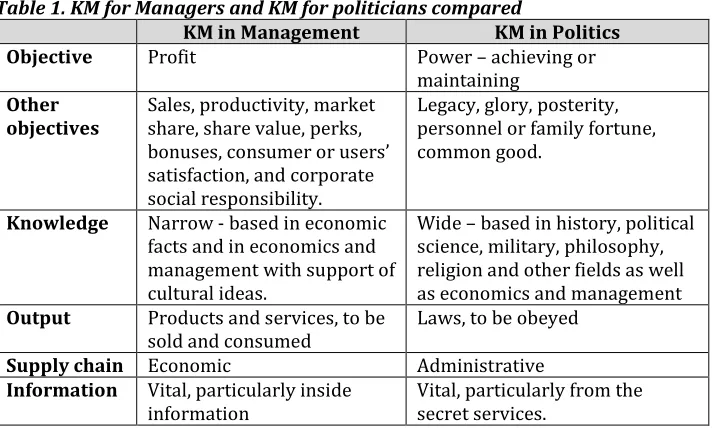
Managers and politicians do KM in different ways. A summary of those differences is depicted in Table 1, below.
Managers essentially seek profits, particularly if they work in the private sector, or in alternative they aim for sales, productivity, share values, bonuses, perks, consumer or users’ satisfaction or corporate social responsibility. The politician’s main goal is to achieve power or to maintain it. Politicians also aim at benefiting the society common good, living a legacy, being known by the posterity, or achieving personnel or family fortune. Managers aim at achieving their goals within a relatively narrow knowledge environment, essentially composed by economic facts even if culture and national culture is becoming more and more important for managers. Politicians usually use a wider range of knowledge to make their decisions, from history to military, passing by political science, philosophy, religion, mass psychology, as well as economics and management.
Managers essentially produce goods and services and those goods and services are made by supply chains of different knowledge intensity. Politicians generate laws, and manage the obeisance of those laws, which are produced and maintained by the administration. Of course the knowledge required and created or originated from a good or service is very different from the knowledge required or created or originated from a legislative piece.
Table 1. KM for Managers and KM for politicians compared
KM in Management KM in Politics
Objective Profit Power – achieving or
maintaining Other
objectives Sales, productivity, market share, share value, perks, bonuses, consumer or users’ satisfaction, and corporate social responsibility.
Legacy, glory, posterity, personnel or family fortune, common good.
Knowledge Narrow - based in economic facts and in economics and management with support of cultural ideas.
Wide – based in history, political science, military, philosophy, religion and other fields as well as economics and management Output Products and services, to be
sold and consumed Laws, to be obeyed
Supply chain Economic Administrative
Information Vital, particularly inside
Written
agreements Non-essential. As clear cut as possible, numeric Subject to controversy – in the lines or in between?
Deals Commercial Political
Role of the
leader Business like, money oriented Policy centred, nation-wide centred Team Business partners,
shareholders, dealers, brokers
Party members, government officials,
Negotiation
focus Commercial deals War or Peace
Conflict Buying through OPA, dumping and price wars, radical innovations, buying property rights
It may result into war or in physical elimination of adversaries
Trust and
reputation Between company organization and costumers Between politicians and citizens Source: Own elaboration
Strategies always being secret, when businesses are to succeed, information is always vital and particularly in the case of inside information. In the case of politicians, we know that they rely also on secrete services information and they may even spy on partners, as it happened when it was reported that the US had spied on Angela Merkel.
Managers often do deals, and many businesses can be closed by a hand-shake, but when words are put on paper they shall be as clear cut and as numeric as possible. Managers do trade, and the business deals result in income and business oriented knowledge.
The world of politicians is quite different. They may even be involved in business deals, as in the G8 summits, or in relation with the current Greek crisis in the EU, but their framework of action is always wider and policy oriented and politically motivated. A politician may do deals a businessman would not do because the ultimate goals are different. All this results in different outcomes and different knowledge. Also, a political deal is usually subject to controversy – sometimes one of the negotiators reads the lines while the other reads in between.
In case of conflict, managers can buy competitors, or eliminate them through dumping or promote radical innovations, or freeze the market by buying property rights. In turn, politicians may declare war on enemies or seek their physical elimination. In both cases the knowledge needed in necessarily different.
Finally, managers and politicians both need to be trusted. But if in the first case complaining and correction can solve the problems, in the second case public demonstrations may have devastating effects. Indeed in the case of managers the reputation of organizations and managers is decisive to ensure long-term profitability. Whereas for politicians, trust and reputation are vital for lasting in power: trust and reputation issues between politicians and citizens are the most important problem in 21st century democracies.
KM and Political Leadership
An historical overview
KM scholars usually consider that KM science only got to exist after the Information Revolution of the eighties and nineties of last century. However, we all know that Humanity has been based on Knowledge, and that all great civilizations have based themselves of knowledge. More than, that we know that all civilizations have based themselves on strong leadership which has been practiced through various forms of government. Therefore it is impossible to try to tell the history of humanity by the perspective of leaders managing knowledge. It may be a bold attempt, but it is something that we consider that is worth being done, and even more it is something.
Just in a snapshot, it is interesting to remember that in Ancient Egypt, the pharaoh, son of the Sun King, was meant to be wiser and more knowledgeable than the other individuals; and that, for managing the successive empires, successive Pharaohs secured themselves with the help of a network of private secretaries and administrators. That network of administrators, centered in the quasi-divine Pharaoh, was in fact the first great demonstration on KM by any administration and for what matters to this paper, the first time political leaders had to have an important role in managing knowledge. In this case, the Pharaoh took decisions and put in place a KM network, on which in fact he had to depend. The main topics of management had to do with agriculture, the pyramids, religion and wars.
democratic and participative, but definitively more democratic and participative than it ever was in the precedent civilizations. This meant that the leadership had a different way of managing knowledge, less based on divine right, and in fact the network of knowledge managers (in which the Roman Senate and the Greek Areopagus were fundamental) was more extended and more horizontal. The production of science and philosophy at the times account for the high intensity and large scope of the activity of KM of the epoch. But other fundamental topics remained to be the economic subsistence, and war and peace.
The Early Middle Ages were somehow a doomed period in civilization, at least in Europe, and the only form of leadership that could be said to maintain any form of KM practice was the Catholic Church. As an improvement to that sorrow state of affairs, in the late Middle Age, kings surrounded themselves by councils of nobles, priests, and anonymous people and jokers in assemblies; some kings were philosophers or writers or poets; and basically KM was related to war and taxes that should finance wars.
In the Renaissance everything became more complex. The geographic discoveries changed trade, but also societies and power. Galileo and Copernicus questioned the leadership of the Earth in the Universe. Hamlet expressed the dilemma over life but also over Knowledge and ultimately over KM and leadership, in societies. In general though, as societies became more affluent and complex, KM recovered in intensity and extension. Leaders began to be more and more educated. In fact Machiavelli’s Prince can be read as a manual of best practices for KM by political leaders (Machiavelli, 1505), in war and in peace; the qualities of the Prince (i.e. the leader) and its prudence were also analyzed by Machiavelli. That the adjective “Machiavellian” made his entrance to the vocabulary of languages shows well the importance of the analysis. Finally, sometimes leaders delegated some part of the national business to companies, in fact delegating KM over that section of economy in societies. Queen Elizabeth I of England even delegated warfare to corsairs (Kelsey, 1998).
different form of Government, based on liberty, Constitutions, and popular government was generating a different form of leadership, and a different production of management of knowledge, which might surprise the Absolutists. But, it should not surprise anybody who knows that non-authoritarian regimes benefit very much from freedom to develop and manage knowledge. And it is by no means a surprise that England, Scotland and the Netherlands were at the forefront of the Agriculture and Industrial Revolutions of the 18th century and the early 19th century. That advantage of liberty versus absolutism happened even taking in consideration that absolutist kings sought the support of philosophers like Voltaire and Jean Jacques Rousseau to rule better. The role of the political leader to foster knowledge was very decisive, because they were the ultimate guarantees of the regimes. But absolutists tried to restrain KM to a small circle, whereas non-absolutists invested in education and science and by that developed a large network of knowledge managers in society. All in all, both types of leaderships tried to manage KM even if in different ways.
Republics, starting particularly with America in 1776, and following with the French Revolution, changed somehow the role of the political leaders managing knowledge, in relation to absolute monarchies and even the more liberal regimes of the past. It is interesting that the first big book of economics in the Modern Age, the Wealth of Nations of Adam Smith (Smith, 1977), was published in 1776. In fact this book had a major influence on the governance of the more civilized countries until the crisis of 1929. And rather importantly, the liberal regime based on Laissez faire and Laissez-passer, effectively promoted the dissemination of KM. Also in such regimes, the role of the political leader was to be a facilitator or a marketer of grand designs and ideas. Indeed in republics like the American, or in Constitutional Monarchies as in the UK, Presidents have governments and Parliaments whose role is to ensure the management of political knowledge for the good of societies. Management relates to producing and enforcing laws, guaranteeing freedom and external security, developing the economy, and intervening more or less in social sphere. But, taking into account the differences in ideologies, there is no doubt that in those regimes, two fundamental realities existed regarding KM and political leadership: the political ruler had an influence in KM; he was helped by an increasing vast administration.
this idea is reflected in some nostalgia which is expressed in the arts or the social media of today over those glorious personages.
What changed in the last 200 years were fundamentally three facts which made life faster and much more exigent: education, democracy and technology. Those facts put a lot of pressure on political leaders to be more accurate in their management of knowledge for the benefits of societies. Also they created more and more possibilities to everyone to manage knowledge, and therefore to participate in the leader’s management of knowledge. And in fact they made possible a much faster and correct management of knowledge by the political leaders, if only they were up to it. Also, the number of world countries augmented from a few dozens in 1800 to about 200 in 2000. This increase was even more felt in the number of non-elected persons with political influence, as party leaders, managers, writers and other intellectuals, which considering the internet age, augmented exponentially as in a political Big Bang. Therefore the number of relevant political leaders augmented, a fact which in itself increased the difficulty and complexity of the task of the leaders. Keynesianism and Socialism when applied in societies, particularly, post-WWII were firm builders of the State, and have an enormous impact in the form of implementing KM, to which the leaders had to adapt themselves. Elections became more and more frequent, and more and more disputed and controlled, a fact that also contributed to the need of a great KM activity by political leaders. Spy games became more and more elaborated. In the early eighties, when the Third Industrial Revolution was about to explode, with the support of Neo-liberalism, societies could be ranked by their development levels, but also by the way their KM network system worked.
The current times
Minister (Lynn & Jay, 1989) is nothing but a satire on how politics was done in the eighties of the last century in the oldest democracy of the world, but more importantly may also be analyzed showing the importance of knowledge as power and the importance of knowledge and the cycle of knowledge in the relations between the elected politician and the civil servant; clearly all is made to state that experience counts and that the civil servant knows much more and much better than the new arrived politician, in fact ending to have power over him. Much more recently a celebrated French movie (Quay D’Orsay), described ironically how politics was managed in the French Ministry of Foreign Affairs. Many other movies have been made over political leaders, like Mandela, Thatcher, JFK, Gandhi, or Queen Elizabeth II. Other important books and movies have dealt with election campaigns. In those campaigns, marketing and authenticity has become a decisive political issue. But no study has been made on KM and those political leaders, yet.
The situation is even more interesting because in modern politics we know that decisions are based on committees, which in fact makes those States a case of “comitology” (EC, 2014). And committees are in fact ways of making KM, almost as Communities of Practice. Following the information revolution, e-government become to be a very important issue in science, and its implications for KM have been widely recognized (Fraser et al., 2013; do Canto Cavalheiro et al., 2014; as a major scientific domain. The same situation applies to digital government. Also, in the last few years with the advent of studies on Big Data and data mining, the possibility of using KM on politics was enlarged. Finally the famous quote of Donald Rumsfeld about known knowns, known unknowns, and unknown unknowns has been largely quoted in the KM field. But to our knowledge, Rumsfeld and his peers have not been analyzed as KM actors. Finally, in the last two years, scandals like those surrounding Julian Assange and Edward Snowden have reminded us of the importance of intelligence and secret services in the running of the world, intelligence being in our opinion a type of KM.
The case of President Obama
Upbringing
Barack Hussein Obama II was born on August 4, 1961, in Honolulu, Hawaii. He lived in Hawaii during his youth and after finishing high school moved to Los Angeles in 1979 where he attended Occidental College before graduating in Columbia University, Ivy League University in New York, in 1983. In 1988 he entered the Harvard School of Law where he graduated in 1991 as Juris Doctor. From 1991 he taught Constitutional Law in the Chicago Law School for twelve years, first as a Lecturer from 1992 to 1996, and then as a Senior Lecturer from 1996 to 2004. He worked as an associate for Davis, Miner, Barnhill and Galland, a 13-attorney law firm specializing in civil rights litigation and neighborhood economic development from 1993 to 1996, and then as a partner from 1996 to 2004. He was Illinois State Senator between 1997 and 2004 and US Senator from Illinois between 2005 and 2008 having lost the race for the position in 2000. He was elected president of the United States in 2008 and was reelected in 2012. In October 2009, he was awarded the Nobel Peace Prize for "his extraordinary efforts to strengthen international diplomacy and cooperation between peoples."
Style and work
Mr. Obama was elected in 2008 with the support of a most dazzling and impressive slogan – Yes, we can. Since election Obama has put together a staggering number of policies.
The US being the biggest world super-power, President Obama has to deal permanently with complex international relations. This has to do with military interventions (such as in Iraq, and Afghanistan), fighting terrorism (such as ISIS), other very problematic issues (such as Syria), diplomatic forums (such as the G7), relations with the European Union and with the UK, relations with the BRICS (and particularly with Russia and China), relations with Japan, relations with the Muslim World and the Catholic Church, and dealing with unexpected problems like the leaks by Julian Assange and Edward Snowden. All these immense and intense international relations generate an amazing flow of data and documents that describe and inform the Obama’s administration Foreign Policy and which in fact are knowledge created by or influenced by Obama himself.
on internal policy addresses such different issues as Education, Health Care reform, LGBT rights, economic policy including the federal budget and the debt, environmental policy, energy policy, gun control or internet security. President Obama has also to relate closely to each one of the federative States of the United States, and in this context his State of the Union Speech usually delivered in February is of paramount importance. All this domestic activity is aimed at maintaining the status of the US as a world leader, benefiting the well-being of its citizens, and consequently guaranteeing the success of the Obama Administration and of the Democrats. All that activity generates laws, reports, instructions which are put in place. Therefore all those policies use and create knowledge. A brief summary of the consequences of that policy can be seen, from mostly an economic point of view in the Annual Census of the United State which is itself a volume from which much knowledge can be extracted. All those policies are put in place by knowledge workers. The Obama Administration is in fact a vast knowledge organization and the President is something like the man at the helm. Even if the boat is so big, the President may, by his everyday choices and style, and by his own knowledge, create himself knowledge and effectively driving the country by his own influence.
Barack Obama is also a writer having published two notable books which summarize much of his thoughts and knowledge. The first “Dreams from my Father” is a memoir published in 1995 when he was preparing to launch his political career. The second “The Audacity of Hope” published in 2004 is a summary of the ideas that were to sustain the wining candidacy in 2008.
Team
Obama works with a myriad of advisers. He has a close team of 21 persons that forms his Cabinet, which is composed by the Vice President, the Attorney General, the Chief of Staff, the United States Trade Representative, the Ambassador to the United Nations, the Administrator of the Environmental Protection Agency, the Director of the Office of Management and Budget and other 14 Secretaries. All these Cabinet Members in turn manage their own staff.
Economic Council, the Chairman of the Economic Recovery Advisory and the Chairperson of the Council on Jobs and Competitiveness. All those persons in fact run the equivalent to extremely important non-ministerial departments in the economy and society of the US.
Obama is also in close contact with the Democratic Party of which he is not the chair person but is the top representative. And the relation is effectively double sided – Obama needs the Party to pass his bills through the Congress and the Party needs Obama to fight the elections, the next being in late 2016.
It is well known that when everything fails by formal ways, leaders use their informal contacts. Obama is known to have phoned European and Russian leaders in situation of crisis during his Presidency. He is known to be a very good friend of David Cameron with whom he played table tennis once, in a team, something which probably easy given the fact both are lefthanders.
Finally, for all his work and dreams, President Obama is known to be a laid back person, spending a month in holidays during the summer, in Hawaii usually. Also he has a very good relation with his wife, who has become a fashion icon. All this transforms into knowledge and creates knowledge and is transferred and shared as knowledge.
Legacy
Quite significantly Obama created in 2014 the Obama Foundation which will be in the future located in Chicago in the Barack Obama Presidential Centre. This building will gather as a repository of documents about the Obama’s presidency. In KM terms this will be a repository of knowledge documents about Obama himself and his experience.
Concluding comments
While analyzing the history of leadership in Humanity we found that there were many ways of managing knowledge but even if non-assumed this was one of the most important activities world rulers always performed. In modern times, democracy, education and technology increased the pressure on leaders and also increased the extension and intensity of KM. Also the impacts of that activity began to be more and more scrutinized. Indeed nowadays, ruling the world amounts at managing and directing massive institutions, public and private, that essentially do KM.
This was meant to be a preliminary study. We would like to do an empirical study on the topic. A possibility would be to question directly or indirectly a large subset of current political leaders. Very different types of leaders exist in the political spectrum from “hiper-presidents” like Nicholas Sharkozy to discrete presences like Queen Elizabeth II who in fact has been in charge for more than 60 years. We would like to compare them empirically and to analyze them in terms of knowledge activity and its impact. If we could conclude that some types of leaders are better knowledge managers than others, given certain circumstances, this fact could have an important feature when the anonymous public chooses regimes and leaders. In any case, we sincerely believe that the study of the interface between KM and politics is worth being pursued and specifically that the study of how world leaders manage KM may prove to be crucial on improving the governability of countries and societies, and therefore on improving the wellbeing of the anonymous people those leaders are meant to serve.
References
Allahawiah, S., and Alsaraireh, M. (2014). The benefits of Knowledge Management and e-government in raising citizen engagement – Jordan case study.
Economics, Management & Financial Markets, 9(1), 213-222.
Andreeva, T., and Kianto, A. (2012). Does knowledge management really matter? Linking knowledge management practices, competitiveness and economic performance. Journal of Knowledge Management, 16(4), 617-636.
Assefa, H., Egziabher, T., Sehai, E., and Tegegne, A. (2011). Agricultural Knowledge Management in Dairy Production Improvement: The Case of Bure Woreda, West Gojjam Zone, Amhara Region. IUP Journal of Agricultural Economics, 8(4), 30-40. Bass, B.M. (1997). Does the Transactional – Transformational Leadership Paradigm
Transcend Organizational and National Boundaries?. American Psychologist,
52(2), 130.
Bounfour, A., and Edvinsson, L. (2005). Intellectual capital for communities – nations, regions, and cities. Oxford: Butterworth-Heinemann.
Boyatzis, R.E., Smith, M.L., and Blaize, N. (2006). Developing
Sustainable Leaders through Coaching and Compassion. Academy of Management Learning & Education, 5(1), 8-24.
Brătianu, C., and Orzea, I. (2013). Knowledge Strategies in Using Social Networks. Management Dynamics in the Knowledge Economy, 1(1), 25-38.
do Canto Cavalheiro, G., and Joia, L, (2014). Towards a heuristic frame for transferring e-government technology. Government Information Quarterly, 31(1), 195-220.
Coad, A. (2011). Appropriate business strategy for leaders and laggards. Industrial & Corporate Change. 20(4), 1049-1079.
Cavaliere, V., and Lombardi, S. (2013). The Distinctiveness of Knowledge Sharing Processes within Multinational Companies. In Proceedings of the International Conference on Intellectual Capital, Knowledge Management & Organizational Learning (pp. 82-90). Washington, DC: ICICKM.
Cegarra Navarro, J.G., and Rodrigo Moya B. (2005). Business performance management and unlearning process. Knowledge Process and Management, 12(3), 161-170.
Cegarra-Navarro, J.G., and Sánchez-Polo, M.T. (2010). Implementing telemedicine through eListening in hospital-in-the-home units. International Journal of Information Management, 30(6), 552–558.
Dai, G., and De Meuse, K. (2013). Human Performance. Types of Leaders across the Organizational Hierarchy: A Person-Centered Approach.Human Performance, 26(1), 150-170.
Drucker, P. (1957). Landmarks of Tomorrow. New York: Harper & Row. European Commission (2014). Glossary: Comitology. Retrieved from
http://europa.eu/legislation_summaries/glossary/comitology_en.htm. Ferguson, S., Burford, S., and Kennedy, M. (2013). Divergent Approaches
to Knowledge and Innovation in the Public Sector. International Journal of Public Administration, 36(3), 168-179.
Ferreira, J., Neves, J., Abreu, P., and Caetano, A. (1996). Psicossociologia das Organizações. Lisboa: McGraw Hill.
Figueiredo, P. (2013). Planning and developing leadership within the organization. Organizational Cultures: An International Journal, 12(3), 31-48.
Fraser, J., Adams, N., and Macintosh, A. (2014). Knowledge Management Applied to E-government Services: The Use of an Ontology Knowledge Management in Electronic Government Lecture Notes in Computer Science, 2645(2003), 116-126. George, B., Sims, P., McLean, A., and Mayer, D. (2007). Discovering Your Authentic
Leadership. Harvard Business Review, 85(2), 1-19.
Goleman, D., Boyatzis, R., and McKee, A. (2001). Primal Leadership : The Hidden Driver of Great Performance. Harvard Business Review, 79(11), 42–51. Hawkins, J., and Dulewicz, V. (2007) The relationship between performance as
a leader and emotional intelligence, intellectual and managerial competences. Journal of General Management, 33(2), 57-78.
Johson, S.K., Garrison, L.L., Hernez Broome, G., Fleenor, J.W., and Steed, J.L. (2012). Academy of Management Learning & Education, 11(4), 555-569.
Katz, D., and Kahn, R. (1978). Psicologia Social das Organizações. São Paulo: Editora
Atlas.
Kelsey, H. (1998). Sir Francis Drake, the Queen's Pirate. New Haven, Connecticut:
Yale University Press.
Khilji, N., and Roberts, S. (2013). An Exploratory Study of Knowledge Management in the UK Local Government Planning System for Improved Efficiency and Effectiveness. In Proceedings of the International Conference on Intellectual Capital, Knowledge Management & Organizational Learning (pp. 551-560). Washington, DC: ICICKM.
Kianto, A. (2008). Assessing Knowledge Renewal Capabilities. International Journal of Innovation and Regional Development, 1(2), 115-129.
Lakshman, C. (2009). Organizational knowledge leadership: An empirical
examination of knowledge management by top executive leaders. Leadership & Organization Development Journal, 30(4), 338-364.
Lynn, J., and Jay, A. (1989). The Complete Yes Prime Minister. London: BBC Books. Liu, S., Leat, M., Moizer, J., Megicks, P., and Kasturiratne, D. (2013). A
decision-focused knowledge management framework to support collaborative decision making for lean supply chain management. International Journal of Production Research, 51(7), 2123-2137.
Machiavelli, N. (1505). The Prince – Constitution Society. Translated by WK Marriot. Maurer, H. (1998). Knowledge Management and Knowledge Transfer: Key Issues of
the Information Society. IICM papers.
May, M. (2005). Lean Thinking for Knowledge Work. Quality Progress, 38(6), 33-40. Nonaka, I., and Takeuchi, H. (1995). The knowledge creating company: how Japanese companies create the dynamics of innovation. New York: Oxford University Press. Polanyi, M. (1966). The Tacit Dimension. Chicago: University of Chicago Press. Ragsdell, G. (2013). Voluntary Sector Organisations: Untapped Sources of Lessons
for Knowledge Management. In Proceedings of the International Conference on Intellectual Capital, Knowledge Management & Organizational Learning (pp. 349-355). Washington, DC: ICICKM.
Rao, V. (2013). A framework for unified digital government: A case of India. Journal of E-Governance, 36(1), 35-55.
Ritzer, G. (1993). McDonalization of Society. London, UK: Harper Collins.
Roos, D, Womack, J., and Jones, D. (1991). The Machine That Changed the World: The Story of Lean Production. New York: Harper Perennial.
Sternberg, R. (2003). WICS: A Model of Leadership in Organizations. Academy of Management Learning & Education, 2(4), 386-401.
Smith, A. (1977). An Inquiry into the Nature and Causes of the Wealth of Nations. Chicago: University of Chicago Press.
Taylor, F. (2003). The Principles of Scientific Management (1st ed. 1911). London: Routledge.
Tomé, E. (2011). Human resource development in the knowledge based and services driven economy. Journal of European Industrial Training, 35(6), 524-539.
Tomé, E. (2012). Knowledge Management. In J.P. Wilson (Ed.), International Human Resource Development: Learning, Education and Training for Individuals and Organizations, 3rd ed. (pp. 93-112). London, UK: Kogan Page.
Torraco, R., and Tuliao, M. (2014). Job Market and Workforce Development: Tracking a Rapidly Moving Target. In Proceedings of AHRD Conference. Houston, USA.
Turner, J., and Müller, R. (2005). The project manager’s leadership style as a success
factor on projects: a literature review. Project Management Journal, 36(2) 49–
62.
World Bank (2012). KEI and KI indexes. Retrieved from http://info.worldbank.org/etools/kam2/KAM_page5.asp. World Economic Forum (2014). Annual Meeting. Retrieved from
http://www.weforum.org/events/world-economic-forum-annual-meeting-2014.
Youssef, C.M., and Luthans, F. (2012). Positive global leadership. Journal of World Business, 47(4), 539-547.