The Thirty-Third AAAI Conference on Artificial Intelligence (AAAI-19)
SADIH: Semantic-Aware DIscrete Hashing
Zheng Zhang,
1Guo-sen Xie,
2Yang Li,
1Sheng Li,
3Zi Huang
11The University of Queensland, Australia
2Inception Institute of Artificial Intelligence, UAE 3University of Georgia, USA
{darrenzz219, gsxiehm}@gmail.com; [email protected]; [email protected]; [email protected]
Abstract
Due to its low storage cost and fast query speed, hashing has been recognized to accomplish similarity search in large-scale multimedia retrieval applications. Particularly, super-vised hashing has recently received considerable research at-tention by leveraging the label information to preserve the pairwise similarities of data points in the Hamming space. However, there still remain two crucial bottlenecks: 1) the learning process of thefull pairwise similarity preservation is computationally unaffordable and unscalable to deal with big data; 2) the available category information of data are not well-explored to learn discriminative hash functions. To overcome these challenges, we propose a unified Semantic-Aware DIscrete Hashing (SADIH) framework, which aims to directly embed the transformed semantic information into the asymmetric similarity approximation and discriminative hashing function learning. Specifically, a semantic-aware la-tent embedding is introduced to asymmetrically preserve the full pairwise similarities while skillfully handle the cum-bersome n ×n pairwise similarity matrix. Meanwhile, a semantic-aware autoencoder is developed to jointly preserve the data structures in the discriminative latent semantic space and perform data reconstruction. Moreover, an efficient al-ternating optimization algorithm is proposed to solve the re-sulting discrete optimization problem. Extensive experimen-tal results on multiple large-scale datasets demonstrate that our SADIH can clearly outperform the state-of-the-art base-lines with the additional benefit of lower computational costs.
Introduction
In the big data era, recent years have witnessed the ever-growing volume of multimedia data with high dimensional-ity. This is made possible by the emergence of large-scale similarity measurement technique with high computational efficiency. Different from the traditional indexing technique (Lew et al. 2006), hashing yields a scalable similarity search mechanism with acceptable accuracies in the fast Hamming space (Wang et al. 2018). Technically, hashing generally compresses the high-dimensional data instances into com-pact binary codes (typically≤128-dim), in which the simi-larity and structural information are preserved from the orig-inal data. In this paper, we will mainly focus on the learning-based hashing methods that are formulated by the
data-Copyright c2019, Association for the Advancement of Artificial Intelligence (www.aaai.org). All rights reserved.
dependent hash encoding strategy, which has shown better retrieval performance than data-independent (or learning-free) hashing schemes, such as locality-sensitive hashing (LSH) (Gionis et al. 1999) and its variants (Kulis and Grau-man 2009; Jiang, Que, and Kulis 2015).
A common problem of learning-based hashing methods is to construct similarity-preserving hash functions, which generate similar binary codes for nearby data items. Many such hashing learning methods have been proposed to enable efficient similarity search and can be broadly grouped into two categories: unsupervised and supervised hashing.
Unsupervised methods typically encode samples as bi-nary codes by exploring data distribution without label or relevances (Zhang et al. 2018b; 2018a). They learn hash codes/functions based on the semantic gap principle (Smeul-ders et al. 2000), i.e., the difference in structures formed within the high- and low-level descriptors. Representative unsupervised hashing methods include manifold learning based hashing and quantization based hashing. Manifold learning based hashing tries to discover the neighborhood relationship of data points in the learned binary codes, such as spectral hashing (SH) (Weiss, Torralba, and Fergus 2009), multiple feature hashing (MFH) (Song et al. 2011), scal-able graph hashing (SGH) (Jiang and Li 2015) and ordi-nal constraint hashing (OCH) (Liu et al. 2018). Quantiza-tion based hashing aims to achieve the minimal quantiza-tion error, such as iterative quantizaquantiza-tion (ITQ) (Gong et al. 2013) and quantization-based hashing (Song et al. 2018). Due to the absence of semantic label information, unsu-pervised hashing is usually inferior to suunsu-pervised hashing, which can produce state-of-the-art retrieval results.
kernel-based supervised hashing (KSH) (Liu et al. 2012), the kernel variant of ITQ (Gong et al. 2013), supervised dis-crete hashing (SDH) (Shen et al. 2015), SDH with relaxation (SDHR) (Gui et al. 2016; Zhang et al. 2018c) and fast SDH (FSDH) (Gui et al. 2018). The kernel based hashing methods have been shown to achieve promising performance.
To further improve the retrieval performance, many deep hashing models (Erin Liong et al. 2015; Shen et al. 2018; Li, Wang, and Kang 2016; Lai et al. 2015; Lin et al. 2015) have been introduced over the past few years, where the non-linear feature embeddings learned by deep neural networks were typically shown to achieve higher performance than hand-crafted descriptors. As we know, semantic hashing (Salakhutdinov and Hinton 2009) is the pioneering work of using deep machine for hashing. However, these deep hash-ing models are complicated and need pre-trainhash-ing, which is inefficient in real applications. Moreover, there might be concern about the encoding time of the training and test data. Although achieving progress, current supervised similarity-preserving hashing methods are still facing severe challenges. First, to avoid using the full n × n pairwise similarity matrix, these methods employ sampling strategies in the training phase to reduce the large computation and memory overhead. In such a case, they fail to capture the full structures residing on the entire data, which inevitably results in information loss and unsatisfactory performance. Their objectives would be suboptimal for realistic search tasks, and such methods become inappropriate for large-scale retrieval tasks. Second, only preserving the pairwise similarities transformed from labels clearly excludes the category information of data from the training step. In this way, these methods can not transfer the discriminative information from labels into the learned binary codes, resulting in inferior performance. Third, since the discrete optimization introduced by binary constraint leads to an NP-hard mixed integer programming problem, most of them usually solve it by relaxing the binary variables into continuous ones, followed by thresholding or quantization. However, such relaxation strategy can amplify the quantiza-tion errors, which may greatly influence the quality of the learned binary codes and degrade the performance.
To address the aforementioned problems, we propose a novel discriminative binary code learning framework, dubbed Semantic-Aware DIscrete Hashing (SADIH), for fast scalable supervised hashing. Specifically, we intro-duce an asymmetric similarity-preserving strategy that can preserve the discrete constraint and reduce the accumu-lated quantization error between binary code matrix and the well-designed latent semantic-aware embedding. During the learning step, such trick can skillfully handle the hugen×n
pairwise similarity matrix, and preserve the discriminative category information into the learned binary codes. Mean-while, we also develop a novel semantic-aware encoder-decoder paradigm to guarantee the high-quality latent em-bedding. In particular, an encoder projects the visual fea-tures of an image into a latent semantic space, and in turn consider the latent semantic-aware embedding as an input to a decoder which reconstructs the original visual repre-sentation. As such, our learning framework not only can
ef-fectively preserve the discriminative semantic information into the learned binary codes and hashing functions, but ef-ficiently approximates the full pairwise similarities without information loss. Furthermore, an alternating algorithm is developed to solve the resulting problem, where each sub-problem can be optimized efficiently, yielding satisfactory solutions.To sum up, the main contributions of this work are: (1) A novel semantic-aware discrete hashing framework is proposed to simultaneously consider the full pairwise simi-larities (n×n) and the category information into the joint learning objective. SADIH aims to generate discriminative binary codes which can successfully capture the entire pair-wise similarities as well as the intrinsic correlations between visual features and semantics from different categories.
(2) We introduce a latent semantic embedding space which can reconcile the structural difference between the vi-sual and semantic spaces, meanwhile preserve the discrimi-native structures in the learned binary codes.
(3) An asymmetric similarity approximation loss is devel-oped to reduce the accumulated quantization error between the learned binary codes and the latent semantic-aware em-beddings. Meanwhile, a supervised semantic-aware autoen-coder is constructed to jointly perform the data structural preservation and data reconstruction. The well-designed al-ternating optimization algorithm with guaranteed conver-gence is applied to produce the high-quality hash codes.
Semantic-Aware Discrete Hashing
Basic Formulation
This work mainly focuses on supervised hashing to enable efficient semantic similarity search by Hamming ranking of compact hash codes. Suppose we haven d-dimensional data points, denoted asX = [x1,· · ·,xn] ∈ <d×n, and
their associated semantic labels are Y = [y1,· · · ,yn] ∈
{0,1}c×n, wherec is the number of classes. Thei-th
col-umn of matrixY,i.e.yi = [0,· · ·1,· · ·,0]T ∈ <c, is the
label vector of the i-th sample, andyji = 1indicates xi
belongs to thej-th class. Notably, supervised hashing also contains a pairwise similarity matrixS ∈ {−1,1}n×n
ob-tained from semantic correlations such as labels used in this paper. Specifically,sij = 1means that data items iandj
are semantically similar and share at least one label, while
sij =−1indicates itemsiandjare semantically dissimilar. The goal of supervised hashing aims to learn l hash-ing functions to project the data X into a discriminative Hamming space, and generate a binary code matrixB = [b1,· · ·,bn] ∈ {−1,1}l×n. Moreover, the learned binary
codes should preserve the semantic similarities indicated in
S. The commonly-used objective function (Liu et al. 2012) quantizes the approximation error between the Hamming affinity and semantic similarity matrix using
min
B krS−B
TBk2
F s.t.B∈ {−1,1}l×n, (1)
where k · kF is the Frobenius norm. In this model, the
supervised hashing learning (Zhang, Zhang, and Li 2014; Lin et al. 2014; Kang, Li, and Zhou 2016). However, there are still several deficiencies.First, such a symmetric binary affinity form is limited in matching the real-valued ground truth. Importantly, the optimization on symmetric discrete constraint is time-consuming, which makes it hard to adapt for large-scale datasets (Neyshabur et al. 2013).Second, ow-ing to its computation and memory prohibition, the full sim-ilarity matrixSis usually avoided using in the training step. An alternative strategy is to sample a small subset for train-ing, which inevitably causes information loss and subopti-mal results. Third, directly transforming labels into pair-wise similarities loses the category information of training data, which can not preserve the discriminative character-istics into the learned binary codes.Finally, most methods solve the discrete optimization problem by relaxing the dis-crete constraint by omitting the sign function. However, the approximate solution is obviously suboptimal and often gen-erates low-quality hashing codes.
Therefore, we present an efficientSemantic-Aware DIs-crete Hashing (SADIH)framework to alleviate the above limitations. In the method, the asymmetric hamming affin-ity approximation, latent semantic embedding and encoder-decoder paradigm are simultaneously considered to guaran-tee discriminative binary codes and hashing functions.
Objective Function
Asymmetric Similarity Approximation Loss To fully explore the entire similarities onnavailable points, we intro-duce a simple but effective semantic-aware constraint,i.e.,
V =W>Y whereW ∈ <c×l, to asymmetrically
approx-imate the ground-truth affinity. Meanwhile, the label infor-mation are embedded into the latent semantic embeddingV. Particularly, the matrixW>can be viewed as the category-level basis matrix of the latent semantic featuresV, because
vi = W>yi, where each item invi contains the category
partition factor. Moreover, using the real-valued embeddings can produce more accurate approximation of similarity, and reduce the accumulated quantization error (Dong, Charikar, and Li 2008; Luo, Wu, and Xu 2018). Based on the asym-metric hashing learning (Shrivastava and Li 2014), we re-place one of the binary codesBin (1), and consider its ro-bust model
min
B,WklS− V
TBk
21
s.t.V=WTY,B∈ {−1,1}l×n,
(2)
whichkAk21=P
n i=1ka
ik
2denotes thel21-norm of matrix
Aandaiis thei-th row of matrixA. Thel21-norm is robust to noise or outliers based on the rotation-invariance property. It is noteworthy that this simple constraint can enable the model to effectively exploit all thendata points for training (shown in optimization) without any sampling. Moreover, it also can more precisely measure the quantization between the given similaritiesSand the learned asymmetric affinity. Semantic-Aware Autoencoder The discriminative binary codes for training data can be learned based on model (2), but there still remain two concerns. On one hand, the latent
semantic embedding only leverages the label information, while the inherent characteristics embedded in the training data are not well-explored to capture the instance-level fea-tures. On the other hand, (2) can not be generalized to the out-of-sample cases for efficient query generation. To this end, we formulate the linear semantic-aware autoencoder scheme, which optimizes against the following objective:
min {Pi,ci}2i=1,V,W
kX−(P2(P1X+c11T) +c21T)k2F
+γR(P2,P1)s.t.V =WTY,V =P1X+c11T, (3)
whereP1∈ <l×dandP2∈ <d×lare the encoding and de-coding matrices, R(·) = k · k2
F is the regularization term
to avoid overfitting,c1 andc2 are the biased vectors, and
γ is a weighting parameter. It is clear thatthis model can make use of semantic attributes in V as an intermediate level clue to associate low-level visual features with high-level semantic information. However, when we project the visuald-dim features into the lowerl-dim (typicallyl d) semantic space, this may encounter the imbalanced projec-tion problem,i.e.the variances of the projected dimensions vary severely (Wang, Kumar, and Chang 2012). To this end, inspired by ITQ (Gong et al. 2013), we may change the co-ordinates of the whole feature space through an adjustment rotation. For eliminating the bias variables, we reformulate the above problem into a relaxed optimization with an or-thogonal transformation:
min P1,P2,V,W
kX−P2Vk2F+βkV −P1Xk2F+γR(P2)
s.t.V =WTY,P1TP1=I. (4)
From Eqn. (4), we can see that the preferred latent attributes satisfyV =P1Xwith minimum reconstruction errorX =
P2V. Given the orthogonal transformation, the overall vari-ance can be effectively diffused into all the learned dimen-sions through the adjustment rotation, and the underlying characteristics hidden in data X are uncovered and trans-ferred into the semantic embeddings. Importantly, the en-coder can be used as a linear hash function for new queries.
Joint Objective Function To preserve the interconnection between the semantic-aware similarity approximation and preferable latent semantic space construction, SADIH com-bines the asymmetric similarity approximation loss given in (2) and semantic-aware autoencoder scheme given in (4) into one unified learning framework. Such a learning frame-work can minimize the intractable full pairwise similarity-preserving error, meanwhile interactively enhances the qual-ities of the learned binary codes and discriminative latent semantic-aware embeddings:
min B,W,P1,P2,V
klS− VTBk
21+αkX−P2Vk2F
+βkV −P1Xk2F+γR(P2)
s.t.B∈ {−1,1}l×n,V=WTY,PT
P1can capture the discriminative information embedded in the latent semantic space, and the hashing codes for out-of-sample xt can be directly generated by b = sgn(P1xt),
wheresgn(·)denotes the element-wise sign function.
Optimization
The key of our optimization is to learn discriminative bi-nary codesBand find a proper latent-embedding spaceV with the data structural preservationP1and data reconstruc-tionP2. However, problem (5) is non-convex to all variables, and involves a discrete constraint, which leads to an NP-hard problem. Thus, we propose an alternating optimization algo-rithm to obtain a local minima.
We first rewrite problem (5) as an equivalent form:
min B,W,P1,P2
klS− WTYT
Bk21+αkX−P2WTYk2F
+βkWTY −P1XkF2 +γR(P2,WTY)
s.t.B∈ {−1,1}l×n,PT
1 P1=I. (6)
Next, we iteratively update each variable with an alternative manner,i.e., updating one when fixing others.
B-Step: When fixingW,P1 andP2, we can updateB by using two discrete learning strategies. The first learning scheme optimizes B with a constant-approximation solu-tion, inspired by (Kang, Li, and Zhou 2016). Specifically, we push thel21-norm loss to a more strictl1-norm loss,i.e.,
min
B klS− W
TYT
Bk1s.t.B∈ {−1,1}l×n. (7)
wherek · k1 denotes thel1-norm. Problem (7) reaches its minimum whenB = sgn(WTQ), whereQ = lY S can be calculated beforehand. We denote this asSADIH-L1.
Alternatively, we can directly optimize thel21-norm loss with an equivalent transformation. We first define D ∈ <n×n as a diagonal matrix, the i-th diagonal element of
which is defined asdii=1/2kuik, whereuiis thei-th row
of lS−YTW B
. In this way, we need to solve
min B T r
lS−YTW BT
D lS−YTW B
s.t.B∈ {−1,1}l×n, (8)
which can be equivalently rewritten as
min B T r R
TBDBTR
−2tr BTM
s.t.B∈ {−1,1}l×n, (9)
whereR =WTY,M =WTDQ, and Tr(·) is the trace
norm. For this binary quadratic program problem, we em-ploy the discrete cyclic coordinate descent (DCC) method (Shen et al. 2015) to sequentially learn each row ofBwhile fixing other rows. Letb>be thek-th row ofB,k= 1,· · · , l, andB¯be the matrix ofBexcludingb. Similarly, letrT and
qTbe thek-th row ofRandM, respectively.R¯andM¯ are
the matrix ofRexcludingrand the matrix ofMexcluding
q, respectively. Then, we have
T r R>BDB>R
=T r B¯>R¯+br>D R¯>B¯+rb> (10) = 2T r br>DR¯>B¯
+T r br>Drb>
+const.
SinceT r(br>Drb>) =T r(r>Drb>b) =nP
idiir>r,
this term is a constantw.r.t.b. Similarly,tr BTM=
b>q b>M¯
¯
B>q B¯>M¯
, and then
tr BTM
=q>b+const. (11)
Therefore, Eqn. (9) can be reformulated as
min b T r r
>DR¯>B¯−q>
b
s.t.b∈ {−1,1}l, (12)
which has a closed-form solution:
b=sgn q−B¯>RDr¯
. (13)
We can see that each bit bis calculated based on the pre-learned (l-1) bitsB¯. We iteratively update each bit until it converges to a set of optimal codesB.
W-Step: When fixingB,P1andP2, the objective func-tion (6)w.r.t.W is degenerated to
min
W T r
lS−YTW BT
D lS−YTW B
(14)
+αkX−P2WTYk2F+βkW TY −P
1Xk2F+γkW TYk2
F.
The closed-form solution of W is given by setting the derivation of (14) to zero,i.e.,
W =L(QDB>+Y X>(αP2+βP1))
(BDB>+αP2P2T + (β+γ)I)
−1, (15)
whereL= (Y Y>)−1can be calculated beforehand.
F-Step: When fixing B,W andP2, problem (6)w.r.t.
P1becomes
min P1
kWTY −P1Xk2F s.t.P T
1 P1=I, (16)
which can be solved by the following lemma.
Lemma 1. P1=U VT is the optimal solution to the
prob-lem in Eqn. (16), whereUandV are the left and right sin-gular matrices of the compact Sinsin-gular Value Decomposi-tion (SVD) on (XY>W).
P-Step: Similarly, when fixing other variables, problem (6)w.r.t.P2can be re-written as:
min P2
αkX−P2WTYkF2 +γkP2k2F. (17)
The minimal P2 can be obtained by setting the partial derivative of Eqn. (17) to zero, and we have
P2=T XYTW, (18)
whereT = (αXX>+γI)−1can be computed beforehand. The proposed optimization iteratively updates four vari-ables until satisfying the convergence criteria. The conver-gence of the proposed optimization algorithm is guaranteed by the following theorem.
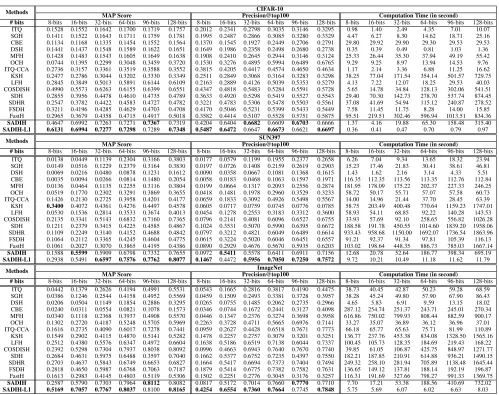
Table 1: The averaged retrieval result comparison (MAP score and precision of top 100 samples) and computation time ef-ficiency (in seconds) onCIFAR-10using512-dimensional GIST features, and bothSUN397 andImageNetdatasets using 4096-dim deep CNN features from VGG19f c7. The best performances have been displayed in boldface.
Methods CIFAR-10
MAP Score Precision@top100 Computation Time (in second)
# bits 8-bits 16-bits 32-bits 64-bits 96-bits 128-bits 8-bits 16-bits 32-bits 64-bits 96-bits 128-bits 8-bits 16-bits 32-bits 64-bits 96-bits 128-bits ITQ 0.1528 0.1552 0.1642 0.1700 0.1719 0.1757 0.2012 0.2341 0.2798 0.3035 0.3146 0.3295 0.98 1.40 2.49 4.35 7.01 10.07 SGH 0.1411 0.1522 0.1643 0.1711 0.1759 0.1781 0.1995 0.2487 0.2866 0.3085 0.3280 0.3329 4.47 6.27 8.30 14.62 18.71 25.16 CBE 0.1134 0.1168 0.1335 0.1454 0.1552 0.1564 0.1370 0.1545 0.1927 0.2449 0.2706 0.2791 29.80 29.92 29.90 29.30 29.53 29.53 DSH 0.1441 0.1437 0.1548 0.1589 0.1622 0.1651 0.1649 0.1986 0.2358 0.2498 0.2680 0.2738 0.35 0.39 0.49 0.81 1.03 1.36 MFH 0.1428 0.1483 0.1543 0.1605 0.1649 0.1638 0.1908 0.2410 0.2645 0.2944 0.3146 0.3124 25.33 26.44 35.30 37.94 49.19 55.42 OCH 0.0744 0.1395 0.2299 0.3048 0.3459 0.3720 0.1530 0.3276 0.4895 0.5994 0.6489 0.6765 9.29 9.25 8.97 13.94 14.53 9.76 ITQ-CCA 0.2736 0.3157 0.3361 0.3519 0.3588 0.3552 0.3815 0.4205 0.4417 0.4574 0.4650 0.4634 1.17 2.14 3.36 6.88 11.25 16.62 KSH 0.2477 0.2786 0.3044 0.3202 0.3330 0.3349 0.2511 0.2849 0.3068 0.3164 0.3283 0.3298 38.25 77.04 171.54 354.14 501.57 729.75 LFH 0.2845 0.3849 0.5013 0.5891 0.6144 0.6109 0.2163 0.2889 0.4126 0.5039 0.5353 0.5279 4.13 7.22 12.07 18.25 29.53 40.03 COSDISH 0.4990 0.5573 0.6263 0.6155 0.6399 0.6551 0.4347 0.4818 0.5483 0.5284 0.5591 0.5728 5.65 14.78 34.84 128.13 302.06 541.51 SDH 0.2855 0.3956 0.4478 0.4610 0.4735 0.4789 0.3633 0.4920 0.5298 0.5419 0.5527 0.5543 29.40 70.30 142.73 278.70 537.74 874.45 SDHR 0.2547 0.3782 0.4422 0.4583 0.4727 0.4782 0.3221 0.4783 0.5306 0.5478 0.5503 0.5561 37.08 41.69 54.94 115.12 240.87 278.52 FSDH 0.3211 0.4196 0.4285 0.4629 0.4703 0.4708 0.4170 0.5046 0.5231 0.5399 0.5433 0.5449 7.58 11.45 11.75 8.28 14.00 15.85 FastH 0.2965 0.3679 0.4358 0.4715 0.4917 0.5018 0.3582 0.4414 0.5107 0.5528 0.5751 0.5875 95.51 219.51 302.46 596.94 1013.51 834.36 SADIH 0.4647 0.6992 0.7263 0.7271 0.7367 0.7319 0.4204 0.6404 0.6682 0.6609 0.6703 0.6666 1.37 4.16 19.88 65.30 158.48 315.40 SADIH-L1 0.6131 0.6994 0.7277 0.7298 0.7289 0.7348 0.5487 0.6472 0.6647 0.6673 0.6621 0.6697 0.36 0.41 0.47 0.70 0.79 0.97
Methods SUN397
MAP Score Precision@top100 Computation Time (in second)
# bits 8-bits 16-bits 32-bits 64-bits 96-bits 128-bits 8-bits 16-bits 32-bits 64-bits 96-bits 128-bits 8-bits 16-bits 32-bits 64-bits 96-bits 128-bits ITQ 0.0138 0.0449 0.1139 0.2304 0.3166 0.3803 0.0177 0.0579 0.1199 0.1955 0.2377 0.2658 6.26 7.04 9.34 13.65 18.32 23.94 SGH 0.0149 0.0516 0.1229 0.2379 0.3164 0.3830 0.0197 0.0726 0.1408 0.2159 0.2619 0.2903 15.23 17.46 21.83 30.41 38.61 46.81 DSH 0.0069 0.0216 0.0480 0.0878 0.1231 0.1612 0.0090 0.0358 0.0667 0.1081 0.1368 0.1615 1.43 1.62 2.16 3.14 4.33 5.51 CBE 0.0035 0.0094 0.0266 0.0814 0.1480 0.2054 0.0058 0.0183 0.0468 0.1063 0.1597 0.1971 116.35 112.35 113.56 113.35 112.76 112.84 MFH 0.0136 0.0464 0.1135 0.2255 0.3116 0.3804 0.0199 0.0664 0.1317 0.2093 0.2556 0.2874 181.95 178.09 175.22 202.37 227.33 246.25 OCH 0.0519 0.1770 0.2302 0.3291 0.3869 0.3655 0.0418 0.1481 0.1978 0.2960 0.3529 0.3233 58.72 50.17 55.71 57.07 57.58 60.73 ITQ-CCA 0.1426 0.2130 0.2725 0.3958 0.4201 0.4177 0.0659 0.1833 0.3092 0.4926 0.5498 0.5567 14.00 14.96 21.44 37.70 28.45 63.39 KSH 0.3400 0.4072 0.4361 0.4276 0.4497 0.4578 0.0605 0.0717 0.0759 0.0745 0.0776 0.0785 58.75 203.49 400.48 770.64 1159.23 1747.01 LFH 0.0530 0.1536 0.2814 0.3533 0.3674 0.4013 0.0454 0.1278 0.2553 0.3183 0.3312 0.3600 58.93 54.11 68.85 92.22 140.28 143.53 COSDISH 0.2135 0.3341 0.5143 0.6832 0.7160 0.7365 0.0796 0.2141 0.4081 0.6096 0.6527 0.6755 33.93 57.69 92.10 258.65 556.82 1026.28
SDH 0.1211 0.2379 0.3415 0.4225 0.4585 0.4867 0.1024 0.3531 0.5070 0.5990 0.6395 0.6672 188.58 191.78 450.55 1014.60 1839.20 1958.06 SDHR 0.1109 0.2249 0.3140 0.4152 0.4688 0.4842 0.0797 0.3212 0.4821 0.6049 0.6489 0.6614 933.43 958.68 1150.00 1692.07 1736.54 1863.96 FSDH 0.1064 0.2112 0.3365 0.4245 0.4604 0.4775 0.0615 0.3224 0.5020 0.6046 0.6451 0.6557 91.21 92.37 91.34 97.81 105.39 116.13 FastH 0.1061 0.2027 0.3070 0.3865 0.4195 0.4386 0.0890 0.2929 0.4676 0.5670 0.5935 0.6203 103.02 198.64 448.35 886.73 785.03 1667.14 SADIH 0.1588 0.5599 0.5909 0.6798 0.7332 0.7655 0.0972 0.5411 0.5578 0.6411 0.6911 0.7156 12.68 20.78 52.64 186.77 398.34 695.19 SADIH-L1 0.2938 0.5491 0.6597 0.7576 0.7762 0.8077 0.1467 0.4472 0.5956 0.7050 0.7250 0.7572 9.72 10.21 10.49 11.18 11.62 11.79
Methods ImageNet
MAP Score Precision@top100 Computation Time (in second)
# bits 8-bits 16-bits 32-bits 64-bits 96-bits 128-bits 8-bits 16-bits 32-bits 64-bits 96-bits 128-bits 8-bits 16-bits 32-bits 64-bits 96-bits 128-bits ITQ 0.0442 0.1379 0.2626 0.4194 0.4991 0.5531 0.0543 0.1665 0.2816 0.3817 0.4190 0.4475 38.73 40.45 42.87 50.23 59.28 68.59 SGH 0.0386 0.1246 0.2544 0.4158 0.4952 0.5569 0.0459 0.1509 0.2493 0.3381 0.3728 0.3957 38.28 45.24 49.80 57.90 67.90 86.43 DSH 0.0206 0.0504 0.1149 0.1854 0.2886 0.3295 0.0265 0.0755 0.1485 0.2062 0.2735 0.2966 4.65 5.83 6.91 9.59 13.15 18.02 CBE 0.0240 0.0311 0.0554 0.0821 0.1078 0.1573 0.0346 0.0744 0.1672 0.2441 0.3127 0.4098 287.12 254.74 251.37 243.71 245.01 270.34 MFH 0.0340 0.1118 0.2368 0.3937 0.4908 0.5570 0.0446 0.1347 0.2376 0.3274 0.3698 0.3958 616.86 750.02 799.93 808.44 882.59 900.17 OCH 0.1302 0.2720 0.4187 0.5248 0.5705 0.5969 0.2263 0.3728 0.4711 0.5665 0.6976 0.7141 33.27 35.07 36.89 36.12 36.96 37.01 ITQ-CCA 0.1616 0.2735 0.4090 0.6017 0.7278 0.7441 0.0959 0.2627 0.4428 0.6518 0.7671 0.7773 66.18 65.77 65.63 75.71 81.99 110.89 KSH 0.1549 0.2902 0.4115 0.4870 0.5141 0.5282 0.1478 0.2257 0.2757 0.3079 0.3201 0.3251 136.77 237.76 453.38 834.08 1328.50 1565.16 LFH 0.2512 0.4380 0.5576 0.6347 0.4972 0.6604 0.1638 0.5186 0.6519 0.7138 0.6044 0.7337 100.45 105.73 128.35 184.69 219.43 168.22 COSDISH 0.2392 0.5298 0.7304 0.7937 0.8038 0.8092 0.0996 0.4663 0.6943 0.7640 0.7670 0.7740 39.85 61.05 106.87 425.75 848.97 1271.77
SDH 0.2684 0.4631 0.5975 0.6488 0.3597 0.7040 0.1662 0.5377 0.6752 0.7235 0.4397 0.7550 182.21 187.85 210.91 614.88 936.21 1490.15 SDHR 0.2703 0.4637 0.5843 0.6749 0.6653 0.6827 0.1664 0.5417 0.6694 0.7373 0.7404 0.7494 249.32 258.10 281.94 705.89 1138.48 1645.44 FSDH 0.2818 0.4650 0.5987 0.6768 0.7063 0.7187 0.1879 0.5414 0.6775 0.7382 0.7582 0.7631 136.65 149.12 137.81 188.14 192.19 196.87 FastH 0.1613 0.2983 0.4145 0.4803 0.5119 0.5306 0.1502 0.2251 0.2776 0.3045 0.3176 0.3257 116.31 191.69 327.66 798.27 991.33 1369.75 SADIH 0.2587 0.5790 0.7303 0.7964 0.8112 0.8082 0.0817 0.5172 0.7014 0.7660 0.7770 0.7710 7.70 17.21 53.38 188.56 410.69 732.02 SADIH-L1 0.5169 0.7057 0.7767 0.8037 0.8100 0.8165 0.4254 0.6554 0.7360 0.7664 0.7745 0.7848 5.75 5.69 6.07 6.02 6.63 8.03
In experiments, we found that our algorithm usually can efficiently converge withint = 5−8 iterations. The main computational complexity of our algorithm comes from cal-culating B of each iteration in O(lcn) for SADIH and O(nc) for SADIH-L1. Additionally, during optimization, the maximum complexity of other steps isO(ndc)due to the property of matrix product and inversion, which is very effi-cient in practice. In general, the computational complexities of the proposed optimization algorithm on SADIH learning is linear to the number of samplesO(n).
Experiments
In this section, we conduct extensive evaluations of our dis-criminative hashing methods on real-world datasets. All the experiments were implemented on Matlab 2013a on a stan-dard Window PC with 64 GB RAM.
Datasets:We evaluate the proposed SADIH and
SADIH-L1 on three publicly available benchmark databases: CIFAR-10 (Krizhevsky and Hinton 2009), Sun397 (Xiao et al. 2010), andImageNet(Deng et al. 2009).Cifar-10is a labeled subset of 80M tiny images, containing60,000tiny color images in10classes of objects with6,000images per class. Each image with unique semantic label is represented by512-dim GIST features on the32×32pixels. Moreover, we employ the nonlinear anchor features to improve the in-terpretation of features as in (Shen et al. 2015).SUN-397
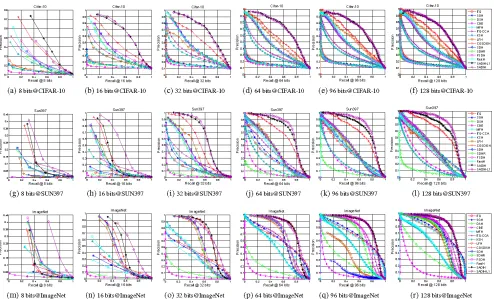
Figure 1: Precision-Recall curves of different methods with different code lengths on CIFAR-10, SUN397 and ImageNet.
Similarly, the4,096-diml deep CNN features from VGG19
f c7were used for evaluation.
Experimental Settings: Following the previous experi-mental configurations used in (Shen et al. 2015; Kang, Li, and Zhou 2016), we randomly split the CIFAR-10 dataset into a training set (59Kimages) and a test query set (1,000 images), which has100images per category. In SUN-397, we randomly sample100 images from each of the first18 largest scene categories to formulate1,800 query images. For ImageNet, we randomly select50images for each cat-egory from the validation image dataset to construct the 5,000 query image dataset. The semantic similarities on these datasets are measured whether two images share the same semantic label. For all datasets, we conduct feature normalization to make each dimension have zero-centered mean and equal variance.
Baseline Methods and Implementation Details:In ex-periments, we compare our SADIH and SADIH-L1 with 14 hashing methods including six unsupervised hashing meth-ods, (i.e., ITQ, SGH, DSH (Jin et al. 2014), CBE, and OCH) and eight supervised hashing methods (i.e., ITQ-CCA (Gong et al. 2013), KSH, LFH, COSDISH, SDH, SDHR, FSDH, FastH). All the compared algorithms were performed five times with different random initializations, and the av-eraged experimental results were reported. To make fair comparison, all the compared methods were reimplemented using the released source codes given by the correspond-ing authors. Specifically, we searched the best parameters
carefully for each algorithm by five-folds cross-validation, or directly employed the default parameters suggested by the original papers. For graph based method such as KSH and OCH, using the full semantic information for train-ing is impossible due to the heavy computation complex-ity, and5,000samples were selected from the training data for model construction. For our SSAH, the parameterγwas empirically set to 0.001. For the parameters αand β, we should tune it by cross-validation from the candidate set {0.01,0.1,1.0,5,10}. The maximum iteration numbertwas set to5, which could assure the best performance.
Evaluation Measures:We adopted three frequently-used performance metrics (Manning, Raghavan, and others 2008) to evaluate different methods, i.e.mean average precision (MAP), the precision-recall curves and mean precision rate curves of top 1000 returned samples. Moreover, we also compared the computation time to show efficiency.
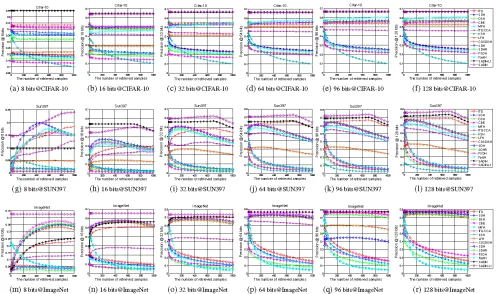
Figure 2: Precision curves of up to 1000 retrieved samples of different methods with different code lengths on CIFAR-10, SUN397 and ImageNet. (Better to view in color)
achieve the highest MAP scores with different code lengths, which demonstrate the efficacy of the proposed framework. Our SADIH and SADIH-L1 always produce superior perfor-mance to SDH, FSDH, FastH and SDHR, since our methods simultaneously consider the category information and pair-wise similarities, however, other mentioned methods neglect the similarity preservation. Compared to KSH, LFH and COSDISH, our methods can make use of thef ull similari-ties and discriminative category-level information for learn-ing effective binary codes, yieldlearn-ing superior performance. 3) SADIH-L1 has a tendency to outperform SADIH, since
l1-norm regularization can generate more accurate approxi-mation measurement. Increasing the coding lengths can im-prove the retrieval accuracies, but needs more training time. 4) Supervised methods seem to consume longer computation time compared to unsupervised ones. However, our SADIH-L1 is the fastest one in supervised methods, and SADIH can provide good balance between performance and time.
We further show the precision-recall curves of the com-pared methods with varying code lengths in Fig. 1. It can be observed that our methods are consistently better than all the competing methods, which indicates that our methods can retrieve more similar samples for a query at any fixed code length. Moreover, the precision variationsw.r.t. differ-ent number of retrieved samples are illustrated in Fig. 2. We can observe that our methods are always superior to other methods, and their precisions are relatively stable with
vary-ing number of returned samples.
Conclusion
In this paper, we proposed a novel joint discriminative hash-ing framework, dubbed semantic-aware DIscrete Hashhash-ing (SADIH), which could efficiently guarantee the full seman-tic similarity preservation and discriminative semanseman-tic space construction. SADIH leveraged the asymmetric similarity approximation loss to preserve the fulln×nsimilarities of the complete dataset. Meanwhile, the supervised semantic-aware autoencoder was designed to construct the discrim-inative semantic embedding space with full data variation preservation and good data reconstruction. The resulting problem was efficiently solved by the proposed discrete op-timization algorithm. Extensive experimental results demon-strated the superiority of our methods on different large-scale datasets in terms of different evaluation protocols.
Acknowledgment This work is partially supported by ARC FT130101530.
References
Deng, J.; Dong, W.; Socher, R.; Li, L.-J.; Li, K.; and Fei-Fei, L. 2009. Imagenet: A large-scale hierarchical image database. InCVPR, 248–255. IEEE.
dis-tance estimation with sketches for similarity search in high-dimensional spaces. InSIGIR, 123–130. ACM.
Erin Liong, V.; Lu, J.; Wang, G.; Moulin, P.; and Zhou, J. 2015. Deep hashing for compact binary codes learning. In
CVPR, 2475–2483.
Gionis, A.; Indyk, P.; Motwani, R.; et al. 1999. Similarity search in high dimensions via hashing. InVLDB, volume 99, 518–529.
Gong, Y.; Lazebnik, S.; Gordo, A.; and Perronnin, F. 2013. Iterative quantization: A procrustean approach to learning binary codes for large-scale image retrieval. IEEE TPAMI
35(12):2916–2929.
Gui, J.; Liu, T.; Sun, Z.; Tao, D.; and Tan, T. 2016. Super-vised discrete hashing with relaxation.TNNLS.
Gui, J.; Liu, T.; Sun, Z.; Tao, D.; and Tan, T. 2018. Fast supervised discrete hashing.TPAMI40(2):490–496.
Jiang, Q.-Y., and Li, W.-J. 2015. Scalable graph hashing with feature transformation. InIJCAI, 2248–2254.
Jiang, K.; Que, Q.; and Kulis, B. 2015. Revisiting kernelized locality-sensitive hashing for improved large-scale image re-trieval. InCVPR, 4933–4941.
Jin, Z.; Li, C.; Lin, Y.; and Cai, D. 2014. Density sensitive hashing. IEEE Trans. Cybern.44(8):1362–1371.
Kang, W.-C.; Li, W.-J.; and Zhou, Z.-H. 2016. Column sampling based discrete supervised hashing. InAAAI, 1230– 1236.
Krizhevsky, A., and Hinton, G. 2009. Learning multiple lay-ers of features from tiny images. Technical report, Citeseer.
Kulis, B., and Darrell, T. 2009. Learning to hash with binary reconstructive embeddings. InNIPS, 1042–1050.
Kulis, B., and Grauman, K. 2009. Kernelized locality-sensitive hashing for scalable image search. InICCV, 2130– 2137. IEEE.
Lai, H.; Pan, Y.; Liu, Y.; and Yan, S. 2015. Simultaneous feature learning and hash coding with deep neural networks. InCVPR, 3270–3278.
Lew, M.; Sebe, N.; Djeraba, C.; and Jain, R. 2006. Content-based multimedia information retrieval: State of the art and challenges.ACM TOMM2(1):1–19.
Li, W.-J.; Wang, S.; and Kang, W.-C. 2016. Feature learn-ing based deep supervised hashlearn-ing with pairwise labels. In
IJCAI, 1711–1717.
Lin, G.; Shen, C.; Shi, Q.; Van den Hengel, A.; and Suter, D. 2014. Fast supervised hashing with decision trees for high-dimensional data. InCVPR, 1963–1970.
Lin, K.; Yang, H.-F.; Hsiao, J.-H.; and Chen, C.-S. 2015. Deep learning of binary hash codes for fast image retrieval. InCVPRW, 27–35.
Liu, W.; Wang, J.; Ji, R.; Jiang, Y.; and Chang, S. 2012. Su-pervised hashing with kernels. InCVPR, 2074–2081. IEEE.
Liu, H.; Ji, R.; Wang, J.; and Shen, C. 2018. Ordinal constraint binary coding for approximate nearest neighbor search.TPAMI(99):1–1.
Luo, X.; Wu, Y.; and Xu, X. 2018. Scalable supervised dis-crete hashing for large-scale search. InWWW, 1603–1612. Manning, C. D.; Raghavan, P.; et al. 2008. Introduction to information retrieval. Cambridge University Press.
Neyshabur, B.; Srebro, N.; Salakhutdinov, R. R.; Makarychev, Y.; and Yadollahpour, P. 2013. The power of asymmetry in binary hashing. InNIPS, 2823–2831. Salakhutdinov, R., and Hinton, G. 2009. Semantic hashing.
IJAR50(7):969–978.
Shen, F.; Shen, C.; Liu, W.; and Tao Shen, H. 2015. Super-vised discrete hashing. InCVPR, 37–45.
Shen, F.; Xu, Y.; Liu, L.; Yang, Y.; Huang, Z.; and Shen, H. T. 2018. Unsupervised deep hashing with similarity-adaptive and discrete optimization.TPAMI.
Shrivastava, A., and Li, P. 2014. Asymmetric lsh (alsh) for sublinear time maximum inner product search (mips). In
NIPS, 2321–2329.
Simonyan, K., and Zisserman, A. 2014. Very deep convo-lutional networks for large-scale image recognition. arXiv preprint arXiv:1409.1556.
Smeulders, A. W.; Worring, M.; Santini, S.; Gupta, A.; and Jain, R. 2000. Content-based image retrieval at the end of the early years. TPAMI(12):1349–1380.
Song, J.; Yang, Y.; Huang, Z.; Shen, H. T.; and Hong, R. 2011. Multiple feature hashing for real-time large scale near-duplicate video retrieval. InACMM, 423–432. ACM. Song, J.; Gao, L.; Liu, L.; Zhu, X.; and Sebe, N. 2018. Quantization-based hashing: a general framework for scal-able image and video retrieval. PR75:175–187.
Wang, J.; Zhang, T.; Sebe, N.; Shen, H. T.; et al. 2018. A survey on learning to hash. IEEE TPAMI40(4):769–790. Wang, J.; Kumar, S.; and Chang, S. 2012. Semi-supervised hashing for large-scale search. TPAMI(12):2393–2406. Weiss, Y.; Torralba, A.; and Fergus, R. 2009. Spectral hash-ing. InNIPS, 1753–1760.
Xiao, J.; Hays, J.; Ehinger, K. A.; Oliva, A.; and Torralba, A. 2010. Sun database: Large-scale scene recognition from abbey to zoo. InCVPR, 3485–3492. IEEE.
Zhang, Z.; Liu, L.; Qin, J.; Zhu, F.; Shen, F.; Xu, Y.; Shao, L.; and Shen, H. 2018a. Highly-economized multi-view binary compression for scalable image clustering. InECCV, 717–732.
Zhang, Z.; Liu, L.; Shen, F.; Shen, H. T.; and Shao, L. 2018b. Binary multi-view clustering. IEEE TPAMI99:1–1. Zhang, Z.; Shao, L.; Xu, Y.; Liu, L.; and Yang, J. 2018c. Marginal representation learning with graph structure self-adaptation. IEEE TNNLS29:4645–4659.