The Thirty-Third AAAI Conference on Artificial Intelligence (AAAI-19)
Self-Supervised Mixture-of-Experts by Uncertainty Estimation
Zhuobin Zheng,
1,2Chun Yuan,
2Xinrui Zhu,
1,2Zhihui Lin,
1,2Yangyang Cheng,
1,2Cheng Shi,
1,2Jiahui Ye
1,31Department of Computer Science and Technologies, Tsinghua University, Beijing, China
2Graduate School at Shenzhen, Tsinghua University, Shenzhen, China
3Tsinghua-Berkeley Shenzhen Institue, Tsinghua University, Shenzhen, China
{zhengzb16, zhuxr17, lin-zh14, cheng-yy13, shic17, yejh16}@mails.tsinghua.edu.cn, [email protected]
Abstract
Learning related tasks in various domains and transferring exploited knowledge to new situations is a significant chal-lenge in Reinforcement Learning (RL). However, most RL algorithms are data inefficient and fail to generalize in com-plex environments, limiting their adaptability and applicabil-ity in multi-task scenarios. In this paper, we propose Self-Supervised Mixture-of-Experts (SUM), an effective algo-rithm driven by predictive uncertainty estimation for multi-task RL. SUM utilizes a multi-head agent with shared pa-rameters as experts to learn a series of related tasks simul-taneously by Deep Deterministic Policy Gradient (DDPG). Each expert is extended by predictive uncertainty estimation on known and unknown states to enhance theQ-value eval-uation capacity against overfitting and the overall generaliza-tion ability. These enable the agent to capture and diffuse the common knowledge across different tasks improving sam-ple efficiency in each task and the effectiveness of expert scheduling across multiple tasks. Instead of task-specific de-sign as common MoEs, a self-supervised gating network is adopted to determine a potential expert to handle each inter-action from unseen environments and calibrated completely by the uncertainty feedback from the experts without explicit supervision. To alleviate the imbalanced expert utilization as the crux of MoE, optimization is accomplished via decayed-masked experience replay, which encourages both diversifi-cation and specialization of experts during different periods. We demonstrate that our approach learns faster and achieves better performance by efficient transfer and robust general-ization, outperforming several related methods on extended OpenAI Gym’s MuJoCo multi-task environments.
1
Introduction
Reinforcement Learning (RL) (Sutton and Barto 1998) trains an agent to solve sequential decision-making prob-lems through trial and error interactions with the environ-ment. With the significant advance of deep neural networks as effective function approximators, Deep RL has been scaled and demonstrated success in various complex do-mains like Go game (Silver et al. 2017), video games (Mnih et al. 2015) and robotic control tasks (Gu et al. 2017). How-ever, most typical RL methods are sample inefficient requir-ing substantial experiences and large computational cost
be-Copyright c2019, Association for the Advancement of Artificial Intelligence (www.aaai.org). All rights reserved.
fore obtaining acceptable behaviors, especially when solv-ing multiple related problems.
One effective direction for improving data efficiency is multi-task learning (Caruana 1997), which shares similar characteristics and transfers reusable representations across multiple tasks. Intuitively, by applying multi-task strategies, algorithms can accelerate the convergence and improve the performance of each task w.r.t. single-task learning, while requiring less training data overall. This further renders the agent applicable to complex real-world environments with robust generalization in different situations (Finn et al. 2017). However, in practice when RL combines with multi-task techniques such as shared structure, the learning process tends to be unstable due to the different complexity and re-ward schemes between tasks (Teh et al. 2017). We ascribe this negative effect to the interference caused by noised gra-dients from different domains, which misleads the training of vanilla multi-task approaches.
Another issue is deep RL agent “robustly” suffers from overfitting (Zhang et al. 2018), which negatively affects the performance of transfer. As deep RL algorithms are increas-ingly employed in critical problems such as autonomous control, healthcare, finance, and safety (Amodei et al. 2016), it is crucial to understand the generalization and adapta-tion abilities of trained agents before real-world deployment. Besides, the crux of multi-task RL is not only exploiting reusable representations but furthermore transferring them across domains effectively. Apart from techniques for mit-igating overfitting, quantifying the uncertainty of specific tasks brings a more intuitive understanding of generaliza-tion capacity in deep models. In this case, multi-task RL agents with well-calibrated predictive uncertainty estima-tion can avert overconfident incorrect predicestima-tions (Lakshmi-narayanan, Pritzel, and Blundell 2017) and accomplish mul-tiple tasks by robust generalization and efficient transfer.
in-cluding multiple actor heads for exploration and multiple critic heads for evaluation. To counteract the adverse effects of overfitting, experts are enhanced by uncertainty
estima-tion on known and unknown states to improve theQ-value
evaluation and generalize robustly across multiple tasks. When interacting with tasks from an unknown distribution, a gating network determines a potential expert according to all uncertainty estimates of the state from experts. It lever-ages these uncertainty feedback as self-supervision to opti-mize without explicit supervision. Furthermore, we exploit decayed-masked experience replay to improve both early di-versification and late specialization of experts in different stages. We present empirical experiments to analyze our al-gorithm dealing with a series of continuous control tasks on extended MuJoCo environments (Henderson et al. 2017).
The contributions of this work include:
• We introduce uncertainty estimation to the critic of DDPG
for enhancedQ-value evaluation, which alleviates
overfit-ting in an individual task and improves robust generaliza-tion ability across multiple tasks.
• We extend multi-head DDPG as MoE architecture with a
gating network self-supervised completely by uncertainty estimates from experts without extra supervision, which improves data efficiency and performance substantially by effective knowledge sharing and expert scheduling.
• To tackle the imbalanced expert utilization, we exploit
decayed-masked experience replay to motivate the experts to concentrate on different objectives during training.
• We evaluate our approach via extensive experiments from
different perspectives, including uncertainty enhance-ment, generalization ability, and multi-task performance.
2
Related Work
In recent years, most research has focused on de-veloping multi-task RL algorithms by transfer learning paradigm (Lazaric 2012). A primary series of approaches are based on policy distillation, which usually constructed as a student-teacher architecture, including (Rusu et al. 2015; Parisotto, Ba, and Salakhutdinov 2015; Teh et al. 2017). Some attempts focus on effective representation reuse in different perspectives, such as shared abstractions of state-action space (Borsa, Graepel, and Shawe-Taylor 2016), pro-gressive network (Rusu et al. 2016), etc.
Uncertainty estimation has been increasingly prevalent as an effective method to reduce the risk of overfitting (Zhang et al. 2018) and understand the agent’s generalization abil-ity. Furthermore, with the advance of reliable uncertainty estimation, algorithms can tackle difficult specific issues in RL, including balancing between exploration and ex-ploitation (Dearden, Friedman, and Russell 1998), avoid-ing collisions in unknown control tasks (Kahn et al. 2017), etc. However, for uncertainty in multi-task RL, there are relatively few methods available based on the Bayesian approach (Lazaric and Ghavamzadeh 2010; Wilson et al. 2007). Unlike these work, we exploit an auxiliary extension of the neural network (Nix and Weigend 1994) to quantify the predictive uncertainty in the critic of DDPG.
Mixture-of-experts (MoE) (Jacobs et al. 1991; Jordan and Jacobs 1994) is an effective ensemble learning ap-proach that uses a gating function to specialize models to alleviate overfitting and improve the performance of com-plex tasks (Shazeer et al. 2017). This paper presents a novel framework based on MoE architecture tackling multi-task RL by two components, one based on the multi-head DDPG (Zheng et al. 2018) as experts and one using a self-supervised gating function for expert scheduling.
Self-supervised learning enables learning without explicit supervision and exploits unlabeled data to provide intrinsic representations as self-supervision. It has been prevalently pursued in computer vision (Donahue, Kr¨ahenb¨uhl, and Dar-rell 2017; Doersch and Zisserman 2017) and RL (Shelhamer et al. 2016; Pathak et al. 2017). In this work, we first inves-tigate the effectiveness of optimizing a gating function via uncertainty estimation in a completely self-supervised man-ner, instead of common supervised approaches.
3
Background
3.1
Preliminary and Notation
In the reinforcement learning setup, tasks are modeled as a
Markov decision process(MDP) where an agent in a state
st interacts with an environmentE by applying an action
atand receives a rewardrttogether with a new statest+1at
each discrete time stept. MDP consists of a state spaceS, an
action spaceA, a state transition functionP :S × A 7→ S,
a reward functionR:S × A 7→Rand a discount factorγ∈
(0,1], which can be formalized ashS,A,P,R, γi. We
de-fine the overall return from the statestas the discounted
cu-mulated rewardRt=rt+PT
i=t+1γ
i−tR(si, ai). The agent
aims to find an optimal policy π : S 7→ A, which can be
stochastic or deterministic, to maximize the expected return
from the initial state, Rπ(s0) =
Eri≥0,si≥0∼E,ai≥0∼π[R0].
Another key concept is the action value, also calledQ-value,
which is an estimate of the expected discounted return for
selecting actionatin statestand following policyπ:
Qπ(st, at) =Eri>t,si>t∼E,ai>t∼π[Rt|st, at]. (1)
3.2
Deep Deterministic Policy Gradient (DDPG)
This work builds upon DDPG (Lillicrap et al. 2016), a model-free off-policy algorithm for high-dimensional con-tinuous action domains. DDPG utilizes an actor-criticarchi-tecture including aQ-value function (the criticQ) optimized
by temporal difference (TD) inpolicy evaluationstep,
L(θQ) = 1 n
X
i
(ri+γQ0(si+1, µ0(si+1|θµ
0
)|θQ0)
−Q(si, ai|θQ))2,
(2)
and a policy function (the actorµ) updated by policy
gradi-ent (Silver et al. 2014) inpolicy improvementstep,
∇θµ ←
1 n
X
i
∇aQ(si, a|θQ)|a=µ(si|θµ)∇θµµ(si|θ µ), (3)
whereQ0, µ0 are target networks that slowly trackQ, µ
re-spectively in each update step,
H1 H2 H3
Concat
H1 H2 H3
Agent (SUM)
Gating
Actor Critic
MSE
Q-variances Q-values Transformer
Replay Buffer
E1
E2
E3
...
Envs
Softmax
H3
H2
H1
Q-variances Q-values
Q1 V1 Q2 V2 Q3 V3
H1 H2 H3
Actor Critic
Action Actions
rt
st
st+1
at
st
st g’t
(st , at, st+1, rt,mt)
st
st
Expert Selector Store
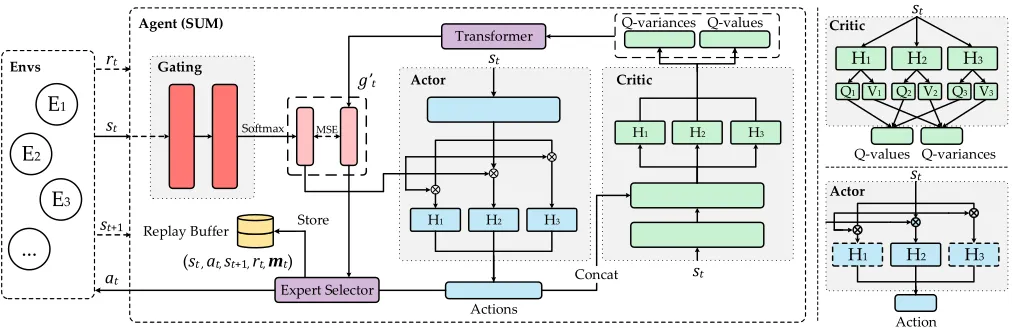
Figure 1: Left: Structure of SUM. When the agent receives a state from an unknown environment, the gating network (red) outputs a scheduling vector expecting a specific expert (actor head) with the highest activation to interact. Given the same state,
each actor head (blue) produces an action together with respectiveQ-value andQ-variance from the paired critic head (green).
Based on this information, a transformer (purple) generates a “ground truth” scheduling vector to select an expert to interact. Besides, experiences with decayed masks are stored for training both the experts and the gating function. Right: Mechanism of the multi-head critic evaluating during training and the multi-head actor activated by the gating network during testing.
withτ∈(0,1]. Benefiting from experience replay and target
networks, DDPG is trainable on off-policy data with stabil-ity, which significantly brings sample efficiency.
4
Self-Supervised Mixture-of-Experts
In this work, we develop Self-Supervised Mixture-of-Experts (SUM) for multi-task RL (see Figure 1). For clar-ity of explanation, we first describe Uncertainty-Enhanced Multi-head DDPG as basic experts of MoE. Following that, we show how Self-Supervised Gating Network trains and works for expert specialization and scheduling.
4.1
Uncertainty-Enhanced Multi-head DDPG
Though vanilla DDPG (Lillicrap et al. 2016) shows impres-sive performance in continuous control tasks, it is suscepti-ble to the randomness of complex environments, which may lead to data inefficiency and poor generalization. To coun-teract the adverse effects of the above problems, we intro-duce predictive uncertainty estimation into DDPG to capture the uncertainty of states from known and unknown tasks. Specifically, following (Nix and Weigend 1994) which is demonstrated effective in quantifying uncertainty, we extend the critic network to generate two values in the final layer,corresponding to the predicted meanQ-valueQ(si, ai)and
Q-varianceσ2(s
i, ai)(shown in Figure 1). By treating the
observedQ-value as a sample from a Gaussian distribution
with the predicted mean and variance, the critic is optimized by minimizing the negative log-likelihood (NLL) criterion,
L(θQ) = 1 n
X
i (logσ
2(si, ai)
2 +
(yi−Q(si, ai))2 2σ2(s
i, ai)
), (5)
whereyiis the targetQ-value andnis the mini-batch size.
With this enhancement, the critic is supervised towards
producing not only accurate but reliableQ-value with
well-calibrated uncertainty estimation reduction, which is robust to task shift. Besides, uncertainty-enhanced DDPG can de-tect and avert overfitting in advance by techniques like early
stopping. In multi-task scenarios, utilizing only Q-value
from the critic trained on a specific task is not sufficient and
reliable for estimatingQ-value in different or unseen tasks.
However, a critic with auxiliary uncertainty estimation can improve understanding of the generalization and adaptation abilities in unknown domains, which further benefits multi-task performance. Notably, this is a general extension for estimating the uncertainty in the environment requiring few modifications to value-based RL algorithms.
Towards the goal of multi-task learning, we contribute predictive uncertainty estimation to SOUP (Zheng et al. 2018), an algorithm that combines multi-head bootstrapped
DDPG with self-adaptive confidence to alleviate spottyQ
-value in single-task RL. However, this rough state-based confidence strategy with the scarcity of crucial relevant in-formation, such as actions selected by respective actors and intermediate representations in the critics, hampers its ca-pacity of accurate evaluation, especially in multi-task do-mains with different complexity and reward schemes. In-stead of crude external uncertainty approximator in SOUP, we directly extend each critic of multi-head DDPG with an
auxiliary output unit asQ-variance. Since this unit is
acces-sible to exploit the entire crucial information, it yields higher potentiality towards well-calibrated uncertainty estimation. Note that, different from SOUP selecting an action simply
with the maximumQ-value, our approach takes not onlyQ
-value but mainlyQ-variance, into consideration for potential
action selection more effectively and reasonably.
ar-chitecture simulates Deep Ensembles technique (Lakshmi-narayanan, Pritzel, and Blundell 2017), averaging predic-tions over multiple models, which significantly improves un-certainty quality and robustness by variance reduction. In
this case, critics can produce more accurateQ-value
esti-mates by “ensemble” improving the generalization ability against overfitting. Furthermore, when applying to unknown tasks, highly specialized experts with relatively lower un-certainty shows reliably higher confidence to tackle specific states, which benefits effective expert scheduling enhancing the overall generalization capacity across multiple tasks.
4.2
Self-Supervised Gating Network
The core of MoE is an effective gating function which per-forms expert specialization in training and expert scheduling in testing. We propose a self-supervised gating network cal-ibrated completely by uncertainty estimates from experts in an end-to-end manner without explicit supervision.
Self-Supervised Training When the agent of MoE with
Kheads{Q, µ}1,...,Kinteracts with the environment given
st, the gating network G, parameterized by θG, generates
a gating value as a scheduling vectorG(st), which denotes
different degrees of expected preference for experts to
inter-act in the current statest. Note that each actor head in
multi-head DDPG is considered as an expert. Following that, each
actor head produces an action candidateak
twhile at the same
time its paired critic head produces respectiveQ-valueQk
andQ-varianceσ2
k, which represents how uncertain the
ex-pert is about its evaluation of the actionak
t. Based on the
un-certainty estimatesσ2, we construct the “ground truth”
soft-max gatingg0(st)(Shazeer et al. 2017) as self-supervision:
g0(st) =Sof tmax(H(st)). (6)
Note thatH(st)is a one-hot vector only when an expert
spe-cializes and “masters” exploiting much more rewards inst
with discriminatively highestQ-value (i.e., twice of others)
and reliably lowestQ-variance concurrently, otherwise
H(st)k =
+1, σ2
k ∈KeepT opX(σ2, x),
0, otherwise, (7)
whereKeepT opX(v, x)keeps only topxvalues inv(we
setx = 2). In this case,H(st)encourages the gating
net-work to alleviate overfitting by activating experts with rela-tively high uncertainty which own more potential to explore
and exploit more rewards in the statestcompared with the
lower ones, which may be stuck in local optima. In
prac-tice,H(st)usually results in a one-hot vector in most cases
(85%∼). The actionatis chosen to interact withst,
receiv-ing a new statest+1and a rewardrt, according to
at={akt|k= arg max k
{g0(st)}}. (8)
A new transition (st, at, st+1, rt,mt) is stored in replay
buffer for experience play, wheremt={mkt|mkt =gk0(st)}
represents the probabilities of this transition trained by the
experts. During training, a mini-batch ofnsamples are
col-lected to optimize both experts as vanilla DDPG and the gat-ing function by Mean Squared Error (MSE) as follows:
L(θG) = 1 n
X
i
(g0(si)−G(si))2, g0(si) =mi. (9)
Algorithm 1Self-Supervised Mixture-of-Experts
Input:number of headsK, environmentsN. batch sizen
Initialize: Initialize critic and actor networks with K
heads{θQk, θµk}K
k=1 and copy weights to target networks
{θQk0, θµk0}K
k=1. Initialize the gating network θG, the
re-play bufferR, and multi-task environments{E}Ni=1
forepisodee= 1, Emaxdo
Initialize a Gaussian noiseN for action exploration
Get states0from randomly selected environmentEi
forstept= 1, Tmaxdo
Generate a scheduling vectorG(st)
Kactor heads output actions
Kcritic heads outputQ-values andQ-variances
Generate targeted scheduling vectorg0(st)by (6)
Select actionataccording to (8) and applyN
Executeatthen observe rewardrtand statest+1
Assign maskmt=g0(st)
Store transition(st, at, st+1, rt,mt)inR
Randomly selectk-th actor and critic heads
Randomly sample a batch ofntransitions
Update paired headsµk, Qkaccording to (3) (5)
Update thek-th target networks according to (4)
Update the gating network according to (9)
Decayxt
DM according to (10)
end for end for
A more detailed procedure is in Figure 1 and Algorithm 1.
Why Uncertainty Estimation as Self-Supervision Dif-ferent from common supervised based MoE demanding large task-specific datasets with rich annotations (i.e., classi-fication), utilizing self-supervision exploited from raw data is significant to accomplish the supervision-starved tasks without human intervention. Well-calibrated uncertainty es-timation is demonstrated effective towards understanding the generalization capacity when tasks shift and simple to implement (Lakshminarayanan, Pritzel, and Blundell 2017). It is intuitively suitable for MoE in multi-task RL domain,
whereQ-value evaluation may be inaccurate and sufficient
for decision-making across MDPs. In this situation, uncer-tainty estimation as a reliable criterion encourages expert specialization and scheduling appropriately driven by their “confidence” in a completely self-supervised manner.
Decayed Mask Experience Replay (DMER) The crux of MoE is balancing expert utilization in both diversification and specialization (Shazeer et al. 2017). We notice that the gating network sometimes tends to converge to a situation where it only produces large weights for the same few ex-perts, which hampers the overall multi-task performance. We exploit decayed mask experience replay designed for training multiple RL experts diversely. Concretely, we
re-placexin Eq. (7) withxt
DM, which is initialized as the
num-ber of headsKand decays throughout training:
xtDM+1 =dxtDM ∗λne, λn = t
Y
i=1
whereλis the decay rate. In the early period, experts are trained in the entire replay buffer for acquiring common behaviors to tackle basic tasks, which leads to diversifica-tion and alleviates the risk of imbalanced capacity and even
single-expert domination. Asxt
DM decreases, experts with
fundamental skills are provided different experiences ac-cording to the diverse masks generated from their uncer-tainty estimates and specialized in different directions.
Data Efficiency Bootstrap technique is demonstrated ef-fective for deep exploration (Osband et al. 2016). DMER applies a masking mechanism similar as bootstrap, which induces diversity for efficient exploration, though in vary-ing degrees durvary-ing different stages from early diversifica-tion to late specializadiversifica-tion. This breaks the limitadiversifica-tion of com-mon task-specific design where experts are only trained on assigned tasks with risk of overfitting. Besides, under the architecture including multiple experts with shared param-eters, common knowledge across related tasks can be dif-fused and transferred quickly, which significantly improves data efficiency and the overall multi-task performance.
5
Experiments
We evaluate our approach on continuous control environ-ment MuJoCo (Todorov, Erez, and Tassa 2012) and its multi-task extension (Henderson et al. 2017) (see Figure 2). In most environments, a specific robot is rewarded by moving forward as fast as possible. We demonstrate the effectiveness and analyze the performance of SUM by experiments:
1. We compare the impacts benefiting from uncertainty en-hancement in the single-task environment.
2. We further examine the generalization ability in tackling multiple related tasks in difficult situations.
3. We evaluate data efficiency and expert utilization of our model on learning multiple tasks simultaneously.
In all cases, we use fully-connected network (see Figure 1),
where hidden layer and head layer sizes are denoted by (N,
M). Unless otherwise stated, we adopt the network structure
(e)
(f)
(g)
(h)
(a)
(b)
(c)
(d)
Figure 2: Illustrations of basic (top) and extended (bottom) locomotion tasks on MuJoCo: (a) Hopper, (b) Walker2D, (c) HalfCheetah, (d) Humanoid, (e) HopperWall, (f) Hop-perStairs, (g) HumanoidWall and (h) HumanoidStandup.
0.0 0.2 0.4 0.6 0.8 1.0 Episodes ×104
0.0 0.5 1.0 1.5 2.0
Averaged Return
×103 Hopper Environment
DDPG (K=1) DDPG (K=3) SUM (K=1) SUM (K=3) SUM (K=5)
0.0 0.2 0.4 0.6 0.8 Episodes ×104
0.0 0.5 1.0 1.5 2.0 2.5 3.0
Averaged Return
×103 Walker Environment
DDPG (K=1) DDPG (K=3) SUM (K=1) SUM (K=3) SUM (K=5)
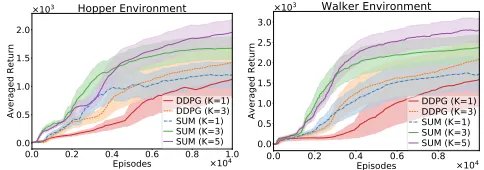
Figure 3: Performance of models with a different number
of heads. The shaded area denotes the mean±the standard
deviation. SUM (K = 3,5) with uncertainty enhancement
outperforms other models in both reward and learning speed
by reliably accurateQ-value evaluation.
D1S1D3
1MS3 S5 D1S1D33MS3 S5 D1S1D35MS3 S5 Steps
0.0 0.5 1.0 1.5 2.0 2.5
Averaged Return
×103 Hopper Environment
Train Test
D1S1D3
1MS3 S5 D1S1D33MS3 S5 D1S1D35MS3 S5 Steps
0.0 0.5 1.0 1.5 2.0 2.5 3.0
Averaged Return
×103 Walker Environment
Train Test
Figure 4: Generalization in different steps. DK and SK
de-note DDPG and SUM withKheads. The bar plots indicate
SUM achieve robust generalization with less gap between the test and training performances, which demonstrates un-certainty enhancement effective for alleviating overfitting.
and common hyperparameters same as (Zheng et al. 2018):
(256, 256,128) for the critic and (256,128) for the actor with
Leaky ReLU activation. The gating network is (256, 128)
with a softmax layer and updated by a learning rate 1e−4.
These networks are trained by Adam (Kingma and Ba 2015)
with a batch sizen= 1024. Besides, we fix the decay rate
for DMERλ = 0.9997. Figure 3, 5, 6 depict the averaged
return by lines and standard deviation (std) return by shaded areas over 10k episodes, while Table 1, 2 tabulate the mean and std of the cumulative reward across 20 sample rollouts.
5.1
Uncertainty Enhancement
AccurateQ-value Evaluation in Individual Tasks Fig-ure 3 shows that in both environments, equipped with the
same head K = 1, SUM achieves slightly better
perfor-mance faster than vanilla DDPG since SUM is optimized by NLL, which captures uncertainty, instead of MSE. Namely, training by the extra objective for uncertainty motivates the critic to be optimized in the direction of producing not only
accurate but reliable Q-value with well-calibrated
uncer-tainty estimation reduction. The auxiliary supervision fur-ther stabilizes the training with better performance and less oscillations. This active impact is magnified obviously with the increasing number of expert heads by comparison
be-tween multi-head DDPG and SUM with headsK = 3. In
this case, shared architecture mimics “ensemble combina-tion”, which further achieves high-quality uncertainty
HalfCheetah TRPO - After Training TRPO - Fully Trained After Training Fully Trained Together
SmallFoot 898.51±363.85 2003.46±933.59 55% 1441±597 3460±460 58% 3748±478
BigFoot 1997.73±101.36 2211.92±65.81 10% 1532±580 2392±421 36% 2754±389
SmallLeg 1494.03±310.11 2327.16±702.69 36% 2243±516 4233±322 47% 4175±357 BigLeg 2101.74±95.98 2269.78±95.57 7% 2234±415 3147±347 29% 3264±303
SmallThigh 1672.22±110.11 2555.16±96.80 35% 2041±538 3346±382 39% 4143±291
BigThigh 2345.88±381.33 2424.95±94.19 3% 1805±586 2465±475 27% 2218±514 SmallTorso 1845.20±86.03 2294.72±109.20 20% 1816±425 2870±245 37% 2548±387 BigTorso 2620.46±297.88 2686.13±97.96 2% 2809±551 3478±423 19% 3737±375
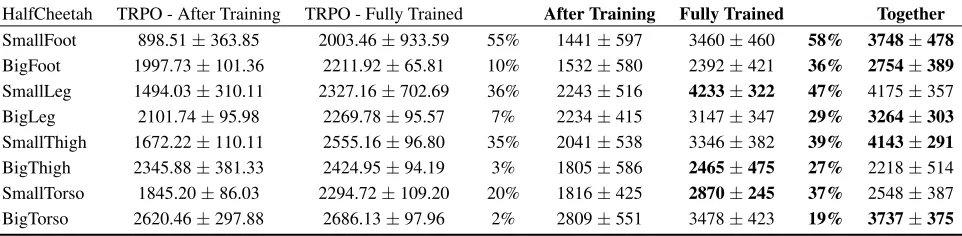
Table 1: Average and standard deviation (µ±σ) of reward across a set of 20 sample rollouts on modified HalfCheetah tasks.
The percentage represents the ratio of average changes betweenAfter TrainingandFully Trained(in order). By comparison
to TRPO (Henderson et al. 2017), SUM (K = 3) achieves an overall improvement of performance attacking catastrophic
forgetting effectively.Togethershows the reward obtained by SUM after training in all tasks simultaneously (without order).
Robust Generalization against Overfitting To demon-strate the effectiveness of uncertainty enhancement for tack-ling overfitting, we measure the generalization capacity in individual tasks by the gap between the test and training per-formances. Figure 4 represents the averaged loss evaluated in the same environments with different random seeds af-ter training. Though sometimes multi-head DDPG performs better in training period, it suffers from overfitting during
testing with different randomness, since overconfident Q
-values mislead the agent into local optima. After training by NLL with uncertainty estimation, SUM generalizes robustly against overfitting tackling both tasks with less loss in per-formance when tested. Concretely, DDPG generalizes with
a decreased performance of factorα ∈ [0.32,0.51] while
SUM decreases byα∈[0.05,0.28]throughout training.
5.2
Generalization in Difficult Situations
In this experiment, we focus on the generalization ability of SUM attacking catastrophic forgetting and handling unseen tasks. The environments are a series of HalfCheetah variant tasks with modified body parts, which demands a common and robust behavior adaptive to any variants.
Generalization against Catastrophic Forgetting Due to the susceptibility of RL agents to different reward schemes and catastrophic forgetting, it is difficult to achieve an over-all satisfying performance across over-all tasks simultaneously. We train SUM consecutively on each environment in the or-der as listed in Table 1. After having trained on a specific task, we evaluate SUM immediately on that environment
across 20 sample rollouts, denoted byAfter Training
(hav-ing seen all the previous environments). We repeat this pro-cedure and finally evaluate the reward across 20 sample
roll-outs on each environment, denoted byFully Trained
(hav-ing seen all the environments). We measure the generaliza-tion capacity against catastrophic forgetting by the gap be-tween After Training and Fully Trained in all tasks as (Hen-derson et al. 2017). To ensure comparability, we adopt the
same network with hidden layers (100, 50,25).
Table 1 shows the difference between TRPO and SUM attacking catastrophic forgetting when learning in order. We ascribe this to the difficulty of tackling task shift by only one
Env. Train (3M) Env. Test
SmallFoot 5628±139 SmallLeg 5298±288 BigFoot 4487±289 BigLeg 5083±134 SmallThigh 5025±137 SmallTorso 5112±207 BigThigh 5644±171 BigTorso 5391±167 SmallFoot 5058±490 BigFoot 4326±333 SmallLeg 5822±367 BigLeg 5741±132 SmallThigh 5346±436 BigThigh 5681±325 SmallTorso 5432±258 BigTorso 5837±360 Wall 4304±521 Wall 4017±501 All Envs 3525±614 Wall 3955±451
Table 2: Performance of SUM (K = 3) tested on unseen
tasks. The last row shows results on a different environment, Wall-v0, after having trained on all modified body tasks is competitive with that trained on the individual Wall-v0 task.
single policy with risk of overfitting, which may limit the improvement of performance in multiple tasks. As an auxil-iary criterion, uncertainty estimation works by understand-ing the generalization of different experts for effective ex-pert scheduling. With this enhancement, SUM outperforms TRPO not only in substantially higher reward but robust generalization against catastrophic forgetting. Moreover, it is also feasible for SUM to learn concurrently without order and achieve a satisfying performance, which means SUM can be trained by samples from different tasks with
vary-ing reward schemes simultaneously (shown asTogether). In
this situation, SUM can capture each expert’s uncertainty es-timates of states from various domains. On the one hand, ex-perts are trained with a shared structure for efficient knowl-edge sharing. On the other hand, the gating network self-supervised by uncertainty estimation can determine the most reliably potential expert to tackle the task.
0.0 0.2 0.4 0.6 0.8 1.0 Episodes ×104
0.0 0.5 1.0 1.5 2.0
Averaged Return
×103 Hopper
SOUP SUM SUM (DMER)
0.0 0.2 0.4 0.6 0.8 1.0 Episodes ×104 0.0
0.5 1.0 1.5
Averaged Return
×103 HopperWall
SOUP SUM SUM (DMER)
0.0 0.2 0.4 0.6 0.8 1.0 Episodes ×104
0.00 0.25 0.50 0.75 1.00 1.25 1.50
Averaged Return
×103 HopperStairs
SOUP SUM SUM (DMER)
Figure 5: Performance of models with headsK= 3on learning multiple Hopper tasks without order and any prior knowledge
(i.e., the distribution of all tasks) simultaneously. SUM with DMER outperforms others in both reward and learning speed.
0.0 0.2 0.4Episodes0.6 0.8 ×10⁴ 0.00
0.25 0.50 0.75 1.00 1.25
Averaged Return
×105 HumanoidStandup
SOUP SUM SUM (DMER)
0.0 0.2 0.4 0.6 0.8 Episodes ×104 0.0
0.5 1.0 1.5
Averaged Return
×103 Humanoid
SOUP SUM SUM (DMER)
0.0 0.2 0.4 0.6 0.8 Episodes ×104 0.00
0.25 0.50 0.75 1.00 1.25 1.50
Averaged Return
×103 HumanoidWall
SOUP SUM SUM (DMER)
0.0 0.2 0.4Episodes0.6 0.8 ×10⁴ 0.00
0.25 0.50 0.75 1.00 1.25
Averaged Return
×105 HumanoidStandupRunWall
SOUP SUM SUM (DMER)
Figure 6: Performance of models with headsK = 5on learning multiple Humanoid tasks without order and any prior
knowl-edge (i.e., the distribution of all tasks) concurrently. SUM with DMER outperforms others in both reward and learning speed.
Hop Wall Stairs
0 500
Hopper
SOUP SUM SUM (DMER)
Hop Wall Stairs
0 500
Use Frequency
Hop Wall Stairs
0 500
Standup Run Wall S+R+W 0
500
Humanoid
SOUP SUM SUM (DMER)
Standup Run Wall S+R+W 0
500
Use Frequency
Standup Run Wall S+R+W 0
500
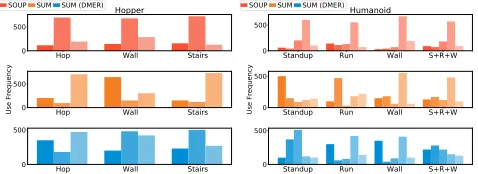
Figure 7: Expert utilization of different models during test-ing, shown by the use frequencies in 1K steps. DMER moti-vates relatively evener utilization and better specialization.
an agent to step over a wall, where common multi-task agents tested on this unseen environment are always stuck in front of the wall. However, SUM trained on modified body variant tasks achieves a competitive performance as single-task learning. Utilizing self-supervised expert scheduling, experts with different potential for tackling each state are allocated more appropriately and effectively.
5.3
Multi-task Performance
We conduct two group of multi-task experiments including Hopper that learns to hop on flat ground, walls, and stairs, and Humanoid that learns to stand up, walk, and pass a wall (see Figure 2). We compare SUM with SOUP (Zheng et al. 2018), an approach based on multi-head DDPG with a con-fidence strategy, to emphasize clearly the strengths of self-supervised expert scheduling and DMER. Figure 5, 6 shows that SUM not only accelerates the training, but achieves more cumulative rewards by data efficiency. Under multi-head MoE architecture, common representations and
knowl-edge are shared and diffused quickly, which boosts the learn-ing with fewer experiences. Furthermore, experts are well-generalized for scheduling, which improves performance.
Expert Utilization and Specialization Note that, StandupRunWall is an extremely challenging task since one of the component environment, HumanoidStandup, pro-vides denser rewards via a different reward scheme making a robot stand up as fast as possible. Though we apply reward scale techniques, SUM and SOUP suffer from imbalanced expert utilization dominated by the expert which is always trained by rewards from HumanoidStandup.
6
Conclusion
In this paper, we propose SUM, an effective algorithm for multi-task reinforcement learning, improving both data effi-ciency in each task and generalization ability across multiple tasks. SUM utilizes multi-head DDPG as experts enhanced by predictive uncertainty estimation, which improves gener-alization capacity against overfitting. A self-supervised gat-ing network trained by uncertainty feedback from experts is exploited to achieve efficient expert scheduling, which improves data efficiency and performance across multiple tasks. Moreover, to alleviate the imbalanced expert utiliza-tion, we adopt decayed mask experience replay to motivate early diversification and late specialization.
To the best of our knowledge, our approach is the first work to investigate the effectiveness of exploiting predictive uncertainty estimation in multi-task reinforcement learn-ing in an end-to-end self-supervised manner. We demon-strate the effectiveness, performance and robust generaliza-tion ability of our algorithm on extended MuJoCo multi-task environments, especially in difficult situations.
7
Acknowledgments
This work is supported by the NSFC project (No. U1833101), Shenzhen Foundational Research Project (No. JCYJ20160428182137473) and the Joint Research Center of Tencent & Tsinghua University.
References
Amodei, D.; Olah, C.; Steinhardt, J.; Christiano, P.; Schulman, J.; and Man´e, D. 2016. Concrete problems in ai safety.
arXiv:1606.06565.
Borsa, D.; Graepel, T.; and Shawe-Taylor, J. 2016. Learn-ing shared representations in multi-task reinforcement learnLearn-ing.
arXiv:1603.02041.
Caruana, R. 1997. Multitask learning.Machine learning28(1). Dearden, R.; Friedman, N.; and Russell, S. 1998. Bayesian q-learning. InAAAI/IAAI.
Doersch, C., and Zisserman, A. 2017. Multi-task self-supervised visual learning. InICCV.
Donahue, J.; Kr¨ahenb¨uhl, P.; and Darrell, T. 2017. Adversarial feature learning.
Finn, C.; Yu, T.; Fu, J.; Abbeel, P.; and Levine, S. 2017. General-izing skills with semi-supervised reinforcement learning. InICLR. Gu, S.; Holly, E.; Lillicrap, T.; and Levine, S. 2017. Deep re-inforcement learning for robotic manipulation with asynchronous off-policy updates. InICRA.
Henderson, P.; Chang, W.-D.; Shkurti, F.; Hansen, J.; Meger, D.; and Dudek, G. 2017. Benchmark environments for multitask learn-ing in continuous domains.arXiv:1708.04352.
Jacobs, R. A.; Jordan, M. I.; Nowlan, S. J.; and Hinton, G. E. 1991. Adaptive mixtures of local experts.Neural computation3(1). Jordan, M. I., and Jacobs, R. A. 1994. Hierarchical mixtures of experts and the em algorithm.Neural computation6(2).
Kahn, G.; Villaflor, A.; Pong, V.; Abbeel, P.; and Levine, S. 2017. Uncertainty-aware reinforcement learning for collision avoidance.
arXiv:1702.01182.
Kingma, D., and Ba, J. 2015. Adam: A method for stochastic optimization. InICLR.
Lakshminarayanan, B.; Pritzel, A.; and Blundell, C. 2017. Simple and scalable predictive uncertainty estimation using deep ensem-bles. InNIPS.
Lazaric, A., and Ghavamzadeh, M. 2010. Bayesian multi-task reinforcement learning. InICML.
Lazaric, A. 2012. Transfer in reinforcement learning: a framework and a survey.
Lillicrap, T. P.; Hunt, J. J.; Pritzel, A.; Heess, N.; Erez, T.; Tassa, Y.; Silver, D.; and Wierstra, D. 2016. Continuous control with deep reinforcement learning. InICLR.
Mnih, V.; Kavukcuoglu, K.; Silver, D.; Rusu, A. A.; Veness, J.; Bellemare, M. G.; Graves, A.; Riedmiller, M.; Fidjeland, A. K.; Ostrovski, G.; et al. 2015. Human-level control through deep rein-forcement learning.Nature518(7540).
Nix, D. A., and Weigend, A. S. 1994. Estimating the mean and variance of the target probability distribution. InNeural Networks, 1994. IEEE World Congress on Computational Intelligence., 1994
IEEE International Conference On, volume 1.
Osband, I.; Blundell, C.; Pritzel, A.; and Van Roy, B. 2016. Deep exploration via bootstrapped dqn. InNIPS.
Parisotto, E.; Ba, J. L.; and Salakhutdinov, R. 2015. Actor-mimic: Deep multitask and transfer reinforcement learning.
arXiv:1511.06342.
Pathak, D.; Agrawal, P.; Efros, A. A.; and Darrell, T. 2017. Curiosity-driven exploration by self-supervised prediction. In
ICML, volume 2017.
Rusu, A. A.; Colmenarejo, S. G.; Gulcehre, C.; Desjardins, G.; Kirkpatrick, J.; Pascanu, R.; Mnih, V.; Kavukcuoglu, K.; and Had-sell, R. 2015. Policy distillation.arXiv:1511.06295.
Rusu, A. A.; Rabinowitz, N. C.; Desjardins, G.; Soyer, H.; Kirk-patrick, J.; Kavukcuoglu, K.; Pascanu, R.; and Hadsell, R. 2016. Progressive neural networks.arXiv:1606.04671.
Shazeer, N.; Mirhoseini, A.; Maziarz, K.; Davis, A.; Le, Q.; Hinton, G.; and Dean, J. 2017. Outrageously large neural networks: The sparsely-gated mixture-of-experts layer. InICLR.
Shelhamer, E.; Mahmoudieh, P.; Argus, M.; and Darrell, T. 2016. Loss is its own reward: Self-supervision for reinforcement learning.
arXiv:1612.07307.
Silver, D.; Lever, G.; Heess, N.; Degris, T.; Wierstra, D.; and Ried-miller, M. 2014. Deterministic policy gradient algorithms. In
ICML.
Silver, D.; Schrittwieser, J.; Simonyan, K.; Antonoglou, I.; Huang, A.; Guez, A.; Hubert, T.; Baker, L.; Lai, M.; Bolton, A.; et al. 2017. Mastering the game of go without human knowledge.Nature
550(7676).
Sutton, R. S., and Barto, A. G. 1998. Reinforcement learning: An
introduction, volume 1.
Teh, Y.; Bapst, V.; Czarnecki, W. M.; Quan, J.; Kirkpatrick, J.; Had-sell, R.; Heess, N.; and Pascanu, R. 2017. Distral: Robust multitask reinforcement learning. InNIPS.
Todorov, E.; Erez, T.; and Tassa, Y. 2012. Mujoco: A physics engine for model-based control. InIROS.