The Thirty-Third AAAI Conference on Artificial Intelligence (AAAI-19)
Unsupervised Stylish Image Description Generation via Domain Layer Norm
Cheng-Kuan Chen,
1∗Zhufeng Pan,
1∗Ming-Yu Liu,
2Min Sun
11Department of Electrical Engineering, National Tsing Hua University2NVIDIA
{sttagomantis, nthupzf}@gmail.com, [email protected],[email protected]
Abstract
Most of the existing works on image description focus on generating expressive descriptions. The only few works that are dedicated to generatingstylish(e.g., romantic, lyric, etc.) descriptions suffer from limited style variation and content digression. To address these limitations, we propose a control-lable stylish image description generation model. It can learn to generate stylish image descriptions that are more related to image content and can be trained with the arbitrary monolin-gual corpus without collecting new paired image and stylish descriptions. Moreover, it enables users to generate various stylish descriptions by plugging in style-specific parameters to include new styles into the existing model. We achieve this capability via a novel layer normalization layer design, which we will refer to as the Domain Layer Norm (DLN). Extensive experimental validation and user study on various stylish im-age description generation tasks are conducted to show the competitive advantages of the proposed model.
Introduction
The image description generation (IDG) problem concerns about generating a natural language description that tran-scribes an input image. Over the years, tremendous effort has been dedicated to developing models that are descriptive. However, little effort is dedicated to generating descriptions that arestylish(e.g. romantic, lyric, etc). Even for the handful of stylish IDG models that exist, they only have a loose con-trol over the style. Ideally, a stylish IDG model should allow users to flexibly control over the generated descriptions as shown in Fig 1. Such a model would be useful for increasing user engagement in applications requiring human interaction such as chatbot and social media sharing.
A naive approach to tackle the stylish IDG problem is to collect new corpora of paired images and descriptions for training. However, this is expensive. For each style that we wish to generate, we have to ask human annotators to write the romantic descriptions for each image in the training dataset.
In this paper, we propose a controllable stylish IDG model. Our model is jointly trained with a paired unstylish image description corpus (source domain) and a monolingual corpus
∗
equal contribution
Copyright c2019, Association for the Advancement of Artificial Intelligence (www.aaai.org). All rights reserved.
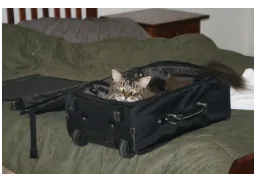
Fairy tale: A cat view himself as the king of the room, waiting for the servant to serve the food and water. He said: Food!
Romance: A cat laying in a luggage bag on a bed with his beloved owner every day. She just wake up, waiting for the kiss from owner. Humorous: A cat laying in a luggage bag on a bed, thinking about to spend his life in that bag. But his owner is going to kick him out. Lyrics: Funny cat scenes, on the front of my screen. Hey, my video on my table you know, you must know. GT (unstylish): A cat laying in a luggage bag on a bed
Figure 1: An ideal IDG can generate stylish descriptions for the given image. The generated descriptions should relate to the image content with different language styles.
of the specific style (target domain). In this setting, our model can learn to generate various styles without collecting new paired data in the target domain. Our main contribution is to show that the layer normalization can be used to disentangle language styles from the content of source and target domains via a small tweak. This design enables us to use the shared content to generate descriptions that are more relevant to the image as well as control the style by plugging in a set of style-specific parameters. We refer this mechanism as Domain Layer Normalization (DLN) since we treat each style as the target domain in the domain transfer setting.
We conduct an extensive experimental evaluation to val-idate the proposed approach using both subjective and ob-jective performance metrics. We evaluate our model on four different styles, including fairy tale, romance, humor, and country song lyrics style (lyrics). Experiment results show that our model generates stylish descriptions that are more preferred by human subjects. It also outperforms prior works on the objective performance metrics.
Related Works
synthesize a new stylish image by recombining image con-tent with style features extracted from different images. Du-moulin, Shlens, and Kudlur (2017) propose to learn the style embedding of visual artistic style by conditioning on the parameter of batch normalization (Ioffe and Szegedy 2015). Huang and Belongie (2017) use adaptive instance norm. More recent approaches use the generative adversarial network (GAN) (Goodfellow et al. 2014) to align and transfer images from different domains. Liu and Tuzel (2016) employ weight-sharing assumption to learn the shared latent code between two domains and further propose translation stream in Liu, Breuel, and Kautz (2017) to encourage the same image in two domains to be mapped into common latent code. While our method is similar to these works in high level, the discrete property of text required new design.
Language style transfer.Supervised learning can be used to generate various linguistic attribute (e.g., different sentiments and different degrees of descriptiveness), but it requires a sig-nificant amount of labeled data. Many recent works assume there exist a share content space and a latent style vector between two non-parallel corpora for unsupervised language style transfer. Shen et al. (2017) propose an encoder-decoder structure with adversarial training to learning this space. Fol-lowing the same line, Melnyk et al. (2017) introduce con-tent preservation loss and classification loss to improve the transfer performance. Fu et al. (2018) propose to use a multi-decoder for different styles and a discriminator to learn a shared content code. Zhang (2018) also use similar struc-ture by using shared and private encoder-decoder. In a recent work, Prabhumoye et al. (2018) introduce to ground the sen-tence in translation model, then apply adversarial training to get the desired style. What differs us from prior works is that we require generated stylish descriptions to match the visual content. Moreover, the style transferred in our work is more abstract instead of explicit styles such as sentiment, gender, or authorship in previous works.
Image description generation. Several works have been proposed to generate image descriptions by using paired im-age description data (Vinyals et al. 2015; Krause et al. 2017; Liang et al. 2017). To increase the naturalness and diversity of generated descriptions, Dai et al. (2017) apply adversarial training approach to train an evaluator to score the quality of generated descriptions. Chen et al. (2017) propose an ad-versarial training procedure to adapt image captioning style using unpaired images and captions. A new objective is pro-posed in Dai and Lin (2017) to enhance the distinctiveness of generated captions. On the other hand, there exist a few works proposed to enhance the attractiveness and style of the generated descriptions. Zhu et al. (2015) align the book and the corresponding movie release to a story-like description of the visual content. However, this method does not preserve the visual content. Mathews, Xie, and He (2016) propose the switch RNN to generate caption with positive and negative sentiments, which requires word level supervision and might not be able to scale. Recently, Gan et al. (2017b) investigate to generate tag-dependent caption by extending the weight matrix of LSTM to consider tag information. The following work StyleNet (Gan et al. 2017a) explores to decomposes LSTM matrix to incorporate the style information. One key
difference is that we leverage an arbitrary stylish monolingual corpus that is not paired with any image dataset as target cor-pus instead of using paired images with stylish ground truth. Munigala et al. (2018) try to generate persuasive description for fashion image in unsupervise way but the descriptions are still transferred within fashion domain. The most similar to our work is Mathews, Xie, and He (2018), the major differ-ences are that we do not exploit the language features such as POS tag of corpus and we do not pre-process the target corpus to make it similar to the source one. Our approach is end to end with minimal pre-process of target corpus.
Unsupervised Stylish Image Description
Generation
The goal of stylish Image Description Generation (IDG) is to generate a natural language descriptiondT in spaceDT given
an imageIin the image spaceI. The style of the description is implicitly captured in the description spaceDT, where we
use subscriptTto emphasize the target style. There exist two settings for learning a stylish IDG model.
Supervised stylish IDG. In supervised stylish IDG, we are given a training datasetD = {(I(n), dT(n)), n = 1, ..., N},
where each sample (I(n), d(n)
T ) is a pair of image and
its target stylish description sampled from the joint dis-tribution p(I,DT). The goal is to learn the conditional
distribution p(DT|I) using D so that we can generate
stylish image descriptions for an input image.
Unsupervised stylish IDG. In unsupervised stylish IDG, we are given two training datasets DS and DT. DS = {(I(n), dS(n)), n= 1, ..., NS}consists of pairs of image and
its description(I(n), d(n)
S )sampled from p(I,DS), where
Sis referred to as the source domain which is typically un-stylish.DT ={(d
(n)
T ), n= 1, ..., NT}is a dataset of target
stylish descriptions d(Tn) sampled fromp(DT), where the
corresponding images are not available. Hence, the learning task is considered as unsupervised. The goal of unsupervised stylish IDG is to learn the conditional distributionp(DT|I)
usingDS andDT.
Unsupervised stylish IDG is an ill-posed problem since it is about learning the conditional distributionp(DT|I)without
using samples from the joint distributionp(I,DT).
There-fore, learning an unsupervised stylish IDG function is diffi-cult without leveraging some useful assumptions. However, under the unsupervised setting, training data collection is greatly simplified: one could pair a general image description dataset (e.g., the MS-COCO dataset (Lin et al. 2014)) with an existing corpus of the target style (e.g., some romantic novels) for learning. A solution to the unsupervised prob-lem could enable many stylish image description generation applications.
Unsupervised Stylish IDG via Domain Layer Norm
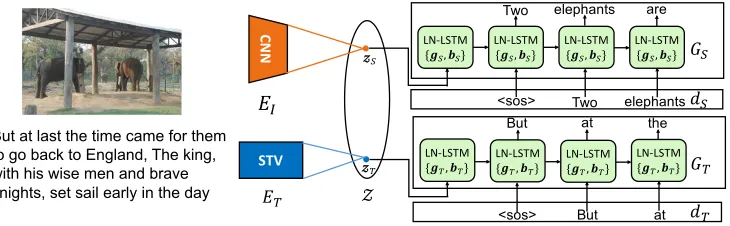
illus-Figure 2: We make several assumptions to deal with the challenging unsupervised stylish image description generation problem. We first assume there exists a shared latent spaceZso that a latent codez∈ Zcan be mapped to the source description spaceDS
and the target stylish description spaceDT viaGSandGT. We also assume there exists a stylish image description embedding
functionET that can map a stylish description to a latent code. Finally, we assume there exists an image embedding functionEI
that can map an image to a latent code. Once these functions are learned from data, we can generate a stylish image description for an image by applyingEI andGT sequentially.
trated in Figure 2. We first assume that there exists a latent spaceZproviding a common ground to effectively map to and from the image spaceI, the source description space
DS, and the target stylish description spaceDT. From latent
space to description space, we assume that there exists a source description generation functionGS(z)∈ DS and a
target stylish description generation functionGT(z)∈ DT.
From non-latent space to latent pace, we assume that there exist an image encoderEI(I)∈ Zand a target description
encoderET(dT) ∈ Z. Our goal is to learn the generation
functions (GT andGS) and the encoding functions (EIand
ET) from the unsupervised stylish IDG training dataDS and
DT. Note that this is a challenging learning task ifGT and
GSis completely independent of each other. Hence, we
as-sume thatGT andGSshare the ability to describe the same
factual content but with different styles. Once these func-tions are learned, we can simply first encode the imageI
to a latent code usingEI and then usingGT to generate a
stylish image description. In other words, the stylish image description is given by GT(EI(I)). We model the
condi-tional distribution asp(DT|I) = δ(GT(EI(I))), where δ
is the delta function. Inspired by the success of deep learn-ing, we model both of the generation and encoding func-tions using deep networks. Specifically, we modelEIusing
a deep convolutional neural network (CNN) (Krizhevsky, Sutskever, and Hinton 2012) and model ET, GT, and
GS using recurrent neural network as illustrated in
Fig-ure 3. We also use Skip-Thought Vectors (STV) (Kiros et al. 2015) to model ET. For GT and GS, we use Layer
Normalized Long Short Term Memory unit (LN-LSTM) as their recurrent module (Ba, Kiros, and Hinton 2016; Hochreiter and Schmidhuber 1997).
Training sketch. With the source domain datasetDS, we
can trainzS = EI(I)anddS = GS(zS)jointly by
solv-ing the supervised IDG learnsolv-ing task, where zS is the
learned latent representation in the source domain. On the other hand, with the target domain datasetDT, we can train zT =ET(dT)anddT =GT(zT)jointly by solving an
un-supervised description reconstruction learning task, where zT is the learned latent representation in the target domain.
To ensure that the latent space is shared (i.e.,zT ∈ Z and zS ∈ Z), we further assume that the generation functions
GSandGT share most of their parameters.
Domain Layer Norm. Specifically, we assumeGS and
GT share all the parameters except those in their layer norm
parameters (Ba, Kiros, and Hinton 2016). In other words, the domain description generators (GSandGT) only defer
in the layer norm parameters. We refer this weight-sharing scheme as the Domain Layer Norm (DLN) scheme. The intuition behind DLN is to encourage the shared weight to capture the factual content between two domains while the differences (i.e., styles) are captured in layer norm parameters. This design helpsGT generate descriptions that are related
to the image content even without the supervision of the corresponding images in training.
TrainingEI andGS via Supervised IDG.The goal of
su-pervised image description generation is to learnp(DS|I)
by usingDS. TheGSconsists of an embedding matrixθW
that maps input textxkto a vectorek, an LN-LSTM module,
and an output matrixθV that maps hidden state to predicted
tokenyˆ. Formally,
(yˆk+1,hk+1) =GS(ek,hk), (1) ˆ
yk+1=θVThk, (2) ek =θWT1{xk}, (3) e−1=EI(I),h−1=0, (4)
where hk is the hidden feature in the LN-LSTM, k ∈ {−1. . . m−1}is time step of description with lengthm, and
1{}denotes the operator for one-hot encoding. To train the network, we minimize the sum of cross-entropy of correct words as follows,
LS =− m
X
k=1
log(1{xk}Tyˆk), (5)
wherexk is thekthword in the ground truth sentence.
TrainingET andGT via Stylish Image Description
Re-construction.TheGT contains the LN-LSTM module, the
For-CN
N LN-LSTM{𝒈
#, 𝒃#}
LN-LSTM
{𝒈#, 𝒃#}
<sos>
LN-LSTM
{𝒈#, 𝒃#}
Two
LN-LSTM
{𝒈#, 𝒃#}
elephants
LN-LSTM
{𝒈', 𝒃'}
LN-LSTM
{𝒈', 𝒃'}
LN-LSTM
{𝒈', 𝒃'}
LN-LSTM
{𝒈', 𝒃'}
But at last the time came for them to go back to England, The king, with his wise men and brave knights, set sail early in the day
STV <sos> 𝐸) 𝐸' 𝐺' 𝐺# 𝒵 𝔃# 𝔃' 𝑑# 𝑑'
Two elephants are
But
But at
at the
Figure 3: TheEI andET map the image and the target stylish description to a shared latent space. BothGS andGT share all
weights except the layer norm parameters to capture the similar content in two domains. To disentangled the style factor, we employ different sets of layer norm parameters denoted as{gS,bS}and{gT,bT}for source and target domain during training.
Layer Norm Operation
Element-wise
Operation Input Flow
Shared Input Flow + x −𝜇 x + 𝒉$%&
𝒄$%& 𝒄$
+ + + 𝒆$ + LN+ LN, LN
-𝒊$ 𝒋$ 𝒇$ 𝒐$ LN2 tanh
x
x
+ LN3
x
𝒉$
𝒈 𝒃
𝒂 𝒂7
1 𝜎⁄
Figure 4: Inside the LN-LSTM cell (left) and the operation of layer normalization (right).
mally,
(yˆk+1,hk+1) =GT(ek,hk), (6) ˆ
yk+1=θVThk, (7) ek =θWT1{dkT}, (8) e−1=ET(dT), (9) h−1=0, (10)
wheredT is the target style image description. To train the
network, we minimize the reconstruction error as follows,
LT =− m
X
k=1
log(1{dkT}Tyˆ
k), (11)
wheredk
T is thekthword in the target style image description.
RelatingGSandGT via Domain Layer Norm.We relate
GSandGT by sharing all weights except layer norm
parame-ters in the LN-LSTM. Details inside the LN-LSTM are shown in Fig 4, where the layer norm operation (LN) is applied to each gate of LSTM. Take the input gate as an example:
ˆik =LN(ik),ik =θieek+θihhk−1, (12)
whereˆikandikare the normalized and unnormalized input
gates,θie,θihare two projection matrices that map the
em-bedding vector and the previous hidden state into the same dimension. The LN operation converts any inputato a
nor-malized outputaˆas follows,
ˆ
a=g
σ(a−µ)) +b, (13)
µ= 1
ph i=ph
X
i=1
ai, (14)
σ= v u u t 1 ph ph X i=1
(ai−µ)2, (15)
where ai denotes the ith entry in the vector a, ph is the
dimention of the inputa,µandσare the mean and standard deviation of the input a,g andbare scaling and shifting vectors (i.e., layer norm parameters) learned from the data.
We train the whole network by jointly minimizing the su-pervised IDG lossLSand the unsupervised image description
reconstruction lossLT subject to the architectural constraint
set toGSandGT as below, whereλis a hyperparameter.
L(θEIθGS,θET,θGT) =λLS(θEI,θGS)
+ (1−λ)LT(θET,θGT). (16)
Extension to New Target Styles. Given a model with pa-rametersθV,θW,θEI, andθGS, pre-trained on a pair of the
source and one target domain, we aim to adapt it to a new target domain (i.e, style) by enlargingθV andθW toθ0V
andθ0W to accommodate new vocabulary and finetuning the remaining parameters toθ0EI,θ
0 ET,θ
0
GS andθ 0
GT. Hence,
we define a new loss function as:
L(θ0EI,θ0GS,θ0ET,θ0GT) =λ1LS(θ0EI,θ 0 GS)
+ (1−λ1)LT(θ0ET,θ 0
GT) +λ2R(θ0EI,θ 0
W,θ
0
V), (17)
whereλ1 andλ2are hyperparameters. The regularization
termR(θ0EI,θ0W,θ0V) =kθ0EI−θEIk2+kθ 0
W−θWk2+ kθ0V −θVk2is used to prevent new weights from deviating
the pretrained model. This encourages the adapted model to keep the information learned during the pretrained phase. We use pretrainedθEIandθGS as initialization ofθ0EIandθ
0 GS.
Forθ0G
T, we share all parameters inθ 0
GS except the layer
do not update the source domain layer norm parameters since we do not need to learn source style.
Experiment
We conduct two experiments to evaluate our proposed method. First, we demonstrate that our method can gener-ate stylish descriptions based on paired image and unstylish description in the source domain and a stylish monolingual corpus that is not paired with any image dataset in the target domain. Then, we demonstrate the flexibility of our DLN to progressively include new styles one by one in the second experiment. The implementation details are in the supple-mentary.
Evaluation Setting
Datasets.We use paragraphs released in (Krause et al. 2017) (VG-Para) as our source domain dataset. We do not use cap-tion dataset such as MS-COCO because we found capcap-tions are less stylish when transfer to target style domain. We use pre-split data which contain 14575, 2489 and 2487 for train-ing, validation and testing. For target dataset, we use humor and romance novel collections in BookCorpus (Zhu et al. 2015). We also collect country song lyrics and fairy tale to show that our method is effective on corpora with different syntactic structures and word usage. More details can be found in supplementary materials.
Baselines. We compare our method with four baselines: StyleNet (Gan et al. 2017a), Neural Story Teller (NST) (Kiros et al. 2015), DLN-RNN and Random. Stylenet generates stylish descriptions in an end-to-end way but with paired image and stylish ground truth description. NST breaks down the task into two steps, which first generate unstylish cap-tions then apply style shift techniques to generate stylish descriptions. DLN-RNN uses the same framework as DLN with only difference in using simple recurrent neural network. Random samples the the same number of nouns as that in the unstylished ground truth from the corresponding vocabulary of target domain. Although a concurrent work (Mathews, Xie, and He 2018) that attempts to solve similar task as ours, the major differences are we do not exploit linguistic features and pre-process the target corpus to facilitate the training. Moreover, it is not sure whether the concurrent work can be applied to other styles or even multiple styles as it only makes a step toward generating sentences with romantic style. Metrics of semantic relevance.As there is no ground truth sentences for stylish image descriptions in unpaired setting, the conventional n-gram based metrics such as BLEU (Pap-ineni et al. 2002), METEOR (Denkowski and Lavie 2014) and CIDEr (Vedantam, Zitnick, and Parikh 2015) cannot be applied. It is also not suitable to calculate these metrics between stylish sentences and the unstylished ground truth because the goal of stylish description generation is to change the word usage while preserve certain semantic relevance be-tween the stylish description and images.
We propose content similarity to evaluate the semantic relevance between generated stylish sentences and the un-stylished ground truth. To calculate content similarity, we defineCS as the set of nouns in the ground truth (source
domain), andCS0 as the union betweenCS and synonyms
for each noun inCS, for the model may describe the same
object with different words (e.g., cup and mug). Similar logic is applied toCT andCT0 in the generated description (target
domain). We calculate:
p= |CT∩C 0 S| |CT|
r=|CS∩C 0 T| |CS|
, (18)
We take the f-score of thepandras the content similar-ity score. The overall content similarsimilar-ity score is averaged over the testing data. This is because we assume stylish de-scriptions should at least contain objects which appear in the image. We also report SPICE (Anderson et al. 2016) score, which calculate the f-score of semantic tuples between untylished ground truth and the generated stylish descriptions. The final score is average over all testing data.
Metrics of stylishness.We use transfer accuracy to evaluate the stylishness of our generated description. The transfer ac-curacy is widely used in language style transfer task (Shen et al. 2017; Melnyk et al. 2017; Fu et al. 2018). It measures how often do descriptions have labels of target style on test dataset based on a pre-trained style classifier. We follow the definition of transfer accuracy in (Fu et al. 2018), which is
T =
1 ifs >0.5
0 ifs≤0.5 (19)
wheresis the output probability score of the classifier. We de-fineRT =NNvt
vsas our transfer accuracy, which is the fraction
of number of testingNvsdata in source domain and number
of testing data that correctly transfer description with target styleNvt. The final score is average over all testing data.
Human evaluation.The difficulty in generating stylish sen-tence in unpaired setting is to remain semantic relevance. Therefore, we conduct a human study on Amazon Mechan-ical Turk (AMT) independently for each methods to judge the semantic relevance between image and description. For each model, we randomly sample 100 images then generate stylish descriptions for each style. Two workers are asked to vote the semantic relevance with following prompt: Given an image and a paragraph from the book (Our stylish cor-pus), how well does the paragraph content relate to objects in the image. Workers are forced to vote from unrelated to related. The criteria for eligible workers are having at least 100 successful HITs with 70% acceptance rate. The total number of HIT is 2400. For each HIT, the order of options is randomized. Workers are forced to vote and all responses are counted without aggregation.
Results
Model
Data
CS
S
T
p
r
n
pn
rNST (Kiros et al. 2015)
Lyrics
0.037
0.016
100%
0.041
0.044
0.68
0.75
StyleNet (Gan et al. 2017a)
Lyrics
0.033
0.014
100%
0.038
0.038
0.57
0.67
Random
Lyrics
0.008
0.002
55.2%
0.007
0.012
0.13
0.09
DLN-RNN
Lyrics
0.072
0.030
100%
0.101
0.069
1.65
1.17
DLN
Lyrics
0.083
0.033
99.2%
0.080
0.115
1.25
1.92
NST (Kiros et al. 2015)
Romance
0.088
0.039
100%
0.087
0.113
1.57
1.90
StyleNet (Gan et al. 2017a)
Romance
0.012
0.005
100%
0.032
0.001
0.11
0.14
Random
Romance
0.005
0.002
100%
0.004
0.001
0.07
0.05
DLN-RNN
Romance
0.083
0.034
94.3%
0.078
0.125
1.27
0.71
DLN
Romance
0.151
0.058
95.4%
0.193
0.148
1.56
2.43
NST (Kiros et al. 2015)
Humor
0.103
0.041
99.7%
0.097
0.143
2.22
2.44
StyleNet (Gan et al. 2017a)
Humor
0.010
0.005
99.8%
0.024
0.001
0.12
0.15
Random
Humor
0.007
0.002
100%
0.006
0.014
0.11
0.07
DLN-RNN
Humor
0.093
0.038
89.5%
0.095
0.12
1.58
0.92
DLN
Humor
0.173
0.065
70.0%
0.205
0.182
2.32
2.99
NST (Kiros et al. 2015)
Fairy tale
0.116
0.044
99.8%
0.116
0.145
2.47
2.44
StyleNet (Gan et al. 2017a)
Fairy tale
0.028
0.013
99.8%
0.045
0.026
0.34
0.46
Random
Fairy tale
0.004
0.001
100%
0.003
0.010
0.06
0.04
DLN-RNN
Fairy tale
0.084
0.033
79.5%
0.076
0.140
1.22
0.72
DLN
Fairy tale
0.135
0.050
93.7%
0.194
0.125
1.29
2.06
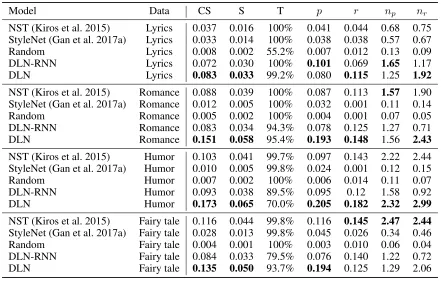
Table 1: Performance comparison between DLN and several baselines. CS, S and T stand for content similarity, SPICE and transfer accuracy.pandrare as defined in Eq. 18.npandnrare the numerator of each. DLN has generally higher score of
content related metrics. Higher is better for all metrics except the transfer accuracy.
marginal drop of transfer accuracy on most datasets. All base-lines are better than Random, which suggests all basebase-lines can generate semantic-related description to certain degree. We observe NST has largenpandnrin fairy tale. We think
this is because NST tends to generate long sentences. For each style (Fairy, Humor, Romance, and Lyrics), the average sentence length of NST is(119,109,103,84)while that of DLN is(38,54,41,97). Therefore, it is possible that NST generates more nouns in the unstylish ground truth.
We also report the performance of DLN and DLN-RNN on unstylish description generation task in Table 2. We calculate the BLEU-4, METEOR and CIDEr scores between generated sentences and unstylished ground truth. Combined with the result of stylish description generation in Table 1, we can conclude that the proposed domain layer norm can benefit the unpaired image to stylish description as we have a better model in conventional image to text generation.
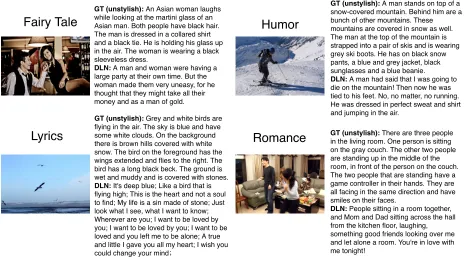
The result of human study is shown in Fig 5, we report the best of our model in Table 1 (DLN) and other baselines for comparison. The DLN has the highest related and lowest unrelated votes while over half of descriptions are voted as unrelated in other baselines. Qualitative results in Fig 6 shows that the description generated by DLN is related to images. Note that the goal of generated stylish description is not to match every factual aspect of images, it should better be judged whether the description is related to the image if the image appears in the target corpus.
Multi-style.We progressively expand DLN to include three
0
200
400
600
DLN
NST
Stylenet
Random
unrelated
weakly related
partially related
related
Figure 5: Human study of semantic relevance of all methods. DLN has highest related and lowest unrelated votes compared to other baselines.
Model BLEU-3 BLEU-4 METEOR CIDEr
DLN-RNN 0.106 0.062 0.130 0.069 DLN 0.132 0.080 0.150 0.127
Table 2: Performance on generate unstylish description. DLN is better than DLN-RNN in all metrics.
GT (unstylish): An Asian woman laughs
while looking at the martini glass of an Asian man. Both people have black hair. The man is dressed in a collared shirt and a black tie. He is holding his glass up in the air. The woman is wearing a black sleeveless dress.
DLN: A man and woman were having a
large party at their own time. But the woman made them very uneasy, for he thought that they might take all their money and as a man of gold.
Fairy Tale
GT (unstylish): There are three people
in the living room. One person is sitting on the gray couch. The other two people are standing up in the middle of the room, in front of the person on the couch. The two people that are standing have a game controller in their hands. They are all facing in the same direction and have smiles on their faces.
DLN: People sitting in a room together,
and Mom and Dad sitting across the hall from the kitchen floor, laughing, something good friends looking over me and let alone a room. You're in love with me tonight!
Romance
Humor
GT (unstylish): A man stands on top of a
snow-covered mountain. Behind him are a bunch of other mountains. These mountains are covered in snow as well. The man at the top of the mountain is strapped into a pair of skis and is wearing grey ski boots. He has on black snow pants, a blue and grey jacket, black sunglasses and a blue beanie.
DLN: A man had said that I was going to
die on the mountain! Then now he was tied to his feet. No, no matter, no running. He was dressed in perfect sweat and shirt and jumping in the air.
Lyrics
GT (unstylish): Grey and white birds are
flying in the air. The sky is blue and have some white clouds. On the background there is brown hills covered with white snow. The bird on the foreground has the wings extended and flies to the right. The bird has a long black beck. The ground is wet and muddy and is covered with stones.
DLN: It's deep blue; Like a bird that is
flying high; This is the heart and not a soul to find; My life is a sin made of stone; Just look what I see, what I want to know; Wherever are you; I want to be loved by you; I want to be loved by you; I want to be loved and you left me to be alone; A true and little I gave you all my heart; I wish you could change your mind;
Figure 6: Examples of stylish descriptions by DLN. Note the goal of stylish description is not to match every factual aspect of the image. It should be better judged whether the descriptions are related to the image if the image appears in the context of the target corpus. The semicolon (;) in lyrics serves as new line symbol.
priorities: content, style, and naturalness. This prompt forces workers to choose the better one if the two options are equally related to images. We sample 100 images for each and use the same criteria to select workers. The result is presented in Table 3, which shows the performance of DLN-Multi is com-petitive to DLN. DLN-Multi thus gives users the capability to include new style into the existing model, which is a novel feature not reported in other baselines.
Discussion: transfer accuracy and domain shift.We ob-serve a drop in transfer accuracy on the source to humor transfer in DLN, and we believe this is related to the scale of domain shift. To quantify this, we analyze the percentage of shared noun between the source (Vsrc= 6.2k) and target
do-main, which are(50%,68%,74%,60%)for lyrics, romance humor and fairy tale. For the transfer from the source to hu-mor domain, the shared nouns account for over 70% nouns in the source domain, which means the domain shift between the source and humor is smaller than others. This makes it more difficult for the classifier to distinguish two domains. Therefore, the transfer accuracy of the source to humor is lower. We note Random get lowest transfer accuracy in lyrics style and we believe this is because sampling word from the vocabulary of lyrics alone cannot have sentences with new line symbol (i.e. ;), which is an important feature for being classified as stylish.
Conclusion and future work
We propose a novel unsupervised stylish IDG model via domain layer norm with the capability to progressively
Model Style CS S T P
DLN-Multi Romance 0.116 0.047 97.1% 36.7% DLN Romance 0.151 0.058 95.4% 63.3%
DLN-Multi Lyrics 0.118 0.047 99.7% 54.3% DLN Lyrics 0.083 0.033 99.2% 45.8%
DLN-Multi Fairy tale 0.120 0.048 99.0% 47.4% DLN Fairy tale 0.135 0.050 93.7% 52.6%
Table 3: Result of DLN and DLN-Multi. CS, S, T and P are content similarity, SPICE, tansfer accuracy and human preference score. Overall, the performance of DLN-Multi is competitive to DLN in all metrics.
include new styles. Experiment results show that our stylish IDG results are more preferred by human subjects. We plan to invesitgate the intermediate style generated by interpolation of domain layer norm parameter and address the fluency of generated sentences in the future.
AcknowledgementWe thanks Nvidia for collaboration. We also thanks MOST-107 2634-F-007-007, MOST Joint Re-search Center for AI Technology and All Vista Healthcare and MediaTeck for their support.
References
Ba, J. L.; Kiros, J. R.; and Hinton, G. E. 2016. Layer normalization. InAdvances in Neural Information Processing Systems (NIPS). Chen, T.-H.; Liao, Y.-H.; Chuang, C.-Y.; Hsu, W.-T.; Fu, J.; and Sun, M. 2017. Show, adapt and tell: Adversarial training of cross-domain image captioner. InIEEE International Conference on Computer Vision (ICCV).
Dai, B., and Lin, D. 2017. Contrastive learning for image captioning. InAdvances in Neural Information Processing Systems (NIPS). Dai, B.; Lin, D.; Urtasun, R.; and Fidler, S. 2017. Towards diverse and natural image descriptions via a conditional gan. InIEEE International Conference on Computer Vision (ICCV).
Denkowski, M., and Lavie, A. 2014. Meteor universal: Language specific translation evaluation for any target language. In Pro-ceedings of the ninth workshop on statistical machine translation, 376–380.
Dumoulin, V.; Shlens, J.; and Kudlur, M. 2017. A learned represen-tation for artistic style.
Fu, Z.; Tan, X.; Peng, N.; Zhao, D.; and Yan, R. 2018. Style transfer in text: Exploration and evaluation.
Gan, C.; Gan, Z.; He, X.; Gao, J.; and Deng, L. 2017a. Stylenet: Generating attractive visual captions with styles. InIEEE Confer-ence on Computer Vision and Pattern Recognition (CVPR). Gan, Z.; Gan, C.; He, X.; Pu, Y.; Tran, K.; Gao, J.; Carin, L.; and Deng, L. 2017b. Semantic compositional networks for visual captioning. InIEEE Conference on Computer Vision and Pattern Recognition (CVPR).
Gatys, L. A.; Ecker, A. S.; and Bethge, M. 2015. A neural algorithm of artistic style.arXiv preprint arXiv:1508.06576.
Goodfellow, I.; Pouget-Abadie, J.; Mirza, M.; Xu, B.; Warde-Farley, D.; Ozair, S.; Courville, A.; and Bengio, Y. 2014. Generative adversarial nets. InAdvances in Neural Information Processing Systems (NIPS).
Hochreiter, S., and Schmidhuber, J. 1997. Long short-term memory.
Neural computation9(8):1735–1780.
Huang, X., and Belongie, S. 2017. Arbitrary style transfer in real-time with adaptive instance normalization. InIEEE International Conference on Computer Vision (ICCV).
Ioffe, S., and Szegedy, C. 2015. Batch normalization: Accelerat-ing deep network trainAccelerat-ing by reducAccelerat-ing internal covariate shift. In
International Conference on Machine Learning (ICML).
Kiros, R.; Zhu, Y.; Salakhutdinov, R. R.; Zemel, R.; Urtasun, R.; Torralba, A.; and Fidler, S. 2015. Skip-thought vectors. InAdvances in Neural Information Processing Systems (NIPS).
Krause, J.; Johnson, J.; Krishna, R.; and Fei-Fei, L. 2017. A hierarchical approach for generating descriptive image paragraphs. InIEEE Conference on Computer Vision and Pattern Recognition (CVPR).
Krizhevsky, A.; Sutskever, I.; and Hinton, G. E. 2012. Imagenet classification with deep convolutional neural networks. InAdvances in Neural Information Processing Systems (NIPS).
Liang, X.; Hu, Z.; Zhang, H.; Gan, C.; and Xing, E. P. 2017. Recurrent topic-transition gan for visual paragraph generation. In
IEEE International Conference on Computer Vision (ICCV). Lin, T.-Y.; Maire, M.; Belongie, S.; Hays, J.; Perona, P.; Ramanan, D.; Doll´ar, P.; and Zitnick, C. L. 2014. Microsoft coco: Common objects in context. InEuropean Conference on Computer Vision (ECCV).
Liu, M.-Y., and Tuzel, O. 2016. Coupled generative adversarial networks. InAdvances in Neural Information Processing Systems (NIPS).
Liu, M.-Y.; Breuel, T.; and Kautz, J. 2017. Unsupervised image-to-image translation networks. InAdvances in Neural Information Processing Systems (NIPS).
Mathews, A. P.; Xie, L.; and He, X. 2016. Senticap: Generating image descriptions with sentiments.
Mathews, A.; Xie, L.; and He, X. 2018. Semstyle: Learning to gen-erate stylised image captions using unaligned text. InProceedings of the IEEE Conference on Computer Vision and Pattern Recognition, 8591–8600.
Melnyk, I.; Santos, C. N. d.; Wadhawan, K.; Padhi, I.; and Kumar, A. 2017. Improved neural text attribute transfer with non-parallel data.
Munigala, V.; Mishra, A.; Tamilselvam, S. G.; Khare, S.; Dasgupta, R.; and Sankaran, A. 2018. Persuaide! an adaptive persuasive text generation system for fashion domain. InCompanion of the The Web Conference 2018 on The Web Conference 2018, 335–342. International World Wide Web Conferences Steering Committee. Papineni, K.; Roukos, S.; Ward, T.; and Zhu, W.-J. 2002. Bleu: a method for automatic evaluation of machine translation. In Proceed-ings of the 40th annual meeting on association for computational linguistics, 311–318. Association for Computational Linguistics. Shen, T.; Lei, T.; Barzilay, R.; and Jaakkola, T. 2017. Style transfer from non-parallel text by cross-alignment. InAdvances in Neural Information Processing Systems (NIPS).
Prabhumoye, S.; Tsvetkov, Y.; Salakhutdinov, R.; and Black, A. W. 2018. Style transfer through back-translation. InAssociation for Computational Linguistics (ACL).
Vedantam, R.; Lawrence Zitnick, C.; and Parikh, D. 2015. Cider: Consensus-based image description evaluation. InProceedings of the IEEE conference on computer vision and pattern recognition, 4566–4575.
Vinyals, O.; Toshev, A.; Bengio, S.; and Erhan, D. 2015. Show and tell: A neural image caption generator. InIEEE Conference on Computer Vision and Pattern Recognition (CVPR).