444
Copyright © 2011-15. Vandana Publications. All Rights Reserved.
Volume-5, Issue-3, June-2015
International Journal of Engineering and Management Research
Page Number: 444-450
Secure and Efficient Data Transmission using Sniffer for Clustered
based Wireless Sensor Networks
Shalini .C. Masaraddi1, Prof. Santosh .I. Shirol2
1
M. Tech Student, CNE (Computer networking), Secab Institute of Engineering and Technology, Vijayapur, Karnataka, INDIA
2Electronics and Communication Engineering Department, Secab Institute of Engineering and Technology, Vijayapur,
Karnataka, INDIA
ABSTRACT
The wireless sensor network (WSN) consists of spatially distributed wireless sensor nodes to monitor physical or environmental conditions, such as sound, temperature, and motion. The individual nodes are capable of sensing their environments, and sending data to one or more collection points in a WSN. Secure data transmission is an important issue for wireless sensor networks (WSNs). Clustering is an effective and practical way to increase the system performance of WSNs. In the proposed system, SET-IBS (Identity-Based digital Signature scheme) and SET-IBOOS (Identity-Based Online/Offline digital Signature scheme) protocols are used for secure data transmission. In SET-IBS, security depends on the hardness of the Diffie-Hellman problem in the pairing domain. SET-IBOOS further decreases the computational overhead for protocol security, which is crucial for WSNs, while its security depends on the hardness of the discrete logarithm problem. And also sniffer is used for extra security.
Keywords---- Microcontroller, LEACH, SET-IBS
I.
INTRODUCTION
Wireless sensor networks (wsn)
The wireless sensor network (WSN) consists of small nodes which can sense, process and communicate, and it consist of autonomous sensors which monitors certain physical conditions, such as sound, temperature, pressure etc. It also enables the control of sensor activity. WSN is used in many applications such as industrial process, health monitoring, military and Agriculture etc.
The WSN consist of many nodes, where each node connected to one sensor or sometimes several sensors. The parts present in each node in sensor networks are:
A Radio transceiver
A Microcontroller
Battery
The sensor node varies in size and also in cost, a resource such as memory, communication band width, energy and communication speed all depends on the cost and size of sensor nodes. The topology of the WSN is different which varies from star network to mesh network, and the propagation technique used in WSN may be routing or flooding. In WSN efficient data transmission is very critical. Hence secure and efficient data transmission (SET) is essential in many WSN’s, in the network the base station (BS) can be used as a gateway between sensors and the end users, while forwarding data from sensor to destination.
Background and motivations
445
Copyright © 2011-15. Vandana Publications. All Rights Reserved.
problem increases the overhead of transmission and energyconsumption.
Asymmetric key management is used to overcome the problem occurred by using symmetric key management, hence digital signature is used. Digital signature is best means to provide security in asymmetric key management system. Here digital certificate is used for binding the public key and identification of signer. Identity–Based digital signature scheme derives the public key from the entity’s identity information (the information may be name or ID number).IBOOS is used to reduce computation and storage cost of signature processing. Many online/offline signature schemes are available. The IBOOS scheme is the most effective means of key management in WSN’s. Offline can be executed on sensor node or BS and online is executed during communication. Offline signature is computes by third party and hence not suitable for CWSNs. A hash function is applied to the message to obtain the message digest and it uses arbitrary-sized message as input produces fixed-size message digest as output, and MD-5 and SHA are commonly used hash functions. There are two broad techniques used in digital signature. 1) Symmetric cryptosystem. 2) Public key cryptosystem. In the symmetric key system, a secret key known which is the sender and legitimate receiver is used. A public key cryptosystem uses a pair of keys: A private key which is owner key and public key, known to everyone. For confidentiality the message will be encrypted with the owner’s public key, which will be decrypted by the owner with private key.
Organization of report
Chapter 1 describes brief introduction about WSN, secure data transmission for clustered based WSNs it also gives information about different protocols, used in this work. Chapter 2 is “Literature Survey”, it shows some related work about this work. Briefly explains the older schemes used for secure data transmission, and techniques used for security. Chapter 3 is of problem formulation. It explains about existing system related to this work and problems in existing system. Chapter 4 is proposed system, it explains how problems of existing systems are solved here. This shows the overall view of the project with block diagram. At the end of this chapter, lists the advantages and objectives. Chapter 5 is system requirements it shows hardware requirements, software requirements. Chapter 6 describes system design. System design part explains main implemented algorithms in this work and their logic of working with appropriate flow diagrams and also the different techniques used. Chapter 7 is implementation, it gives complete explanation about each and every step of project implementation. How topology is created and explains step by step procedure, of the work with snap shots. Chapter 8 shows results of this project, it has snapshots of output which consists of user interactive graphs with the explanation of each figure. And also shows result analysis of results got in this project. Last part of this report contains conclusion that describes how the work is concluded at the end. References which have been referred for to complete this work. Appendix part describes briefly about tools used for the project.
II.
RELATED WORK
Some of the related works are summarized in the following:
Application-specific protocol architecture for wireless micro sensor networks is presented in [1]. Users can monitor a remote environment by intelligently combining the data from the individual nodes using networking together hundreds or thousands of cheap micro sensor nodes, these networks require robust wireless communication protocols that are energy efficient and provide low latency. author has develop and analyze low-energy adaptive clustering hierarchy (LEACH), a protocol architecture for micro sensor networks that combines the ideas of energy-efficient cluster-based routing and media access together with application-specific data aggregation to achieve good performance in terms of system lifetime, latency, and application-perceived quality. LEACH includes a new, distributed cluster formation technique that enables self-organization of large numbers of nodes, algorithms for adapting clusters and rotating cluster head positions to evenly distribute the energy load among all the nodes, and techniques to enable distributed signal processing to save communication resources. And results shows that LEACH can improve the system lifetime on order of magnitude compared with general-purpose multihop approaches.
An analytical model for information retrieval in wireless sensor networks using enhanced APTEEN protocol is presented in [2]. In this study Wireless sensor networks are kind of ad hoc networks. They enable reliable monitoring and analysis of unfamiliar and untested environments. As technology advances are make it is possible to have small nodes, low driven sensor devices prepared with programmable calculating, multiple limitation sensing, and wireless communication ability. Here M/G/1 model is developed which analytically determine the delay incurred in node in the network. Verification of analytical results is done by simulating a temperature sensing application with a Poisson arrival rate for queries on the network simulator ns-2. APTEEN (Adaptive Periodic Threshold-sensitive Energy Efficient sensor Network protocol) protocol uses an enhanced TDMA for query handling for heavy loads using query handling mechanism. Querying the networks is done through analytically determining the delay characteristics of a wireless sensor network.
446
Copyright © 2011-15. Vandana Publications. All Rights Reserved.
security requirements, and attacks with their correspondingcountermeasures in wsns. Then it presents a holistic view of security issues. These issues are classified into five categories 1) cryptography,2)key management,3) secure routing,4)secure data aggregation,5)intrusion detection. It describes the advantages and disadvantages of various wsn and security protocols. further compare and evaluate these protocols based on their categories, and it also point out the open research issues in each subarea and concluded possible future research directions on security.
PEACH: “Power-efficient and adaptive clustering hierarchy protocol for Wireless Sensor Networks is presented in [4]. The author mainly concentrates on clustering protocols which minimizes the energy consumption of each node, and maximizes the network lifetime of wireless sensor networks. It discusses about existing clustering protocols. These protocols consume large amounts of energy cluster formation overhead is incurred and fixed-level clustering, particularly when sensor nodes are densely deployed in wireless sensor networks. In this paper, author proposes PEACH protocol. This protocol is more power-efficient and adaptive clustering hierarchy protocol for wireless sensor networks. PEACH protocol forms clusters without any additional overhead and supports adaptive multi-level clustering. PEACH protocol can be used for both location-unaware and location-aware wireless sensor networks. Here simulation results show that PEACH when compared to other minimizes energy consumption of each node and extends the network lifetime. The distribution of sensor nodes least affects the performance of PEACH than other clustering protocols.
Security and performance analysis of a secure clustering protocol for sensor network is proposed in [5]. Clustering protocols are often used in sensor networks. Security is a key concern in sensor networks. In this paper author provides a secure solution to a commonly used clustering protocol, the LEACH protocol. The GS-LEACH protocol is more energy efficient than any of the secure flavors of LEACH. The GS-LEACH (grid-based secure LEACH) protocol uses pre deployment key distribution using prior knowledge of the deployment area. Author provides a detailed security analysis of this protocol and show that it is more secure than the secure versions of LEACH. The simulation results show that this protocol is very energy efficient and provides a longer network lifetime compared to the other flavors of LEACH.
Design and Implementation Issues of Clustering in Wireless Sensor Networks are presented in [6]. In WSN, resources of sensors nodes are limited hence it is necessary to reduce communication overhead by using an energy-efficient routing protocol. The existing cluster-based routing protocols have some problems. First, due to the random selection of a cluster head node concentration problem occurs. Secondly, low reliability problem for data communication due to the less consideration of node communication range. Finally, data communication overhead is greatly increased while constructing clusters. The author overcomes these problems, using a new cluster-based routing protocol using message success rate. The
node concentration problem is overcome by using cluster head selection algorithm based on node connectivity and devise cluster maintenance algorithms. Moreover, to guarantee data communication reliability, w message success rate is used, which is one of popular measures to select a routing path. Finally, to reduce data communication overhead, use on author uses the information of neighboring nodes during both cluster construction and cluster head selection phases. Through performance analysis, author show that protocol outperforms existing schemes in terms of communication reliability and energy efficiency.
III.
PROBLEM FORMULATION
This section has been divided into 3 parts first part explains the existing system that is obtained from the literature survey, second part list the drawbacks of the existing system that are to be overcome in the proposing work. Third part defines the problem in existing system. Existing system
In WSN data transmission has to efficient and secure, many methods are developed to achieve this aim. Leach protocol is employed which uses cluster means for transmission. Leach protocol rotates CHs in rounds and rotates clusters randomly, periodically. It reduces and balances the energy consumption, this protocol increases life time of the network. But providing security to leach is very important as clusters are periodically rotated. Hence Sec Leach – GS Leach were introduced which made use of symmetric management, this symmetric key management suffers from orphan node problem.The orphan node will not share the pair wise key with the other nodes and hence this node will select itself as a cluster head. Because of this large number of cluster heads will be selected which results in more energy consumption.
Drawbacks
In WSNs low-energy adaptive clustering hierarchy protocol is used.
Physical conditions such as sound, temperature, and motion may be varied.
Adding safety to LEACH is very tough because LEACH rearrange the network’s clusters and data associations by vigorously, arbitrarily, and periodically
In WSNs the individual nodes are capable to sensing their environments, processing the information locally, and sending data to one or more collection points.
Problem definition
447
Copyright © 2011-15. Vandana Publications. All Rights Reserved.
IV.
PROPOSED SYSTEM
The fourth chapter explains the proposed work in that first, described proposed protocols and also explained the proposed work with a block diagram. Finally section 4 described advantages.
Secure and efficient data transmission is very much necessary for WSN’s. Hence to provide security and efficient data transmission, two protocols are proposed. Proposed system used SET-IBS and SET-IBOOS protocols along with Identity Based digital signature (IBS) scheme and IBOOS scheme. Proposed system, reduce the computation and storage costs to authenticate the encrypted sensed data. In the proposed protocols pairing parameters are distributed and preloaded in all sensor nodes. The feasibility of the proposed protocols is shown with respect to the security requirements and analysis against three attack models. The proposed protocols are compared with the existing secure protocols for efficiency, calculations and simulations respectively. Many attackers exist in the network which threatens the system, hence security is provided against nodes. Sniffer is used to detect and remove such attackers and make the transmission secure. The scope of the project is to provide the security against attacks like active attacks and passive attacks etc. Using two protocols SET-IBS and SET-IBOOS to detecting the attackers, when multiple adversaries masquerading as the sane node identity, deleting the attackers using sniffer.
Description of the proposed work
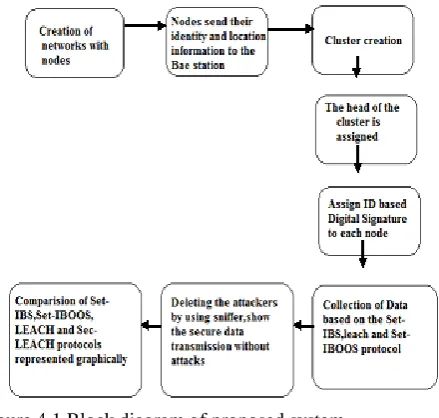
Proposed system is as shown in Figure 4.1 where initially the nodes of network are created.These nodes send their identity and informatiom about their location to the base station, then cluster head is assigned and digital signature is given to each node and data collection is done using Set-IBS and Set-IBOOS protocols.The transmissin of data is secure because during transmission if the attacker tries to get the data, attacker will be detected and removed.Sniffer is used to deleteing the attackers and finally the secure and efficient data will be transmitted in the network represented by graphically.IBS and Set-IBOOS protocol have better performance then existing
protocols called LEACH and Sec
LEACH.
Figure 4.1 Block diagram of proposed system
Clustering scheme for SET-IBS and SET-IBOOS.
In large-scale CWSNs, multihop data transmission is used for transmission where the direct communication is not possible due to the distance. The SET-IBS and SET-IBOOS protocols can be extended using multihop routing algorithms to form secure data transmission protocols for hierarchical clusters. Following two routing models can be used to solve the problem that occurs due to extended protocols:
1. The multihop planar model: A CH node sends data to the BS through forwarding its data to all of its neighbor nodes. This work proposes an energy-efficient routing algorithm, and it is appropriate for secure data transmission protocols.
2. The cluster-based hierarchical method: The network is separated into clustered layers, and the data packages move from a lower cluster head to higher one.
Sniffer
Sniffer is nothing but a device or a machine which continuously monitors the network. Whenever an attacker tries to hack the information, sniffer identifies the attackers and deletes it. Thus it adds extra security for data transmission.
Advantages of proposed system
It provides high security and authentication.
Efficient data transmission.
Low energy consumption.
Solves orphan node problem.
Reduce the computational overhead.
448
Copyright © 2011-15. Vandana Publications. All Rights Reserved.
Figure 4.2 System ArchitectureSystem architecture is given in Figure 4.2. CWSNs contain fixed BS and many number of sensor nodes. These function likely and have same capabilities.BS is reliable and is trusted authority. When sensor nodes transmit the data, many attackers will try to interrupt on wireless channel and get the data. A cluster contains the CH and many sensor nodes where CH is autonomously elected. When leaf nodes receive the data will join the cluster depending on received signal strength. These leaf nodes send this received data to CHs and saves energy. These CHs inform send data to BS with high energy. Sensor nodes, BS and CH all are time synchronized. Data transmission costs more, Hence the method of transmitting the data from CH to BS is preferred than each node sending data directly to BS. In this method sensor node goes to sleep mode and saves energy.
V.
RESULT AND DISCUSSION
Throughput
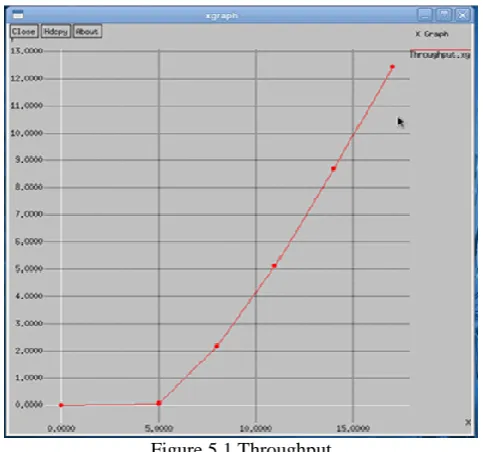
Numbers of packets that reach the destination successfully indicate the throughput. In this work it is number of safety messages that reach the destination data successfully. The graph in Figure 5.1shows the throughput achieved. It is measured in terms of bytes per second.
Figure 5.1 Throughput
Packet drops
It indicates the total number of packets dropped during simulation due to lack of resources like queue, bandwidth.
Figure 5.2 Packet drops
The graph in the Figure 5.2 indicates number of number of packets dropped with time. Till 5msecs no drops as the route discovery and start of transmission takes times. The drop increases and then decreases. Again the drop increases till it reaches the maximum point and start decreasing.
Packet delivery ratio
449
Copyright © 2011-15. Vandana Publications. All Rights Reserved.
Figure 5.3 Packet delivery ratioGraph in Figure 5.3 indicates the delivery ratio achieved by the proposed work. It is clear that the delivery ratio is always more than 50% in any condition and it is possible to achieve 100% delivery ratio some times. X-axis shows the timing factor in msecs and y-axis indicates packets ratio
VI.
CONCLUSION
The existing method make use of LEACH protocols which uses symmetric key management, this suffers from orphan node problem. So Secure and efficient data transmission is very much necessary for WSN’s. Hence to provide security and efficient data transmission two protocols are proposed. Proposed system used SET-IBS and SET-IBOOS protocols along with Identity Based digital Signature (IBS) scheme and IBOOS scheme. It reduces storage cost, computation cost and provides high security. It is an effective method to overcome orphan node problem. This method also detects and removes the attackers by using sniffer. SET-IBS and SET-IBOOS secure routing protocols have better performance than the existing protocols (LEACH and sec LEACH) and reduces the energy consumption for data transmission, hence increases network life time of the wireless sensor networks.
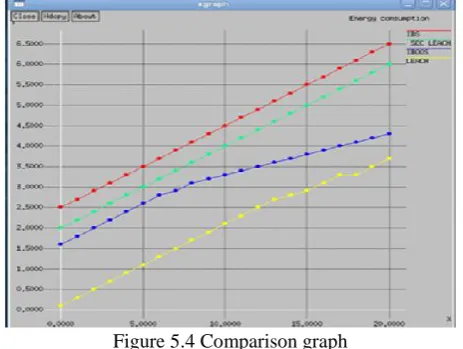
Figure 5.4 Comparison graph
In Figure 5.4 comparing four protocols are called LEACH, sec LEACH,SET-IBS and SET-IBOOS. In that SET-IBS and SET-IBOOS secure routing protocols have better performance than the existing protocols (LEACH and sec LEACH).
Comparison graph
Here comparing existing protocols with proposed protocols then conclude which performance is better.
REFERENCES
[1] T. Hara, V.I.Zadorozhny, and E. Buchmann, Wireless Sensor Network Technology for the Explosion Era, Studies in Computational Intelligence, vol. 278. Springer-Verlag, 2010 .
[2] Y. Wang, G. Attebury, and B. Ramamurthy, “A Survey of Security Issues in Wireless Sensor Networks,” IEEE Comm. Surveys & Tutorials, vol. 8, no. 2, pp. 2-23, Second Quarter 2006.
[3] A.A. Abbasi and M. Younis, “A Survey on Clustering Algorithms for Wireless Sensor Networks,” Computer Comm., vol. 30, nos. 14/ 15, pp. 2826-2841, 2007.
[4] W. Heinzelman, A. Chandrakasan, and H. Balakrishnan, “An Application-Specific Protocol Architecture for Wireless Microsensor Networks,” IEEE Trans. Wireless Comm., vol. 1, no. 4, pp. 660-670, Oct. 2002.
[5] A. Manjeshwar, Q.-A.Zeng, and D.P. Agrawal, “An Analytical Model for Information Retrieval in Wireless Sensor Networks Using Enhanced APTEEN Protocol,” IEEE Trans. Parallel & Distributed Systems, vol. 13, no. 12, pp. 1290-1302, Dec. 2002.
[6] S. Yi et al., “PEACH: Power-Efficient and Adaptive Clustering Hierarchy Protocol for Wireless Sensor Networks,” Computer Comm., vol. 30, nos. 14/15, pp. 2842-2852, 2007.
[7] K. Pradeepa, W.R. Anne, and S. Duraisamy, “Design and Implementation Issues of Clustering in Wireless Sensor Networks,” Int’l J. Computer Applications, vol. 47, no. 11, pp. 23-28, 2012.
[8] L.B. Oliveira et al., “SecLEACH-On the Security of Clustered Sensor Networks,” Signal Processing, vol. 87, pp. 2882-2895, 2007.
[9]Seema Patil1, Shanti M.B2 M.Tech1, Assistant Professor2 Dept. of Computer Science & Engineering, CMRIT, Bangalore, “Feasibility Study of SET-IBS and SET-IBOOS Protocols in Cluster Based Wireless Sensors Networks with Enhancement in Security Overhead and Energy Consumption”, DOI 10.4010/2014.206 ISSN-2321 -3361 © JUNE 2014 IJESC
[10] Ayushi Lecturer, Hindu College of Engineering,”H.No:438, sec-12, sonipat, Haryana “A Symmetric Key Cryptographic Algorithm”,International Journal of Computer Applications (0975 - 8887) Volume 1 – No. 15,2010
450
Copyright © 2011-15. Vandana Publications. All Rights Reserved.
[12] K. Zhang, C. Wang, and C. Wang, “A Secure RoutingProtocol for Cluster-Based Wireless Sensor Networks Using Group Key Management,” Proc. Fourth Int’l Conf. Wireless Comm., Networking and Mobile Computing (WiCOM), pp. 1-5, 2008.
[13] S. Sharma and S.K. Jena, “A Survey on Secure Hierarchical Routing Protocols in Wireless Sensor Networks,” Proc. Int’l Conf. Comm., Computing & Security (ICCCS), pp. 146-151, 2011.
[14] Anil Lamba, 2014. "Uses of Cluster Computing Techniques to Perform Big Data Analytics for Smart Grid Automation System", International Journal for Technological Research in Engineering, Volume 1 Issue 7, pp.5804-5808,2347-4718..
[15] W. Diffie and M. Hellman, “New Directions in Cryptography,” IEEE Trans. Information Theory, vol. IT-22, no. 6, pp. 644-654, Nov. 1976.
[16] A. Shamir, “Identity-Based Cryptosystems and Signature Schemes,” Proc. Advances in Cryptology (CRYPTO), pp. 47-53, 1985.
[17] D.W. Carman, “New Directions in Sensor Network Key Management,” Int’l J. Distributed Sensor Networks, vol. 1, pp. 3-15, 2005.
[18] H. Lu, J. Li, and H. Kameda, “A Secure Routing Protocol for Cluster-Based Wireless Sensor Networks Using ID-Based Digital Signature,” Proc. IEEE GLOBECOM, pp. 1-5, 2010.