The Thirty-Third AAAI Conference on Artificial Intelligence (AAAI-19)
Devil in the Details: Towards Accurate Single and Multiple Human Parsing
Tao Ruan,
1∗Ting Liu,
1∗Zilong Huang,
3Yunchao Wei,
†Shikui Wei,
1Yao Zhao
11Institute of Information Science, Beijing Jiaotong University, China 2University of Illinois at Urbana-Champaign, USA
3School of Electronic Information and Communications, Huazhong University of Science and Technology, China
Abstract
Human parsing has received considerable interest due to its wide application potentials. Nevertheless, it is still unclear how to develop an accurate human parsing system in an effi-cient and elegant way. In this paper, we identify several useful properties, including feature resolution, global context infor-mation and edge details, and perform rigorous analyses to re-veal how to leverage them to benefit the human parsing task. The advantages of these useful properties finally result in a simple yet effective Context Embedding with Edge Perceiv-ing (CE2P) framework for sPerceiv-ingle human parsPerceiv-ing. Our CE2P is end-to-end trainable and can be easily adopted for con-ducting multiple human parsing. Benefiting the superiority of CE2P, we won the 1st places on all three human parsing tracks in the 2nd Look into Person (LIP) Challenge. Without any bells and whistles, we achieved 56.50% (mIoU), 45.31% (meanAPr) and 33.34% (AP0p.5) in Track 1, Track 2 and
Track 5, which outperform the state-of-the-arts more than 2.06%, 3.81% and 1.87%, respectively. We hope our CE2P will serve as a solid baseline and help ease future research in single/multiple human parsing. Code has been made available at https://github.com/liutinglt/CE2P.
Introduction
Human parsing is a fine-grained semantic segmentation task which aims at identifying the constituent parts (e.g.
body parts and clothing items) for a human image on pixel-level. Understanding the contents of the human image makes sense in several potential applications including e-commerce, human-machine interaction, image editing and virtual reality to name a few. Currently, human parsing has gained remarkable improvement with the development of fully convolutional neural networks on semantic segmenta-tion.
For the semantic segmentation, researchers have devel-oped many solutions from different views to tackle the chal-lenging dense prediction task. In general, current solutions can be grossly divided into two types: 1) High-resolution MaintenanceThis kind of approaches are attempting to ob-tain high-resolution features to recover the desired detailed
∗
Equal contribution
†
Corresponding author
Copyright c2019, Association for the Advancement of Artificial Intelligence (www.aaai.org). All rights reserved.
information. Due to consecutive spatial pooling and convo-lution strides, the resoconvo-lution of the final feature maps is re-duced significantly that the finer image information is lost. To generate high-resolution features, there are two typical solutions,i.e.cutting several down-sampling (e.g.max pool-ing) operations (Chen et al. 2016a) and introducing details from low-level feature maps (Chen et al. 2018b). For the latter case, it is usually embedded in an encoder-decoder ar-chitecture, in which the high-level semantic information is captured in the encoder and the details and spatial informa-tion are recovered in the decoder. 2)Context Information EmbeddingThis kind of approaches is devoting to capture rich context information to handle the objects with multi-ple scales. Feature pyramid is one of the effective ways to mitigate the problem caused by various scales of objects, and atrous spatial pyramid pooling (ASPP) based on di-lated convolution (Chen et al. 2018a) and pyramid scene parsing (PSP) (Zhao et al. 2017) are two popular struc-tures. ASPP utilizes parallel dilated convolution layers with different rates to incorporate multi-scale context. PSP de-signs pyramid pooling operation to integrate the local and global information together for more reliable prediction. Be-yond these two typical types, some other works also propose to advantage the segmentation performance by introduc-ing additional information such as edge (Liang et al. 2017; Liu et al. 2017) or more effective learning strategy such as cascaded training (Li et al. 2017b).
Compare with the general semantic segmentation tasks, the challenges of human parsing is to produce finer predic-tions for every detailed region belonging to a person. Be-sides, the arms, legs and shoes are further divided into the left side and right side for more precise analysis, which makes the parsing more difficult. Despite the approaches mentioned above showing impressive results in semantic segmentation, it remains unclear how to develop an accu-rate human parsing system upon these solutions and most previous works did not explore and analyze how to leverage them to unleash the full potential in human parsing. In this work, we target on answering such a question: can we sim-ply formulate a powerful framework for human parsing by exploiting the recent advantages in the semantic segmenta-tion area?
performance of human parsing. In particular, we perform an analysis of potential gains in mIoU score with different properties. The evaluated useful properties include feature resolution, context information and edge details. Based on the analysis, we present a simple yet effective Context Em-bedding with Edge Perceiving (CE2P) framework for single human parsing. The proposed CE2P consists of three key modules to learn for parsing in an end-to-end manner: 1) A high-resolution embedding module used to enlarge the fea-ture map for recovering the details; 2) A global context em-bedding module used for encoding the multi-scale context information; 3) An edge perceiving module used to integrate the characteristic of object contour to refine the boundaries of parsing prediction. Our approach achieves state-of-the-art performance on all three human parsing benchmarks. Those results manifest that the proposed CE2P can provide con-sistent improvements over various human parsing tasks. The main contributions of our work are as follows:
• We analyze the effectiveness of several properties for hu-man parsing, and reveal how to leverage them to benefit the human parsing task.
• We design a simple yet effective CE2P framework by leveraging the useful properties to conduct human pars-ing in a simple and efficient way.
• Our CE2P brings a significant performance boost to all three human parsing benchmarks, outperforming the cur-rent state-of-the-art method by a large margin.
• Our code is available, which can serve as a solid baseline for the future research in single/multiple human parsing.
Related Work
Human Parsing
The study of human parsing has drawn more and more at-tention due to the wide range of potential application. The early works (Yamaguchi et al. 2012; Dong et al. 2013; Simo-Serra et al. 2014; Ladicky, Torr, and Zisserman 2013) performed the parsing with CRF framework and utilized the human pose estimation to assist the parsing. A Co-CNN (Liang et al. 2017) architecture was proposed to hier-archically integrate the local and global context information and improved the performance greatly. Recently, SSL (Gong et al. 2017) introduced a self-supervised structure-sensitive loss, which was used for enforcing the consistency between parsing results and the human joint structures, to assist the parsing task. Following previous work, JPPNet (Liang et al. 2018) incorporated the human parsing and pose estimation task into a unified network. With multi-scale feature con-nections and iterative refinement, the parsing and pose tasks boosted each other simultaneously. Considering the practical application, several current works (Li, Arnab, and Torr 2017; Li et al. 2017a; Zhao et al. 2018) focus on handling the scenario with multiple persons. Usually, it consisted of three sequential steps: object detection (He et al. 2017), object segmentation and part segmentation. Besides, many research efforts (Girshick et al. 2014; Wang et al. 2015; Chen et al. 2016b; Hariharan et al. 2015) have been devoted
into the object parts segmentation, which was similar to hu-man parsing. Most of those works leveraged the multi-scale features to enhance the performance.
Semantic Segmentation
Human parsing is a fine-grained semantic segmentation task. Hence, the methods used in human parsing is simi-lar to semantic segmentation. Since the fully convolutional network (FCN) (Long, Shelhamer, and Darrell 2015) has shown numerous improvements in semantic segmentation, many researchers (Chen et al. 2016a; J´egou et al. 2017; Wei et al. 2018; 2017a; 2017b) have made efforts based on the FCN. Several pieces of work (Badrinarayanan, Kendall, and Cipolla 2017; Ronneberger, Fischer, and Brox 2015; Lin et al. 2017), leveraged an encoder-decoder architecture with skip connection to recover the dense feature responses. Another literatures (Chen et al. 2016a; Yu and Koltun 2015; Chen et al. 2018b) exploited the dilated convolution for higher resolution output. Besides, the local and global in-formation are integrated for generating more reliable pre-diction, such as (Chen et al. 2018a; Zhao et al. 2017).
Context Embedding with Edge Perceiving
In this section, we first provide the architecture of our Context Embedding with Edge Perceiving(CE2P) approach. Within CE2P, we analyze the effectiveness of several key modules motivated from the previous state-of-the-art seman-tic segmentation models and reveal how they can work to-gether to accomplish the single human parsing task. Then, we give the details of applying the CE2P to address the more challenging multiple human parsing task.
Key Modules of CE2P
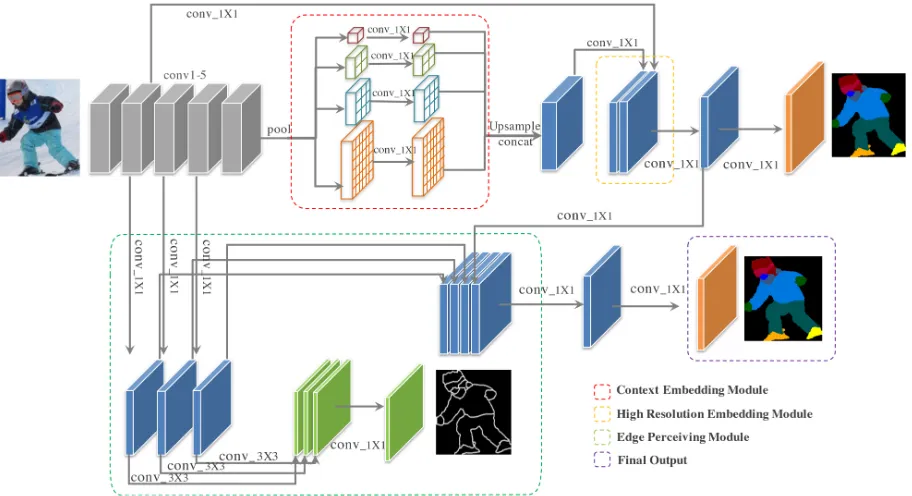
Our CE2P integrates the local fine details, global context and semantic edge context into a unified network. The overview of our framework is shown in Fig. 1. Specifically, it consists of three key components to learn for parsing in an end-to-end manner,i.e.context embedding module, high-resolution em-bedding module and edge perceiving module. ResNet-101 is adopted as the feature extraction backbone.
Figure 1: The framework of our proposed CE2P. The overall architecture consists of three key modules: 1) high resolution embedding module 2) global context embedding module; 3) edge perceiving module.
context information. Finally, the output of context embed-ding module is fed into the following high-resolution mod-ule as global context prior.
High-resolution Embedding Module In human parsing, there exist several small objects to be segmented,e.g.socks, shoes, sunglasses and glove. Hence, high-resolution feature for final pixel-level classification is essential to generate an accurate prediction. To recover the lost details, we adopt a simple yet effective method which embeds the low-level vi-sual features from intermediate layers as complementary to the high-level semantic features. We exploit the feature from theconv2to capture the high-resolution details. The global context feature is upsampled by factor 4 with bilinear in-terpolation, and concatenated with local feature after chan-nel reduced by 1×1 convolution. Finally, we conduct two sequential 1×1 convolution on the concatenated feature to better fuse the local and global context feature. In this man-ner, the output of high-resolution module simultaneously ac-quires high-level semantic and high-resolution spacial infor-mation.
Edge Perceiving ModuleThis module aims at learning the representation of contour to further sharp and refine the pre-diction. We introduce three branches to detect multi-scale semantic edges. As illustrated in Fig. 1, a 1×1 convolu-tion are conducted to conv2, conv3 and conv4 to gener-ate 2-channel score map for the semantic edge. And then, 1×1 convolution is performed to obtain the fused edge map. Those intermediate features of edge branches, which can capture useful characteristics of object boundaries, are upsampled and concatenated with the features from high-resolution. Finally, 1×1 convolution is performed on the
concatenated feature map to predict the pixel-level human parts.
Our CE2P consisting of the three modules is learned with an end-to-end manner. The outputs of CE2P consist of two parsing results and edge prediction. Hence, the loss can be formulated as:
L=LP arsing+LEdge+LEdge−P arsing, (1)
whereLEdgedenotes the weighted cross entropy loss
func-tion between the edge map detected by edge module and the binary edge label map;LP arsingdenotes the cross entropy loss function between the parsing result from high resolu-tion module and the parsing label;LEdge−P arsingdenotes
the cross entropy loss function between the final parsing re-sult, which is predicted from the edge perceiving branch, and the parsing label.
Multiple Human Parsing (MHP)
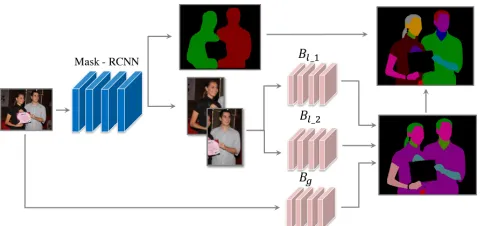
MHP is a more challenging task, which not only needs to classify the semantics of pixels but also identify the in-stance (i.e.one unique person) that these pixels belong to. To achieve high-quality parsing results in the scenario of multi-ple persons, we design a framework called M-CE2P upon our CE2P and Mask R-CNN (He et al. 2017). As shown in Fig. 2, our M-CE2P leverages three branches, denoted by Bg, Bl1, Bl2, to make predictions from global to lo-cal views. The details of the three branches are introduced in the following.
Figure 2: The overall framework of CE2P for Multiple Hu-man Parsing task.
apply it over the entire image for global parsing. For the branch ofBg, we train a CE2P model with the entire im-ages. Then, the output of this branch is leveraged as comple-mentary to the following local parsing. The global parsing branch can provide context information when there exist oc-clusions among multiple persons. For instance, the same se-mantic parts form different persons can be easy to tell apart, and the spatial relationship among persons can be captured to handle the circumstance of occlusion. However, it does not concentrate on the relatively small human instances. As a result, body parts belonging to small-scale person are likely ignored byBg.
Local Parsing with Predicted Instance MasksBl1To al-leviate the problem of global parsingBg, we consider lo-cating the persons as a preprocessing step to generate ac-curate parsing results. Towards this end, we propose a two-stage branch devoting to human-level local parsing. Specif-ically, we employ Mask R-CNN (He et al. 2017) to extract all the person patches in the input image, and resize them to fit the input size of CE2P. And then, all the human-level sub-images are fed into CE2P to training the model for local view. During inference stage, the sub-images with single hu-man instance of input images are extracted by Mask R-CNN, and further fed into the trained model to make parsing pre-dictions. The predicted confidence maps are resized to the original size by bilinear interpolation for the following pre-diction over the entire image. Finally, the confidence maps for each sub-images are padded with zeros to keep the same size as the confidence map fromBg, and further fused to-gether by element-wise summation on foreground channels and minimization on background channel.
Local Parsing with Ground-truth Instance Masks Bl2 Considering that a human instance obtained from the ground-truth instance mask is more approximate to the real single human image, we introduce the branchBl2 to train a model with the data generated from ground-truth instance mask. This branch is rather similar withBl1, the only dif-ference is that we obtain person patches with the guide of the ground truth bounding boxes in the training stage. With the Bl2, the performance of local parsing can be further boosted. Finally, the predictions generated by the three branches are fused by element-wise summation to ob-tain the final instance-agnostic parsing result. The predicted
instance-agnostic parsing results are further fed into the fol-lowing process to make the instance-level parsing.
Instance-level Parsing and Label Refinement With the instance-agnostic parsing result obtained from M-CE2P, we consider two aspects to generate the instance-level label,i.e. instance assignment for predicting instance-aware results andlabel refinementfor solving the shortage of the under-segmentation phenomenon of Mask R-CNN. For instance assignment, we directly apply human masks generated by Mask R-CNN to assign instance-level part label of global body parts. Concretely, parts will be assigned with differ-ent part instance labels when they are same category while belonging to different masks. Through the experiments, we find that the parsing mask predicted from our CE2P is more reliable than human instance map. To further validate the reliability of parsing results, we introduce the label refine-ment by expanding the area of intersection with the neigh-bor pixels which have same parsing label while exceeding the human instance. For example, some regions of marginal parts(e.g. hair, hands) are very likely to be outside of the area of predicted human masks. We use searching based method to alleviate this problem. Specifically, for each bor-der pixel of the part obtained from the assignment step, we use Breadth-First Search to find the pixel that is endowed with an instance-agnostic class label but no part label due to the inaccuracy of segmentation prediction. With the pro-posed refinement, the body parts excluded by human mask can be effectively included in the final instance-level result.
Experimental Results
Dataset and Metrics
We compare the performance of single human parsing of our proposed approach with other state-of-the-arts on the LIP (Liang et al. 2018) dataset, and we further evaluate the multiple human parsing on CIHP (Gong et al. 2018) and MHP v2.0 (Li et al. 2017a) dataset.
LIP dataset: The LIP (Liang et al. 2017) dataset is used in LIP challenge 2016, which is a large-scale dataset that focuses on single human parsing. There are 50,462 images with fine-grained annotations at pixel-level with 19 semantic human part labels and one background label. Those images are further divided into 30K/10K/10K for training, valida-tion and testing, respectively.
CIHP dataset: CIHP (Gong et al. 2018) provides a dataset with 38,280 diverse human images, in which contains 28,280 training, 5K validation and 5K test images. The images have pixel-wise annotation on 20 categories and instance-level identification.
MHP v2.0 dataset: The MHP v2.0 dataset is designed for multi-human parsing in the wild including 25,403 images with finer categories up to 58 semantic labels. The validation set and test set have 5K images respectively. The rest 15,403 are provided as the training set.
Table 1: Comparison of CE2P in various module settings on the validation set of LIP. The results are obtained without left-right flipping except for the last row. ’B’ means baseline model. ’G’, ’H’ and ’E’ denote global context, high resolution and edge perceiving module, respectively.
Method bkg hat hair glo
v
e
glasses u-cloth dress coat socks pants j-suits scarf skirt face l-arm r-arm l-le
g
r-le
g
l-shoe r-shoe mIoU B 86.08 63.24 70.14 33.75 29.45 66.15 24.10 51.79 45.70 70.75 21.52 13.56 20.36 73.04 58.24 60.88 49.70 48.06 36.50 36.40 47.97 B+H 86.69 64.65 71.53 33.76 33.30 66.50 25.11 51.52 46.10 71.46 23.62 14.77 21.44 74.08 60.04 62.41 50.36 50.74 36.95 37.19 49.11 B+G 86.61 63.77 71.01 34.90 30.73 67.93 30.89 54.14 46.11 72.21 23.38 13.16 20.16 73.50 59.51 62.12 50.70 50.48 38.63 38.84 49.44 B+E 86.87 63.47 71.56 35.60 31.35 67.06 27.80 52.28 47.85 72.21 23.89 15.60 20.57 74.37 61.04 63.36 53.30 52.70 39.72 40.16 50.04 B+G+H 87.22 65.34 72.13 36.18 31.97 68.86 31.02 55.81 47.35 73.23 26.91 12.28 20.58 74.49 62.95 65.18 56.31 55.59 43.49 43.80 51.54 B+G+H+E
(CE2P) 87.41 64.62 72.07 38.36 32.20 68.92 32.15 55.61 48.75 73.54 27.24 13.84 22.69 74.91 64.00 65.87 59.66 58.02 45.70 45.63 52.56 CE2P
(Flipping) 87.67 65.29 72.54 39.09 32.73 69.46 32.52 56.28 49.67 74.11 27.23 14.19 22.51 75.50 65.14 66.59 60.10 58.59 46.63 46.12 53.10
which is first introduced in (Hariharan et al. 2014);APp(Li et al. 2017a) computes the pixel-level IoU of semantic part categories within a person, instead of global circumstance;
P CP (Li et al. 2017a) elaborates how many body parts are correctly predicted of a certain person, guided with pixel-level IoU.
Implement Details
We implement the proposed framework in PyTorch (Paszke et al. 2017) based on (Huang et al. 2018), and adopt ResNet-101 (He et al. 2016) as the backbone network. The input size of the image is 473×473 during training and testing. We adopt the similar training strategies with Deeplab (Chen et al. 2018b),i.e.“Poly” learning rate policy with base learning rate 0.007. We fine-tune the networks for approximately 150 epochs. For data augmentation, we apply the random scal-ing (from 0.5 to 1.5), croppscal-ing and left-right flippscal-ing durscal-ing training. Note that the edge annotation used in the edge per-ceiving module is directly generated from the parsing anno-tation by extracting border between different semantics.
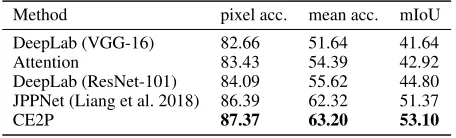
Table 2: Comparison of performance on the validation set of LIP with state-of-arts methods.
Method pixel acc. mean acc. mIoU
DeepLab (VGG-16) 82.66 51.64 41.64
Attention 83.43 54.39 42.92
DeepLab (ResNet-101) 84.09 55.62 44.80 JPPNet (Liang et al. 2018) 86.39 62.32 51.37
CE2P 87.37 63.20 53.10
Single Human Parsing
To investigate the effectiveness of each module, we report the performance under several variants of CE2P in Tab. 1. We begin the experiment with a baseline model without any proposed modules. For our baseline, the prediction is di-rectly performed on the final feature map extracted from ResNet-101. The resolution of the final feature map is1/16
to the input size. The results are shown in Tab. 1, and we can see the baseline model reaches 47.97% accuracy. Some fail-ure examples are shown in Fig. 3. Observing the per-classes performance and the visualized results, there exist the fol-lowing problems. 1) Big-size objects have the discontinu-ous prediction. For instance, the dress is always parsed as
a upper-clothes and skirt, and the jumpsuit is separated into a upper-clothes and pants. 2) The confusable categories are hard to distinguish.i.e. the coat and upper-clothes. 3) The left and right parts are easily confused, which frequently oc-curs in the back-view human body and the front-view body with legs crossed.
Global Context Embedding Module To evaluate the ef-fectiveness of each module, we first conduct experiments by introducing a global context embedding module. In our architecture, we leverage the pyramid pooling (Zhao et al. 2017) to generate multi-scale context information. As shown in Tab. 1, we can find it brings about 1.5% improvements on mIoU, which demonstrates that the multi-scale context in-formation can assist the fine-grained parsing. Particularly, it shows significant boosts (nearly 7%) in the class of dress. Since the long-range context information can provide the more discriminated characteristic, the global context embed-ding module is helpful for the big-size objects.
High Resolution Embedding ModuleTo figure out the im-portance of the high resolution, we conduct experiments by further introducing a high resolution module. From Tab. 1, we can find that the performance gains nearly 2% improve-ment with the high resolution embedding module. As hu-man parsing is a fine-grained pixel-wise classification, it re-quires a lot of detailed information to identify the various small-size parts accurately. With high resolution embedding module, the features from shallow and high-resolution lay-ers provide more details not available in deep laylay-ers. The results demonstrate the effectiveness as well.
Edge Perceiving Module Finally, we report the perfor-mance with the edge perceiving module in Tab. 1. Based on the above two modules, appending edge perceiving mod-ule still brings nearly 1% boosts. That’s the contours of the parts can be underlying constraints during separating the se-mantic parts from a human body. In addition, the features from multiple edge branches carrying various details of the objects can further promote the human parts prediction. Fi-nally, fusing with the flipped images gives 0.6% gain.
compar-Figure 3: Some issues of baseline model on LIP dataset. (a) The left arm (leg) is wrongly predicted as right arm (leg). (b) The dress is separated into a upper-clothes and skirt. (c) The jumpsuits is parsed into a upper-clothes and pants. (d) The coat is mislabeled as upper-clothes.
ing with the current state-of-the-art approach JPPNet, our method exceeds by 1.73% in terms of mIoU. In particu-lar, the performance on the small-size categories,i.e.‘socks’ and ‘sunglasses’, yields obviously improvement. Thanks to the high resolution embedding and edge perceiving module, the details and characteristic of small objects can be cap-tured for further pixel-level classification. Besides, the JPP-Net achieves the performance of 51.37% by utilizing extra pose annotation with a complex network structure. Never-theless, our CE2P obtains better performance with a simpler network structure and no need for extra annotation.
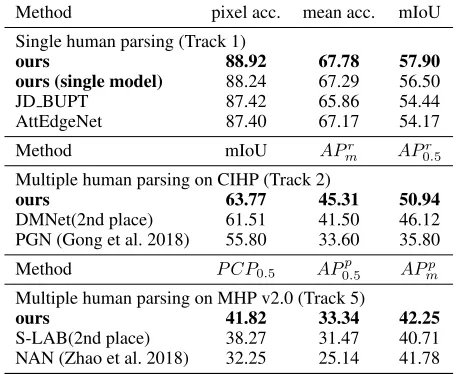
Table 3: Comparison of the performance on the test set of single and multiple human parsing datasets. Here the sub-scriptminXmmeans the mean value ofX.
Method pixel acc. mean acc. mIoU
Single human parsing (Track 1)
ours 88.92 67.78 57.90
ours (single model) 88.24 67.29 56.50
JD BUPT 87.42 65.86 54.44
AttEdgeNet 87.40 67.17 54.17
Method mIoU APr
m AP0.5r
Multiple human parsing on CIHP (Track 2)
ours 63.77 45.31 50.94
DMNet(2nd place) 61.51 41.50 46.12
PGN (Gong et al. 2018) 55.80 33.60 35.80
Method P CP0.5 AP0.5p AP
p m
Multiple human parsing on MHP v2.0 (Track 5)
ours 41.82 33.34 42.25
S-LAB(2nd place) 38.27 31.47 40.71
NAN (Zhao et al. 2018) 32.25 25.14 41.78
Multiple Human Parsing
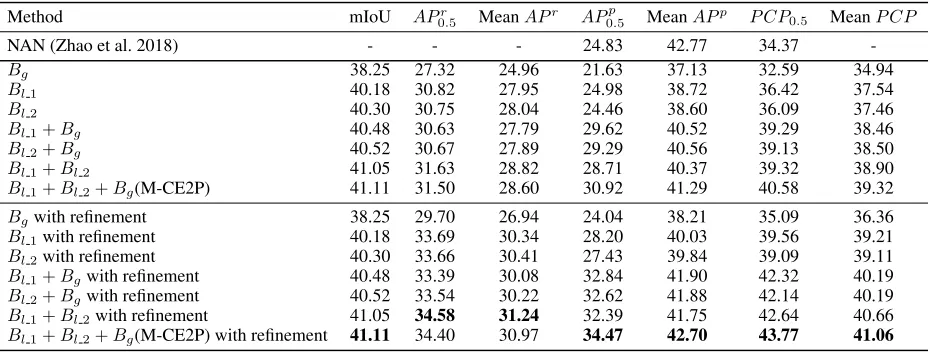
We provide abundant experimental results on two large datasets of multiple human parsing task, named CIHP and MHP v2.0. The results are exhibited in Tab. 4. Due to space limitation, we only show detailed results on the more chal-lenging MHP v2.0 dataset. The detailed explanation will be
Figure 4: A visualized example for Multiple Human Parsing task. The areas surrounded by white bounding boxes indi-cate the failure cases of predicted results.
given in the following paragraphs.
Label RefinementA remarkable improvement attributes the success to the label refinement operation. As Tab. 4 shows, it exactly brings performance boosting, despite of the com-bination strategies. As we mentioned before, the results pro-vided by Mask R-CNN are likely to ignore some partial area of marginal body parts, especially on complex images. How-ever, CE2P may catch these parts from the localized human sub images. Therefore, the refinement operation can allevi-ate the under segmentation problem. For clarity, the follow-ing analyses are all based on refined results.
Comparison with Various Combination Strategies To prove the effectiveness of the multi-branch fusion strate-gies, we perform experiments with various branch combina-tions. From Tab. 4, we can notice that the results produced by the double-branch model are better than that produced by the single-branch model, and the all-branch model, i.e.
M-CE2P, catch the best performance on most of the met-rics. Especially on more convincing human-centric metrics likeAPp andP CP, M-CE2P shows out a significant
per-formance boosting than all the other models. It proves that branches can make complements with each other. As men-tioned in the previous section, the branch Bg trained with
the entire image lacks the ability to grab small-scale persons in a scene, such as the first image in Fig. 4. Hence, it only achieves the performance of 24.04% in terms ofAP0p.5. Nev-ertheless, this shortcoming can be compensated byBl1and Bl2to capture a more precise view of local context. On the other hand, the benefits fromBgare still cannot be ignored. The global context that Bg has makes a performance
im-provement of 2.08% in terms ofAP0p.5 than the result only utilizesBl1andBl2. Finally, the all-branch fused M-CE2P can reach the best performance under the APp andP CP
metrics.
Table 4: Comparisons on MHP v2.0 validation dataset
Method mIoU APr
0.5 MeanAPr AP
p
0.5 MeanAPp P CP0.5 MeanP CP
NAN (Zhao et al. 2018) - - - 24.83 42.77 34.37
-Bg 38.25 27.32 24.96 21.63 37.13 32.59 34.94
Bl1 40.18 30.82 27.95 24.98 38.72 36.42 37.54
Bl2 40.30 30.75 28.04 24.46 38.60 36.09 37.46
Bl1+Bg 40.48 30.63 27.79 29.62 40.52 39.29 38.46
Bl2+Bg 40.52 30.67 27.89 29.29 40.56 39.13 38.50
Bl1+Bl2 41.05 31.63 28.82 28.71 40.37 39.32 38.90
Bl1+Bl2+Bg(M-CE2P) 41.11 31.50 28.60 30.92 41.29 40.58 39.32
Bgwith refinement 38.25 29.70 26.94 24.04 38.21 35.09 36.36
Bl1with refinement 40.18 33.69 30.34 28.20 40.03 39.56 39.21
Bl2with refinement 40.30 33.66 30.41 27.43 39.84 39.09 39.11
Bl1+Bgwith refinement 40.48 33.39 30.08 32.84 41.90 42.32 40.19
Bl2+Bgwith refinement 40.52 33.54 30.22 32.62 41.88 42.14 40.19
Bl1+Bl2with refinement 41.05 34.58 31.24 32.39 41.75 42.64 40.66
Bl1+Bl2+Bg(M-CE2P) with refinement 41.11 34.40 30.97 34.47 42.70 43.77 41.06
et al. 2018) 8.20%, 9.57% and 0.47% in terms of AP0p.5,
P CP0.5 and mean APp, respectively; On the test set of CIHP, our M-CE2P performs 63.77%, 45.31%, 50.94% in terms of mIoU, meanAPrandAPr
0.5, respectively, which all outperform than (Gong et al. 2018). Above all, we in-vestigate and combine several useful properties to improve the parsing results. Each module plays an important role and makes improvements for the final results. Benefiting from our parsing network, the prediction on the whole multi-person image already has a comparable result with baseline methods. Based on the accurate parsing results, our fusion strategy and label refinement can make further boost.
Visualization Some visualized results with their failure cases are shown in Fig. 4. Generally speaking, our M-CE2P can handle a rather complex scene with multiple persons, and produce a satisfactory result. However, there are also some failure cases produced by our M-CE2P. From the per-spective of fusion strategy, it has following problems: 1) Un-der some circumstances, the Bg brings too much negative confidence to parts belong to human far away from camera, so that the confidence provided by local parsing may be dras-tically reduced; 2) When acting sub-image fusion, the local information of tightly closed humans may be disturbed with each other. For example, in bottom line of Fig. 4, the man with black suit make the edge of woman’s skirt strongly be mistaken as other semantics.
Results in Challenge
With our CE2P framework, we achieved the 1st places of all three human parsing tracks in the 2nd Look into Per-son (LIP) Challenge. Tab. 3 shows a few of the results on the single human parsing lead-board. By integrating the re-sults from three models with different input size, our CE2P achieved 57.9%. More importantly, our single model already attained the state-of-arts performance without any bells and whistles. Besides, we design a M-CE2P upon our CE2P for multiple human parsing with three branches to predict from global to local view. Benefiting from the M-CE2P model, we achieved high performance in all the multiple human parsing
benchmarks without refinement process,i.e.CIHP and MHP v2.0, respectively. Specifically, we yielded 45.31% of Mean
APr and 33.34% of AP0p.5, which outperform the second place more than 3.81% 1.87%, respectively.
Conclusion
In this paper, we investigate several useful properties for hu-man parsing, including feature resolution, global context in-formation and edge details. We design a simple yet effective CE2P system, which consists of three key modules to in-corporate the context and detailed information into a unified framework. Specifically, we use a high-resolution embed-ding module to capture details from shallow layer, a global context embedding module for multi-scale context infor-mation, and an edge perceiving module to constrain object contours. For multiple human parsing, we fuse three CE2P based model to generate global parsing prediction, and use a straight-forward way to produce the instance-level result with the guide of human mask. The experimental results demonstrate the superiority of the proposed CE2P.
Acknowledgment
This work was supported in part by National Key Research and Development of China (No.2017YFC1703503), Na-tional Natural Science Foundation of China (No.61532005, No.61572065), Fundamental Research Funds for the Cen-tral Universities (No. 2017YJS048, No. 2018JBZ001), Joint Fund of Ministry of Education of China and China Mobile (No.MCM20160102), IBM-ILLINOIS Center for Cognitive Computing Systems Research (C3SR) - a research collabo-ration as part of the IBM AI Horizons Network.
References
Badrinarayanan, V.; Kendall, A.; and Cipolla, R. 2017. Seg-net: A deep convolutional encoder-decoder architecture for image segmentation. TPAMI39(12):2481–2495.
task-specific edge detection using cnns and a discrimina-tively trained domain transform. InCVPR, 4545–4554. Chen, L.; Yang, Y.; Wang, J.; Xu, W.; and Yuille, A. L. 2016b. Attention to scale: Scale-aware semantic image seg-mentation. InCVPR, 3640–3649.
Chen, L.; Papandreou, G.; Kokkinos, I.; Murphy, K.; and Yuille, A. L. 2018a. Deeplab: Semantic image segmentation with deep convolutional nets, atrous convolution, and fully connected crfs. TPAMI40(4):834–848.
Chen, L.; Zhu, Y.; Papandreou, G.; Schroff, F.; and Adam, H. 2018b. Encoder-decoder with atrous separable convolution for semantic image segmentation. arXiv:1802.02611. Dong, J.; Chen, Q.; Xia, W.; Huang, Z.; and Yan, S. 2013. A deformable mixture parsing model with parselets. InICCV, 3408–3415.
Girshick, R. B.; Donahue, J.; Darrell, T.; and Malik, J. 2014. Rich feature hierarchies for accurate object detection and se-mantic segmentation. InCVPR, 580–587.
Gong, K.; Liang, X.; Zhang, D.; Shen, X.; and Lin, L. 2017. Look into person: Self-supervised structure-sensitive learn-ing and a new benchmark for human parslearn-ing. In CVPR, 6757–6765.
Gong, K.; Liang, X.; Li, Y.; Chen, Y.; Yang, M.; and Lin, L. 2018. Instance-level human parsing via part grouping network.arXiv:1808.00157.
Hariharan, B.; Arbel´aez, P.; Girshick, R.; and Malik, J. 2014. Simultaneous detection and segmentation. InECCV, 297– 312.
Hariharan, B.; Arbel´aez, P.; Girshick, R.; and Malik, J. 2015. Hypercolumns for object segmentation and fine-grained lo-calization. InCVPR, 447–456.
He, K.; Zhang, X.; Ren, S.; and Sun, J. 2016. Deep residual learning for image recognition. InCVPR, 770–778. He, K.; Gkioxari, G.; Doll´ar, P.; and Girshick, R. 2017. Mask r-cnn. InICCV, 2980–2988.
Huang, Z.; Wei, Y.; Wang, X.; and Liu, W. 2018. A pytorch semantic segmentation toolbox.
J´egou, S.; Drozdzal, M.; V´azquez, D.; Romero, A.; and Ben-gio, Y. 2017. The one hundred layers tiramisu: Fully convo-lutional densenets for semantic segmentation. InCVPR. Ladicky, L.; Torr, P. H. S.; and Zisserman, A. 2013. Hu-man pose estimation using a joint pixel-wise and part-wise formulation. InCVPR, 3578–3585.
Li, Q.; Arnab, A.; and Torr, P. H. S. 2017. Holistic, instance-level human parsing. arXiv:1709.03612.
Li, J.; Zhao, J.; Wei, Y.; Lang, C.; Li, Y.; and Feng, J. 2017a. Towards real world human parsing: Multiple-human parsing in the wild.arXiv:1705.07206.
Li, X.; Liu, Z.; Luo, P.; Change Loy, C.; and Tang, X. 2017b. Not all pixels are equal: Difficulty-aware semantic segmen-tation via deep layer cascade. InCVPR, 3193–3202. Liang, X.; Xu, C.; Shen, X.; Yang, J.; Tang, J.; Lin, L.; and Yan, S. 2017. Human parsing with contextualized convolu-tional neural network. TPAMI39(1):115–127.
Liang, X.; Gong, K.; Shen, X.; and Lin, L. 2018. Look into person: Joint body parsing & pose estimation network and A new benchmark. TPAMI.
Lin, G.; Milan, A.; Shen, C.; and Reid, I. D. 2017. Re-finenet: Multi-path refinement networks for high-resolution semantic segmentation. InCVPR, 5168–5177.
Liu, T.; Wei, Y.; Zhao, Y.; Liu, S.; and Wei, S. 2017. Magic-wall: Visualizing room decoration. In ACM Multimedia, 429–437.
Long, J.; Shelhamer, E.; and Darrell, T. 2015. Fully con-volutional networks for semantic segmentation. InCVPR, 3431–3440.
Paszke, A.; Gross, S.; Chintala, S.; Chanan, G.; Yang, E.; DeVito, Z.; Lin, Z.; Desmaison, A.; Antiga, L.; and Lerer, A. 2017. Automatic differentiation in pytorch. InNIPS-W. Ronneberger, O.; Fischer, P.; and Brox, T. 2015. U-net: Convolutional networks for biomedical image segmentation. InMICCAI, 234–241.
Simo-Serra, E.; Fidler, S.; Moreno-Noguer, F.; and Urtasun, R. 2014. A high performance CRF model for clothes pars-ing. InACCV, 64–81.
Wang, P.; Shen, X.; Lin, Z. L.; Cohen, S.; Price, B. L.; and Yuille, A. L. 2015. Joint object and part segmentation using deep learned potentials. InICCV, 1573–1581.
Wei, Y.; Feng, J.; Liang, X.; Cheng, M.-M.; Zhao, Y.; and Yan, S. 2017a. Object region mining with adversarial eras-ing: A simple classification to semantic segmentation ap-proach. InCVPR.
Wei, Y.; Liang, X.; Chen, Y.; Shen, X.; Cheng, M.-M.; Feng, J.; Zhao, Y.; and Yan, S. 2017b. Stc: A simple to com-plex framework for weakly-supervised semantic segmenta-tion. TPAMI39(11):2314–2320.
Wei, Y.; Xiao, H.; Shi, H.; Jie, Z.; Feng, J.; and Huang, T. S. 2018. Revisiting dilated convolution: A simple approach for weakly-and semi-supervised semantic segmentation. In
CVPR, 7268–7277.
Yamaguchi, K.; Kiapour, M. H.; Ortiz, L. E.; and Berg, T. L. 2012. Parsing clothing in fashion photographs. InCVPR, 3570–3577.
Yu, F., and Koltun, V. 2015. Multi-scale context aggregation by dilated convolutions. arXiv:1511.07122.
Zhao, H.; Shi, J.; Qi, X.; Wang, X.; and Jia, J. 2017. Pyramid scene parsing network. InCVPR, 6230–6239.