Xiuyan Li, Kang Cheng (Correspondence)
+This article is published under the terms of the Creative Commons Attribution License 4.0 Author(s) retain the copyright of this article. Publication rights with Alkhaer Publications. Published at: http://www.ijsciences.com/pub/issue/2019-06/
DOI: 10.18483/ijSci.2074; Online ISSN: 2305-3925; Print ISSN: 2410-4477
Effects of Mental Abacus Calculation (MAC) on
Developments of Children's Cognitive Abilities
Xiuyan Li
1, Zaisen Liu
1, Kang Cheng
1
1
Qingdao Binhai University, Medical School, Qingdao, Shandong, PR China
Abstracts: In this investigation, MAC (mental abacus calculation) trained and unchained (control) groups of elementary school children were measured with Raven Reasoning Intelligence Test and basic cognitive abilities; the tested scores were processed with transverse (across-sectional) comparisons between the two groups in the same time as well as longitudinal comparisons within the same groups in different times; and roles of MAC in developing children's intelligence were discussed. Our results showed: (1) The intelligence quotient (IQ) of the children in MAC group was significantly higher (P ﹤0.01) than that of the control group when the cross-sectional comparisons were performed, and (2) the cognitive abilities of children in MAC group were more significantly improved (P ﹤0.05) when the longitudinal comparisons were performed. Conclusion: MAC trainings can promote developments of children's IQ, basic cognitive abilities and intelligence. Children's brain function has a strong plasticity and huge space to develop.
Keywords: Neuroscience, IQ, Brain, Function, Imaginary Thinking, Transverse, Across-Sectional, Longitudinal Comparison
1. Introduction
Psychological studies have shown that a non-linguistic strategy using visual imagery of the abacus (a “mental abacus”) underlies unusual calculation ability. These works have demonstrated examples of the role of mental imagery in mental arithmetic operations [1 - 5].
Mental abacus calculation (MAC) [6] or abacus-based mental calculation (AMC) [7] means a mental arithmetic using an imaginary abacus, it is a special mental arithmetic strategy, it is based on the abacus, through the actual bead training, to the simulation of bead training, and then transition to the image of the bead, eventually a bead movement is formed in the brain. This computational skill comes from relying on beads to leaving the beads; transforms the abstract digital into an intuitive bead image through the visual, auditory, tactile; and completes the calculation process in the brain. Therefore, we can say, in imagine, MAC is equivalent to playing the abacus in the mind.
In a previous study [8], investigators compared the abacus experts and novices and found the experts could instantly turn the numbers into a mental abacus, and the novices could only decode the numbers through words; the former performed parallel processes and the latter performed a series of processes, mainly. When processing mental arithmetic, children without abacus training, started from digital perception to processing the input number by using some certain mental arithmetic strategy, and then to the results of output, generally they carried out the process in a series of
ways; differently, the abacus trained children could instantly convert the digital string into a mental abacus beads when they perceived the digitals, and then they converted the beads to digital outputs, during the entire calculation process, the information was mostly in parallel processing. From digital perception to the use of mental arithmetic strategies in working memory, there are significant differences in the ways information is processed.
In our previous experimental study [9], we found, early event-related potentials changes during simple mental calculation in older adults with mild cognitive impairment.
In this study, we tried to find the effect of MAC on children's cognitive ability development.
2. Materials and methods 2.1 Subjects
For the cross-sectional study, 80 students (10 - 11 years old) were randomly selected from a primary school; the students were equally divided into two groups: MAC trained and the control untrained; the average ages of the both groups were 10.5 years old; numbers of the male and the female in the both groups are equal; all students are in the same grade. For the students in MAC group, their practice time of abacus is more than four years.
Effects of Mental Abacus Calculation (MAC) on Developments of Children's Cognitive Abilities
http://www.ijSciences.com
Volume 8 – June 2019 (06)
7
selected from a primary school; the students were equally divided into two groups: MAC trained and the control untrained; the average ages of the both groups were 7.2 years old; numbers of the male and the female in the both groups are equal. After 1 and 3 years of training in MAC group, the two groups were measured with Raven Reasoning Intelligence Test.
There were no significant differences in student family backgrounds, educational backgrounds and grades in the classes (P ﹥ 0.05), all of the students were the first time to participate in the experiment, all of them were the right hand, and their vision or correction of vision were above 1.0.
2.2 Research methods
2.2.1 Raven Reasoning Intelligence Test
Using standard software package of Raven Reasoning Intelligence Test in Shanghai Prudential Test System, there are totally 60 problems in the test, the software scale consists of a total of 5 groups, and each group has 12 questions. Group A mainly measures perceptual discernment, graphic comparison, graphic imagination and other abilities; group B mainly measures similarity, comparison, graphic combination and other abilities; group C mainly measures comparison, reasoning, graphic combination and other abilities; group D mainly measures series relationship, graphic fitting; group E mainly measures the ability of abstract reasoning such as fitting and swapping. A single test of the subjects was conducted by trained psychologists to record the reactions and test results of the subjects in the tests, and statistical analysis of the data was carried out with SPSS10.0 statistical software: analysis of variance (ANOVA) and T test.
2.2.2 Basic cognitive ability test
The basic cognitive ability tests were performed using published software [10] designed and compiled by Deming Li of the Institute of Psychology of the Chinese Academy of Sciences.
The software includes 7 subtests: digital copies,
comparison of Chinese characters, mental arithmetic, Chinese character rotation, digital working memory, double word re-recognition and meaningless graphics re-recognition. The students were respectively measured in tests of perception speed, mental arithmetic efficiency, spatial representation efficiency, working memory and memory recognition of five aspects of cognitive ability; and individually tested by a trained psychologist, who used a double-blind record of the subject reactions and test results, and performed an independent sample statistical analysis with statistics software SPSS10.0.
3. Results
3.1 Effect of MAC training on children's IQ, transverse comparisons
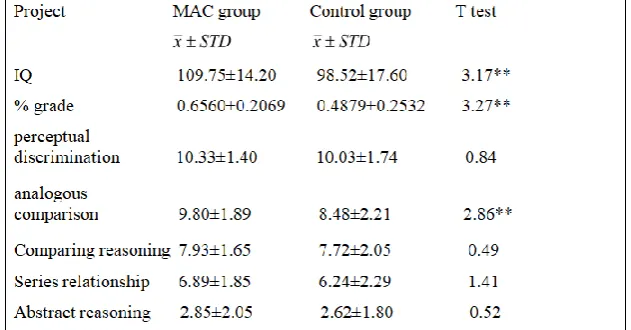
Using Raven Reasoning Intelligence Test tables, strictly trained test operators measured the intelligence quotient (IQ) scores for the two groups of children with standardized treatment. The training time of abacus is 1, 3, 4 years respectively.
The IQ of MAC group was significantly higher than that of the control group (The average training time of MAC was 3.5 years), and MAC group showed a stronger ability than the control group in comparing and combining pictures. It is suggested that MAC exercises can promote developments of children's intelligence quotient (Table 1).
3.2 Studies of correct rate and reaction time of transverse and longitudinal comparisons
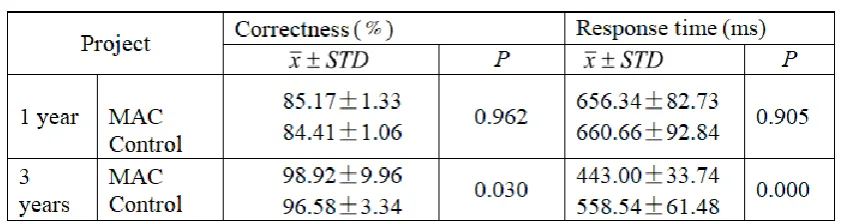
For comparisons of the correct rate and reaction time: there was no statistical difference between of MAC and the control groups in the first grade; there were statistical differences between the two groups after 3 years of MAC training in the transverse comparison; and between the beginning of the first year and the end of the third year for MAC group in the longitudinal comparison. The main effects of growth and MAC trainings were significant compared with that of the control group, P < 0.05 (Tables 2 and 3).
Effects of Mental Abacus Calculation (MAC) on Developments of Children's Cognitive Abilities
http://www.ijSciences.com
Volume 8 – June 2019 (06)
8
Table 2. Comparisons of correctness (accuracy) and response time of contrasts of numbers and objects between groups of the MAC and control.
Source of variation Square sum df Variance F Sig. growth main effect 1749.446 1 1749.446 5.874 .023 interaction effect 1143.018 1 1143.018 3.838 .061 Training main effect 546.875 1 546.875 3.905 .039 Growth error 7743.036 26 297.809
Table 3. Analysis of variance (ANAVA) of intelligence quotient (IQ) change caused by abacus training and student growth factors.
3.3 Effect of MAC training on children's basic cognitive abilities
The basic cognitive abilities of the students were measured by well trained professionals the published software [4]; the average training time for MAC was 3.5 years.
3.3.1 Multiple studies of transverse comparisons
The mental arithmetic efficiency and response time of MAC group were significantly (P < 0.001) higher and shorter than that of the control group respectively; there was also significant differences (P < 0.05) of the working memory breadth and the meaningless graphic re-recognition between the trained and untrained
groups. Additionally, MAC trainings have an impact on the processing of graphics: They can promote children's ability to remember, classify, reason and recognize graphics (Table 4).
3.3.2 Cognitive ability studies of longitudinal and transverse comparisons
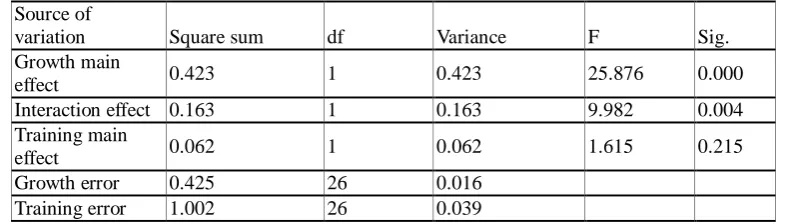
The cognitive abilities of MAC group were significantly enhanced compared with that of themselves after 3 years training and with that of the control group; the correspondent P values of the main effect of growth and the main effect of MAC trainings were smaller than 0.05 (Table 5 - 8 ).
Table 4. Comparisons of basic cognitive abilities between MAC and control groups. Number n = 40 in each group. * P < 0.05, ** P < 0.001.
ART = Averaged response time
RTCCC = Response time of comparing Chinese characters MCE = Mental calculation efficiency
CCRE = Chinese character rotation efficiency WMB = working memory breadth
DWRR = double word re-recognition
Effects of Mental Abacus Calculation (MAC) on Developments of Children's Cognitive Abilities
http://www.ijSciences.com
Volume 8 – June 2019 (06)
9
Table 5. ANOVA of response time to number copy of comparing the MAC and control groups.Source of
variation Square sum df Variance F Sig. Growth main
effect 12.063 1 12.063 38.479 0.000 Interaction effect 0.422 1 0.422 1.345 0.257 Training main
effect 1.563 1 1.563 6.025 0.021 Growth error 8.151 26 0.313
Training error 6.746 26 0.259
Table 6. ANOVA of response time to rapid comparison of Chinese characters of comparing the MAC and control groups.
Source of
variation Square sum df Variance F Sig. Growth main
effect 0.300 1 0.300 23.936 0.000 Interaction effect 0.019 1 0.019 1.518 0.230 Training main
effect 1.440 1 1.440 74.698 0.000 Growth error 0.288 23 0.013
Training error 0.443 23 0.019
Table 7. ANOVA of mental calculation efficiencies of comparing MAC trained and untrained groups.
Source of
variation Square sum df Variance F Sig. Growth main
effect 0.423 1 0.423 25.876 0.000 Interaction effect 0.163 1 0.163 9.982 0.004 Training main
effect 0.062 1 0.062 1.615 0.215 Growth error 0.425 26 0.016
Training error 1.002 26 0.039
Table 8. ANOVA of rotation efficiencies of Chinese characters of comparing MAC trained and untrained groups.
Additionally, the experiment results also showed that the students' mental arithmetic efficiency and intelligence are influenced by the growth factors and practices of MAC; but the factors and practices are independent from each other, there is not any interaction effect between them. For the children trained with MAC, in addition to the promotion factors of growth, MAC training itself improved the developments of basic cognitive ability and intelligence such as mental arithmetic efficiency as well as their mental arithmetic efficiency and intelligence.
4. Discussion
Effects of Mental Abacus Calculation (MAC) on Developments of Children's Cognitive Abilities
http://www.ijSciences.com
Volume 8 – June 2019 (06)
10
When humans make specific movements or reactions to specific or certain stimuli, there is a procedure of information processing in the brain. The procedure is also known as the psychological incubation period. In complex tasks, the psychological incubation period can be divided into multiple stages: the stimulation recognition (identification), the selection reaction, the reaction organization and the reaction execution; through the analysis of the selection reaction time and the reaction procedure, the internal information processing procedure can be inferred.
The mechanism of MAC trainings to improve children's basic cognitive abilities and intelligence is very complicated. As far as digital processing is concerned, the acceleration of reaction speed and the improvement of mental arithmetic efficiency may involve many links/factors, such as improving the perception and recognition abilities of numbers, choosing the reaction ability, etc.
In the experiment, it was found that MAC training on children enhanced the perception and sensitivity of digital objects and visual stimulation of formulas, so that the trained children's cognitive processing abilities of objects and numbers (especially numbers) and additive formulas began at an earlier stage than that of the untrained. Therefore, MAC trainings improved children's early perceptual ability to numbers and objects. This improvement effect can be manifested in a year after the training of MAC, and as the training time increased, the improvement effect gradually increased too. The result indicated MAC trainings played a certain advancing role in promoting children's basic cognitive ability and intelligence.
The extraction theory proposed by Ashcraft and Battaglia [11] may be possible to explain the improvement of the efficiency of mental arithmetic. The theory assumes that: (1) That arithmetic knowledge is systematically/organically stored in long term memory networks with a certain coupling intensity; (2) arithmetic answers are extracted from the long term memories; and (3) because nodes of the networks are stored at a certain strength, the speed and correctness of the extraction depend much on the intensity of the problem being characterized in the memory structure, rather than entirely on the numerical characteristics of the problem itself. Therefore, it can be considered that a simple mathematical operation is a procedure of the answer extraction for a MAC trainer. We think, during MAC trainings, it seems that inputs are symbols, and outputs are also symbols. However, MAC trainings are far away from simple mathematical operations. The training procedures actually are performed with a coordination of the mouth, eyes, ears, hands and other sensory motor organs. The students must be trained to observe, to pay attention, to memory and to think; and all of the activities have to be comprehensively completed by the students.
We also believe, during MAC trainings, high concentration of attention, careful identification of beads, rapid operation, clear and fast brain response, and being able to produce a clear image of beads in an instant suggest that MAC trainings play certain roles in
promoting improvements on early perception and attention of children's mental arithmetic, enhancing identification sensitivity of perceiving/sensing numbers, and more likely activating the digital cognitive processing.
Additionally, the results of this experiment showed MAC trainings could promote the practice of rapid comparison, judgment and discernment of similar images and the long-term practice could promote the development of their intelligence. MAC training procedures could enhance a number of information processing stages and links. Although, the working mechanism of MAC trainings is complex, and many related problems have not been resolved, we believe as developments of neuroscience and the creation and application of new technologies, we will understand more the mechanism and promote more developments of brain function.
5. Conclusion
MAC trainings can promote developments of children's IQ, basic cognitive abilities and intelligence. Children's brain function has a strong plasticity and huge space to develop.
References
1. Tanaka S, Seki K, Hanakawa T, Harada M, Sugawara SK, Sadato N, Watanabe K, Honda M. Abacus in the brain: a longitudinal functional MRI study of a skilled abacus user with a right hemispheric lesion. Front Psychol. 2012; 3:315. doi: 10.3389/fpsyg.2012.00315. eCollection 2012.
2. Hatano G, Miyake Y, Bink M. Performance of expert abacus operators. Cognition 1977; 5 57–71. DOI: 10.1016/0010-0277(77)90016-6
3. Hatano G, Amaiwa S, Shimizu K. Formation of a mental abacus for computation and its use as a memory device for digits: a developmental study. Dev. Psychol. 1987; 23: 832–838. DOI: 10.1037/0012-1649.23.6.832
4. Hatano G, Osawa K, Digit memory of grand experts in abacus derived mental calculation. Cognition. 1983; 15: 95–110. DOI:
10.1016/0010-0277(83)90035-5
5. Hatta T. Hirose T, Ikeda K, Fukuhara H. Digit memory of soroban experts: evidence of utilization of mental imagery. Appl. Cogn. Psychol. 1989; 3: 23–33. DOI :
10.1002/acp.2350030104
6. Liu X, Sun Y. An event-related potential investigation of spatial attention orientation in children trained with mental abacus calculation. NeuroReport. 2017; 28(1): 35 – 41. DOI: 10.1097/WNR.0000000000000705
7. Yao Y, Du F, Wang C, Liu Y, Wen J, Chen F, Numerical processing efficiency improved in children using mental abacus: ERP evidence utilizing a numerical Stroop task. Front. Hum. Neurosci. 2015; 9: 245. DOI: 10.3389/fnhum.2015.00245 8. Hishitani S, Imagery expert: how do expert abacus operators
process imagery? Appl. Cogn. Psychol. 1990; 4: 33–46. DOI:
10.1002/acp.2350040104
9. Li X, Zhang Y, Feng L, Meng Q. Early event-related potentials changes during simple mental calculation in Chinese older adults with mild cognitive impairment: A case-control study. Neuroscience letters. 2010; 475: 29-32. DOI : 10.1016/j.neulet.2010.03.038
10. Li D, Design and development of the basic cognitive ability test, 2nd ed. 2005. (Chinese) DOI: 10.1038/sj.cr.7290097