The Thirty-Third AAAI Conference on Artificial Intelligence (AAAI-19)
Read + Verify: Machine Reading
Comprehension with Unanswerable Questions
Minghao Hu,
∗1Furu Wei,
2Yuxing Peng,
1Zhen Huang,
1Nan Yang,
2Dongsheng Li
1 1College of Computer, National University of Defense Technology2Microsoft Research Asia
{huminghao09,pengyuxing,huangzhen,dsli}@nudt.edu.cn {fuwei,nanya}@microsoft.com
Abstract
Machine reading comprehension with unanswerable ques-tions aims to abstain from answering when no answer can be inferred. In addition to extract answers, previous works usually predict an additional “no-answer” probability to de-tect unanswerable cases. However, they fail to validate the answerability of the question by verifying the legitimacy of the predicted answer. To address this problem, we propose a novel read-then-verify system, which not only utilizes a neural reader to extract candidate answers and produce no-answer probabilities, but also leverages an no-answer verifier to decide whether the predicted answer is entailed by the in-put snippets. Moreover, we introduce two auxiliary losses to help the reader better handle answer extraction as well as no-answer detection, and investigate three different architectures for the answer verifier. Our experiments on the SQuAD 2.0 dataset show that our system obtains a score of 74.2 F1 on test set, achieving state-of-the-art results at the time of sub-mission (Aug. 28th, 2018).
Introduction
The ability to comprehend text and answer questions is crucial for natural language processing. Due to the cre-ation of various large-scale datasets (Hermann et al. 2015; Nguyen et al. 2016; Joshi et al. 2017; Koˇcisk`y et al. 2018), remarkable advancements have been made in the task of ma-chine reading comprehension. Nevertheless, one important hypothesis behind current approaches is that there always exists a correct answer in the context passage. Therefore, the models only need to choose a most plausible text span based on the question, instead of checking if there exists an answer in the first place. Recently, a new version of Stanford Ques-tion Answering Dataset (SQuAD), namely SQuAD 2.0 (Ra-jpurkar, Jia, and Liang 2018), has been proposed to test the ability of answering answerable questions as well as detect-ing unanswerable cases. To deal with unanswerable cases, systems must learn to identify a wide range of linguistic phenomena such as negation, antonymy and entity changes between the passage and the question.
Previous works (Levy et al. 2017; Clark and Gardner 2018; Kundu and Ng 2018) all apply a shared-normalization
∗
Contribution during internship at Microsoft Research Asia. Copyright c2019, Association for the Advancement of Artificial Intelligence (www.aaai.org). All rights reserved.
Question: What is France a region of?
Passage: The Normans were the people who in the 10th and 11th centuries gave their name to
Normandy, a region in France. They were ...
Read
Answer: Normandy
Sentence: The Normans … in France.
NA Prob: 0.4
Verify
NA Prob: 0.9 Final Prob: 0.65
No answer
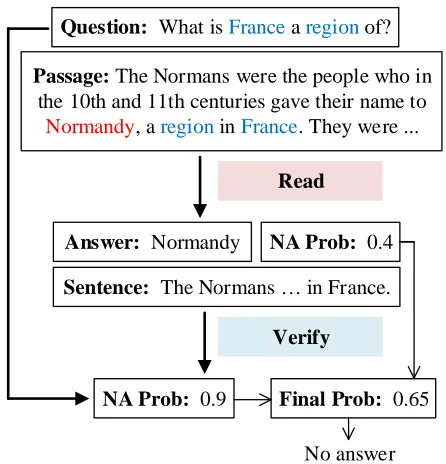
Figure 1: An overview of our approach. The reader first ex-tracts a candidate answer and produces a no-answer proba-bility (NA Prob). The answer verifier then checks whether the extracted answer is legitimate or not. Finally, the system aggregates previous results and outputs the final prediction.
operation between a “no-answer” score and answer span scores, so as to produce a probability that a question is unan-swerable as well as output a candidate answer. However, they have not considered further validating the answerability of the question by verifying the legitimacy of the predicted answer. Here, answerability denotes whether the question has an answer, andlegitimacymeans whether the extracted text can be supported by the passage and the question. Hu-man, on the contrary, tends to first find a plausible answer given a question, and then checks if there exists any contra-dictory semantics.
To address the above issue, we propose aread-then-verify
components: (1) a no-answer reader for extracting candi-date answers and detecting unanswerable questions, and (2) ananswer verifierfor deciding whether or not the extracted candidate is legitimate. The key contributions of our work are three-fold.
First, we augment existing readers with two auxiliary losses, to better handle answer extraction and no-answer de-tection respectively. Since the downstream verifying stage always requires a candidate answer, the reader must be able to extract plausible answers for all questions. However, pre-vious approaches are not trained to find potential candidates for unanswerable questions. We solve this problem by in-troducing an independent span loss that aims to concentrate on the answer extraction task regardless of the answerabil-ity of the question. In order to not conflict with no-answer detection, we leverage amulti-head pointer networkto gen-erate two pairs of span scores, where one pair is normal-ized with the no-answer score and the other is used for our auxiliary loss. Besides, we present another independent no-answer loss to further alleviate the confliction, by focus-ing on the no-answer detection task without considerfocus-ing the shared normalization of answer extraction.
Second, in addition to the standard reading phase, we in-troduce an additional answer verifying phase, which aims at finding local entailment that supports the answer by compar-ing the answer sentence with the question. This is based on the observation that the core phenomenon of unanswerable questions usually occurs between a few passage words and question words. Take Figure 1 for example, after comparing the passage snippet “Normandy, a region in France” with the question, we can easily determine that no answer exists since the question asks for an impossible condition1. This
observation is even more obvious whenantonymormutual exclusionoccurs, such as the question asks for “the decline of rainforests” but the passage mentions that “the rainforests spread out”. Inspired by recent advances in natural language inference (NLI) (Bowman et al. 2015), we investigate three different architectures for the answer verifying task. The first one is a sequential model that takes two sentences as a long sequence, while the second one attempts to capture interac-tions between two sentences. The last one is a hybrid model that combines the above two models to test if the perfor-mance can be further improved.
Lastly, we evaluate our system on the SQuAD 2.0 dataset (Rajpurkar, Jia, and Liang 2018), a reading com-prehension benchmark augmented with unanswerable ques-tions. Our best reader achieves a F1 score of 73.7 and 69.1 on the development set, with or without ELMo embed-dings (Peters et al. 2018). When combined with the answer verifier, the whole system improves to 74.8 F1 and 71.5 F1 respectively. Moreover, the best system obtains a score of 74.2 F1 on test set, achieving state-of-the-art results at the time of submission (Aug. 28th, 2018).
1
Impossible condition means that the question asks for some-thing that is not satisfied by anysome-thing in the given passage.
Background
Existing reading comprehension models focus on answer-ing questions where a correct answer is guaranteed to ex-ist. However, they are not able to identify unanswerable questions but tend to return an unreliable text span. Conse-quently, we first give a brief introduction on the unanswer-able reading comprehension task, and then investigate cur-rent solutions.
Task Description
Given a context passage and a question, the machine needs to not only find answers to answerable questions but also de-tect unanswerable cases. The passage and the question are described as sequences of word tokens, denoted as P =
{xpi}lp
i=1 and Q = {x
q j}
lq
j=1 respectively, where lp is the
passage length andlq is the question length. Our goal is to
predict an answerA, which is constrained as a segment of text in the passage:A={xpi}lb
i=la, or return an empty string
if there is no answer, where la andlb indicate the answer
boundary.
No-Answer Reader
To predict an answer span, current approaches first embed and encode both of passage and question into two series of fix-sized vectors. Then they leverage various attention mechanisms, such as bi-attention (Seo et al. 2017) or reat-tention (Hu et al. 2018a), to build interdependent repre-sentations for passage and question, which are denoted as U ={ui}
lp
i=1andV ={vj} lq
j=1 respectively. Finally, they summarize the question representation into a dense vector t, and utilize the pointer network (Vinyals, Fortunato, and Jaitly 2015) to produce two scores over passage words that indicate the answer boundary (Wang et al. 2017):
oj=wTvvj, t= lq
X
j=1 eoj
Plq
k=1eok vj
α, β= pointer network(U, t)
whereαandβ are thespan scoresfor answer start and end bounds.
In order to additionally detect if the question is unanswer-able, previous approaches (Levy et al. 2017; Clark and Gard-ner 2018; Kundu and Ng 2018) attempt to predict a special
no-answer scorezin addition to the distribution over answer spans. Concretely, a shared softmax function can be applied to normalize both of no-answer score and span scores, yield-ing a joint no-answer objective defined as:
Ljoint=−log
(1−δ)ez+δeαaβb
ez+Plp
i=1
Plp
j=1eαiβj
!
Approach
In this section we describe our proposed read-then-verify system. The system first leverages a neural reader to extract a candidate answer and detect if the question is unanswer-able. It then utilizes an answer verifier to further check the legitimacy of the predicted answer. We enhance the reader with two novel auxiliary losses, and investigate three differ-ent architectures for the answer verifier.
Reader with Auxiliary Losses
Although previous no-answer readers are capable of jointly learning answer extraction and no-answer detection, there exists two problems for each individual task. For the answer extraction, previous readers are not trained to find candidate answers for unanswerable questions. In our system, how-ever, the reader is required to extract a plausible answer that is fed to the downstream verifying stage for all questions. As for no-answer detection, aconflictioncould be triggered due to the shared normalization between span scores and no-answer score. Since the sum of these normalized scores is always 1, an over-confident span probability would cause an unconfident no-answer probability, and vice versa. There-fore, inaccurate confidence on answer span, which has been observed by Clark et al. (2018), could lead to imprecise pre-diction on no-answer score. To address the above issues, we propose two auxiliary losses to optimize and enhance each task independently without interfering with each other.
Independent Span Loss This loss is designed to concen-trate on answer extraction. In this task, the model is asked to extract candidate answers for all possible questions. There-fore, besides answerable questions, we also include unan-swerable cases as positive examples, and consider the plau-sible answer as gold answer2. In order to not conflict with no-answer detection, we propose to use a multi-head pointer network to additionally produce another pair of span scores
˜
αandβ˜:
˜
oj= ˜wTvvj, ˜t= lq
X
j=1 eo˜j
Plq
k=1e˜ok vj
˜
α,β˜= pointer network(U,˜t)
where multiple heads share the same network architecture but with different parameters.
Then, we define an independent span loss as:
Lindep−I =−log
eα˜˜aβ˜˜b
Plp
i=1
Plp
j=1eα˜i ˜
βj
!
where ˜a and ˜b are the augmented ground-truth answer boundaries. The final span probability is obtained using a simple mean pooling over the two pairs of softmax-normalized span scores.
2
In SQuAD 2.0, the plausible answer is annotated by human for every unanswerable question. A pre-trained reader can also be used to extract plausible answers if no annotation is provided.
Independent No-Answer Loss Despite a multi-head pointer network being used to prevent the confliction prob-lem, no-answer detection can still be weakened since the no-answer score z is normalized with span scores. There-fore, we consider exclusively encouraging the prediction on no-answer detection. This is achieved by introducing an in-dependent no-answer loss as:
Lindep−II =−(1−δ) logσ(z)−δlog(1−σ(z))
where σ is the sigmoid activation function. Through this loss, we expect the model to produce a more confident prediction on no-answer score z without considering the shared-normalization operation.
Finally, we combine the above losses as follows:
L=Ljoint+γLindep−I+λLindep−II
where γ and λ are two hyper-parameters that control the weight of two auxiliary losses.
Answer Verifier
After the answer is extracted, an answer verifier is used to compare the answer sentence with the question, so as to recognize local textual entailment that supports the answer. Here, we define theanswer sentenceas the context sentence that contains either gold answers or plausible answers. We explore three different architectures, as shown in Figure 2: (1) a sequential model that takes the inputs as a long se-quence, (2) an interactive model that encodes two sentences interdependently, and (3) a hybrid model that takes both of the two approaches into account.
Model-I: Sequential Architecture In Model-I, we con-vert the answer sentence and the question along with the extracted answer into an ordered input sequence. Then we adapt the recently proposed Generative Pre-trained Trans-former (OpenAI GPT) (Radford et al. 2018) to perform the task. The model is a multi-layer Transformer decoder (Liu et al. 2018a), which is first trained with a language modeling objective on a large unlabeled text corpus and then finetuned on the specific target task.
Specifically, given an answer sentence S, a questionQ and an extracted answer A, we concatenate the two sen-tences with the answer while adding a delimiter token in be-tween to get[S;Q; $;A]. We then embed the sequence with its word embedding as well as position embedding. Multiple transformer blocks are used to encode the sequence embed-dings as follows:
h0=We[X] +Wp
hi= transformer block(hi−1),∀i∈[1, n]
whereX denotes the sequence’s indexes in the vocab,We
is the token embedding matrix, Wp is the position
Answer
Sentence Question Answer
Answer Sentence
Question
Text & Position Embed Masked Multi Self Attention Add & Norm Feed Forward
Add & Norm
Model-I
Model-II
Answer
Sentence Question Answer Model-I
Model-II
y
y
y
12x Answer
Text Embed Text Embed
BiLSTM BiLSTM
Inference Modeling Intra-Sent Modeling
Intra-Sent Modeling
BiLSTM BiLSTM
Mean-max Pooling
y
s q
s q
s q
y
(a) (b) (c)
Merge
Figure 2: An overview of answer verifiers. (a) Input structures for running three different models. (b) Generative Pre-trained Transformer proposed by Radford et al. (2018). Here, “Masked Multi Self Attention” refers to multi-head self-attention func-tion (Vaswani et al. 2017) that only attends to previous tokens. “Add & Norm” indicates residual connecfunc-tion and layer normal-ization. (c) Our proposed token-wise interaction model, which is designed to compare two sentences and aggregate the results for verifying the answer.
The last token’s activationhlm
n is then fed into a linear
projection layer followed by asoftmaxfunction to output the no-answer probabilityy:
p(y|X) = softmax(hlm
n Wy)
A standard cross-entropy objective is used to minimize the negative log-likelihood:
L(θ) =− X (X,y)
logp(y|X)
Model-II: Interactive Architecture In Model-II, we con-sider an interactive architecture that aims to capture the in-teractions between two sentences, so as to recognize their local entailment relationships for verifying the answer. This model consists of the following layers:
Encoding: We embed words using the GloVe embed-ding (Pennington, Socher, and Manning 2014), and also em-bed characters of each word with trainable vectors. We run a bidirectional LSTM (BiLSTM) (Hochreiter and Schmidhu-ber 1997) to encode the characters and concatenate two last hidden states to get character-level embeddings. In addition, we use a binary feature to indicate if a word is part of the answer. All embeddings along with the feature are then con-catenated and encoded by a weight-shared BiLSTM, yield-ing two series of contextual representations:
si= BiLSTM([wordsi; char s i; fea
s
i]),∀i∈[1, ls] qj= BiLSTM([wordqj; char
q j; fea
q
j]),∀j∈[1, lq]
wherelsis the length of answer sentence, and[·;·]denotes
concatenation.
Inference Modeling:An inference modeling layer is used to capture the interactions between two sentences and pro-duce two inference-aware sentence representations. We first compute the dot products of all tuples< si, qj >as attention
weights, and then normalize these weights so as to obtain at-tended vectors as follows:
aij =sTiqj,∀i∈[1, ls],∀j ∈[1, lq]
bi = lq
X
j=1 eaij
Plq
k=1eaik
qj, cj= ls
X
i=1 eaij
Pls
k=1eakj si
Here,birefers to the attended vector from questionQfor the i-th word in answer sentenceS, and vice versa forcj.
Next, in order to separately compare the aligned pairs {(si, bi)}ils=1 and{(qj, cj)}
lq
j=1 for finding local inference information, we use a weight-shared function F to model these aligned pairs as:
˜
si=F(si, bi), q˜j =F(qj, cj)
F can have various forms, such as BiLSTM, multilayer perceptron, and so on. Here we use a heuristic function o =F(x, y)proposed by Hu et al. (2018a), which demon-strates good performances compared to other options:
r= gelu (Wr[x;y;x◦y;x−y]) g=σ(Wg[x;y;x◦y;x−y])
o=g◦r+ (1−g)◦x
Intra-Sentence Modeling:Next we apply an intra-sentence modeling layer to capture self correlations inside each sen-tence. The input are inference-aware vectors s˜i and q˜j,
which are first passed through another BiLSTM layer for encoding. We then use the same attention mechanism de-scribed above, only now between each sentence and itself, and we setaij = −inf ifi= jto ensure that the word is
not aligned with itself. Another functionF is used to pro-duce self-aware vectorssˆiandqˆjrespectively.
Prediction:Before the final prediction, we apply a concate-nated residual connection and model the sentences with a BiLSTM as:
¯
si= BiLSTM([˜si; ˆsi]), q¯j = BiLSTM([˜qj; ˆqj])
A mean-max pooling operation is then applied to sum-marize the final representation of two sentences, namely¯si
andq¯j. All summarized vectors are then concatenated and
fed into a feed-forward classifier that consists of a projection sublayer withgeluactivation and asoftmaxoutput sublayer, yielding the no-answer probability. As before, we optimize the negative log-likelihood objective function.
Model-III: Hybrid Architecture To explore how the fea-tures extracted by Model-I and Model-II can be integrated to obtain better representation capacities, we investigate the combination of the above two models, namely Model-III. We merge the output vectors of two models into a single joint representation. An unified feed-forward classifier is then applied to output the no-answer probability. Such de-sign allows us to test whether the performance can benefit from the integration of two different architectures. In prac-tice we use a simple concatenation to merge the two sources of information.
Experimental Setup
Dataset
We evaluate our approach on the SQuAD 2.0 dataset (Ra-jpurkar, Jia, and Liang 2018). SQuAD 2.0 is a new ma-chine reading comprehension benchmark that aims to test the models whether they have truely understood the ques-tions by knowing what they don’t know. It combines answer-able questions from the previous SQuAD 1.1 dataset (Ra-jpurkar et al. 2016) with 53,775 unanswerable questions about the same passages. Crowdsourcing workers craft these questions with a plausible answer in mind, and make sure that they are relevant to the corresponding passages.
Training and Inference
Our no-answer reader is trained on context passages, while the answer verifier is trained on oracle answer sentences. Model-I follows a procedure of unsupervised pre-training and supervised fine-tuning. That is, the model is first opti-mized with a language modeling objective on a large unla-beled text corpus to initialize its parameters. Then it adapts the parameters to the answer verifying task with our super-vised objective. For Model-II, we directly train it with the supervised loss. Model-III, however, consists of two differ-ent architectures that require differdiffer-ent training procedures.
Therefore, we initialize Model-III with the pre-trained pa-rameters from both of Model-I and Model-II, and then fine-tune the whole model until convergence.
At test time, the reader first predicts a candidate answer as well as a passage-level no-answer probability. The answer verifier then validates the extracted answer along with its sentence and outputs a sentence-level probability. Following the official evaluation setting, a question is detected to be unanswerable once the joint no-answer probability, which is computed as the mean of the above two probabilities, ex-ceeds some threshold. We tune this threshold to maximize F1 score on the development set, and report both of EM (Exact Match) and F1 metrics. We also evaluate the per-formance on no-answer detection with an accuracy metric (ACC), where its threshold is set as 0.5 by default.
Implementation
We use the Reinforced Mnemonic Reader (RMR) (Hu et al. 2018a), one of the state-of-the-art reading comprehension models on the SQuAD 1.1 dataset, as our base reader. The reader is configurated with its default setting, and trained with the no-answer objective with our auxiliary losses. ELMo (Embeddings from Language Models) (Peters et al. 2018) is exclusively listed in our experimental configura-tion. We run a grid search onγandλamong [0.1, 0.3, 0.5, 0.7, 1, 2]. Based on the performance on development set, we setγ as 0.3 andλto be 1. As for answer verifiers, we use the original configuration from Radford et al. (2018) for Model-I. For Model-II, the Adam optimizer (Kingma and Ba 2014) with a learning rate of 0.0008 is used, the hidden size is set as 300, and a dropout (Srivastava et al. 2014) of 0.3 is applied for preventing overfitting. The batch size is 48 for the reader, 64 for Model-II, and 32 for Model-I as well as Model-III. We use the GloVe (Pennington, Socher, and Manning 2014) 100D embeddings for the reader, and 300D embeddings for Model-II and Model-III. We utilize thenltk
tokenizer3to preprocess passages and questions, as well as split sentences. The passages and the sentences are truncated to not exceed 300 words and 150 words respectively.
Evaluation
Main Results
We first submit our approach on the hidden test set of SQuAD 2.0 for evaluation, which is shown in Table 1. We use Model-III as the default answer verifier, and only report the best result. As we can see, our system obtains state-of-the-art results by achieving an EM score of 71.7 and a F1 score of 74.2 on the test set. Notice that SLQA+ has reached a comparable result compared to our approach. We argue that its promising result is largely due to its superior perfor-mance compared to our base reader4.
Ablation Study
Next, we do an ablation study on the SQuAD 2.0 develop-ment set to show the effects of our proposed methods for
3
https://www.nltk.org/
4
Model Dev Test
EM F1 EM F1
BNA1 59.8 62.6 59.2 62.1
DocQA2 61.9 64.8 59.3 62.3
DocQA + ELMo 65.1 67.6 63.4 66.3
ARRR† - - 68.6 71.1
VS3−Net† - - 68.4 71.3
SAN3 - - 68.6 71.4
FusionNet++(ensemble)4 - - 70.3 72.6
SLQA+5 - - 71.5 74.4
RMR + ELMo + Verifier 72.3 74.8 71.7 74.2
Human 86.3 89.0 86.9 89.5
Table 1: Comparison of different approaches on the SQuAD 2.0 test set, extracted on Aug 28, 2018: Levy et al. (2017)1, Clark et al. (2018)2, Liu et al. (2018b)3, Huang et al. (2018)4 and Wang et al. (2018)5.†indicates unpublished works.
Configuration HasAns All NoAns
EM F1 EM F1 ACC
RMR 72.6 81.6 66.9 69.1 73.1
- indep-I 71.3 80.4 66.0 68.6 72.8
- indep-II 72.4 81.4 64.0 66.1 69.8
- both 71.9 80.9 65.2 67.5 71.4
RMR + ELMo 79.4 86.8 71.4 73.7 77.0
- indep-I 78.9 86.5 71.2 73.5 76.7
- indep-II 79.5 86.6 69.4 71.4 75.1
- both 78.7 86.2 70.0 71.9 75.3
Table 2: Comparison of readers with different auxiliary losses.
each individual component. Table 2 first shows the ablation results of different auxiliary losses on the reader. Removing the independent span loss (indep-I) results in a performance drop for all answerable questions (HasAns), indicating that this loss helps the model in better identifying the answer boundary. Ablating independent no-answer loss (indep-II), on the other hand, causes little influence on HasAns, but leads to a severe decline on no-answer accuracy (NoAns ACC). This suggests that a confliction between answer ex-traction and no-answer detection indeed happens. Finally, deleting both of two losses causes a degradation of more than 1.5 points on the overall performance in terms of F1, with or without ELMo embeddings.
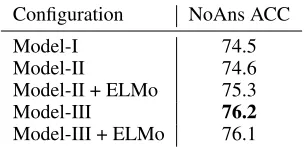
Table 3 details the results of various architectures for the answer verifier. Model-III outperforms all of other competi-tors, achieving a no-answer accuracy of 76.2. This illustrates that the combination of two different architectures can bring in further improvement. Adding ELMo embeddings, how-ever, does not boost the performance. We hythosize that the bytepair encoding (Sennrich, Haddow, and Birch 2016) from Model-I and the word/character embeddings from Model-II have provided enough representation capacities.
Configuration NoAns ACC
Model-I 74.5
Model-II 74.6
Model-II + ELMo 75.3
Model-III 76.2
Model-III + ELMo 76.1
Table 3: Comparison of different architectures for the an-swer verifier.
Configuration All NoAns
EM F1 ACC
RMR 66.9 69.1 73.1
+ Model-I 68.3 71.1 76.2
+ Model-II 68.1 70.8 75.6
+ Model-II + ELMo 68.2 70.9 75.9
+ Model-III 68.5 71.5 77.1
+ Model-III + ELMo 68.5 71.2 76.5
RMR + ELMo 71.4 73.7 77.0
+ Model-I 71.8 74.4 77.3
+ Model-II 71.8 74.2 78.1
+ Model-II + ELMo 72.0 74.3 78.2
+ Model-III 72.3 74.8 78.6
+ Model-III + ELMo 71.8 74.3 78.3
Table 4: Comparison of readers with different answer veri-fiers.
After doing separate ablations on each component, we then compare the performance of the whole system, as shown in Table 4. The combination of base reader with any answer verifier can always result in considerable per-formance gains, and combining the reader with Model-III obtains the best result. We find that the improvement on no-answer accuracy is significant. This metric raises from 73.1 to 77.1 after adding Model-III to RMR, increasing by 4 ab-solute points. Similar observation can be found when ELMo embeddings are used, demonstrating that the gains are con-sistent and stable.
In order to investigate how the readers affect the overall performance, we fix the answer verifier as Model-III and use DocQA (Clark and Gardner 2018) as the base reader instead of RMR, as shown in Table 5. We find that the ab-solute improvements are even larger: the no-answer accu-racy roughly increases by 6 points when adding Model-III to DocQA (from 69.1 to 75.2), and 5.5 points when adding Model-III to DocQA + ELMo (from 70.6 to 76.1).
Configuration All NoAns
EM F1 ACC
DocQA 61.9 64.8 69.1
+ Model-III 66.5 69.2 75.2
DocQA + ELMo 65.1 67.6 70.6
+ Model-III 68.0 70.7 76.1
Table 5: Comparison of different readers with fixed answer verifier.
Error Analysis
To perform error analysis, we first categorize all examples on the development set into 5 classes:
• Case1: the question isanswerable, the no-answer proba-bility islessthan the threshold, and the answer iscorrect. • Case2: the question isunanswerable, and the no-answer
probability islargerthan the threshold.
• Case3: almost the same as case1, except that the predicted answer iswrong.
• Case4: the question is unanswerable, but the no-answer probability islessthan the threshold.
• Case5: the question is answerable, but the no-answer probability islargerthan the threshold.
We then show the percentage of each category in Table 6. As we can see, the base reader trained with auxiliary losses is notably better atcase2andcase4compared to the baseline, implying that our proposed losses help the model mainly improve upon unanswerable cases. After adding the answer verifier, we observe that although the system’s per-formance on unanswerable cases slightly decreases, the re-sults oncase1andcase5have been improved. This demon-strates that the answer verifier does well on detecting an-swerable question rather than unanan-swerable one. Besides, we find that the error of answer extraction is relatively small (6.5% for Case3 in RMR + ELMo + Verifier). However, the classification error on no-answer detection is much larger. More than 20% of examples are misclassified even with our best system (10.3% for Case4 and 10.9% for Case5 in RMR + ELMo + Verifier). Therefore, we argue that the main per-formance bottleneck lies in no-answer detection instead of answer extraction.
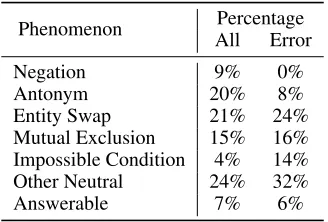
Next, to understand the challenges our approach faces, we manually investigate 50 incorrectly predicted unanswerable examples (based on F1) that are randomly sampled from the development set. Following the types of negative examples defined by Rajpurkar et al. (2018), we categorize the sam-pled examples and show them in Table 7. As we can see, our system is good at recognizenegationandantonym. The frequency of negation decreases from 9% to 0% and only 4 antonym examples are predicted wrongly. We think that this is because the two types are relatively easier to iden-tify. Both of negation and antonym only require to detect one single word in the question, such as “never” or “not” for negation and “increase” to “decrease” for antonym. How-ever,impossible condition andother neutral types roughly
0
20
40
60
80
Recall
40
50
60
70
80
90
Precision
DocQA + ELMo
RMR + ELMo - both
RMR + ELMo
RMR + ELMo + Verifier
Figure 3: Precision-Recall curves of F1 score.
acount for 46% of the error set, indicating that our system performs less effectively on these more difficult cases.
Related Work
Reading Comprehension Datasets. Various large-scale reading comprehension datasets, such as cloze-style test (Hermann et al. 2015), answer extraction bench-mark (Rajpurkar et al. 2016; Joshi et al. 2017) and answer generation benchmark (Nguyen et al. 2016; Koˇcisk`y et al. 2018), have been proposed. However, these datasets still guarantee that the given context must contain an answer. Re-cently, some works construct negative examples by retriev-ing passages for existretriev-ing questions based on Lucene (Tan et al. 2018) and TF-IDF (Clark and Gardner 2018), or using crowdworkers to craft unanswerable questions (Rajpurkar, Jia, and Liang 2018). Compared to automatically retrieved negative examples, human-annotated examples are more dif-ficult to detect for two reasons: (1) the questions are relevant to the passage and (2) the passage contains a plausible an-swer to the question. Therefore, we choose to work on the SQuAD 2.0 dataset in this paper.
Neural Networks for Reading Comprehension. Neural reading models typically leverage various attention mecha-nisms to build interdependent representations of passage and question, and sequentially predict the answer boundary (Seo et al. 2017; Hu et al. 2018a; Wang et al. 2017; Yu et al. 2018; Hu et al. 2018b). However, these approaches are not de-signed to handle no-answer cases. To address this problem, previous works (Levy et al. 2017; Clark and Gardner 2018; Kundu and Ng 2018) predict a no-answer probability in ad-dition to the distribution over answer spans, so as to jointly learn no-answer detection as well as answer extraction. Our no-answer reader extends existing approaches by introduc-ing two auxiliary losses that enhance these two tasks inde-pendently.
contra-Configuration Case13 Case23 Case37 Case47 Case57
RMR - both 27.8% 37.3% 6.5% 12.7% 15.7%
RMR 27% 39.9% 5.9% 10.2% 17%
RMR + Verifier 30.3% 38.2% 8.4% 11.8% 11.3%
RMR + ELMo - both 31.5% 38.3% 5.6% 11.8% 12.8%
RMR + ELMo 31.2% 40.2% 5.5% 9.9% 13.2%
RMR + ELMo + Verifier 32.5% 39.8% 6.5% 10.3% 10.9%
Table 6: Percentage of five categories. Correct predictions are denoted with3, while wrong cases are marked with7.
Phenomenon Percentage
All Error
Negation 9% 0%
Antonym 20% 8%
Entity Swap 21% 24%
Mutual Exclusion 15% 16%
Impossible Condition 4% 14%
Other Neutral 24% 32%
Answerable 7% 6%
Table 7: Linguistic phenomena exhibited by all negative ex-amples (statistics from Rajpurkar et al. (2018)) and sampled error cases of RMR + ELMo + Verifier.
diction or semantic neutrality between two sentences. This task is strongly related to no-answer detection, where the machine needs to understand if the passage and the ques-tion supports the answer. To recognize entailment, various branches of works have been proposed, including encoding-based approach (Bowman et al. 2016; Mou et al. 2015), interaction-based approach (Parikh et al. 2016; Chen et al. 2016) and sequence-based approach (Radford et al. 2018). In this paper we investigate the last two branches and further propose a hybrid architecture that combines both of them properly.
Answer Validation.Early answer validation task (Magnini et al. 2002) aims at ranking multiple candidate answers to return a most reliable one. Later, the answer validation exer-cise (Rodrigo, Pe˜nas, and Verdejo 2008) has been proposed to decide whether an answer is correct or not according to a given supporting text and a question, but the dataset is too small for neural network-based approaches. Recently, Tan et al. (2018) propose to validate the candidate answer for de-tecting unanswerable questions, by comparing the question with the passage. Our answer verifier, on the contrary, de-noises the passage by comparing questions with answer sen-tences, so as to focus on finding local entailment that sup-ports the answer.
Conclusion
We proposed a read-then-verify system that is able to ab-stain from answering when a question has no answer given the passage. We first introduce two auxiliary losses to help the reader concentrate on answer extraction and no-answer
detection respectively, and then utilize an answer verifier to validate the legitimacy of the predicted answer, in which three different architectures are investigated. Our system has achieved state-of-the-art results on the SQuAD 2.0 dataset at the time of submission (Aug. 28th, 2018). Looking forward, we plan to design new structures for answer verifiers to han-dle questions with more complicated inferences.
Acknowledgments
We would like to thank Pranav Rajpurkar and Robin Jia for their helps with SQuAD 2.0 submissions. This work is sup-ported by the Major State Research Development Program (2016YFB0201305).
References
Bowman, S. R.; Angeli, G.; Potts, C.; and Manning, C. D. 2015. A large annotated corpus for learning natural language inference. InProceedings of EMNLP.
Bowman, S. R.; Gauthier, J.; Rastogi, A.; Gupta, R.; Man-ning, C. D.; and Potts, C. 2016. A fast unified model for parsing and sentence understanding. arXiv preprint arXiv:1603.06021.
Chen, Q.; Zhu, X.; Ling, Z.; Wei, S.; Jiang, H.; and Inkpen, D. 2016. Enhanced lstm for natural language inference.
arXiv preprint arXiv:1609.06038.
Clark, C., and Gardner, M. 2018. Simple and effective multi-paragraph reading comprehension. InProceedings of ACL. Dagan, I.; Dolan, B.; Magnini, B.; and Roth, D. 2010. Recognizing textual entailment: rational, evaluation and ap-proaches.Natural Language Engineering16(1):105–105. Hendrycks, D., and Gimpel, K. 2016. Bridging nonlinear-ities and stochastic regularizers with gaussian error linear units.arXiv preprint arXiv:1606.08415.
Hermann, K. M.; Kocisky, T.; Grefenstette, E.; Espeholt, L.; Kay, W.; Suleyman, M.; and Blunsom, P. 2015. Teaching machines to read and comprehend. InProceedings of NIPS. Hochreiter, S., and Schmidhuber, J. 1997. Long short-term memory.Neural computation9(8):1735–1780.
Hu, M.; Peng, Y.; Huang, Z.; Qiu, X.; Wei, F.; and Zhou, M. 2018a. Reinforced mnemonic reader for machine reading comprehension. InProceedings of IJCAI.
distilla-tion for machine reading comprehension. InProceedings of EMNLP.
Huang, H.-Y.; Zhu, C.; Shen, Y.; and Chen, W. 2018. Fu-sionnet: fusing via fully-aware attention with application to machine comprehension. InProceedings of ICLR.
Joshi, M.; Choi, E.; Weld, D. S.; and Zettlemoyer, L. 2017. Triviaqa: a large scale distantly supervised challenge dataset for reading comprehension. InProceedings of ACL. Kingma, D. P., and Ba, L. J. 2014. Adam: A method for stochastic optimization. InCoRR, abs/1412.6980.
Koˇcisk`y, T.; Schwarz, J.; Blunsom, P.; Dyer, C.; Hermann, K. M.; Melis, G.; and Grefenstette, E. 2018. The narra-tiveqa reading comprehension challenge. Transactions of ACL6:317–328.
Kundu, S., and Ng, H. T. 2018. A nil-aware answer extrac-tion framework for quesextrac-tion answering. InProceedings of EMNLP, 4243–4252.
Levy, O.; Seo, M.; Choi, E.; and Zettlemoyer, L. 2017. Zero-shot relation extraction via reading comprehension. arXiv preprint arXiv:1706.04115.
Liu, P. J.; Saleh, M.; Pot, E.; Goodrich, B.; Sepassi, R.; Kaiser, L.; and Shazeer, N. 2018a. Generating wikipedia by summarizing long sequences. arXiv preprint arXiv:1801.10198.
Liu, X.; Shen, Y.; Duh, K.; and Gao, J. 2018b. Stochastic answer networks for machine reading comprehension. In
Proceedings of ACL.
Magnini, B.; Negri, M.; Prevete, R.; and Tanev, H. 2002. Is it the right answer? exploiting web redundancy for answer validation. InProceedings of ACL.
Marelli, M.; Menini, S.; Baroni, M.; Bentivogli, L.; Bernardi, R.; Zamparelli, R.; et al. 2014. A sick cure for the evaluation of compositional distributional semantic models. InLREC, 216–223.
Mou, L.; Men, R.; Li, G.; Xu, Y.; Zhang, L.; Yan, R.; and Jin, Z. 2015. Natural language inference by tree-based convolution and heuristic matching. arXiv preprint arXiv:1512.08422.
Nguyen, T.; Rosenberg, M.; Song, X.; Gao, J.; Tiwary, S.; Majumder, R.; and Deng, L. 2016. Ms marco: a human generated machine reading comprehension dataset. arXiv preprint arXiv:1611.09268.
Parikh, A. P.; T¨ackstr¨om, O.; Das, D.; and Uszkoreit, J. 2016. A decomposable attention model for natural language inference. arXiv preprint arXiv:1606.01933.
Pennington, J.; Socher, R.; and Manning, C. D. 2014. Glove: Global vectors for word representation. InProceedings of EMNLP.
Peters, M. E.; Neumann, M.; Iyyer, M.; Gardner, M.; Clark, C.; Lee, K.; and Zettlemoyer, L. 2018. Deep contextualized word prepresentations. InProceedings of NAACL.
Radford, A.; Narasimhan, K.; Salimans, T.; and Sutskever, I. 2018. Improving language understanding by generative pre-training.
Rajpurkar, P.; Zhang, J.; Lopyrev, K.; and Liang, P. 2016. Squad: 100,000+ questions for machine comprehension of text. InProceedings of EMNLP.
Rajpurkar, P.; Jia, R.; and Liang, P. 2018. Know what you don’t know: unanswerable questions for squad. In Proceed-ings of ACL.
Rodrigo, ´A.; Pe˜nas, A.; and Verdejo, F. 2008. Overview of the answer validation exercise 2008. InWorkshop of CLEF, 296–313. Springer.
Sennrich, R.; Haddow, B.; and Birch, A. 2016. Neural ma-chine translation of rare words with subword units. In Pro-ceedings of ACL.
Seo, M.; Kembhavi, A.; Farhadi, A.; and Hajishirzi, H. 2017. Bidirectional attention flow for machine comprehension. In
Proceedings of ICLR.
Srivastava, N.; Hinton, G.; Krizhevsky, A.; Sutskever, I.; and Salakhutdinov, R. 2014. Dropout: a simple way to prevent neural networks from overfitting.JMLR1929–1958. Tan, C.; Wei, F.; Zhou, Q.; Yang, N.; Lv, W.; and Zhou, M. 2018. I know there is no answer: modeling answer valida-tion for machine reading comprehension. InProceedings of NLPCC, 85–97. Springer.
Vaswani, A.; Shazeer, N.; Parmar, N.; Uszkoreit, J.; Jones, L.; Gomez, A. N.; Kaiser, Ł.; and Polosukhin, I. 2017. At-tention is all you need. InProceedings of NIPS, 5998–6008. Vinyals, O.; Fortunato, M.; and Jaitly, N. 2015. Pointer networks. InProceedings of NIPS.
Wang, W.; Yang, N.; Wei, F.; Chang, B.; and Zhou, M. 2017. Gated self-matching networks for reading comprehension and question answering. InProceedings of ACL.