Copyright © 2014 (Clarissa C. David, Erika Fille T. Legara, Jenna Mae L. Atun, Christopher P. Monterola). Licensed under the Creative Commons Attribution Non-commercial No Derivatives (by-nc-nd). Available at http://ijoc.org.
News Frames of the Population Issue in the Philippines
CLARISSA C. DAVID
1University of the Philippines, Philippines
ERIKA FILLE T. LEGARA
Institute of High Performance Computing, A*STAR, Singapore
JENNA MAE L. ATUN
Ateneo de Manila University, Philippines
CHRISTOPHER P. MONTEROLA
Institute of High Performance Computing, A*STAR, Singapore
Using automated semantic network analysis, this study examines media framing of the population issue in the Philippines through the different labels used to refer to it in public discourse. The population issue has been relabeled and repackaged in legislation and other policy documents. This article examines how each relabeling of the issue was reflected in the media. Analysis of news articles published from 1987 to 2007 reveals that word clusters around each label reflect strategic framing of the terms population control, population management, family planning, reproductive health, responsible parenthood, and pro-life. Whereas population control and population management are associated with developmental and economic goals, reproductive health and family planning are more linked with women’s and youth’s health issues. The terms responsible parenthood and pro-life are mostly identified with the Catholic Church, with the latter more identified with positions on abortion and contraception.
Keywords: framing, semantic network analysis, media framing, population, family planning
1 This research was supported by research grants from the Institute of Philippine Culture of the Ateneo de
Manila University and the Office of the Vice Chancellor for Research and Development of the University of the Philippines, Diliman. The authors are thankful for valuable comments of two anonymous reviewers of this article.
Clarissa C. David: [email protected] Erika Fille T. Legara: [email protected] Jenna Mae L. Atun: [email protected]
Population growth, size, and its consequences have been contentious issues in the Philippines since the 1970s. Debates about the proper mechanisms for addressing population growth as a problem continue to play out in public discourse, peopled by interest groups on the various sides of the issue such as legislators who seek to create policies for population management, scholars who advocate the importance of creating a national population policy, and religious conservatives who aim to stem efforts to promote proposed solutions to population issues. Throughout the issue’s history, its framing and naming has evolved as a result of compromises between opposing interests and strategic framing (David, Atun, & La Viña, 2012) to win public (and the opposition’s) approval.
Framing is defined as selecting “some aspects of a perceived reality and make them more salient in a communicating text, in such a way as to promote a particular problem definition, causal interpretation, moral evaluation, and/or treatment recommendation for the item described” (Entman, 1993, p. 52). In media research, framing has been defined broadly as “the central organizing idea for making sense of an issue or conflict and suggesting what is at stake” (Koch, 1998, p. 210). Research has shown that the naming and framing of an issue can influence how the public understands the issue, and the likelihood that it will favor or oppose a solution (e.g., Chong & Druckman, 2007; Lee, McLeod, & Shah, 2008). Schon and Rein (1994) describe the struggle “over the naming and framing of a policy situation” as “symbolic contests over the social meaning of an issue domain” (p. 29), while Elwood (1995) contends that “power is terminological control” (p. 260). It is the framing of the press that matters most in shaping social meanings, and, thus, an examination of how Philippine newspapers have framed the population issue is critical to understanding how the debate is depicted by the media.
This article examines how the news media have reflected the various frames that are used by interest and policy groups when discussing population policies. It contributes to the literature by adopting a sociolinguistic approach to frame construction, focusing on how the labels used to refer to the issue, which have been strategically constructed to reflect a particular framing of population as a political problem, appear in the news in relation to the different frame-relevant attributes (e.g., actors, policy features). Semantic networks are constructed and interpreted as indicators of the ideas and rationales that are reflected in each naming of the issue. Newspaper articles are the products of framing struggles between those who are in favor of and against population management policies in the country. This research offers information about whether the issue appears to have been covered or framed differently depending on the label used.
how an issue will be framed by the press (Carragee & Roefs, 2004). The “entrenchment of some terms and the disappearance of others is often a signal of political triumph and defeat” (Kinder & Sanders, 1990, p. 73).
Linguistic Networks as Indicators of Frames
Frames can be examined using linguistic approaches. Through such lenses, it is argued that frames are constructed through the strategic selection of words and phrases that act as framing mechanisms. The construction of arguments that put the issue under a certain light can be gleaned from an examination of the rhetorical structure of texts (Gamson & Modigliani, 1989) and the use of stock phrases (Pan & Kosicki, 1993), stereotyped images, and sources of information (Simon & Jerit, 2007). The linguistic approach implies that frames can be detected through a systematic examination of how words are used, what words are present, and how these words work together to reinforce a message.
A growing literature adapts this approach and conducts analysis through semantic network analysis (SNA). Earlier work in this area uses frequencies of word use and relationships or co-occurrences between sets of words and identifies these as indicators of frames and framing strategies (e.g., Baden, 2010; van Atteveldt, Kleinnijenhuis, & Ruigrok, 2008). A word-cluster analysis of expert disagreements expressed in congressional hearings about nicotine addiction revealed that tobacco industry experts use language that implies a preference for citing laboratory studies, while academic research experts draw on concerns about public health and beliefs of the health effects of smoking (Murphy, 2001). In an earlier study, the same word-clustering technique was used to investigate the framing of genetic testing as depicted in testimony for public policy purposes (Murphy & Maynard, 2000).
Various approaches to framing analysis offer their own sets of advantages and disadvantages (see de Vreese, 2005; Matthes & Kohring, 2008, for reviews). Computer-assisted methods allow frames to emerge from the text at the end of the analysis (e.g., Murphy, 2001; Shah, Watts, Domke, & Fan, 2002) or from a combination of inductive and deductive iterative techniques. Manual coding researchers approach the data with frames derived from a reading of a subset of texts—frames that have specific definitions and a set of indicators. It is used extensively in many kinds of framing research, including studies that investigate general and issue-specific frames (e.g., de Vreese, Peter, & Semetko, 2001; Semetko & Valkenburg, 2000). Many approaches have been applied within manual coding as well, ranging from highly specific coding of individual elements within the definition of frames (e.g., Matthes & Kohring, 2008) to binary measures based on questions that seek to capture the presence of factors that comprise a particular frame (Semetko & Valkenburg, 2000).
iterative process was conducted to extract an associate frame for press releases and news reports. Their results indicate that BP was strategically able to influence the news frames where BP was dissociated from responsibility as a cause and was packaged as a source of solutions.
Other applications of automated text analyses techniques have been applied to questions of political communication, usually for news. Van Atteveldt, Kleinnijenhuis, Ruigrok, and Schlobach (2008) investigated positive and negative relations between actors and issues, representing these as a network, enabling an estimation of the tone of news, issue positions, and presence of conflict. Related efforts to use automated methods on political texts were conducted by Quinn, Monroe, Colaresi, Crespin, and Radev (2010) to facilitate the analysis of voluminous text for topic categories. Their method takes advantage of statistical learning using word choices and agglomerative clustering to tag for topic categories. The substance of topics is then estimated. They derive the topics from the texts and then, after the automated clustering procedure, assign texts to topics.
Highly sophisticated methodological work has been conducted on how to extract frames (see Baden, 2010, and Matthes & Kohring, 2008, for reviews), on using automated methods to examine dynamic framing changes over time (Motta & Baden, 2013), and on the validity of automated SNA when compared to manual coding (David, Atun, Legara, & Monterola, 2011; van Atteveldt et al., 2008). Most studies that use network analysis on communication texts examine some combination of the frequency of word occurrence, the frequency of different words co-occurring with some unit of analysis, and the overall network map that results from these bits of information. Words are laden with meaning; the building blocks of a communicating text and the distance between words and the co-occurrence of words with one another are interpreted as indicators of an argument. Frames can be understood as a series of arguments. Thus, SNA is a way of quantitatively detecting arguments or frames by treating words as concepts, and distance between concepts as an indicator of a thought or argument being communicated. All SNAs rely on some qualitative interpretation of the resulting network structure; sometimes it is done during the analysis in an iterative fashion, and sometimes at the end when interpreting the final network result. Comparative research for this new type of framing analysis generally supports its validity when tested alongside the more widely used manual content coding (David et al., 2011; Legara, Monterola, & David, 2013; van Atteveldt et al., 2008). Reliability, as is mentioned in many of these methodological studies, is the strength of this method.
Population as a Political Issue in the Philippines
Population management, contraceptive use, and family planning are politically contentious issues in the Philippines and in many other countries. Catholic churches in different nations have been outspoken in their opposition to contraception. When the United Nations pushed for greater contraceptive use around the world to prevent unwanted pregnancies and sexually transmitted illnesses, the Vatican took a public position that this was harmful to women (Bunderson, n.d.). Melinda Gates, a prominent U.S. philanthropist, stirred controversy when she singled out the Vatican’s position against condoms as harmful in the fight against HIV/AIDS in high-risk countries. In fact, in sub-Saharan Africa, where the Catholic populations are small but quite conservative, the position of the church against artificial contraception has a strong behavioral influence. In the United States, new rules under the health care law for providing free birth control have prompted Catholic hospitals and schools to file for exemptions (Dwyer, 2012). This struggle between church and state plays out internationally; its impacts are felt most acutely in the national arena, where political powers of the church can direct policy. All these efforts by the Vatican, through its local churches, to influence local policy have been visible in the news and have been targeted in some way toward changing the news agenda. The Philippines is one such country where the Catholic Church actively lobbies, even threatens, politicians who support contraception.
The Philippines continues to struggle to find effective approaches to manage its population growth. Empirical evidence links poverty with population, singling out the persistently high fertility rate as a key barrier to poverty reduction (Orbeta, 2002). It is argued that the failure of the Philippine government to institutionalize population policies is due, in large part, to inconsistencies in written policies that are evident upon an over-time examination (Herrin, 2002). Changes in policy approaches and arguments may have contributed to delays in getting bills passed and, thus, to the implementation of any possible effective policies. Why have there been inconsistencies in the first place?
Shifts in policy statements from one presidential administration to another can be explained in large part by strong and consistent opposition of the Catholic Church (Balisacan & Tubianosa, 2004; Orbeta, 2002). Over time, the shifts in policy away from fertility reduction as an objective of family planning to increased emphasis on maternal and child health appear to have been adopted as a reaction to the church’s objections. This debate has been going on for more than 25 years, with significant changes in discourse. At the end of 2012, Congress finally took the measure to a vote on the floor. The voting process was televised, church representatives were commenting in media, and ultimately the Reproductive Health (RH) Bill was passed into law. The power struggle is not over yet, however, as conservative groups took the new law to the Supreme Court and asked for and were granted a temporary restraining order from implementation while the court considers the church’s petition that the law be reversed on grounds that it was unconstitutional.
advocacy efforts of allied groups from both sides. This article examines how the media have covered each issue label and reveals whether these frame shifts have been reflected in media texts.
Framing of Population in the Media and in Policy
The present study is part of a broader inquiry into how the population issue has been framed politically in Philippine public discourse. David and colleagues (2010) present a comparative analysis that shows how the issue is strategically framed by those who are for population management policies, those who are against it, and those who are covering it (the media). SNA was used with the software program Catpac (Woelfel, Danielson, & Woelfel, 1995) to analyze text gathered from interest group archive materials such as press statements, position papers, and opinion columns in addition to a separate analysis of news content. Catpac is an automated content analysis tool that uses co-occurrences of words (representing concepts) to draw a network of relationships between frame-relevant words, weighted by frequency of co-occurrence. Analysis yields word clusters, which are treated as indicators of framing elements.
The analysis showed that those in favor of a national population management policy typically take a “development frame,” which argues that the size and growth rate of the population is an urgent problem (i.e., characterized as uncontrolled, runaway, or looming). If left unaddressed, the consequences are developmental in nature, foremost of which are stunted economic growth, declines in human development, and exacerbated poverty incidence in the country. The proposed solution involves a broad-scale government response that includes public promotion and provision of family planning services, inclusion of sex education in schools, and incentive programs for underprivileged families with a small number of children.
Opposition to population management is present based on religious objections to specific items of the policy—namely, the promotion of and public funding support for modern methods of family planning (e.g., birth control pills, intrauterine devices [IUDs], and injectable hormonal contraception) and sex education in public schools. The textual materials used in the analysis included opinion columns of openly church-allied authors, press statements of the Catholic Bishops’ Conference of the Philippines, and statements and position papers of other organized groups that are against contraception and family planning in general. This opposition is led most strongly by the Catholic Church hierarchy, which has historically lobbied successfully against any legislation that would put a population policy in place. Over 80% of the Philippines is Catholic, providing the hierarchy with powerful leverage against elected officials. Conservative lay groups closely affiliated with the church augment them. Analysis of the discourse used by conservative groups revealed two distinct frames that are reactions to the sub-issues within the policies against which objections were lodged. The first is an anti-abortion or pro-life frame that first denies that population size is a problem at all and then proceeds to attack the proposed population management policies as promotion of abortion. The second frame is against sex education, which is said to be against church teachings and an assault on the morals of the country.
the church. The former is comprised of straight news stories reporting on population growth rate estimates, total size of the population, and statements by research organizations. The latter frame indicates conflict-driven coverage in which, instead of reporting on the substance of policy debates, focus is placed on the presence of opposition and the ensuing conflict.
A separate comparative analysis of bills about population filed in Congress between 1987 and 2008 reveals essentially similar sets of frame-indicating word network structures (David et al., 2012). Together these studies reveal that the discourse in both policy and public arenas about population has evolved over time, as evidenced by changes in how the issue is labeled and the attending change in overall framework, rationale, and solution sets. Population policies (or attempts to institute them) have been characterized as being driven by changing objectives, from fertility reduction to the defense of reproductive rights to the protection of maternal and child health (Herrin, 2002). These policies have been alternately labeled reproductive health, family planning, or responsible parenthood.
Because the SNA is weighted by word frequencies, less used terms are not revealed in the analysis. Although this earlier research on newspaper coverage (David, Atun, & La Viña, 2010) reveals the conflict-driven nature of press treatment of the population issue, it masks information about how each strategic framing through relabeling of the issue (i.e., population management, reproductive health, family planning, pro-life) is reflected in news articles. This article addresses this limitation by examining frame-relevant concept networks surrounding each term (or strategic framing) in newspaper coverage. It uses an analytical approach that is similar to the one used in the Catpac software, but revises it to allow the analysis to focus on key framing terms and derive the semantic network structure around them.
Having examined the different frames used by issue interest groups, the legislature, and the media by deriving patterns of arguments and rationales used in each set of text, some questions naturally arise. How are the labels or strategic frames for population policies represented in the news? Are the labels represented differently in terms of rationale and substance, or are the issue labels superficial? Specifically, for example, in newspaper coverage, is the framing of the issue when it is labeled reproductive health different from its framing when it is labeled population management or population control? We examine the semantic network structures around six of the most prominent terms used in the debate: population control, population management, family planning, reproductive health, responsible parenthood, and pro-life.
Method
each president’s term was included in the final sample. Four and a half years’ worth of newspapers was manually scanned for all news articles related to population, family planning, reproductive health, and contraception.
Semantic Network Analysis
At the initial phase of the SNA, raw texts were filtered, screened, and transformed into a more manageable concept-level data set (Feldman & Sanger, 2007). Stop words and function words (content-free words) such as articles and conjunctions were replaced with placeholders (xxx) to maintain the proximity between concepts (Carley, 2003), leaving only content-bearing terms for analyses. Figure 1 shows an example of a preprocessed text with deleted words replaced by placeholders (xxx).
Figure 1. Example of a preprocessed text with deleted words replaced by placeholders.
Plurals and modified versions of the words were replaced with their singular and infinitive forms. Words pertaining to a single concept were substituted with a single term. For example, the terms Catholic Church and Catholic Bishops Conference of the Philippines were generalized into one central concept. Words that refer to young people such as teenager and adolescent were included under the concept youth. These decisions were made by the research team, and the preprocessing of text that eliminated frame-inconsequential words such as prepositions and pronouns made use of automated processes with available dictionaries.
A collection of unique concepts across all documents was generated, resulting in a total of 17,616 concepts with 4,061 unique ones. A weighted network S was constructed by mapping strengths of relationships between words or concepts across all available concepts. This procedure is well founded under the supposition that the frequency of a concept is directly proportional to its relevance in the text (Yeo, Park, & Arabi, 2007).
The semantic network S was generated by initially constructing a co-occurrence matrix M, with columns and rows representing each unique concept in the collection. The elements mij of M quantify the
strengths of relationship between two concepts i and j. This was measured in terms of the number of times the concepts co-occurred in a scanning window, which moves through the entire text. After calculating the mean sentence length across all documents, a window size of 20 (w = 20) was used. This procedure assumes that two words are linked when they co-occur in a sentence.
Using the co-occurrence matrix M, the weighted network S was generated with nodes corresponding to the unique concepts and where network edges in the network represent a link between two concepts (or nodes). The weighted edges represent the strength of the relationship between concepts; that is, an edge eij is weighted with the value that corresponds to the element value mij in M.
Once the network S was constructed, six partition networks were then extracted that highlight central terms: family planning, population control, population management, pro-life, reproductive health, and responsible parenthood. For each central term or node (CN), a partition network was extracted where neighboring nodes that have the strongest links to the CN (i.e., js that have eCNj values in the top 10 edge
weights list) were tracked and retained, while others were removed from the original network S. The six central terms were chosen because of their prominence and use in the population debate. How these terms and concepts are associated with other terms indicates various arguments that are present in the text.
Word co-occurrence matrices surrounding each of the six labels yielded scores that indicate the number of times each word appears in proximity with the label. These scores were normalized by dividing all raw scores by the maximum score of each frame label’s co-occurrence with all words in the matrix, yielding comparable scores across the six labels when there are identical words in the networks.
Results and Discussion
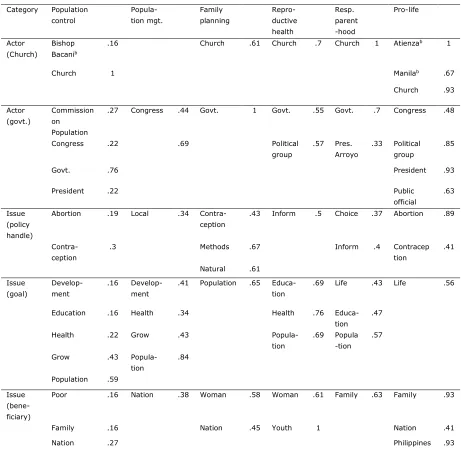
Table 1. Co-Occurrence of Frame-Relevant Words With Frame Labels
Using Normalized Co-occurrence Scoresa
Category Population control Popula-tion mgt. Family planning Repro-ductive health Resp. parent -hood Pro-life Actor (Church) Bishop Bacanib
.16 Church .61 Church .7 Church 1 Atienzab 1
Church 1 Manilab .67
Church .93
Actor (govt.)
Commission on Population
.27 Congress .44 Govt. 1 Govt. .55 Govt. .7 Congress .48
Congress .22 .69 Political
group
.57 Pres. Arroyo
.33 Political group
.85
Govt. .76 President .93
President .22 Public
official
.63
Issue (policy handle)
Abortion .19 Local .34
Contra-ception
.43 Inform .5 Choice .37 Abortion .89
Contra- ception
.3 Methods .67 Inform .4 Contracep
tion
.41
Natural .61
Issue (goal)
Develop-ment
.16 Develop- ment
.41 Population .65
Educa-tion
.69 Life .43 Life .56
Education .16 Health .34 Health .76 Educa-
tion
.47
Health .22 Grow .43 Popula-
tion
.69 Popula
-tion .57
Grow .43
Popula-tion
.84
Population .59
Issue (bene-ficiary)
Poor .16 Nation .38 Woman .58 Woman .61 Family .63 Family .93
Family .16 Nation .45 Youth 1 Nation .41
Nation .27 Philippines .93
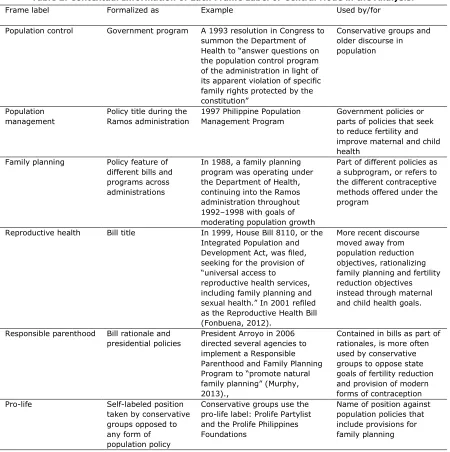
To determine how each of the frame labels is represented in terms of rationale and substance, we compare the main actors, policy handles, issue goals, and beneficiaries across the six frame labels— whether the words appear as frequently co-occurring with the frame label. When the same word occurs in more than one frame, comparisons can be made on the relative strength of normalized scores, with higher scores suggesting stronger co-occurrence. Table 2 reviews and summarizes the background of each frame to provide context for the following discussion of results.
Table 2. Contextual Information of Each Frame Label or Central Node in the Analysis.
Frame label Formalized as Example Used by/for
Population control Government program A 1993 resolution in Congress to summon the Department of Health to “answer questions on the population control program of the administration in light of its apparent violation of specific family rights protected by the constitution”
Conservative groups and older discourse in population
Population management
Policy title during the Ramos administration
1997 Philippine Population Management Program
Government policies or parts of policies that seek to reduce fertility and improve maternal and child health
Family planning Policy feature of different bills and programs across administrations
In 1988, a family planning program was operating under the Department of Health, continuing into the Ramos administration throughout 1992–1998 with goals of moderating population growth
Part of different policies as a subprogram, or refers to the different contraceptive methods offered under the program
Reproductive health Bill title In 1999, House Bill 8110, or the Integrated Population and Development Act, was filed, seeking for the provision of “universal access to
reproductive health services, including family planning and sexual health.” In 2001 refiled as the Reproductive Health Bill (Fonbuena, 2012).
More recent discourse moved away from population reduction objectives, rationalizing family planning and fertility reduction objectives instead through maternal and child health goals.
Responsible parenthood Bill rationale and presidential policies
President Arroyo in 2006 directed several agencies to implement a Responsible Parenthood and Family Planning Program to “promote natural family planning” (Murphy, 2013).,
Contained in bills as part of rationales, is more often used by conservative groups to oppose state goals of fertility reduction and provision of modern forms of contraception
Pro-life Self-labeled position
taken by conservative groups opposed to any form of population policy
Conservative groups use the pro-life label: Prolife Partylist and the Prolife Philippines Foundations
The list of conservative political actors frequently mentioned reveals that the church has played a large role in the debate about population policies. Except for population management, the church appears to be a prominent source for journalists whenever population policies are covered. As shown in Table 1, the church co-occurs most with population control, responsible parenthood, and pro-life. This is consistent with observations that only conservative arguments employ the term population control in recent history. The term has been actively avoided by proponents since the 1980s to dissociate the movement from demographic targets in developing countries encouraged by international agencies that inspired some unethical programs such as forced sterilization. In the position statements of conservative groups, all manner of population policies, family planning, and reproductive health are connected back to population control. The quote below, which appeared in an article that reports on government allocation toward the purchase of “reproductive health products,” illustrates this form of use:
“We hope it is not true that Congress plans to appropriate 1 billion for the purchase of condoms, birth control pills, and other “reproductive health” products to control population growth,” CBCP president and Jaro (Iloilo) Archbishop Angel Lagdameo said. . . . What the Church advocates, he said, is natural family planning as this is the only morally acceptable way of practicing responsible parenthood. (“CBCP Opposes Plan” 2007, p. 1)
The frequent co-occurrence of responsible parenthood with church illustrates the attempt to reframe population and reproductive health policies toward more conservative means of fertility regulation. In 2004 President Arroyo drew up a policy on responsible parenthood that provided funding exclusively for natural family planning methods (Family Planning Organization of the Philippines, n.d.) and avowing that she would veto any bill by Congress to promote “modern” family planning methods (i.e., contraception).
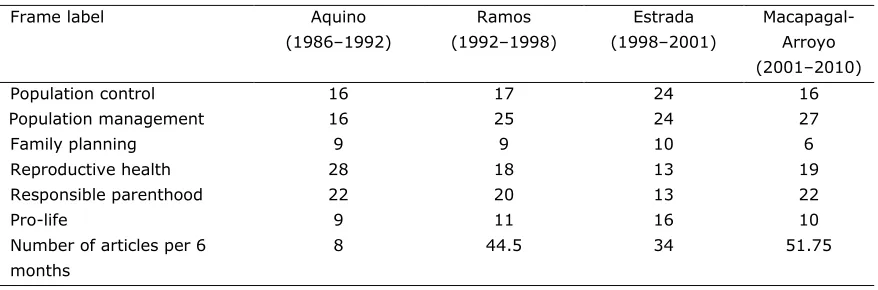
Table 3. Rank of Frame Labels by Frequency of Appearance in News Articles, by Presidential Administration.
Frame label Aquino
(1986–1992)
Ramos (1992–1998)
Estrada (1998–2001)
Macapagal-Arroyo (2001–2010)
Population control 16 17 24 16
Population management 16 25 24 27
Family planning 9 9 10 6
Reproductive health 28 18 13 19
Responsible parenthood 22 20 13 22
Pro-life 9 11 16 10
Number of articles per 6 months
8 44.5 34 51.75
Pro-life represents both a specific position against any form of state promotion of family planning and names of political and church groups. The actors most closely allied with it besides the church itself are Atienza and Manila; Lito Atienza was the mayor of Manila City from 1998 to 2007 and is an outspoken pro-life advocate who banned the sale of all contraceptive devices, including condoms, in Manila.
Among the government actors frequently cited in the news, some differences can be seen between frame labels. Government is the main proponent of the different policies labeled with each of the frames. Congress appears as a significant actor only for the labels population control and population management, supporting the observation that Congress’ failure to legislate a population policy has meant that presidents have had inordinate influence on the direction of such policies (for review, see David et al., 2010).
An analysis by David and colleagues (2010) of position papers and policies of proponents of reproductive health and family planning measures finds the presence of a “development frame” that argues the growth rate of the country’s population is not sustainable and has negative consequences on economic growth, human development, and poverty. This finding is reflected in the news articles analyzed here. Each frame label highlights a slightly different set of policy goals, moving from a development and economic-oriented rationale to one that emphasizes health and education over general economic development arguments.
pro-life position does not co-occur often with any policy goals except for “life,” because its advocates often cite these positions as being for the “protection of life of the unborn child.” Below is an example of a statement from Manila Archbishop Jaime Cardinal Sin:
But Sin, who reminded the faithful to respect all life “from the moment of conception up to the last breath of life,” also said the Church and the government can still work together to protect human life. . . . Sin also pointed out that Pope John Paul II had already made his stand against contraception and sterilization clear by banning their use as a means of family planning.
The Pope affirmed the stand of the Church against abortion and contraception during his Manila visit last January. “Protect the sanctity of human life from the womb to the tomb,” he urged the faithful. (“Abortionists Seen in Manila,” 1995, p. 16)
The groups of words classified as policy handles show specific parts or mechanisms of a proposed policy that appear in the text. Family planning appears alongside methods, natural, and contraception, which are different categories of fertility regulation means. The high co-occurrence between family planning and methods as well as natural suggests an emphasis on the forms of family planning as well as the distinction attached to natural family planning (NFP). That coverage about family planning policies frequently includes any mention of NFP is an indicator that the church is heavily represented in the discourse, as the insistence on focusing public funds solely on promoting natural methods (i.e., no birth control pills, vasectomies, etc.) emanates from church lobbying.
Reproductive health is mentioned often alongside inform, which is prominent in several versions of the proposed bill, referring to the centrality in the policy of having health workers provide full information about the entire spectrum of modern methods of family planning. The main proponent of the RH bill has been quoted as saying that at the heart of the RH bill is “informed choice” (Philippine Commission on Women, 2011). A much earlier version of the RH bill filed in 2002 was covered in the news:
Yesterday, Castillo, through co-author Rep. Nereus Acosta presented an amended version of the bill, this time, sans the suspected pro-abortion articles.
HB 4110 seeks to put in place a reproductive health program that recognizes women’s reproductive rights, gender equality and ensure universal access to reproductive health, services, information and education. It also recognizes basic right of individuals and couples to freely decide and responsible the number, spacing and timing of their children. (“Iglesia Backs Bill.” 2002, p. 13)
church node than the population control node, suggesting that the terms are more often mentioned by church sources or in relation to objections being made by the church. Proponents of population programs rarely use the term contraception specifically to avoid rousing the church’s ire, usually preferring the phrase modern methods of family planning instead. It is likely the church that uses this term more heavily. The same is true for the term abortion. In fact, there is a heavier co-occurrence between contraception and abortion than there is between these words and the frame label population control. The responsible parenthood label shows concern for choice and inform, both of which refer to NFP in policies adopted by government.
The reframing of population policy from one rationalized as the need to address a problem for economic development to one that addresses problems of maternal and child health is evident in the group of words that identify the intended beneficiaries of proposed policies discussed in the news. Pro-life is concerned about family and country; this is evident in statements made by members of the Catholic Church that their opposition to any government policy with family planning provisions is based on the constitution’s provision to protect the family. Conservative groups have repeatedly argued that any population policy is an assault on the family and its moral core. The pro-life frame is not situated within developmental or women’s concerns, taking a strategically different tack and positioning itself as being protectors of life and family through opposition to contraception and abortion. Family similarly appears as a frequently co-occurring word with responsible parenthood and population control.
Meanwhile, both family planning and reproductive health have been depicted in news as being concerned with women, consistent with the reframing of policies as targeted toward maternal health goals. The most frequently co-occurring word with reproductive health is youth, reflecting the rationale of supporters that one of the most important problems it seeks to address is early pregnancy and that the means to reduce incidence is through reproductive health education.
Table 4. Percent of Articles Citing Government and Church Actors by Frame.
Actor Population
control
Population management
Family planning
Reproductive health
Responsible parenthood
Pro-life
Government 82% 74% 63% 64% 69% 73%
Church 79% 73% 61% 68% 73% 77%
Percentage of articles with frame
17% 26% 7% 19% 21% 11%
Conclusion
Semantic network analysis reveals that word clusters around each label used to refer to the issue support the notion that the media reflect strategic frames. Population control and population management are both associated with developmental goals and programs, while reproductive health and family planning are more linked with women’s and youth’s health issues. Word network structures around labels used by those who oppose—namely, pro-life and, to a limited extent, responsible parenthood—show that both are reflected in media coverage as being associated with the Catholic Church and its positions on abortion and contraception. Absent in both are evidence of development or women’s health goals. Thus, media’s framing of each of these labels closely reflects the strategic frames constructed by supporters and opponents and are not superficial differences in terminologies. When the press chooses to use a particular term to refer to the population issue, it tends to follow the substantive arguments and rationales being advocated by the sources of the messages.
The prominence of the church in almost all the issue labels is indicative of its large role in the way population policies are represented in the media. Population policies, however these are labeled, are perennially attached to church positions no matter that these are state policies in a governance setup that is supposed to have strong separation between church and state. The church’s conspicuous presence in any public conversation about population policies signifies its political power as far as this issue is concerned.
Reproductive Health Law has been passed, but more than a year after its passage it cannot be implemented because of a case against it (by interest groups allied with the church, pro-life groups included) filed with the Supreme Court challenging its constitutionality. A decision is still pending.
To what extent have interest groups been able to shape the way news covered the population issue through the years? Generally, it appears that stakeholder attempts to reframe the issue have been faithfully reflected in news coverage, but there is representation of both the liberal and conservative positions. The prominence of church sources across all frame labels suggests that journalists make sure the opposition views are well represented in stories. This level of prominence, we would argue, results in the overrepresentation of opposition in the depiction of this debate. Many public opinion surveys have shown that large majorities of the public (consistently over 75%) support population policies and the need to have government programs for family planning. In many of its positions, the church insists that since 90% of the country is Catholic, then it stands to reason that the majority of Filipinos oppose the measure. The prominence given in the news for church positions, and the absence of coverage about public opinion, make it appear as though public opposition is strong. Government is the primary source of information and opinion about population, and the church positions are largely reactions that attempt to reframe government arguments. Coverage of this debate reflects some of the literature supporting indexing theory (Bennett, 1990). “It is generally reasonable for journalists to grant government officials a privileged voice in the news, unless the range of official debate on the topic excludes of ‘marginalizes’ stable majority opinion in society” (Bennett, 1990, p. 104). On the issue of Philippine population, the opinions of government and the church have largely crowded out coverage of public sentiment. Journalists are taught to represent both sides of an issue, which necessitates some discussion of opposition positions without reflection on the balance of public support for either side.
References
Abortionists seen in Manila, Sin says. (1995, July 3). Philippine Star, p. 16.
Baden, C. (2010). Communication, contextualization, and cognition: Patterns and process of frames’ influence on people’s interpretations of the EU Constitution (Dissertation). FMG: Amsterdam School of Communication Research, Amsterdam, The Netherlands. Retrieved from
http://dare.uva.nl/en/record/353065
Balisacan, A., & Tubianosa, C. (2004). The population-poverty nexus: The Philippines in comparative East Asian context. Quezon City: The Asia-Pacific Policy Center and Philippine Center for Population and Development.
Bennett, L. W. (1990). Toward a theory of press-state relations in the United States. Journal of Communication, 40(2), 103–125.
Bunderson, C. (n.d.). Critics find UN contraception push harmful to women. Catholic News Agency. Retrieved from http://www.catholicnewsagency.com/news/critics-find-un-contraception-push-harmful-to-women/
Carley, K. M. (2003). Dynamic network analysis in dynamic social network modeling and analysis: Workshop summary and papers. Washington, DC: National Research Council.
Carragee, K., & Roefs, W. (2004). The neglect of power in recent framing research. Journal of Communication, 54(2), 214–233.
Chong, D., & Druckman, J. N. (2007). A theory of framing and opinion formation in competitive elite environments. Journal of Communication, 57, 99–118.
CBCP opposes plan to buy reproductive health products. (2007, October 7). Manila Bulletin, p. 1.
David, C. C., Atun, J. L., & La Viña, A. G. M. (2010). Framing the population debate: A comparison of source and news frames in the Philippines. Asian Journal of Communication, 20(3), 337–353.
David, C. C., Atun, J. L., & La Viña, A. G. M. (2012). Framing in legislation: The case of population policy in the Philippines. Population Research and Policy Review, 31(2), 297–319.
David, C. C., Atun, J. L., Legara, E. F. T., & Monterola, C. P. (2011). Finding frames: Comparing two methods of frame analysis. Communication Methods and Measures, 5(4), 329–351.
de Vreese, C. H., Peter, V., & Semetko, H. A. (2001). Framing politics at the launch of the euro: A cross-national comparative study of frames in the news. Political Communication, 18, 107–122.
Dwyer, D. (2012, January 20). Obama rejects contraception exemption for Catholic hospitals, schools. ABC News. Retrieved from
http://abcnews.go.com/blogs/politics/2012/01/obama-rejects-contraception-exemption-for-catholic-hospitals-schools
Elwood, W. N. (1995). Public relations and the ethics of the moment: The anatomy of a local ballot issue campaign. In W. N. Elwood (Ed.), Public relations inquiry as rhetorical criticism: Case studies of corporate discourse and social influence (pp. 255–275). Westport, CT: Praeger.
Entman, R. M. (1993). Framing: Toward clarification of a fractured paradigm. Journal of Communication, 43, 51–58.
Family Planning Organization of the Philippines (n.d.). History. Retrieved from http://www.fpop1969.org/whoweare/history.html
Feldman, R., & Sanger, J. (2007). Text mining handbook: Advanced approaches in analyzing data. Cambridge, UK: Cambridge University Press.
Fonbuena, C. (2012, December 30). RH law: The long and rough road. Rappler. Retrieved from http://www.rappler.com/newsbreak/18730-rh-law-the-long-and-rough-road
Gamson, W. A., & Modigliani, A. (1989). Media discourse and public opinion on nuclear power: A constructionist approach. American Journal of Sociology, 95, 1–37.
Gamson, W. A., & Wolfsfeld, G. (1993). Movements and media as interacting systems. Annals of the AAPSS, 28(5), 114–125.
Herrin, A. (2002). Population policy in the Philippines, 1969–2002. Makati City, Philippines: Philippine Institute for Development Studies.
Iglesia backs bill on family planning. (2002, October 3). Manila Bulletin, p. 13.
Joachim, J. (2003). Framing issues and seizing opportunities: The UN, NGOs, and women’s rights. International Studies Quarterly, 47, 247–274.
Kinder, D., & Sanders, L. (1990). Mimicking political debate with survey questions: The case of White opinion on affirmative action for Blacks. Social Cognition, 8(1), 73–103.
Lee, N. J., McLeod, D. M., & Shah, D. V. (2008). Framing policy debates: Issue dualism, journalistic frames, and opinions on controversial policy issues. Communication Research, 35, 695–718.
Legara, E. F. T., Monterola, C. P., & David, C. C. (2013). Complex network tools in building expert systems that perform framing analysis. Expert Systems with Applications, 40(11), 4600–4608. Retrieved from http://dx.doi.org/10.1016/j.eswa.2013.01.064
Lind, R. A., & Salo, C. (2002). The framing of feminists and feminism in news and public affairs programs in U.S. electronic media. Journal of Communication, 52, 211–228.
Matthes, J., & Kohring, M. (2008). The content analysis of media frames: Toward improving reliability and validity. Journal of Communication, 58, 258–279.
Motta, G., & Baden, C. (2013). Evolutionary factor analysis of the dynamics of frames: Introducing a method for analyzing high-dimensional semantic data with time-changing structure. Communication Methods and Measures, 7, 48–82.
Murphy, P. (2001). Affiliation bias and expert disagreement in framing the nicotine addiction debate. Science, Technology, & Human Values, 26, 278–299.
Murphy, S. (2013). Philippines RH Act: Rx for controversy. Legal Commentary, Appendix A: Philippines population control and management policies. Retrieved from
http://www.consciencelaws.org/law/commentary/legal055-002.aspx
Murphy, P., & Maynard, M. (2000). Framing the genetic testing issue: Discourse and cultural clashes among policy communities. Science Communication, 22, 133–153.
Orbeta, A. (2002). Review of the population program: 1986–2002. Makati City: Population Commission and the Philippine Institute for Development Studies. Retrieved from
http://www.pids.gov.ph/dp.php?id=2200&pubyear=2002
Pan, Z., & Kosicki, G. M. (1993). Framing analysis: An approach to news discourse. Political Communication, 10, 59–79.
Philippine Commission on Women. (2011, March 7). PCW, NAPC, POPCOM lead RH mobilization. Retrieved from http://www.edcellagman.com.ph/speeches/reproductive-health/127-the-rh-bill-calling-a-spade-a-spade.html
Schon, D. A., & Rein, M. (1994). Frame reflection: Toward resolution of intractable policy controversies. New York, NY: Basic Books.
Schultz, F., Kleinnijenhuis, J., Oegema, D., Utz, S., & van Atteveldt (2012). Strategic framing in the BP crisis: A semantic network analysis of associative frames. Public Relations Review, 38, 97–107.
Semetko, H. A., & Valkenburg, P. M. (2000). Framing European politics: A content analysis of press and television news. Journal of Communication, 50, 93–109.
Shah, D., Watts, M. D., Domke, D., & Fan, D. P. (2002). News framing and cueing of issue regimes: Explaining Clinton’s public approval in spite of scandal. Public Opinion Quarterly, 66(3), 339–370.
Simon, A. F., & Jerit, J. (2007). Toward a theory relating political discourse, media, and public opinion. Journal of Communication, 57, 254–271.
van Atteveldt, W., Kleinnijenhuis, J., & Ruigrok, N. (2008). Parsing semantic networks, and political authority using syntactic analysis to extract semantic relations from Dutch newspaper articles. Political Analysis, 16(4), 428–446.
van Atteveldt, W., Kleinnijenhuis, J., Ruigrok, N., & Schlobach, S. (2008). Good news or bad news?: Conducting sentiment analysis on Dutch text to distinguish between positive and negative relations. Journal of Information Technology & Politics, 5(1), 73–94.
Woelfel, J. K., Danielsen, S., & Woelfel, J. (1995). Catpac for Windows. Troy, NY: Terra Research & Computing, The Galileo Company.