Database Systems
Relational Algebra
Syed Sarmad Ali Database Management Systems
1
Today’s agenda
Example Database Application (COMPANY)
Relational Algebra
Unary Relational Operations
Relational Algebra Operations From Set Theory
Syed Sarmad Ali
2
DEFINITION SUMMARY
Informal Terms
Formal Terms
Table
Relation
Column
Attribute/Domain
Row
Tuple
Values in a column
Domain
Table Definition
Schema of a Relation
Populated Table
Extension
The attributes and tuples of a relation
STUDENT
4
Relational Algebra Overview
£ Unary Relational Operations
• SELECT (symbol: s (sigma))
• PROJECT (symbol: p (pi))
• RENAME (symbol: r (rho))
£ Relational Algebra Operations from Set Theory
• UNION ( È ), INTERSECTION ( Ç ), DIFFERENCE (or
MINUS, – )
• CARTESIAN PRODUCT ( x )
£ Binary Relational Operations
• JOIN (several variations of JOIN exist)
• DIVISION
£ Additional Relational Operations
• OUTER JOINS, OUTER UNION
Relational Algebra
The basic set of operations for the relational model is known as the
relational algebra. These operations enable a user to specify basic
retrieval requests.
The result of a retrieval is a new relation, which may have been formed
from one or more relations. The
algebra operations
thus produce new
relations, which can be further manipulated using operations of the same
algebra.
A sequence of relational algebra operations forms a
relational algebra
expression
, whose result will also be a relation that represents the result
of a database query (or retrieval request).
Syed Sarmad Ali
6
Relational Algebra: 5 Basic Operations
Selection
( ) Selects a subset of
rows
from relation (horizontal).
Projection
( ) Retains only wanted
columns
from relation (vertical).
Cross-product
(
x
) Allows us to combine two relations.
Set-difference
(–) Tuples in r1, but not in r2.
Union
(
∪
) Tuples in r1 and/or in r2.
Unary Relational Operations
SELECT Operation
SELECT operation is used to select a subset of the tuples from a relation that satisfy a
selection condition. It is a filter that keeps only those tuples that satisfy a qualifying condition – those satisfying the condition are selected while others are discarded.
Example: To select the EMPLOYEE tuples whose department number is four or those whose salary is greater than $30,000 the following notation is used:
σ
DNO = 4 (EMPLOYEE)σ
SALARY > 30,000(EMPLOYEE)In general, the select operation is denoted by
σ <selection condition>(R) where the
symbol
σ
(sigma) is used to denote the select operator, and the selection condition is a Boolean expression specified on the attributes of relation R8
Unary Relational Operations
SELECT Operation Properties
The SELECT operation σ <selection condition>(R) produces a relation S that has the same schema as R
The SELECT operation σ is commutative; i.e.,
● σ<condition1>(σ < condition2> (R)) = σ<condition2> (σ < condition1> ( R))
A cascaded SELECT operation may be applied in any order; i.e., ● σ<condition1>(σ < condition2> (σ<condition3> ( R))
● = σ <condition2> (σ< condition3> (σ < condition1> ( R)))
A cascaded SELECT operation may be replaced by a single selection with a conjunction of all the conditions; i.e.,
● σ<condition1>(σ < condition2> (σ<condition3> ( R))
● = σ <condition1> AND < condition2> AND < condition3> ( R)))
Syed Sarmad Ali
9
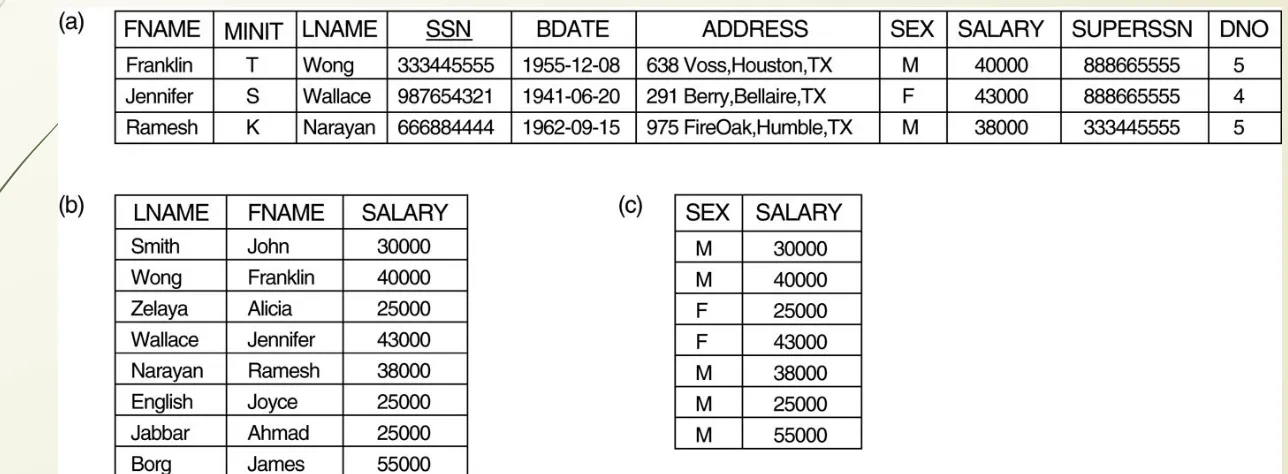
FIGURE 6.1
Results of SELECT and PROJECT operations. (a) σ(DNO=4 AND SALARY>25000) OR (DNO=5 AND
SLARY>30000)(EMPLOYEE). (b) πSEX, SALARY(EMPLOYEE).
Syed Sarmad Ali
10
Unary Relational Operations (cont.)
PROJECT Operation
This operation selects certain columns from the table and discards the other columns. The PROJECT creates a vertical partitioning – one with the needed columns (attributes)
containing results of the operation and other containing the discarded Columns.
Example: To list each employee’s first and last name and salary, the following is used:
π
LNAME, FNAME,SALARY(EMPLOYEE)The general form of the project operation is
π
<attribute list>(R) whereπ
(pi) is the symbol used to represent the project operation and <attribute list> is the desired list of attributes from the attributes of relation R.The project operation removes any duplicate tuples, so the result of the project operation is a set of tuples and hence a valid relation.
Syed Sarmad Ali
13
Projection
Unary Relational Operations (cont.)
PROJECT Operation Properties
The number of tuples in the result of projection
π
<list>
(R)
is alwaysless or equal to the number of tuples in R.
If the list of attributes includes a key of R, then the number of tuples is equal to the number of tuples in R.
π
<list1>(
π
<list2>(R)
)
=
π
<list1>(R)
as long as
<list2>contains
the
attributes in
<list2>Syed Sarmad Ali
15
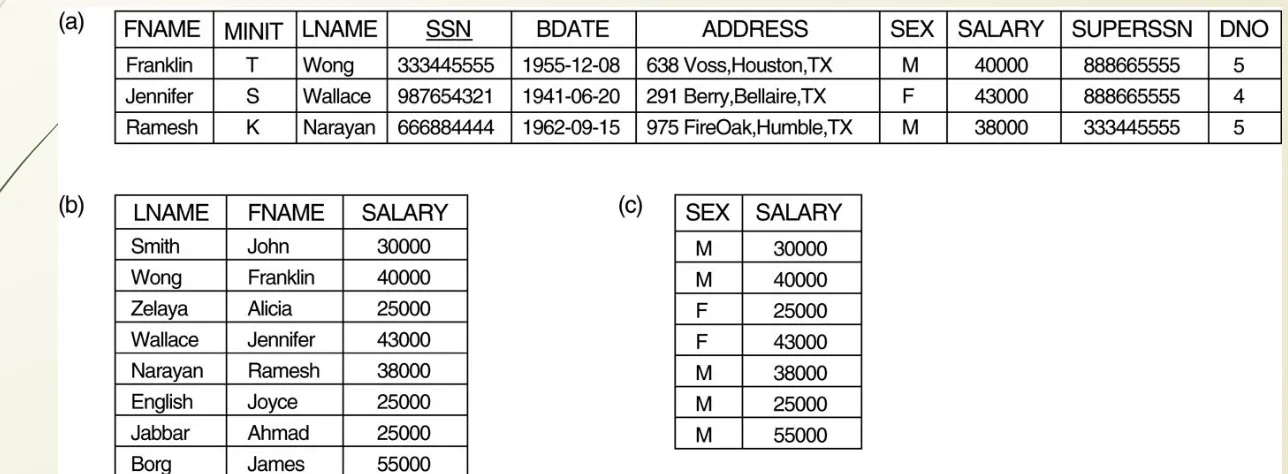
FIGURE 6.1
Results of SELECT and PROJECT operations. (a) σ(DNO=4 AND SALARY>25000) OR (DNO=5 AND
SLARY>30000)(EMPLOYEE). (b) πSEX, SALARY(EMPLOYEE).
Syed Sarmad Ali
16
(a) Project sname,rating
Unary Relational Operations (cont.)
Rename Operation
We may want to apply several relational algebra operations one after the other. Either we can write the operations as a single relational algebra expression by nesting the
operations, or we can apply one operation at a time and create intermediate result
relations. In the latter case, we must give names to the relations that hold the intermediate results.
Example: To retrieve the first name, last name, and salary of all employees who work in department number 5, we must apply a select and a project operation. We can write a single relational algebra expression as follows:
π
FNAME, LNAME, SALARY(σ
DNO=5(EMPLOYEE))OR We can explicitly show the sequence of operations, giving a name to each intermediate relation:
DEP5_EMPS ←
σ
DNO=5(EMPLOYEE)RESULT ←
π
FNAME, LNAME, SALARY (DEP5_EMPS) Syed Sarmad Ali19
Unary Relational Operations (cont.)
The RENAME operator is used to give a name to results or output of queries, returns of selection statements, and views of queries that we would like to view at some other point in time: [3] [4] [5] [6]
The RENAME operator is symbolized by ρ (rho).
The general syntax for RENAME operator is: ρ
s(B1, B2, B3,….Bn)(R )
ρ is the RENAME operation.
S is the new relation name.
B1, B2, B3, …Bn are the new renamed attributes (columns).
Syed Sarmad Ali
20
RENAME OPERATOR
The RENAME Operator
R is the relation or table from which the attributes are chosen.
To implement the RENAME statement in SQL, we take a look at an example in which we would like to choose the Date of Birth and Employee Number attributes and RENAME them as ‘Birth_Date’ and ‘Employee_Number’ from the EMPLOYEE relation…
ρ
(Birth_Date, Employee_Number)(EMPLOYEE ) ←
π
dob, empno(EMPLOYEE )
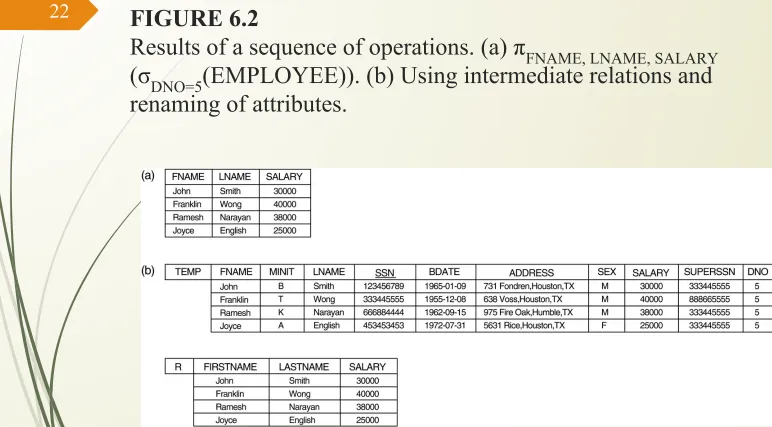
FIGURE 6.2
Results of a sequence of operations. (a) π
FNAME, LNAME, SALARY(σ
DNO=5(EMPLOYEE)). (b) Using intermediate relations and
renaming of attributes.
Syed Sarmad Ali
22
Union and Set-Difference
All of these operations take two input relations, which
must be
union-compatible
:
Same number of fields.
`Corresponding’ fields have the same type.
Union
S1
Relational Algebra Operations From
Set Theory
UNION Operation
The result of this operation, denoted by R
∪
S, is a relation that includes all tuples that are either in R or in S or in both R and S. Duplicate tuples are eliminated.Example: To retrieve the social security numbers of all employees who either work in
department 5 or directly supervise an employee who works in department 5, we can use the union operation as follows:
DEP5_EMPS ←
σ
DNO=5 (EMPLOYEE)RESULT1 ←
π
SSN(DEP5_EMPS)RESULT2(SSN) ←
π
SUPERSSN(DEP5_EMPS)RESULT ← RESULT1 ∪ RESULT2
The union operation produces the tuples that are in either RESULT1 or RESULT2 or both. The two operands must be “type compatible”.
Syed Sarmad Ali
25
Relational Algebra Operations From
Set Theory
Type Compatibility
The operand relations R
1(A
1, A
2, ..., A
n) and R
2(B
1, B
2, ..., B
n) must have
the same number of attributes, and the domains of corresponding attributes
must be compatible; that is, dom(A
i)=dom(B
i) for i=1, 2, ..., n.
The resulting relation for R
1∪
R
2,R
1∩
R
2, or R
1-R
2has the same attribute
names as the
first
operand relation R1 (by convention).
Syed Sarmad Ali
26
Relational Algebra Operations From
Set Theory
UNION Example
STUDENT∪INSTRUCTOR Syed Sarmad Ali
27
Relational Algebra Operations From Set Theory (cont.)
INTERSECTION OPERATION
The result of this operation, denoted by R
∩
S, is a relation that includes all tuples that are in both R and S. The two operands must be "type compatible"Example: The result of the intersection operation (figure below) includes only those who are both students and instructors.
STUDENT ∩ INSTRUCTOR
Syed Sarmad Ali
28
Intersection
S1
Relational Algebra Operations From Set Theory (cont.)
Set Difference (or MINUS) Operation
The result of this operation, denoted by R - S, is a relation that includes all tuples that are in R but not in S. The two operands must be "type compatible”.
Example: The figure shows the names of students who are not instructors, and the names of instructors who are not students.
STUDENT-INSTRUCTOR
INSTRUCTOR-STUDENT
Syed Sarmad Ali
30
Set Difference
S1
S2
Relational Algebra Operations From Set Theory (cont.)
Notice that both union and intersection are
commutative operations;
that is
R
∪
S = S
∪
R, and R
∩
S = S
∩
R
Both union and intersection can be treated as n-ary operations applicable
to any number of relations as both are
associative operations;
that is
R
∪
(S
∪
T) = (R
∪
S)
∪
T, and (R
∩
S)
∩
T = R
∩
(S
∩
T)
The minus operation is
not commutative;
that is, in general
R - S ≠ S – R
Syed Sarmad Ali
32
Relational Algebra Operations From Set Theory (cont.)
CARTESIAN (or cross product) Operation
This operation is used to combine tuples from two relations in a combinatorial fashion. In general, the result of R(A
1, A2, . . ., An) x S(B1, B2, . . ., Bm) is a relation Q with degree n + m
attributes Q(A
1, A2, . . ., An, B1, B2, . . ., Bm), in that order. The resulting relation Q has one
tuple for each combination of tuples—one from R and one from S. Hence, if R has n
R tuples (denoted as |R| = nR ), and S has nS tuples, then
| R x S | will have nR
*
nS tuples.The two operands do NOT have to be "type compatible”
Example:
FEMALE_EMPS ←
σ
GENDER=’F’(EMPLOYEE)
EMPNAMES ←
π
FNAME, LNAME, SSN (FEMALE_EMPS)
EMP_DEPENDENTS ← EMPNAMES x DEPENDENT
Syed Sarmad Ali
33
FIGURE≈6.5a
The CARTESIAN PRODUCT (CROSS PRODUCT) operation.
Syed Sarmad Ali
34
FIGURE≈6.5b
The CARTESIAN PRODUCT (CROSS PRODUCT) operation.
Syed Sarmad Ali
35
Cross Product Example
R1
S1
Compound Operator: Join
Joins are compound operators involving cross product, selection, and (sometimes) projection.
Most common type of join is a “natural join” (often just called “join”). R S conceptually is:
Compute R X S
Select rows where attributes that appear in both relations have equal values
Project all unique atttributes and one copy of each of the common ones.
Note: Usually done much more efficiently than this.
Natural Join Example
R1
S1
Other Types of Joins
Condition Join (or “theta-join”):
Result schema
same as that of cross-product.
May have fewer tuples than cross-product.
“Theta” Join Example
R1
S1