SCED 441 Lab Experiment Benito Espinoza
Connor Saller Sandra Pike Introduction:
Refraction is a characteristic of waves that occurs when the direction of a wave changes. This phenomenon happens when a ray of light travels as a wave from one medium to another thus changing the velocity of the wave. Light travels with a velocity that is slowest through a solid, faster through a liquid, and fastest through a gas (Ackay 2005).
The index of refraction for a specific material or substance determines how light will bend when passed through one medium to another. A vacuum’s index of refraction is exactly equal to one and air’s index refraction is slightly above one but we round to the value of one for convenient purposes. Water’s index of refraction is equal to 4/3 and glass has an index of refraction around 1.5 depending on the type of glass medium.
Temperature is the average kinetic energy of a measured system that reflects the velocity of moving molecules in that system. When a temperature of a substance or material fluctuates, the density of the substance or material will fluctuate as well (Ochi, Y 2003). As the temperature of a substance increases, the density of the substance decreases due a gain in average kinetic energy in the molecules of a measured system (Ochi, Y 2003).
Question: How does the temperature (average kinetic energy) of an alcohol affect its index of refraction when a ray of light passes through an alcohol medium?
Hypothesis: Decreasing the temperature of an alcohol will increase the alcohol’s density, so the alcohol’s index of refraction of light will increase with a lower temperature.
Methods: Materials:
Square glass container Everclear (alcohol) Thermometer Hot plate Laser Optical bench Lens holder
Measuring screen (measured in mm) Angular translator
Procedure:
displacement of the laser by rotating the glass container with an angular translator to 10 degrees, 20 degrees, and 30 degrees from the normal line. The normal line is a reference line that is perpendicular, or 90 degrees, to a refractive surface. Once the data was recorded, we poured room temperature water into the glass container and measured the displacement of the laser at 10 degrees, 20 degrees, and 30 degrees from the normal. It should be noted that these three angles were used repeatedly and consistently to measure the displacement of the laser for each medium.
After we measured how the glass refracts light with air and water in the glass container, we began our experiment with an alcohol medium. Before we cooled or heated the alcohol, we measured the displacement of the laser at room temperature (23.7 degrees Celsius) at the measured angles noted above. Since alcohol has a much lower freezing point than water, we placed our alcohol into a freezer to lower its average kinetic energy (temperature). Our first measured temperature for the alcohol was -12 degrees Celsius. We poured the alcohol into the glass container and measured the displacement of the laser at the designated angles. We then used a heating plate to warm the alcohol in order to find any differences in the displacement of the laser. Our measured temperatures for the alcohol during the heating process were 8.2º, 42.8º, 59º, and 74º Celsius. Overall, we tested six different temperatures at three different angles to find any change in the displacement of the laser after being refracted.
Results and Data: Observations:
Our first observation occurred when there was a differences in the laser displacement for air, water at room temperature, and alcohol at room temperature when the laser was refracted. When the glass container contained air, the displacement of the laser was the least displaced. The displacement of the laser increased with an alcohol medium at room temperature compared to water at room temperature.
When we began our experiment of measuring the displacement of the laser for different temperatures, we observed that the laser displaced the greatest distance at the lowest
measured temperature of -12º Celsius. As the temperature of the alcohol increased, the displacement of the laser decreased.
Our last observation during the experiment was the boiling point of our alcohol. We noticed that the alcohol began to vaporize and started bubbling from the bottom of the glass. The temperature at which this occurred was 74º Celsius.
Displacement of Laser in Air
Displacement of laser (mm) Angle of Incidence (degrees)
4 30
2.5 20
0.5 10
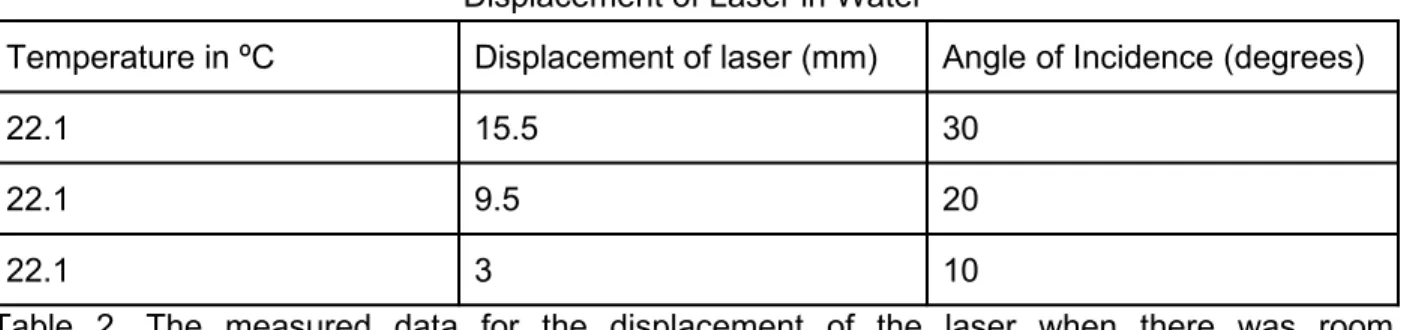
Displacement of Laser in Water
Temperature in ºC Displacement of laser (mm) Angle of Incidence (degrees)
22.1 15.5 30
22.1 9.5 20
22.1 3 10
Table 2. The measured data for the displacement of the laser when there was room temperature water in our glass container.
Displacement of Laser in Alcohol
Temperature in ºC Displacement of laser (mm) Angle of Incidence (degrees)
-12 17.5 30
-12 10.5 20
-12 4 10
8.2 17 30
8.2 10 20
8.2 4 10
23.7 16.5 30
23.7 10 20
23.7 3.5 10
42.8 15.5 30
42.8 9.5 20
42.8 3.5 10
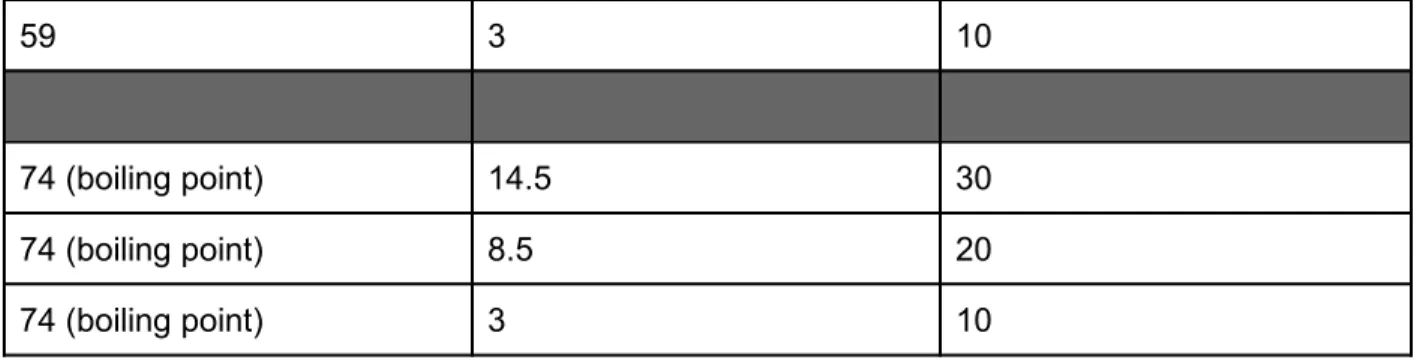
59 15 30
59 3 10
74 (boiling point) 14.5 30
74 (boiling point) 8.5 20
74 (boiling point) 3 10
Table 3. The measured data for the displacement of the laser for various temperatures of an alcohol medium.
Graph 2. The above graph illustrates the relationship between the measured laser displacement and the temperature of the alcohol.
Discussion:
The measured data in Table 3 and Graph 2 illustrates a relationship between the alcohol’s temperature and index of refraction. The index of refraction reflects the degree at which the laser was displaced on the screen. A greater laser displacement directly relates to a greater index of refraction for the alcohol. When the laser is displaced greater distances on the screen for lesser temperatures, the velocity of the laser beam decreases due to an increase in the alcohol’s density. Therefore, as the temperature of the alcohol increased, the displacement of the laser on the screen decreased. This relationship demonstrates how the velocity of light through a medium changes when the temperature of the medium increases or decreases.
As mentioned earlier in the introduction, the index of refraction determines how light will bend when passing through a specific medium. This phenomenon occurs due to a change in the wave’s velocity thus a change in the wave’s direction. For this experiment, we can determine that a ray of light travels at a slower velocity through mediums with lesser
temperatures. This results in a greater index of refraction as well as a greater displacement when a ray of light passes through an alcohol medium.
Literature Cited: