1
A. Understand Scientific Explanations: Students understand core concepts and principles of science and use measurement and observation tools to assist in categorizing, representing, and interpreting the natural and designed world.
Pre-K By the end of grade 4 By the end of grade 8 By the end of grade 12
Content: Who, what, when, where, why, and how questions form the basis for young learners’ investigations during sensory explorations,
experimentation, and focused inquiry.
5.1.P.A.1: Display curiosity about science objects, materials, activities, and longer-term investigations in progress.
Content: Fundamental scientific concepts and principles and the links between them are more useful than discrete facts.
5.1.4.A.1: Demonstrate understanding of the interrelationships among fundamental concepts in the physical, life, and Earth systems sciences.
Content: Core scientific concepts and principles represent the conceptual basis for model-building and facilitate the generation of new and productive questions.
5.1.8.A.1: Demonstrate understanding and use interrelationships among central scientific concepts to revise explanations and to consider alternative explanations.
Content: Mathematical, physical, and computational tools are used to search for and explain core scientific concepts and
principles.
5.1.12.A.1: Refine interrelationships among concepts and patterns of evidence found in different central scientific explanations.
Content: Connections developed between fundamental concepts are used to explain, interpret, build, and refine explanations, models, and theories.
5.1.4.A.2: Use outcomes of investigations to build and refine questions, models, and explanations.
Content: Results of observation and measurement can be used to build conceptual-based models and to search for core explanations.
5.1.8.A.2: Use mathematical, physical, and computational tools to build conceptual-based models and to pose theories.
Content: Interpretation and manipulation of evidence-based models are used to build and critique arguments/explanations.
5.1.12.A.2: Develop and use mathematical, physical, and computational tools to build evidence-based models and to pose theories.
Content: Outcomes of investigations are used to build and refine questions, models, and explanations.
5.1.4.A.3: Use scientific facts, measurements, observations, and patterns in nature to build and critique scientific arguments.
Content: Predictions and explanations are revised based on systematic observations, accurate measurements, and structured data/evidence.
5.1.8.A.3: Use scientific principles and models to frame and synthesize scientific arguments and pose theories.
Content: Revisions of predictions and explanations are based on systematic observations, accurate measurements, and structured data/evidence.
2
5.1 Science Practices: Science is both a body of knowledge and an evidence-based, model-building enterprise that continually extends, refines, and revises knowledge. The four Science Practices strands encompass the knowledge and reasoning skills that students must acquire to be proficient in science.
B. Generate Scientific Evidence Through Active Investigations: Students master the conceptual, mathematical, physical, and computational tools that need to be applied when constructing and evaluating claims.
Pre-K By the end of grade 4 By the end of grade 8 By the end of grade 12
Content: Observations and investigations form young learners’ understandings of science concepts.
5.1.P.B.1: Observe, question, predict, and investigate materials, objects, and phenomena (e.g., using simple tools to crack a nut and look inside) during indoor and outdoor classroom activities and during any longer-term investigations.
Content: Building and refining models and explanations requires generation and evaluation of evidence.
5.1.4.B.1: Design and follow simple plans using systematic observations to explore questions and predictions.
Content: Evidence is generated and evaluated as part of building and refining models and explanations.
5.1.8.B.1: Design investigations and use scientific instrumentation to collect, analyze, and evaluate evidence as part of building and revising models and explanations.
Content: Logically designed investigations are needed in order to generate the evidence required to build and refine models and explanations.
5.1.12.B.1: Design investigations, collect evidence, analyze data, and evaluate evidence to determine measures of central tendencies, causal/correlational relationships, and anomalous data.
Content: Experiments and explorations provide opportunities for young learners to use science vocabulary and scientific terms.
5.1.P.B.2: Use basic science terms and topic-related science vocabulary.
Content: Tools and technology are used to gather, analyze, and communicate results.
5.1.4.B.2: Measure, gather, evaluate, and share evidence using tools and technologies.
Content: Mathematics and technology are used to gather, analyze, and communicate results.
5.1.8.B.2: Gather, evaluate, and represent evidence using scientific tools, technologies, and computational strategies.
Content: Mathematical tools and technology are used to gather, analyze, and communicate results.
5.1.12.B.2: Build, refine, and represent evidence-based models using mathematical, physical, and computational tools.
Content: Experiments and explorations give young learners opportunities to use science tools and technology.
5.1.P.B.3: Identify and use basic tools and technology to extend exploration in conjunction with science
investigations.
Content: Evidence is used to construct and defend arguments.
5.1.4.B.3: Formulate explanations from evidence.
Content: Carefully collected evidence is used to construct and defend arguments.
5.1.8.B.3: Use qualitative and quantitative evidence to develop evidence-based arguments.
Content: Empirical evidence is used to construct and defend arguments.
5.1.12.B.3: Revise predictions and explanations using evidence, and connect explanations/arguments to established scientific knowledge, models, and theories.
Content: Reasoning is used to support scientific conclusions.
5.1.4.B.4: Communicate and justify explanations with reasonable and logical arguments.
Content: Scientific reasoning is used to support scientific conclusions.
5.1.8.B.4: Use quality controls to examine data sets and to examine evidence as a means of generating and reviewing explanations.
Content: Scientific reasoning is used to evaluate and interpret data patterns and scientific conclusions.
5.1.12.B.4: Develop quality controls to examine data sets and to examine evidence as a means of generating and reviewing
3
C. Reflect on Scientific Knowledge: Scientific knowledge builds on itself over time.Pre-K By the end of grade 4 By the end of grade 8 By the end of grade 12
Content: Interacting with peers and adults to share questions and explorations about the natural world builds young learners’ scientific knowledge.
5.1.P.C.1: Communicate with other children and adults to share observations, pursue questions, and make predictions and/or conclusions.
Content: Scientific understanding changes over time as new evidence and updated arguments emerge.
5.1.4.C.1: Monitor and reflect on one’s own knowledge regarding how ideas change over time.
Content: Scientific models and
understandings of fundamental concepts and principles are refined as new evidence is considered.
5.1.8.C.1: Monitor one’s own thinking as understandings of scientific concepts are refined.
Content: Refinement of understandings, explanations, and models occurs as new evidence is incorporated.
5.1.12.C.1: Reflect on and revise understandings as new evidence emerges.
Content: Revisions of predictions and explanations occur when new
arguments emerge that account more completely for available evidence.
5.1.4.C.2: Revise predictions or explanations on the basis of learning new information.
Content: Predictions and explanations are revised to account more completely for available evidence.
5.1.8.C.2: Revise predictions or explanations on the basis of discovering new evidence, learning new
information, or using models.
Content: Data and refined models are used to revise predictions and explanations.
5.1.12.C.2: Use data representations and new models to revise predictions and explanations.
Content: Scientific knowledge is a particular kind of knowledge with its own sources, justifications, and uncertainties.
5.1.4.C.3: Present evidence to interpret and/or predict cause-and-effect outcomes of investigations.
Content: Science is a practice in which an established body of knowledge is continually revised, refined, and extended.
5.1.8.C.3: Generate new and productive questions to evaluate and refine core explanations.
Content: Science is a practice in which an established body of knowledge is continually revised, refined, and extended as new evidence emerges.
4
5.1 Science Practices: Science is both a body of knowledge and an evidence-based, model-building enterprise that continually extends, refines, and revises knowledge. The four Science Practices strands encompass the knowledge and reasoning skills that students must acquire to be proficient in science.
D. Participate Productively in Science: The growth of scientific knowledge involves critique and communication, which aresocial practices that are governed by a core set of values and norms.
Pre-K By the end of grade 4 By the end of grade 8 By the end of grade 12
Content: Science practices include drawing or “writing” on observation clipboards, making rubbings, or charting the growth of plants.
5.1.P.D.1: Represent observations and work through drawing, recording data, and “writing.”
Content: Science has unique norms for participation. These include adopting a critical stance, demonstrating a willingness to ask questions and seek help, and developing a sense of trust and skepticism.
5.1.4.D.1: Actively participate in discussions about student data, questions, and understandings.
Content: Science involves practicing productive social interactions with peers, such as partner talk, whole-group discussions, and small-group work.
5.1.8.D.1: Engage in multiple forms of discussion in order to process, make sense of, and learn from others’ ideas,
observations, and experiences.
Content: Science involves practicing productive social interactions with peers, such as partner talk, whole-group discussions, and small-group work.
5.1.12.D.1: Engage in multiple forms of discussion in order to process, make sense of, and learn from others’ ideas,
observations, and experiences. Content: In order to determine which
arguments and explanations are most persuasive, communities of learners work collaboratively to pose, refine, and evaluate questions, investigations, models, and theories (e.g., scientific argumentation and representation).
5.1.4.D.2: Work collaboratively to pose, refine, and evaluate questions,
investigations, models, and theories.
Content: In order to determine which arguments and explanations are most persuasive, communities of learners work collaboratively to pose, refine, and evaluate questions, investigations, models, and theories (e.g., argumentation, representation, visualization, etc.).
5.1.8.D.2: Engage in productive scientific discussion practices during conversations with peers, both face-to-face and virtually, in the context of scientific investigations and model-building.
Content: Science involves using language, both oral and written, as a tool for making thinking public.
5.1.12.D.2: Represent ideas using literal representations, such as graphs, tables, journals, concept maps, and diagrams.
Content: Instruments of measurement can be used to safely gather accurate
information for making scientific comparisons of objects and events.
5.1.4.D.3: Demonstrate how to safely use tools, instruments, and supplies.
Content: Instruments of measurement can be used to safely gather accurate information for making scientific comparisons of objects and events.
5.1.8.D.3: Demonstrate how to safely use tools, instruments, and supplies.
Content: Ensure that instruments and specimens are properly cared for and that animals, when used, are treated
humanely, responsibly, and ethically.
5.1.12.D.3: Demonstrate how to use scientific tools and instruments and knowledge of how to handle animals with respect for their safety and welfare. Content: Organisms are treated humanely,
responsibly, and ethically.
5
D. Participate Productively in Science: The growth of scientific knowledge involves critique and communication, which aresocial practices that are governed by a core set of values and norms.
Pre-K By the end of grade 4 By the end of grade 8 By the end of grade 12
5.1.4.D.4: Handle and treat organisms humanely, responsibly, and ethically.
6
5.2 Physical Science: Physical science principles, including fundamental ideas about matter, energy, and motion, are powerful conceptual tools for making sense of phenomena in physical, living, and Earth systems science.
A. Properties of Matter: All objects and substances in the natural world are composed of matter. Matter has two fundamental properties: matter takes up space, and matter has inertia.
Pre-K By the end of grade 2 By the end of grade 4 By the end of grade 6 By the end of grade 8 By the end of grade 12
Content: Observations and investigations form a basis for young learners’ understanding of the properties of matter.
5.2.P.A.1: Observe, manipulate, sort, and describe objects and materials (e.g., water, sand, clay, paint, glue, various types of blocks, collections of objects, simple household items that can be taken apart, or objects made of wood, metal, or cloth) in the classroom and outdoor environment based on size, shape, color, texture, and weight.
Content: Living and nonliving things are made of parts and can be described in terms of the materials of which they are made and their physical properties.
5.2.2.A.1: Sort and describe objects based on the materials of which they are made and their physical properties.
Content: Some objects are composed of a single substance; others are composed of more than one substance.
5.2.4.A.1: Identify objects that are composed of a single substance and those that are composed of more than one substance using simple tools found in the classroom.
Content: The volume of some objects can be determined using liquid (water) displacement.
5.2.6.A.1: Determine the volume of common objects using water displacement methods.
Content:All matter is made of atoms. Matter made of only one type of atom is called an element.
5.2.8.A.1: Explain that all matter is made of atoms, and give examples of common elements.
Content: Electrons, protons, and neutrons are parts of the atom and have measurable properties, including mass and, in the case of protons and electrons, charge. The nuclei of atoms are composed of protons and neutrons. A kind of force that is only evident at nuclear distances holds the particles of the nucleus together against the
electrical repulsion between the protons.
5.2.12.A.1: Use atomic models to predict the behaviors of atoms in interactions.
Content: Matter exists in several different states; the most commonly
encountered are solids, liquids, and gases. Liquids take the shape of the part of the container they occupy. Solids retain their shape regardless of the container they occupy.
Content: Each state of matter has unique properties (e.g., gases can be compressed, while solids and liquids cannot; the shape of a solid is independent of its container; liquids and gases take the shape of their containers).
Content: The density of an object can be determined from its volume and mass.
5.2.6.A.2: Calculate the density of objects or substances after
determining volume and mass.
Content: All substances are composed of one or more of approximately 100 elements.
5.2.8.A.2: Analyze and explain the implications of the statement “all substances are composed of elements.”
7
A. Properties of Matter: All objects and substances in the natural world are composed of matter. Matter has two fundamental properties: matter takes up space, and matter has inertia.
Pre-K By the end of grade 2 By the end of grade 4 By the end of grade 6 By the end of grade 8 By the end of grade 12
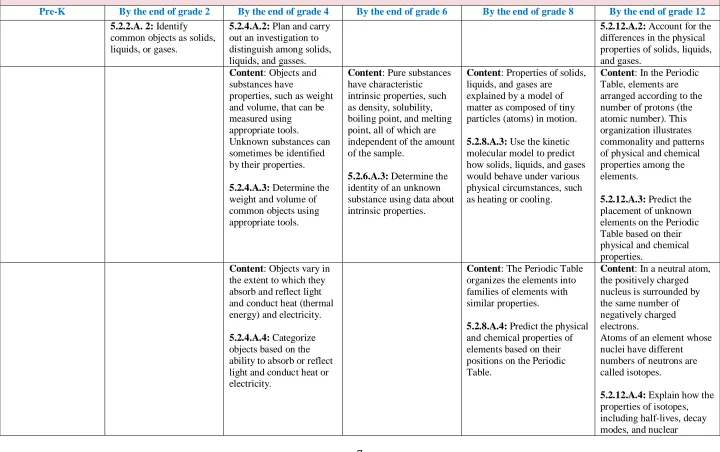
5.2.2.A. 2: Identify common objects as solids, liquids, or gases.
5.2.4.A.2: Plan and carry out an investigation to distinguish among solids, liquids, and gasses.
5.2.12.A.2: Account for the differences in the physical properties of solids, liquids, and gases.
Content: Objects and substances have
properties, such as weight and volume, that can be measured using appropriate tools. Unknown substances can sometimes be identified by their properties.
5.2.4.A.3: Determine the weight and volume of common objects using appropriate tools.
Content: Pure substances have characteristic intrinsic properties, such as density, solubility, boiling point, and melting point, all of which are independent of the amount of the sample.
5.2.6.A.3: Determine the identity of an unknown substance using data about intrinsic properties.
Content: Properties of solids, liquids, and gases are explained by a model of matter as composed of tiny particles (atoms) in motion.
5.2.8.A.3: Use the kinetic molecular model to predict how solids, liquids, and gases would behave under various physical circumstances, such as heating or cooling.
Content: In the Periodic Table, elements are arranged according to the number of protons (the atomic number). This organization illustrates commonality and patterns of physical and chemical properties among the elements.
5.2.12.A.3: Predict the placement of unknown elements on the Periodic Table based on their physical and chemical properties.
Content: Objects vary in the extent to which they absorb and reflect light and conduct heat (thermal energy) and electricity.
5.2.4.A.4: Categorize objects based on the ability to absorb or reflect light and conduct heat or electricity.
Content: The Periodic Table organizes the elements into families of elements with similar properties.
5.2.8.A.4: Predict the physical and chemical properties of elements based on their positions on the Periodic Table.
Content: In a neutral atom, the positively charged nucleus is surrounded by the same number of negatively charged electrons.
Atoms of an element whose nuclei have different numbers of neutrons are called isotopes.
8
5.2 Physical Science: Physical science principles, including fundamental ideas about matter, energy, and motion, are powerful conceptual tools for making sense of phenomena in physical, living, and Earth systems science.
A. Properties of Matter: All objects and substances in the natural world are composed of matter. Matter has two fundamental properties: matter takes up space, and matter has inertia.
Pre-K By the end of grade 2 By the end of grade 4 By the end of grade 6 By the end of grade 8 By the end of grade 12
resonances, lead to useful applications of isotopes. Content: Elements are a class
of substances composed of a single kind of atom.
Compounds are substances that are chemically formed and have physical and chemical properties that differ from the reacting substances.
5.2.8.A.5: Identify unknown substances based on data regarding their physical and chemical properties.
Content: Solids, liquids, and gases may dissolve to form solutions. When combining a solute and solvent to prepare a solution, exceeding a particular concentration of solute will lead to
precipitation of the solute from the solution. Dynamic equilibrium occurs in saturated solutions. Concentration of solutions can be calculated in terms of molarity, molality, and percent by mass.
5.2.12.A.5: Describe the process by which solutes dissolve in solvents. Content: Substances are
classified according to their physical and chemical properties. Metals are a class of elements that exhibit physical properties, such as conductivity, and chemical properties, such as producing salts when combined with nonmetals.
5.2.8.A.6: Determine whether a substance is a metal or nonmetal through
student-Content: Acids and bases are important in numerous chemical processes that occur around us, from industrial to biological processes, from the laboratory to the environment.
9
A. Properties of Matter: All objects and substances in the natural world are composed of matter. Matter has two fundamental properties: matter takes up space, and matter has inertia.
Pre-K By the end of grade 2 By the end of grade 4 By the end of grade 6 By the end of grade 8 By the end of grade 12
designed investigations.
Content: Substances are classified according to their physical and chemical properties.
Acids are a class of compounds that exhibit common chemical properties, including a sour taste, characteristic color changes with litmus and other acid/base indicators, and the tendency to react with bases to produce a salt and water.
10
5.2 Physical Science: Physical science principles, including fundamental ideas about matter, energy, and motion, are powerful conceptual tools for making sense of phenomena in physical, living, and Earth systems science.
B. Changes in Matter: Substances can undergo physical or chemical changes to form new substances. Each change involves energy.
Pre-K By the end of grade 2 By the end of grade 4 By the end of grade 6 By the end of grade 8 By the end of grade 12
Content: Observations and investigations form a basis for young learners’ understanding of changes in matter.
5.2.P.B.1: Explore changes in liquids and solids when substances are combined, heated, or cooled (e.g., mix sand or clay with various amounts of water; mix different colors of tempera paints; freeze and melt water and other liquids).
Content: Some properties of matter can change as a result of processes such as heating and cooling. Not all materials respond the same way to these processes.
5.2.2.B.1: Generate accurate data and organize
arguments to show that not all substances respond the same way when heated or cooled, using common materials, such as shortening or candle wax.
Content: Many substances can be changed from one state to another by heating or cooling.
5.2.4.B.1: Predict and explain what happens when a common substance, such as shortening or candle wax, is heated to melting and then cooled to a solid.
Content: When a new substance is made by combining two or more substances, it has
properties that are different from the original
substances.
5.2.6.B.1: Compare the properties of reactants with the properties of the products when two or more substances are combined and react chemically.
Content: When substances undergo chemical change, the number and kinds of atoms in the reactants are the same as the number and kinds of atoms in the products. The mass of the reactants is the same as the mass of the products.
5.2.8.B.1: Explain, using an understanding of the concept of chemical change, why the mass of reactants and the mass of products remain constant.
Content: An atom’s electron configuration, particularly of the outermost electrons, determines how the atom interacts with other atoms. Chemical bonds are the interactions between atoms that hold them together in molecules or between oppositely charged ions.
5.2.12.B.1: Model how the outermost electrons determine the reactivity of elements and the nature of the chemical bonds they tend to form.
Content: Chemical changes can occur when two substances, elements, or compounds react and produce one or more different substances. The physical and chemical properties of the products are different from those of the reacting substances.
5.2.8.B.2: Compare and contrast the physical properties of reactants with products after a chemical reaction, such as those that occur during
photosynthesis and cellular respiration.
Content: A large number of important reactions involve the transfer of either electrons or hydrogen ions between reacting ions, molecules, or atoms. In other chemical reactions, atoms interact with one another by sharing electrons to create a bond.
11
B. Changes in Matter: Substances can undergo physical or chemical changes to form new substances. Each change involves energy.
Pre-K By the end of grade 2 By the end of grade 4 By the end of grade 6 By the end of grade 8 By the end of grade 12
corrosion and the burning of fuel.
Content: The conservation of atoms in chemical reactions leads to the ability to calculate the mass of products and reactants using the mole concept.
12
5.2 Physical Science: Physical science principles, including fundamental ideas about matter, energy, and motion, are powerful conceptual tools for making sense of phenomena in physical, living, and Earth systems science.
C. Forms of Energy: Knowing the characteristics of familiar forms of energy, including potential and kinetic energy, is useful in coming to the understanding that, for the most part, the natural world can be explained and is predictable.
Pre-K By the end of grade 2 By the end of grade 4 By the end of grade 6 By the end of grade 8 By the end of grade 12
Content: Observations and investigations form a basis for young learners’ understanding of forms of energy.
5.2.P.C.1: Investigate sound, heat, and light energy (e.g., the pitch and volume of sound made by commercially made and homemade instruments, looking for shadows on the playground over time and under different weather conditions) through one or more of the senses.
Content: The Sun warms the land, air, and water.
5.2.2.C.1: Compare, citing evidence, the heating of different colored objects placed in full sunlight.
Content: Heat (thermal energy), electricity, light, and sound are forms of energy.
5.2.4.C.1: Compare various forms of energy as observed in everyday life and describe their applications.
Content: Light travels in a straight line until it interacts with an object or material.
Light can be absorbed, redirected, bounced back, or allowed to pass through. The path of reflected or refracted light can be predicted.
5.2.6.C.1: Predict the path of reflected or refracted light using reflecting and refracting telescopes as examples.
Content: A tiny fraction of the light energy from the Sun reaches Earth. Light energy from the Sun is Earth’s primary source of energy, heating Earth surfaces and providing the energy that results in wind, ocean currents, and storms.
5.2.8.C.1: Structure evidence to explain the relatively high frequency of tornadoes in “Tornado Alley.”
Content: Gas particles move independently and are far apart relative to each other. The behavior of gases can be explained by the kinetic molecular theory. The kinetic molecular theory can be used to explain the relationship between pressure and volume, volume and temperature, pressure and temperature, and the number of particles in a gas sample. There is a natural tendency for a system to move in the direction of disorder or entropy.
5.2.12.C.1: Use the kinetic molecular theory to describe and explain the properties of solids, liquids, and gases. Content: An object can be
seen when light strikes it and is reflected to a viewer's eye. If there is no light, objects cannot be seen.
5.2.2.C.2: Apply a variety of strategies to collect evidence that validates the principle that if there is no
Content: Heat (thermal energy) results when substances burn, when certain kinds of materials rub against each other, and when electricity flows though wires.
Metals are good conductors of heat (thermal energy) and
Content: Visible light from the Sun is made up of a mixture of all colors of light. To see an object, light emitted or reflected by that object must enter the eye.
Content: Energy is transferred from place to place. Light energy can be thought of as traveling in rays. Thermal energy travels via conduction and convection.
Content: Heating
13
C. Forms of Energy: Knowing the characteristics of familiar forms of energy, including potential and kinetic energy, is useful in coming to the understanding that, for the most part, the natural world can be explained and is predictable.
Pre-K By the end of grade 2 By the end of grade 4 By the end of grade 6 By the end of grade 8 By the end of grade 12
light, objects cannot be seen.
electricity.
Increasing the temperature of any substance requires the addition of energy.
5.2.4.C.2: Compare the flow of heat through metals and nonmetals by taking and analyzing measurements.
5.2.6.C.2: Describe how to prisms can be used to demonstrate that visible light from the Sun is made up of different colors.
5.2.8.C.2: Model and explain current technologies used to capture solar energy for the purposes of converting it to electrical energy.
energy of its atoms, molecules, or ions. When the vibrational energy of the molecules of a pure substance becomes great enough, the solid melts.
5.2.12.C.2: Account for any trends in the melting points and boiling points of various compounds. Content: When light
strikes substances and objects through which it cannot pass, shadows result.
5.2.2.C.3: Present evidence that represents the relationship between a light source, solid object, and the resulting shadow.
Content: Energy can be transferred from one place to another. Heat energy is transferred from warmer things to colder things.
5.2.4.C.3: Draw and label diagrams showing several ways that energy can be transferred from one place to another.
Content: The transfer of thermal energy by conduction, convection, and radiation can produce large-scale events such as those seen in weather.
5.2.6.C.3: Relate the transfer of heat from oceans and land masses to the evolution of a
hurricane. Content: Light travels in
straight lines. When light travels from one substance to another (air and water), it changes direction.
14
5.2 Physical Science: Physical science principles, including fundamental ideas about matter, energy, and motion, are powerful conceptual tools for making sense of phenomena in physical, living, and Earth systems science.
D. Energy Transfer and Conservation: The conservation of energy can be demonstrated by keeping track of familiar forms of energy as they are transferred from one object to another.
Pre-K By the end of grade 2 By the end of grade 4 By the end of grade 6 By the end of grade 8 By the end of grade 12
Content: Batteries supply energy to produce light, sound, or heat.
5.2.2.D.1: Predict and confirm the brightness of a light, the volume of sound, or the amount of heat when given the number of batteries, or the size of batteries.
Content: Electrical circuits require a complete loop through conducting materials in which an electrical current can pass.
5.2.4.D.1: Repair an electric circuit by completing a closed loop that includes wires, a battery (or batteries), and at least one other electrical component to produce observable change.
Content: The flow of current in an electric circuit depends upon the components of the circuit and their arrangement, such as in series or parallel. Electricity flowing through an electrical circuit produces magnetic effects in the wires.
5.2.6.D.1: Use simple circuits involving batteries and motors to compare and predict the current flow with different circuit arrangements.
Content: When energy is transferred from one system to another, the quantity of energy before transfer equals the quantity of energy after transfer. As an object falls, its potential energy decreases as its speed, and consequently its kinetic energy, increases. While an object is falling, some of the object’s kinetic energy is transferred to the medium through which it falls, setting the medium into motion and heating it.
5.2.8.D.1: Relate the kinetic and potential energies of a roller coaster at various points on its path.
Content: The potential energy of an object on Earth’s surface is increased when the object’s position is changed from one closer to Earth’s surface to one farther from Earth’s surface.
5.2.12.D.1: Model the
relationship between the height of an object and its potential energy.
Content: Nuclear reactions take place in the Sun.
In plants, light energy from the Sun is
transferred to oxygen and carbon compounds, which in combination, have chemical potential energy (photosynthesis).
Content: The driving forces of chemical reactions are energy and entropy. Chemical reactions either release energy to the environment
(exothermic) or absorb energy from the environment
15
D. Energy Transfer and Conservation: The conservation of energy can be demonstrated by keeping track of familiar forms of energy as they are transferred from one object to another.
Pre-K By the end of grade 2 By the end of grade 4 By the end of grade 6 By the end of grade 8 By the end of grade 12
5.2.8.D.2: Describe the flow of energy from the Sun to the fuel tank of an automobile.
5.2.12.D.2: Describe the potential commercial
applications of exothermic and endothermic reactions.
Content: Nuclear reactions
(fission and fusion) convert very small amounts of matter into energy.
5.2.12.D.3: Describe the products and potential applications of fission and fusion reactions.
Content: Energy may be transferred from one object to another during collisions.
5.2.12.D.4: Measure quantitatively the energy transferred between objects during a collision.
16
5.2 Physical Science: Physical science principles, including fundamental ideas about matter, energy, and motion, are powerful conceptual tools for making sense of phenomena in physical, living, and Earth systems science.
D. Energy Transfer and Conservation: The conservation of energy can be demonstrated by keeping track of familiar forms of energy as they are transferred from one object to another.
Pre-K By the end of grade 2 By the end of grade 4 By the end of grade 6 By the end of grade 8 By the end of grade 12
17
E. Forces and Motion: It takes energy to change the motion of objects. The energy change is understood in terms of forces.
Pre-K By the end of grade 2 By the end of grade 4 By the end of grade 6 By the end of grade 8 By the end of grade 12
Content: Observations and investigations form a basis for young learners’ understanding of motion.
5.2.P.E.1: Investigate how and why things move (e.g., slide blocks, balance structures, push structures over, use ramps to explore how far and how fast different objects move or roll).
Content: Objects can move in many different ways (fast and slow, in a straight line, in a circular path, zigzag, and back and forth).
5.2.2.E.1: Investigate and model the various ways that inanimate objects can move.
Content: Motion can be described as a change in position over a period of time.
5.2.4.E.1: Demonstrate through modeling that motion is a change in position over a period of time.
Content: An object’s position can be described by locating the object relative to other objects or a background. The description of an object’s motion from one
observer’s view may be different from that reported from a different observer’s view.
5.2.6.E.1: Model and explain how the
description of an object’s motion from one
observer’s view may be different from a different observer’s view.
Content: An object is in motion when its position is changing. The speed of an object is defined by how far it travels divided by the amount of time it took to travel that far.
5.2.8.E.1: Calculate the speed of an object when given distance and time.
Content: The motion of an object can be described by its position and velocity as functions of time and by its average speed and average acceleration during intervals of time.
5.2.12.E.1: Compare the calculated and measured speed, average speed, and acceleration of an object in motion, and account for differences that may exist between calculated and measured values.
Content: A force is a push or a pull. Pushing or pulling can move an object. The speed an object moves is related to how strongly it is pushed or pulled. When an object does not move in
response to a push or a pull, it is because another push or pull (friction) is being applied by the environment.
Content: There is always a force involved when something starts moving or changes its speed or direction of motion. A greater force can make an object move faster and farther.
5.2.4.E.2: Identify the force that starts something moving or changes its speed or direction of motion.
Content: Magnetic, electrical, and
gravitational forces can act at a distance.
5.2.6.E.2: Describe the force between two magnets as the distance between them is changed.
Content: Forces have magnitude and direction. Forces can be added. The net force on an object is the sum of all the forces acting on the object. An object at rest will remain at rest unless acted on by an unbalanced force. An object in motion at constant velocity will continue at the same velocity unless acted on by an unbalanced force.
Content: Objects undergo different kinds of motion (translational, rotational, and vibrational).
18
5.2 Physical Science: Physical science principles, including fundamental ideas about matter, energy, and motion, are powerful conceptual tools for making sense of phenomena in physical, living, and Earth systems science.
E. Forces and Motion: It takes energy to change the motion of objects. The energy change is understood in terms of forces.
Pre-K By the end of grade 2 By the end of grade 4 By the end of grade 6 By the end of grade 8 By the end of grade 12
5.2.2.E.2: Predict an object’s relative speed, path, or how far it will travel using various forces and surfaces.
5.2.8.E.2: Compare the motion of an object acted on by balanced forces with the motion of an object acted on by unbalanced forces in a given specific scenario. Content: Some forces act
by touching, while other forces can act without touching.
5.2.2.E.3: Distinguish a force that acts by direct contact with an object (e.g., by pushing or pulling) from a force that can act without direct contact (e.g., the attraction between a magnet and a steel paper clip).
Content: Magnets can repel or attract other magnets, but they attract all matter made of iron. Magnets can make some things move without being touched.
5.2.4.E.3: Investigate and categorize materials based on their interaction with magnets.
Content: Friction is a force that acts to slow or stop the motion of objects.
5.2.6.E.3: Demonstrate and explain the frictional force acting on an object with the use of a physical model.
Content: The motion of an object changes only when a net force is applied.
5.2.12.E.3: Create simple models to demonstrate the benefits of seatbelts using Newton's first law of motion.
Content: Earth pulls down on all objects with a force called gravity. Weight is a measure of how strongly an object is pulled down toward the ground by gravity. With a few exceptions, objects fall to the ground no matter where they are on Earth.
Content: Sinking and floating can be predicted using forces that depend on the relative densities of objects and materials.
5.2.6.E.4: Predict if an object will sink or float using evidence and reasoning.
Content: The magnitude of acceleration of an object depends directly on the strength of the net force, and inversely on the mass of the object. This relationship (a=Fnet/m) is independent of the nature of the force.
19
E. Forces and Motion: It takes energy to change the motion of objects. The energy change is understood in terms of forces.
Pre-K By the end of grade 2 By the end of grade 4 By the end of grade 6 By the end of grade 8 By the end of grade 12
20
5.3 Life Science: Life science principles are powerful conceptual tools for making sense of the complexity, diversity, and interconnectedness of life on Earth. Order in natural systems arises in accordance with rules that govern the physical world, and the order of natural systems can be modeled and predicted through the use of mathematics.
A. Organization and Development: Living organisms are composed of cellular units (structures) that carry out functions required for life. Cellular units are composed of molecules, which also carry out biological functions.
Pre-K By the end of grade 2 By the end of grade 4 By the end of grade 6 By the end of grade 8 By the end of grade 12
Content: Observations and discussions about the natural world form a basis for young learners’ understanding of life science.
5.3.P.A.1: Investigate and compare the basic physical characteristics of plants, humans, and other animals.
Content: Living organisms:
• Exchange nutrients and water with the environment. • Reproduce.
• Grow and develop in a predictable manner.
5.3.2.A.1: Group living and nonliving things according to the characteristics that they share.
Content: Living organisms:
• Interact with and cause changes in their environment.
• Exchange materials (such as gases, nutrients, water, and waste) with the environment. • Reproduce.
• Grow and develop in a predictable manner.
5.3.4.A.1: Develop and use evidence-based criteria to determine if an
unfamiliar object is living or nonliving.
Content: Systems of the human body are
interrelated and regulate the body’s internal environment.
5.3.6.A.1: Model the interdependence of the human body’s major systems in regulating its internal environment.
Content: All organisms are composed of cell(s). In multicellular organisms, specialized cells perform specialized functions. Tissues, organs, and organ systems are composed of cells and function to serve the needs of cells for food, air, and waste removal.
5.3.8.A.1: Compare the benefits and limitations of existing as a single-celled organism and as a multicellular organism.
Content: Cells are made of complex molecules that consist mostly of a few elements. Each class of molecules has its own building blocks and specific functions.
5.3.12 A.1: Represent and explain the relationship between the structure and function of each class of complex molecules using a variety of models.
Content: Observations and discussions form a basis for young learners’ understanding of the similarities and differences among living and
nonliving things.
5.3.P.A.2: Observe similarities and differences in the needs of various living things, and
differences between living and nonliving things.
Content: Essential functions required for the well-being of an organism are carried out by
specialized structures in plants and animals.
5.3.4.A.2: Compare and contrast structures that have similar functions in various organisms, and explain how those functions may be carried out by structures that have different physical
Content: Essential functions of plant and animal cells are carried out by organelles.
5.3.6.A.2: Model and explain ways in which organelles work together to meet the cell’s needs.
Content: During the early development of an organism, cells
differentiate and multiply to form the many specialized cells, tissues, and organs that compose the final organism. Tissues grow through cell division.
5.3.8.A.2: Relate the structures of cells, tissues, organs, and systems to their functions in supporting life.
Content: Cellular processes are carried out by many different types of molecules, mostly by the group of proteins known as enzymes.
21
mathematics.A. Organization and Development: Living organisms are composed of cellular units (structures) that carry out functions required for life. Cellular units are composed of molecules, which also carry out biological functions.
Pre-K By the end of grade 2 By the end of grade 4 By the end of grade 6 By the end of grade 8 By the end of grade 12
appearances. Content: Essential functions of the human body are carried out by specialized systems:
Digestive
Circulatory
Respiratory
Nervous
Skeletal
Muscular
Reproductive
5.3.4.A.3: Describe the interactions of systems involved in carrying out everyday life activities.
Content: Cellular function is maintained through the regulation of cellular processes in response to internal and external environmental conditions.
5.3.12.A.3: Predict a cell’s response in a given set of environmental conditions.
Content: Cells divide through the process of mitosis, resulting in daughter cells that have the same genetic
composition as the original cell.
5.3.12.A.4: Distinguish between the processes of cellular growth (cell division) and development (differentiation).
Content: Cell
22
5.3 Life Science: Life science principles are powerful conceptual tools for making sense of the complexity, diversity, and interconnectedness of life on Earth. Order in natural systems arises in accordance with rules that govern the physical world, and the order of natural systems can be modeled and predicted through the use of mathematics.
A. Organization and Development: Living organisms are composed of cellular units (structures) that carry out functions required for life. Cellular units are composed of molecules, which also carry out biological functions.
Pre-K By the end of grade 2 By the end of grade 4 By the end of grade 6 By the end of grade 8 By the end of grade 12
development of complex multicellular organisms.
5.3.12.A.5: Describe modern applications of the regulation of cell
differentiation and analyze the benefits and risks (e.g., stem cells, sex
determination). Content: There is a relationship between the organization of cells into tissues and the
organization of tissues into organs.
The structures and functions of organs determine their
relationships within body systems of an organism.
23
mathematics.B. Matter and Energy Transformations: Food is required for energy and building cellular materials. Organisms in an ecosystem have different ways of obtaining food, and some organisms obtain their food directly from other organisms.
Pre-K By the end of grade 2 By the end of Grade 4 By the end of Grade 6 By the end of Grade 8 By the end of Grade 12
Content: Investigations form a young learners’ understanding of how a habitat provides for an organism’s energy needs.
5.3.P.B.1: Observe and describe how plants and animals obtain food from their environment, such as by observing the
interactions between organisms in a natural habitat.
Content: A source of energy is needed for all organisms to stay alive and grow. Both plants and animals need to take in water, and animals need to take in food.
Plants need light.
5.3.2.B.1: Describe the requirements for the care of plants and animals related to meeting their energy needs.
Content: Almost all energy (food) and matter can be traced to the Sun.
5.3.4.B.1: Identify sources of energy (food) in a variety of settings (farm, zoo, ocean, forest).
Content: Plants are producers: They use the energy from light to make food (sugar) from carbon dioxide and water. Plants are used as a source of food (energy) for other organisms.
5.3.6.B.1: Describe the sources of the reactants of photosynthesis and trace the pathway to the products.
Content: Food is broken down to provide energy for the work that cells do, and is a source of the molecular building blocks from which needed materials are assembled.
5.3.8.B.1: Relate the energy and nutritional needs of organisms in a variety of life stages and situations, including stages of development and periods of maintenance.
Content: As matter cycles and energy flows through different levels of organization within living systems (cells, organs, organisms, communities), and between living systems and the physical environment, chemical elements are recombined into different products.
5.3.12.B.1: Cite evidence that the transfer and transformation of matter and energy links
organisms to one another and to their physical setting.
Content: Animals have various ways of obtaining food and water. Nearly all animals drink water or eat foods that contain water.
5.3.2.B.2: Compare how different animals obtain food and water.
Content: Plants are producers: They use the energy from light to make food (sugar) from carbon dioxide and water. Plants are used as a source of food (energy) for other organisms.
5.3.6.B.1: Describe the sources of the reactants of photosynthesis and trace the pathway to the products.
Content: All animals, including humans, are consumers that meet their energy needs by eating other organisms or their products.
5.3.6.B.2: Illustrate the flow of energy (food) through a community.
Contents: All animals, including humans, are consumers that meet their energy needs by eating other organisms or their products.
5.3.8.B.2: Analyze the components of a
consumer’s diet and trace them back to plants and plant products.
Content: Each
recombination of matter and energy results in storage and dissipation of energy into the
environment as heat.
5.3.12.B.2: Use
24
5.3 Life Science: Life science principles are powerful conceptual tools for making sense of the complexity, diversity, and interconnectedness of life on Earth. Order in natural systems arises in accordance with rules that govern the physical world, and the order of natural systems can be modeled and predicted through the use of mathematics.
B. Matter and Energy Transformations: Food is required for energy and building cellular materials. Organisms in an ecosystem have different ways of obtaining food, and some organisms obtain their food directly from other organisms.
Pre-K By the end of grade 2 By the end of Grade 4 By the end of Grade 6 By the end of Grade 8 By the end of Grade 12
Content: Most plants have roots to get water and leaves to gather sunlight.
5.3.2.B.3: Explain that most plants get water from soil through their roots and gather light through their leaves.
Content: Continual input of energy from sunlight keeps matter and energy flowing through ecosystems.
5.3.12.B.3: Predict what would happen to an ecosystem if an energy source was removed.
Content: Plants have the capability to take energy from light to form sugar molecules containing carbon, hydrogen, and oxygen.
5.3.12.B.4: Explain how environmental factors (such as temperature, light intensity, and the amount of water available) can affect photosynthesis as an energy storing process.
Content: In both plant and animal cells, sugar is a source of energy and can be used to make other carbon-containing (organic) molecules.
25
mathematics.B. Matter and Energy Transformations: Food is required for energy and building cellular materials. Organisms in an ecosystem have different ways of obtaining food, and some organisms obtain their food directly from other organisms.
Pre-K By the end of grade 2 By the end of Grade 4 By the end of Grade 6 By the end of Grade 8 By the end of Grade 12
relationship (cycling of matter and flow of energy) between photosynthesis and cellular respiration. Content: All organisms must break the high-energy chemical bonds in food molecules during cellular respiration to obtain the energy needed for life processes.
26
5.3 Life Science: Life science principles are powerful conceptual tools for making sense of the complexity, diversity, and interconnectedness of life on Earth. Order in natural systems arises in accordance with rules that govern the physical world, and the order of natural systems can be modeled and predicted through the use of mathematics.
C. Interdependence: All animals and most plants depend on both other organisms and their environment to meet their basic needs.
Pre-K By the end of grade 2 By the end of Grade 4 By the end of Grade 6 By the end of Grade 8 By the end of Grade 12
Content: Investigations and observations of the interactions between plants and animals form a basis for young learners’ understanding of interdependence in life science.
5.3.P.C.1: Observe and describe how natural habitats provide for the basic needs of plants and animals with respect to shelter, food, water, air, and light (e.g., dig outside in the soil to investigate the kinds of animal life that live in and around the ground).
Content: Organisms interact and are
interdependent in various ways; for example, they provide food and shelter to one another.
5.3.2.C.1: Describe the ways in which organisms interact with each other and their habitats in order to meet basic needs.
Content: Organisms can only survive in
environments in which their needs are met. Within ecosystems, organisms interact with and are dependent on their physical and living environment.
5.3.4.C.1: Predict the biotic and abiotic characteristics of an unfamiliar organism’s habitat.
Content: Various human activities have changed the capacity of the environment to support some life forms.
5.3.6.C.1: Explain the impact of meeting human needs and wants on local and global environments.
Content: Symbiotic interactions among organisms of different species can be classified as: • Producer/consumer • Predator/prey • Parasite/host • Scavenger/prey • Decomposer/prey
5.3.8.C.1: Model the effect of positive and negative changes in population size on a symbiotic pairing.
Content: Biological communities in
ecosystems are based on stable interrelationships and interdependence of organisms.
5.3.12.C.1: Analyze the interrelationships and interdependencies among different organisms, and explain how these relationships contribute to the stability of the ecosystem.
Content: A habitat supports the growth of many different plants and animals by meeting their basic needs of food, water, and shelter.
5.3.2.C.2: Identify the characteristics of a habitat that enable the habitat to support the growth of many different plants and animals.
Content: Some changes in ecosystems occur slowly, while others occur rapidly. Changes can affect life forms, including humans.
5.3.4.C.2: Explain the consequences of rapid ecosystem change (e.g., flooding, wind storms, snowfall, volcanic eruptions), and compare them to consequences of gradual ecosystem change
Content: The number of organisms and
populations an ecosystem can support depends on the biotic resources available and on abiotic factors, such as quantities of light and water, range of temperatures, and soil composition.
5.3.6.C.2: Predict the impact that altering biotic and abiotic factors has on an ecosystem.
Content: Stability in an ecosystem can be disrupted by natural or human interactions.
5.3.12.C.2: Model how natural and human-made changes in the
environment will affect individual organisms and the dynamics of
27
mathematics.C. Interdependence: All animals and most plants depend on both other organisms and their environment to meet their basic needs.
Pre-K By the end of grade 2 By the end of Grade 4 By the end of Grade 6 By the end of Grade 8 By the end of Grade 12
(e.g., gradual increase or decrease in daily temperatures, change in yearly rainfall). Content: Humans can
change natural habitats in ways that can be helpful or harmful for the plants and animals that live there.
5.3.2.C.3: Communicate ways that humans protect habitats and/or improve conditions for the growth of the plants and animals that live there, or ways that humans might harm habitats.
Content: All organisms cause changes in the ecosystem in which they live. If this change reduces another organism’s access to resources, that organism may move to another location or die.
28
5.3 Life Science: Life science principles are powerful conceptual tools for making sense of the complexity, diversity, and interconnectedness of life on Earth. Order in natural systems arises in accordance with rules that govern the physical world, and the order of natural systems can be modeled and predicted through the use of mathematics.
D. Heredity and Reproduction: Organisms reproduce, develop, and have predictable life cycles. Organisms contain genetic information that influences their traits, and they pass this on to their offspring during reproduction.
Pre-K By the end of grade 2 By the end of Grade 4 By the end of Grade 6 By the end of Grade 8 By the end of Grade 12
Content: Observations of developmental changes in a plant or animal over time form a basis for young learners’ understanding of heredity and reproduction.
5.3.P.D.1: Observe and record change over time and cycles of change that affect living things (e.g., use baby photographs to discuss human change and growth, observe and photograph tree growth and leaf changes throughout the year, monitor the life cycle of a plant).
Contents: Plants and animals often resemble their parents.
5.3.2.D.1: Record the observable characteristics of plants and animals to determine the similarities and differences between parents and their offspring.
Content: Plants and animals have life cycles (they begin life, develop into adults, reproduce, and eventually die). The characteristics of each stage of life vary by species.
5.3.4.D.1: Compare the physical characteristics of the different stages of the life cycle of an individual organism, and compare the characteristics of life stages among species.
Content: Reproduction is essential to the
continuation of every species.
5.3.6.D.1: Predict the long-term effect of interference with normal patterns of reproduction.
Content: Some organisms reproduce asexually. In these organisms, all genetic information comes from a single parent. Some organisms reproduce sexually, through which half of the genetic information comes from each parent.
5.3.8.D.1: Defend the principle that, through reproduction, genetic traits are passed from one generation to the next, using evidence collected from observations of inherited traits.
Content: Genes are segments of DNA molecules located in the chromosome of each cell. DNA molecules contain information that
determines a sequence of amino acids, which result in specific proteins.
5.3.12.D.1: Explain the value and potential applications of genome projects.
Content: Organisms have predictable characteristics at different stages of development.
5.3.2.D.2: Determine the characteristic changes that occur during the life cycle of plants and animals by examining a variety of species, and distinguish between growth and development.
Content: Variations exist among organisms of the same generation (e.g., siblings) and of different generations (e.g., parent to offspring).
5.3.6.D.2: Explain how knowledge of inherited variations within and between generations is applied to farming and animal breeding.
Content: The unique combination of genetic material from each parent in sexually reproducing organisms results in the potential for variation.
5.3.8.D.2: Explain the source of variation among siblings.
Content: Inserting, deleting, or substituting DNA segments can alter the genetic code.
An altered gene may be passed on to every cell that develops from it. The resulting features may help, harm, or have little or no effect on the offspring’s success in its environment.
29
mathematics.D. Heredity and Reproduction: Organisms reproduce, develop, and have predictable life cycles. Organisms contain genetic information that influences their traits, and they pass this on to their offspring during reproduction.
Pre-K By the end of grade 2 By the end of Grade 4 By the end of Grade 6 By the end of Grade 8 By the end of Grade 12
change in a specific DNA code, and provide specific real world examples of conditions caused by mutations.
Content: Traits such as eye color in human beings or fruit/flower color in plants are inherited.
5.3.6.D.3: Distinguish between inherited and acquired
traits/characteristics.
Content: Characteristics of organisms are influenced by heredity and/or their environment.
5.3.8.D.3: Describe the environmental conditions or factors that may lead to a change in a cell’s genetic information or to an organism’s development, and how these changes are passed on.
Content: Sorting and recombination of genes in sexual reproduction result in a great variety of possible gene combinations in the offspring of any two parents.
30
5.3 Life Science: Life science principles are powerful conceptual tools for making sense of the complexity, diversity, and interconnectedness of life on Earth. Order in natural systems arises in accordance with rules that govern the physical world, and the order of natural systems can be modeled and predicted through the use of mathematics.
E. Evolution and Diversity: Sometimes, differences between organisms of the same kind provide advantages for surviving and reproducing in different environments. These selective differences may lead to dramatic changes in characteristics of organisms in a population over extremely long periods of time.
Pre-K By the end of grade 2 By the end of Grade 4 By the end of Grade 6 By the end of Grade 8 By the end of Grade 12
Content: Variations exist within a group of the same kind of organism.
5.3.2.E.1: Describe similarities and differences in observable traits between parents and offspring.
Content: Individuals of the same species may differ in their characteristics, and sometimes these differences give
individuals an advantage in surviving and
reproducing in different environments.
5.3.4.E.1: Model an adaptation to a species that would increase its chances of survival, should the environment become wetter, dryer, warmer, or colder over time.
Content: Changes in environmental conditions can affect the survival of individual organisms and entire species.
5.3.6.E.1: Describe the impact on the survival of species during specific times in geologic history when environmental conditions changed.
Content: Individual organisms with certain traits are more likely than others to survive and have offspring in particular environments. The advantages or
disadvantages of specific characteristics can change when the environment in which they exist changes. Extinction of a species occurs when the
environment changes and the characteristics of a species are insufficient to allow survival.
5.3.8.E.1: Organize and present evidence to show how the extinction of a species is related to an inability to adapt to changing environmental conditions using
quantitative and qualitative data.
Content: New traits may result from new
combinations of existing genes or from mutations of genes in reproductive cells within a population.
5.3.12.E.1: Account for the appearance of a novel trait that arose in a given population.
Content: Plants and animals have features that help them survive in different environments.
5.3.2.E.2: Describe how similar structures found in different organisms (e.g.,
Content: In any ecosystem, some populations of organisms thrive and grow, some decline, and others do not survive at all.
Content: Anatomical evidence supports evolution and provides additional detail about the sequence of branching of various lines of descent.
31
mathematics.E. Evolution and Diversity: Sometimes, differences between organisms of the same kind provide advantages for surviving and reproducing in different environments. These selective differences may lead to dramatic changes in characteristics of organisms in a population over extremely long periods of time.
Pre-K By the end of grade 2 By the end of Grade 4 By the end of Grade 6 By the end of Grade 8 By the end of Grade 12
eyes, ears, mouths) have similar functions and enable those organisms to survive in different environments.
5.3.4.E.2: Evaluate similar populations in an
ecosystem with regard to their ability to thrive and grow.
5.3.8.E.2: Compare the anatomical structures of a living species with fossil records to derive a line of descent.
lines of descent branched.
5.3.12.E.2: Estimate how closely related species are, based on scientific evidence (e.g., anatomical similarities, similarities of DNA base and/or amino acid sequence).
Content: The principles of evolution (including natural selection and common descent) provide a scientific explanation for the history of life on Earth as evidenced in the fossil record and in the similarities that exist within the diversity of existing organisms.
5.3.12.E.3: Provide a scientific explanation for the history of life on Earth using scientific evidence (e.g., fossil record, DNA, protein structures, etc.). Content: Evolution occurs as a result of a
combination of the following factors: • Ability of a species to
reproduce
32
5.3 Life Science: Life science principles are powerful conceptual tools for making sense of the complexity, diversity, and interconnectedness of life on Earth. Order in natural systems arises in accordance with rules that govern the physical world, and the order of natural systems can be modeled and predicted through the use of mathematics.
E. Evolution and Diversity: Sometimes, differences between organisms of the same kind provide advantages for surviving and reproducing in different environments. These selective differences may lead to dramatic changes in characteristics of organisms in a population over extremely long periods of time.
Pre-K By the end of grade 2 By the end of Grade 4 By the end of Grade 6 By the end of Grade 8 By the end of Grade 12
recombination of genes • Finite supply of the
resources required for life
• Natural selection, due to environmental pressure, of those organisms better able to survive and leave offspring